

In this post:
Your analytics say most of your best deals came from direct traffic with no source, which is another way of saying your tracking has no idea where they came from.
The people who truly know the answer are the buyers themselves, and the simplest way to find out is almost embarrassingly obvious, because all it takes is asking them.
Self-reported attribution is exactly that move, and it's refreshingly direct. Rather than reconstruct a buyer's journey from cookies and referral data that mostly failed to capture it, you put a question on your high-intent forms and let the buyer tell you in their own words how they found you.
Self-reported attribution is the practice of asking prospects directly how they first heard about you, usually through an open question on a high-intent form like a demo request. It captures the influences buyers remember, especially the untrackable ones, that software-based attribution completely misses.
The reason it has become essential is that so much real influence is now invisible to software. Word of mouth, private sharing, podcasts, and communities drive enormous amounts of B2B pipeline while leaving no digital trail, so asking the buyer is often the only way to see the channels that mattered most.
TL;DR
Self-reported attribution means asking buyers directly how they heard about you, typically through an open-text field on a high-intent form like a demo or pricing request.
Its biggest strength is capturing the untrackable, because it surfaces dark social and dark funnel channels like word of mouth, podcasts, and private sharing that software attribution can't see.
The details matter, because open text beats dropdowns, the wording should anchor on how buyers first heard of you, and the question belongs only on high-intent forms.
It isn't perfect because of recency bias and vague answers, so the right approach blends it with software attribution instead of treating either one as the whole truth.
What self-reported attribution is and exactly where you ask the question
Self-reported attribution works by adding a simple question to the forms buyers fill out when they're serious, asking them to tell you directly how they came to you. Instead of inferring the source from technical data, you collect the buyer's own account of what led them to reach out.
The natural home for the question is a high-intent form. A demo request, a pricing inquiry, or a contact-sales page is where a real buyer is committing, so a short attribution field there captures the answer at the exact moment someone has decided you're worth talking to.
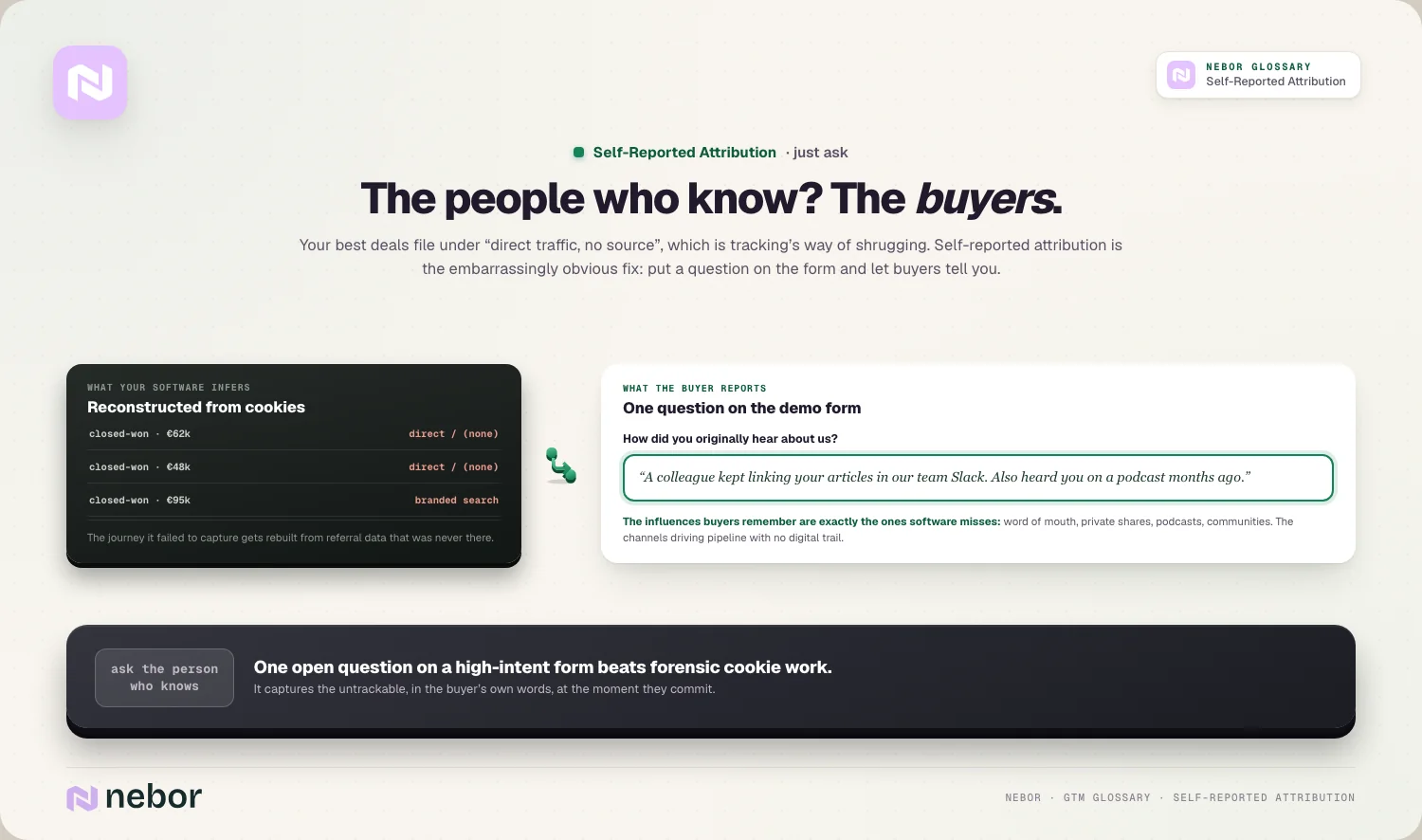
What you get back is qualitative instead of a clean data point, and that's the point. A buyer might write that a colleague recommended you, that they heard you on a podcast, or that they've read your content for months, none of which your analytics could ever have told you on its own.
Why an open text field beats a dropdown menu every single time
The instinct is to offer a dropdown of channels to keep the data tidy, but that choice quietly defeats the purpose. A dropdown anchors buyers to the options you already thought of, so it can only ever confirm the channels you know about and can never surface the ones you didn't.
Open text avoids that trap by letting buyers answer in their own words. Because they're not picking from your list, they mention the unexpected podcast, the specific person, or the community you had no idea was driving deals, which is exactly the hidden influence self-reported attribution exists to reveal.

The tradeoff is messier data that takes work to categorize, but the richness is worth it. You have to read and group the free-text answers, yet those raw responses contain the surprising, specific detail that a neat dropdown would have flattened into a useless "social media" or "other."
Why the exact wording of the question changes the answer you get
Small changes in how you phrase the question produce meaningfully different answers, so the wording deserves real thought. Asking "how did you originally hear about us" tends to outperform "how did you find us," because it anchors the buyer on their first exposure instead of the last click before they converted.
That distinction is important because you usually care about what started the journey more than what ended it. The last touch is often a branded search or a direct visit that your analytics already captured, whereas the first exposure, the thing that put you on their radar, is the influence you most need to uncover.

Getting the framing right nudges buyers toward the memory you need. A question pointed at initial awareness pulls up the podcast or recommendation from months earlier, while a vaguely worded one collects the obvious final step that tells you nothing you didn't already know.
Where to place the self-reported attribution question and where not to
Placement is as important as wording, and the rule is to ask only on high-intent forms. Demo requests, contact-sales pages, and consultation bookings are where a serious buyer is converting, so the attribution answer there reflects a real deal instead of casual interest.
Low-intent forms are exactly where the question does more harm than good. Putting it on a newsletter signup or a content download collects noise from people who aren't buyers and adds friction to a step meant to be effortless, so those answers dilute the signal you're trying to sharpen.
Keeping the question on high-intent forms also protects the quality of your data. When only serious prospects answer, every response ties to a potential deal, which lets you connect what buyers say influenced them to whether they became conversion rate wins instead of idle traffic.
Why self-reported attribution is the best tool for seeing dark social
The single biggest reason to use self-reported attribution is that it sees what software fundamentally cannot. Channels like dark social, where your content spreads through private Slack messages and email forwards, leave no referral trail, so asking the buyer is the only way to detect them at all.
It works because the buyer remembers what your analytics never recorded. When someone writes that a peer sent them your article or that they found you in a community, they're handing you a piece of the dark funnel that no tracking pixel could ever have captured on its own.
This is why self-reported attribution pairs so naturally with a modern content strategy. If your thought leadership is spreading through private channels, the survey is what proves it, turning invisible influence into evidence you can point to when defending the demand creation budget behind it.
The recency bias limitation and how to read the answers honestly
Self-reported attribution is powerful but not precise, and its main weakness is human memory. Buyers are prone to recency bias, so they often name the most recent or most memorable touchpoint instead of the one that first put you on their radar, which can skew the answers toward the obvious.
This means you should read the data as directional instead of exact. A single answer might be incomplete or slightly wrong, but across hundreds of responses, clear patterns emerge, so the value is in the aggregate trends instead of in trusting any one buyer's recollection as literal truth.
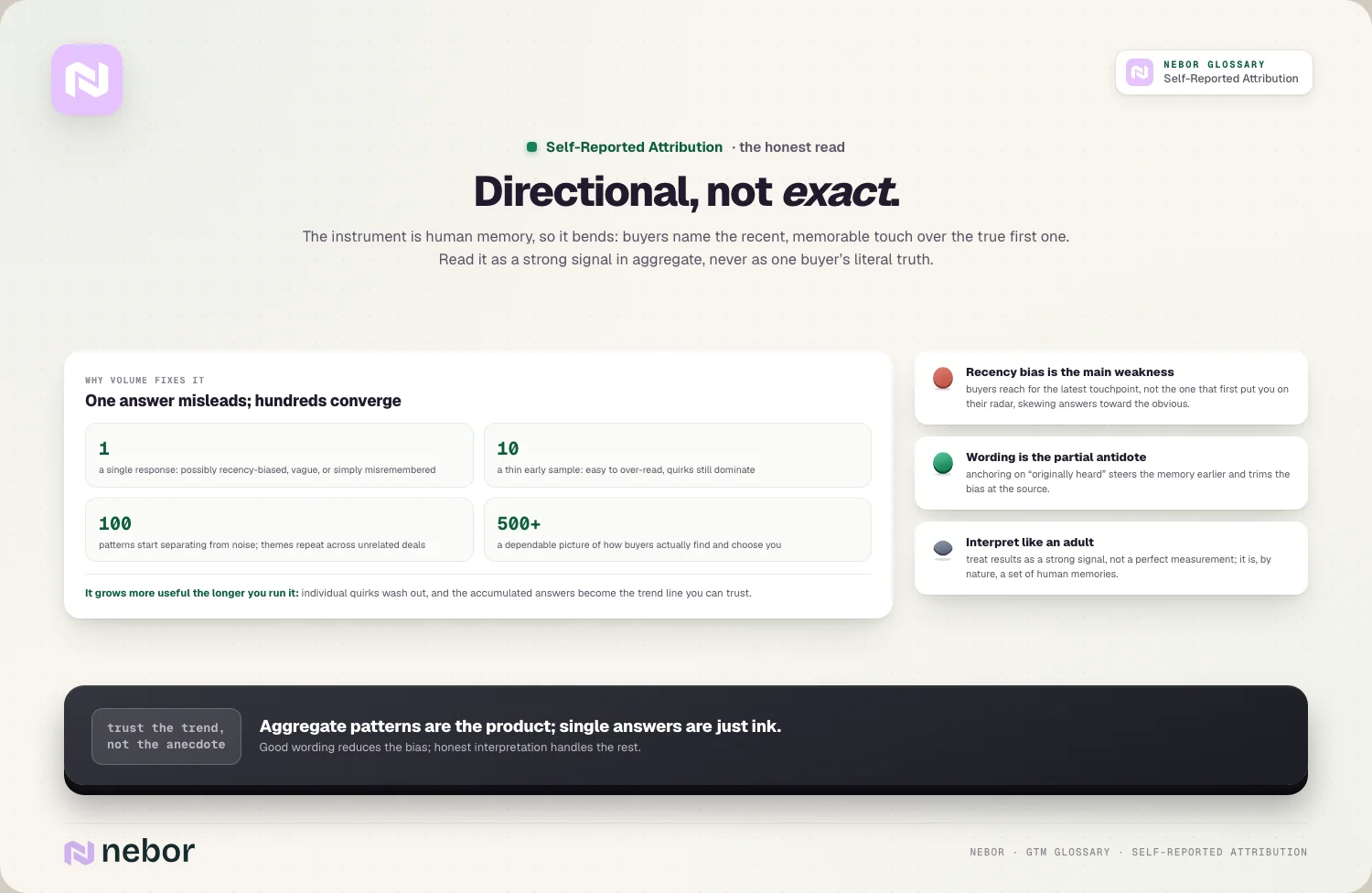
Good wording and honest interpretation both help manage the limitation. Anchoring the question on first exposure reduces recency bias, and treating the results as a strong signal instead of a perfect measurement keeps you from over-trusting a metric that is, by its nature, a set of human memories.
Volume is what makes the imperfection manageable. A handful of answers can mislead, but hundreds of them wash out individual quirks, so the more high-intent forms you collect from, the more the noise cancels and the real patterns come into focus.
This is also why, in our experience, self-reported attribution grows more useful the longer you keep at it. Early on the sample is thin and easy to misread, but over time the accumulated answers build into a dependable picture of how buyers really find and choose you.
Why self-reported attribution and software attribution belong together
The debate over self-reported versus software attribution is a false choice, because each covers the other's blind spots. Software is precise about the trackable digital touches it can see, while self-reported attribution captures the untrackable human ones, so using both gives a fuller picture than either alone.
Software gives you the rigor that surveys lack. It can tell you exactly how many people came from a specific campaign or which pages they viewed, providing the hard, repeatable data that self-reported answers, with their vagueness and bias, simply can't offer on their own.
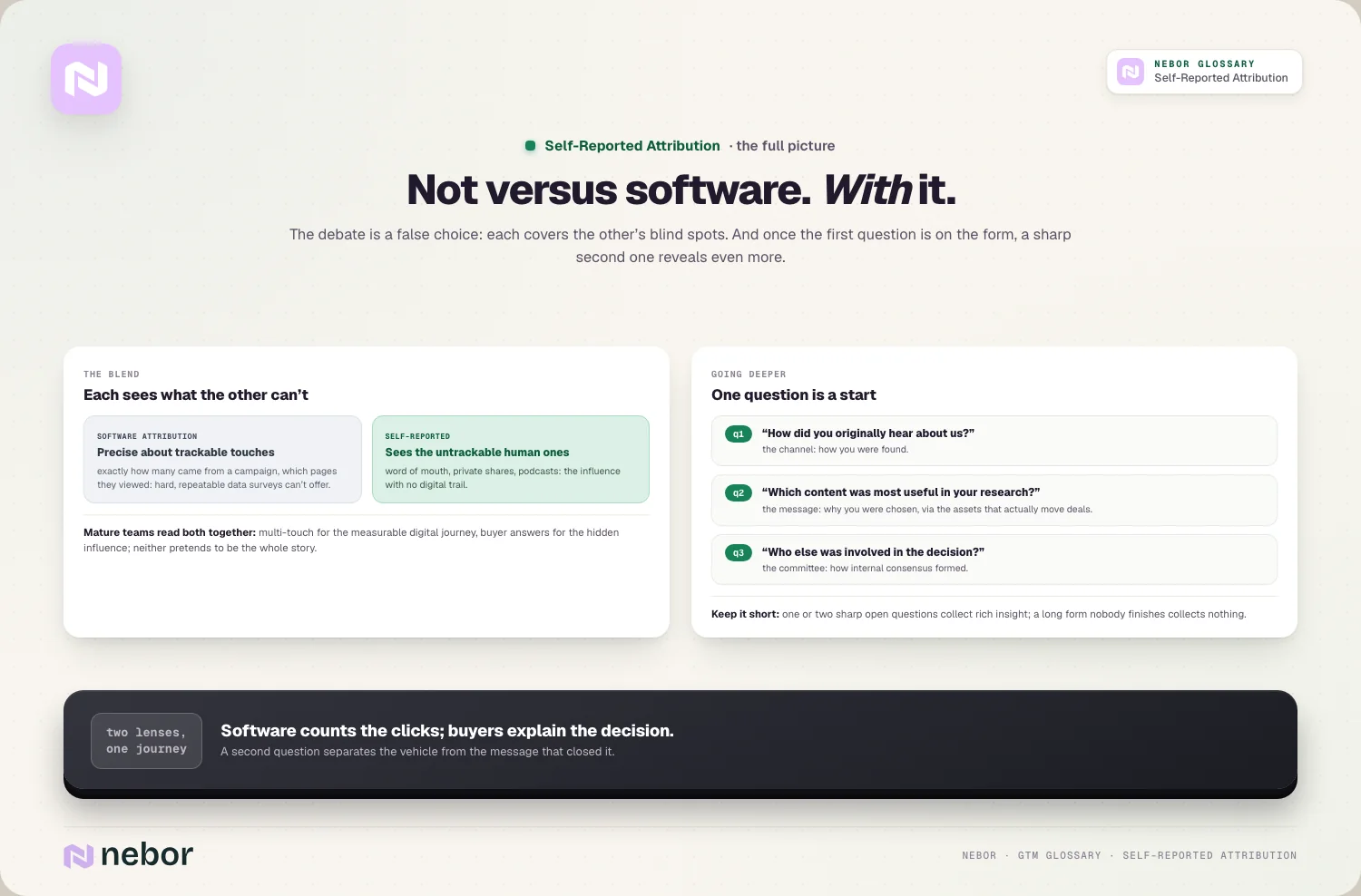
Blending the two is what mature teams end up doing. They lean on multi-touch attribution for the measurable digital journey and on self-reported answers for the hidden influences, so their revenue operations function reads both together instead of pretending either tells the whole story.
Why one attribution question is a start and a second reveals even more
The classic single question about how a buyer heard of you is the foundation, but clients ask us what else to add, and a second question often reveals even more.
Asking which piece of content was most useful during their research surfaces the specific assets that move deals, going a level deeper than the channel that delivered them.
That content question is powerful because it separates the vehicle from the message. Knowing a buyer came from a podcast is useful, but knowing which idea or asset convinced them tells you what to make more of, so the two answers together explain both how you were found and why you were chosen.
A third angle worth capturing is who else was involved in the decision. Because B2B purchases go through a buying committee, asking about the other stakeholders who evaluated you reveals how internal consensus formed, which a single awareness question can never show on its own.
The caution is to keep the whole thing short so you don't add friction to a high-intent moment. One or two well-chosen open questions collect rich insight without turning a demo request into a survey, so the goal is depth from a couple of sharp questions instead of a long form nobody finishes.
How to turn self-reported answers into decisions your team can act on
Collecting the answers is only useful if you act on them, and we advise clients to start by categorizing the free text into consistent themes.
Grouping raw responses into channels like referral, podcast, or community lets you count patterns instead of drowning in individual comments, turning messy text into something you can analyze.

The real payoff comes from spotting mismatches between what buyers say and what your analytics show. A channel your dashboards barely register that buyers credit again and again is proof of private spread, which tells you to invest more in something the reports would have told you to cut.
Those insights should feed budget and content decisions directly. If buyers consistently credit a channel your software can't see, you fund it with confidence, so self-reported attribution becomes a guide for where to invest in demand generation instead of a survey you collect and ignore.
Why self-reported attribution restores common sense to marketing measurement
The deepest value of self-reported attribution is that it reconnects measurement to reality by simply asking the people who know. After years of trying to infer buyer journeys from increasingly unreliable digital signals, the humble step of asking the buyer directly is often the most accurate read available.
It also rebalances attention toward the channels that modern tracking has made invisible. Because software systematically undercounts word of mouth and private sharing, teams that rely only on it starve their best channels, while those that ask buyers can see and fund the influence that's doing the real work.
A go-to-market system that listens to its buyers makes far better bets than one that trusts only its dashboards. When you know what genuinely influenced the deals you closed and the pipeline you automate sales prospecting to build, you invest in what works instead of in what merely happened to be trackable.
Share this post
Marketing
Analytics
Glossary
Related glossary items
Understanding the core GTM concepts



Ready to build your pipeline