

In this post:
A great-fit account books a demo and, when you ask how they heard about you, they say "someone on the team shared your stuff."
Your analytics show that visit as direct traffic with no source, so the months of your content circulating in their Slack, forwarded in emails, and dropped into DMs stay invisible to you.
That hidden layer of sharing is dark social, and it's where a huge share of real B2B influence happens.
The buyer did their homework, built consensus, and decided you were worth a conversation, all through channels your tracking can't see, and that invisibility is why your best marketing often looks like it produced nothing.
Dark social is the private, untracked sharing of content through channels like Slack, direct messages, email forwards, and group chats, where links carry no referral data and analytics tools can't see the source. It shows up as anonymous direct traffic even though it was driven by a real recommendation.
The reason it deserves a name is that ignoring it leads you to defund the very things that work. When a channel's impact is invisible, it looks worthless in the reports, so marketers cut the content and word-of-mouth that were driving pipeline out of view, simply because the attribution couldn't see them.
TL;DR
Dark social is the private sharing of your content through channels like Slack, DMs, and email forwards, where the link carries no referral data so analytics logs it as direct traffic.
It's enormous and growing, with an estimated 84% of online sharing happening in these untracked channels, which makes it a widening blind spot instead of a minor gap.
It matters most in B2B because buying committees debate, share, and build consensus privately, so the critical evaluation of your product happens exactly where your analytics can't follow.
You can't track it link by link, so measuring it means shifting to self-reported attribution and account-level engagement signals instead of trying to trace every individual visit to a source.
What dark social is under the hood and why it shows up as direct traffic
Dark social describes any sharing through private channels where the link loses its referral information along the way. When someone copies your article URL into a Slack message or email, the person who clicks arrives with no record of where they came from, so your analytics has nothing to attribute the visit to.
The technical result is that these visits get bucketed as direct traffic, the same category as someone typing your URL by hand. That mislabeling is the whole problem, because a visit driven by a trusted colleague looks identical to a random direct hit, so the influence of the share disappears into an anonymous pile.
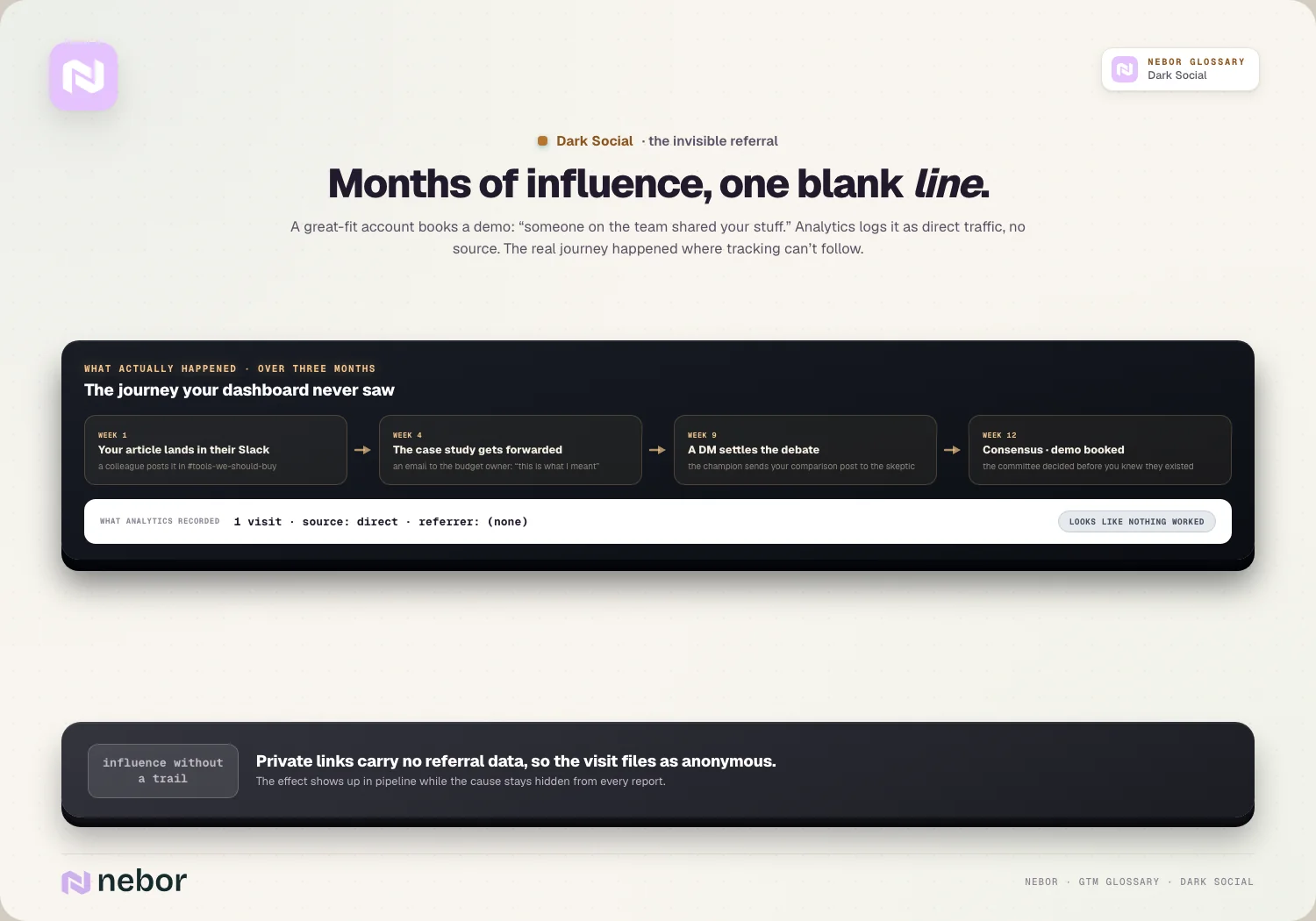
This is why dark social is often described as invisible instead of absent. The traffic and the influence are completely real, but the trail that would connect them to a source is broken, so the effect shows up in your pipeline while the cause stays hidden from every report you open.
Where dark social sharing takes place across a buyer's working day
The channels behind dark social are the private, everyday tools where people really talk. Slack workspaces and Microsoft Teams channels, LinkedIn and other direct messages, WhatsApp and text threads, and plain email forwards are where a link gets passed from one person to another out of your view.
What these channels share is that they're closed and personal instead of public and trackable. A tweet linking to your content is measurable, but the same link pasted into a private team channel is not, so the more a conversation moves into trusted private spaces, the more of its sharing becomes dark.
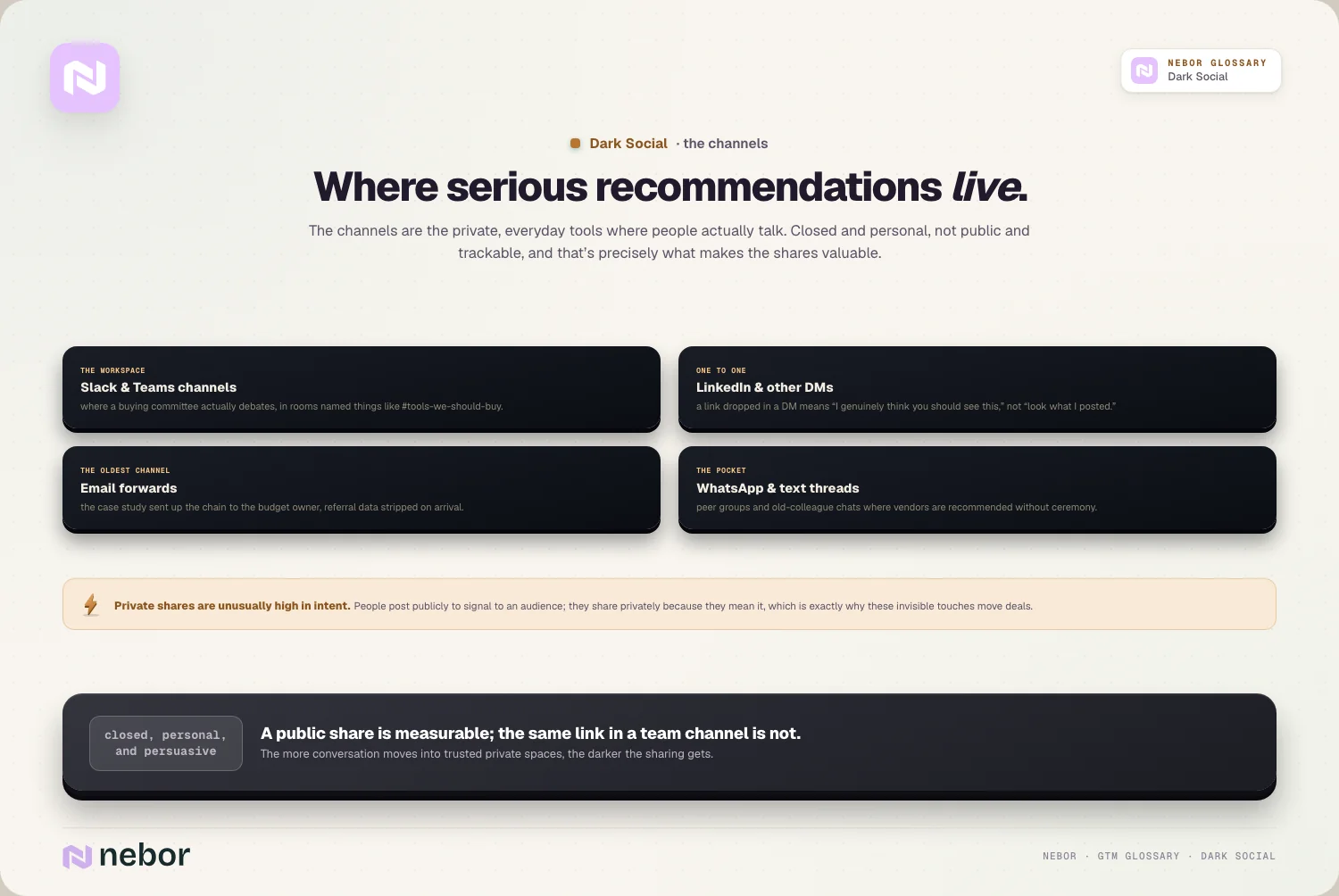
This is important because private channels are where serious recommendations happen. People share in a public feed to signal to an audience, but they drop a link into a colleague's DM because they believe that person should see it, which makes dark social shares unusually high in intent.
Why dark social is so large and keeps getting bigger every year
Dark social is the majority of how content spreads, far past being a rounding error. Estimates put around 84% of online sharing in these untracked private channels, which means the sharing you can see in public feeds is the small, visible tip of a much larger hidden iceberg.
The share is growing because behavior keeps moving toward private, closed communication. As people spend more of their working lives in Slack, Teams, and DMs instead of public feeds, more of the sharing that shapes opinions happens where analytics can't reach, so the blind spot widens over time.
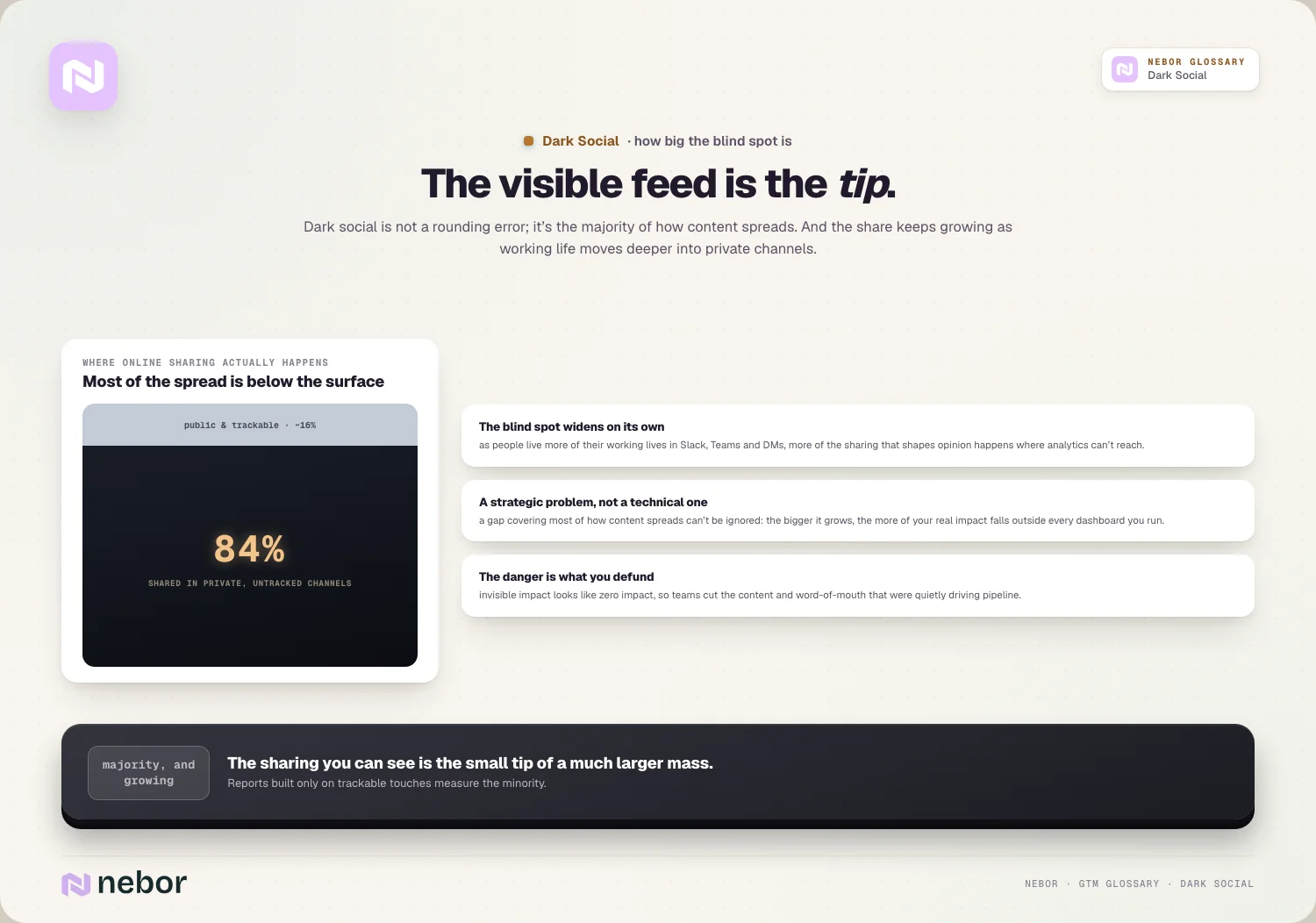
This is what makes dark social a strategic problem instead of a technical curiosity. A blind spot covering most of how your content spreads isn't something you can safely ignore, because the bigger it gets, the more of your real marketing impact falls outside everything your dashboards are built to measure.
Why dark social matters so much specifically in B2B buying journeys
Dark social hits B2B especially hard because B2B buying is a committee sport played mostly in private. A buying committee of several stakeholders debates a purchase over weeks or months, and most of that debate happens in internal Slack channels and email threads instead of anywhere a vendor can see.
Your content is doing its most important work inside those private conversations. When a champion forwards your case study to build the business case, or drops your article into a channel to win over a skeptic, that content is directly shaping the deal, yet none of that high-intent activity registers in your analytics.
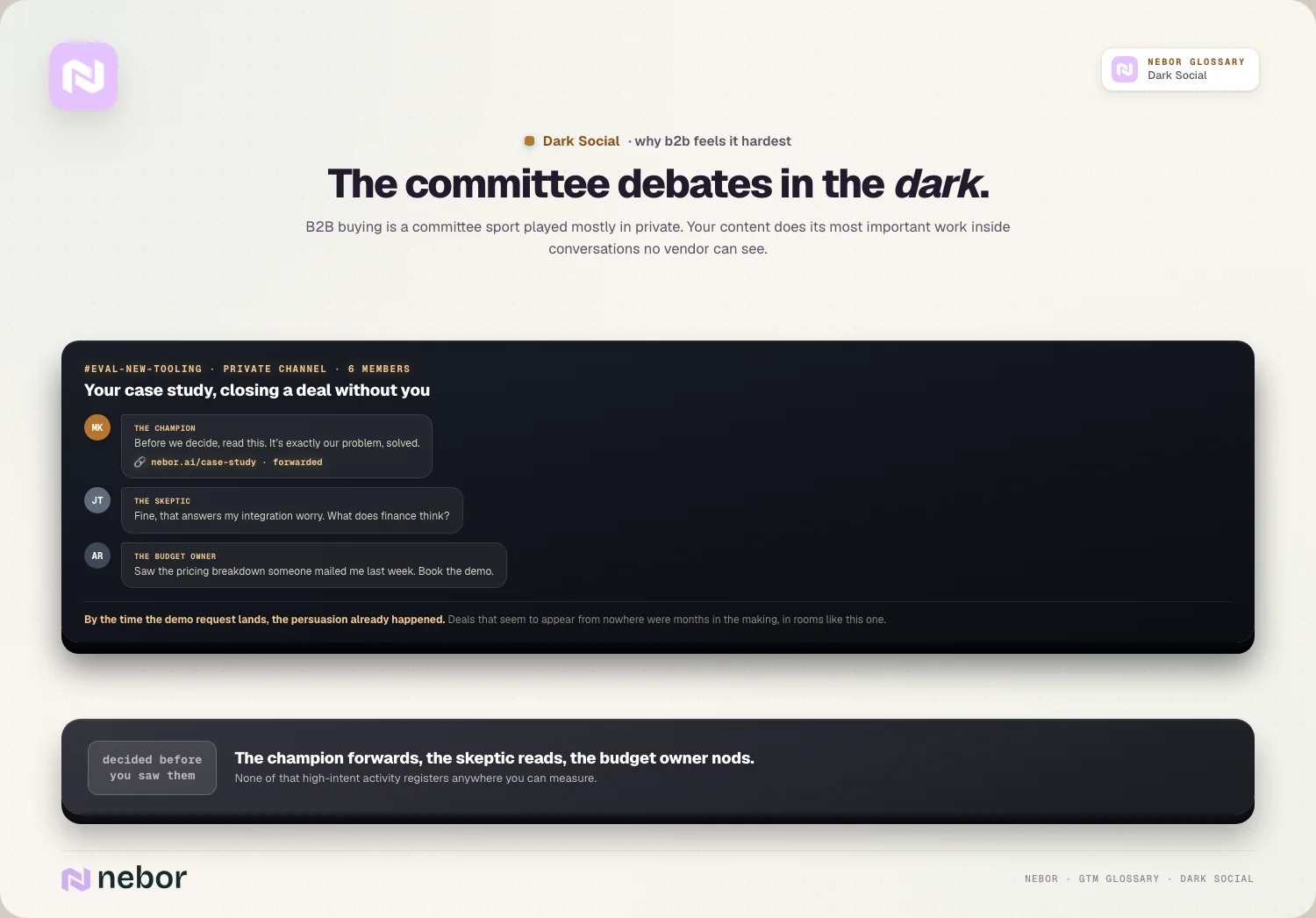
The consequence is that the most decisive phase of the buying journey is invisible to you. By the time a deal surfaces as a demo request, the real persuasion has already happened in the dark, explaining why so many B2B deals seem to appear from nowhere when they were months in the making.
How dark social differs from the broader dark funnel it belongs to
Dark social is often used interchangeably with the dark funnel, but the two aren't quite the same thing. Dark social specifically means the private sharing of content, while the dark funnel is the wider set of all untracked touchpoints that influence a buyer, of which dark social is one major part.
The dark funnel includes influences beyond private sharing entirely. Podcasts a buyer hears, communities they lurk in, review sites they read, and events they attend all shape opinion without leaving a trail, so the dark funnel is the whole universe of hidden influence and dark social is the peer-to-peer slice.
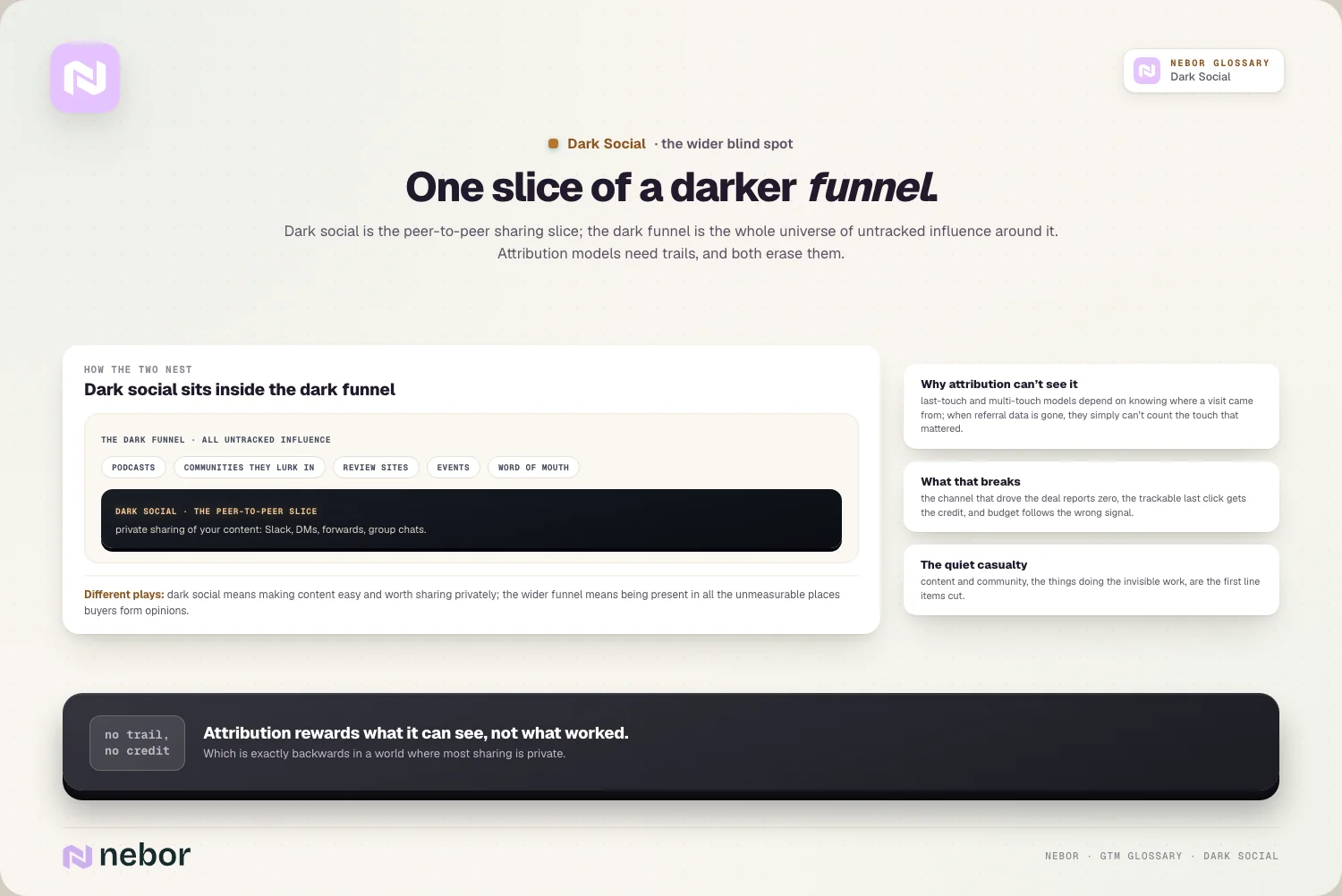
Keeping the distinction clear helps you respond to each correctly. Dark social is about making your content easy and worth sharing in private, while the broader dark funnel is about being present across all the unmeasurable places a buyer forms opinions, so the two overlap but call for slightly different plays.
Why traditional attribution can't see dark social and what that breaks
Standard attribution models are built on a trackable trail from touch to touch, which is exactly what dark social erases. Last-touch and even multi-touch attribution both depend on knowing where a visit came from, so when the referral data is gone, these models simply can't count the touch that mattered.
The damage goes past missing data into actively misleading conclusions. Because dark-social-driven visits land in the direct bucket, attribution credits the wrong thing, often handing the win to whatever branded search or direct visit happened last while the content that did the real persuading gets nothing.
This is how good marketing gets defunded on bad numbers. When the reports show your thought leadership driving little measurable traffic, it looks like a poor investment, so budget shifts toward whatever the flawed model can see, starving the very content that was winning deals in the dark.
How to measure dark social with self-reported attribution and account signals
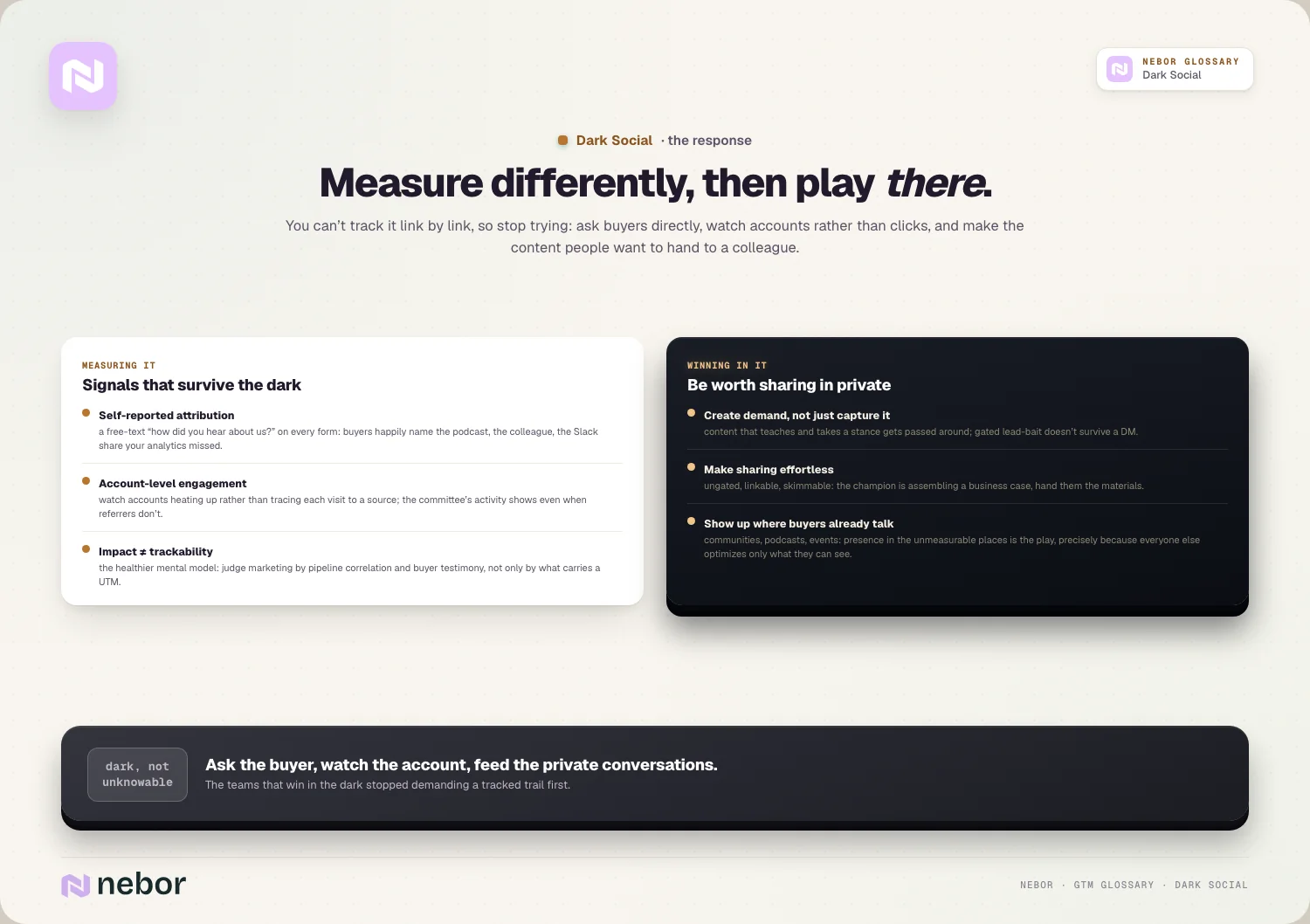
Since you can't trace individual dark social shares, the practical move, and the one we advise before any tooling purchase, is to ask buyers directly.
Adding a self-reported attribution question like "what was most useful in your research" to demo forms surfaces the content and channels that influenced a deal, revealing patterns your analytics never could.
Self-reported answers also expose dark sharing through telltale mismatches, and we keep seeing this pattern in the funnels clients bring us.
When a blog post shows low tracked traffic but keeps getting named by new signups as what convinced them, that gap is the fingerprint of private sharing, so the survey reveals content that's spreading widely off the record.
The other shift is from individual visits to account-level signals.
Rather than asking which touch converted one person, you watch whether a target account is heating up, using website deanonymization and buying signals to spot rising engagement from multiple stakeholders at one of your accounts.
That rising multi-stakeholder engagement is what dark-social-driven consensus looks like from the outside.
Why dark social rewards demand creation over simple lead capture
Dark social changes what kind of marketing pays off, tilting the advantage toward creating demand instead of just capturing it. Because the influence happens privately and early, the marketing that wins plants ideas and builds reputation long before a buyer ever fills out a form.
This is the heart of the demand creation versus demand capture distinction. Capture tactics like search ads catch buyers already looking and are easy to track, while creation tactics like content and point of view shape who starts looking, and most of that shaping travels through dark social.
The practical implication is that you have to invest in the harder-to-measure half. A team that funds only what it can attribute keeps pouring money into capture while starving the creation that feeds it, so respecting dark social means protecting demand creation budget even when its returns are unattributable.
How to win inside dark social instead of merely trying to measure it
Measurement only matters if it changes what you do, and the real goal is to be shared in the first place.
That means creating content people find worth forwarding, the kind of thought leadership a person wants to drop into a channel because it makes them look smart or helps a colleague, because shareability is what feeds dark social.
Making content easy to share and remember matters as much as making it good. A memorable idea, a quotable stat, or a framework with a name travels through private channels better than a dense page nobody can summarize, so packaging ideas to be passed along is part of the work instead of an afterthought.
It also helps to give people something concrete to point to. A single strong asset that a champion can forward to win over a skeptic does more in a private thread than a scattered library, so a few truly quotable pieces often outperform a large volume of forgettable ones.
Accepting that you won't get clean credit is the final mindset shift, and in our experience it's the hardest one for reporting-driven teams.
Dark social rewards consistent presence and useful ideas over trackable campaigns, so a mature demand generation approach invests in being talked about privately even though the payoff shows up as unattributable pipeline instead of a tidy line in a report.
Why dark social forces a healthier way of thinking about marketing impact
The deepest lesson of dark social is that the map is not the territory, and your analytics are only a partial map. Treating what you track as the whole of your impact leads you to overrate measurable channels and underrate the private word-of-mouth that drives the best deals, so humility about the data is the start.
Embracing dark social pushes you toward measuring what matters instead of only what's easy. Shifting to self-reported attribution and account-level engagement amounts to a more honest read on how buyers really decide, well past a workaround, which improves marketing decisions well beyond the dark social problem itself.
A go-to-market system that respects dark social stops demanding a clean source for every deal and invests in being genuinely worth sharing.
When the content and reputation you build travel through private channels on their own, the pipeline you generate alongside what you automate sales prospecting to create grows in ways no dashboard will fully explain.
Share this post
Intent
Marketing
Glossary
Related glossary items
Understanding the core GTM concepts



Ready to build your pipeline











