In this post:
A follow-up sequence is the planned series of messages you send after a first outreach that got no reply, each one giving the prospect a fresh reason to answer, until they respond or the sequence ends. Silence after one email rarely means no. Usually the message arrived at a bad moment, got buried, or was read on a phone and forgotten.
The mechanics around those messages already have homes. How many steps, how far apart, threading, stop rules and testing are covered under email sequence, while mixing email with calls and LinkedIn messages is what a sales cadence plans. This entry is about the follow-ups themselves: what each one has to say that the first email didn't.
That's where most sequences fall down. The opener gets three drafts and a review. The follow-ups get "just bumping this to the top of your inbox", which tells the prospect your next email won't contain anything either.
TL;DR
Every follow-up has to change something the first email didn't have: a new angle, a piece of proof, a smaller ask, a different person at the account or a different channel. A follow-up that only repeats the request trains people to skip you.
The first follow-up reaches almost everyone on a cold list, so write it as carefully as the opener. Send it a few days later, open with one line of context instead of "following up", bring the new angle, and ask for something the prospect can answer in one line.
Decide when to stop from your own numbers, not from a vendor's percentages. Count positive replies per step against the people who received that step, set opt-outs beside them, and rewrite or cut a step once it brings in about as many unsubscribes as interested replies across more than one campaign.
End on purpose. The last message says plainly that it's the last, repeats the one reason to talk in a sentence, and leaves an easy way back. After that, no more automated email until there's a new reason to write.
Warm and inbound leads need faster, shorter follow-ups built from what they did. After a meeting, a demo, a proposal, a no-show or a "try me later" reply, the follow-up starts from that event, and tools like HubSpot and Calendly have rules worth knowing before you automate it.
What each message in a follow-up sequence has to add
Picture the prospect opening your third email. They might have read the first one, or might not. Either way, the third email has to stand on its own, and it has to justify interrupting them again. The simplest test is to ask what this message contains that the previous one didn't. If the answer is "nothing, it's a reminder", it shouldn't go out.

In practice, a follow-up can add one of five things. A good sequence uses several of them, roughly in this order.
A new angle. The same problem from a different side: the cost instead of the time, the risk instead of the effort, the new hire's first month instead of the manager's quarter. If the first email didn't land, the angle was probably the part that missed.
Proof. A short story about a company like theirs, a screenshot of the result, or something from their own world, such as three open job ads for the role your product makes easier.
A smaller ask. A thirty-minute call is a big request from a stranger. "Is this on your list for this year at all?" or "Shall I send the two-page version?" can be answered in one word, and a one-word reply starts a conversation.
A different person. Sometimes the first contact is simply the wrong one. A follow-up to the colleague who actually owns the problem, mentioning that you wrote to their manager, is often more useful than a fourth email to the same inbox. Multi-threading covers how to do that without going around anyone.
A different channel. A connection request, a short call or a voice note reaches people who never open cold email. When and how often to switch channels is a cadence question, and multi-channel outreach covers what each channel does well.

Follow-ups fall flat the moment they drop the specifics that made the opener relevant. A tailored first email followed by three generic ones reads as a person who wrote once and then handed you to a machine. Keeping every step specific for hundreds of prospects is what personalization at scale is for, and it mostly comes down to researching each prospect once and giving every step something from that research to use.
Writing the first follow-up
The first follow-up reaches everyone who didn't answer the opener, which on a cold list is nearly everyone, so it deserves the same care as the first email. Four habits make it work.
Give it a few days. A follow-up the next morning looks impatient and lands before the prospect has caught up with their inbox. The exact gaps are covered under email sequence. What matters here is that the follow-up shouldn't feel like it was triggered by a timer.
Open with context, not with the fact that you're following up. One line that reminds them who you are and why you wrote is enough. "Just following up on my last email" spends the most-read line of the message on something with no value to them.
Bring the new angle, and keep the ask small. Here is a first follow-up to an operations manager at a Rotterdam freight forwarder, after an opener about manual customs paperwork that got no reply:
"Mark, one thing I left out last week. The forwarders we work with rarely struggle with the declarations themselves. It's the corrections afterwards that eat Friday afternoons. Is that the same for your team, or have you already solved it?"
It's four sentences, it needs no context from the first email, and it can be answered with a yes, a no or "we use X for that".

Finally, assume the best. People don't reply because they're busy, travelling or unsure who should answer. A follow-up that hints at disappointment ("I haven't heard back") makes replying awkward. One that sounds like a helpful second thought makes it easy.
Your own reply data shows when to stop adding follow-ups
Published figures on how many follow-ups to send come mostly from sending-tool vendors, measured on their customers' campaigns, and they vary with the market, the list and the copy. Your own sequences tell you far more, as long as you count the right things.
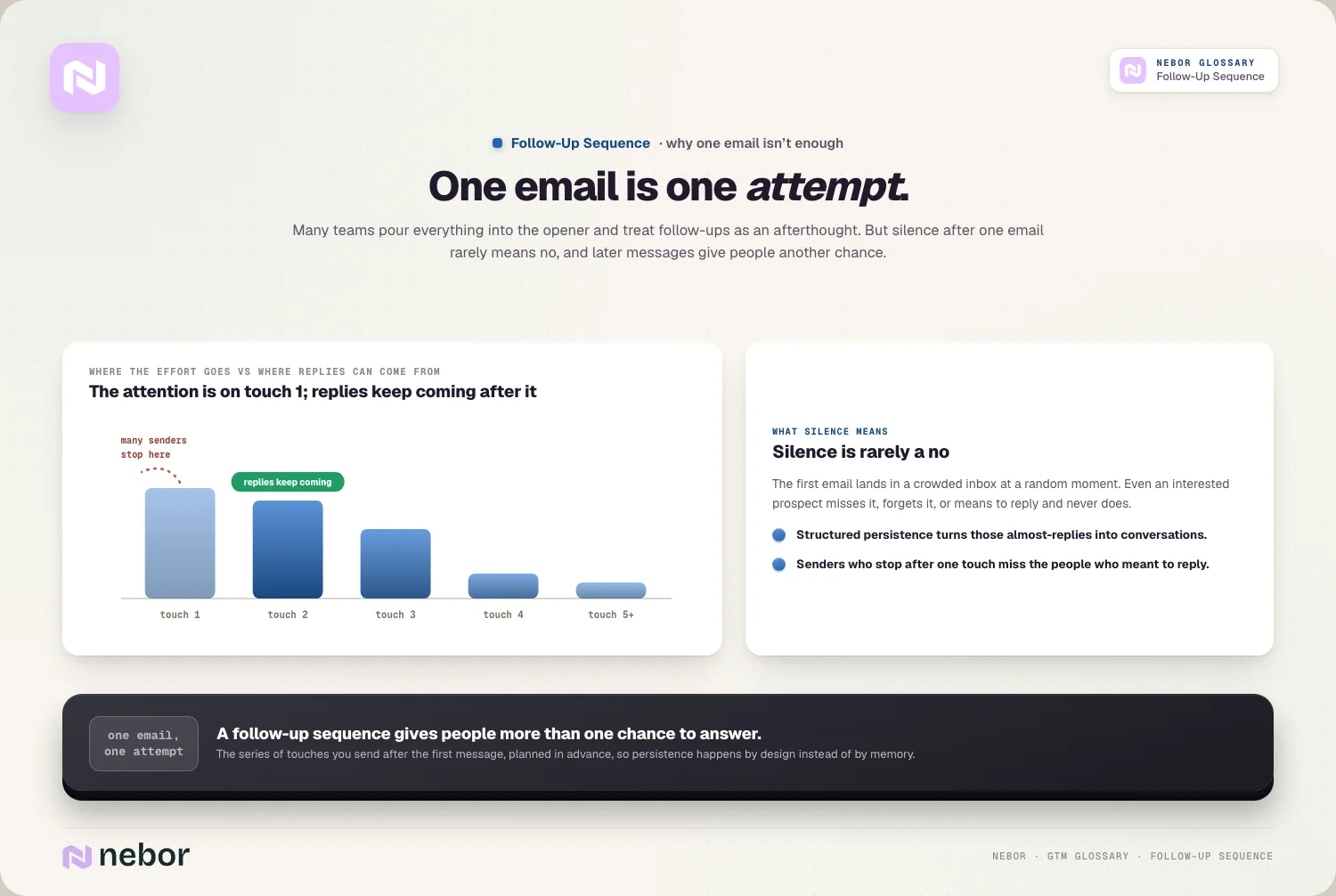
For each step, count the positive replies (people who want to talk, or ask a real question) and divide by the number of prospects who actually received that step, not by the size of the original list. Set unsubscribes, "please stop" replies and spam complaints next to it. Leave opens out, because they no longer say much about whether anyone read the email.
Here's a made-up campaign to show the method. A Utrecht software company sends a four-step sequence to 400 prospects. The first follow-up reaches 370 of them (the rest replied, bounced or opted out after the opener) and produces 9 positive replies, about 2.4%. The second follow-up reaches 350 and produces 6, about 1.7%. The third reaches 335 and produces 2, about 0.6%, alongside 5 unsubscribes.
The third follow-up is now bringing in fewer interested replies than opt-outs. On one campaign, two replies is too small a number to be sure of anything. If the same pattern shows up across two or three campaigns, rewrite that step with a genuinely different angle or a different person, and if it still doesn't pull its weight, cut it. Steady per-step comparisons like this are the core of sequence optimization.

Check the costs you can't see in the reply column as well. Each follow-up uses part of a sending inbox's daily allowance of 10 to 20 cold emails, and every unwanted follow-up is another chance of a spam complaint.
How to end a follow-up sequence
A sequence should end deliberately, not by running out of steps. The last message has three jobs. It says plainly that this is the last email, so the prospect knows the pressure is off. It repeats the single reason to talk in one sentence, for the reader who skimmed everything before. And it leaves an easy way back, such as "if this comes up next year, a one-line reply is enough".
That last email often draws replies the earlier ones didn't, mostly polite timing answers ("not now, try in the autumn") and the occasional pointer to the right colleague. A timing answer becomes a dated restart, described below. A referral starts a new, short sequence to the colleague that mentions who pointed you there.
After the final message, stop the automated email. A prospect who ignored four messages shouldn't land in another campaign next week with the same pitch. How long to park them and what justifies trying again is part of the cadence design. What the follow-up sequence owes them is a clean ending and a record of what was sent, so the next attempt can start from something new.
And when someone replies with a firm no, end it on the spot. Thank them, log the reason if they gave one, and add them to the suppression list if they asked not to be contacted.
Following up with warm leads, inbound leads and people you've already met
Cold follow-ups have to earn attention. Once a prospect has engaged, by filling in a form, taking a meeting or asking for a proposal, the job changes: the follow-up has to keep a promise and make the next step easy. These sequences are shorter and faster, and their content comes from what the prospect did. Warm leads go quiet as often as cold ones, so they need follow-ups too, just not the cold ones. The difference between the two kinds of lead is laid out under warm lead vs cold lead.
Inbound forms and warm signals
The first response to a demo request belongs to speed to lead and should happen within minutes. The follow-up sequence covers what comes after, when the first call went to voicemail or the booking link sat unused. Every message should answer something from the form, the question they typed, the team size they gave, the page they came from, so it reads as a reply rather than a campaign. The inbound meetings workflow shows how routing, the first touch and these follow-ups fit together.
After a first meeting or a demo
The recap goes out the same day: the problem in their words, what you promised to send, and the next step with a date. If no next step was agreed, the recap proposes one. Later follow-ups deliver what was promised, such as a customer story from their sector or the answer to a question you couldn't handle live. After a demo, write a two-minute version for the colleagues who missed it, so your contact can forward it.
After a proposal
A proposal is the easiest place for a deal to stall without anyone noticing. The buyer says it looks good, then disappears into an approval process you can't see. HubSpot shows quote statuses such as "Published - viewed" and "Viewed - pending signature", which tells a proposal nobody opened apart from one that's been read and is waiting. The first may need sending to someone else. The second needs help getting through sign-off.
Say a Ghent logistics firm received a €24,000 annual proposal on Monday, opened it that evening and went silent. "Just checking you received it" is pointless, because you know they did. A better follow-up on Thursday: "Lies, you mentioned your CFO signs off anything above €20,000. Here's a half-page version for her, with the start date and what the first month delivers."
After a no-show
Most no-shows come down to a double booking or a meeting that ran over, so the follow-up should assume something like that and offer new times. The tooling is what trips teams up. Calendly's documentation says invitees marked as no-shows only get the no-show automations, not the thank-you and follow-up messages that would otherwise go out after the event. If nobody marks the no-show, the person who never turned up gets a "great to meet you" email. HubSpot records the same fact in its meeting outcome properties, though those apply to meetings booked through its own meetings tool.
After a "try me later" reply
A reply like "not now, try us after the summer" tells you two useful things: they haven't ruled you out, and they've named a time. Store the date and the reason on the record and schedule the first follow-up for then. HubSpot lets a rep switch a sequence's first email to "Send later" and pick a date and time at enrollment, which handles the simple cases. When the date comes, mention the earlier conversation and bring something new, because the original pitch a second time tells them nobody remembered.

All of these fail the same way: they depend on someone remembering. A rep with eleven meetings this week will forget one recap, and the deal attached to it is the one that goes cold. Let a change in the CRM start the right sequence (a meeting outcome, a deal stage, a quote status, a date arriving), have the rep write the first message after any real conversation, and put the rules for which event starts which follow-up in the team's outbound playbook.
In short
A follow-up sequence exists because one email is one attempt at one moment. What makes it work isn't persistence on its own. It's that every message after the first brings something new: an angle, a proof point, an easier question, a better person or a different channel.
The rest follows from paying attention. Write the first follow-up as carefully as the opener, decide how many to send from your own reply and opt-out counts, end with a clear last message, and treat people who have already engaged differently from strangers. Once the follow-ups carry real content, the sending is the easy part, and it's among the first things worth handing to software when you automate the repetitive parts of prospecting, as a dependable piece of a GTM system built around booked meetings. For more voices on writing follow-ups people answer, our list of outbound experts worth following is a good place to start.
At Nebor, we write and test follow-up sequences with clients, connect the warm and post-meeting ones to triggers in whichever CRM and sending tool they already run, and leave the reasoning behind each step written up for whoever edits them next.
Frequently asked questions
Is a follow-up sequence the same as an email sequence?
They overlap. An email sequence is the whole automated series sent to one prospect, the first email included, and it covers the mechanics such as timing, threading and stop rules. A follow-up sequence is the part after the first message, the emails that go out when the opener got no reply. The term also covers the planned messages after a meeting, demo or proposal that went quiet.
How many follow-up emails should you send before you stop?
For cold outreach, two to four follow-ups after the first email is a sensible starting range, which makes three to five emails in total. Treat that as a starting point rather than a rule. Track positive replies and opt-outs for each step across a few campaigns, and cut or rewrite the step where interested replies stop outnumbering unsubscribes and complaints. Warm leads usually need fewer messages, sent closer together.
Do follow-up emails need as much personalization as the first email?
They need to stay just as specific, though not every one needs new research. A follow-up can reuse what you learned for the opener, such as the prospect's role, a recent hire or a problem common in their sector, and add a new angle or proof point to it. What fails is a tailored first email followed by generic reminders, which makes the opener look like a one-off trick.
What should a follow-up email say when you get no response?
Something the first email didn't. Open with a line of context so the message stands on its own, then add one new thing: a different angle on the problem, a short example from a similar company, or an easier question that can be answered in a word. Skip phrases like "just checking in" or "did you see my email", which ask the prospect to do work for you.
How do you follow up without being annoying?
Make every message worth reading even if the prospect never replies, leave a few days between them, and stop when the sequence ends rather than starting a new one with the same pitch. Keep the tone friendly and assume the silence has an innocent reason. Most annoyance comes from repetition and guilt-tripping, not from the number of messages, so a short, useful follow-up rarely causes offence.
Can a follow-up go out on LinkedIn instead of email?
Yes, and switching channel is one of the most useful things a follow-up can do, since some people barely read cold email. A connection request with a short note, or a message after they accept, works best when it refers to the same reason you wrote and doesn't repeat the email word for word. Make sure a reply on either channel stops the follow-ups on both.
What should you do when a prospect replies that they are not interested?
Stop the sequence straight away, thank them, and if it feels natural ask whether the problem or the timing is the reason. Log the answer on the record, because a timing answer can become a dated restart while a firm no should stay closed. If they ask not to be contacted again, add them to your suppression list so no other campaign or colleague writes to them.
How quickly should the recap go out after a sales meeting?
The same working day, while the conversation is fresh for both of you. A short recap that repeats the problem in the prospect's words, lists what you promised to send and confirms the next step shows you were listening. Waiting several days and then sending a long summary turns the follow-up into homework for the buyer and makes the meeting feel less important than it was.
What are the most common follow-up sequence mistakes?
Stopping after one email, sending follow-ups that only bump the thread, and following up too fast or too slowly are the classic ones. Others are mechanical: sending a thank-you email to someone who missed the meeting because nobody marked the no-show, leaving a prospect in a cold campaign after they booked a demo, and never checking which steps actually produce interested replies before adding more.
Share this post
Sequences
Glossary
Related glossary items
Understanding the core GTM concepts
Automation
Email Sequence
An email sequence is a planned series of emails sent automatically to a prospect with set delays between them, built to earn a reply. Most replies come from the follow-ups after the first email.
Automation
Sales Cadence
A sales cadence is a planned sequence of outreach touches across channels like email, phone and LinkedIn, spread over a set timeframe, so reps keep following up long enough to earn a response.
Automation
Sequence Optimization
Sequence optimization is the ongoing process of improving an outreach sequence by testing one element at a time, from subject lines to timing to structure, and keeping whatever gets more replies.
Automation
Multi-Channel Outreach
Multi-channel outreach is contacting the same prospect across several channels, like email, LinkedIn and phone, in a planned and coordinated sequence, so you reach buyers where they pay attention.
Ready to build your pipeline