

In this post:
A given company isn't in the market for your product most of the time. They have their tools, their processes, and no urgent reason to change, so even a perfect pitch lands on someone who simply isn't looking.
Then something shifts inside the company itself. They raise funding, hire a new VP, expand into a new region, or outgrow a tool. Suddenly there's a real reason to buy, and the same outreach that would have been ignored last month now lands.
A trigger event is a specific, time-bound change at a company that creates a window of buying readiness, like a funding round, an executive hire, or rapid hiring. It's the moment a non-buyer becomes a buyer.
The reason trigger events matter so much is that they reveal timing you can't see otherwise. Instead of guessing who might be ready, you watch for the changes that make companies ready, then reach out while the window is open.
TL;DR
A trigger event is a specific change at a company, like funding, a leadership hire, or expansion, that opens a short window where they're suddenly more likely to buy.
Timing drives conversion, because reaching a company right after a relevant trigger lands far better than reaching them at a random moment, given the change created a real need.
Common triggers include funding rounds, executive hires, rapid hiring, expansion, tech changes, and M&A, each signaling a different kind of new need or budget.
The constraint that comes with them is a short window. A trigger loses value fast as competitors arrive and the company settles, so acting quickly is what turns a trigger into a deal.
So what is a trigger event, exactly, and what makes one a trigger?
A trigger event is a specific, observable change in a company's situation that suggests they may now be ready to buy. It's a discrete event instead of a vague sense of interest.
The key traits are that it's specific and time-bound. A funding round happens on a date, an executive starts on a date, so a trigger is a concrete moment with a clear before and after.
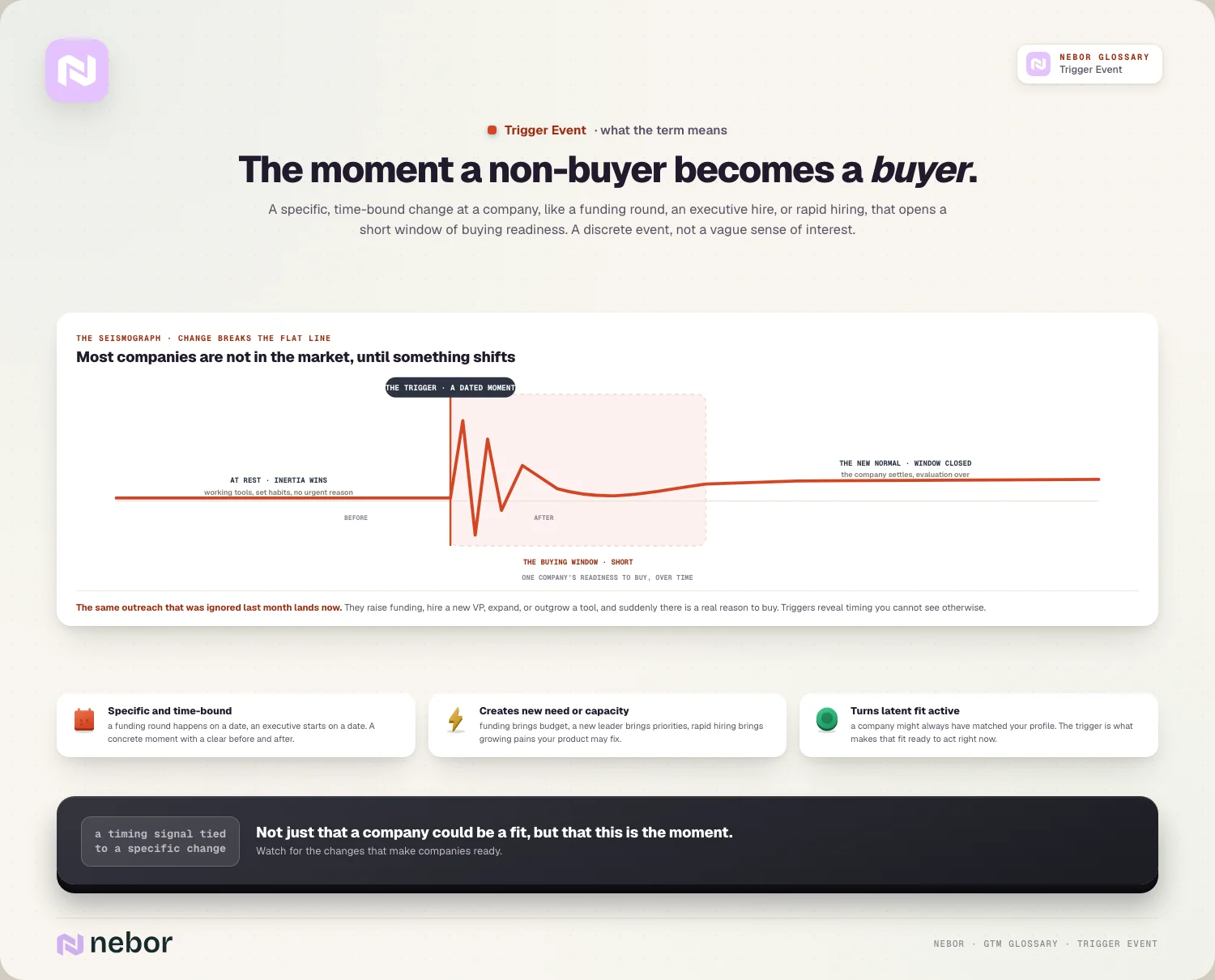
That change creates a new need or capacity. New funding brings budget, a new leader brings new priorities, and rapid hiring brings growing pains, each of which can make your product newly relevant.
This is what separates a trigger from a static fit. A company might always have matched your profile, but the trigger is what turns that latent fit into active readiness right now.
So a trigger event is essentially a timing signal tied to a specific change. It tells you not just that a company could be a fit, but that this is the moment they're most likely to act.
How is a trigger event different from the broader buying signals around it?
These terms overlap, but they're nested instead of interchangeable, because a trigger event is a particular kind of signal instead of a synonym for all of them.
A buying signal is any indicator that an account may be in-market, which is a broad category covering behavior, intent, and events.
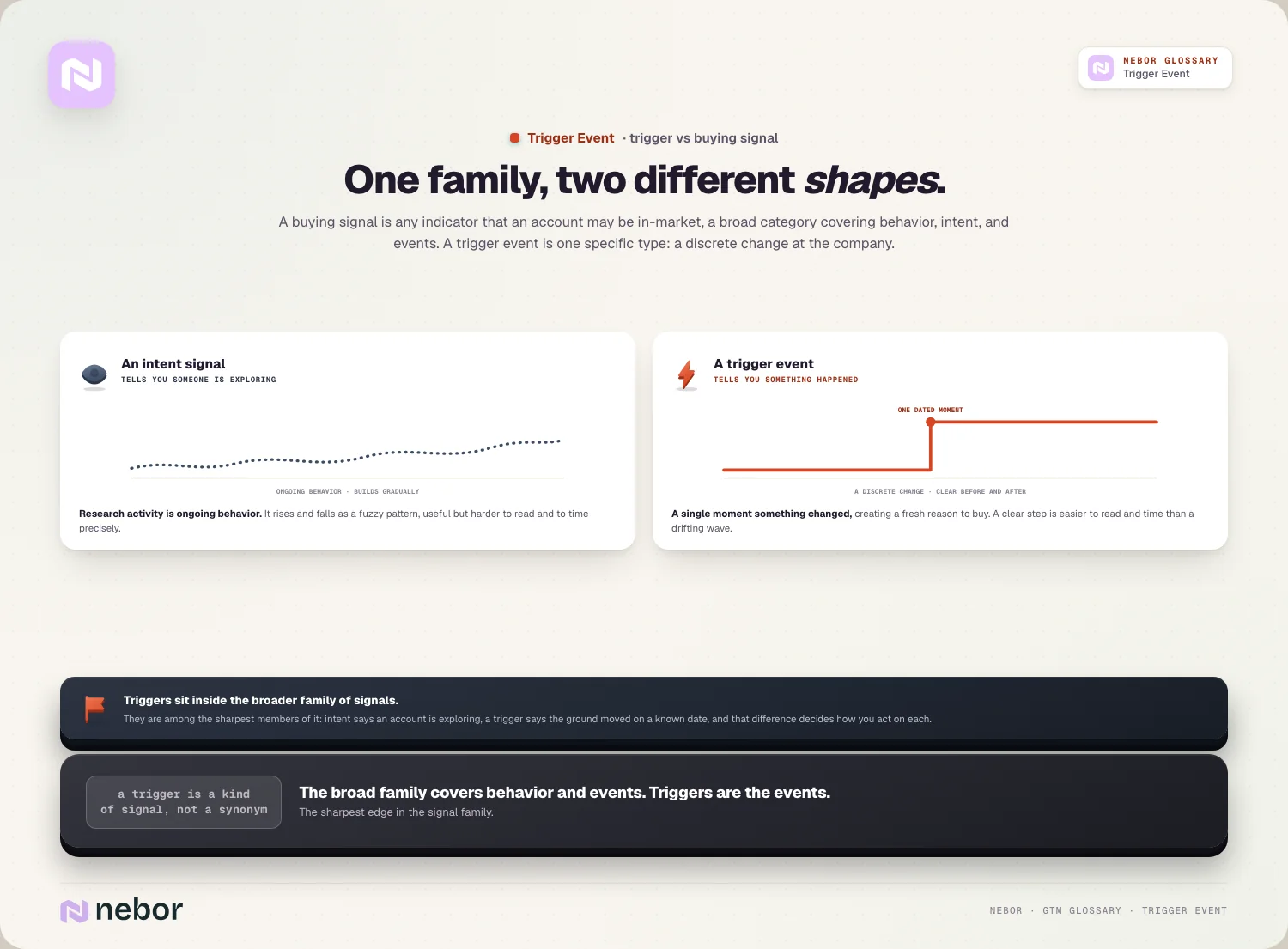
A trigger event is one specific type, a discrete change at the company. Where an intent signal like research activity is ongoing behavior, a trigger is a single moment something changed.
The distinction matters for how you act. Intent signals tell you someone is exploring, while trigger events tell you something happened that created a fresh reason to buy.
So triggers are part of the broader family of signals. They're among the sharpest, because a clear change is easier to read and time than a fuzzy pattern of behavior.
What are the most valuable trigger events you can watch for?
Not all triggers are equal, and in our experience a few categories open the strongest windows.
Funding rounds top most lists of these. New funding means new budget and expansion plans, so a recently funded company often has both the money and the motive to buy.
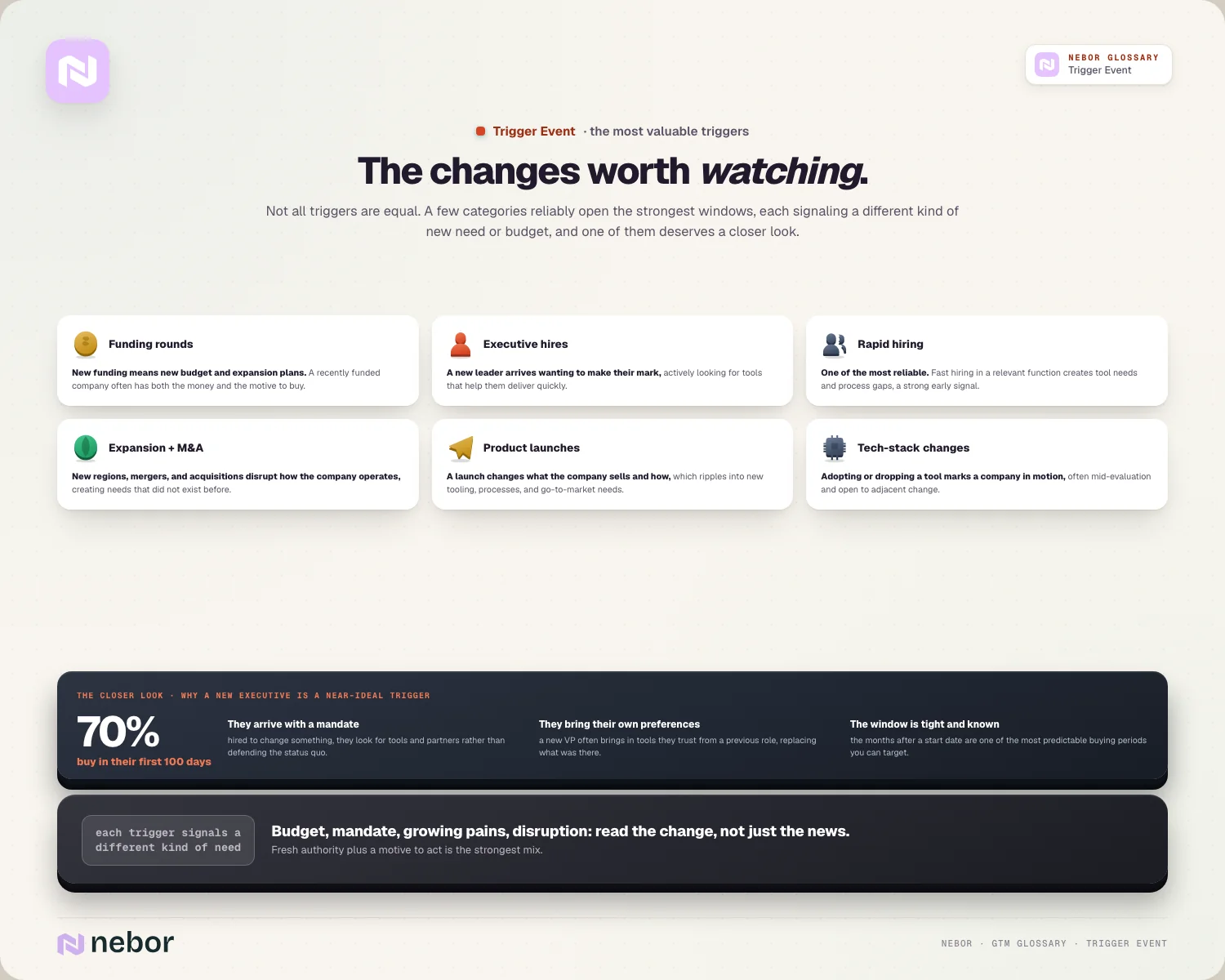
Executive hires carry more force than people expect. A new leader arrives wanting to make their mark, and research shows around 70% of new executives make a technology purchase within their first 100 days.
Rapid hiring is one of the most reliable of all. A company hiring fast, especially in a relevant function, is creating tool needs and process gaps, which makes a hiring spike a strong early signal.
Then there are the structural changes, because expansion into new regions, mergers and acquisitions, product launches, and tech-stack changes all create new needs, with each one disrupting how the company currently operates.
Why does a trigger event open a buying window where none existed?
The core idea behind trigger events is the buying window, and the reason change opens one comes down to disruption.
A company at rest resists change by default. They have working tools and habits, so even a better option faces the inertia of switching, and that inertia is what makes steady-state outreach convert poorly.
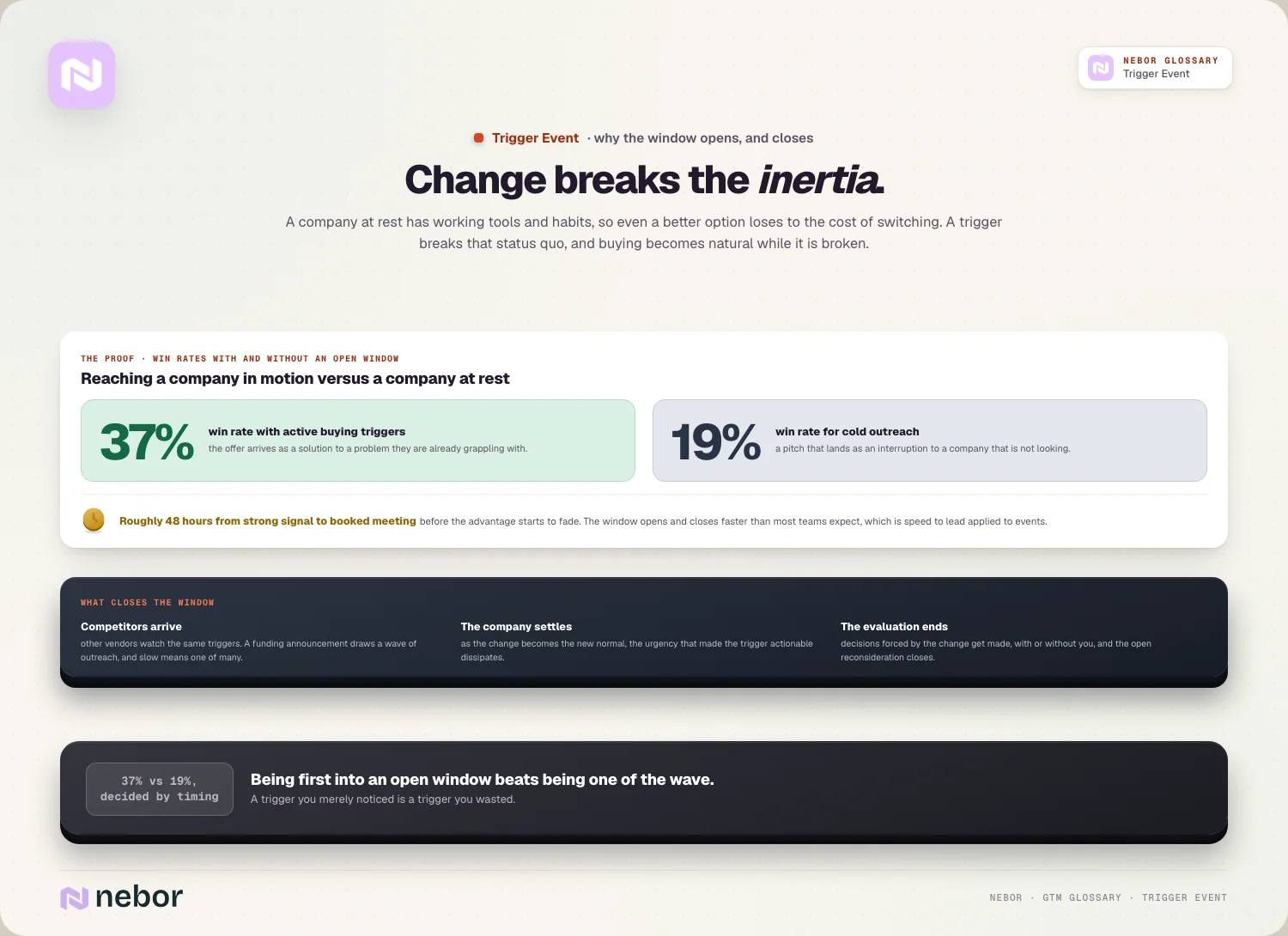
A trigger disrupts exactly that state of rest. Funding, a new leader, or rapid growth breaks the status quo, creating a moment where the company is actively reconsidering how it operates.
In that moment, buying becomes the natural move. The change itself forces decisions, so a relevant offer arrives as a solution to a problem they're already wrestling with instead of an interruption.
The proof shows up in the conversion numbers. Selling to accounts with active buying triggers delivers around a 37% win rate versus 19% for cold outreach, because you're reaching them during a real opening.
Why is acting fast on a trigger the part that decides everything?
A trigger event is perishable, and that quality decides whether it pays off, because the window opens and closes faster than most teams expect.
The window is shorter than it feels. Research suggests the gap between a strong signal and a booked meeting is roughly 48 hours before the advantage starts to fade.
After that window, the competitors start arriving. Other vendors watch the same triggers, so a funding announcement draws a wave of outreach, and being slow means being one of many instead of the first.
The company settles back down as well. As the change becomes the new normal, the urgency that made the trigger actionable dissipates, and the open evaluation closes.
So triggers reward whoever moves the fastest. Reaching the account quickly is speed to lead applied to events, and it's what separates a trigger you capitalize on from one you merely noticed.
How do you find trigger events and act on them systematically?
Knowing triggers matter is one thing, and systematically catching them is another. A real motion built on triggers has a few parts.
Detection comes first, where you monitor sources like funding databases, job boards, news, and LinkedIn for the specific changes that matter to your business, often as part of a sales signal stack.
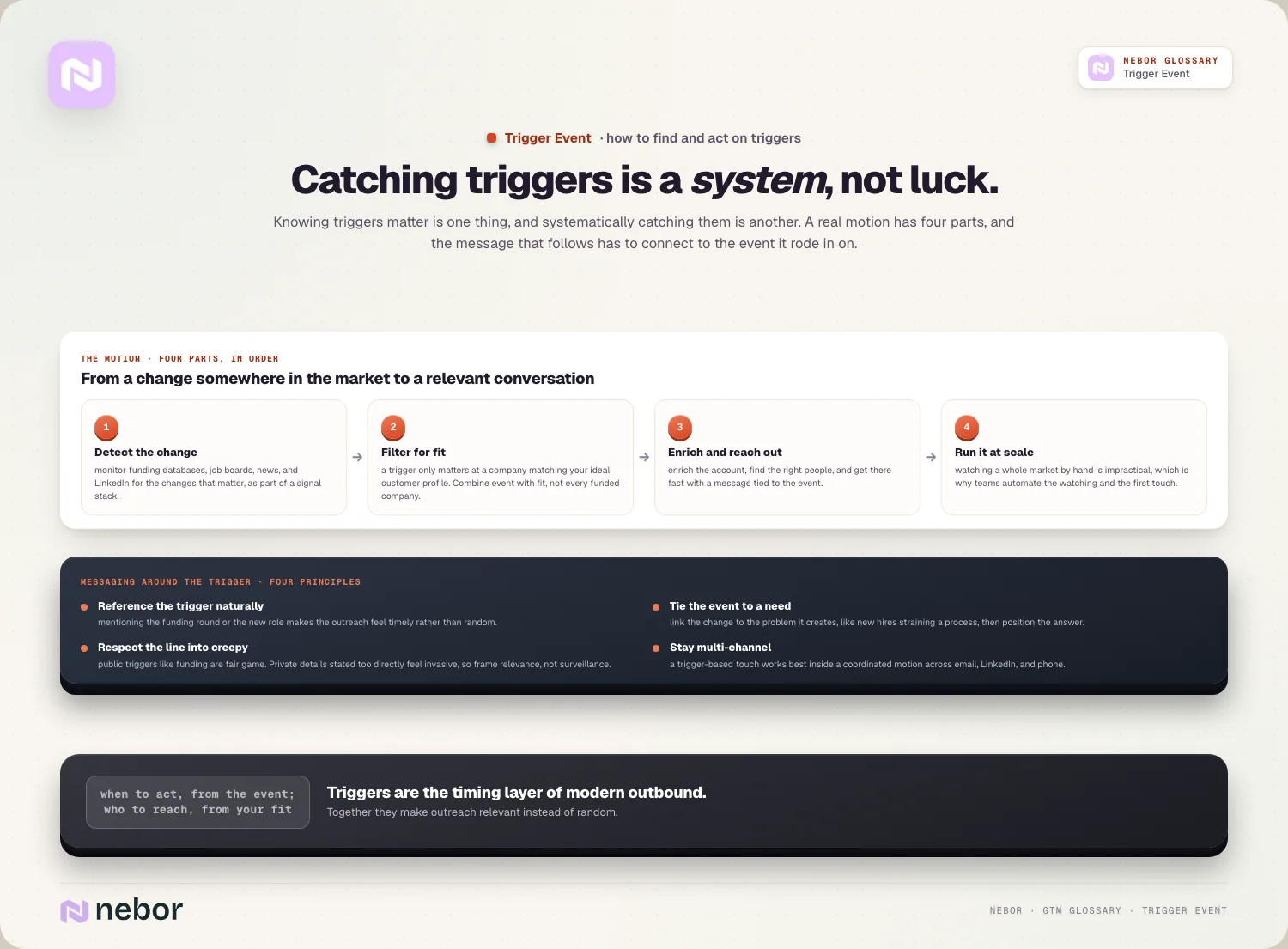
Filtering for fit comes right after, because a trigger only matters at a company that matches your ideal customer profile, so you combine the event with fit instead of chasing every funded company.
Then you enrich the account and reach out. Once you spot a fitting trigger, you enrich the account through data enrichment and reach the right people fast, with a message tied to the event.
And scale is its own requirement, because watching for triggers across a whole market by hand is impractical, so teams build systems to automate sales prospecting around them.
Why the detail inside a trigger tells you more than the event itself
Detection is where most programs stop, logging that a funding round closed or a VP started and then sending the same congratulations to every account that matched. We push clients one level deeper, because the useful intelligence is inside the event.
Take the example of a new VP arriving at a target account. The event tells you a window opened, while their previous roles tell you what they will try to do with it, because a leader who ran a particular stack at their last company usually pushes for something familiar within weeks of arriving.
A senior vacancy rewards the same reading once you open the posting itself. The responsibilities name the gap the company is trying to close, the requirements often list the exact tools already in the stack, and the seniority tells you how much budget is behind the problem.
That reading changes the message you end up writing. Opening on the specific problem their own job description says they were hired to solve lands as research, while a note congratulating them on the move reads like every other message in their inbox that week.
So the trigger is the doorway and the artifact behind it is the brief. A funding announcement, a job post, and a public profile each carry enough detail to tell you what the account is trying to do next, and reading them properly is what separates timely outreach from noise.
How do trigger events fit inside a signal-based selling motion?
Trigger events are one of the clearest forms of signal-based work, so they fit naturally into that approach. They're often the strongest signals to act on.
The broader practice is signal-based selling, where you time outreach to real signals instead of working a static list. Trigger events are among the most actionable of those signals.
They turn cold outreach into something warmer. Reaching a company because of a specific change, with a message about that change, is a form of inbound-led outbound logic applied to external events.
They sharpen your targeting universe as well. Layering triggers onto your list and your list building means you contact good-fit companies at the moment they're most ready instead of whenever you get to them.
So trigger events are the timing layer of modern outbound. They tell you when to act, while your fit criteria tell you who, and together they make outreach far more relevant.
How should you message around a trigger event without wasting it?
Detecting a trigger is wasted if your message ignores it, so the outreach has to connect to the event. A few principles make trigger-based messaging land.
The message should reference the trigger naturally. Mentioning the funding round or new role connects your outreach to what's happening at the company, which makes it feel timely rather than random.
It should tie the event to a need. The strongest messages link the change to a problem it creates, like new hires straining a process, then position your product as the answer.
It should respect where relevance tips into intrusion. Public triggers like funding are fair game, but referencing private details too directly feels invasive, so let the event inform your angle without dominating it.
And it should still work across several channels. A trigger-based touch works best inside a coordinated motion across email, LinkedIn, and phone, so you reach the account on the channel they favor.
Why is a new executive such a strong trigger to build plays around?
Of all the triggers, a leadership change deserves a closer look, because it's one of the most reliable. A new executive reshapes buying in a short window.
New leaders arrive carrying a mandate to deliver. They were hired to change something, so they're actively looking for tools and partners that help them deliver quickly, rather than defending the status quo.
They bring their own preferences with them too. A new VP often wants to bring in tools they trust from a previous role, which can mean replacing whatever the company used before.
The timing is tight and unusually predictable. With a large share of new executives making a purchase in their first months, the window after they start is one of the most predictable buying periods you can target.
So a leadership change is a near-ideal trigger. It combines fresh budget authority, a motive to act, and a clear, short window, and that combination is why so many teams watch job changes closely.
Does every business benefit from trigger-based selling equally?
Trigger-based selling is powerful, but it fits some businesses better than others, and it pays to know where you fall.
It works best when triggers map clearly to your value. If a specific change reliably creates the need your product fills, like funding for an expansion tool, triggers are a natural fit.
It matters less when the need is constant. If companies need your product regardless of any change, timing matters less, and broad targeting may serve you about as well.
Deal size affects the math as well. Higher-value deals justify the effort of monitoring and acting on triggers, while very low-priced, high-volume products may not repay the work.
So triggers work as a sharpening tool rather than a universal rule. For most B2B companies whose product solves a change-driven need, watching triggers is a clear edge, but the value depends on how tightly events map to demand.
What are the common mistakes teams make with trigger events?
Trigger-based selling can misfire in a few predictable ways, and we keep seeing the same ones when we review how teams use it, so knowing them upfront keeps the approach effective.
Acting too slowly costs the most, because a trigger you respond to a week later has often gone cold, which wastes the timing advantage entirely.
Ignoring fit fills the pipeline with the wrong accounts, because chasing every company with a trigger, regardless of whether they match your profile, wastes the motion on companies that were never going to buy.
Generic messaging throws the advantage away, because detecting a trigger but sending a message that never references it discards the relevance the trigger made possible.
And relying on one trigger type narrows your vision, because watching only for funding, for example, misses the many other changes that open windows, so a broader set catches more opportunities.
How do multiple triggers stack together into a much stronger signal?
A single trigger is useful, but several at once is far stronger. Stacking triggers is how you find the accounts most likely to buy right now.
One trigger opens a window, while two or three together suggest a company in real motion. A funded company that's also hiring fast and just brought in a new leader is about as ready as an account gets.
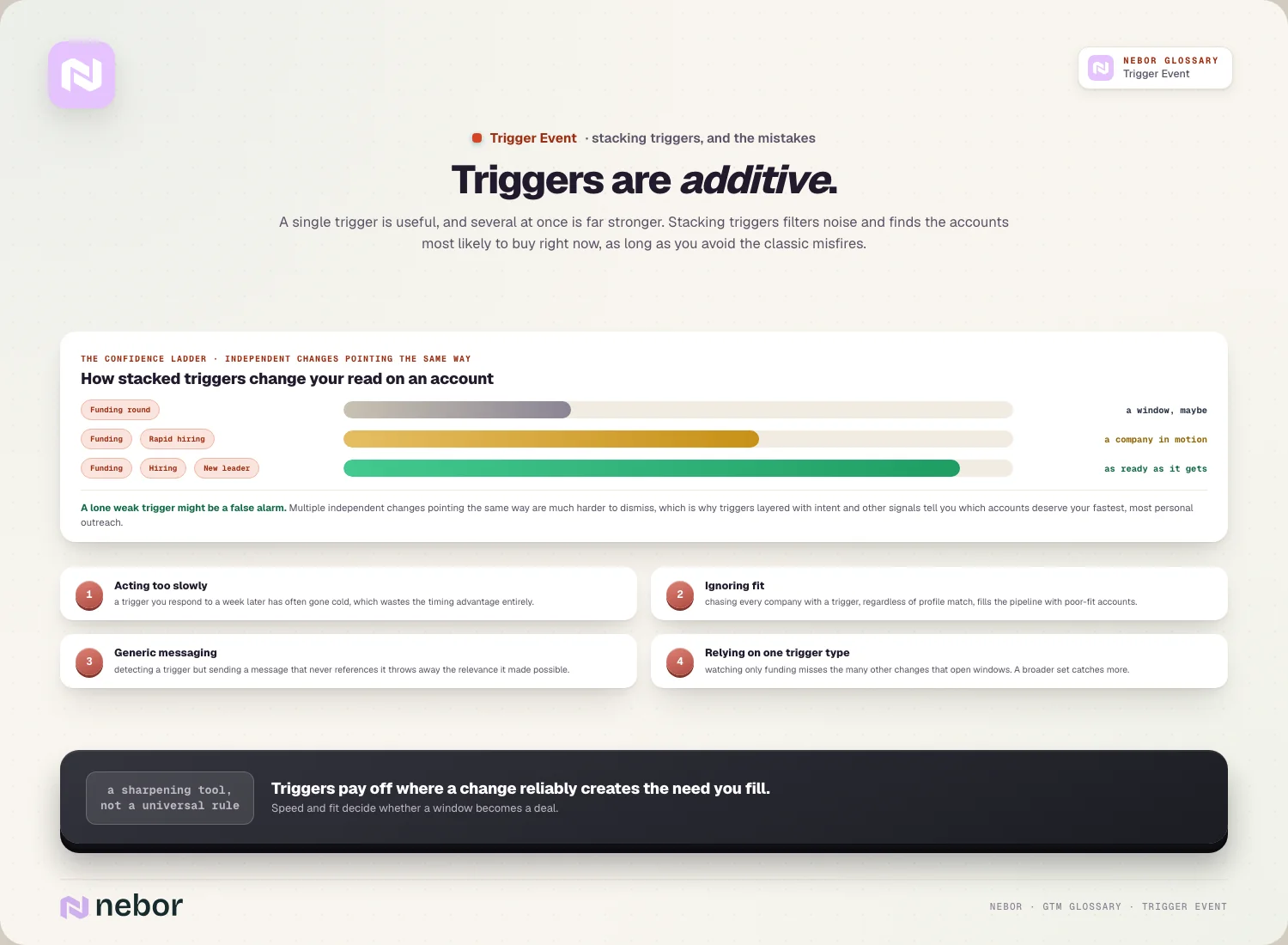
Combining triggers filters out noise as well. A lone weak trigger might be a false alarm, but multiple independent changes pointing the same way is much harder to dismiss.
This is why triggers live inside a broader signal system, and it's how we build them into client setups. Layered with intent and other signals, a stack of triggers tells you which accounts deserve your fastest, most personal outreach.
So triggers behave additively when you read them. The more relevant changes you can see happening at one account, the higher your confidence that the buying window is genuinely open.
Why watching for change catches buyers at the moment they become buyers
Trigger events matter because they solve the timing problem at the heart of outbound. Most companies aren't ready most of the time, and triggers tell you the rare moments when they are.
The deeper idea is that change creates demand. A company at rest resists buying, while a company in motion, from funding, a new leader, or fast growth, is actively reconsidering and far more open.
The honest requirement is speed and fit. A trigger is only worth as much as a fast, relevant response to a good-fit account, because the window closes quickly and competitors are watching too.
So if your outbound ignores what's changing at your target accounts, you're reaching most of them at the wrong time. Watching for trigger events is how you catch companies right when change has made them ready.
That timing advantage is exactly what a modern go-to-market system is built to capture, especially when you can find the right people fast through a workflow to find decision makers the moment a trigger goes off.
Share this post
Outbound
Intent
Glossary
Related glossary items
Understanding the core GTM concepts


Ready to build your pipeline