

In this post:
A prospect ignores your email, and a week later they ignore your second one, so you assume they're not interested and move on.
The problem is that they might have replied to a LinkedIn message, or picked up a call. They might have noticed you after seeing your name in three places, but you never gave them the chance.
That gap is what multi-channel outreach is built to close. It's the practice of reaching the same prospect across more than one channel, like email, LinkedIn, phone, and sometimes video or direct mail.
The point is to do it in a coordinated way instead of leaning on any single one. It's how you meet a buyer where they actually pay attention, instead of where it's easiest for you to send.
The word that matters most there is coordinated. Using three channels badly is not multi-channel outreach. It's three streams of noise hitting one person at once, which is usually worse than a single good email.
TL;DR
Multi-channel outreach means contacting a prospect across several channels, email, LinkedIn, phone, and others, in a planned sequence. The opposite is hammering one channel until they reply or block you.
It works because buyers don't all live in the same place. Some read every email, some only check LinkedIn, some answer the phone.
Reaching across channels means you find them wherever they engage. Coordinated cadences tend to beat single-channel ones by a wide margin, roughly 287% in some analyses.
The failure mode is treating more channels as more volume. If every channel carries the same generic message at the same time, you just annoy people faster.
When you do it well, the channels build on each other and each touch earns the next. The prospect feels followed up with instead of chased. It applies to warm inbound follow-up as much as cold outbound.
So what does multi-channel outreach mean in day-to-day practice?
At its simplest, it means you don't put all your eggs in one channel. Instead of sending five emails and giving up, you might send a couple of emails, connect on LinkedIn, leave a short message there, and place one well-timed call.
The channels most teams use are email, LinkedIn, and phone. Some add video messages, voicemail drops, text, or even physical mail for high-value accounts.
The exact mix matters less than the fact that you're not depending on one path to a busy person who may never look there.
The key idea is that these touches are planned together instead of bolted on at random. A real multi-channel motion has an order, a rhythm, and a logic to which channel comes when.
The whole thing should feel like one coherent follow-up rather than separate people all chasing the same lead. That coordination is what separates it from just being active on a lot of channels.
You can be everywhere and still be ignored if your everywhere is uncoordinated and repetitive.
Why does using more than one channel work so much better here?
The honest answer is that people are scattered, with one buyer living in their inbox, another checking LinkedIn every morning but rarely clearing their email, and a third only engaging when their phone rings.
If you only use email, you reach the first person and miss the other two.
Multi-channel outreach widens the surface area, giving you more than one shot at attention, and more importantly more than one type of attention.
A LinkedIn comment feels different from a cold email, which feels different from a call.
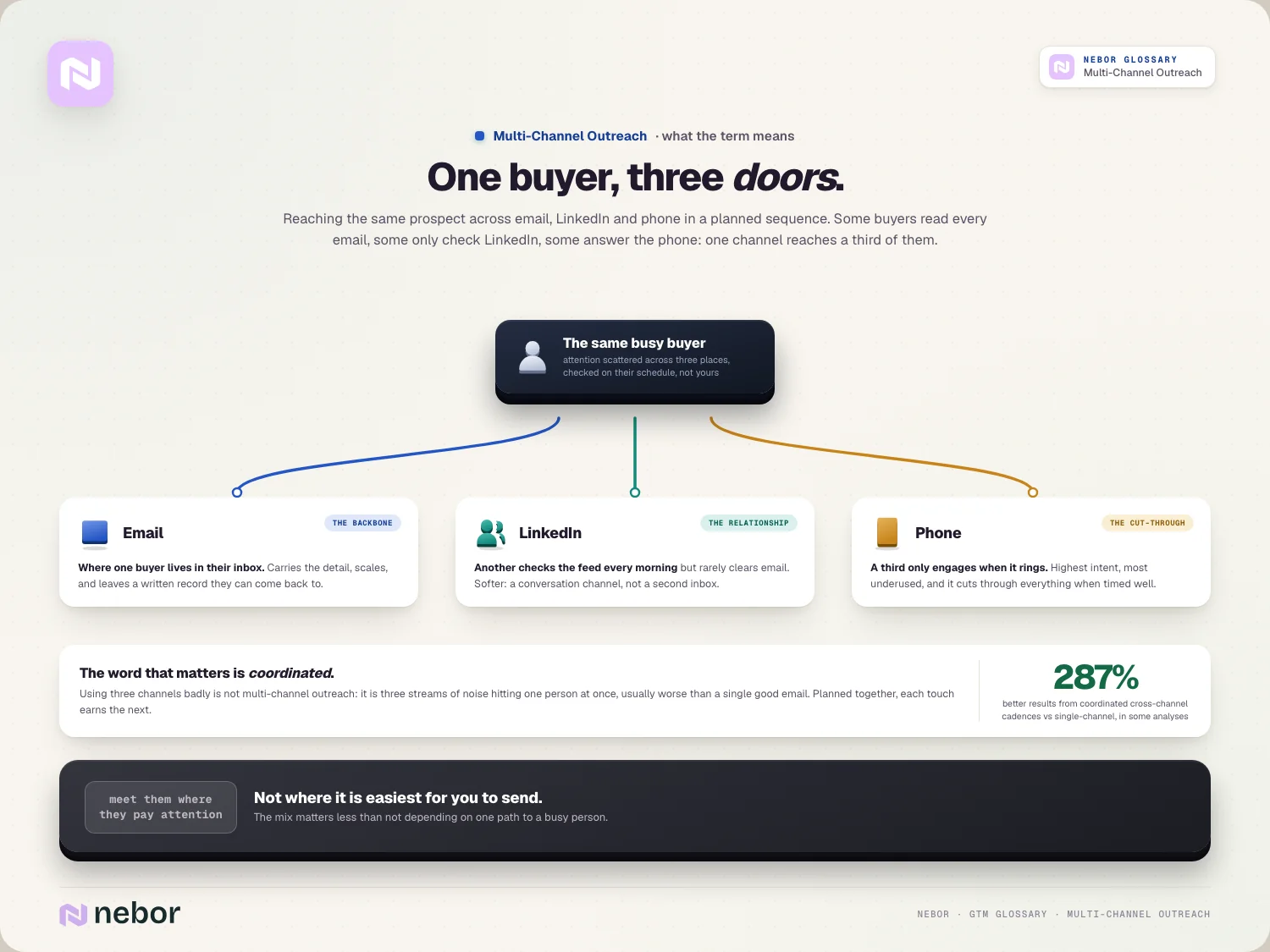
There's also a familiarity effect that single-channel outreach can't get. When someone sees your name in their inbox, then notices your connection request, then hears your voicemail, you stop being a random sender.
You start being a person they recognize, and that recognition lowers the resistance to replying.
The numbers back this up in plain terms. Email-only programs are quietly getting weaker as inboxes get more crowded, with single-channel email generating noticeably fewer leads year over year.
Coordinated cross-channel cadences hold up far better. Spreading across channels isn't a nice-to-have anymore, it's becoming the baseline for getting noticed.
How do you actually sequence the channels instead of blasting all of them?
This is where most of the teams we meet go wrong, so let's slow down. The instinct is to hit every channel at once for maximum coverage, but that feels like an ambush to the person on the other end.
Good sequencing spaces the touches and lets each one set up the next.
A simple, sane sequence might start with a first email that's genuinely relevant. A few days later, you view their profile and send a connection request on LinkedIn, with no pitch attached.
After they accept, you send a short, specific message. Then you follow with a second email that adds something new, and only after that, once there's some familiarity, do you place a call.
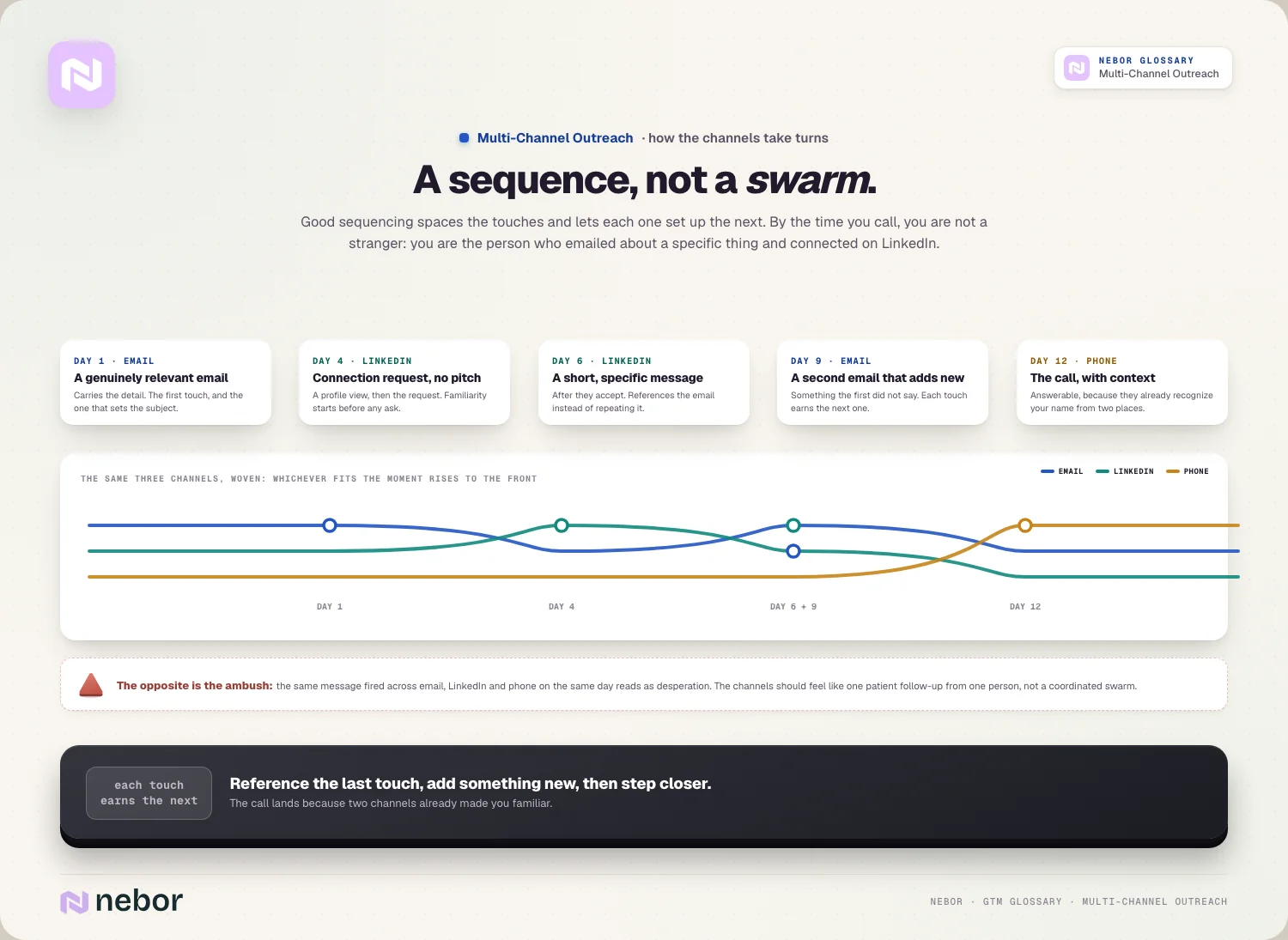
Notice what's happening across that flow, because each touch references or builds on the last.
By the time you call, you're not a stranger, you're the person who emailed about a specific thing and connected on LinkedIn. The call has context, and that context is exactly what makes it answerable.
The opposite approach is the same message blasted across email, LinkedIn, and phone on the same day, which reads as desperation. The channels should feel like one patient follow-up from one person instead of a coordinated swarm.
If you want a deeper build on cadence structure, the way we build an email sequence carries straight over to multi-channel timing.
Which channels should you use, and when does each one make sense?
Email is still the backbone for most B2B outreach, and for good reason. It's where a large share of B2B buyers say they prefer to be contacted, it scales, and it leaves a written record they can come back to.
Your cold email is usually the first touch and the channel that carries the most detail.
LinkedIn works as the relationship layer of the mix. It's softer than email and lets you warm someone up by engaging with their posts before you ever pitch.
That's why we treat LinkedIn outreach as a conversation channel rather than a second inbox. It's especially strong for people who barely read email but check LinkedIn daily.
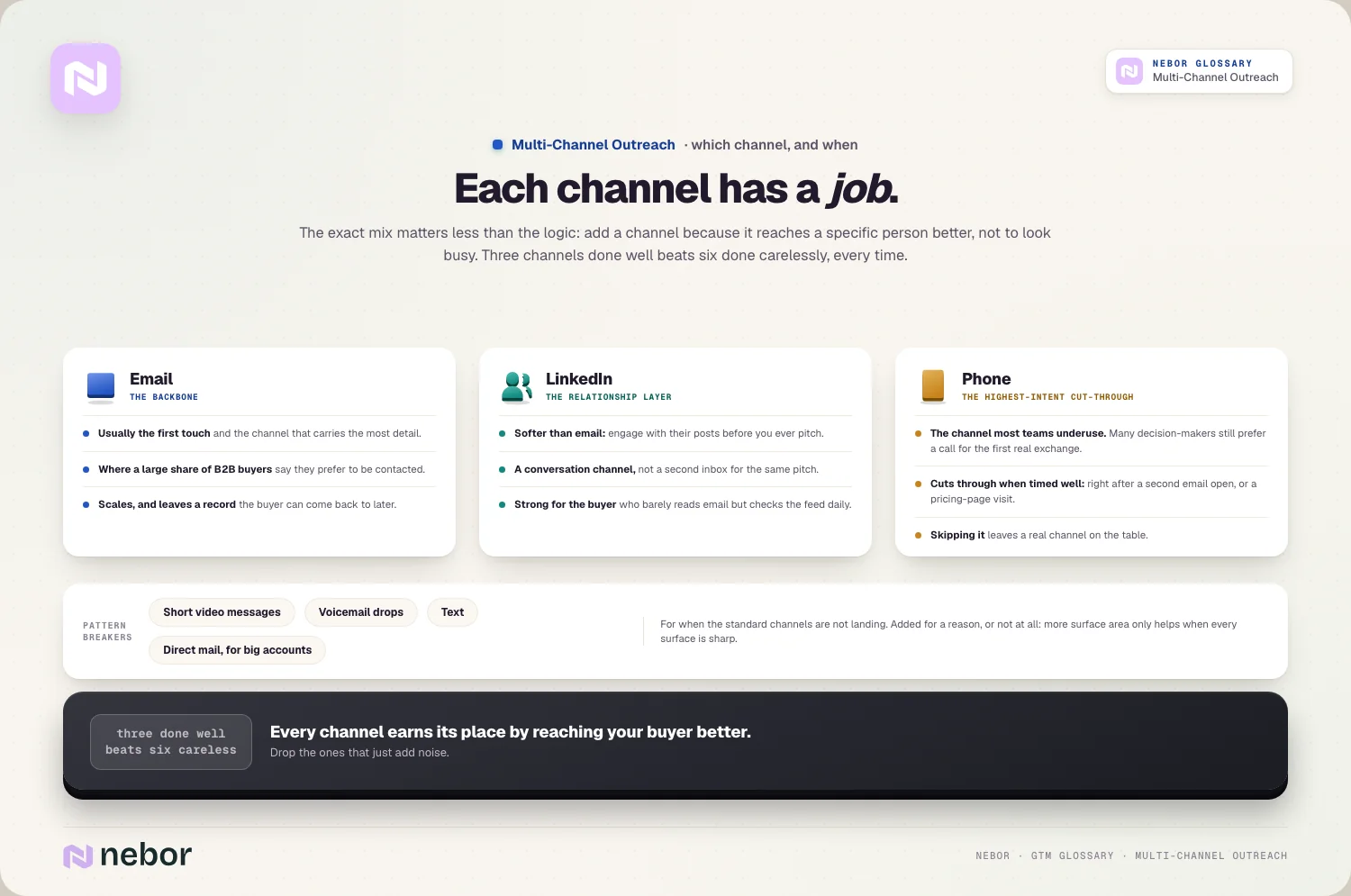
Phone is the highest-intent channel and the one most teams underuse. A call cuts through everything if it's timed well, like right after someone opens your email twice or visits your pricing page.
Many decision-makers still prefer a phone conversation for that first real exchange, so skipping it leaves a real channel on the table.
Then there are the extras worth a look. Short personal video messages, voicemail drops, and the occasional piece of direct mail for big accounts can all break the pattern when your standard channels aren't landing.
The trick is to add channels because they reach a specific person better, and skip the ones that only make you look busy.
How is multi-channel different from omnichannel, and does the difference matter?
You'll hear omnichannel used as a fancier word for the same thing, but there's a real distinction underneath. Multi-channel simply means you use several channels.
Omnichannel means those channels share context and feel like one continuous experience to the buyer.
In a basic multi-channel setup, your email and your LinkedIn message might both go out, but they don't really know about each other.
In an omnichannel setup, the LinkedIn message references the email and the call references both. If the buyer replies anywhere, every other channel adjusts, so nothing repeats and nothing contradicts.
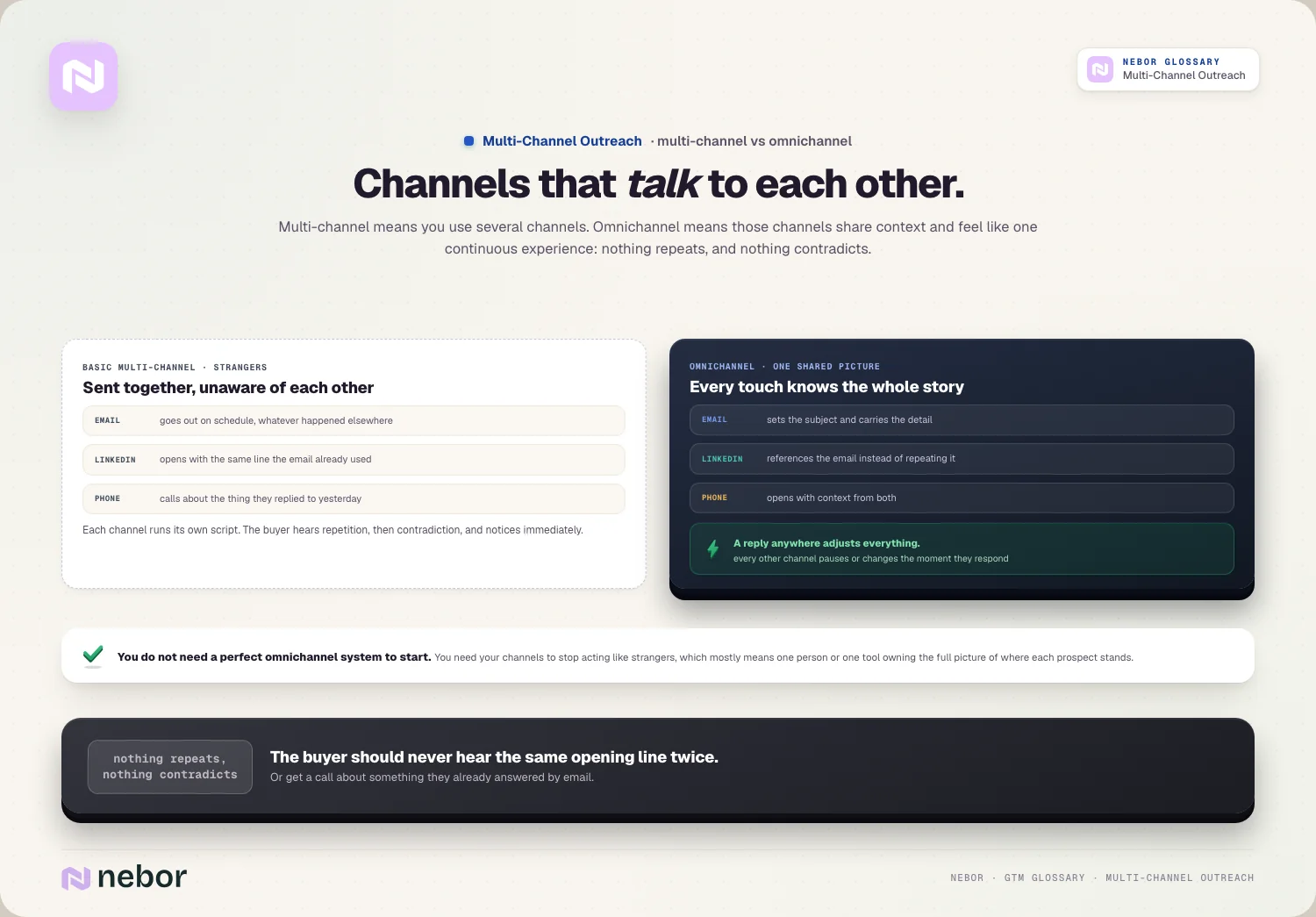
For practical purposes, the goal is to push your outreach toward that omnichannel feel. The buyer shouldn't get a call about something they already replied to by email, and they shouldn't hear the same opening line twice.
When the channels are aware of each other, the whole sequence feels considerate instead of mechanical.
You don't need a perfect omnichannel system to start. You just need your channels to stop acting like strangers.
That mostly comes down to one person or one tool owning the full picture of where each prospect is.
What are the mistakes that ruin multi-channel outreach unseen?
The first and biggest is treating extra channels as permission to send more of the same. If your LinkedIn message is just your email pasted in, and your call script is the email read aloud, you haven't built a multi-channel motion.
What you've built there is plain repetition. Each channel needs a message that fits how people use that channel.
Poor timing is the second, because if you hit all channels on day one, you overwhelm the person before they've had a chance to respond to anything.
If your touches are wildly spaced with no logic, they feel random. The rhythm has to feel like a human following up instead of a system emptying a queue.
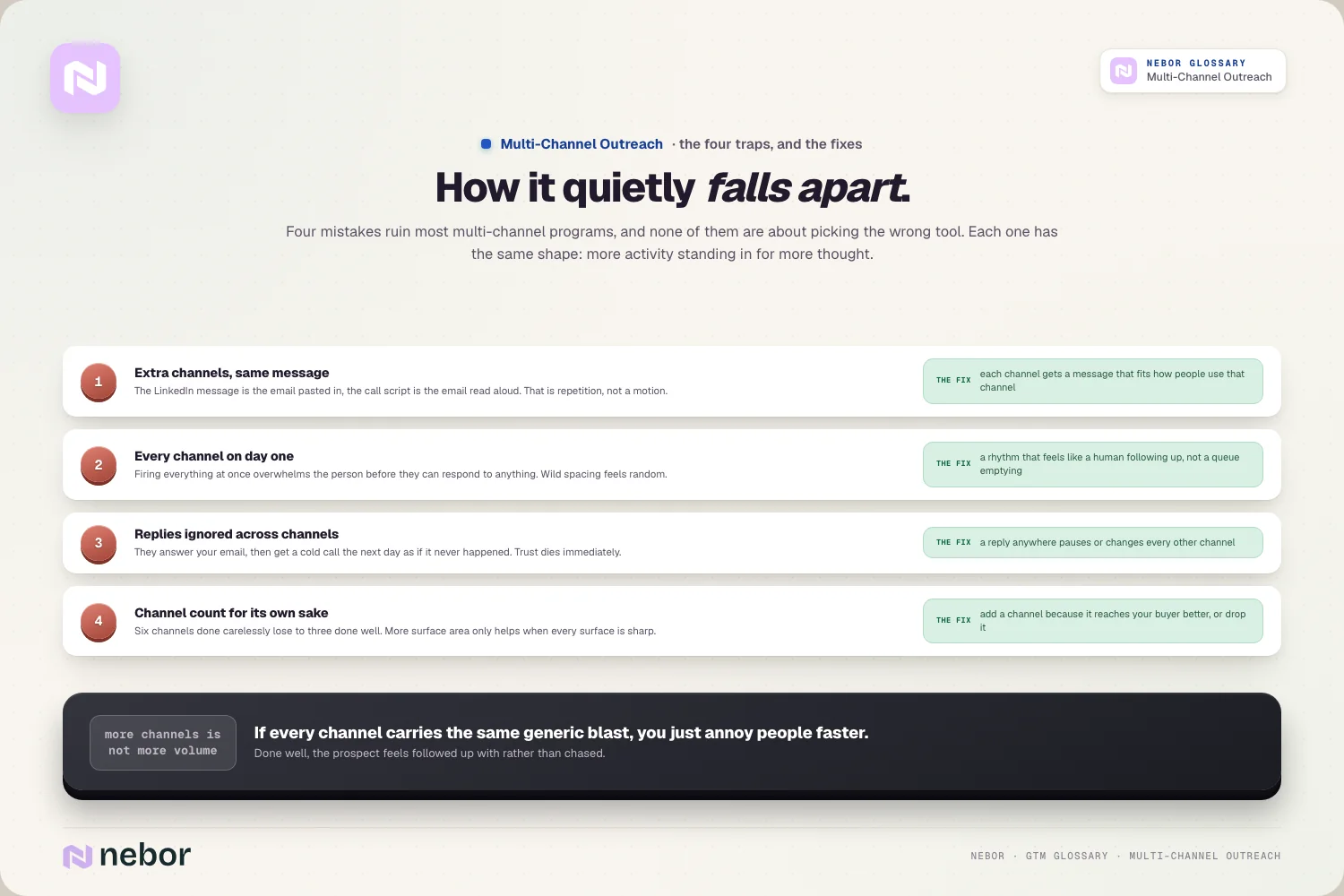
Ignoring replies across channels is the third, and nothing kills trust faster than someone replying to your email and then getting a cold call the next day as if the reply never happened.
If you can't keep state across channels, you'll regularly contradict yourself, and buyers notice immediately.
And chasing channel count for its own sake rounds out the list, because three channels done well beats six done carelessly every time.
A channel deserves adding when it reaches your buyer better, and dropping when it's just adding noise. More surface area only helps when every surface is sharp, which is the same lesson that shows up in good list building.
A smaller, cleaner set beats a sprawling messy one.
How do you keep the channels coordinated without losing your mind?
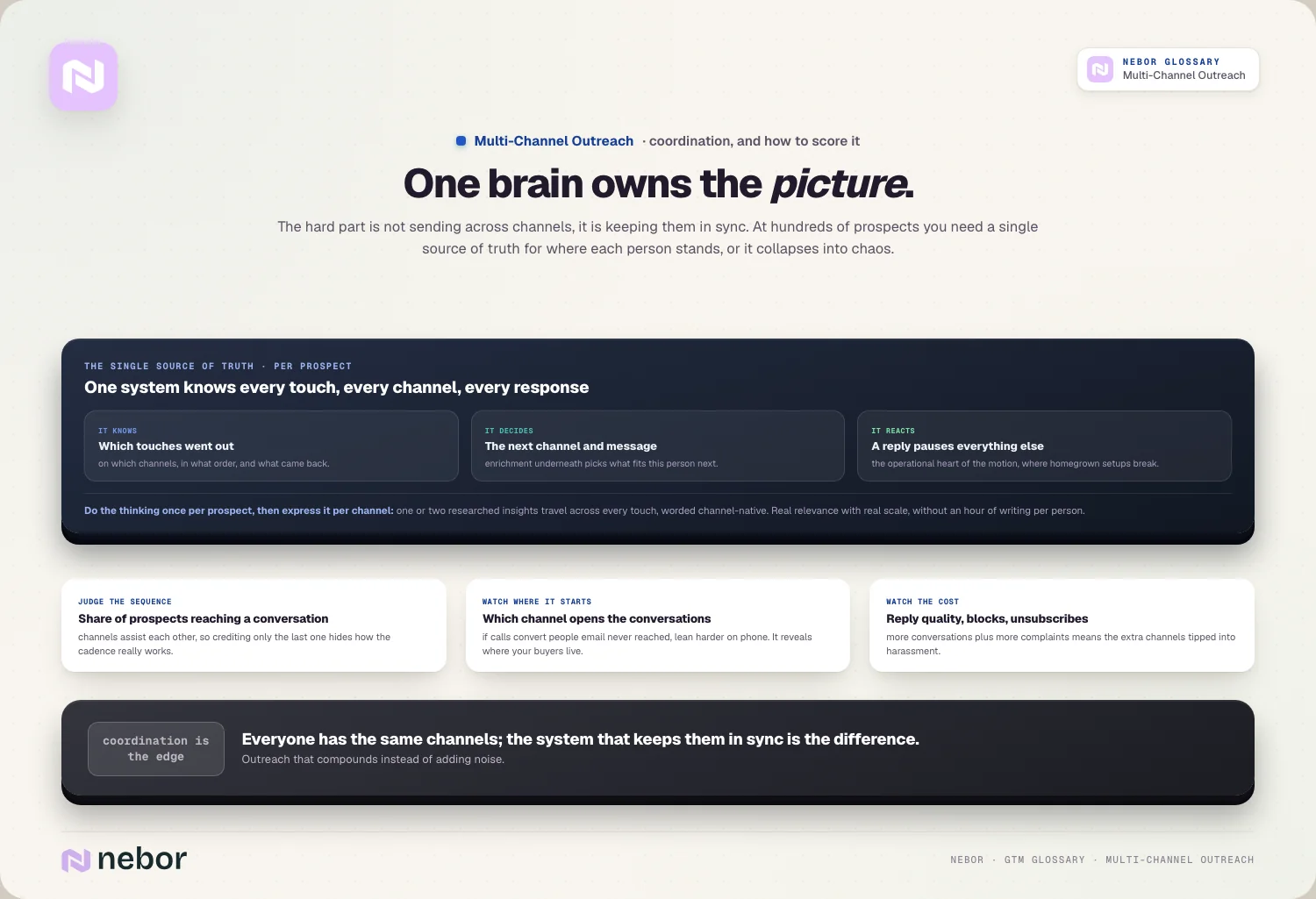
The hard part of multi-channel outreach isn't sending across channels, it's keeping them in sync. The moment you're working email, LinkedIn, and phone for hundreds of prospects, you need a single source of truth for where each person stands.
Without it, the whole thing collapses into chaos.
In practice that means one system that knows, for each prospect, which touches have gone out, on which channels, and what the response was.
When a reply comes in anywhere, every other channel for that person should pause or change. This is the operational heart of the whole motion, and it's where most homegrown setups break.
This is also where modern tooling shows its value, because sequencing platforms and orchestration layers exist precisely to hold this state.
A Clay-style build can work underneath to enrich each contact and decide which channel and message fit them next. The specific tool matters less than having something own the cross-channel picture, so a human doesn't have to track it in their head.
If you want to see how this coordination gets built into a real prospecting machine, our piece on how to automate sales prospecting shows the moving parts.
The broader go-to-market system post puts multi-channel outreach in its proper place inside the larger engine.
Does multi-channel outreach only matter for cold outbound work?
This is a blind spot we see constantly. Teams build multi-channel sequences for cold prospects, then handle warm inbound interest with a single follow-up email that often goes nowhere.
That's backwards, because warm contacts are exactly where multi-channel coordination pays off most.
When someone fills out a form, books a meeting, or shows up repeatedly on your site, you already know they're interested.
Reaching that person across email, a quick LinkedIn message, and a fast call raises the odds you connect while the interest is still hot. Speed and coverage together are what turn intent into a conversation.
This is the heart of an inbound-led outbound motion, where signals from your own channels tell you who to reach. Multi-channel outreach is how you reach them well.
The same logic applies to anonymous interest you uncover through a website visitor tracking workflow, where you spot the account first and then take a coordinated approach into the right people.
It also strengthens multi-threading inside an account. Reaching several stakeholders across channels, going beyond one champion over email, is how deals get multi-threaded.
Multi-threaded deals close at a far higher rate, around 30% versus 5% for single-threaded ones. Multi-channel and multi-threaded reinforce each other at every step.
How do you personalize across channels without burning hours per prospect?
The fear with multi-channel outreach is that personalizing a message for email, then LinkedIn, then a call, for every prospect, simply doesn't scale, and by hand it truly doesn't.
But the fix is to anchor personalization in shared research that travels across channels, instead of dropping it.
The trick is to do the thinking once per prospect, then express it differently per channel. You research the account and the person, and find the one or two things that make your outreach relevant.
Then you reuse that core insight across every touch in the appropriate format. The insight is shared, the wording is channel-native.
That's where enrichment and light automation come in. When each contact is enriched with the firmographic and signal data you need, a system can tailor the angle automatically.
That's the practical side of hyper-personalization at scale. You're not writing every word by hand, you're letting good data shape a relevant message on each channel.
The result is outreach that feels personal everywhere without a human spending an hour per prospect. The buyer experiences one coherent, relevant follow-up across channels, while behind the scenes it's research plus tooling doing most of the lifting.
That balance, real relevance with real scale, is the whole point of building this as a system instead of a manual grind.
How do you measure whether your multi-channel outreach is working?
The mistake here is judging each channel on its own, like asking what your email reply rate is in isolation. In a coordinated motion the channels assist each other, so a call might close a conversation that an email and a LinkedIn touch warmed up.
Crediting only the last channel hides how the sequence really works.
The better view looks at the sequence as a whole. What share of prospects who entered the cadence ended up in a conversation, and how many touches did that take on average?
That tells you whether the orchestration is doing its job, which one channel's numbers alone can't show.
Where conversations start deserves watching too, because it reveals where your buyers live. If calls consistently convert the people email couldn't reach, that's a signal to lean harder on phone.
Untangling which touch deserves credit is its own discipline, and multi-touch attribution exists for exactly that. It keeps you from killing a channel that's setting up the wins in the background.
Above all, watch the reply quality and the unsubscribe and block rates. Multi-channel outreach can produce more conversations, but if it's also generating complaints, you're pushing too hard.
The extra channels have tipped from helpful into harassment. Healthy outreach grows conversations without growing the number of people who never want to hear from you again.
Why coordination, more than any channel, is what gets you noticed
The direction is clear at this point. As inboxes stay crowded and single-channel email keeps losing power, the teams that win treat outreach as one coordinated motion across channels instead of a pile of separate campaigns.
The channels themselves aren't the edge anymore, since everyone has access to the same ones.
The edge lives in the coordination itself. It's having a system that knows where every prospect stands, picks the right channel and message for each one, and reacts the instant someone replies.
It keeps the whole thing feeling like a single thoughtful follow-up. That's the difference between outreach that compounds and outreach that just adds noise to an already noisy world.
If you get that coordination right, multi-channel outreach stops being about doing more. It starts being about doing the same outreach in the places your buyers really are.
And that, more than any single clever channel, is what gets you in the room.
Share this post
Outbound
Sequences
Glossary
Related glossary items
Understanding the core GTM concepts


Ready to build your pipeline











