

In this post:
Your company is drowning in buying signals it never acts on. Intent data lives in one tool, website visitors in another, job-change alerts in a third, and review activity somewhere else, and each stream is useful, yet none of it reliably turns into a rep reaching out to the right account at the right moment.
Signal orchestration is the system that fixes that disconnect. Instead of leaving signals scattered across tools where they expire unread, it pulls them into one place, scores and enriches them, and routes each meaningful one to a specific action, so a signal becomes a play instead of a data point nobody sees.
Signal orchestration is the practice of aggregating buying signals from many sources into a single layer, scoring and enriching them, and automatically routing the meaningful ones to the right action across sales, marketing, and success. It turns a chaotic flood of signals into coordinated, timely execution.
It has become essential because signals are now abundant but attention is scarce. There are far more signals available than any team can manually watch, so without orchestration most go unnoticed and unworked, which means the intelligence you're paying for never reaches a buyer while the signal is still hot.
TL;DR
Signal orchestration aggregates buying signals from many sources into one layer, scores and enriches them, and routes the meaningful ones to specific actions across your revenue teams.
It exists because signals are scattered across separate tools and expire quickly, so without a system to unify and act on them, most valuable signals go unnoticed and unworked.
Stacked signals beat single ones, so orchestration is really about spotting when several signals cluster on one account inside a short window, which is far more predictive than any lone signal.
Speed and coordination are the whole point, because the teams that win respond fast to strong signals, route them clearly, and match the channel and play to how hot the signal truly is.
What signal orchestration consists of and the three jobs it performs
Signal orchestration does three distinct jobs that together turn raw signals into action. First it aggregates, pulling signals from every source, your website, intent providers, social platforms, and review sites, into a single unified feed instead of a dozen disconnected dashboards.
Second it scores and enriches, adding the context needed to judge and act on each signal. A raw signal on its own is thin, so orchestration attaches firmographic data, fit information, and a score, turning a bare event into an enriched record a team can make a real decision about.
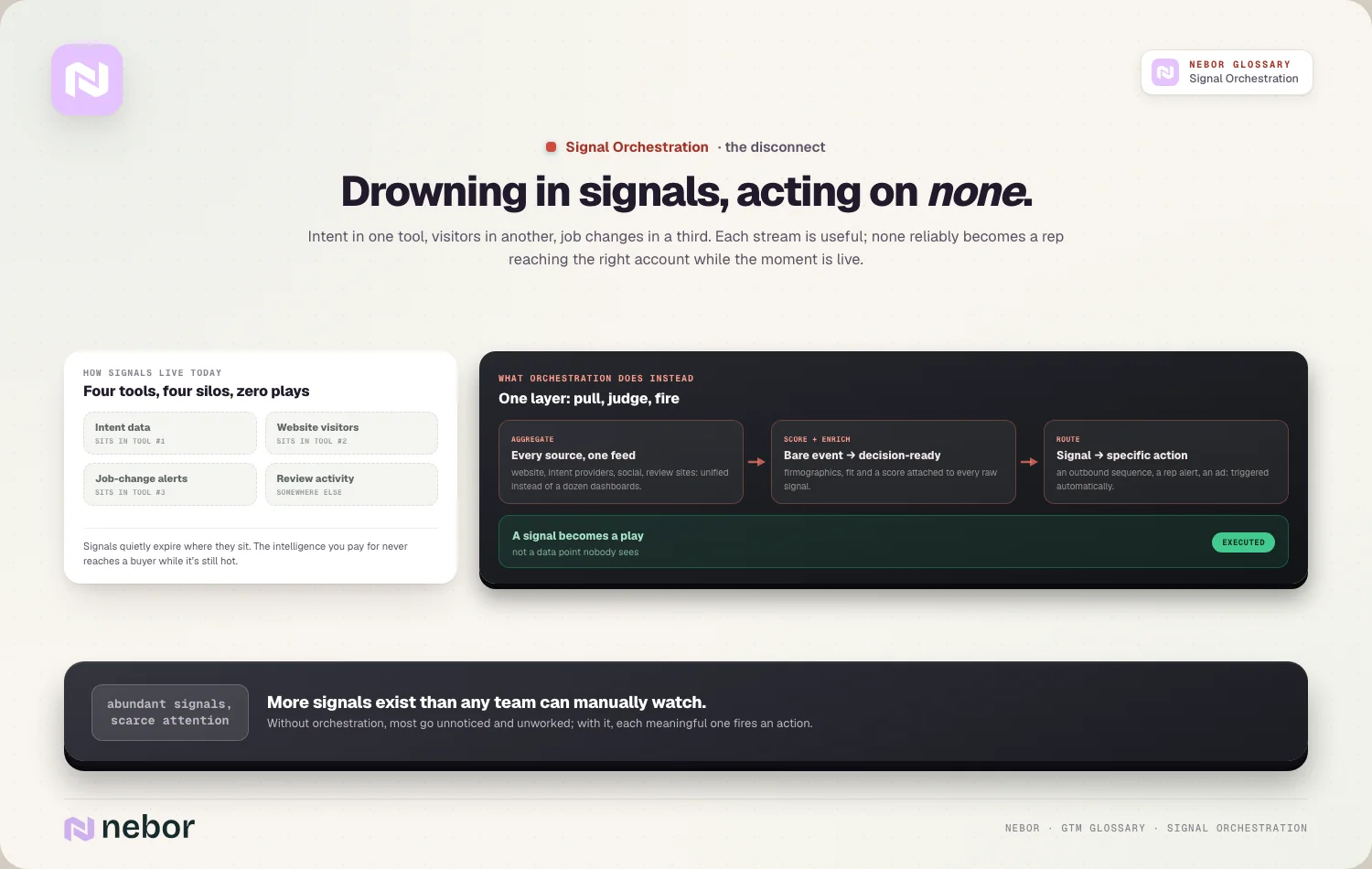
Third it routes, sending each meaningful signal to the right action automatically. This is where orchestration differs from a mere signal feed, because it doesn't just surface signals but triggers the follow-through, whether that's an outbound sequence, an alert to a rep, or an ad, so the signal reliably becomes a play.
How signal orchestration differs from signal-based selling and a signal stack
These three terms travel together and often get blurred, but they describe different things. Signal-based selling is the strategy, the decision to build your motion around real buying signals instead of cold lists, so it's the philosophy that says timing and relevance beat volume.
A signal stack is the specific collection of signals a team chooses to watch. It's the curated set of triggers, from website visits to hiring activity to product usage, that a company decides are worth paying attention to for its particular buyers.
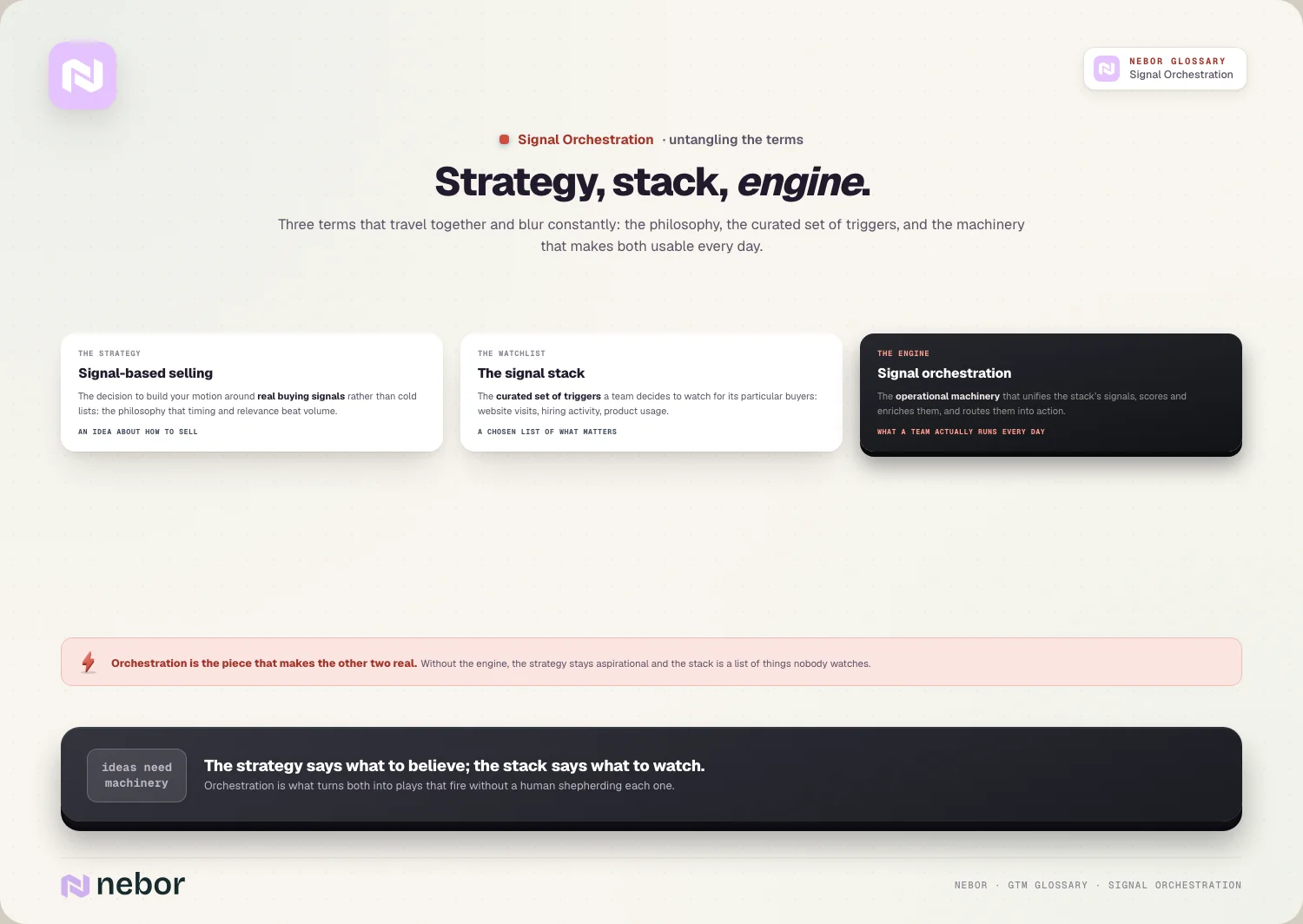
Signal orchestration is the operational engine that makes both of those usable. It's the machinery that unifies the signals in the stack, scores and enriches them, and routes them into action, so it's the piece that turns the strategy and the stack from ideas into something a team can use every day.
Why scattered signals are almost worthless until they are orchestrated
The core problem orchestration solves is that a signal has value only if someone acts on it in time. A perfect buying signal left unnoticed in a tool nobody checks is worth nothing, so the gap between a signal existing and a signal being acted upon is where most of the potential value drains away.
Scattered signals also can't be compared or combined, which hides the patterns that matter most. When intent lives in one system and website activity in another, no one can see that the same account triggered both, so the strongest evidence, several signals pointing at one account, stays invisible across the silos.
This is why aggregation alone is a huge step forward even before automation. Simply bringing every signal into one view lets a team see which accounts are heating up for real, something impossible when the evidence is spread across tools that never talk to each other.
Why stacked signals beat any single signal you could ever act on alone
The deepest principle behind signal orchestration is that signal stacking is far more predictive than any lone signal. One signal, like a single website visit, is weak and noisy, but several signals clustering on the same account in a short window is a strong indication that a real buying process is underway.
Orchestration is what makes stacking detectable in the first place. Because it unifies all your signals into one layer, it can recognize when an account has triggered multiple signals at once, exactly the pattern that separates genuine intent from the random noise a single signal often represents.
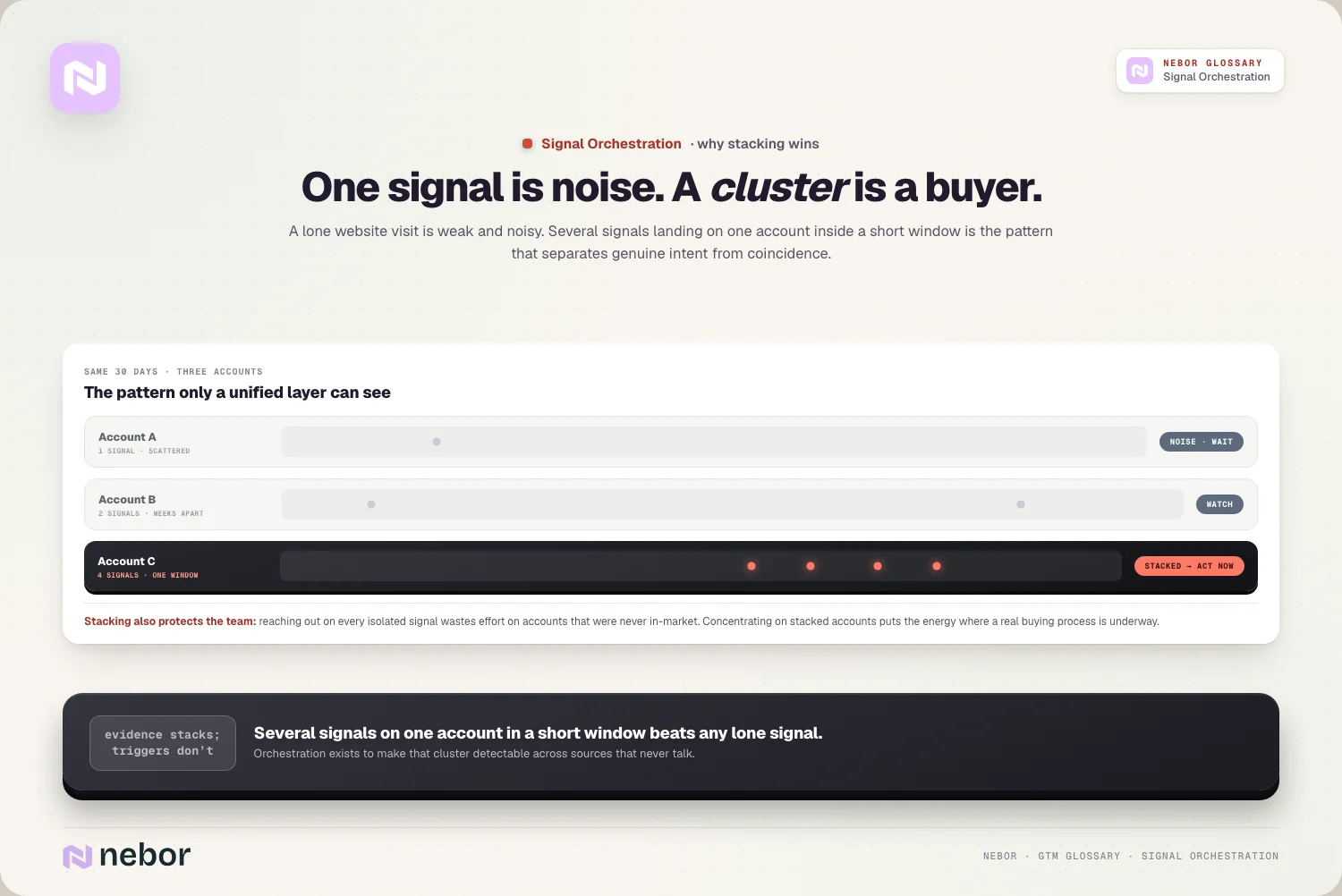
Acting on stacked signals also protects your team from chasing false positives. Reaching out on every isolated signal wastes effort on accounts that were never in-market, so focusing only on accounts showing several stacked signals, the idea behind a well-built sales signal stack, concentrates effort where it pays off.
How orchestration routes signals into coordinated action across your teams
The routing layer is where orchestration earns its name, taking scored signals and directing them to the right team and play. A strong signal on a target account might trigger an outbound sequence, while a different one alerts an account executive and a third feeds an ad campaign, each matched to what the signal means.
Coordination across teams is the harder and more valuable part of this. Because signals are relevant to sales, marketing, and customer success alike, orchestration gives all of them shared visibility and clear triggers, so a signal doesn't get worked twice or missed entirely as it crosses team boundaries.
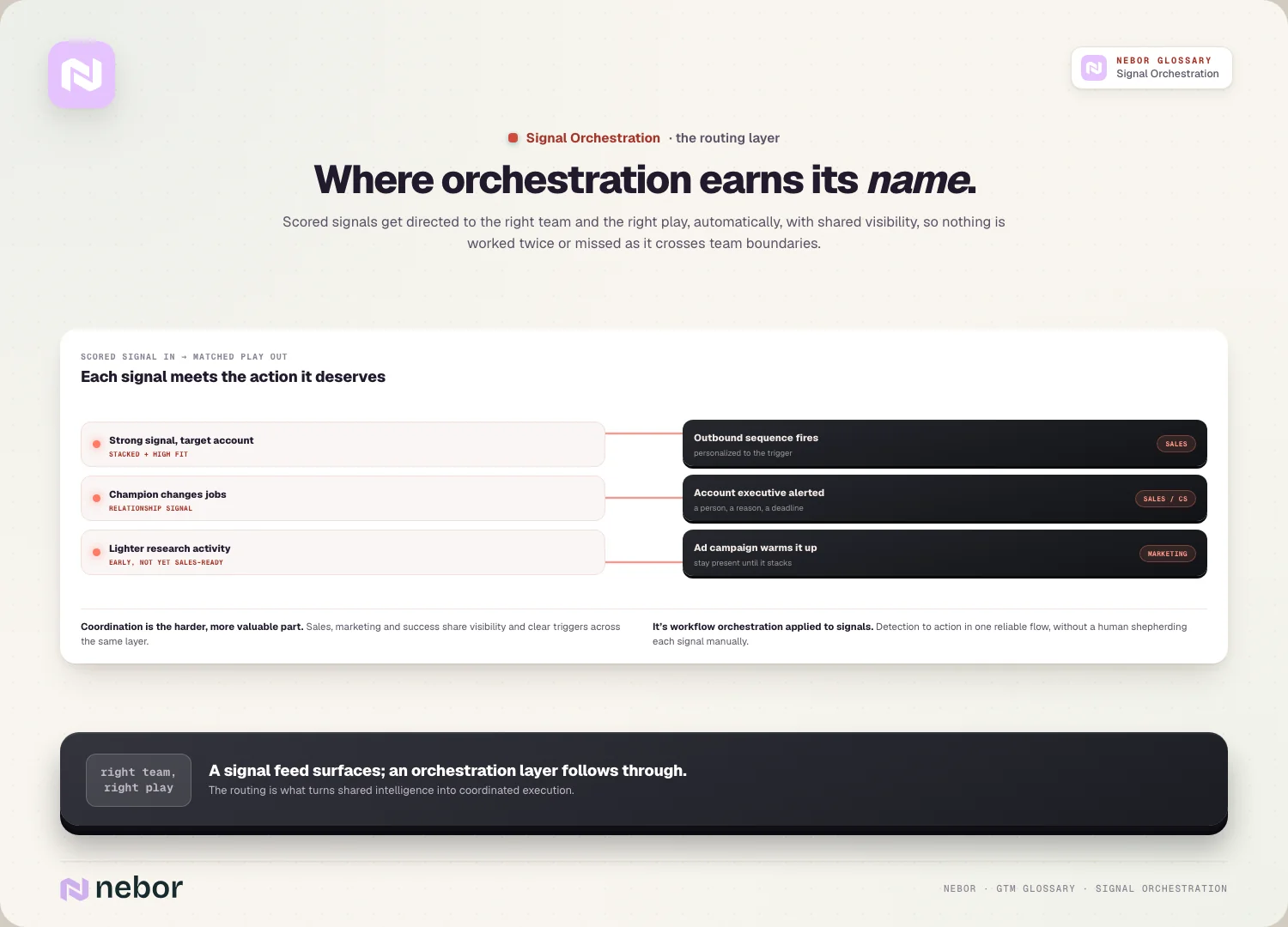
This coordination is really a form of workflow orchestration applied to signals specifically. The same discipline that connects data, enrichment, and follow-up into one reliable flow is what ensures a signal moves cleanly from detection to the right action without a human having to shepherd it manually each time.
Why speed and signal windows matter so much in signal orchestration
A signal has a shelf life, and orchestration exists partly to beat the clock. Buying signals decay quickly, so an account that's hot today may have moved on in a week, which means the value of a signal drops sharply the longer it waits before anyone acts, much like speed to lead at the top of the funnel.
This is why orchestration emphasizes signal windows, the limited period during which a signal is still worth acting on. Focusing on accounts that show stacked signals inside a defined window keeps effort on actively moving buyers instead of stale accounts whose moment has already passed.
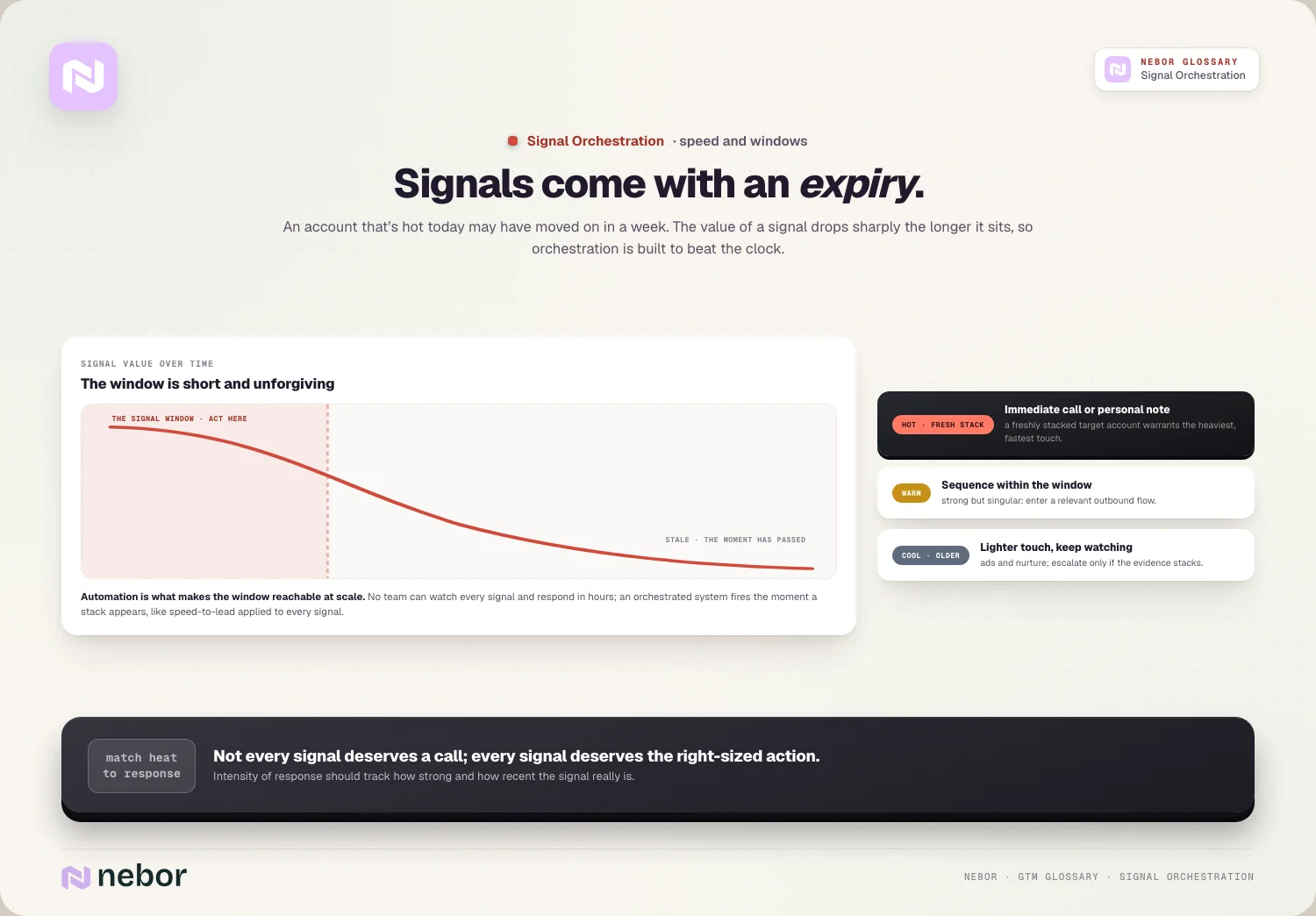
Automation is what makes acting inside those windows possible at scale. A human team can't watch every signal and respond in hours, but an orchestrated system can take the right action the moment a signal or a stack appears, and that automation turns fast response from an aspiration into a reliable habit.
The window also shapes which channel makes sense. A very hot, freshly stacked account may warrant an immediate call or personalized note, while a weaker or older signal fits a lighter touch.
Orchestration is therefore partly about matching the intensity of the response to how strong and recent the signal really is, instead of treating every signal the same way.
How signal orchestration connects to your ICP and the buying committee
Orchestration only works when it's anchored to who you sell to, so it starts from your target profile. Filtering signals against a clear ideal customer profile keeps the system focused on accounts worth pursuing, because a signal from a company that could never buy is noise no matter how strong it looks.
The account and committee lens is essential because B2B buying is a group activity. Buying groups now average six to ten stakeholders, so orchestration that watches signals across a whole buying committee sees the account heating up far more clearly than tracking any single person's behavior.
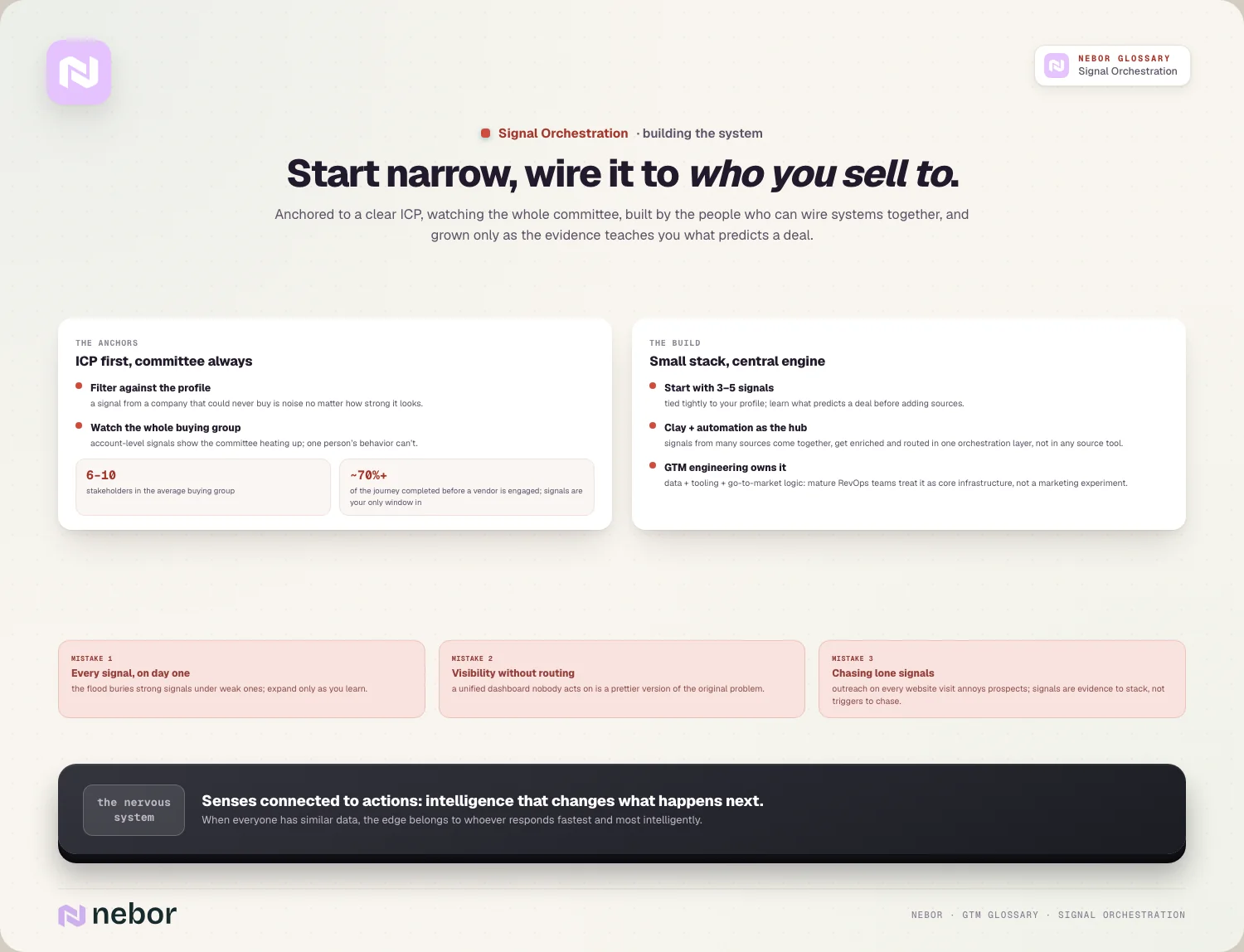
Timing matters even more because so much buying happens before you're invited. Buyers now complete around 70% or more of their journey independently before engaging a vendor, so signals are often your only window into that hidden research, and orchestrating them is how you show up before the shortlist is set.
How teams build a signal orchestration system without overreaching
The practical advice from teams doing this well, and the first thing we tell clients who want one, is to start small instead of wiring everything at once.
Beginning with three to five signals tied tightly to your profile keeps the system focused and manageable, so you learn what predicts a deal before adding the complexity of dozens of signal sources.
The stack usually centers on an orchestration layer that unifies and acts on the signals. Tools like Clay, along with automation platforms and reverse ETL, serve as the layer where signals from many sources come together, get enriched, and get routed, so the engine is the center instead of any one source tool.
Building this well is increasingly the work of gtm engineering instead of traditional roles, and it's where most of the builds we do now concentrate.
Because it blends data, tooling, and go-to-market logic, orchestration tends to live with people who can wire systems together, and mature revenue operations teams accordingly treat it as core infrastructure instead of a marketing experiment.
The common mistakes teams make when they attempt signal orchestration
The most common mistake, and we keep seeing it in ambitious first builds, is trying to act on too many signals at once.
Turning on every available signal floods the system with noise and buries the strong signals under weak ones, so the discipline is starting narrow and expanding only as you learn which signals reliably predict buying.
Another is aggregating signals without ever routing them to action. A unified dashboard of signals that nobody acts on is just a prettier version of the original problem, so orchestration only delivers value when the routing and follow-through get built alongside the visibility.
The subtler mistake is acting on single signals as if they were reliable intent. Sending outreach on every lone website visit or content download annoys prospects and wastes effort, so treating buying signals as evidence to stack instead of triggers to chase individually is what keeps the whole motion credible.
Why signal orchestration is becoming the backbone of modern go-to-market
The deepest way to see signal orchestration is as the nervous system that finally connects a company's senses to its actions. For years teams collected more and more signals without a reliable way to respond to them, and orchestration closes that loop so the intelligence changes what happens next.
Its importance keeps growing because the volume of signals and the ease of automation both keep rising. When everyone can access similar data, the advantage shifts to who responds fastest and most intelligently, so orchestration becomes the stabilizing force that turns a flood of signals into a durable edge.
Orchestration is what makes signal-based selling real instead of aspirational, and it is at the heart of any go-to-market system that reacts to buyers in real time. When signals reliably become action, the outreach you automate sales prospecting to generate lands on accounts precisely when they're ready to talk.
Share this post
Intent
Automation
Workflows
Glossary
Related glossary items
Understanding the core GTM concepts




Ready to build your pipeline