

In this post:
A single buying signal is mostly noise. One person visited your pricing page, or one company showed up in some intent report, and on its own that tells you almost nothing reliable.
The power comes from stacking signals together. When a target account visits your pricing page, hires for a relevant role, and starts researching your category all at once, that's not noise anymore, that's a buyer.
A sales signal stack is the layered set of signal sources a team monitors and combines, across first-party, second-party, and third-party data, to spot when an account is truly moving toward a purchase. It's the system that turns scattered signals into a clear read on intent.
The shift it represents is from targeting to timing. Old outbound asked who to reach, while a signal stack answers when to reach them, which is often the difference between a cold pitch and a perfectly timed one.
TL;DR
A sales signal stack is the combined set of intent and buying signals a team tracks across multiple data sources, layered together to identify accounts that are ready to engage.
A single signal is unreliable on its own, while stacked signals from different sources give a far stronger, more trustworthy read on real intent.
The stack is built from three layers, first-party signals from your own properties, second-party signals from partners and review sites, and third-party signals aggregated across the web.
The condition attached is that more signals only help if you can combine and act on them. A pile of disconnected signal sources is just noise, so the stack needs one place to unify them and a fast motion to respond.
So what is a sales signal stack, exactly, and why call it a stack?
A sales signal stack is the full set of signal sources you watch to detect buying intent. Instead of relying on one feed, you layer several so the picture is richer and more reliable.
The word stack is chosen deliberately, because just as a tech stack is many tools working together, a signal stack is many signal sources combined into one view of who's in-market.
Each source on its own is partial. Website visits show some intent, hiring data shows some, and third-party research shows some, but no single one captures the whole story of an account.
Combined, though, those partial views become powerful. When several independent sources point at the same account at the same time, your confidence that they're really buying jumps dramatically.
So the stack is really about confidence and timing. It tells you not just who might be a fit, but which accounts are showing enough combined intent to act on right now.
This is a genuine shift in how outbound works. For years the hard part was finding fit, and now fit is cheap while timing is the edge, and capturing that edge is the stack's whole job.
Why is one signal never enough to justify reaching out on its own?
This is the core insight behind the whole concept, and it deserves a moment, because individual signals are noisy and easy to misread.
Take a single website visit as an example. It could be a serious buyer, a curious competitor, a job seeker, or a random click, and from that one data point you can't tell which.
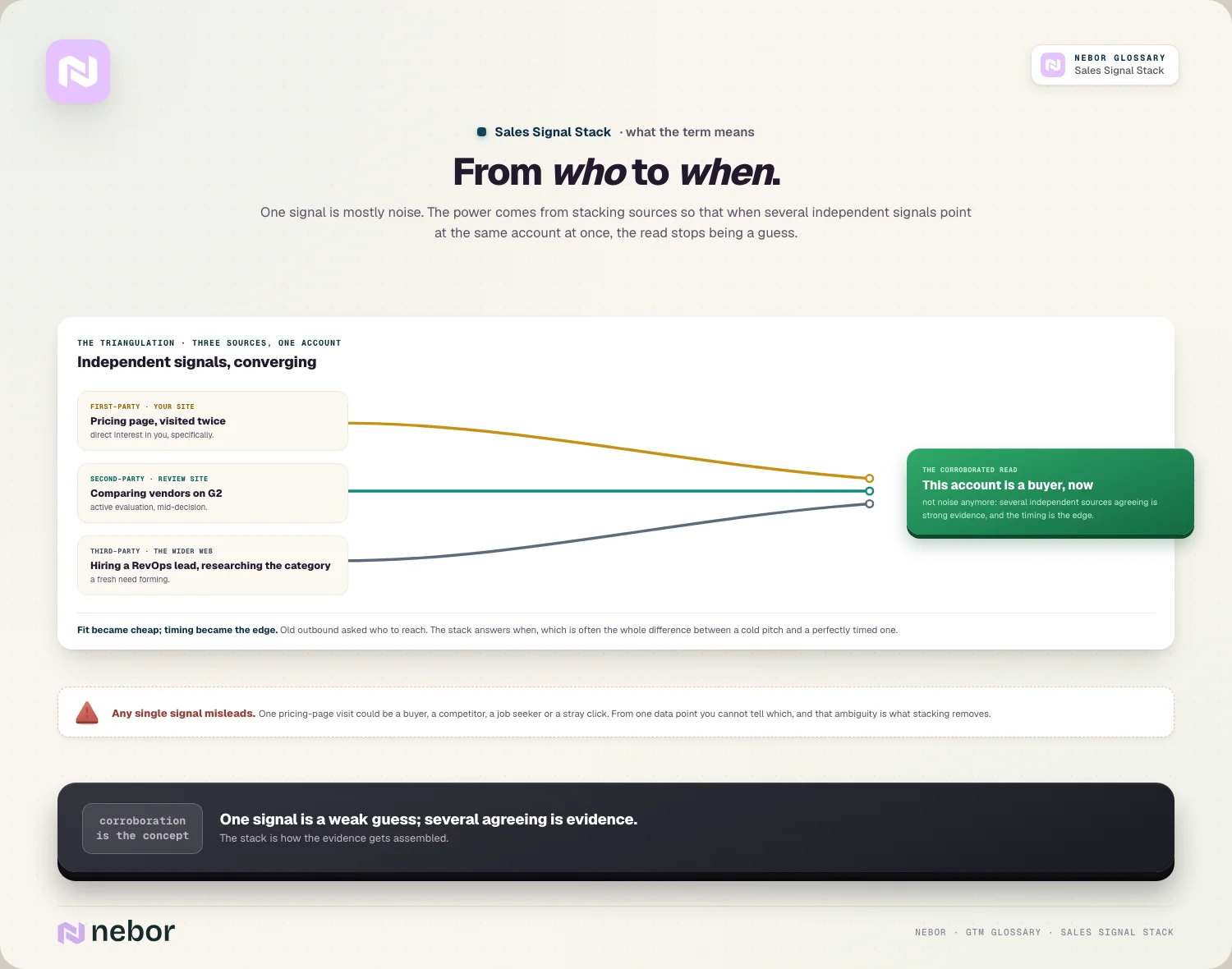
The same is true of third-party intent alone. A company showing research activity in your category might be evaluating you, or a dozen competitors, or just educating themselves with no intent to buy.
Stacking signals is what filters out the noise. When that website visitor is also at a company that's hiring for a relevant role and researching your category, the odds they're a real buyer climb sharply.
This is the ordinary logic of corroboration. Any one buying signal is a weak guess, but several independent signals pointing the same way is strong evidence, and the stack exists to find that agreement.
What are the three layers every complete signal stack is built from?
A good signal stack is built from three distinct kinds of data, and each plays a different role. In our experience, understanding the layers is how you build a balanced stack.
The base layer is first-party data, the signals from your own properties. Website visits, content downloads, and product usage are the most reliable layer, because you own them and they're specific to you.
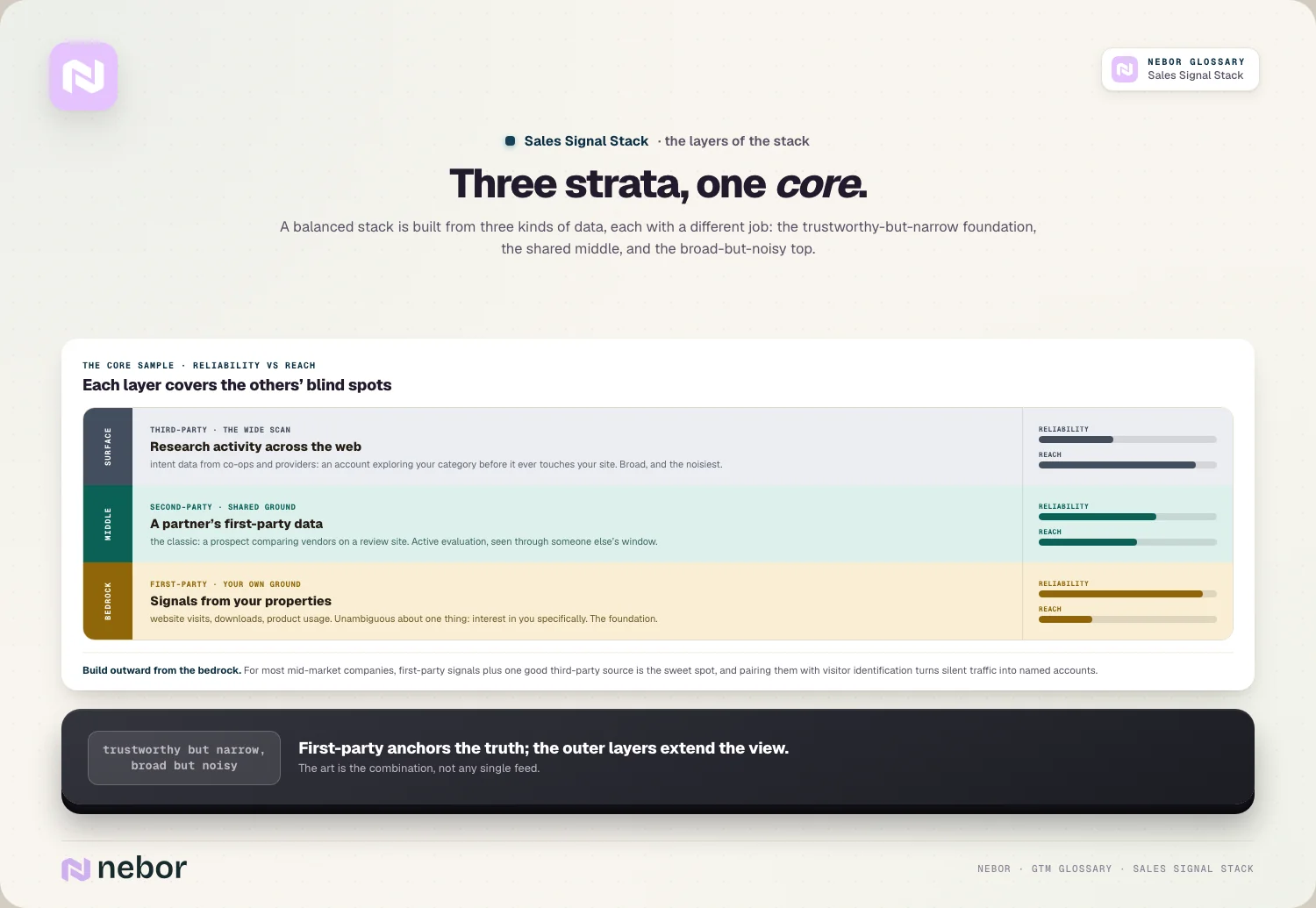
On top of that comes second-party data, a partner's first-party data shared with you. The classic example is a prospect comparing vendors on a review site like G2, which signals active evaluation.
The outer layer is third-party data, research activity aggregated across many external sites. This is what most people mean by intent data, gathered through data co-ops and providers.
The three differ in reliability and reach. First-party is the most trustworthy but narrow, third-party is broad but noisier, and the art is combining them so each covers the others' blind spots.
Why is first-party data the foundation the rest of the stack is built on?
Among the three layers, first-party data deserves special attention. It's the most reliable place to start, and the smartest stacks we build work outward from it.
First-party signals are unambiguous about one thing, which is interest in you specifically. Someone on your pricing page is engaging with your company rather than researching your category in the abstract.
This is why experts recommend nailing first-party first. For most mid-market companies, first-party signals plus one third-party source is the sweet spot, instead of buying every feed at once.
Getting first-party right often means seeing your anonymous traffic. Pairing signals with website visitor identification turns silent visits into named accounts you can act on, instead of a traffic count you can't use.
So the practical advice is to start at home. Capture and act on your own first-party signals before layering in the noisier external data, because the foundation determines how useful the rest becomes.
How does a signal stack relate to intent signals and trigger events?
These terms get tangled easily, and the cleanest untangling is this. The stack is the system, and the signals are what flow through it.
An intent signal is any single indicator that an account may be in-market, like research activity or a website visit, one data point on its own.
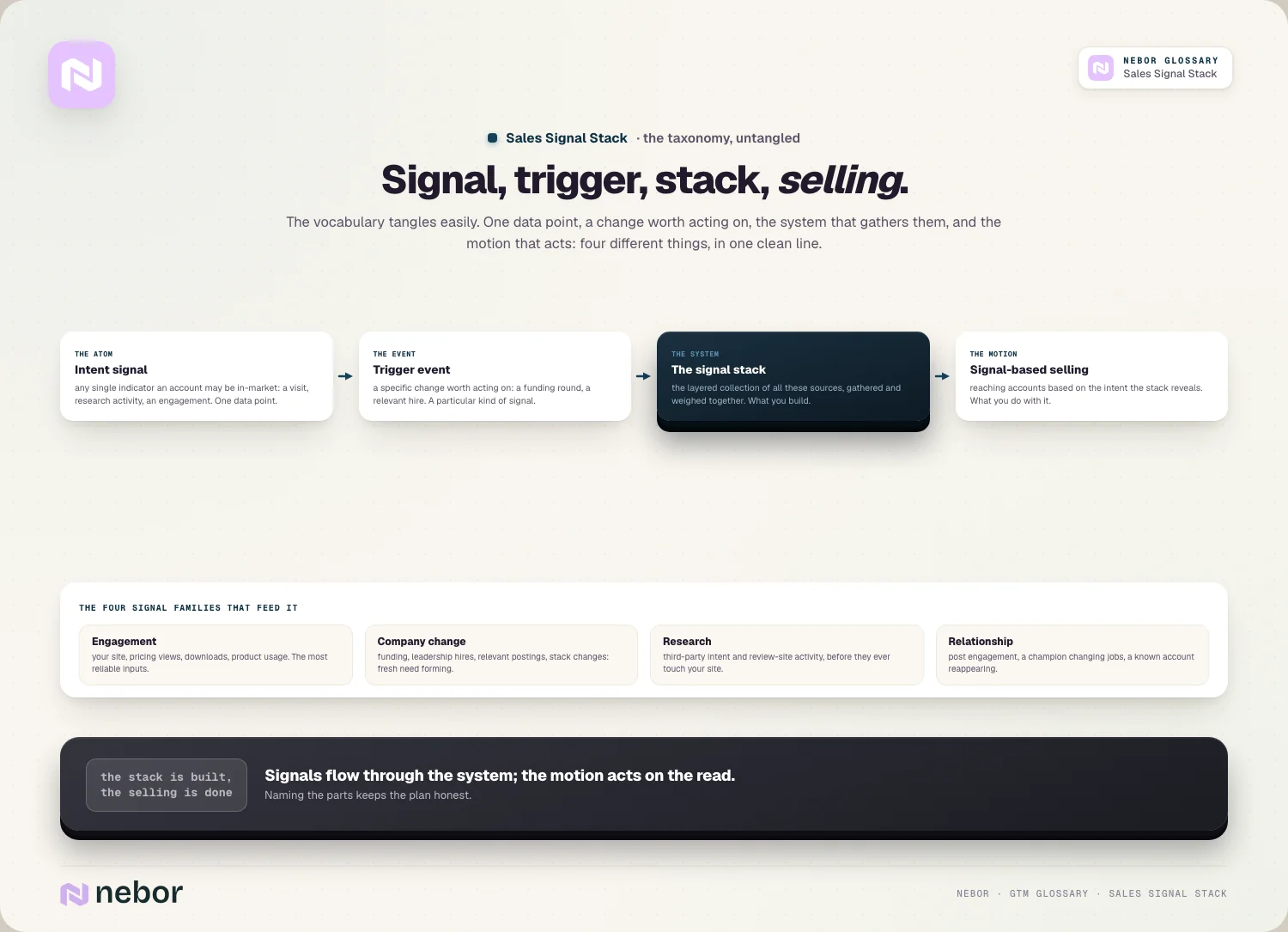
A trigger event is a specific change worth acting on, like a funding round or a new hire in a relevant role, which makes it a particular kind of signal.
The signal stack is the layered collection of all these sources together, the combined system that gathers and weighs many signals at once.
And acting on that combined view is signal-based selling. The stack is what you build, and signal-based selling is what you do with it, reaching accounts based on the intent it reveals.
How do you combine all those signals into something you can act on?
Collecting signals is the easy part, and combining them is where the real work lives. A stack only helps if the signals come together in one place and produce a clear answer.
Unification has to come before everything else. Signals scattered across separate tools are useless, so you need one layer that pulls website, review-site, hiring, and third-party data into a single view.
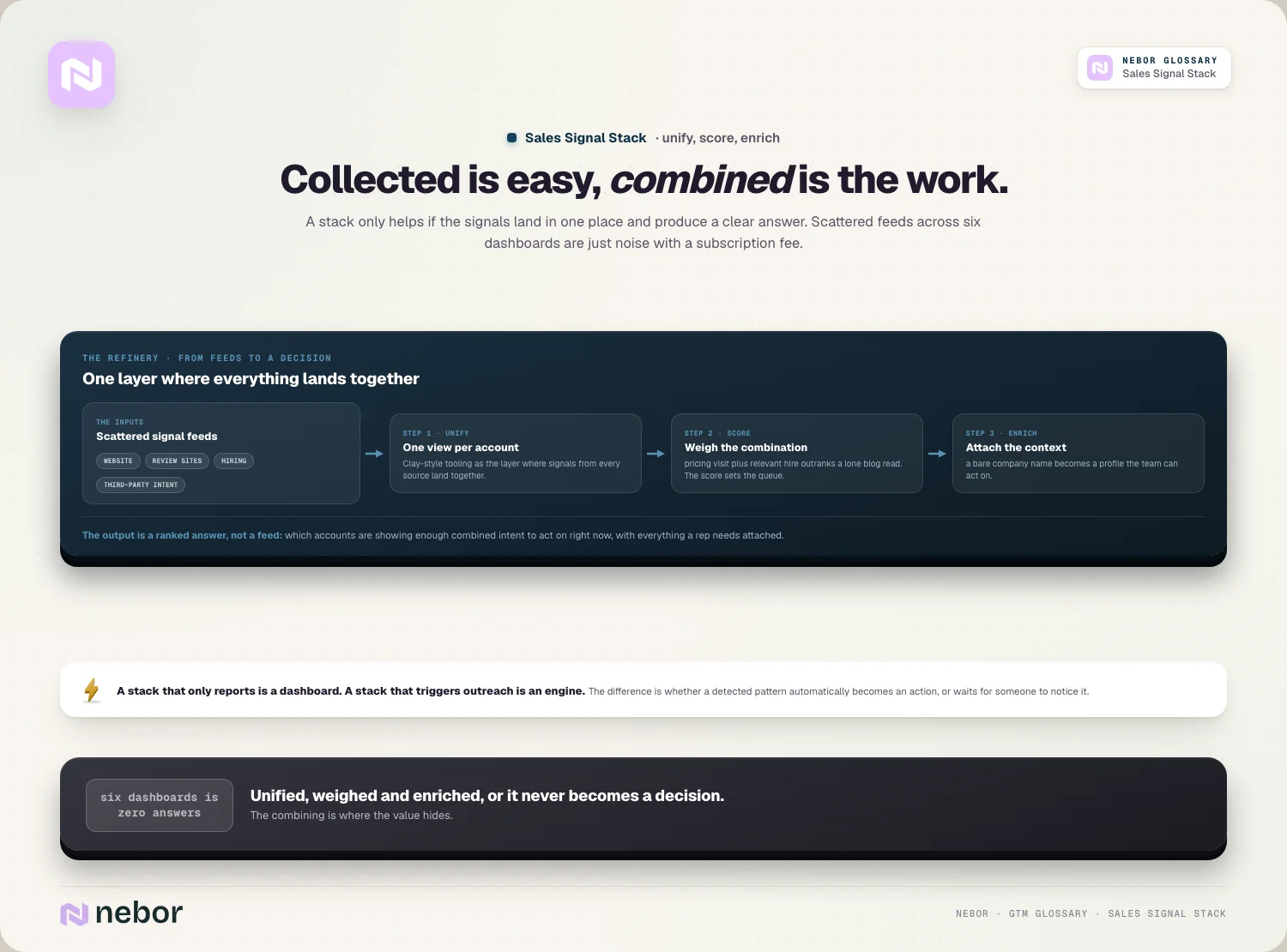
This is exactly the job Clay-style tooling was built for. It acts as the unified layer where signals from many sources land together, so you're not checking six dashboards to understand one account.
Scoring turns the unified view into priorities. Once everything lands in one place, you weigh the signals, because a pricing-page visit plus a relevant new hire matters far more than a single blog read, and that combined score is what tells you which accounts to act on first.
Enrichment completes the picture, because raw signals become actionable once you attach context through data enrichment, turning a bare company name into a profile your team can act on.
Why does a signal stack only pay off when you act on it quickly?
A signal stack is worthless if it just stalls in a dashboard. The entire value depends on turning a detected signal into a timely action.
Signals decay faster than most teams expect. An account researching your category this week may have chosen a vendor by next month, so a stack that surfaces intent you act on slowly captures little of the value.
This makes speed central to the payoff. Reaching an account while the combined signals are still hot is speed to lead applied to intent, and it's where most of the advantage lives.
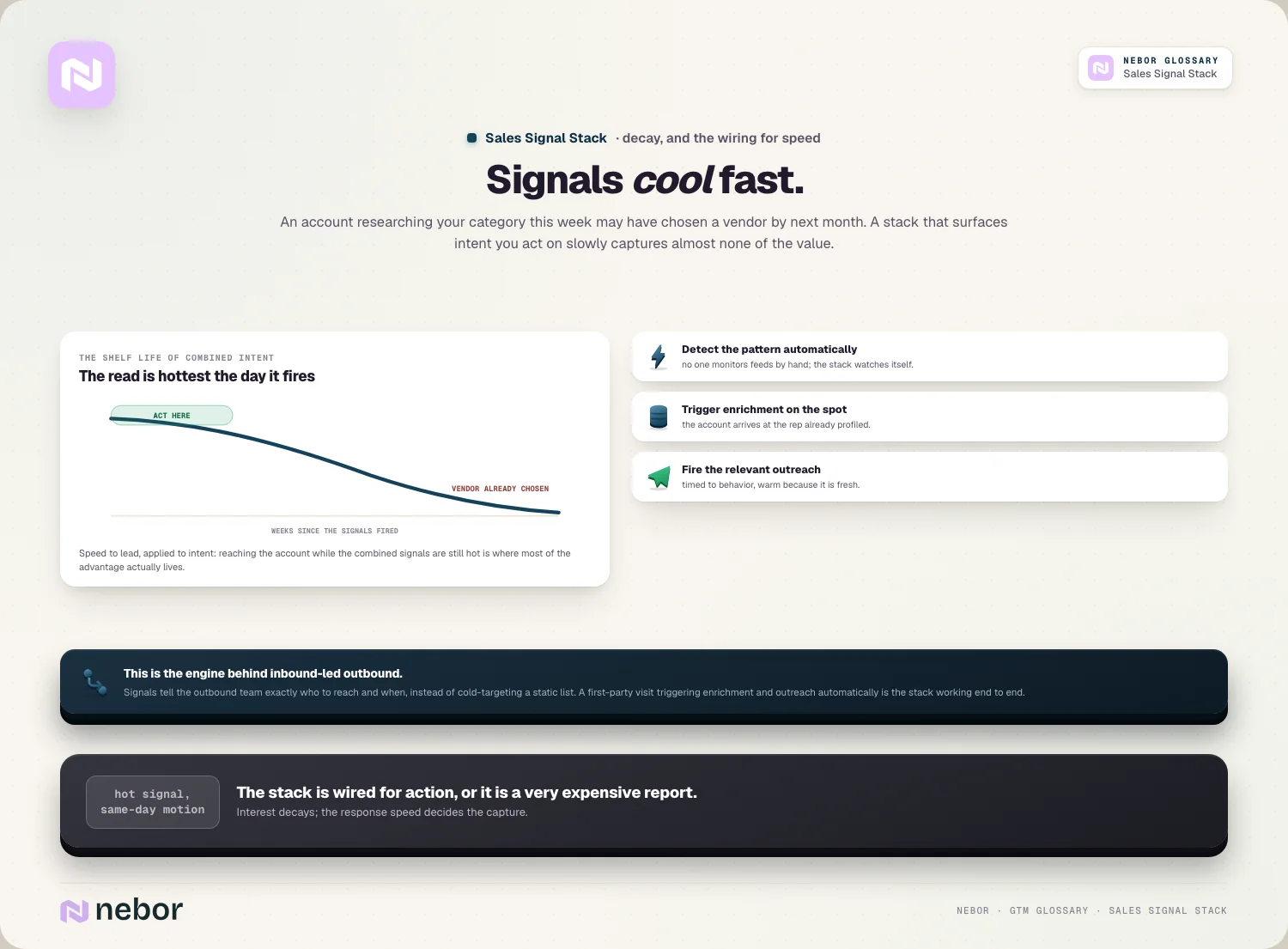
It argues for automation just as strongly. Detecting a signal pattern and triggering enrichment and outreach automatically is the kind of work that lets you automate sales prospecting instead of manually monitoring feeds.
So a real stack is wired for action. The signals flow in, get combined and scored, and trigger a fast, relevant response, instead of piling up as interesting but unused data.
A stack that only reports is a dashboard, while a stack that triggers outreach is an engine. The difference is whether a detected signal automatically becomes an action, or just waits for someone to notice it.
How does a signal stack power an inbound-led outbound motion?
The signal stack is the engine behind one of the strongest modern motions. It's what makes warm, well-timed outbound possible at scale.
The motion is inbound-led outbound, where signals tell your outbound team exactly who to reach and when. The stack is what generates those signals.
Instead of cold-targeting from a static list, you let the stack surface accounts showing real intent, then reach out while that intent is fresh. The outreach lands warm because it's timed to behavior.
This is also how you pull hidden demand into the light. Much buyer research happens where you can't see it, and a broad signal stack catches more of that otherwise invisible activity.
A concrete version is a website visitor tracking workflow, where a first-party signal triggers enrichment and outreach automatically, which is the signal stack working end to end.
What signals belong in your stack once you get down to specifics?
It helps to get concrete about what these signals are, because the term stays abstract otherwise. The useful ones cluster into a few familiar types.
There are engagement signals from your own properties. Website visits, pricing-page views, content downloads, and product usage all show direct interest in you, and they're the most reliable inputs.
There are company-change signals too, because new funding, leadership hires, a relevant new role posting, or a tech-stack change often create a fresh need, which is why these triggers are so valuable.
There are research signals from outside your own walls. Third-party intent data and review-site activity show an account exploring your category, even when they haven't touched your site yet.
And there are relationship signals rounding out the picture. A prospect engaging with your posts, a past champion changing jobs, or a known account reappearing all hint at openings worth acting on.
The art is layering several of these so they corroborate each other. Any one type can mislead, but when an engagement signal, a company change, and research activity all point at the same account, the read becomes trustworthy.
How do you start building a signal stack without overcomplicating it?
The idea can sound like it needs a huge budget and a dozen tools. It doesn't, and starting narrow usually beats starting broad.
Begin with first-party signals, because they're free or cheap and the most reliable. Set up website tracking, capture form and product activity, and route the high-intent ones to your team fast.
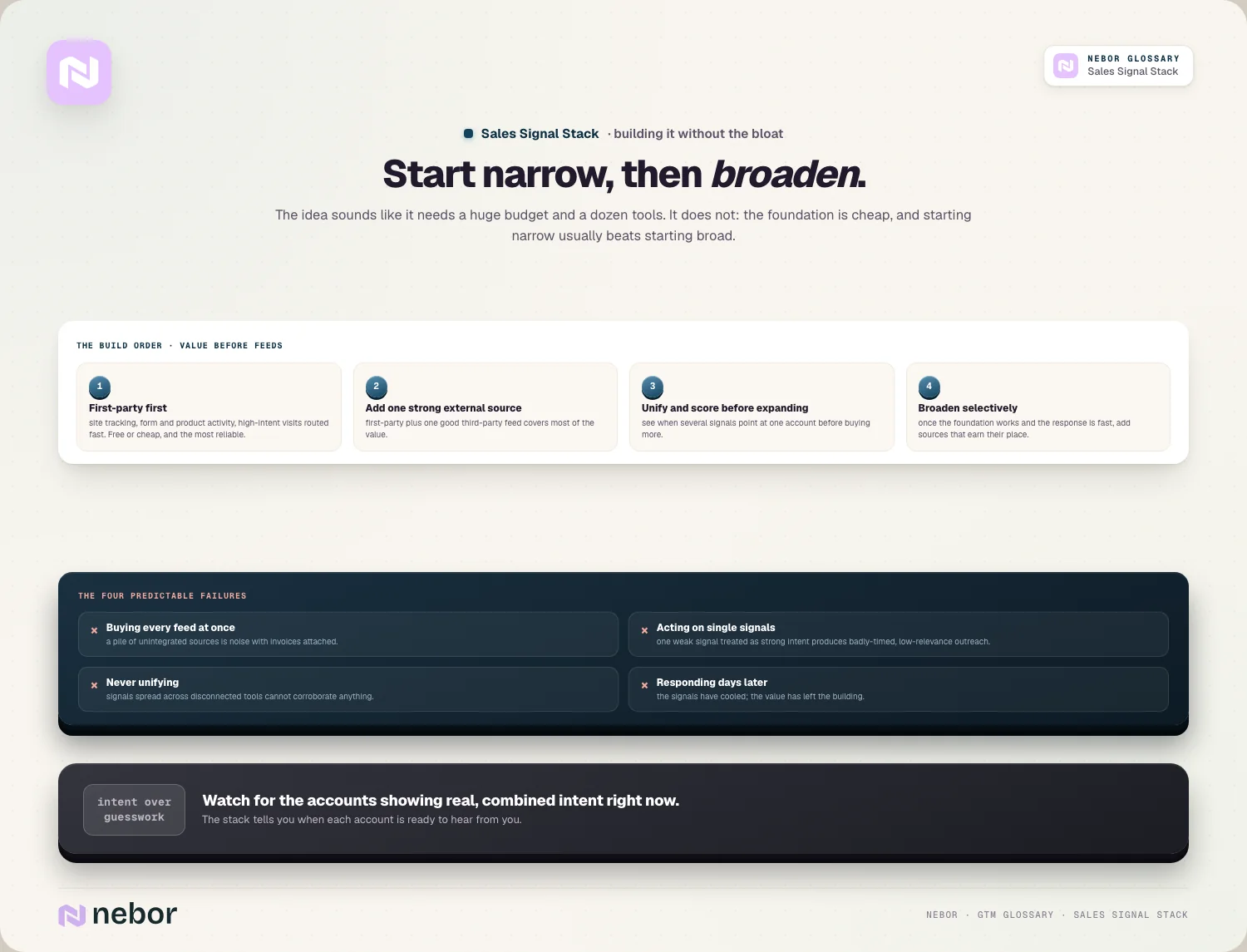
Then add one strong external source, because layering first-party versus third-party data thoughtfully, with one good third-party feed, covers most of the value without the bloat.
Next, unify and score before you expand anything. Get your signals into one place and weigh them, so you can see when several point at the same account, before adding more sources.
Only then does broadening the stack make sense. Once the foundation works and you're acting on it fast, you can add selective sources, which keeps the stack useful instead of turning it into noise you can't process.
What are the common mistakes teams make when building a signal stack?
Signal stacks fail in a few predictable ways, usually from collecting signals without a plan to use them, and we see the same ones in most of the setups we review. Knowing them upfront keeps your stack useful.
Buying every data source at once heads the list, because a pile of feeds without integration is just noise, when first-party plus one good third-party source is usually the smarter start.
Acting on single signals comes next, because treating one weak signal as strong intent leads to badly-timed, low-relevance outreach, which is the exact problem stacking is meant to solve.
Failing to unify wastes what you collected, because signals spread across disconnected tools never combine into a clear picture, so your team can't see when several point at the same account.
And slow action drains the rest, because a stack that surfaces intent you respond to days later captures little of the value, given the signals have cooled by the time you reach out.
Why watching for combined intent beats guessing which accounts care
A sales signal stack matters because it changes the central question of outbound from who to when. Instead of guessing which accounts might care, you watch for the ones showing real, combined intent right now.
The deeper idea underneath all of it is corroboration. One signal is a weak guess, but several independent signals pointing at the same account is strong evidence, and the stack is how you assemble that evidence.
The honest requirement is that a stack only works if you unify and act on it. Scattered feeds and slow responses waste the whole point, while a unified stack and a fast motion turn intent into pipeline.
So if your outbound feels like shouting into the void, the missing piece may not be a better message. It may be a signal stack that tells you exactly when each account is ready to hear from you.
That timing is what turns cold outreach into the right message at the right moment. It's why a signal stack has become a core layer of any modern go-to-market system built around intent instead of guesswork.
Share this post
Intent
Data
Workflows
Glossary
Related glossary items
Understanding the core GTM concepts




Ready to build your pipeline











