

In this post:
Marketing hands sales a stack of qualified leads. Sales works them, finds most aren't really interested, and gradually stops trusting the handoff. We meet some version of this standoff in almost every company we work with.
The root cause is usually how the leads were qualified. Downloading an ebook or attending a webinar marks someone as a marketing qualified lead, but it barely predicts whether they'll buy.
A product qualified lead fixes that by using a far stronger signal. A product qualified lead, or PQL, is someone who has used your product, usually through a free trial or freemium plan, and shown real value from it.
That difference changes everything about lead quality. Instead of guessing interest from a content download, a PQL is based on someone actually experiencing your product, which is a much better predictor of who will become a customer.
TL;DR
A product qualified lead is a user who has tried your product through a free trial or freemium model, experienced genuine value, and shown behavior that signals readiness to buy.
Product usage beats marketing engagement as a buying signal, because a PQL has felt your value firsthand, so they convert far better than a lead who merely interacted with your content.
The numbers back it up strongly, because PQLs tend to convert at several times the rate of marketing qualified leads, and that gap explains why product-led companies build their whole motion around them.
One requirement comes with the model, because PQLs need a product people can try and the tracking to see how they use it. You also have to define which behaviors signal real value, or the PQL label becomes as hollow as a weak MQL.
What is a product qualified lead, and what earns a user the label?
A product qualified lead is a user who has reached a point in your product where they've clearly gotten value and look ready to pay. The qualification comes from what they do inside the product instead of from outside interest.
It depends on a try-before-you-buy model, because free trials and freemium plans let people use your product before paying, and that early usage is what you qualify on.
The signal is behavioral from start to finish. A PQL has done the things in your product that tend to precede a purchase, like hitting a usage limit, inviting teammates, or using a core feature repeatedly.
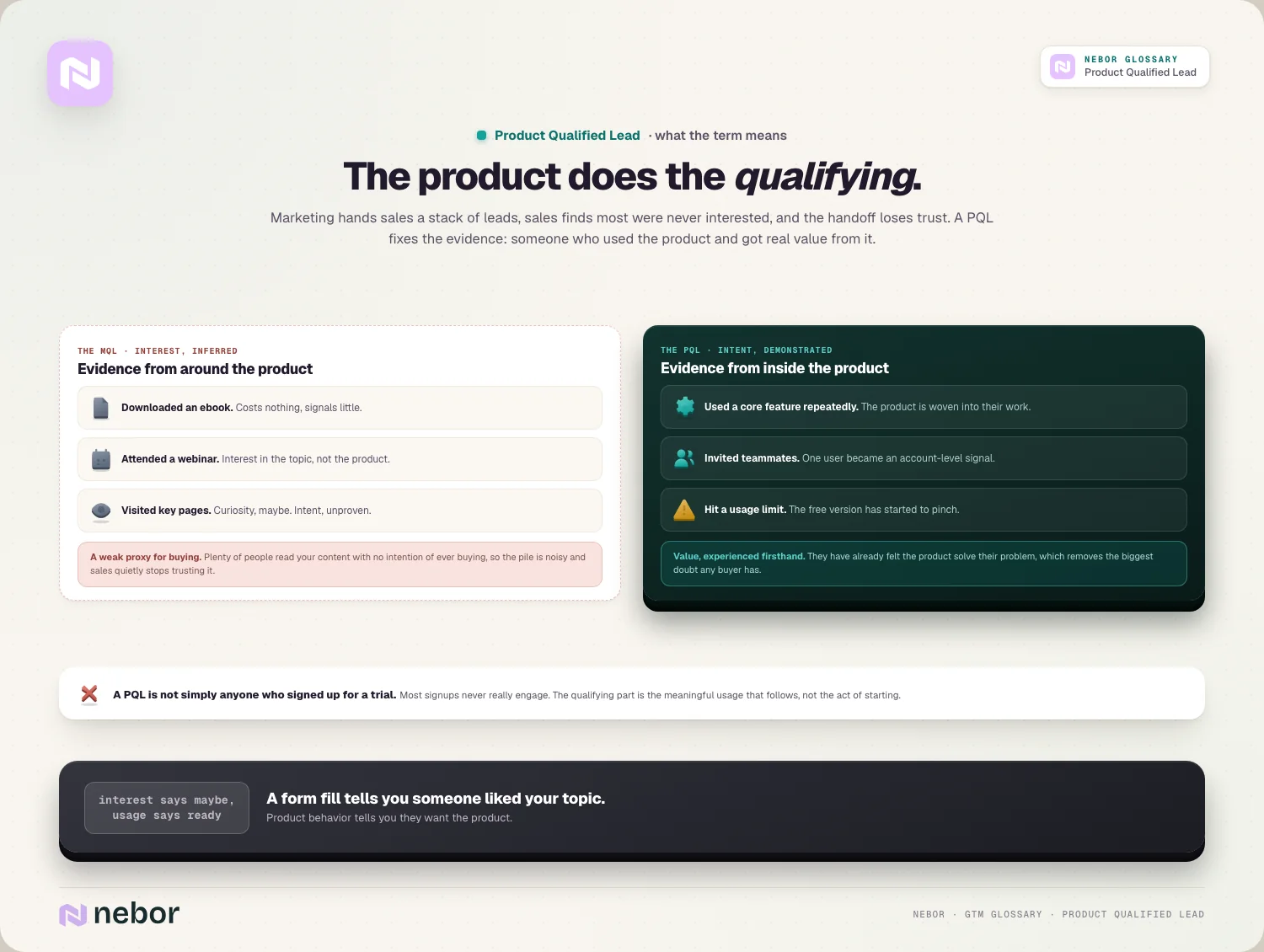
That's what makes the label meaningful in practice. A PQL has already woven your product into their work and bumped against the reasons to upgrade, which says far more than any claim of interest ever could.
So a PQL is much closer to a sale than most leads. The buying intent is demonstrated through action, which is a far stronger basis than anything a form fill can tell you.
One boundary keeps the definition honest, though. Simply signing up for a trial doesn't make anyone a PQL, because most signups never really engage, and the qualifying part is the meaningful usage that follows the signup.
How is a PQL different from the MQLs your marketing team hands over?
The cleanest way to grasp a PQL is to compare it with the lead type it improves on. PQLs and MQLs both try to flag good leads, from very different evidence.
An MQL is a marketing qualified lead. It's someone who engaged with your marketing, by downloading content, attending a webinar, or visiting key pages, and scored high enough on those actions to be passed to sales.
The weakness is that marketing engagement is a weak proxy for buying intent. Plenty of people read your content or grab a guide with no intention of ever buying, so MQLs are noisy.
A PQL flips the basis of qualification. Instead of marketing engagement, it uses product usage, which is a behavior far more tightly linked to genuinely wanting the product.
The result is a much cleaner signal for your reps. Where an MQL says someone showed interest in your topic, a PQL says someone used your product and found it valuable, which is a much shorter step from there to a sale.
Just how much better do PQLs convert compared to other lead types?
The case for PQLs rests on conversion, so the numbers deserve a direct look, and the gap over other lead types is large and consistent.
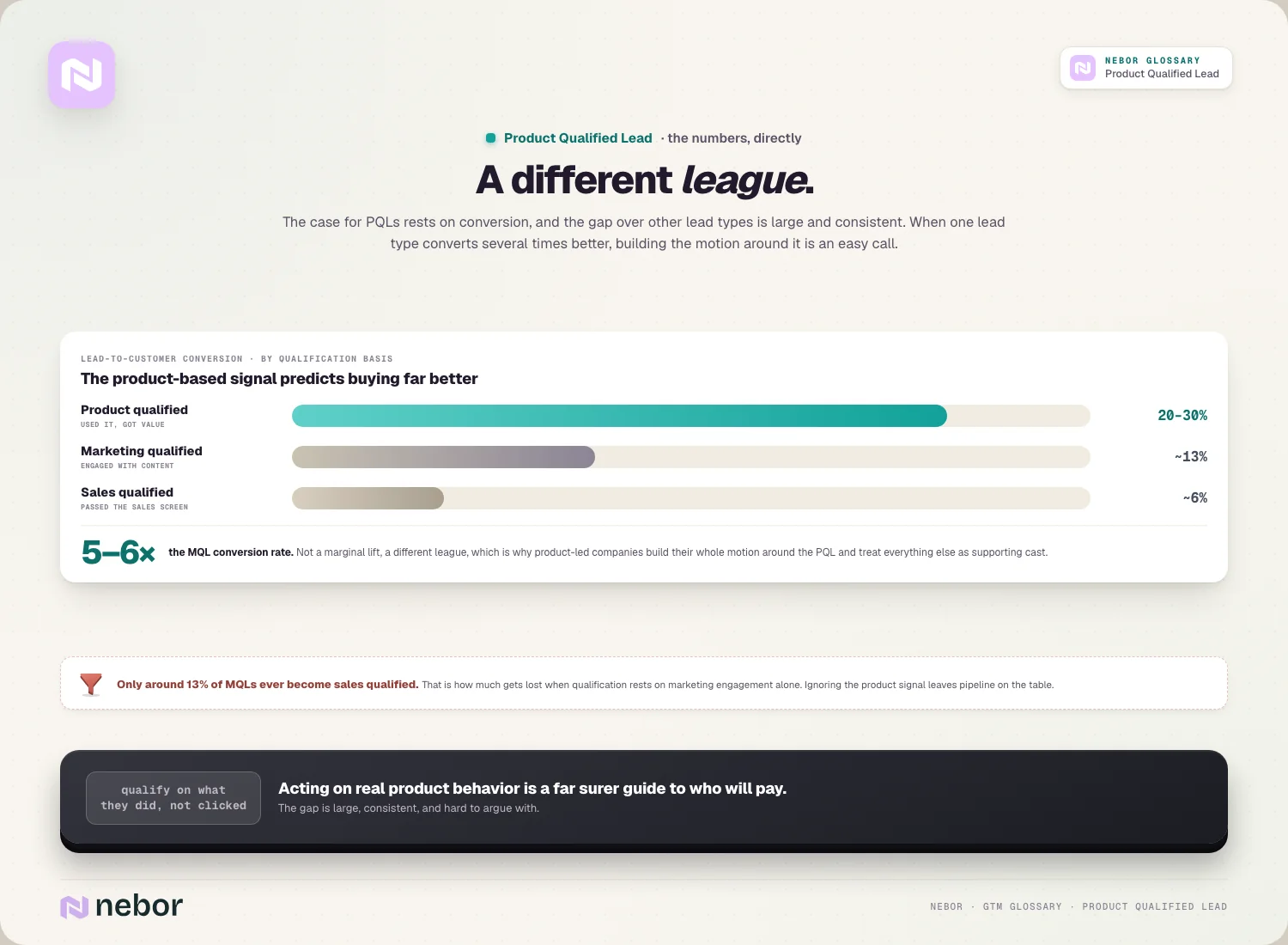
PQLs convert at a much higher rate than marketing qualified leads, often around 5 to 6 times the rate of an MQL. That's a different league rather than a marginal lift.
Put in concrete terms, one common breakdown has PQLs converting at 20 to 30%, MQLs at around 13%, and SQLs at about 6%. The product-based signal simply predicts buying far better.
The contrast with the MQL funnel is telling. Only around 13% of MQLs ever convert to a sales qualified lead, which shows how much gets lost when qualification rests on marketing engagement alone.
This is why product-led companies obsess over PQLs. When a lead type converts several times better than the alternative, building your motion around it is an easy call, and ignoring it leaves a lot of pipeline on the table.
Why does product usage predict buying so much better than marketing does?
Understanding why the PQL signal is so strong explains when PQLs work and when they don't, and the answer comes down to revealed behavior.
People say one thing and do another. Downloading a guide costs nothing and signals little, while actually setting up and using a product takes real effort that only invested users put in.
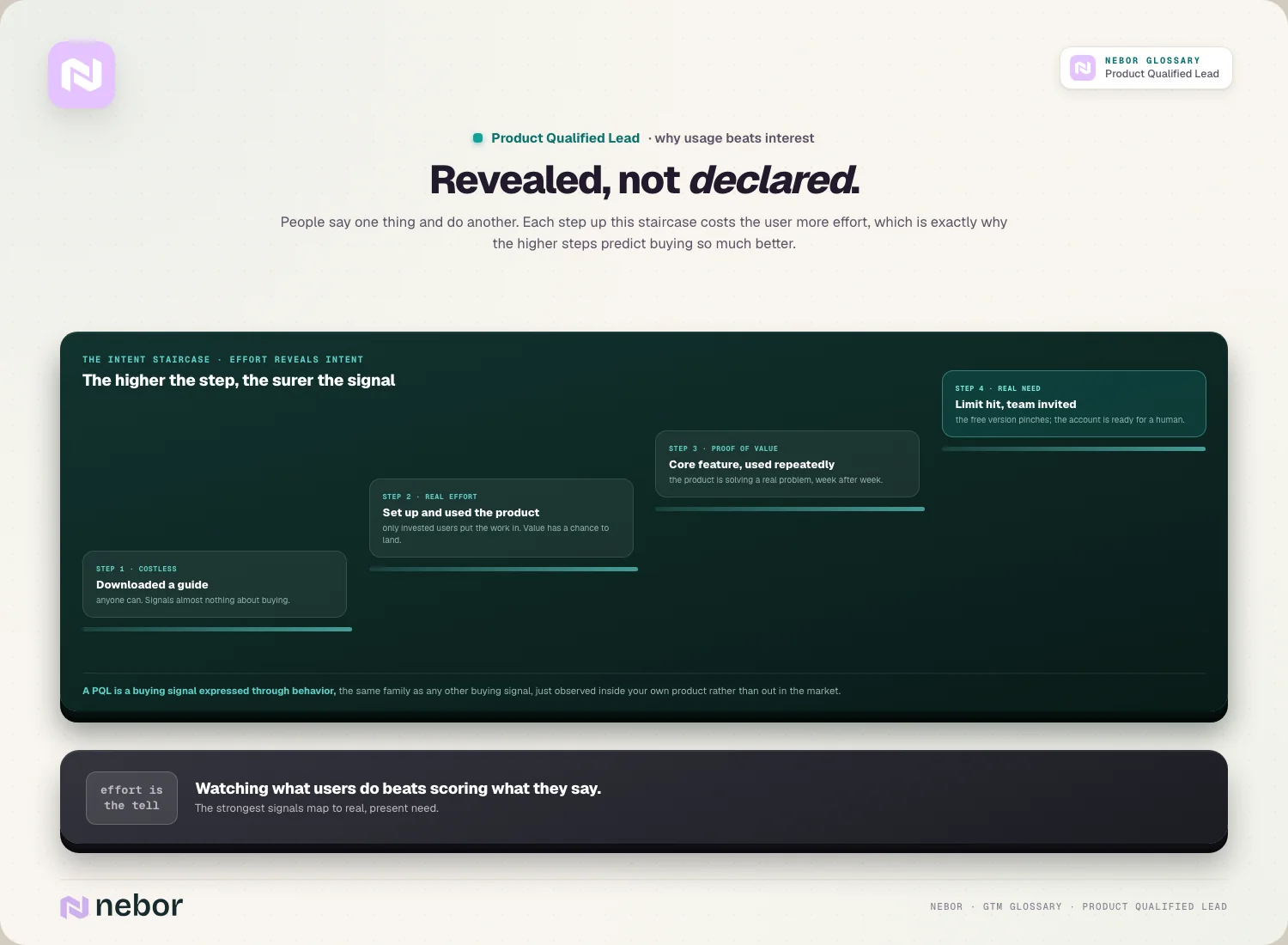
Usage proves the value landed as well. A PQL hasn't just heard your pitch, they've experienced the product solving their problem, which removes the biggest doubt any buyer has.
And the strongest PQL signals map to real need. Hitting a plan limit or inviting a whole team shows the product has become useful enough that the free version is starting to pinch.
So a PQL amounts to a buying signal expressed through behavior. It belongs in the same family as other buying signals, just observed inside your own product rather than out in the market.
How do you define which product actions should count as a PQL?
This is where PQLs get real or stay theoretical. The label only means something if you've defined the specific behaviors that signal readiness to buy.
Start from your own data rather than someone else's playbook. Look at users who became paying customers and find what they did in the product before converting, because those actions are your strongest PQL candidates.
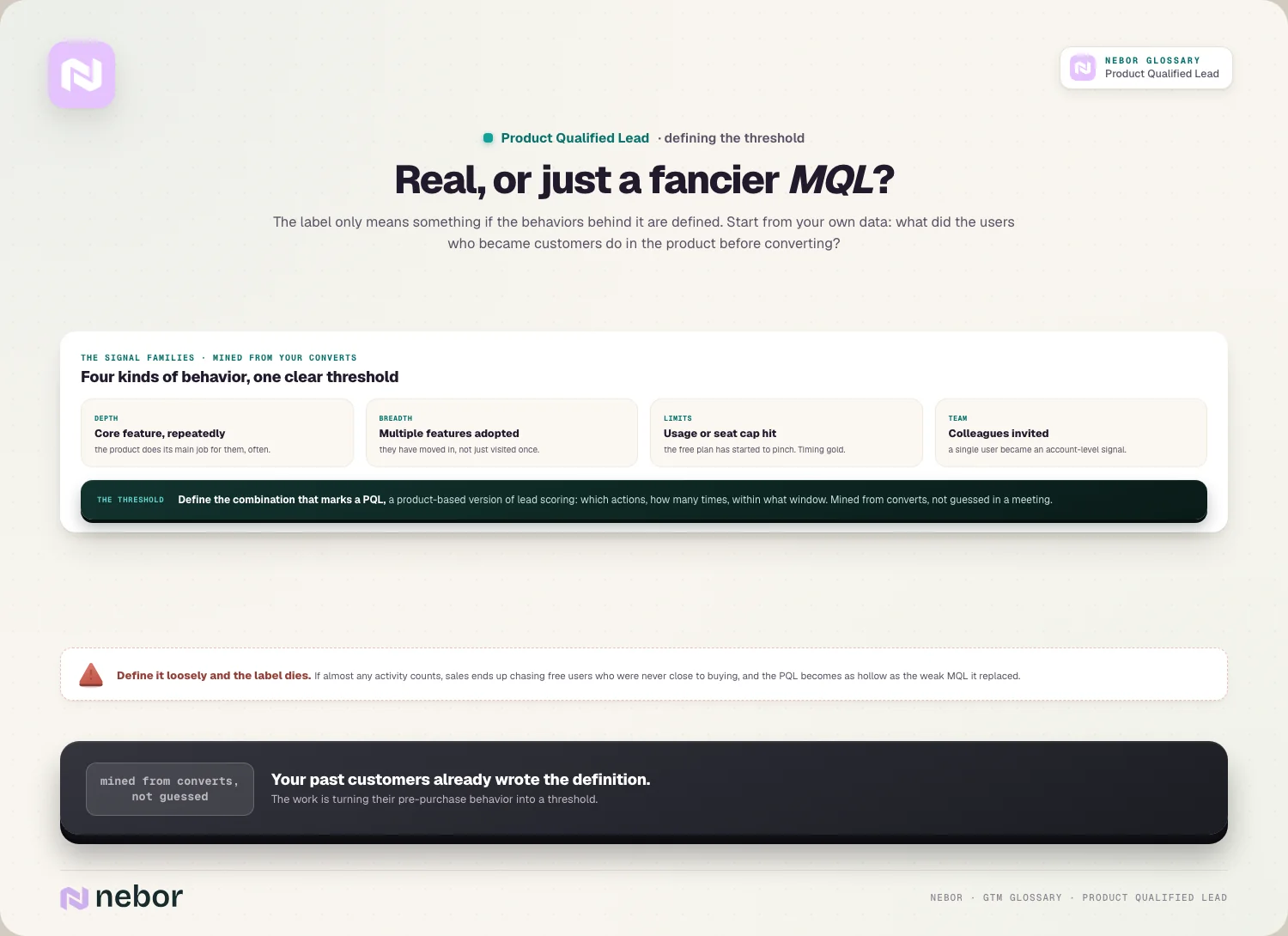
Common signals cluster into a few types. There's depth of use, like using a core feature repeatedly, breadth, like adopting multiple features, and limits, like hitting a usage or seat cap.
Team behavior deserves its own weight in the definition. A single user trying your product is one thing, but that user inviting colleagues turns it into an account-level signal worth acting on quickly.
The work is to turn these into a clear threshold. You define the combination of actions that marks someone as a PQL, a product-based version of lead scoring in practice.
How do PQLs connect to the product-led growth motion around them?
PQLs and product-led growth go hand in hand, with one being the strategy and the other the signal that makes it work, so the relationship deserves spelling out.
Product-led growth is a motion where the product itself drives acquisition, through free trials and freemium plans that let people experience value before buying.
That motion produces a stream of users, but not all of them are ready to buy. The PQL is how you spot the ones who are, so your team focuses on the users most likely to convert.
Without PQLs, a product-led motion is just a pile of free users with no way to prioritize. The PQL is the filter that turns self-serve usage into a list of real sales opportunities.
So the two reinforce each other constantly. The product creates the usage, and the PQL reads that usage to tell you who deserves a human touch, and that filtering is what makes the whole motion efficient.
How should your sales team act on a PQL in the moment it appears?
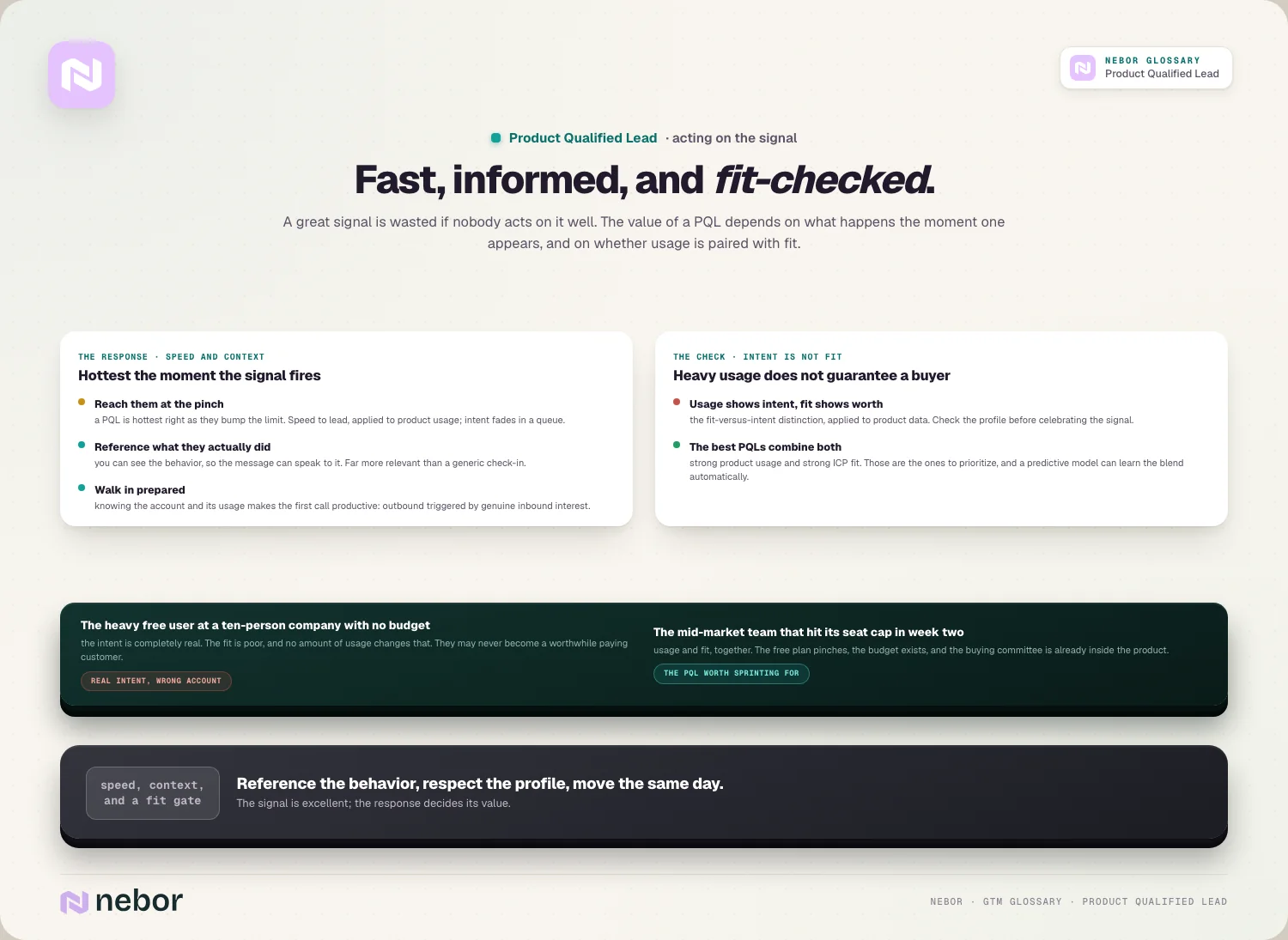
A great signal is wasted if nobody acts on it well. So the value of a PQL depends on what happens the moment one appears.
Speed decides most of the outcome here. A PQL is hottest right when they hit the signal, like the instant they bump a limit, so reaching them fast is the heart of speed to lead applied to product usage.
Context is what makes the outreach land. Because you can see exactly what the user did, your message can reference their real behavior, which is far more relevant than a generic check-in.
This is also a natural place for inbound-led outbound. A PQL is a warm, self-served signal, and reaching out to that user is outbound triggered by genuine inbound interest.
Preparation is the last piece of a good response. Walking into the conversation already knowing the account and its usage, the way a strong inbound meeting workflow sets up, makes the first call far more productive.
Why does a PQL still need to be a good fit before sales jumps in?
A subtle trap with PQLs is treating heavy usage as the only thing that matters. Usage shows intent, but it doesn't guarantee the user is a good fit.
This is the fit score versus intent score distinction applied to product data. A PQL has strong intent, but you still need to check whether they match your ideal customer.
Take a heavy free user at a tiny company with no budget. The intent is real, but the fit is poor, so they may never become a worthwhile paying customer no matter how much they use the product.
The fix is to weigh PQL behavior against your ideal customer profile. The best PQLs combine strong product usage with strong fit, and those are the ones to prioritize.
Modern setups can blend the two automatically, and we build this into scoring wherever the data allows. A predictive lead scoring model can weigh product usage and fit together, learning which combination reliably predicts a sale.
What are the common mistakes teams make once they adopt PQLs?
PQLs are powerful but easy to get wrong, and the same few mistakes show up again and again in the setups we see.
Defining PQLs too loosely tops the list, because if almost any activity counts, the label loses meaning, and sales ends up chasing free users who were never close to buying.
Ignoring fit comes next, as covered above, because treating every heavy user as a hot lead wastes effort on users who can't or won't become good customers.
Acting too slowly is the quiet one, because PQL intent fades, so a signal that waits in a queue for days is far weaker by the time a rep finally follows up.
And weak tracking undermines the rest, because PQLs depend on clean product data, so poor instrumentation means you either miss real signals or act on bad ones.
How do you create more product qualified leads instead of just spotting them?
Spotting PQLs is half the job, and the other half is producing more of them. A PQL only exists if a user reaches real value, so generating PQLs means getting more users to that point.
A strong free experience is the biggest lever, because if your trial or freemium plan makes value easy to reach, more users hit the milestones that define a PQL, so the quality of onboarding directly shapes your PQL volume.
Removing friction to first value is a close second, because every confusing step in setup loses users before they ever experience the product, so smoothing that path turns more signups into qualified leads.
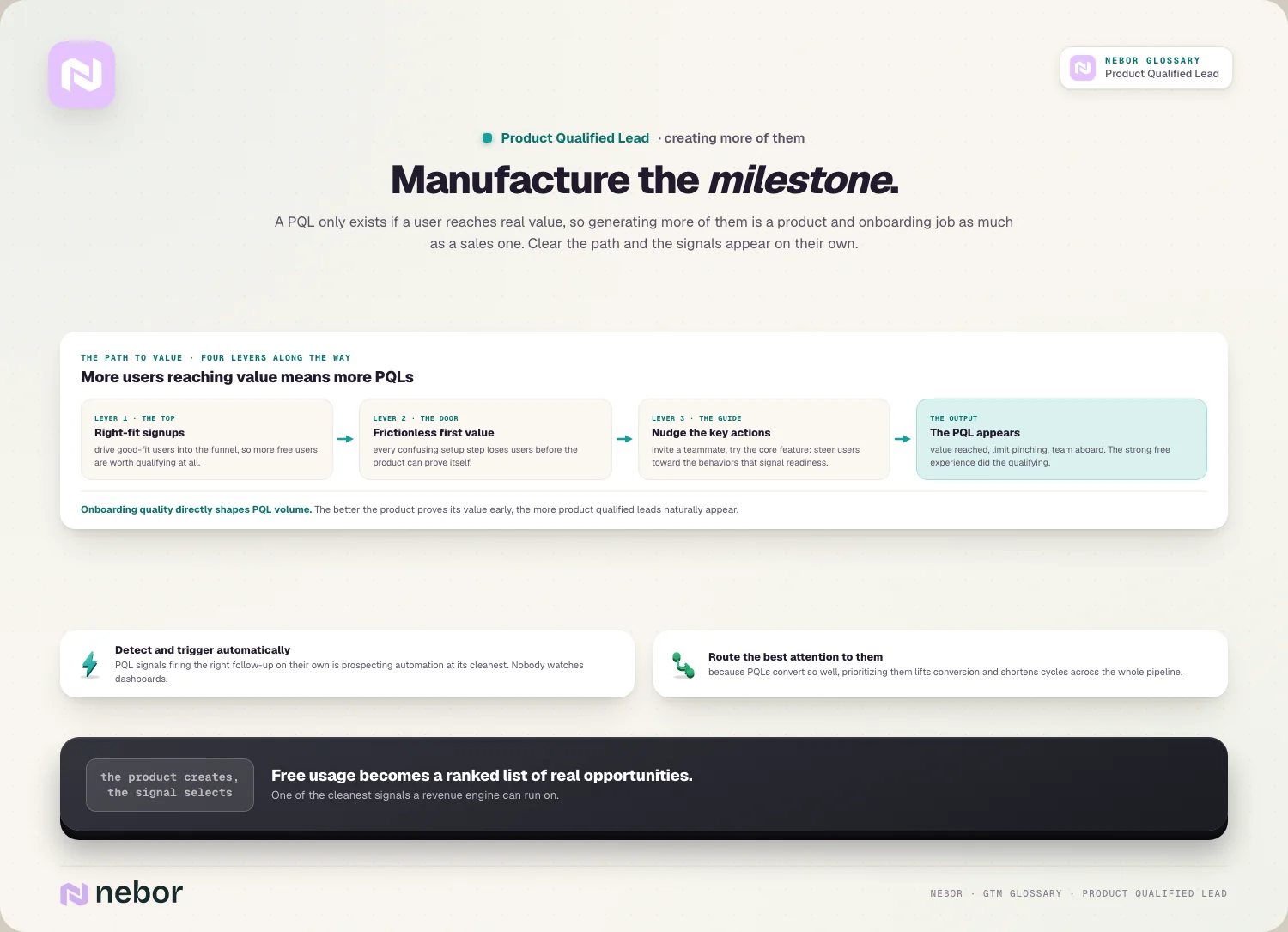
Guiding users toward the actions that matter helps as well, because nudging people to invite teammates or try a core feature moves them toward the behaviors that signal readiness to buy.
And feeding the top of the funnel with the right users multiplies all of it, because driving good-fit signups in the first place means more of your free users are people worth qualifying, which raises the share that become PQLs.
So PQL generation is a product and onboarding job as much as a sales one. The better your product proves its value early, the more product qualified leads naturally appear.
How do PQLs fit into the bigger revenue picture across your funnel?
PQLs function as one high-quality input into your whole revenue engine, and they deliver the most when the systems around them are set up to act on the signal.
They feed your prioritization first, because PQLs convert so well that routing your team's attention toward them lifts conversion and shortens cycles, which raises your pipeline velocity.
They reward automation too, because detecting PQL signals and triggering the right follow-up automatically is exactly the kind of work that lets you automate sales prospecting instead of watching dashboards.
And they slot into the larger system. Inside a connected go-to-market system, PQLs are one of the cleanest signals telling the machine where real buying intent lives.
Underneath all of this is one idea, which is that a PQL is only as good as the action it triggers. The signal is excellent, and the value comes from a fast, relevant, well-aimed response to it.
Why letting your product qualify your leads changes the handoff for good
The PQL matters because it solves the oldest problem in the marketing-to-sales handoff, which is that interest and intent are not the same thing. A content download is interest, and product usage is intent.
That shift in signal is why PQLs convert several times better than the leads most teams chase. You're acting on what people did inside your product instead of what they clicked in an email, which is a far surer guide to who will pay.
The honest requirement is that PQLs need a product people can try and the discipline to define real value milestones. Without those, the label is just a fancier version of a weak MQL.
So if your sales team has stopped trusting marketing's leads, the answer probably has little to do with better content or stricter scoring rules. It may be letting your product do the qualifying, which is exactly what a product qualified lead lets it do.
Share this post
Inbound
RevOps
Glossary
Related glossary items
Understanding the core GTM concepts




Ready to build your pipeline











