

In this post:
Two prospects land side by side in your pipeline. One has never heard of you, and the other visited your pricing page last week. Reach out to both with the same message and the results won't be close, because one of them is already paying attention and the other has no idea who you are.
That gap between a warm lead and a cold lead is one of the most consequential distinctions in sales. It determines how likely a lead is to convert, how long the deal takes, and how much effort you should spend.
Treating the two the same wastes your time on one and undersells the other.
A cold lead is a prospect with no prior relationship who doesn't know your company. A warm lead has already shown some interest, by visiting your site, downloading content, or being referred, without yet asking to be contacted.
The difference is whether any trust or awareness exists before you reach out.
The distinction carries real weight because warm leads convert dramatically better. Across most B2B benchmarks, warm leads convert at roughly 5 to 10 times the rate of cold ones, which changes how you should treat each.
TL;DR
A cold lead has no prior relationship with you and doesn't know your company, while a warm lead has already shown interest through some engagement.
The conversion gap is huge, because warm leads convert at roughly 5 to 10 times the rate of cold ones, driven by existing trust, proven interest, and shorter cycles.
The two demand different approaches, so cold leads need warming and patience, while warm leads need speed since their interest fades within weeks.
The practical goal is to turn cold into warm, because warming prospects before you sell to them is what earns the far higher conversion rate.
What actually separates a warm lead from a cold lead at the start
The core difference between the two is whether any relationship exists before you make contact. That single factor changes everything that follows in the deal.
A cold lead starts the relationship from nothing. They have no awareness of you, so your first message is an interruption to someone who never asked to hear from you.
A warm lead starts from some interest. They've engaged in some way, so they at least recognize you, which means your outreach continues a relationship instead of starting one cold.
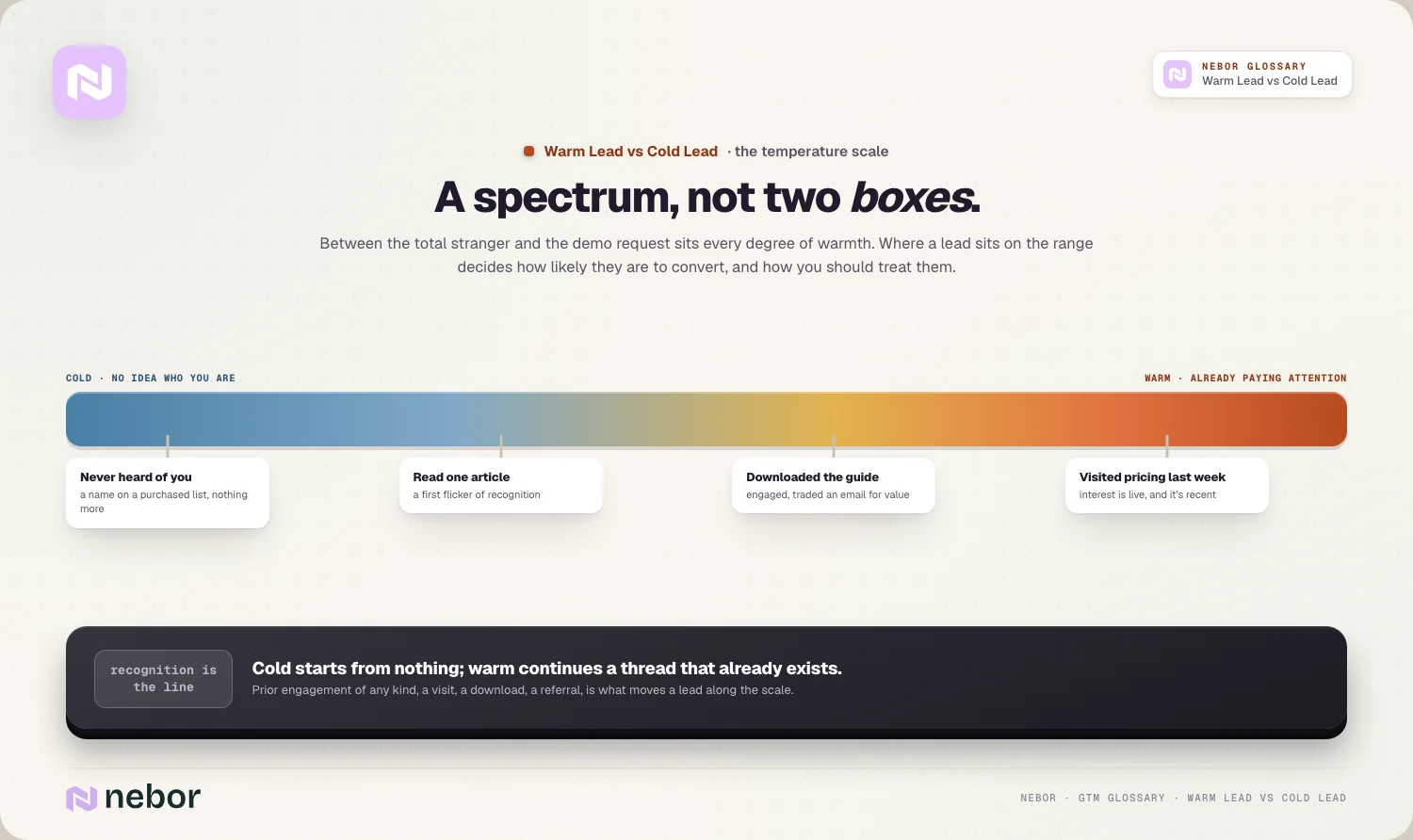
The dividing line is prior engagement with you. Whether a lead visited your site, read your content, or was referred is what moves them from cold to warm, because any of those creates a thread to build on.
So the split comes down to recognition and interest. A cold lead is a stranger and a warm lead is an acquaintance, and that difference in starting point shapes how the entire interaction goes.
It's also a spectrum rather than a binary. Between a total stranger and someone who requested a demo lies every degree of warmth, so leads fall along a range instead of into two clean boxes.
Why warm leads tend to convert so much better than cold leads do
The performance gap between warm and cold leads is dramatic, and in our experience the reasons behind it explain the whole point of the distinction. Three forces drive the gap between the two.
Trust already exists in some measure before the first call. A warm lead has some familiarity with you, so they're more open to a conversation, while a cold lead has to be convinced you're worth their attention first.
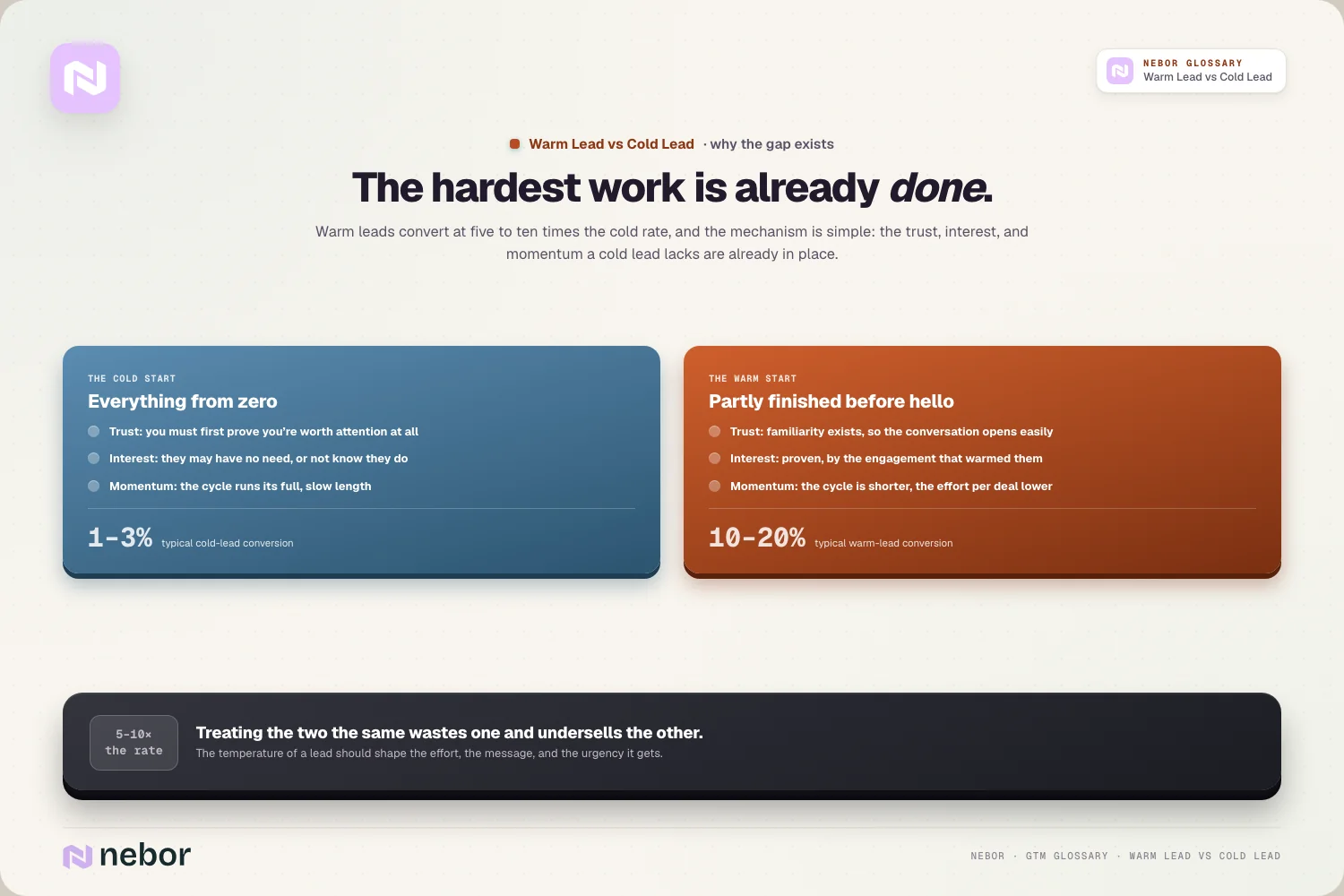
Interest has already been demonstrated through a real action. A warm lead has shown they care about the problem you solve, so they're closer to a decision than a cold lead who may have no need whatsoever.
The cycle from contact to close gets shorter. Because trust and interest are partly established, warm leads move through the process faster, which raises conversion and lowers the effort per deal.
So warm leads convert better because the hardest early work is already done. Trust, interest, and momentum that a cold lead lacks are what push warm-lead conversion to 10 to 20%, against 1 to 3% for cold.
How much bigger the conversion gap actually is in the numbers
The size of the warm-versus-cold gap surprises people, so the concrete figures are worth seeing. The multiplier is large and holds across industries.
Cold conversion stays stubbornly low no matter the effort. A cold lead typically converts at around 1 to 3%, so the vast majority of cold outreach goes nowhere, which is simply the nature of contacting strangers.
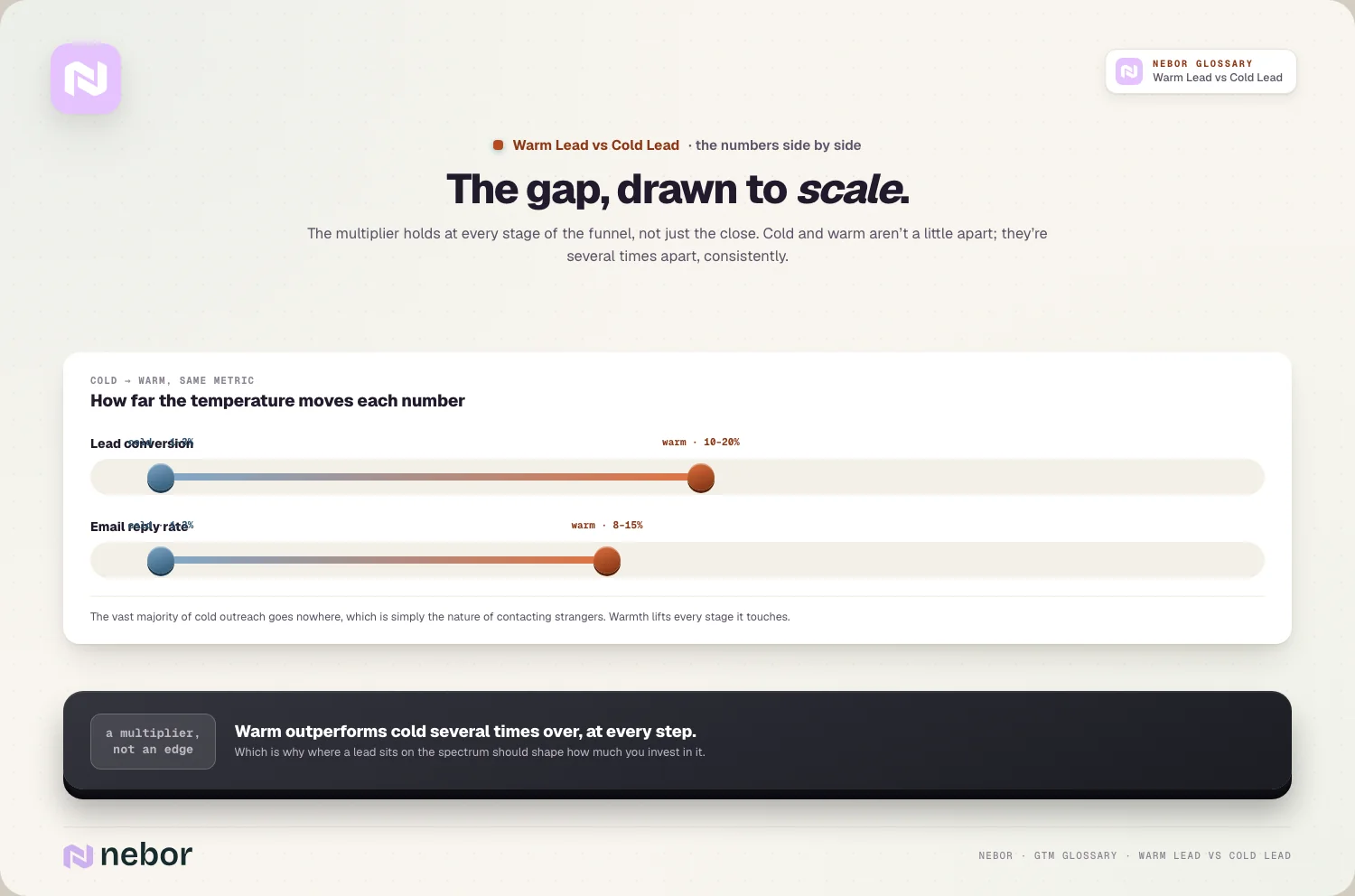
Warm conversion is far higher on every measure. A warm lead converts at roughly 10 to 20%, many times the cold rate, because the prospect already has interest and trust.
The reply gap is just as wide. Cold email replies come in at 1 to 3%, while warm leads reply at 8 to 15%, so warmth lifts your conversion rate at every stage of the funnel, close included.
So the gap is a multiplier instead of a small edge. Warm leads outperform cold ones by several times over, meaning where a lead lands on this spectrum should shape how much you invest in it.
Why cold leads still matter despite their much lower conversion
Given the gap, it's tempting to dismiss cold leads entirely, but that would be a mistake. Cold leads play a role warm ones can't.
They're by far the larger pool of buyers. Most of your addressable market has never heard of you, so cold leads are where the volume is, even if each converts at a lower rate.
They reach the accounts nobody has touched yet. Warm leads come only from people who already found you, while cold outreach lets you target the best-fit accounts that haven't discovered you yet.
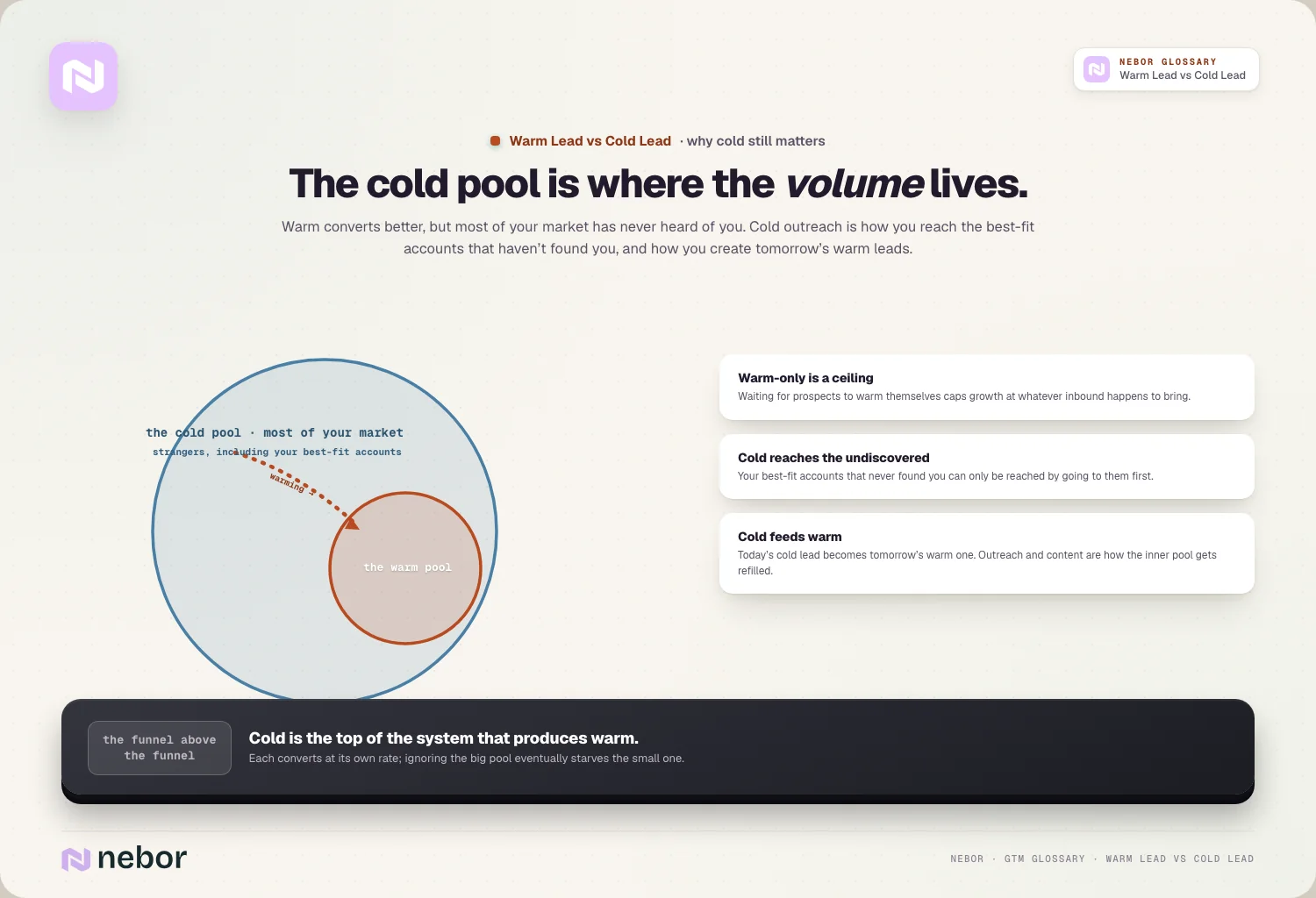
They feed the warm pool over time. Today's cold lead becomes tomorrow's warm one, so cold outreach and content are how you create future warm leads in the first place.
So cold leads are the top of a funnel that produces warm ones. Ignoring them means limiting yourself to inbound interest alone, which caps how many accounts you can ever reach.
Relying only on warm leads is a common ceiling. A business that waits for prospects to warm themselves up can only grow as fast as its inbound, so cold outreach is what lets you reach beyond that limit deliberately.
How to warm up a cold lead over time into a real opportunity
Since warm leads convert so much better, the highest-value move is turning cold leads warm. That transformation takes deliberate effort over time.
It starts with offering something of relevant value. Sharing useful content and insight, instead of pitching, gives a cold prospect a reason to engage, which is the first step toward warming them.
It builds through contact that's repeated and useful each time. Warmth grows across a series of touches, so consistent, valuable interaction over time is what moves a lead from stranger to acquaintance.
It takes more patience than most teams have. Warming cold prospects typically takes three to six months for simpler offerings and far longer for complex ones, so it's a slow build instead of a quick flip.
So warming a cold lead is a gradual process of earning familiarity. Consistent value over months is what converts a cold prospect into a warm one who's finally worth a direct sales push.
Why speed matters far more with a warm lead than with a cold one
Warm and cold leads differ not just in conversion but in urgency. A warm lead is a time-sensitive opportunity in a way a cold lead isn't.
Warm interest is perishable in a matter of days. A warm lead's interest fades fast, so most warm leads cool off within 30 to 45 days without contact, which means waiting lets the advantage evaporate.
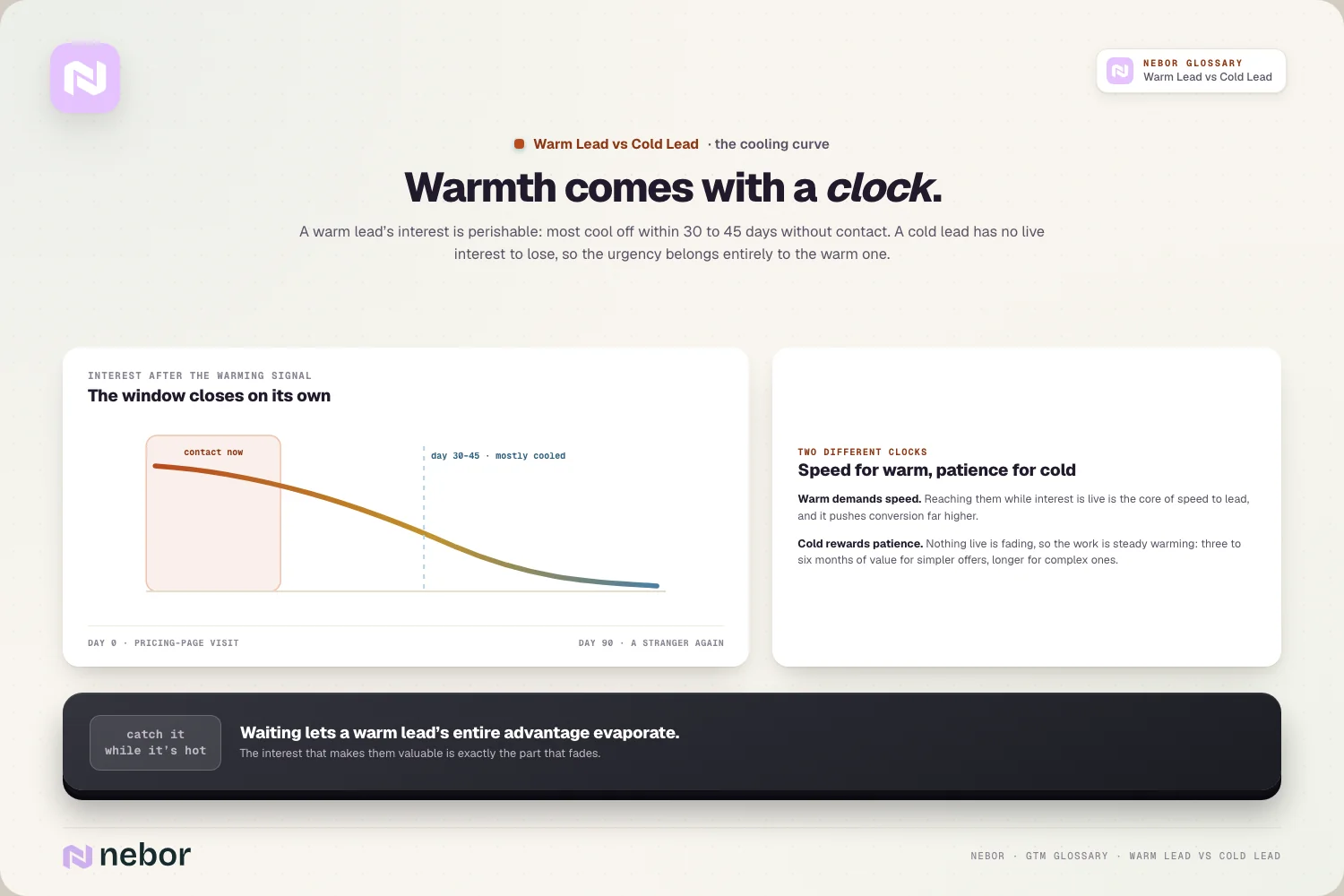
A fast response is what captures it. Reaching a warm lead quickly, the core of speed to lead, can push conversion far higher, because you catch them while the interest is live.
Cold leads carry far less urgency than warm ones. A cold lead has no active interest to lose, so the timing pressure is different, and the work there is patient warming instead of instant response.
So warmth arrives with a clock already ticking. A warm lead demands speed because the interest that makes them valuable is fleeting, while a cold lead rewards patience instead, which is a key difference in how you handle each.
How buying signals tell you a cold lead has turned warm unnoticed
The moment a cold lead becomes warm is often invisible unless you're watching for it, and we tell clients to build that watching into their systems. Signals are how you catch that transition.
Engagement is the tell you watch for. When a cold prospect opens emails, visits your site repeatedly, or downloads content, those are the signs they're warming, which is the essence of an intent signal.
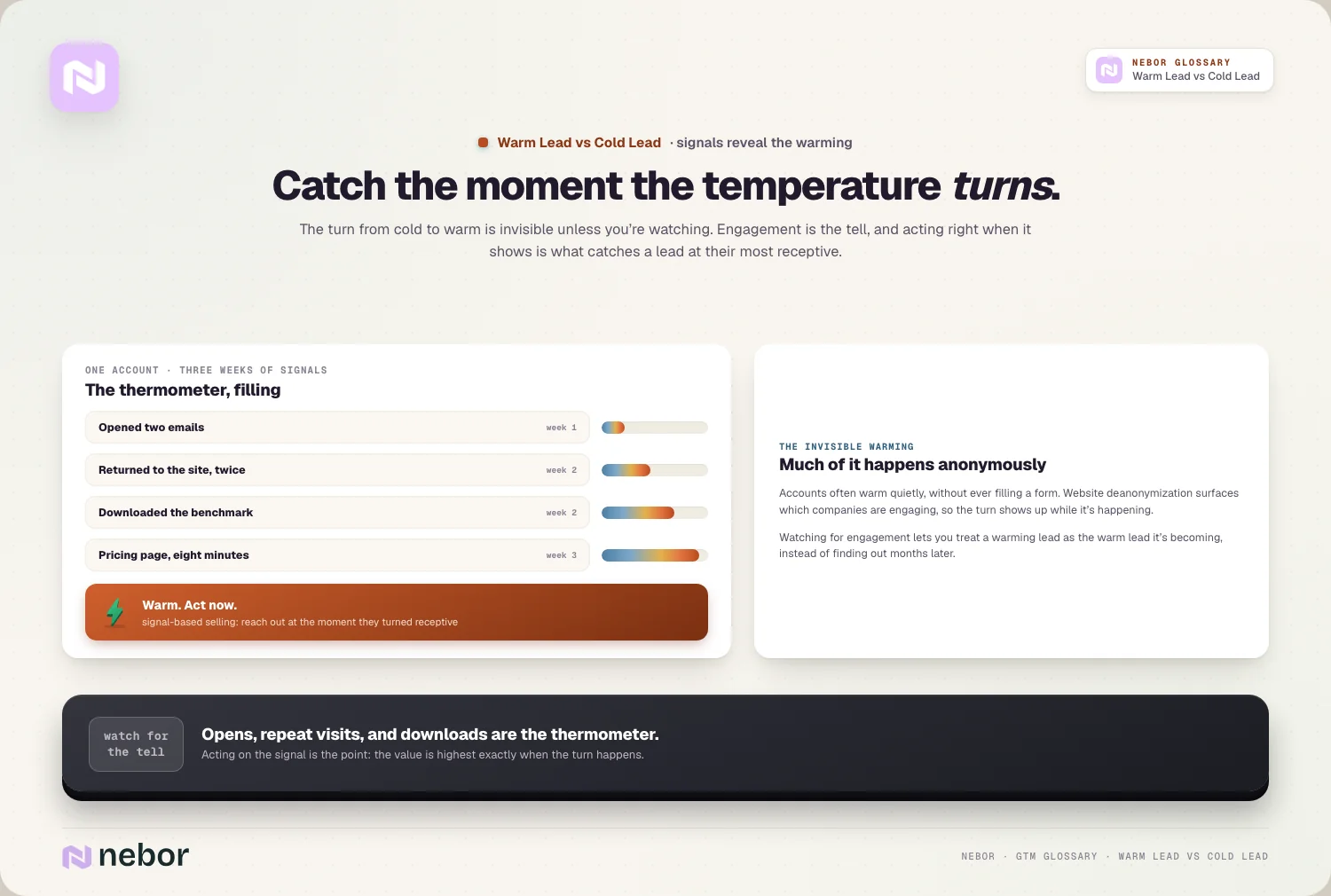
Anonymous warming needs surfacing before you can act. Much warming happens invisibly, so website deanonymization reveals which accounts are engaging behind the scenes before they ever fill out a form.
Acting on the signal is the point. Reaching out right when a lead shows warming signals, the heart of signal-based selling, catches them at the moment they've turned receptive.
So signals are how you spot warmth as it happens. Watching for engagement lets you treat a warming lead as the warm lead it's becoming, instead of missing the window entirely.
How this distinction connects to your outbound and inbound motions
The warm-versus-cold split maps directly onto how modern teams structure their outreach. It shapes both of the outreach motions you build.
Cold leads are what drive traditional outbound. Reaching strangers through cold email and calls is how you engage the cold end of the spectrum, which is necessary but lower-converting.
Warming is what turns cold outreach into warm outbound. Reaching leads showing early interest is the essence of warm outbound, which is between the two and converts far better than fully cold outreach.
Signals blur the line further every year. Triggering outreach off inbound interest, the logic of inbound-led outbound, is really a way of catching leads exactly as they warm up.
So the whole modern motion is about moving leads rightward on this spectrum. The best teams work to warm cold leads and catch warm ones fast, because that's where the conversion advantage lives.
Why qualification depends on where a lead falls on this spectrum
How you qualify and prioritize a lead depends heavily on whether it's warm or cold. The distinction feeds directly into your process.
Warmth decides which lead gets called first each morning. A warm lead deserves faster, more personal attention than a cold one, so a lead's place on the spectrum shapes how you rank it in your workflow.
It feeds directly into the scoring your team relies on. Engagement that makes a lead warm is exactly what lead scoring measures, so warmth shows up directly in how a lead is scored and ranked.
It shapes the conversation a rep opens with. A warm lead is further along, so lead qualification can move faster with them, while a cold lead needs more groundwork before serious qualification.
So warmth is a core input to how you handle a lead. Treating warm and cold leads identically in your process wastes the extra potential of the warm ones and rushes the cold ones too fast.
Where a hot lead fits between warm and cold on the same spectrum
The warm-cold split has a third stage worth naming, because it changes how you act. A hot lead is at the far warm end.
A hot lead shows explicit intent to buy. Where a warm lead has shown interest, a hot lead has signaled a real intention to buy, like requesting a demo or pricing, which puts them closest to a decision.
It demands action within the hour instead of the week. A hot lead is a live opportunity that needs a fast, direct sales response, because the buying intent is active right now instead of merely forming.
It's the state all the warming aims for. Moving a lead from cold to warm to hot is the whole progression, so a hot lead is what a disciplined warming process eventually produces.
So warm, cold, and hot describe three points on one journey. A cold lead has no relationship, a warm lead has interest, and a hot lead is ready to buy, which is the sequence your motion is built to move leads through.
The common mistakes teams make with warm and cold leads alike
Teams mishandle the warm-cold distinction in a few predictable ways, and we keep seeing the same ones when they walk us through their pipelines. Avoiding them is straightforward once you see them.
The biggest is treating all leads the same. Applying identical urgency and messaging to warm and cold leads wastes the warm ones and over-pushes the cold ones.
Another is being slow with warm leads. Letting a warm lead wait lets their interest cool, which throws away the very advantage that made them valuable.
A third is being pushy with cold leads. Hitting a cold prospect with a hard pitch before any trust exists gets ignored, because cold leads need warming before anyone attempts a close.
The last is never warming cold leads in the first place. Treating cold leads as either instant sales or worthless misses the whole opportunity of gradually turning them warm.
Why the real goal is steadily turning cold leads into warm ones
The most useful way to hold this distinction is as a spectrum you move leads along, instead of two fixed categories. The whole game is shifting leads toward warm.
Warmth is the state that converts several times better. Since warm leads convert several times better, moving a lead from cold to warm is one of the highest-value things your motion can do.
It's a process more than a label. A lead isn't permanently cold, so consistent value and attention are what warm them up over time into a real opportunity.
Both ends of the spectrum need each other. Cold outreach creates the leads that warming turns into conversions, so a healthy motion works the whole spectrum instead of only one end.
Understanding where each lead stands, and working to warm the cold ones, is one of the most practical levers in a modern go-to-market system. It turns raw cold volume into the warm, high-converting leads that the outreach you automate sales prospecting around is ultimately meant to produce.
Share this post
Outbound
Prospecting
Glossary
Related glossary items
Understanding the core GTM concepts


Ready to build your pipeline











