

In this post:
Most teams treat outbound as inherently cold. They build a list of strangers, write a pitch, and accept that the vast majority will ignore it, because that's just how outbound works.
But cold is a choice instead of a law of nature. A large share of the people you could reach already have some connection to you, and reaching those people is a completely different game.
Warm outbound is proactive outreach to prospects who already have some link to you, like a website visit, a past conversation, a shared connection, or a relevant trigger, instead of total strangers. It's outbound with a reason behind the timing.
The difference matters enormously, because warmth changes how the message is received. A stranger asks why are you emailing me, while a warm prospect already has a context that makes your outreach make sense.
TL;DR
Warm outbound is outreach to prospects who already have a connection to you, through prior engagement, a shared link, a signal, or a trigger, instead of contacting cold strangers.
Warmth dramatically lifts response, because cold reply rates have fallen to the low single digits, while outreach tied to real context or signals performs far better.
It covers many sources of warmth, from website visitors and past contacts to job changers and accounts showing intent, all reached proactively instead of waiting.
The requirement underneath it is a system to surface the warmth. You need to detect who's warm right now and reach them fast, or the connection cools before you act on it.
What is warm outbound, and what counts as a warm connection?
Warm outbound is outbound outreach where the prospect isn't a complete stranger. There's some existing connection that makes your message more relevant and more welcome.
That connection can take many different forms. They may have visited your site, engaged with your content, met you before, share a mutual contact, or just experienced a relevant change at their company.
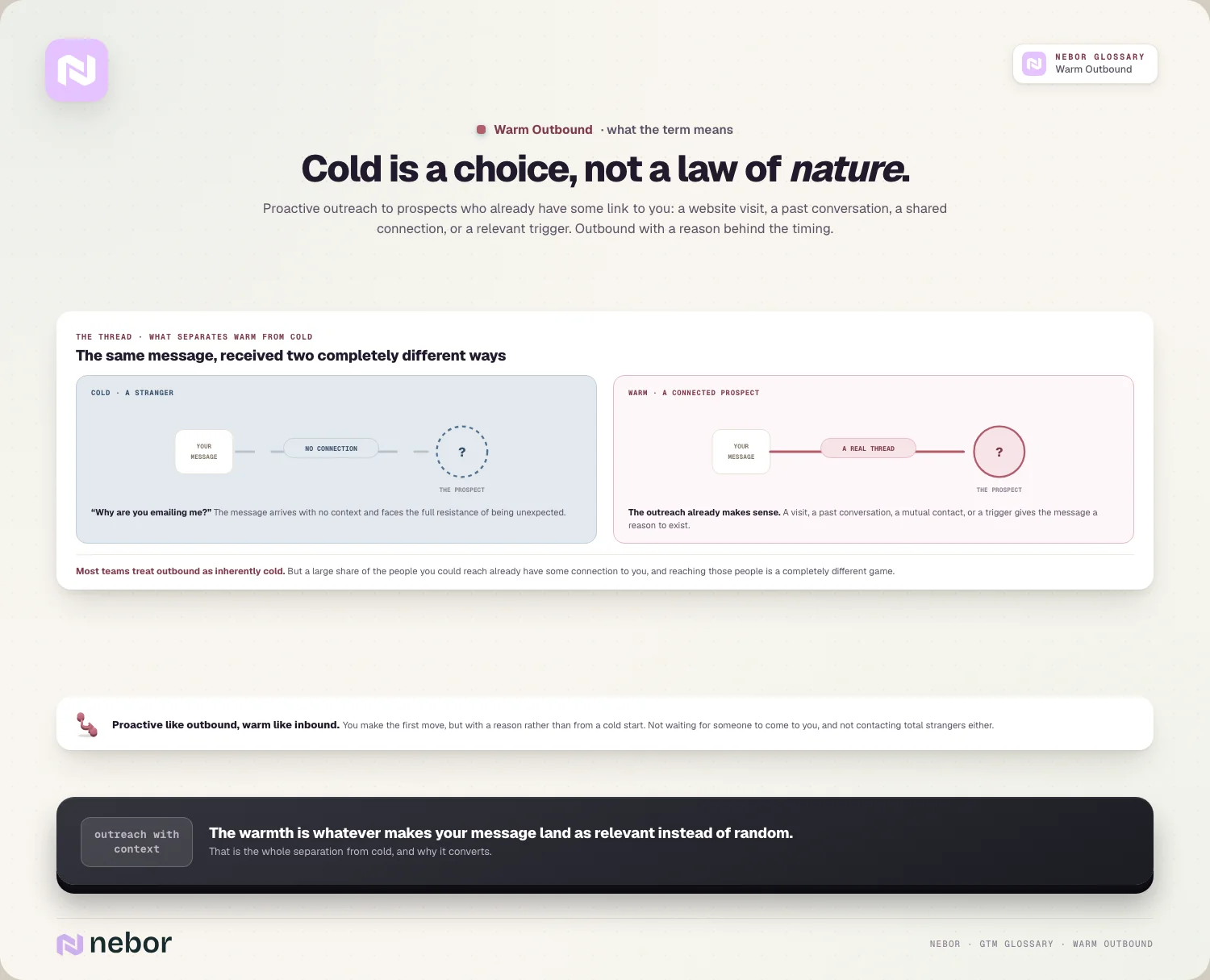
The defining trait is that you reach out proactively, like outbound, but with warmth, like inbound. You make the first move, but you do it with a reason instead of from a cold start.
This falls between pure cold outbound and pure inbound. You skip the waiting that inbound requires and the total strangers that cold requires, reaching instead the people who have a thread connecting them to you.
So warm outbound is really about outreach with context. The warmth is whatever makes your message land as relevant instead of random, which is what separates it from cold and is the reason it converts so much better.
How is warm outbound different from the cold outbound most teams send?
The cleanest way to understand warm outbound is against its cold counterpart. They share a motion but differ in starting point.
Cold email and cold outbound reach people with no prior connection. You select them on fit alone, so your message arrives with no context and faces the full resistance of being unexpected.
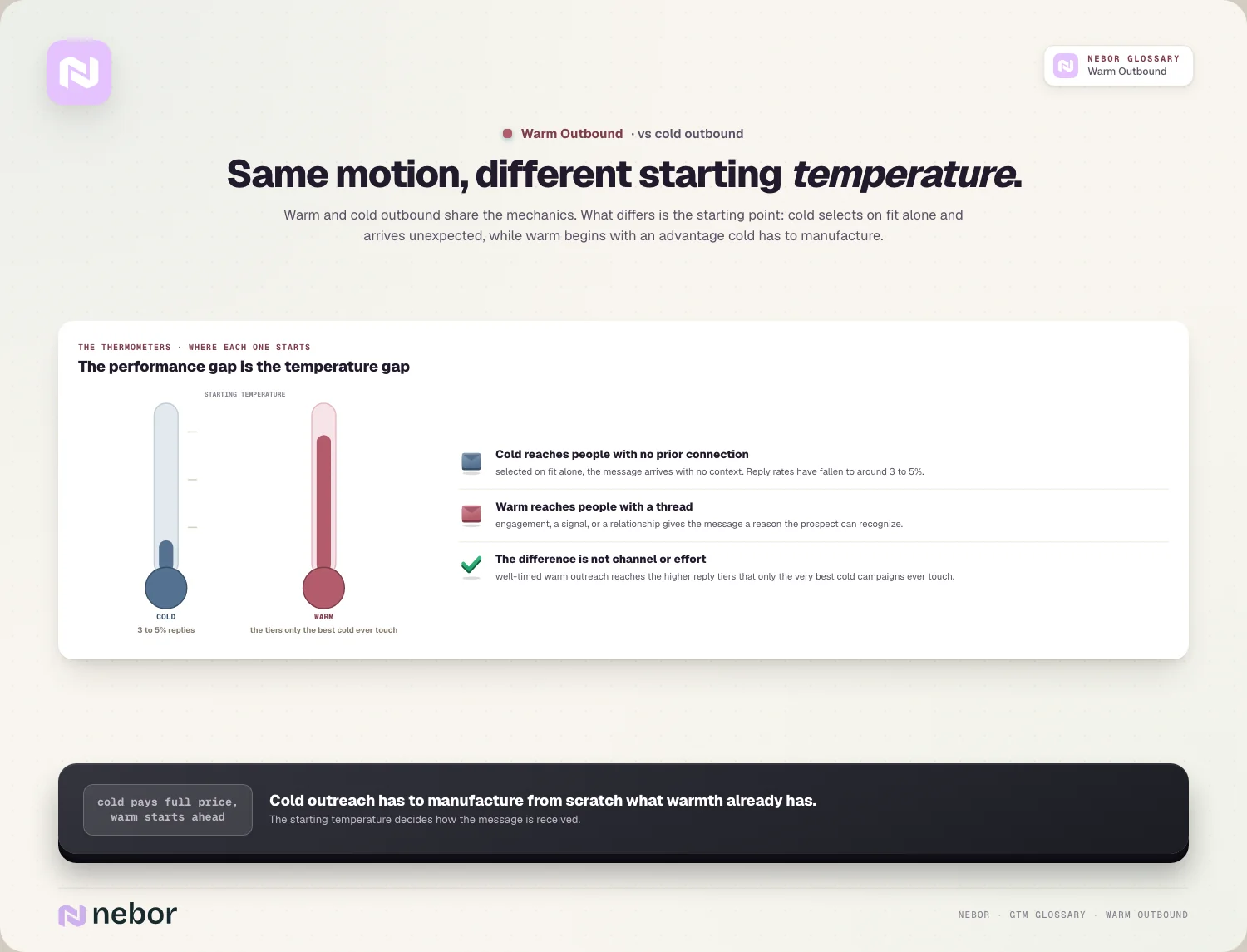
Warm outbound reaches people with some connection. That thread, whether engagement, a signal, or a relationship, gives your message a reason to exist that the prospect can recognize.
The performance gap between the two is large. Cold reply rates have fallen to around 3 to 5%, while warm, well-timed outreach reaches the higher tiers that only the best cold campaigns ever touch.
So the difference lives in the starting temperature, with the channel and the effort staying the same. Warm outbound begins with an advantage cold outbound has to manufacture from scratch.
Where does the warmth in warm outbound come from in the first place?
Warmth has many sources, and knowing them helps you find it, because each gives your outreach a different kind of context.
Engagement is the most direct source of all. Someone who visited your site, opened your content, or attended a webinar has shown interest, which is a clear thread to reach out on.
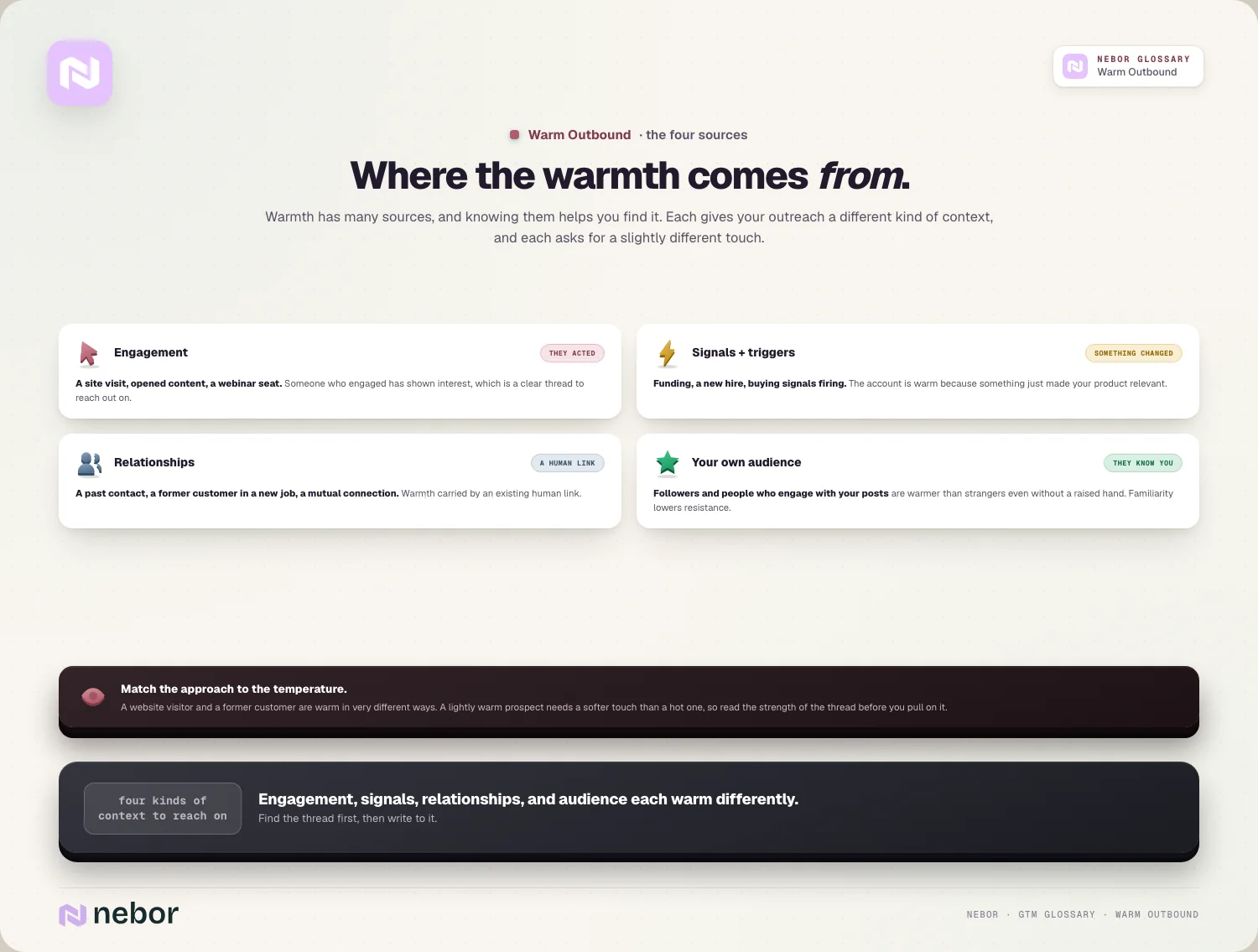
Signals supply warmth from outside your walls, because an account showing buying signals or hitting a relevant trigger event, like funding or a new hire, is warm because something just made your product relevant.
Relationships carry warmth of a more human kind, where a past contact, a former customer who changed jobs, or a mutual connection all bring an existing link into the outreach.
And your own audience rounds it out, because people who follow you, engage with your posts, or know your brand are warmer than strangers, even if they never directly raised a hand, and the familiarity itself lowers their resistance.
Why does warmth lift response as much as the numbers suggest?
The reasons warm outbound outperforms are the same reasons it's teachable, because warmth removes the biggest barriers cold outreach faces.
Relevance is the first barrier warmth clears, because a cold message has to prove it matters, while a warm one already does, connecting as it does to something the prospect did or experienced.
Trust is the second, because a shared connection, prior interaction, or known brand gives the prospect a reason to believe you're worth a reply, which a stranger has to earn from zero.
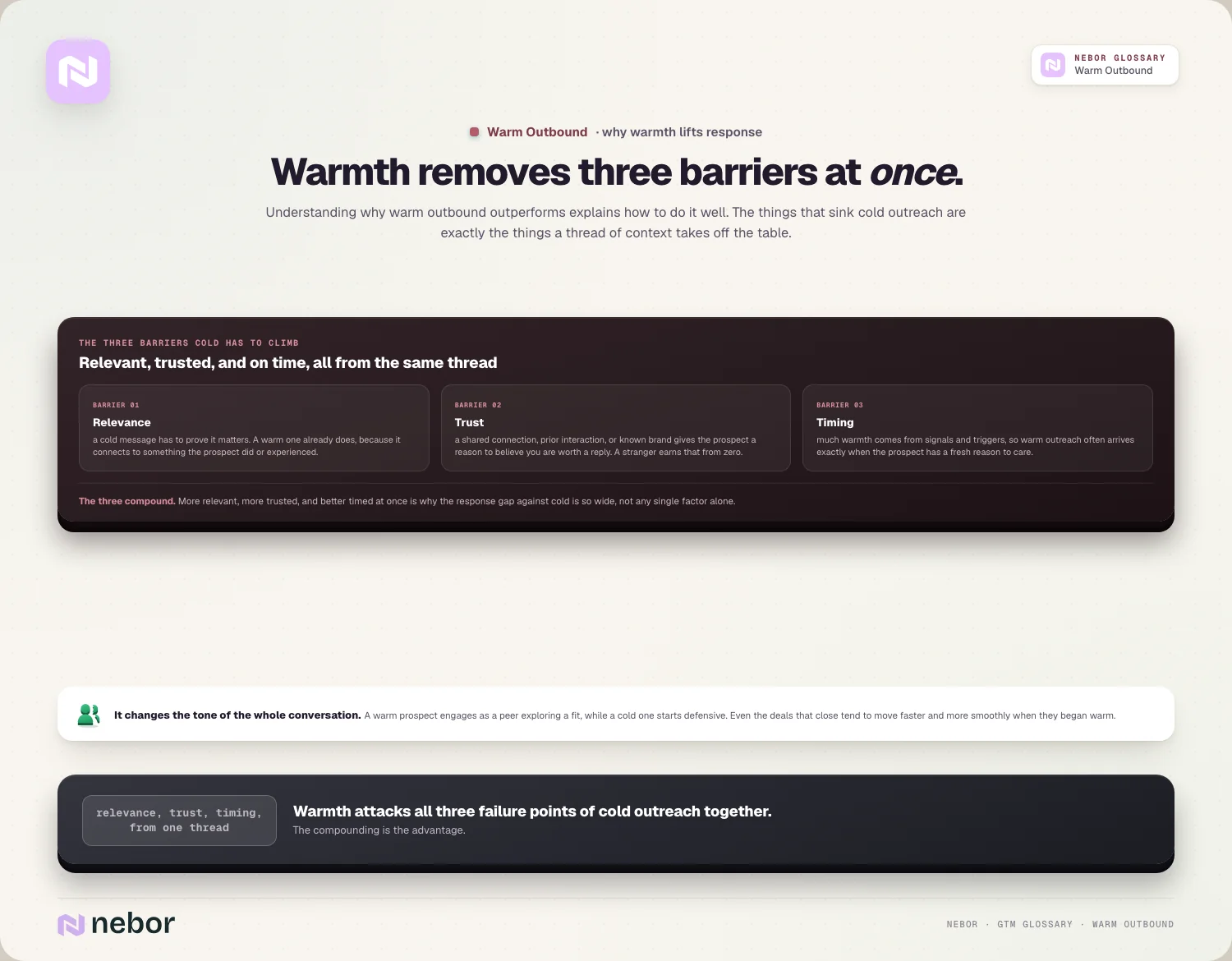
And timing is the third, because much warmth comes from signals and triggers, which means warm outreach often arrives exactly when the prospect has a fresh reason to care.
So warmth attacks the three things that sink cold outreach at once. The message is more relevant, more trusted, and better timed, which compounds into far higher response.
It also changes the tone of the whole conversation. A warm prospect engages as a peer exploring a fit, while a cold one starts defensive, so even the deals that close tend to move faster and more smoothly when they began warm.
How does warm outbound relate to the inbound-led outbound motion?
These terms are close cousins, so it helps to place them. Warm outbound is the broad category, and inbound-led outbound is one powerful version of it.
Inbound-led outbound is warm outbound driven specifically by inbound signals. Someone visits your site or engages with your content, and you reach out based on that inbound interest.
Warm outbound covers more ground than that. It includes inbound-led outbound but also warmth from relationships, triggers, and your audience, beyond the signals from your own channels.
The shared idea is using context to warm the outreach. Whether the thread is an inbound signal or a past relationship, you're reaching out with a reason instead of cold.
So inbound-led outbound is the signal-driven slice of warm outbound. Both reject the idea that outbound has to start cold, which is the whole point of the category.
How do you build a warm outbound motion that works at real scale?
Warm outbound sounds appealing, but it takes a system to do at scale, and in our experience a few components make it work. We tell clients to build the detection before worrying about the copy.
Detecting warmth comes before everything else in the motion. You need to surface who's warm right now, whether that's identifying website visitors, watching for triggers, or tracking past contacts who changed jobs.
Capturing your own signals feeds that detection, because much warmth hides in your own data and your CRM, and tools like a website visitor tracking workflow turn anonymous interest into named, warm accounts.
Acting fast protects the advantage, because warmth fades, so reaching a warm prospect quickly is speed to lead applied broadly, capturing the connection while it's still fresh.
And doing it at scale takes automation, because surfacing and acting on warmth across a whole market by hand is impractical, so teams build systems to automate sales prospecting around warm signals.
How do you message warm outbound so the warmth shows in the copy?
Warmth gives you an advantage, but only if your message uses it. A few principles make warm outreach land.
The message should reference the warmth naturally, and we coach clients on exactly this line. Connecting to the visit, the trigger, or the shared link is what makes the outreach feel relevant instead of just another pitch.
It should still lead with something valuable. Warmth gets you attention, but the message still has to offer a reason to engage, so the context sets up a genuinely useful point.
It should match the temperature of the connection. A lightly warm prospect needs a softer touch than a hot one, so the outreach should fit how strong the connection really is.
And it works best spread across channels. A warm touch across email, LinkedIn outreach, and a call reinforces the connection, so warm outbound fits a coordinated motion.
How does warm outbound fit alongside signal-based selling in practice?
Warm outbound and signal-based work overlap heavily, so it helps to connect them. Signals are one of the main ways outbound gets warm.
The practice of signal-based selling times outreach to real signals, and acting on those signals is a core form of warm outbound, because the signal is the warmth.
It's also how you build a pipeline that warms over time. Nurturing cold prospects into engaged ones is warm outbound applied as a system instead of a one-off, which compounds as your audience grows.
The reply rates reflect how much the two overlap. Warm, signal-driven outreach reaches the higher reply rate tiers, while purely cold outreach lands at the bottom of the range.
So warm outbound, signal-based selling, and pipeline nurturing are all facets of the same shift. They all reject cold-by-default in favor of outreach with a real reason behind it, which is where modern outbound has been heading for years.
What does warm outbound look like next to cold, prospect for prospect?
A concrete example makes the difference from cold clear. Consider the same prospect reached two ways, and how differently each one lands.
In the cold version, a rep finds a company that fits the profile and sends a generic pitch. The prospect has never heard of them, sees no reason it's relevant, and ignores it like the dozen others that week.
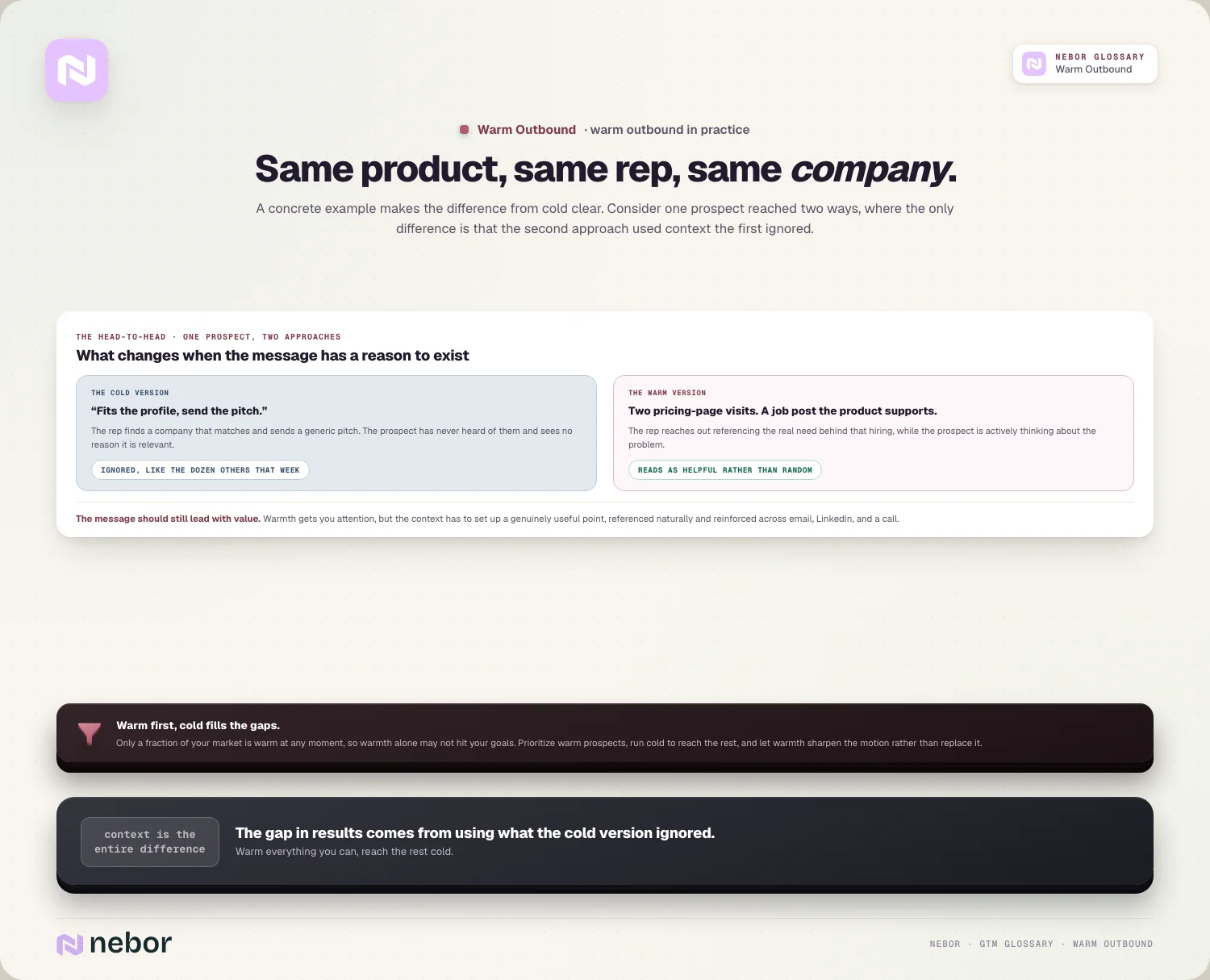
In the warm version, that same company just visited the pricing page twice and posted a job for a role the product supports. The rep reaches out referencing the real need behind that hiring.
Now the message has a reason to exist. It arrives while the prospect is actively thinking about the problem, framed around something true about their situation, so it reads as helpful instead of random.
The product, the rep, and the company were identical in both versions. The only difference is that the second approach used context the first ignored, which is the entire point of warm outbound and why the gap in results is so large.
Is warm outbound always better than cold, or does cold keep a place?
Warm outbound clearly outperforms cold, but that doesn't mean cold has no place. It pays to be honest about the trade-offs.
The ceiling on warm outbound is how much warmth exists. Only a fraction of your market is warm at any moment, so if you rely solely on warmth, you may not have enough prospects to hit your goals.
Cold outbound picks up what warmth can't reach. You can still contact good-fit accounts that aren't showing any warmth yet, accepting lower response in exchange for covering more of the market.
The two motions work best in combination. You prioritize warm prospects first, because they convert best, while sending cold outreach to fill the gaps, so warmth sharpens your motion without replacing it.
So the goal is to warm everything you can and reach the rest cold, rather than treating every prospect as a stranger by default when many of them aren't.
How do you turn cold prospects warm instead of waiting for warmth?
Warmth is something you can create as well as find, and turning cold prospects into warm ones is a motion in itself.
The core idea is to build a connection before you pitch. Engaging with a prospect's content, showing up in their feed, or providing something useful creates a thread that wasn't there before.
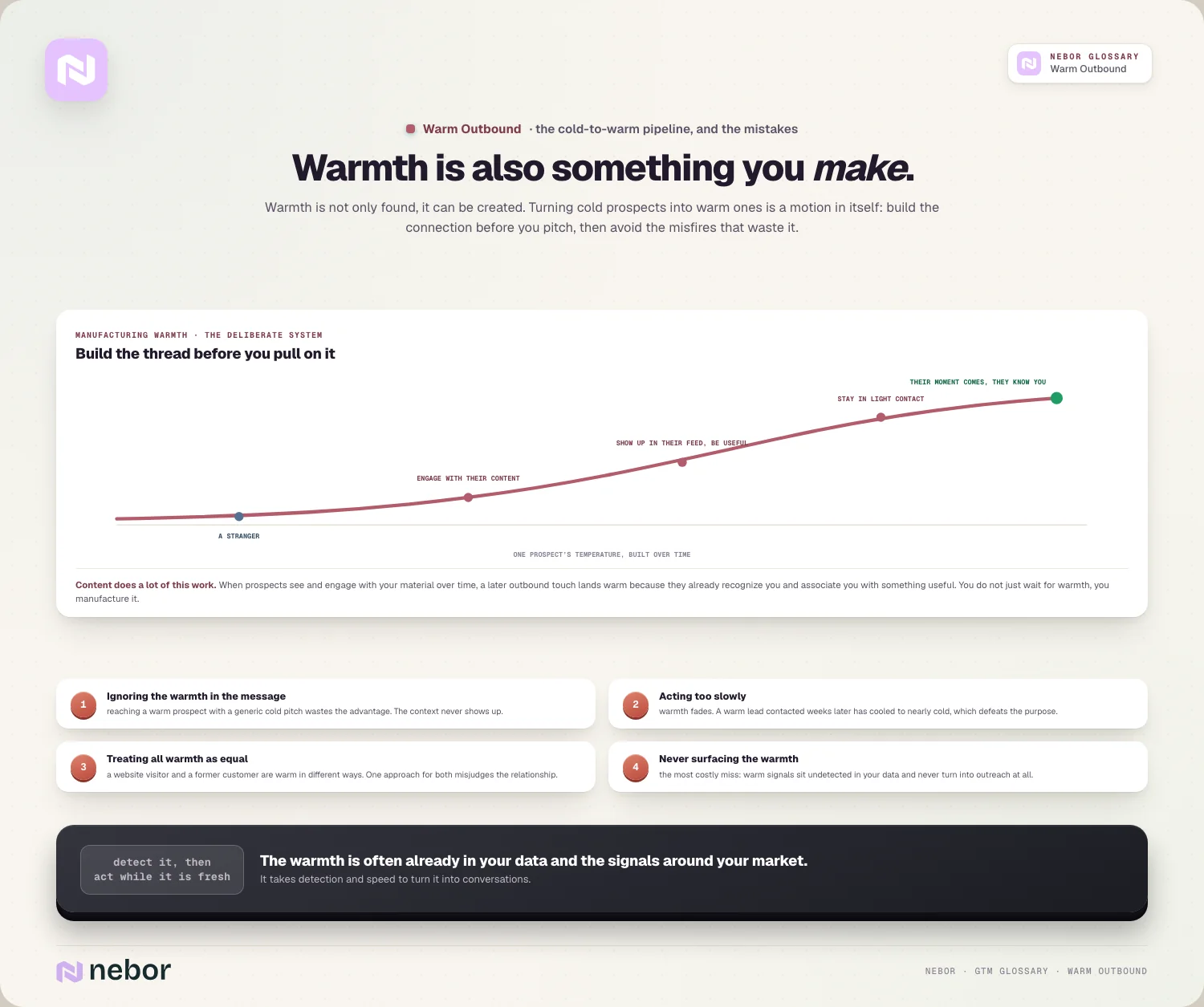
Content does a lot of this work. When prospects see and engage with your material over time, a later outbound touch lands warm because they already recognize you and associate you with something useful.
Nurturing plays its own quiet part as well. Staying in light contact with prospects who aren't ready yet means that when their moment comes, your outreach reaches someone who already knows you.
This is the heart of a cold-to-warm pipeline as a deliberate system. You don't just wait for warmth, you manufacture it, so more of your future outbound starts from a connection.
What are the common mistakes teams keep making with warm outbound?
Warm outbound can underperform when it's mishandled, and we keep seeing the same few mistakes in the motions we review.
Ignoring the warmth in your message wastes the advantage outright, because reaching a warm prospect with a generic cold pitch means the context never shows up.
Acting too slowly comes next, because warmth fades, so a warm lead you contact weeks later has cooled to nearly cold, which defeats the purpose.
Treating all warmth as equal misjudges the relationship, because a website visitor and a former customer are warm in very different ways, so the same approach to both fits neither.
And failing to surface warmth at all is the most common and costly miss, because many teams hold warm signals they never detect, so the warmth exists in their data but never turns into outreach.
Why using the threads you already have beats treating everyone as a stranger
Warm outbound matters because it challenges the assumption that outbound has to be cold. Much of the audience your team could reach already has a thread connecting them to you, and using that thread changes everything.
The deeper point is that warmth attacks the real reasons cold outreach fails. It makes your message more relevant, more trusted, and better timed, and that combination is what beats cold by such a wide margin.
The honest requirement is a system to find and act on warmth. The warmth is often already there in your data and the signals around your market, but it takes detection and speed to turn it into conversations.
So if your outbound is all cold by default, you're choosing the hardest version of the job. Warming it with engagement, signals, and relationships is how you make outbound land, which is exactly the shift a modern go-to-market system is built around.
Share this post
Outbound
Intent
Glossary
Related glossary items
Understanding the core GTM concepts




Ready to build your pipeline











