

In this post:
Your best potential buyers visit your website every day. They read your pricing page, compare your features, and study your case studies, then leave without filling out a single form.
For most companies, all that interest just disappears. The vast majority of website traffic never identifies itself, so you have warm buyers browsing your site and no idea who they are.
Reverse IP lookup is one way to close that gap. It's a technique that identifies the company behind a website visitor by matching their IP address to business records, turning anonymous traffic into named accounts.
The idea itself is simple enough to hold in one sentence. Every visitor's device has an IP address, and many corporate IP addresses can be traced back to the company that owns them, which tells you which businesses are on your site.
TL;DR
Reverse IP lookup identifies the company behind an anonymous website visitor by matching their IP address against databases that map IP ranges to organizations.
Most of your site traffic never converts, so reverse IP lookup recovers some of that lost signal by revealing which companies are showing interest, even when no one fills out a form.
It works by logging a visitor's IP and cross-referencing it against company records, often combined with a first-party tag and an identity graph for better accuracy.
The honest caveat is that match rates have fallen. Remote work, VPNs, and modern networking mean a shrinking share of traffic comes from identifiable corporate IPs, so reverse IP lookup works as a useful signal instead of a complete answer.
So what is reverse IP lookup, exactly, and what does it tell you?
Reverse IP lookup is the process of working backward from an IP address to the organization that owns or uses it. When you apply it to web traffic, it tells you which company a visitor likely belongs to.
The mechanism is straightforward once you see it laid out. When someone visits your site, your server logs their IP address, which is then checked against databases that map IP ranges to specific organizations.
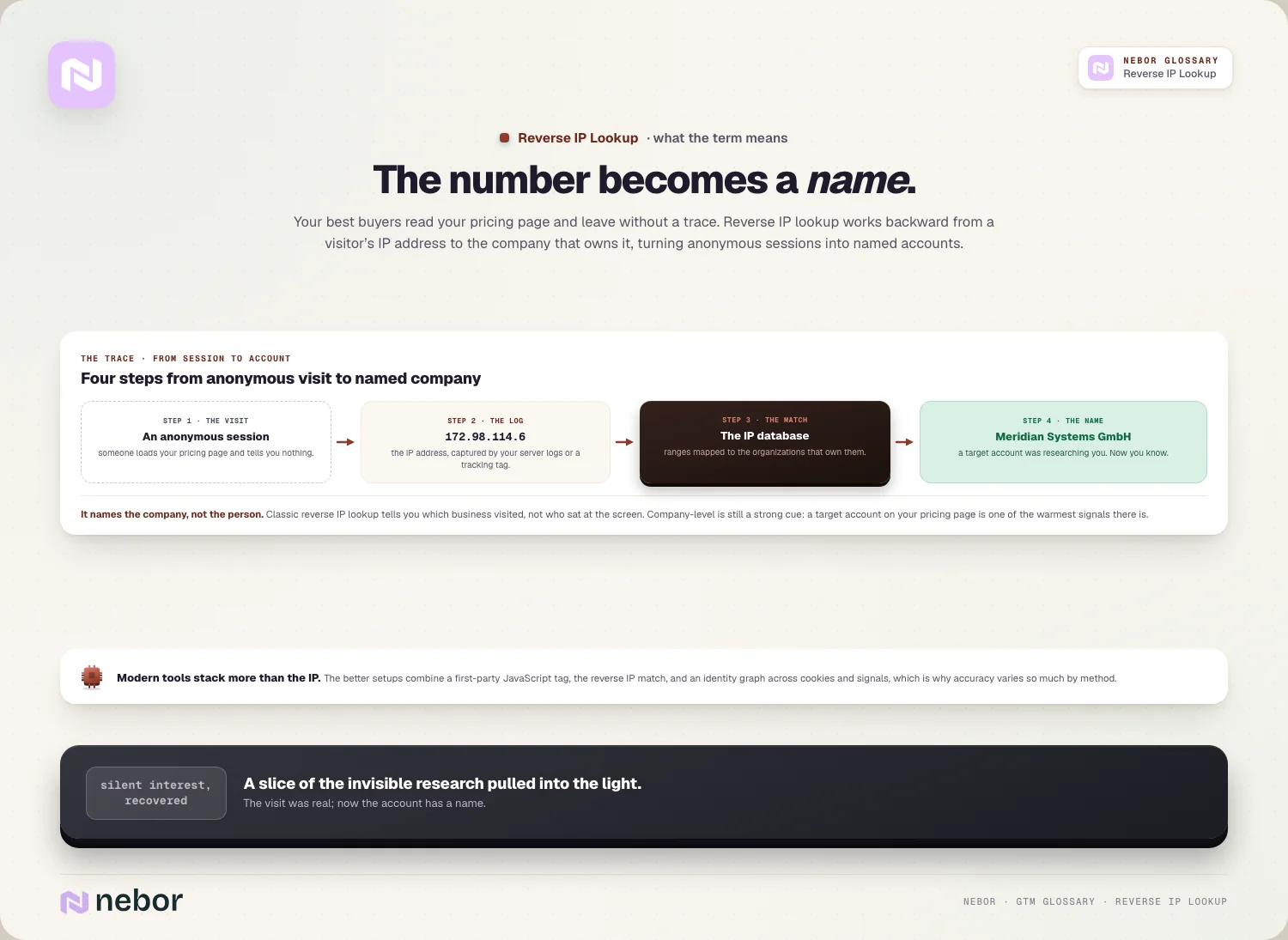
If that IP belongs to a known company, you get a match. The visit gets attached to a business name, so an anonymous session becomes an identifiable account showing interest in you.
Precision about what it identifies saves confusion later. Classic reverse IP lookup reveals the company instead of the individual person, so you learn which business visited without knowing exactly who.
That company-level signal is still valuable on its own. Knowing that a target account is researching your pricing page is a strong cue, even if you don't yet know the specific person behind the screen.
Why does so much of your website traffic stay anonymous forever?
To see why reverse IP lookup matters, you have to appreciate the problem it addresses. Almost all website visitors never tell you who they are.
The vast majority of B2B traffic leaves without converting. People research in private, comparing options long before they ever fill out a form, so by default you see numbers without names.

This invisible research is part of the dark funnel, the large portion of the buyer journey that happens where you can't track it. Real interest is there, but it's hidden.
That adds up to a big missed opportunity. A company seriously evaluating you is one of the warmest signals you can get, and without identification, that signal vanishes the moment they leave your site.
Reverse IP lookup is one attempt to recover it. By naming the companies behind some of that anonymous traffic, it pulls a slice of the dark funnel into the light.
How does reverse IP lookup work, step by step, under the hood?
The technical flow explains both the power and the limits, and it only takes a few steps to turn a raw IP into a company name.
It starts when a visitor loads a page and their IP address is captured, which happens automatically through your server logs or a tracking tag on your site.
That IP then gets matched against a database. Providers maintain large datasets mapping IP ranges to the organizations that own them, and that mapping is what turns the number into a name.
Modern tools go further than a plain lookup. The better ones combine a first-party JavaScript tag, the reverse IP match, and an identity graph against cookies and other signals to improve accuracy.
That combination is why results vary so much by method. A pure reverse IP tool typically matches around 10 to 20% of traffic, while richer multi-signal approaches reach higher.
What match rates can you realistically expect from these tools?
This is where honesty matters, because vendor claims and reality often diverge. It pays to know the real numbers before you build a strategy on them.
For company-level identification, independent testing puts realistic match rates at around 30 to 65% of US B2B traffic, well below the 60 to 80% some vendors advertise.
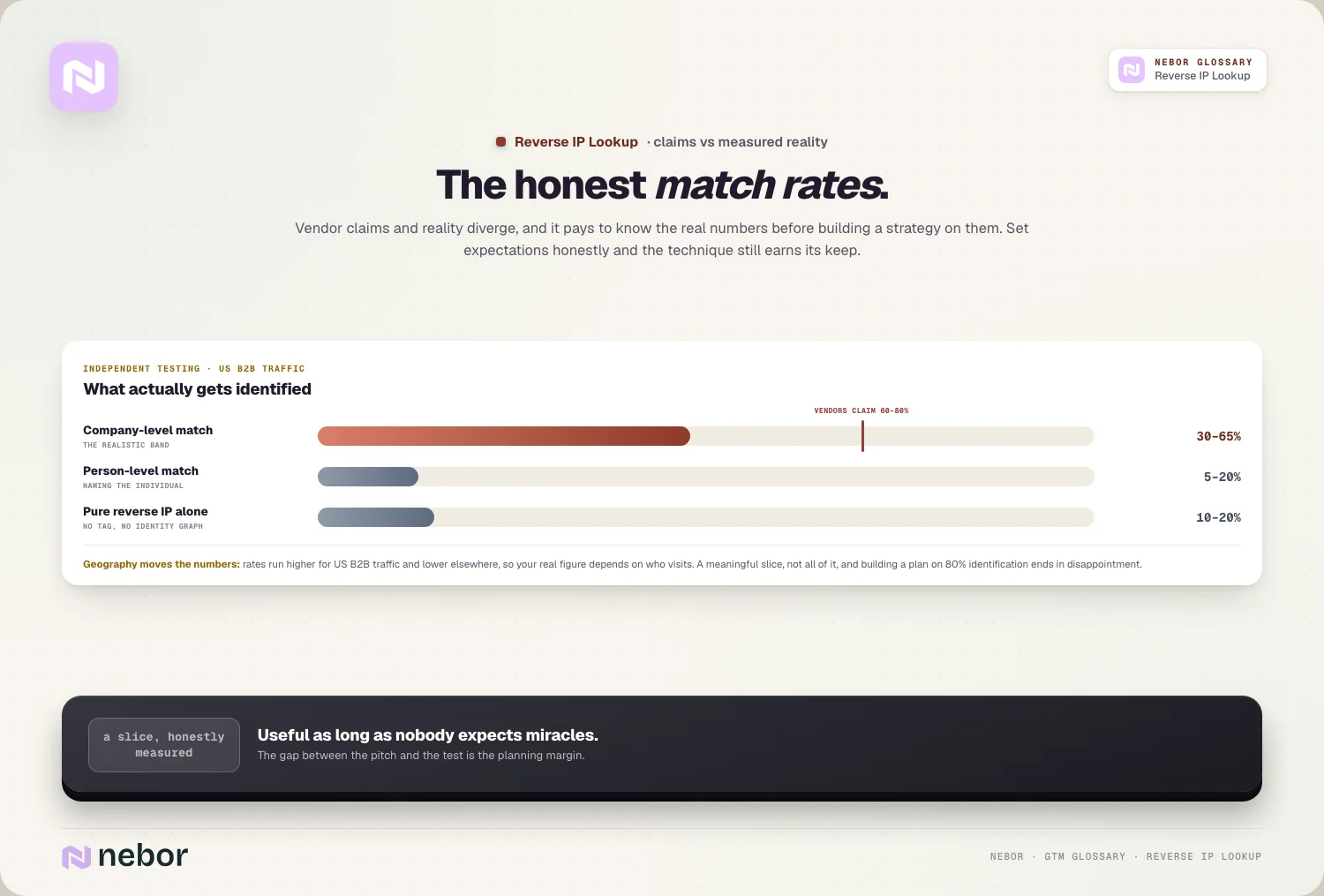
Person-level identification lands much lower than that. Matching an actual individual instead of just a company works out around 5 to 20% for US B2B traffic, so naming the exact person is far harder.
Geography and audience shift the numbers as well, because match rates are generally higher for US B2B traffic and lower elsewhere, so your real results depend heavily on who visits your site.
The takeaway is to set expectations honestly. Reverse IP lookup identifies a meaningful slice of your traffic instead of all of it, which is still useful as long as you don't expect miracles.
Why have match rates been falling across the whole industry lately?
Identification has gotten harder for reasons that are real and worth planning around, because the old assumptions about IPs broke down.
The biggest cause is the shift to remote work. When people worked in offices, their traffic came from corporate IPs that were easy to map, but home and mobile networks don't carry that signal.
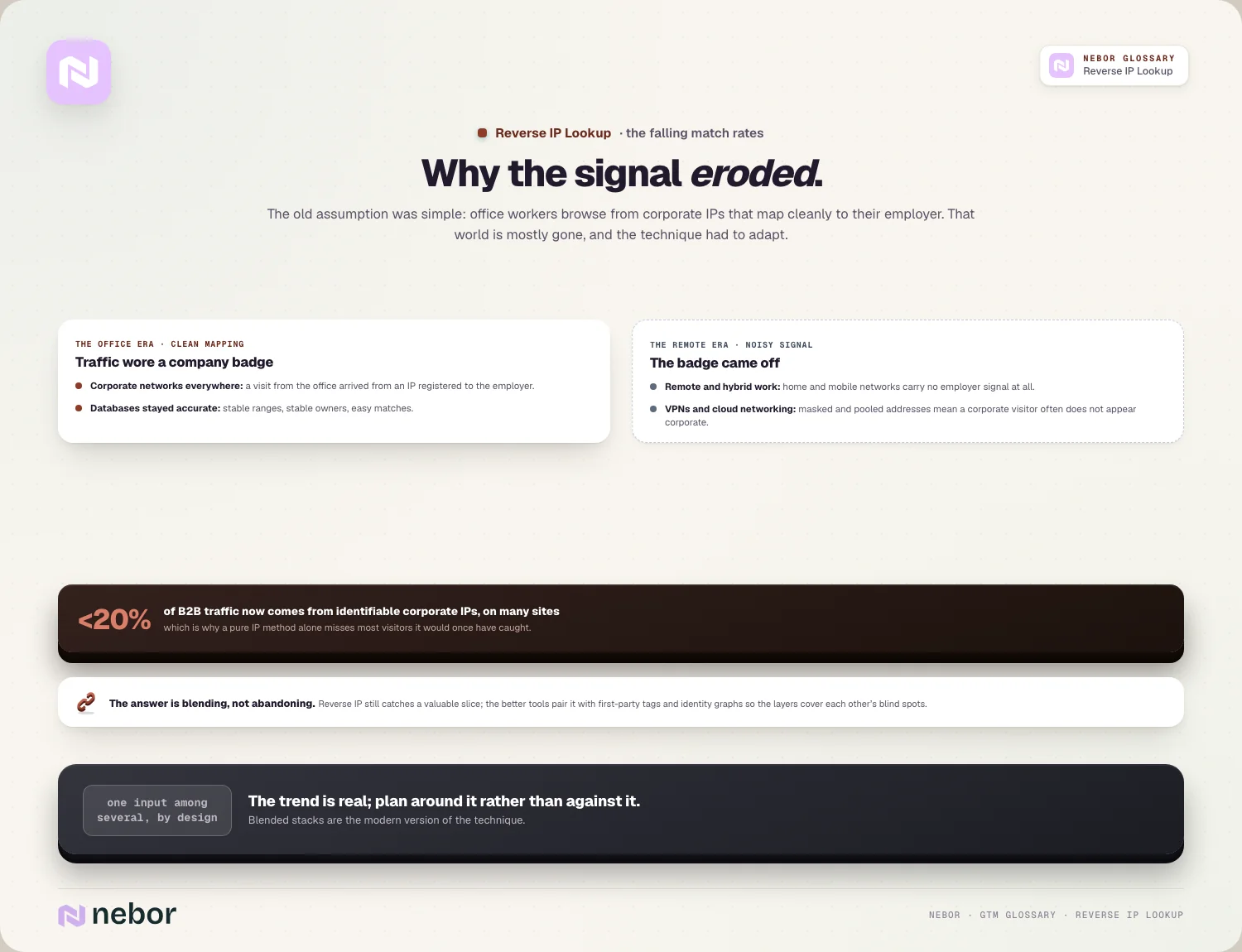
VPNs and modern networking add more noise. Tools that mask or pool IP addresses, plus cloud-first networking, mean a corporate visitor often doesn't appear to come from their company at all.
The combined effect adds up to a lot. Some estimates put the share of B2B traffic coming from identifiable corporate IPs below 20% for many sites, so pure IP methods alone now miss most of what walks in.
This is exactly why the better tools blend signals, and why we point clients toward multi-signal setups. Reverse IP lookup on its own catches less than it used to, so it works best as one input among several.
How does reverse IP lookup relate to website visitor deanonymization?
People often blur these terms, so it helps to separate them clearly. Reverse IP lookup is one technique within a broader goal.
The broader goal is website visitor deanonymization, which is identifying the anonymous visitors on your site by any reliable method. Reverse IP lookup is one of the oldest ways to do it.
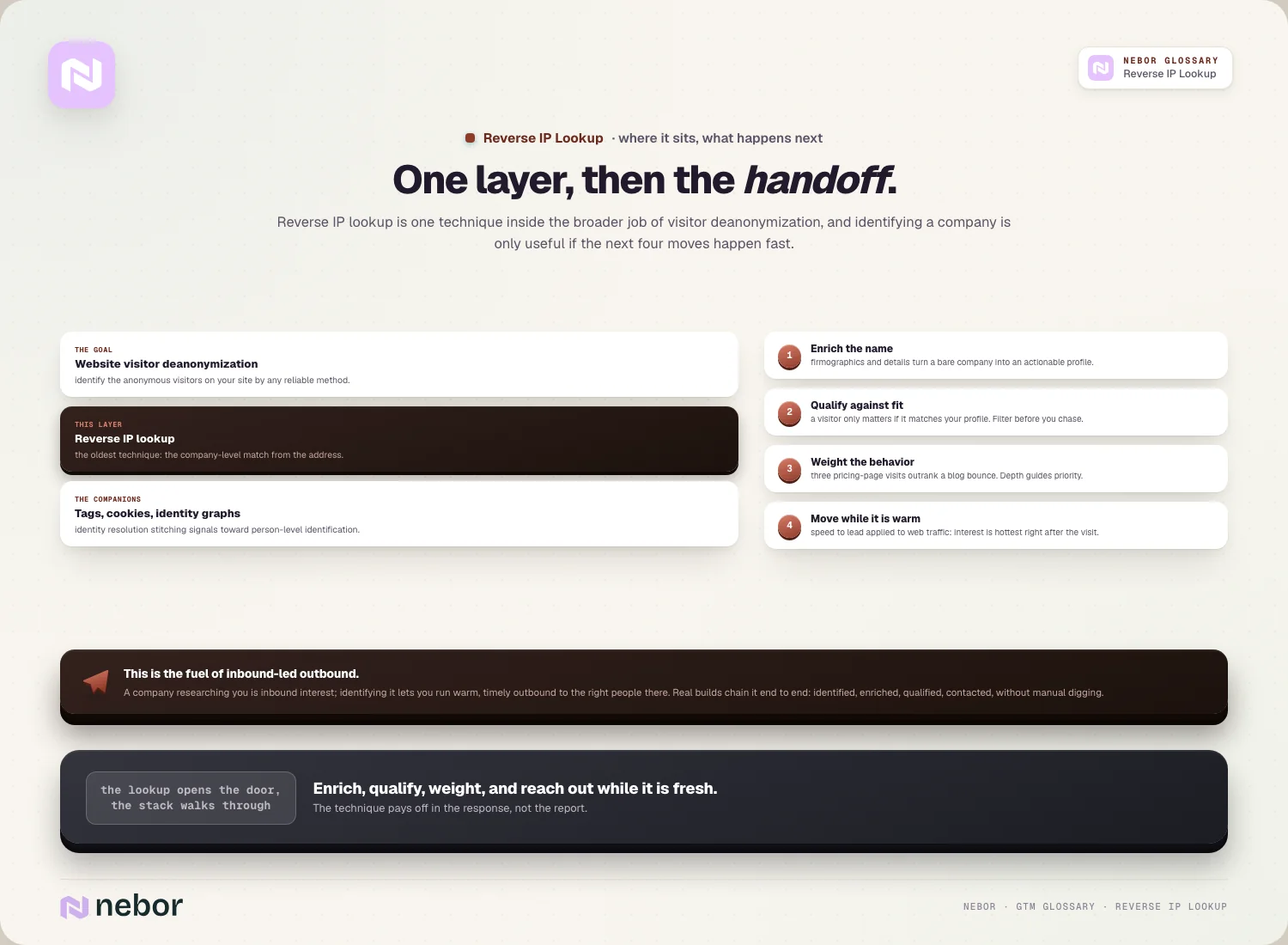
Modern deanonymization goes well beyond the IP alone. It layers in identity graphs, cookies, and matched profiles, which is the work of identity resolution stitching signals into a single identity.
So reverse IP lookup is one piece of a larger puzzle. It handles the company-level match, while other techniques push toward person-level identification.
The practical upshot is that you rarely rely on reverse IP alone now. It's one layer in a stack of methods that together turn more of your anonymous traffic into known accounts.
What do you do with a visitor once you've identified the company?
Identifying a company is only useful if you act on it well. So the value of reverse IP lookup depends entirely on what happens next.
Enrichment comes first, because once you know the company, you can pull its firmographic data and details through data enrichment, turning a bare name into an actionable account profile.
Then you qualify the account against fit, because a visiting company only matters if it matches your ideal customer profile, so you filter the identified traffic down to accounts worth pursuing.
The behavior itself carries meaning too, because a target account visiting your pricing page is a strong intent signal, telling you they're actively evaluating and worth reaching now.
That makes speed essential to the whole play. Reaching an identified, in-market account quickly is speed to lead applied to web traffic, because the interest is hottest right after the visit.
How does reverse IP lookup feed an inbound-led outbound motion?
Reverse IP lookup is most powerful as part of a connected motion, where it feeds one of the warmest plays in modern go-to-market.
The play in question is inbound-led outbound. A company visiting your site is showing inbound interest, and identifying them lets you send warm outbound to the right people there.
That turns a cold outreach into a timely one. Instead of guessing who might care, you reach out to a company you know was just researching you, which lands very differently.
This is exactly the logic behind a website visitor tracking workflow, where identified visitors trigger enrichment and outreach automatically.
Real builds we do chain it end to end, feeding your CRM along the way. The website visitor workflow examples show how an identified account becomes an enriched, qualified, contacted opportunity without manual digging.
Is reverse IP lookup compliant and privacy-safe enough to use freely?
Anything that identifies website visitors raises privacy questions, and they deserve a direct answer, though the picture is more nuanced than a simple yes or no.
Company-level identification is generally the lower-risk half. An IP mapped to an organization tells you a business visited, which is closer to firmographic information than to personal data about an individual.
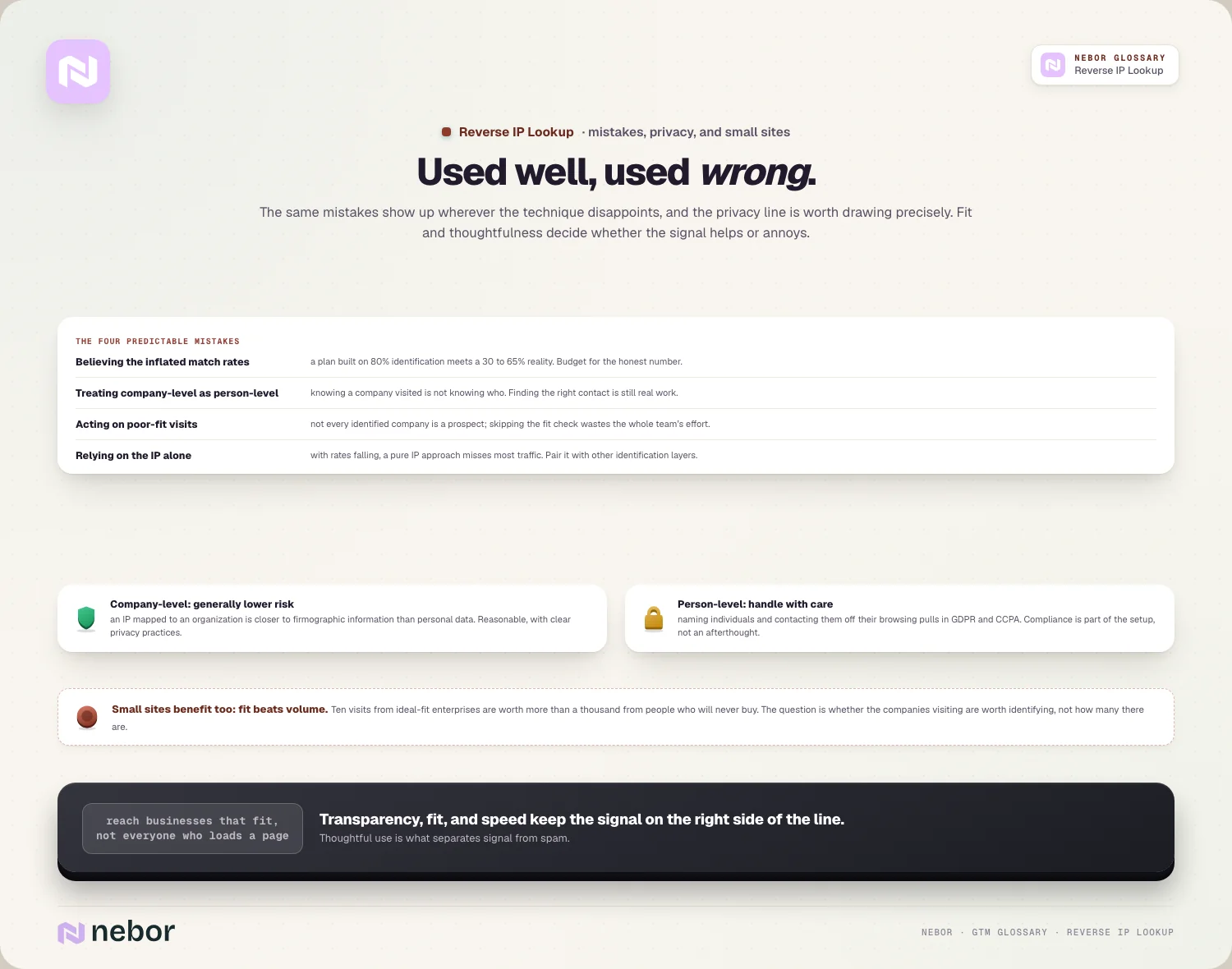
Person-level identification is where care is needed. Naming actual individuals and contacting them based on browsing pulls in privacy rules like GDPR and CCPA, which vary by region and matter a lot.
The responsible approach is transparency and fit. You use the signal to reach businesses that match your profile, with clear privacy practices, rather than scraping and spamming everyone who loads a page.
So compliance belongs in the setup from day one. When you keep it thoughtful at the company level, reverse IP lookup is a reasonable signal, and person-level identification deserves stricter handling.
How do you get the most out of reverse IP lookup once it's live?
Reverse IP lookup rewards teams who treat it as one input in a system, and in our experience a few habits separate the companies who get value from those who don't.
Focusing on fit over volume does the most, because filtering identified visitors down to accounts that match your profile keeps your team working real prospects instead of every random company.
Weighting behavior comes next, because a visitor who hit your pricing page three times matters more than one who bounced off your blog, so let the depth of the visit guide priority.
Acting fast and with context turns the signal into meetings, because reaching an identified account while their interest is fresh, armed with what they looked at, makes the outreach land far better.
And preparing for the conversation finishes the job, because walking into a meeting already knowing the account and its activity, the way a good inbound meeting workflow sets up, turns a visit into a real opportunity.
What are the common mistakes teams make with reverse IP lookup?
Reverse IP lookup gets misused in a few predictable ways we keep seeing. Knowing them keeps your expectations and your strategy realistic.
Believing inflated match rates leads the pack, because vendors often quote best-case numbers, so building a plan on 80% identification leads to disappointment when reality is far lower.
Treating company-level as person-level follows right behind, because knowing a company visited still leaves you the work of finding the right contact before anyone reaches out.
Acting on poor-fit visits burns quieter money, because not every identified company is worth pursuing, so skipping the fit check wastes effort on accounts that were never prospects.
And relying on IP alone caps the whole thing, because with match rates falling, a pure reverse IP approach now misses most traffic, so pairing it with other identification methods matters.
Does reverse IP lookup work for smaller sites or only the big ones?
A fair question is whether you need a lot of traffic for this to be worth it. The answer depends more on who visits than on how many.
High-traffic sites get more raw matches, simply because more visitors mean more identifiable companies. So at scale, reverse IP lookup can surface a steady stream of accounts.
But a smaller site can still benefit a lot. If your traffic is low but highly targeted, even a handful of identified accounts a week can be valuable when they're the exact companies you want.
What matters most is the fit of the traffic instead of the volume. Ten visits from ideal-fit enterprises are worth more than a thousand from people who will never buy.
So don't dismiss it as an enterprise-only tool. The real question is whether the companies visiting you are worth identifying, and for most B2B sites with good-fit traffic, some of them clearly are.
Why naming even a slice of your anonymous traffic changes what you can do
Reverse IP lookup matters because it recovers signal you'd otherwise lose entirely. Most of your site traffic stays anonymous, and naming even a portion of it turns silent interest into accounts you can act on.
The honest framing is that it delivers a useful slice instead of a full solution. Match rates have fallen, person-level identification is hard, and a pure IP method now misses most visitors, so it works best as one layer among several.
The real value shows up in what you do with it. An identified, good-fit company researching you is a warm signal, and reaching out quickly and relevantly is where the technique pays off.
So treat reverse IP lookup as a starting point rather than the whole answer. It opens the door, and the rest of your stack walks through it.
Combined with richer identification, enrichment, and a fast inbound-led outbound motion, it helps you turn quiet website visitors into real conversations. That is the entire point of identifying them in the first place.
Share this post
Intent
Data
Glossary
Related glossary items
Understanding the core GTM concepts




Ready to build your pipeline











