

In this post:
Every quarter, sales leaders present a confident number to the board. And every quarter, most of them miss it, often badly, because the forecast was an educated guess dressed up to look like a calculation.
The gap between the number you promise and the number you hit is what forecast accuracy measures. For most companies that gap is uncomfortably large, which makes their forecasts closer to fiction than fact.
Forecast accuracy is how closely your sales forecast matches your actual results, usually expressed as the percentage difference between what you predicted and what you achieved. It measures whether your forecast can be trusted at all.
The whole business depends on the forecast. Hiring, spending, and planning all assume the number is real, so when forecasts are wildly off, every decision built on them is built on sand.
TL;DR
Forecast accuracy measures how close your predicted sales come to your actual results, shown as the percentage variance between forecast and reality.
The business plans around the forecast, so an inaccurate one means hiring, budgeting, and strategy are all based on a number that won't come true.
Most companies forecast poorly, missing by well over 10%, while top performers stay within a tight band. The gap usually comes down to data and process.
The lesson underneath is that accuracy comes from clean data and disciplined process instead of better guessing. A forecast built on messy pipeline data and gut feel will always be unreliable.
What is forecast accuracy, and how is the number usually expressed?
Forecast accuracy measures the difference between what you predicted you'd sell and what you really sold, telling you how trustworthy your forecast is.
It's usually expressed as a percentage variance. If you forecast a million dollars and close $900,000, your forecast was off by 10%, so your accuracy is within a 10% band.
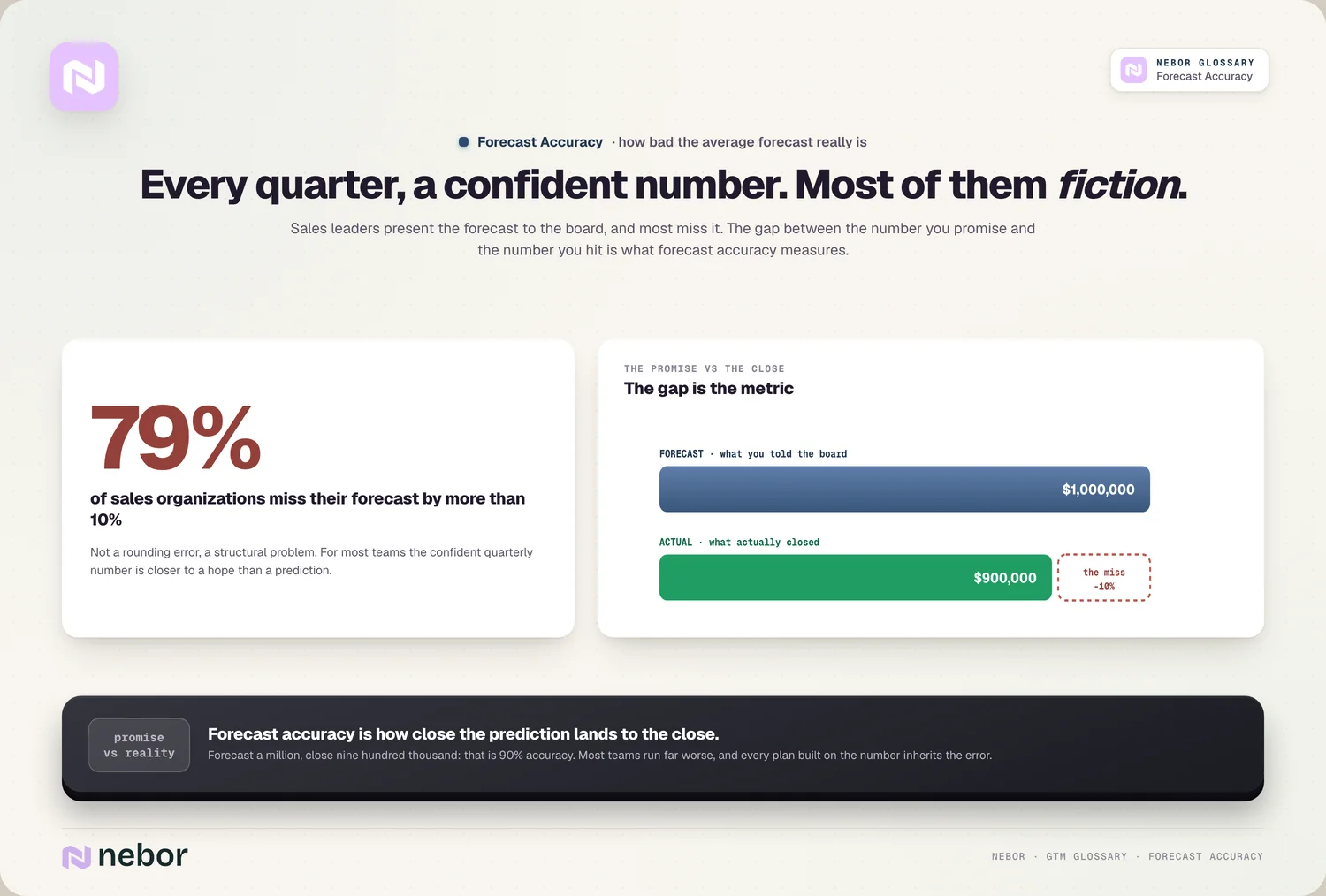
It works in both directions at once. Missing low and overshooting both count as inaccuracy, because a forecast that's wildly over is as unhelpful for planning as one that's wildly under.
It's measured over a defined period as well. Forecast accuracy is tracked per quarter or month, and the consistency of your accuracy over time matters as much as any single period.
So forecast accuracy is really a measure of how much you can trust your own predictions. The tighter and more consistent your accuracy, the more confidently the business can plan around the number.
Why are most sales forecasts so inaccurate, year after year?
The numbers on average forecast quality are sobering, because most organizations miss by a wide margin.
The majority miss badly, and keep missing. Research finds that around 79% of sales organizations miss their forecast by more than 10%, with only about a fifth landing within that band.
High performers are more rare than you'd expect. Most B2B teams operate at around 15 to 25% variance, while top performers reach 5 to 10%, so genuine accuracy is the exception.
The causes are structural instead of mysterious. Forecasts fail because of messy pipeline data, inconsistent deal stages, optimistic reps, and gut-feel adjustments, and none of that is the future being unknowable.
So most forecasts are inaccurate by default. Forecasting is far from impossible, but most teams forecast on bad data and loose process, which guarantees a big miss.
Why does forecast accuracy matter so much beyond the sales team?
The stakes of an inaccurate forecast are higher than they look, because so much depends on the number, and the damage spreads everywhere it touches.
The business plans its year around it. Hiring, budgets, and investment decisions all assume the forecast is real, so when it's wrong, those commitments are made on a false basis.
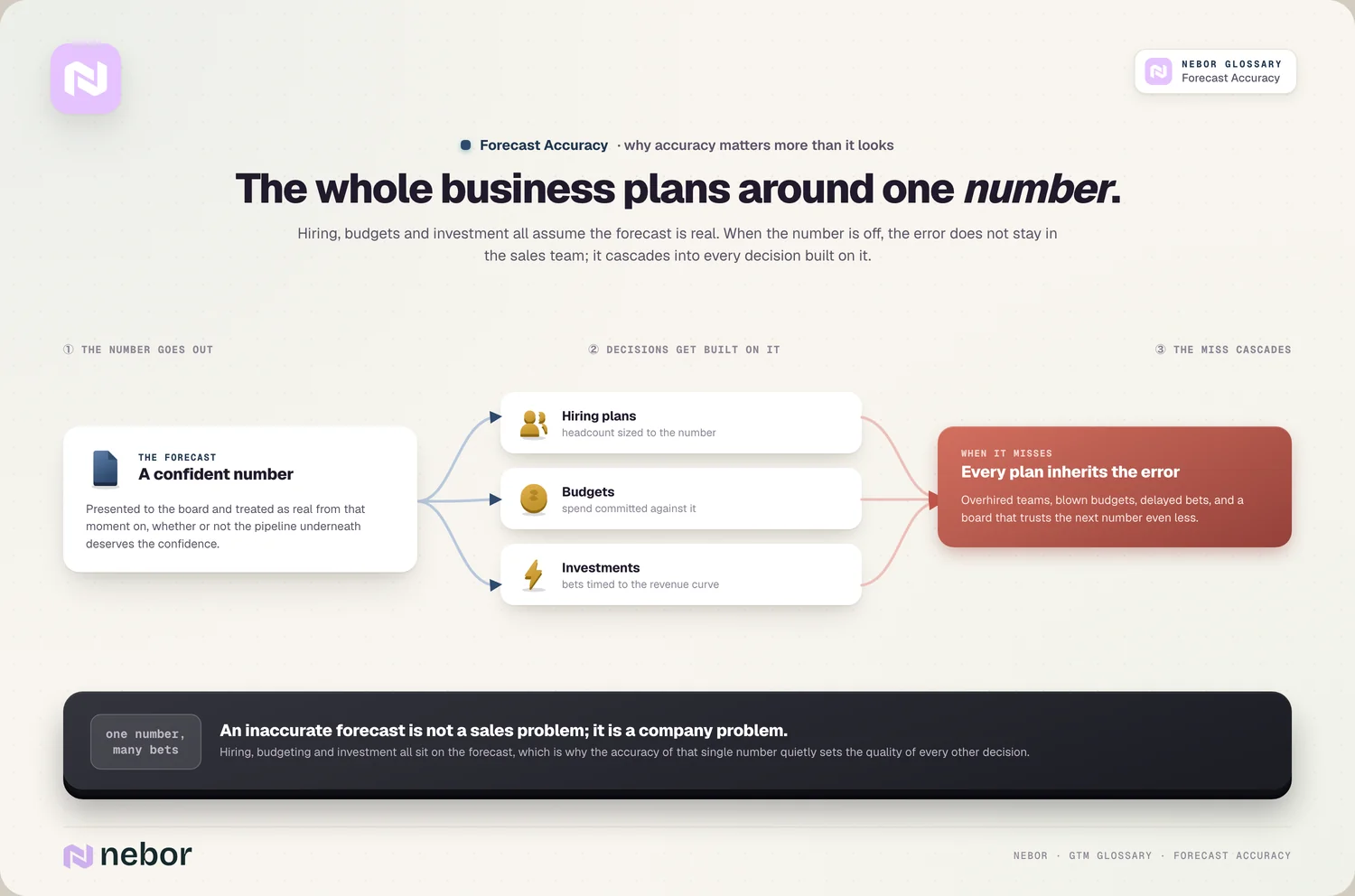
A high forecast that misses is dangerous. Spending ahead of revenue that never arrives can put a company in real trouble, so overshooting is as harmful as falling short.
It erodes trust as well, meeting by meeting. When a sales leader's forecast misses repeatedly, the board and the rest of the business stop trusting any number they present.
So forecast accuracy works as a foundation for the whole company's planning, well beyond a sales metric. An unreliable forecast makes every downstream decision riskier than it needs to be.
Where does forecast accuracy genuinely come from in practice?
The key insight about forecasting is that accuracy comes from inputs and process instead of better intuition, and two things drive it most.
Clean data comes first, because a forecast built on messy pipeline data is unreliable by definition, and that makes CRM hygiene a precondition for any accurate forecast.
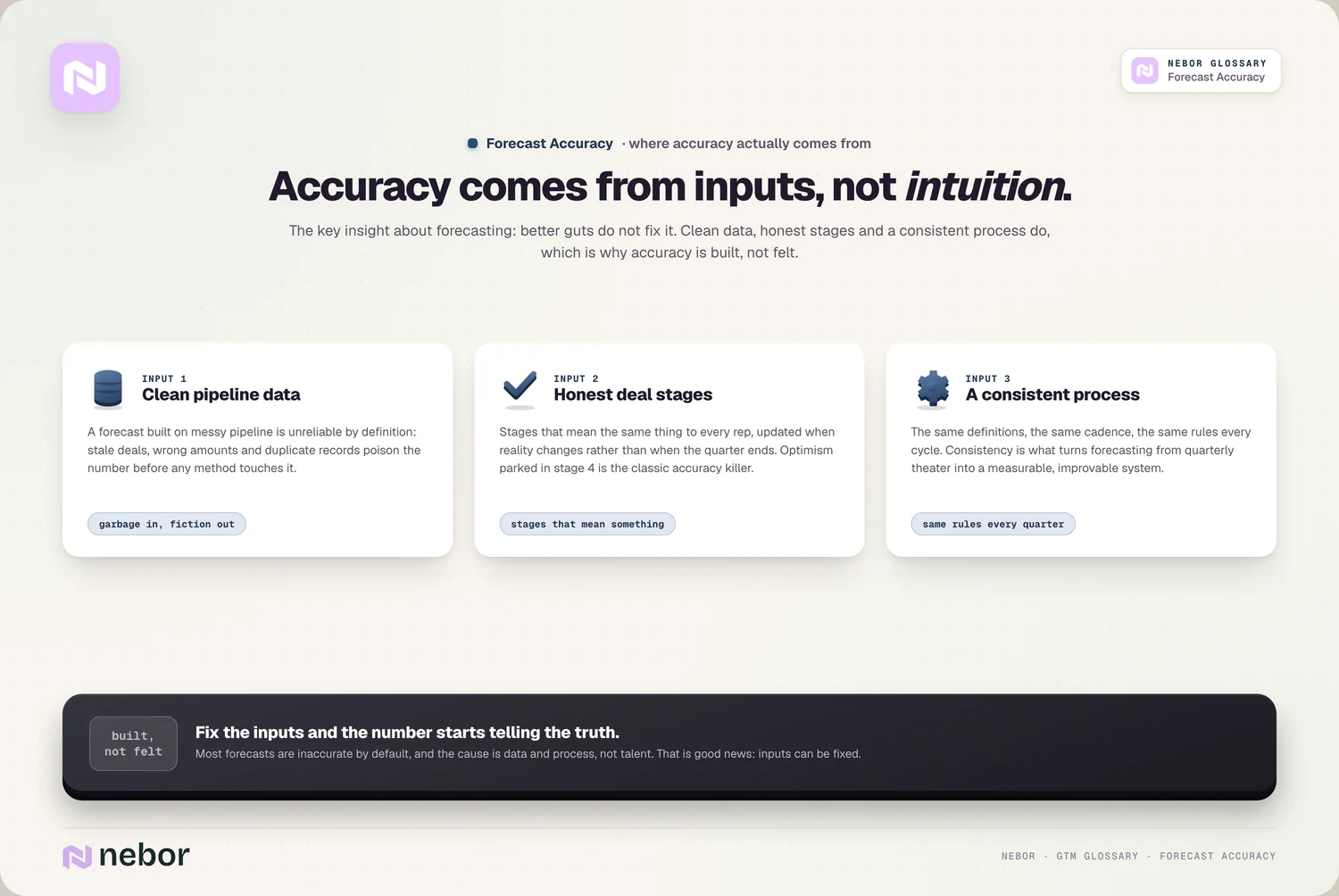
Consistent process comes right behind the data. When deal stages mean the same thing across the team and reps update honestly, the pipeline reflects reality, and that reality is what a forecast depends on.
It also rests on understanding your funnel. Knowing your real conversion rate at each stage lets you forecast from what's in the pipeline instead of guessing.
So accuracy is engineered instead of intuited. The teams that forecast well do so because their data is clean and their process is disciplined, with no special gift for prediction involved.
How does the state of your pipeline data drive the forecast you produce?
Since forecasts are built on the pipeline, the quality of that pipeline data is decisive, and a few connections matter most.
Your pipeline is the raw material of the forecast. The deals in it, weighted by their stage and likelihood, are what the forecast is calculated from, so the pipeline has to be accurate.
Velocity tracking sharpens the projection more than most levers. Teams that watch pipeline velocity closely forecast far better, with weekly tracking linked to around 87% accuracy versus 52% for irregular tracking.
Scoring adds another layer of rigor on top. Using predictive lead scoring and lead scoring to judge which deals will really close makes the forecast less dependent on rep optimism.
So forecasting is really pipeline analysis in disguise. The better you understand and maintain your pipeline, the more accurate your forecast becomes, because the forecast is just a projection of that pipeline.
How do you improve forecast accuracy without better crystal balls?
Improving accuracy is mostly about fixing the inputs and process, and in our experience a few practices do the heavy lifting.
Cleaning the data comes before everything, because accurate deal stages, current pipeline, and honest updates are the foundation, and no method overcomes bad data.
Standardizing the process follows, because defining what each stage means and requiring consistent updates makes the pipeline comparable, so the forecast rests on a common reality.
Tracking regularly catches problems early, because reviewing pipeline and velocity frequently spots drift before it compounds, and frequent tracking correlates strongly with accuracy.
And reducing gut-feel closes the biggest leak, because replacing optimistic rep estimates with data-driven judgments, like scoring and historical conversion, removes a major source of error.
Who should own forecast accuracy inside a revenue organization?
Forecast accuracy tends to fall between teams, so ownership deserves clarity, and in our experience it's largely a RevOps responsibility.
Revenue operations owns the data and process. Because accuracy depends on clean pipeline data and consistent process, the function that owns those owns the forecast's reliability.
Sales provides the raw inputs every week. Reps update deals and provide estimates, so their honesty and discipline directly affect accuracy, and that's where process and incentives matter.
Leadership consumes the finished output of both. The forecast informs company decisions, so leaders need to trust it, which they only can if RevOps has made it reliable.
So forecast accuracy is a shared effort with a clear owner. RevOps builds the reliable system, sales feeds it honestly, and leadership plans on the result.
How does forecast accuracy connect to the wider revenue operation?
Forecast accuracy works as a readout of how well your whole revenue operation is understood, connecting to almost everything around it.
It reflects your revenue engine more directly than anything. An accurate forecast means you understand how your revenue engine behaves, which is a sign the engine is well-built and well-measured.
It depends on understanding your retention too. For recurring businesses, forecasting also means predicting net revenue retention, because existing customers drive much of future revenue.
It benefits from attribution work as well. Knowing which sources reliably produce revenue, through multi-touch attribution, makes forecasting future pipeline more grounded.
So forecast accuracy is a measure of self-knowledge. A company that forecasts well understands its own motion, and accuracy improves naturally as the rest of the operation matures.
How do you measure forecast accuracy so the number means something?
Measuring accuracy sounds simple, but a few choices shape the number, and getting them consistent is what makes it meaningful.
The basic calculation is the variance itself. You compare what you forecast to what you closed, and express the difference as a percentage, which gives you the accuracy band.
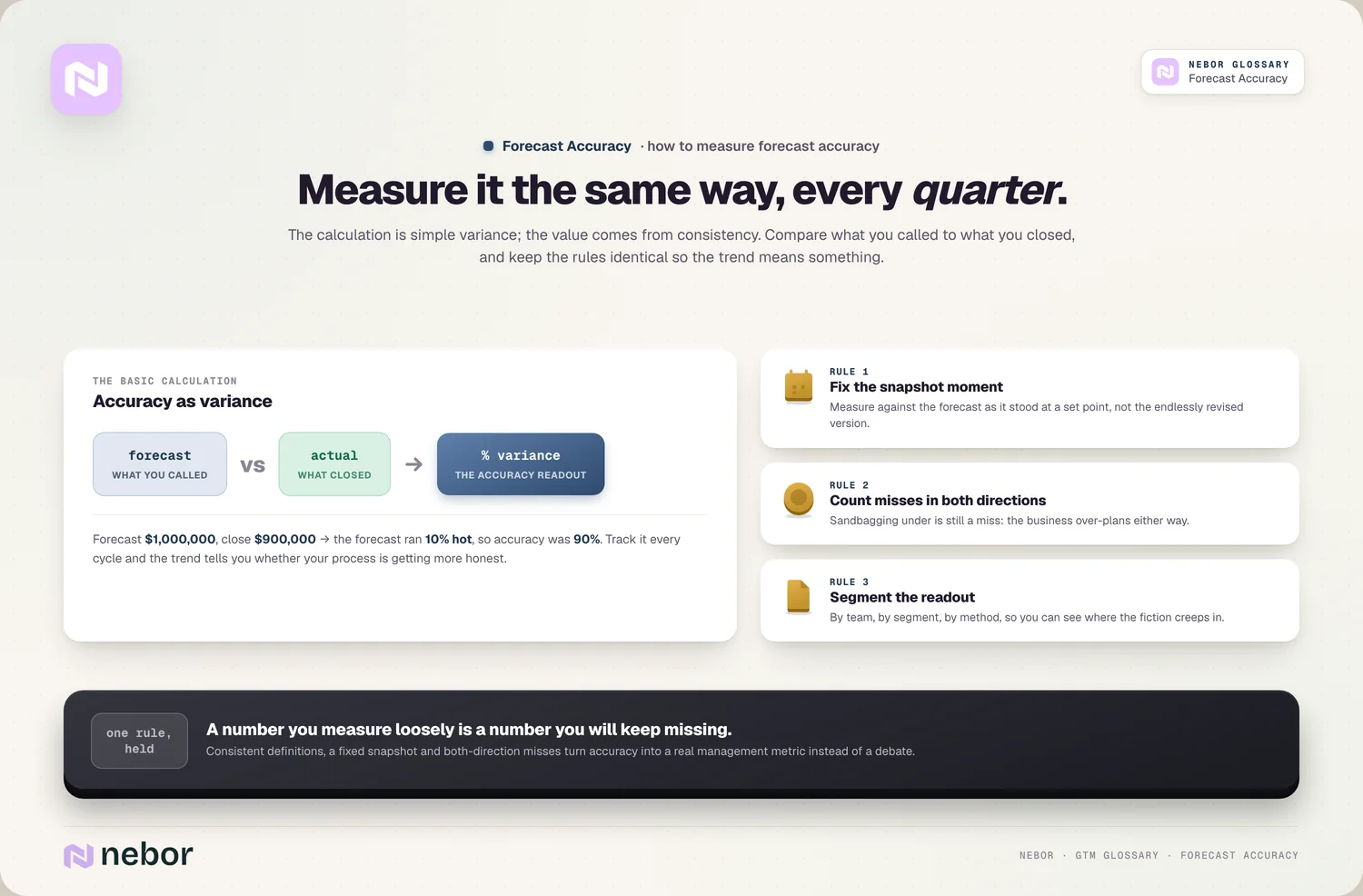
Direction matters alongside the size of the miss. Tracking whether you tend to over- or under-forecast reveals a systematic bias you can correct, which a single accuracy number hides.
Consistency is the real measure in the end. A forecast that's accurate one quarter and wildly off the next isn't trustworthy, so you track accuracy over time instead of once.
So measure accuracy as a trend with direction instead of a one-off percentage. That fuller view tells you whether your forecasting is reliable or just occasionally lucky.
What are the main forecasting methods, from gut feel to data-driven?
There are several ways to build a forecast, and they vary enough in rigor that knowing them helps you choose.
The simplest method is pure gut-feel estimation. Reps and managers guess what will close based on intuition, which is fast but the least reliable and most prone to optimism.
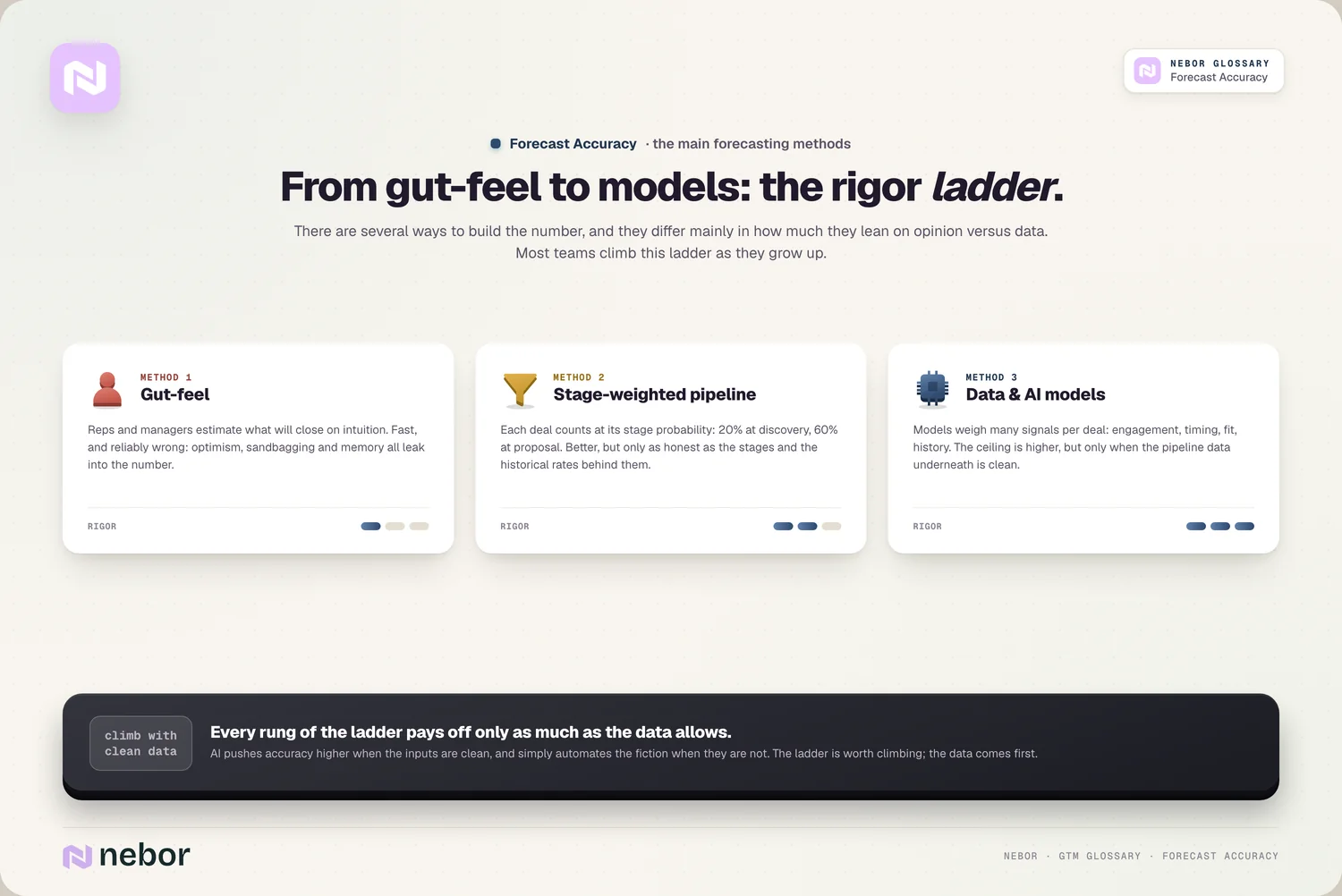
Pipeline-weighted forecasting stands on much firmer ground. You weight each deal by its stage probability, so the forecast reflects the actual pipeline instead of a feeling.
Historical and conversion-based methods add the most rigor. Using your real conversion rates and past patterns to project forward removes more guesswork from the number.
So forecasting methods range from intuition to data-driven. The more you lean on real pipeline data and conversion history instead of gut feel, the more accurate the forecast tends to be.
How does AI change what forecast accuracy is possible to reach?
AI is reshaping forecasting, pushing accuracy higher wherever the data supports it.
AI weighs far more signals at once. Instead of simple stage probabilities, AI models can weigh many factors across deals to predict which will close, sharpening the forecast.
It reduces human bias in the process. By basing predictions on patterns instead of rep optimism, AI removes a major source of forecast error.
But it still needs clean data underneath. AI forecasting on messy pipeline data produces confident, wrong predictions, so the data foundation matters as much as the model.
So AI raises the ceiling on forecast accuracy without touching the floor. It helps teams with good data forecast better, but it can't rescue a forecast built on a messy pipeline.
How does customer fit upstream affect your forecast accuracy?
A subtle driver of forecast accuracy is who's in your pipeline. The quality of the deals shapes how predictable they are.
Good-fit deals behave far more predictably than the rest. Deals that match your ideal customer profile tend to convert at consistent rates, which makes them easier to forecast.
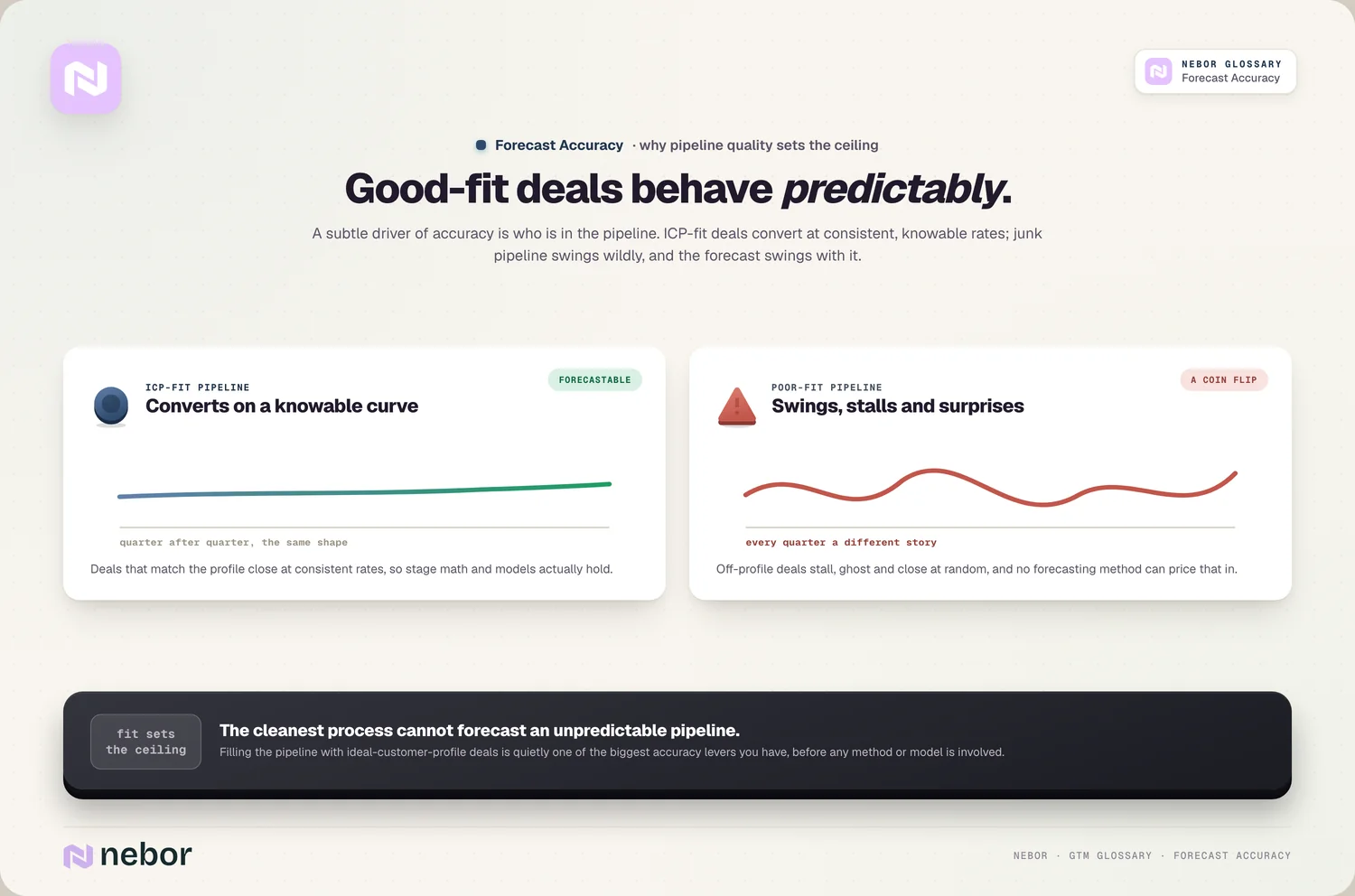
Poor-fit deals add noise to everything downstream. Deals that were never a great match behave erratically, stalling or dying unpredictably, which makes the whole forecast harder to trust.
So tighter targeting improves the forecast itself. A pipeline full of well-fit deals is more predictable than one stuffed with marginal ones, which means fit upstream improves accuracy downstream.
So forecast accuracy starts before the forecast. A disciplined pipeline of good-fit deals is inherently more forecastable, which is another reason targeting quality matters.
What are the common mistakes teams make with forecast accuracy?
Forecasting goes wrong in a few predictable ways, and we keep seeing the same ones when clients show us their models. Avoiding them is most of what improves accuracy.
Forecasting on bad data undermines every method, because a forecast built on a messy pipeline is unreliable no matter how you calculate it, so data quality has to come first.
Relying on gut feel comes next, because optimistic rep estimates and intuition-based adjustments introduce error that data-driven judgment would have reduced.
Inconsistent stages corrupt the raw material, because when deal stages mean different things to different reps, the pipeline can't be trusted, so the forecast inherits the inconsistency.
And tracking too rarely lets drift compound, because reviewing the forecast only at quarter-end means you miss the chance to catch and correct problems while there's still time.
Why is forecast accuracy worth the effort it takes to build?
Forecasting can feel like an administrative chore, but accuracy earns real advantages that repay the effort.
It enables confident decisions across the company. When you trust the forecast, you can hire, spend, and invest decisively, because you know the revenue is likely to arrive as predicted.
It steers you around the costliest mistakes too. An accurate forecast keeps you from spending ahead of revenue that won't come, which is one of the most dangerous traps a growing company faces.
It builds credibility one quarter at a time. A sales leader who consistently hits forecast earns trust from the board and the rest of the business, which makes future planning smoother.
So forecast accuracy is a strategic asset rather than busywork. The ability to predict revenue reliably is what lets a company plan and grow with confidence instead of lurching from surprise to surprise.
Why a forecast the business can trust has to be engineered deliberately
The whole business plans around the forecast. When the number is unreliable, every decision built on it, from hiring to spending, rests on a false foundation.
The deeper point is that most forecasts are inaccurate by default, and the cause is data and process instead of the unknowable future. Teams that forecast well do so because their pipeline is clean and their process is disciplined.
The honest reality is that accuracy gets engineered piece by piece. Clean data, consistent stages, frequent tracking, and less gut-feel are what turn a forecast from fiction into something the business can trust.
So if your forecasts keep missing, the fix is better inputs rather than better intuition. Building forecast accuracy on clean data and disciplined process is what makes the number real.
That reliability is a core capability of any mature go-to-market system. It gets stronger as you automate sales prospecting and feed more reliable data into the pipeline the forecast is built from.
Deel dit bericht
RevOps
Begrippenlijst
Gerelateerde begrippen
De basis GTM-concepten begrijpen




Klaar om je pipeline te bouwen