

In this post:
Your rep closes a two-year deal worth 240,000 dollars and the whole company celebrates, but almost none of that number is money you can report as earned yet. The contract is signed, the customer has committed, and still your financial statements will recognize only a small slice of it this month.
That gap between what was sold, what gets invoiced, and what you can count as income is where bookings, billings, and revenue live. They describe three moments in the life of one deal, and treating them as interchangeable is a common way SaaS teams mislead themselves about how the business is doing.
Bookings, billings, and revenue are three distinct metrics that track a contract from signature to recognized income. Bookings are the value of contracts signed in a period, billings are the amounts you've invoiced, and revenue is the portion you've earned by delivering the service.
Keeping them straight matters because each answers a different question. Bookings tell you what your team committed, billings tell you what's gone out of your CRM as invoices, and revenue tells you what you've earned, so mixing them up paints a picture that's either far too rosy or simply wrong.
TL;DR
Bookings are the value of contracts signed in a period, a forward-looking promise of future revenue that isn't yet earned and doesn't appear on your income statement.
Billings are the amounts you've invoiced customers, which affect cash and deferred revenue, and often differ from both bookings and revenue depending on how you invoice.
Revenue is the portion of a contract you've earned by delivering the service, recognized over the contract's life under accounting rules rather than counted upfront when the deal is signed.
The three are stages of one lifecycle, so confusing them, especially treating a big bookings number as if it were revenue, is a classic SaaS reporting mistake that flatters the business.
What bookings count, and why they are a promise instead of earned money
Bookings capture the total value of the contracts your sales team signs in a given period, which makes them fundamentally a forward-looking commitment. When a customer signs, they've promised to pay over the life of the deal, and bookings record the full value of that promise the moment the ink dries.
Because they represent future money instead of earned money, bookings never appear directly on your financial statements. They're a sales metric, useful for measuring what the team sold, but accounting rules don't let you report a signed promise as income until you've delivered against it.
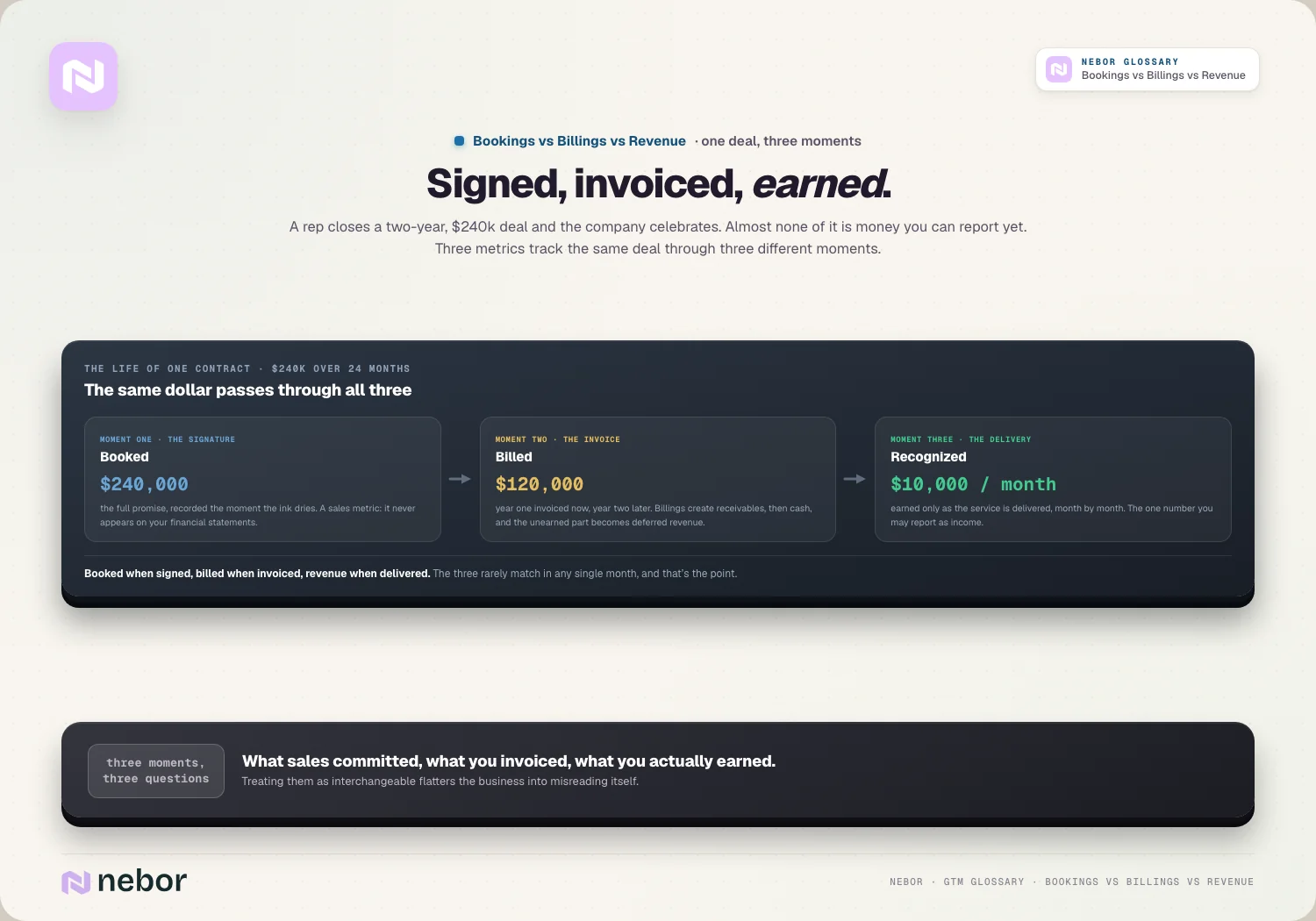
Bookings can also include pieces revenue treats very differently, like one-time setup fees or the full value of a multi-year deal. A three-year contract books at full value upfront even though the service is delivered across three years, and that's how a bookings number can dwarf the revenue you recognize this period.
How billings differ from bookings once the invoices start going out
Billings are the amounts you've invoiced customers in a period, which is a different event from signing the contract. A deal is booked when it's signed, but it's billed only when you send an invoice, and those two moments can be far apart depending on how the contract is structured.
The way you invoice determines how billings relate to bookings. If you bill a two-year deal annually, you book the full two years at signature but bill only the first year now, so billings for the period are smaller than bookings, with the rest invoiced later as the contract rolls forward.
Billings matter because they drive cash and land on the balance sheet in a way bookings don't. Invoicing a customer creates accounts receivable and, once paid, cash, while the portion billed but not yet earned becomes deferred revenue, so billings bridge a signed promise and the money moving.
Why revenue is the only one of the three you are allowed to report as earned
Revenue is the amount you've genuinely earned by delivering your service, and it's the only one of the three that accounting rules let you report as income. You recognize it as the performance obligation is fulfilled, which for a subscription means spreading it across the months you provide the service.
This is the heart of SaaS revenue recognition and where the biggest confusion lives. If a customer pays a full year upfront, you don't book a year of revenue that month, you recognize one twelfth of it each month across the year, because you earn it only as you deliver the service you promised.
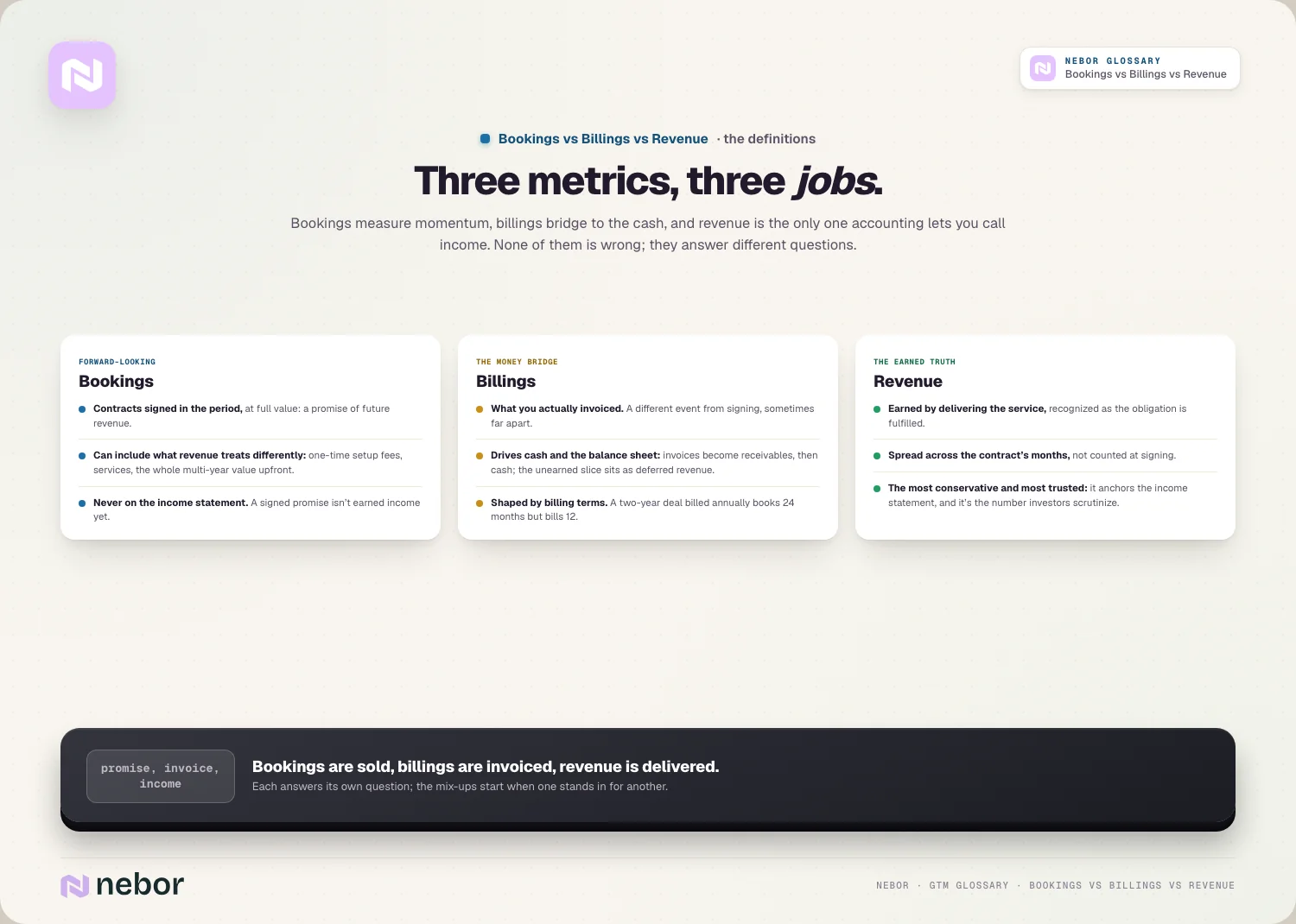
The result is that revenue is the most conservative and most trustworthy of the three numbers. Bookings and billings can both get ahead of what you've earned, but revenue reflects value actually delivered, so it anchors your income statement and investors treat it as the real measure of the business.
How the three connect as stages of one lifecycle from signature to recognized income
The cleanest way to hold the three together is to see them as sequential stages of one deal rather than competing metrics. A contract is booked when it's signed, billed when it's invoiced, and recognized as revenue as the service is delivered, so every dollar generally travels through all three in that order.
Timing is what separates the stages, because the same dollar becomes a booking, then a billing, then revenue at different moments. A deal signed in January, invoiced in February, and delivered across the next year shows up in each metric in different periods, so the three rarely match in one month.
This lifecycle view is also why bookings are the top of a revenue waterfall and revenue at the bottom. Bookings represent everything sold, and the waterfall traces how those commitments convert into recognized revenue over time, with billings marking the invoicing step in between.
Where deferred revenue belongs and why billing ahead creates a liability rather than income
Deferred revenue ties billings and revenue together, and it confuses people because it's a liability instead of an asset. When you invoice a customer for service you haven't delivered yet, that billed-but-unearned amount stays on your balance sheet as a promise you still owe instead of income you've earned.
It works as a holding account that drains into revenue over time. As you deliver each month of service, a slice of deferred revenue converts into recognized revenue, so a customer who paid a year upfront starts with a large deferred balance that shrinks steadily as the year progresses and you earn what they prepaid.
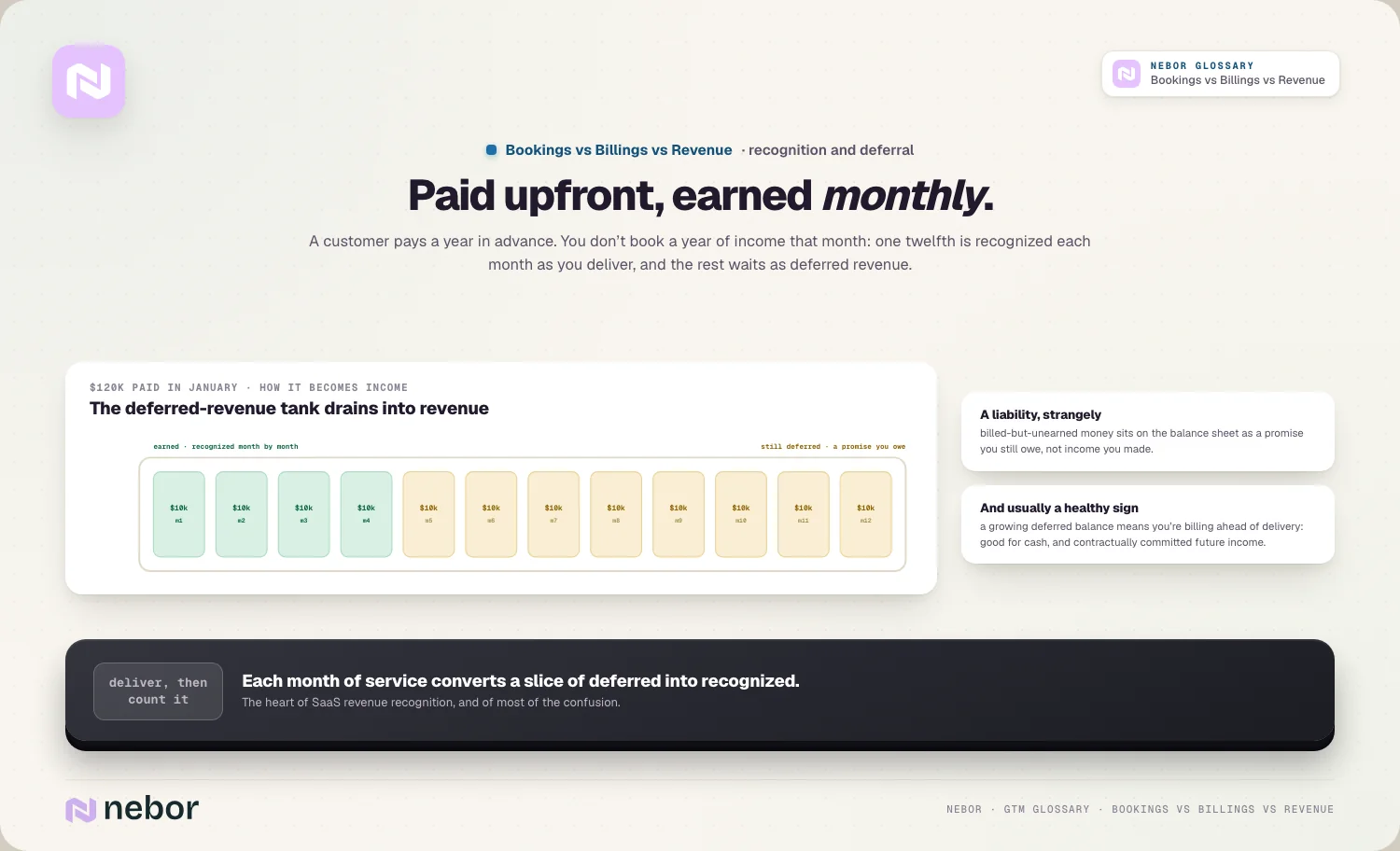
This is why a growing deferred revenue balance is often a healthy sign despite being a liability. It usually means you're billing ahead of delivery, which is good for cash, and it represents revenue you're contractually going to earn, so finance teams read it as committed future income instead of a debt.
How ARR relates to all three without ever appearing on your financial statements
Annual recurring revenue gets tangled into this because it sounds like revenue but behaves more like a normalized bookings metric. ARR is the annualized value of your recurring subscriptions, a way to express the annualized value of the base, and like bookings it never appears directly on your financial statements.
The key difference from bookings is that ARR strips out anything that isn't recurring. A booking might include one-time setup fees or professional services, but ARR counts only the repeatable subscription value, which makes it a cleaner measure of the durable revenue base a subscription business depends on.
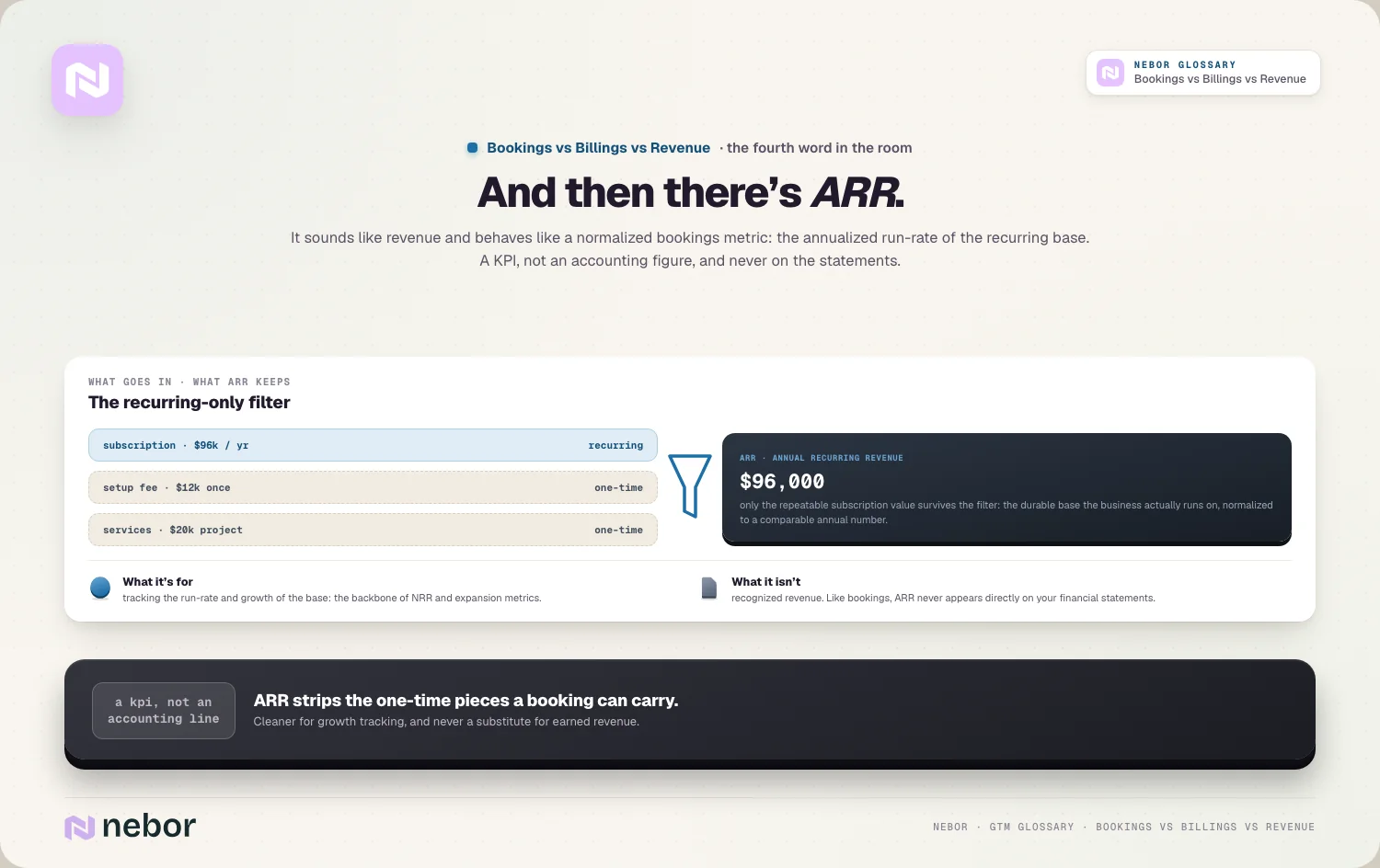
ARR is best understood as a KPI instead of an accounting figure, which keeps it distinct from recognized revenue. It normalizes contracts of different lengths into a comparable annual number, so it's ideal for tracking growth through metrics like net revenue retention and expansion revenue.
Why confusing these three metrics leads to the most common SaaS reporting mistakes
The most damaging mistake is treating a big bookings number as if it were revenue, which makes a company look far larger than it is. A quarter of heavy multi-year bookings can post an impressive signed figure while recognizing only a fraction as revenue, so reporting one as the other badly overstates the business.
A subtler error is comparing the three across companies without checking definitions, because teams draw the lines differently. One company's bookings might include renewals and services while another's counts only new subscriptions, so a comparison is meaningless unless both define the metric the same way.
These mix-ups also distort planning when go-to-market and finance use different vocabularies. If sales celebrates bookings while finance plans on recognized revenue, the two can disagree without realizing they're measuring different things, so aligned definitions underpin clean revenue operations.
What each metric tells you about a different part of your business
The three metrics form a diagnostic set instead of rivals, because each illuminates a different part of the machine. Bookings measure sales momentum, showing what the team is closing, which makes them a companion to quota attainment and pipeline coverage and a leading indicator of revenue to come.
Billings are closer to the cash and operational side of the business. They tell you what you're invoicing and therefore what cash you can expect to collect, so they matter enormously for managing working capital and understanding the timing gap between selling something and being paid for it.
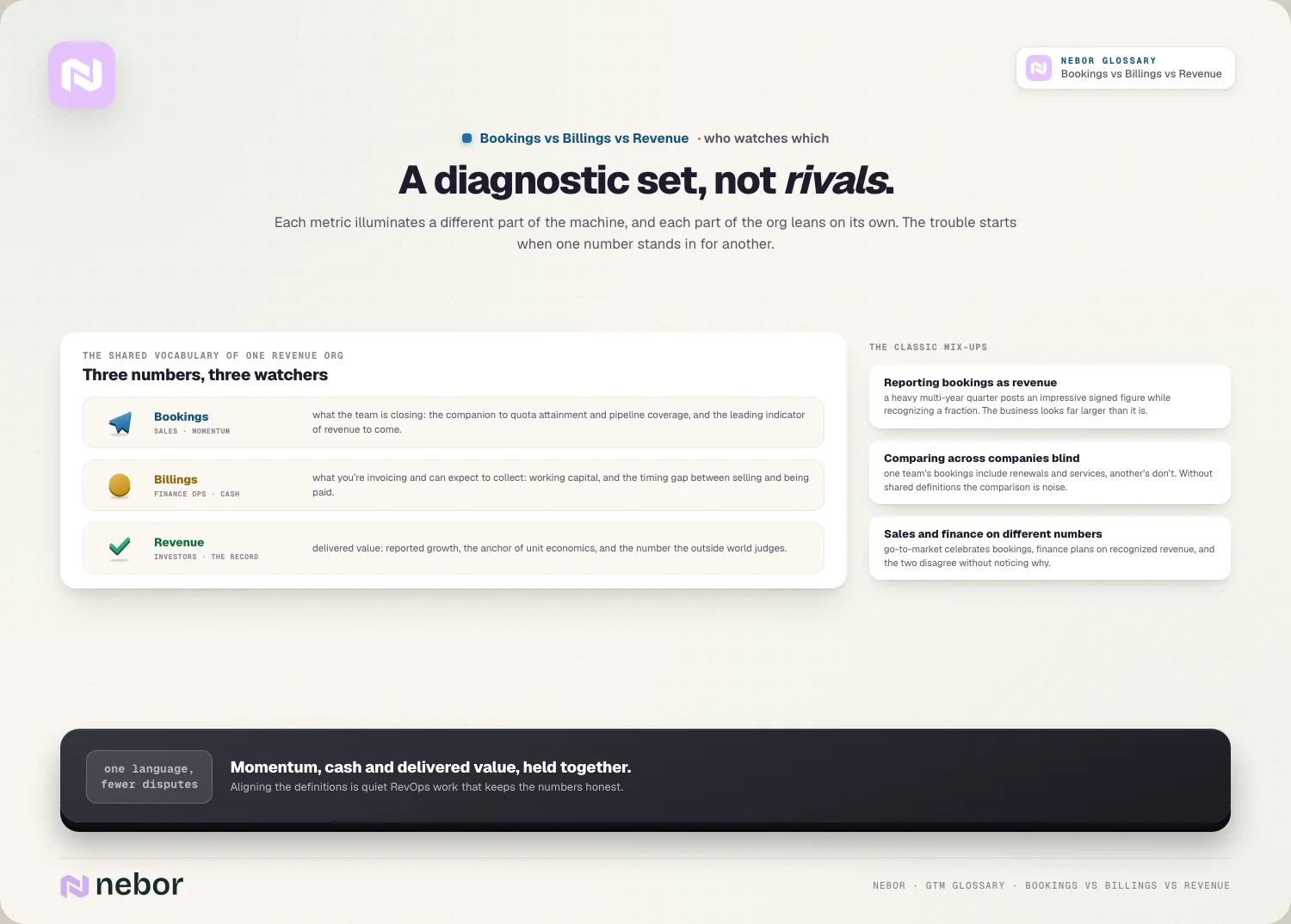
Revenue is the measure of delivered value and the anchor for how the outside world judges you. It reflects what you've earned, drives your reported growth, and underpins the unit economics behind customer lifetime value, and that's the reason investors scrutinize it far more closely than bookings.
How the timing gaps between them shape cash flow and forecasting
The gaps between booking, billing, and recognizing a deal have real consequences for how a SaaS business manages money.
A company can grow bookings fast while cash stays tight if it bills monthly, because the committed revenue hasn't turned into invoices and collections yet, a squeeze we watch scaling teams hit constantly.
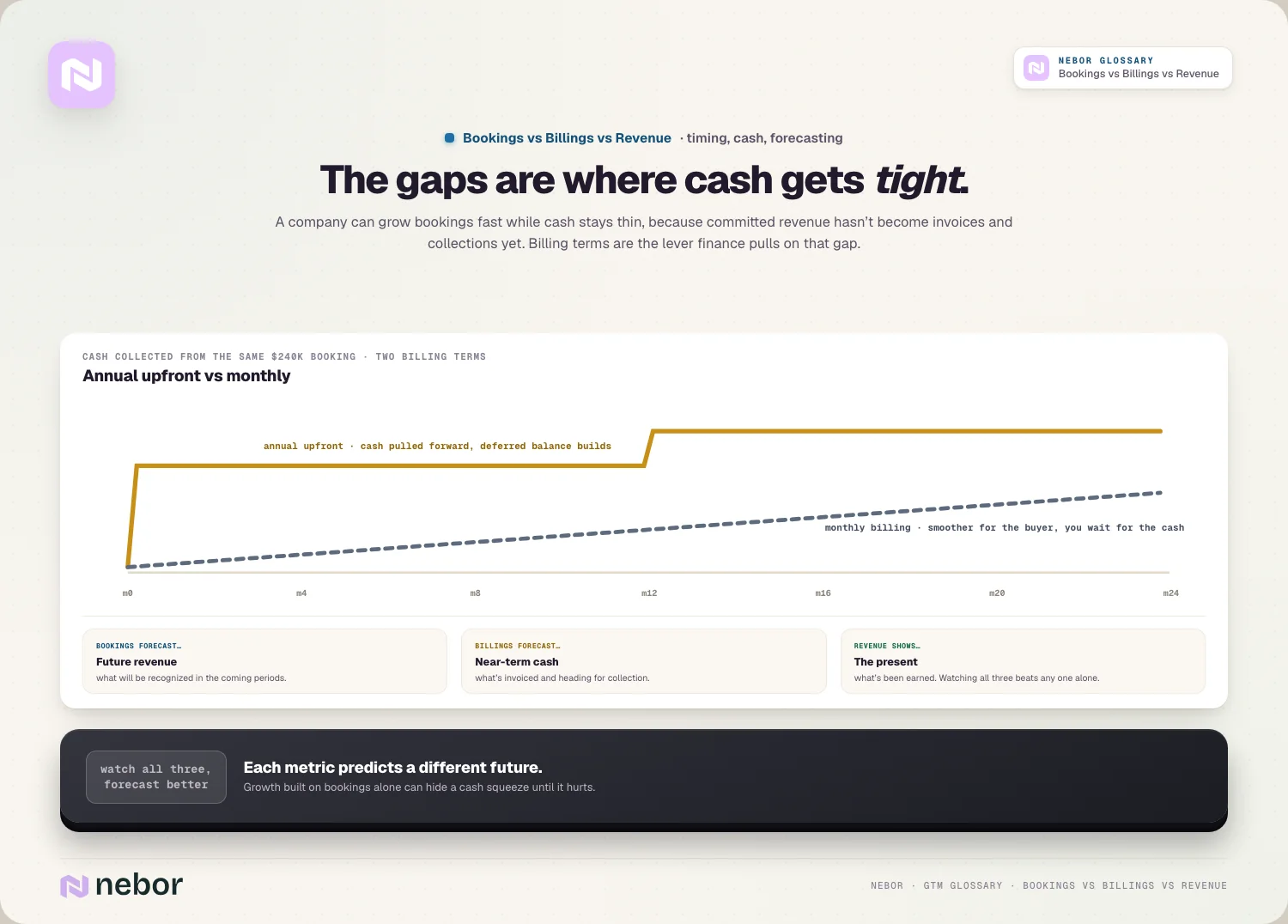
Billing terms are a lever finance pulls precisely because of these gaps. Asking customers to pay annually upfront pulls cash forward and builds deferred revenue, easing the strain, whereas monthly billing smooths the customer's spend but leaves the company waiting longer for the cash behind each booking.
Understanding the gaps also sharpens forecasting, because each metric predicts a different future. Bookings forecast revenue recognized in coming periods, billings forecast near-term cash, and revenue shows the present, so watching all three produces far better forecast accuracy than any one alone.
The common mistakes teams make when they track bookings, billings, and revenue
The most frequent mistake is defining bookings loosely, so the number means different things quarter to quarter without anyone noticing. If one period's bookings include renewals and a later one doesn't, the trend becomes noise, so a written, consistent definition matters more than the exact choice of what to include.
Another is ignoring billings entirely and being blindsided by cash. Teams that watch only bookings and revenue can miss that a growing business is starved for cash because of how it invoices, so tracking billings and deferred revenue is what keeps the growth story tethered to the money available.
The deepest mistake is letting sales and finance operate on different numbers without reconciling them. When misalignments between the two compound into real disputes, a shared understanding of how a deal moves from signed to earned is what keeps the revenue engine honest, and we tell clients to write that mapping down.
Why bookings, billings, and revenue are the shared language of a healthy revenue org
In our experience, these three metrics deserve the effort because they're the vocabulary every part of a revenue org uses for the same deals. Sales, finance, and leadership each lean on a different one, and a business works smoothly only when everyone knows which metric answers which question.
That shared understanding turns a source of confusion into a complete picture. Bookings show what you're winning, billings show what you're collecting, and revenue shows what you've earned, and holding all three at once lets you see momentum, cash, and delivered value together instead of one at a time.
Any go-to-market system that scales cleanly depends on this alignment, because growth built on bookings alone can hide cash and recognition problems until they hurt. When the whole team speaks one language about the deals you automate sales prospecting to win, the numbers you report stay honest as you grow.
Share this post
RevOps
Glossary
Related glossary items
Understanding the core GTM concepts




Ready to build your pipeline











