
In this post:
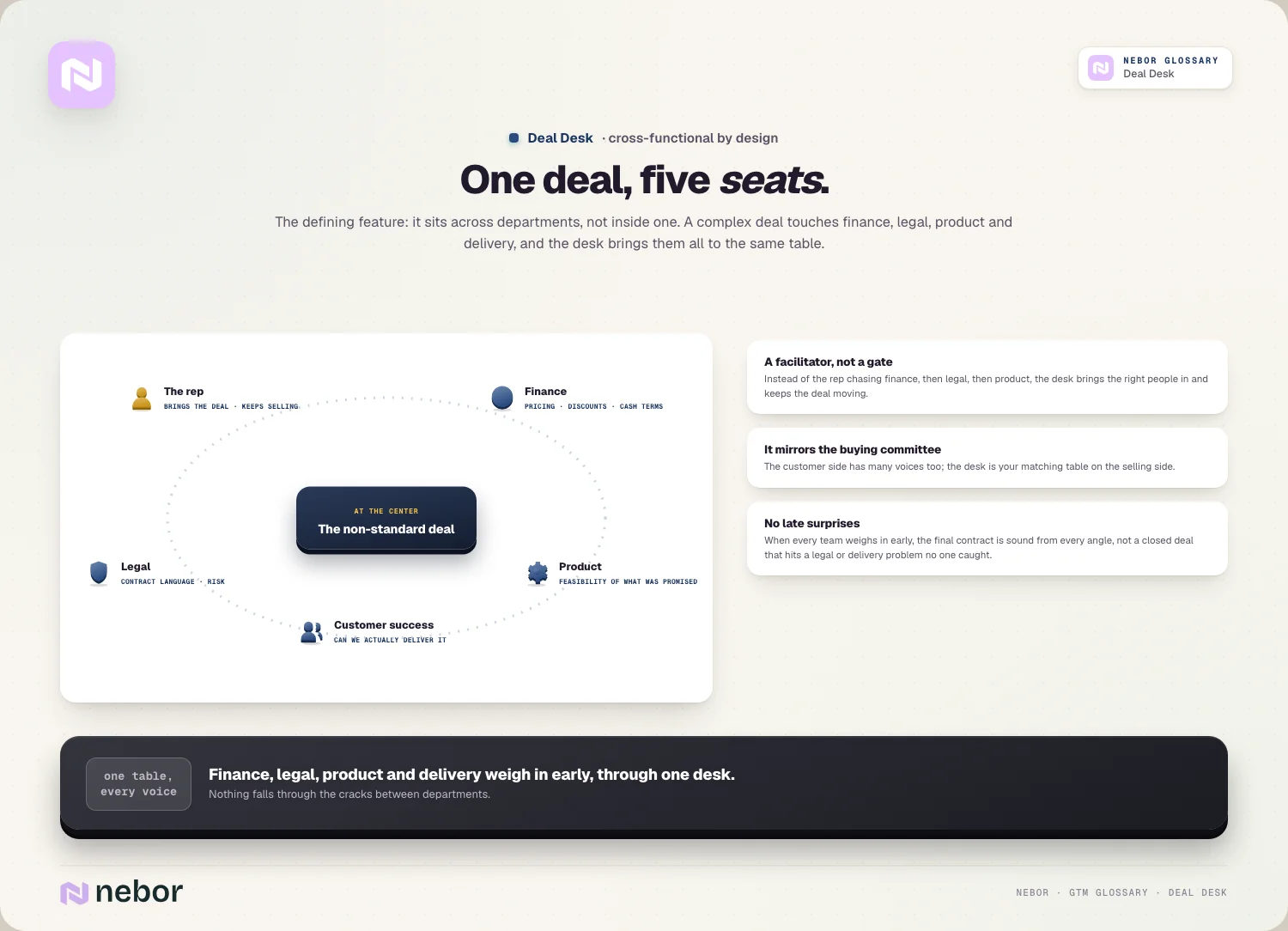
As a company grows, its deals stop looking alike. A prospect wants a bigger discount than the price list allows, another needs custom contract terms, and a third asks for a multi-year structure that touches finance, legal, and product at once.
Left to individual reps and ad hoc approvals, these non-standard deals either stall for weeks or slip through with terms the company later regrets, and your pipeline pays for both outcomes.
A deal desk is the function that brings order to that chaos. It's a central place where complex and non-standard deals get reviewed and approved, so that the unusual requests are handled quickly and consistently instead of bouncing around the org in search of whoever can say yes.
A deal desk is a centralized, cross-functional team and process that reviews, structures, and approves complex or non-standard sales deals, pulling in finance, legal, product, and others as needed. Its job is to keep those deals aligned with the business, protect margins, and speed them to close.
The reason it exists is that complex deals create a real tension between moving fast and staying disciplined. Without a deal desk, reps either wait too long for scattered approvals or cut corners to close, and a deal desk resolves that by making the approval path clear and quick.
TL;DR
A deal desk is a centralized, cross-functional team that reviews and approves complex or non-standard deals involving special pricing, custom terms, or unusual structures.
It exists to resolve the tension between speed and discipline, because it gets unusual deals the right approvals quickly instead of letting them stall or slip through unchecked.
It pulls together the people who need to weigh in, from finance on discounts to legal on terms, so a rep isn't chasing sign-offs across the whole organization alone.
Companies usually need one as they scale, typically once non-standard deal volume grows past what informal, one-off approvals can handle without breaking down.
What a deal desk does when a complex deal actually comes through
When a rep has a deal that falls outside the standard playbook, the deal desk is where it goes to be shaped and approved. It reviews the proposed pricing, terms, and structure, checks whether the deal makes financial and strategic sense, and figures out exactly who needs to sign off before it can close.
Much of that work is managing exceptions instead of routine deals. A large discount, an unusual payment schedule, or a custom service agreement each needs individual review, and the deal desk is the group that examines those requests and decides whether and how to approve them.
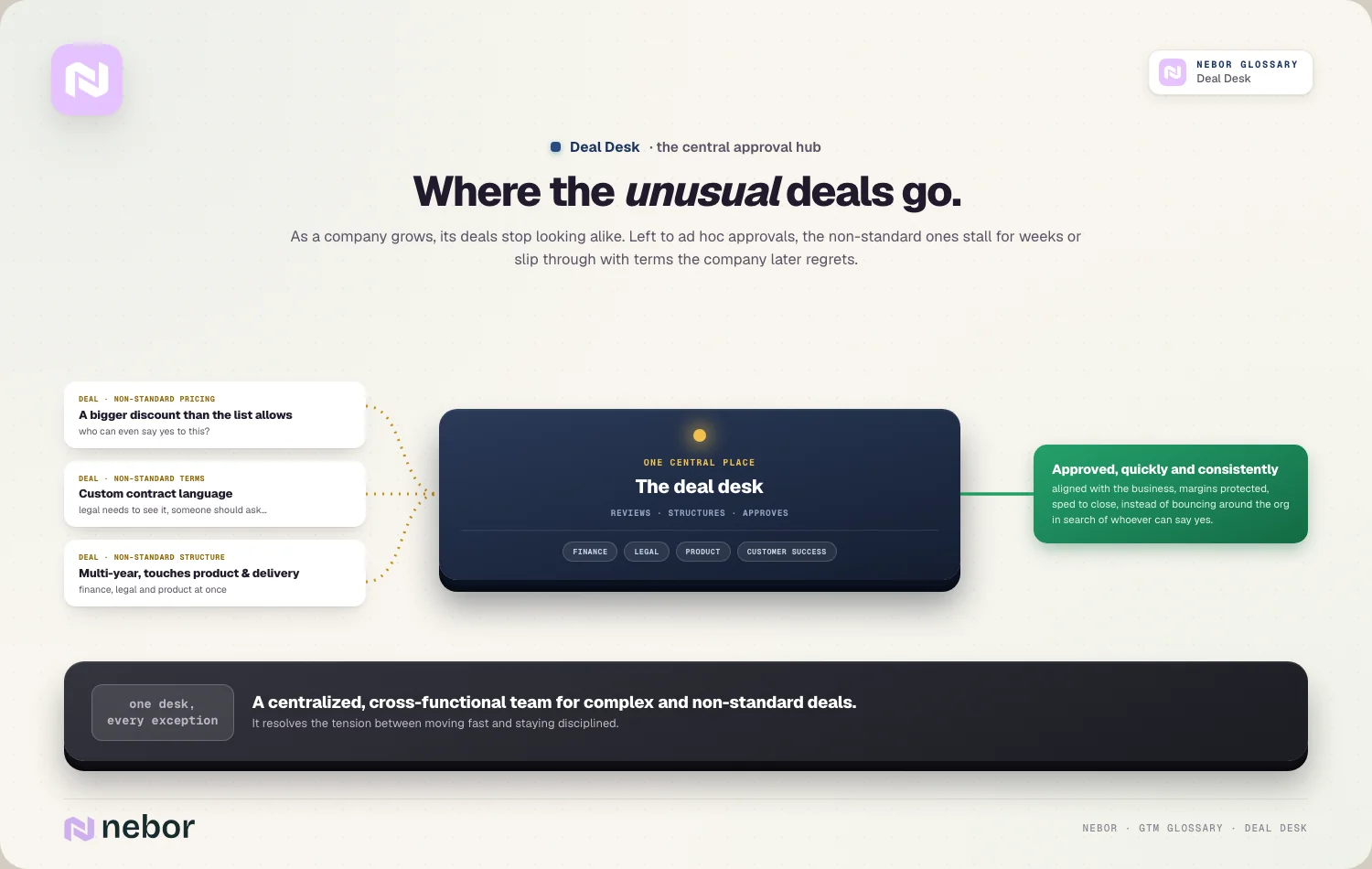
The desk also acts as a quality check on the final contract. It reviews the paperwork for accuracy and unusual changes, and once a deal is approved, it makes sure the correct terms are recorded in your CRM so the agreement everyone signed is the one that gets tracked.
Why a deal desk is fundamentally a cross-functional function
The defining feature of a deal desk is that it spans departments rather than inside just one. A complex deal often touches finance for pricing, legal for terms, product for feasibility, and customer success for delivery, mirroring the buying committee on the customer's side, and the desk coordinates all of it.
Its real value is acting as a facilitator among those groups so nothing falls through the cracks. Instead of a rep separately chasing finance, then legal, then product, the deal desk brings the right people to the table and keeps the deal moving through each approval it needs.
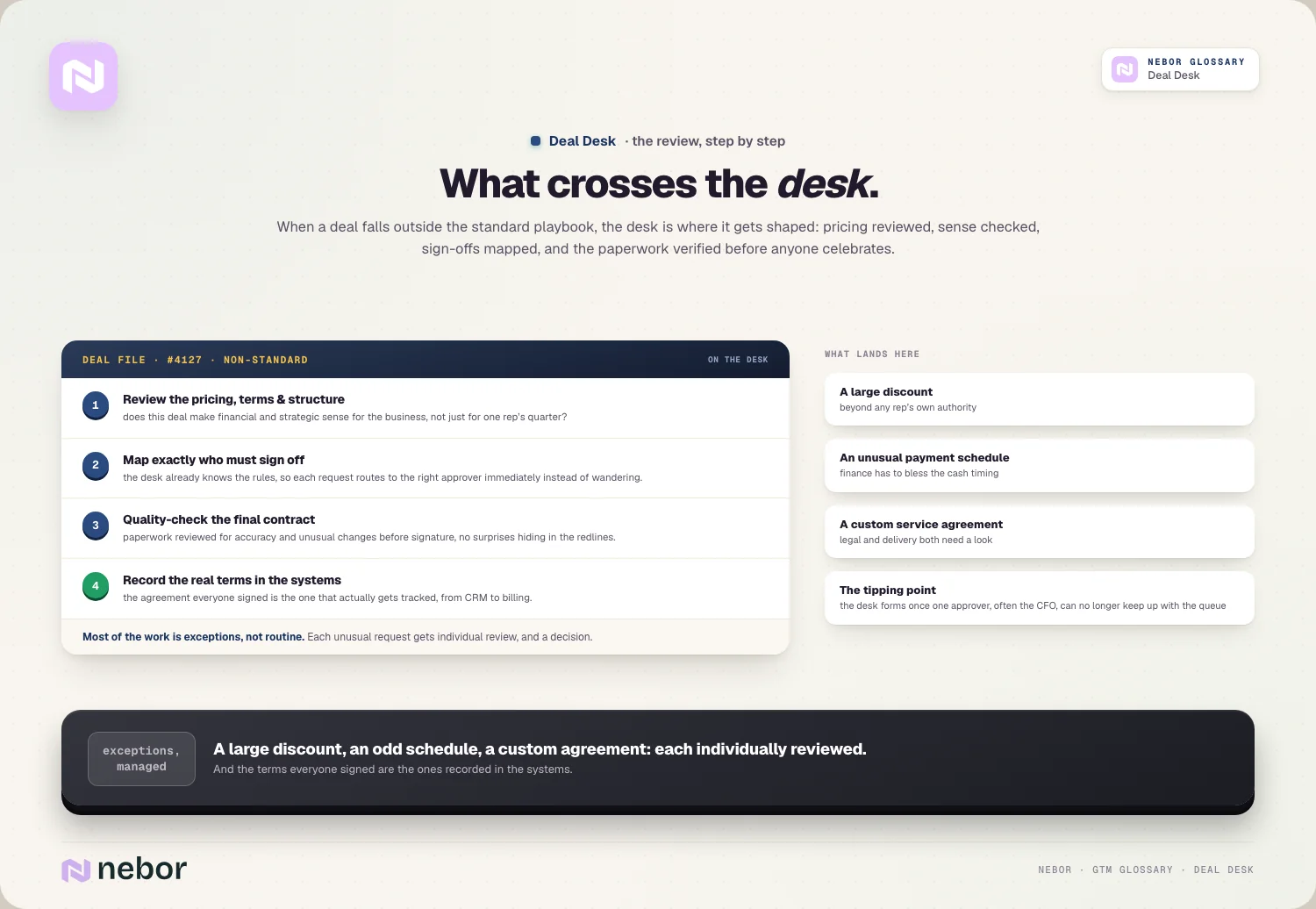
This coordination is what prevents nasty surprises late in a deal. When every relevant team has weighed in early through the desk, the final contract is sound from every angle, instead of a deal that closes only to hit a legal or delivery problem no one caught in time.
How a deal desk speeds up deals rather than slowing them down
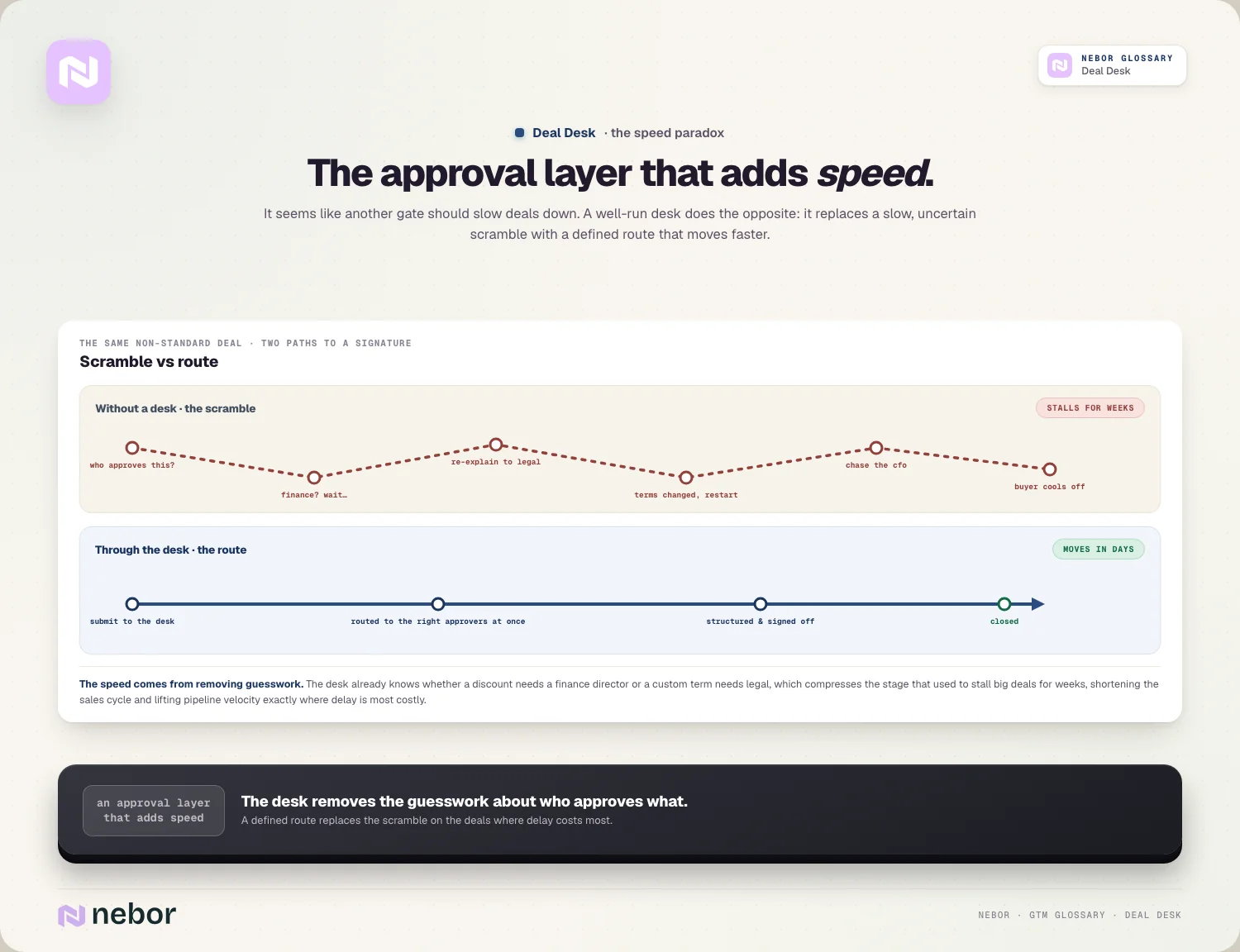
It might seem like adding an approval layer would slow deals, but a good deal desk usually does the opposite. By making the approval path clear and owning the process of gathering sign-offs, it replaces a slow, uncertain scramble with a defined route that moves faster.
The speed comes from removing the guesswork about who approves what. A rep no longer has to figure out whether a discount needs a finance director or a custom term needs legal, because the deal desk already knows the rules and routes each request to the right person immediately.
That efficiency shows up directly in how quickly complex deals close. By compressing the approval stage that used to stall deals for weeks, a deal desk shortens the sales cycle and lifts pipeline velocity on exactly the large, non-standard deals where delay is most costly.
Why a deal desk protects margins and pricing discipline at scale
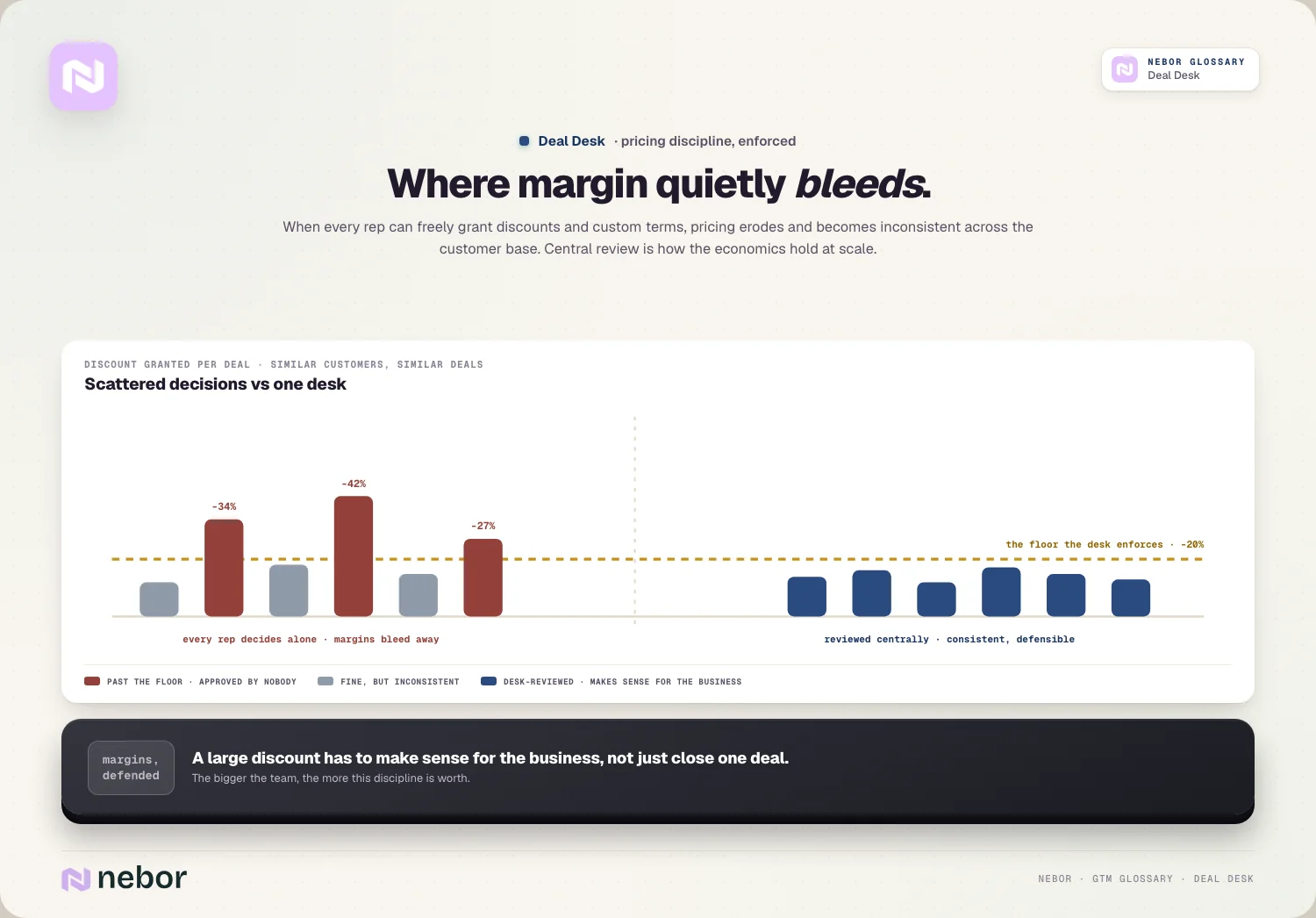
Beyond speed, a deal desk is one of the main ways a company keeps its pricing from eroding as it grows. When every rep can freely grant discounts and custom terms, margins slowly bleed away and pricing becomes inconsistent across the customer base, and the desk exists precisely to prevent that.
By reviewing non-standard pricing centrally, the deal desk enforces consistency that scattered individual decisions can't. It ensures a large discount makes sense for the business instead of just closing one rep's deal, so the company protects its economics deal by deal.
This discipline matters more the bigger the sales team gets. As reps spread across territories and segments, a deal desk keeps pricing and deal quality consistent, so the company doesn't end up with wildly different terms for similar customers depending on who happened to sell to them.
When a growing company reaches the point of needing a real deal desk
Most companies don't need a formal deal desk early, because a founder or a single leader can approve the occasional non-standard deal by hand. That informal approach works until deal complexity and volume grow enough that one-off approvals become a bottleneck rather than a quick favor.
The usual trigger we see is scale and complexity arriving together. Many SaaS companies formalize a deal desk somewhere in the tens of millions in revenue, once non-standard quotes pile up and a single approver, often the CFO, can no longer keep up with the queue.
Certain business traits push that need earlier than revenue alone would suggest. Multiple products, heavy customization, complex pricing tiers, and long sales cycles all create non-standard deals sooner, so a company with those characteristics may need a deal desk well before a simpler one would.
How a deal desk connects to your broader revenue operations function
A deal desk rarely stands alone, because it's usually part of the wider revenue operations function that keeps the whole go-to-market machine working smoothly. It is the point where sales strategy meets financial and legal reality, which makes it a natural piece of the RevOps remit.
Its work also depends on and feeds clean data. The desk relies on accurate deal information to review terms, and it updates the systems when deals are approved, so good CRM hygiene is both an input to the desk and one of its outputs.
The desk connects to how the company codifies its selling too. The rules a deal desk enforces about pricing and terms often live in or alongside the sales playbook, so the two work together to keep both the message and the mechanics of a deal consistent.
Why a deal desk improves win rates on your most valuable deals
The deals a deal desk handles are usually the largest and most complex ones, which makes getting them right especially valuable. By structuring these deals well and moving them through approvals quickly, the desk lifts the win rate on exactly the opportunities where a loss hurts most.
Part of that comes from removing friction the buyer feels. A deal that stalls in internal approvals frustrates the customer and gives competitors time to intervene, so a smooth process protects your conversion rate on deals that would otherwise die to delay.
The other part is structuring deals that hold up for both sides. A well-designed deal is more likely to close and less likely to cause problems later, so the desk's expertise in shaping terms improves both the odds of winning and the quality of what gets won.
How a deal desk supports reps without taking deals away from them
A common worry is that a deal desk takes control away from sales reps, but a good one is built to support them instead of police them. It handles the parts of a complex deal reps are least equipped for, like navigating internal approvals, so they can focus on selling.
The desk becomes a resource reps actively want to use when it makes their hard deals easier. A rep facing a complicated pricing request or a tough negotiation can bring it to the desk for help structuring something that works, much as good objection handling support helps them earlier in the deal.
That support role is what keeps the desk from becoming a bottleneck reps route around. When the deal desk clearly speeds up and improves complex deals, reps engage it early and willingly, and that willing adoption is what makes the function work as intended.
How a deal desk should be structured as a company grows into it
The shape of a deal desk changes with the company, so there's no single right structure to copy. Early on it's often just a part-time responsibility, where a RevOps or finance leader handles non-standard deals alongside their main job, which is enough while the volume is low.
As deal volume climbs, the function usually earns dedicated people who do nothing but structure and approve complex deals. At that stage the desk needs clear thresholds for what requires review and a defined approval matrix, so reps and approvers both know exactly which deals go where and who signs off.
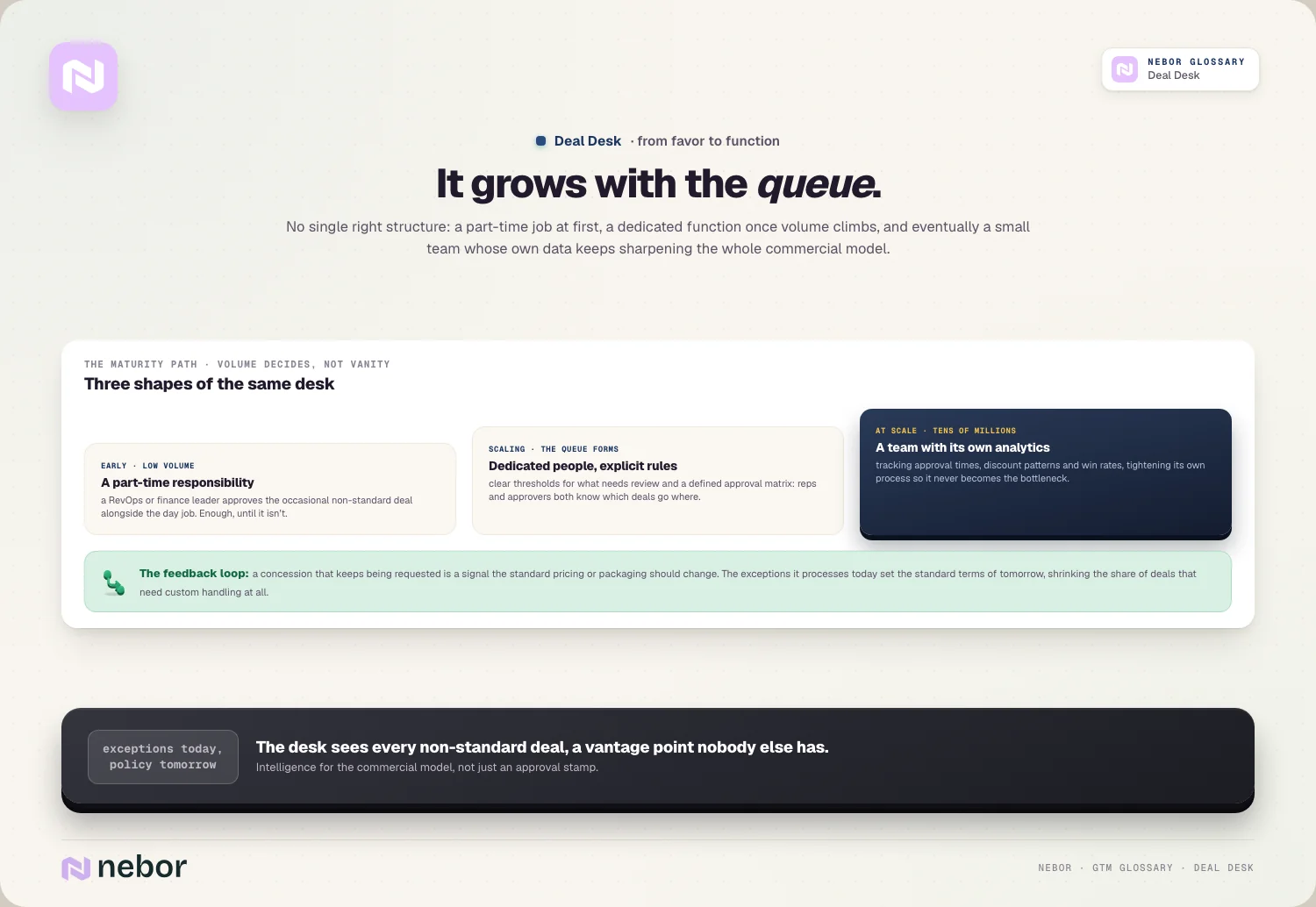
At full scale, a mature deal desk becomes a small team with its own tooling and analytics, tracking approval times, discount patterns, and win rates. That data lets it keep tightening its own process, so it gets faster and sharper instead of becoming the bottleneck an unmanaged approval layer would.
What a deal desk does with the data from every deal it reviews
Because a deal desk sees every non-standard deal, it ends up holding a uniquely clear picture of how the company truly prices and negotiates. That vantage point lets it spot patterns no individual rep would notice, like a discount level that keeps getting requested or a contract term that repeatedly causes friction.
Feeding those patterns back into pricing and policy is one of the desk's most valuable and overlooked jobs, and we tell clients to put it on a calendar.
When a certain concession comes up constantly, that's a signal the standard pricing or packaging may need to change, so the desk becomes a source of intelligence instead of just an approval stamp.
Over time this turns the deal desk into a feedback loop for the whole commercial model. The exceptions it processes today inform the standard terms it sets tomorrow, which gradually shrinks the share of deals that need custom handling at all and makes the entire motion more efficient.
The common mistakes companies make when they build a deal desk
A deal desk can go wrong in a few ways, usually by tilting too far toward either control or speed, and in our experience the tilt toward rigid control is the more common failure.
A desk that becomes an inflexible approval gate slows every deal and pushes reps to work around it, while one with no real authority fails to protect the margins it exists to defend.
Another frequent mistake is unclear rules about what needs to go to the desk at all. When reps don't know which deals require review, standard deals get bogged down unnecessarily and genuinely risky ones sometimes skip the desk entirely, so the thresholds have to be explicit.
Building the desk too late is just as common as building it wrong. We keep seeing companies wait until non-standard deals are already causing chaos and margin leakage before formalizing the function, when introducing it earlier would have prevented the very problems that finally forced the decision.
Why a deal desk is really about turning complexity into a repeatable process
The deepest value of a deal desk is that it takes the messiest, highest-stakes deals and makes handling them systematic instead of improvised.
Complex deals will always exist as a company grows, and the desk is what keeps them from being handled differently and unpredictably every single time.
That repeatability is what lets a company scale its complex selling without losing control of pricing or speed, which flows through to steadier quota attainment.
Instead of every unusual deal being a fresh scramble, the desk provides a known path that protects the business while still getting deals done.
Within a modern go-to-market system, a deal desk is what allows a company to say yes to complexity without chaos.
It handles the deals that don't fit the standard motion, so the rest of the engine, including everything you automate sales prospecting around, can keep working cleanly on the deals that do.
Share this post
RevOps
CRM
Glossary
Related glossary items
Understanding the core GTM concepts




Ready to build your pipeline