

In this post:
Most reps hear an objection and brace for a fight. The prospect says the price is too high or the timing is wrong, and the instinct is to argue, defend, or scramble for a discount. That reaction is exactly what loses the deal.
Objection handling is the skill of doing the opposite. It treats a concern as information instead of an attack, so instead of defending against it, you dig into what's really behind it and move the conversation forward.
Objection handling is the process of acknowledging, understanding, and addressing the doubts or concerns a prospect raises during a sale. When it's handled well, it resolves the real hesitation behind an objection instead of just countering the words.
An objection is usually a sign of engagement instead of rejection. A prospect who raises a concern is still thinking about buying, which means the objection is a door into the conversation instead of the end of it.
TL;DR
Objection handling is how you respond to a prospect's doubts during a sale, by understanding the real concern behind them and addressing it instead of arguing.
An objection often signals interest more than refusal. A prospect who pushes back is usually still engaged, so the concern is an opening instead of a dead end.
The strongest reps handle objections by asking questions instead of talking more. Uncovering the real reason behind a concern matters far more than a slick rebuttal.
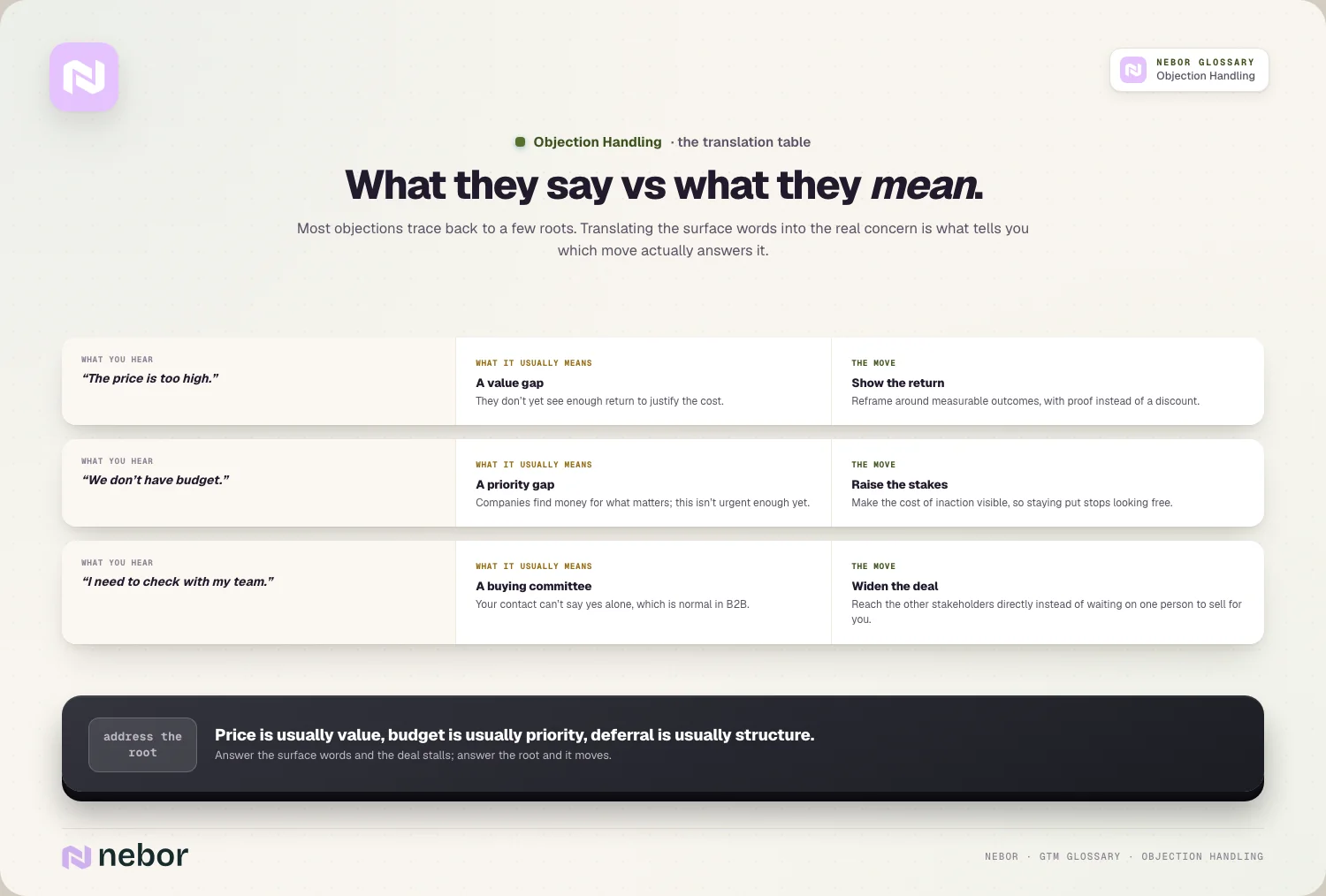
Most objections trace back to a few roots, because price is usually a value concern and a budget objection is usually a priority one, so you address the root instead of the surface.
What objection handling means inside a real sales conversation
Objection handling is how you respond when a prospect raises a concern. Instead of treating the concern as a wall, you work to understand and resolve what's driving it.
It starts with the concern the prospect voices. They raise a doubt about price, timing, fit, or authority, and that doubt is the objection your rep needs to handle.
The goal is resolution instead of rebuttal. You're trying to honestly address the hesitation so the prospect can move forward, without winning an argument or talking them into anything.
It carries through the whole length of the sale. Objections come up at every stage, from the first cold conversation to the final contract, so handling them is a constant skill instead of a single moment.
Handled well, an objection becomes a step forward. Working through a real concern together builds trust and moves the deal, which is the opposite of what defending against it would do.
Why an objection usually signals interest instead of a real rejection
The single most useful shift in mindset about objections is understanding what they really mean, because a concern is rarely the brush-off it can feel like.
A truly disengaged prospect simply stays silent. Someone with no interest ends the conversation, so the fact that a prospect bothers to raise a concern shows they're still weighing it.
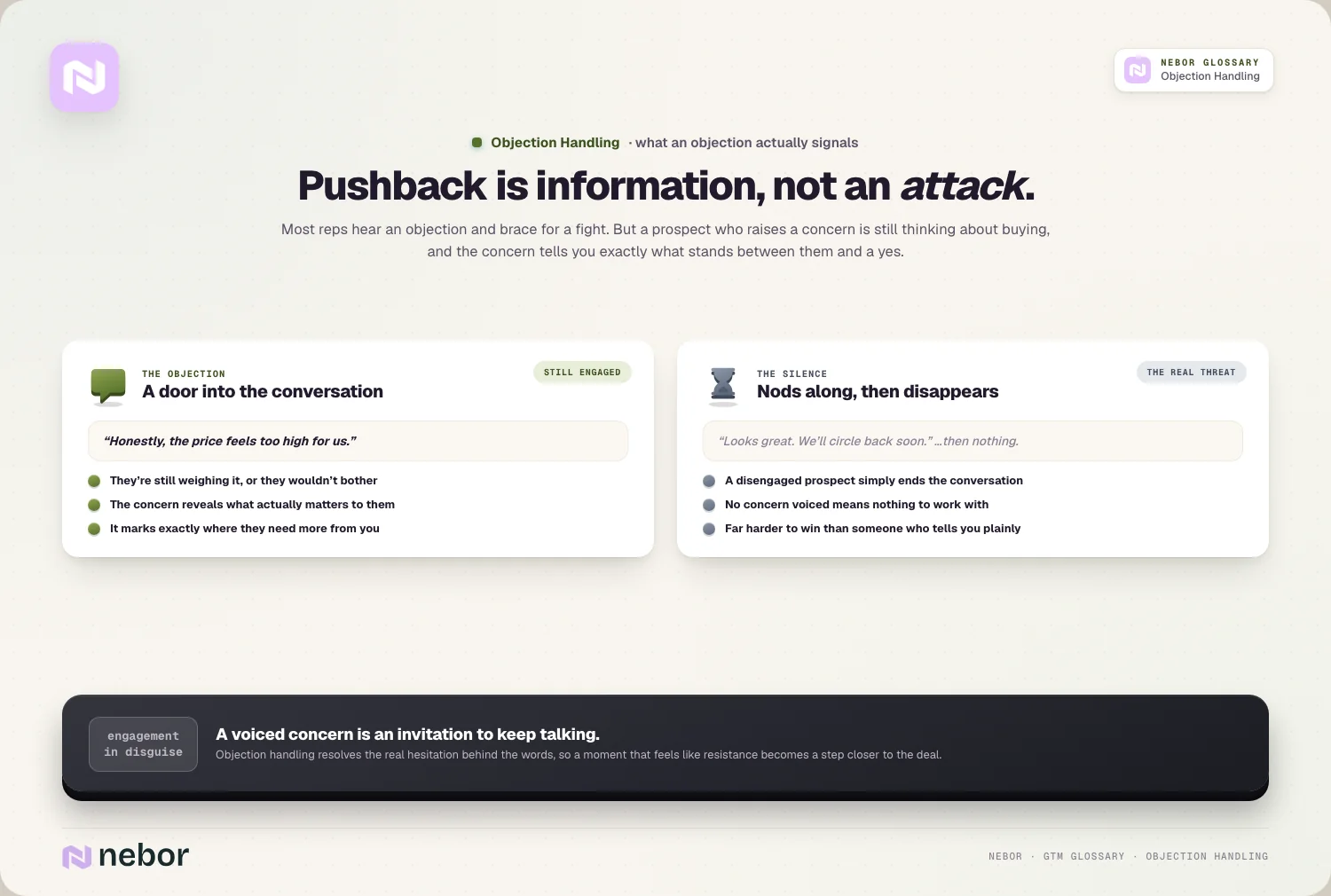
An objection reveals what matters to them. The specific concern tells you what's standing between the prospect and a yes, which is exactly the information you need to help them.
Silence is the real threat here, far more than objections. A prospect who nods along and then disappears is far harder to win than one who tells you plainly what's holding them back.
So an objection is an invitation to keep talking. It marks where the prospect needs more from you, which turns a moment that feels like resistance into a chance to move closer.
Why the best reps handle objections by asking instead of talking
A clear divide separates strong objection handlers from weak ones, and it comes down to questions. The instinct to explain more is usually the wrong one.
Weak reps rush straight to the rebuttal. They hear an objection and immediately start talking, defending the product or the price before they understand what the concern really is.
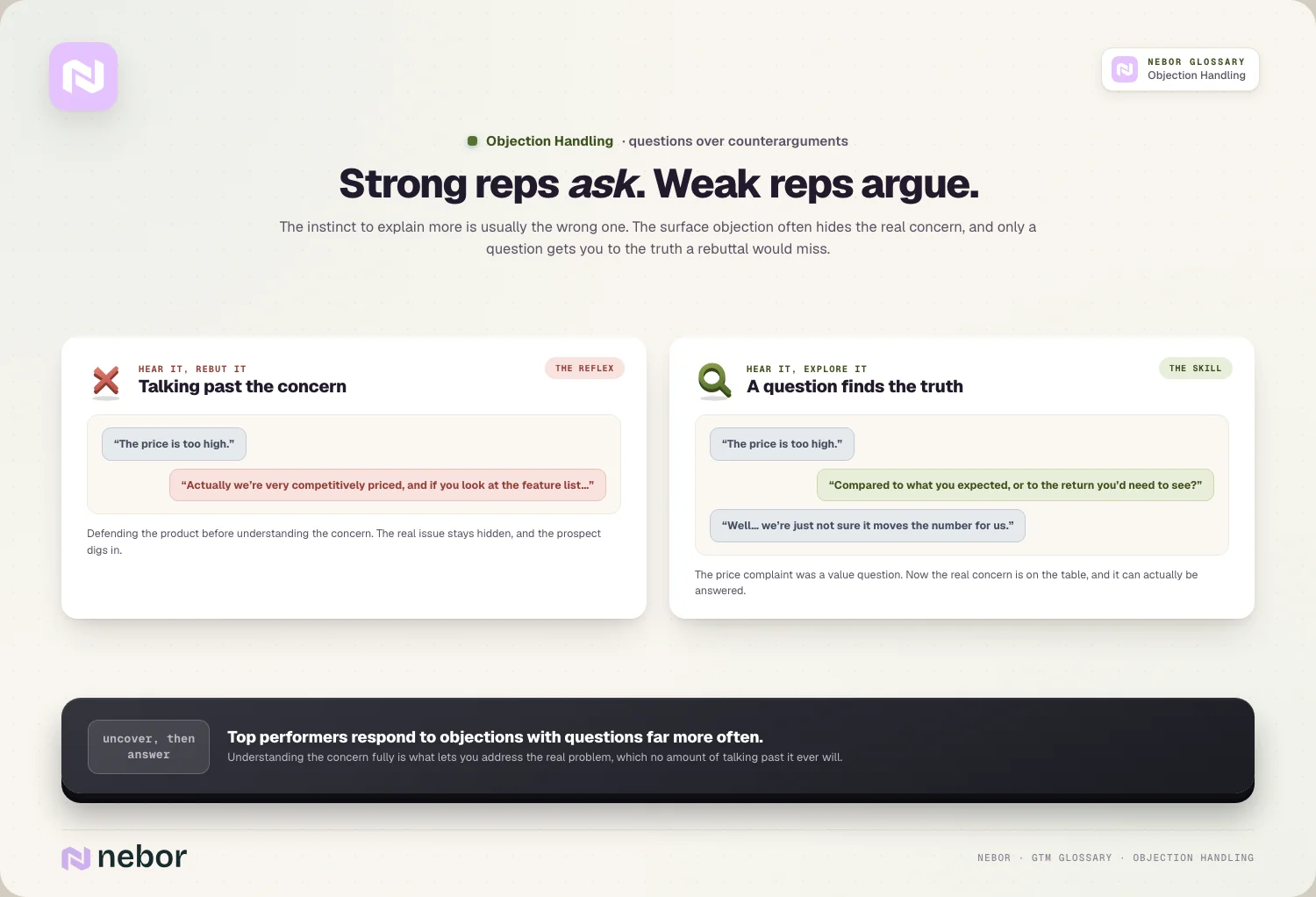
Strong reps ask a question before anything else. Top performers respond to objections with questions far more often than average reps do, using them to uncover the real reason behind the surface concern.
The surface objection often hides the real one. A prospect says the price is too high when the real issue is they don't see the value, so a question gets you to the truth a rebuttal would miss.
So questions are the core technique, well ahead of counterarguments. Understanding the concern fully is what lets you address the real problem, which no amount of talking past it ever will.
How the LAER framework gives objection handling a repeatable shape
Frameworks help reps handle objections consistently, and in our experience one shows up more than any other. LAER turns instinct into a repeatable sequence.
The steps are listen, acknowledge, explore, respond. You listen fully without interrupting, acknowledge the concern with genuine empathy, explore the real reason with a question, then respond with a relevant answer.
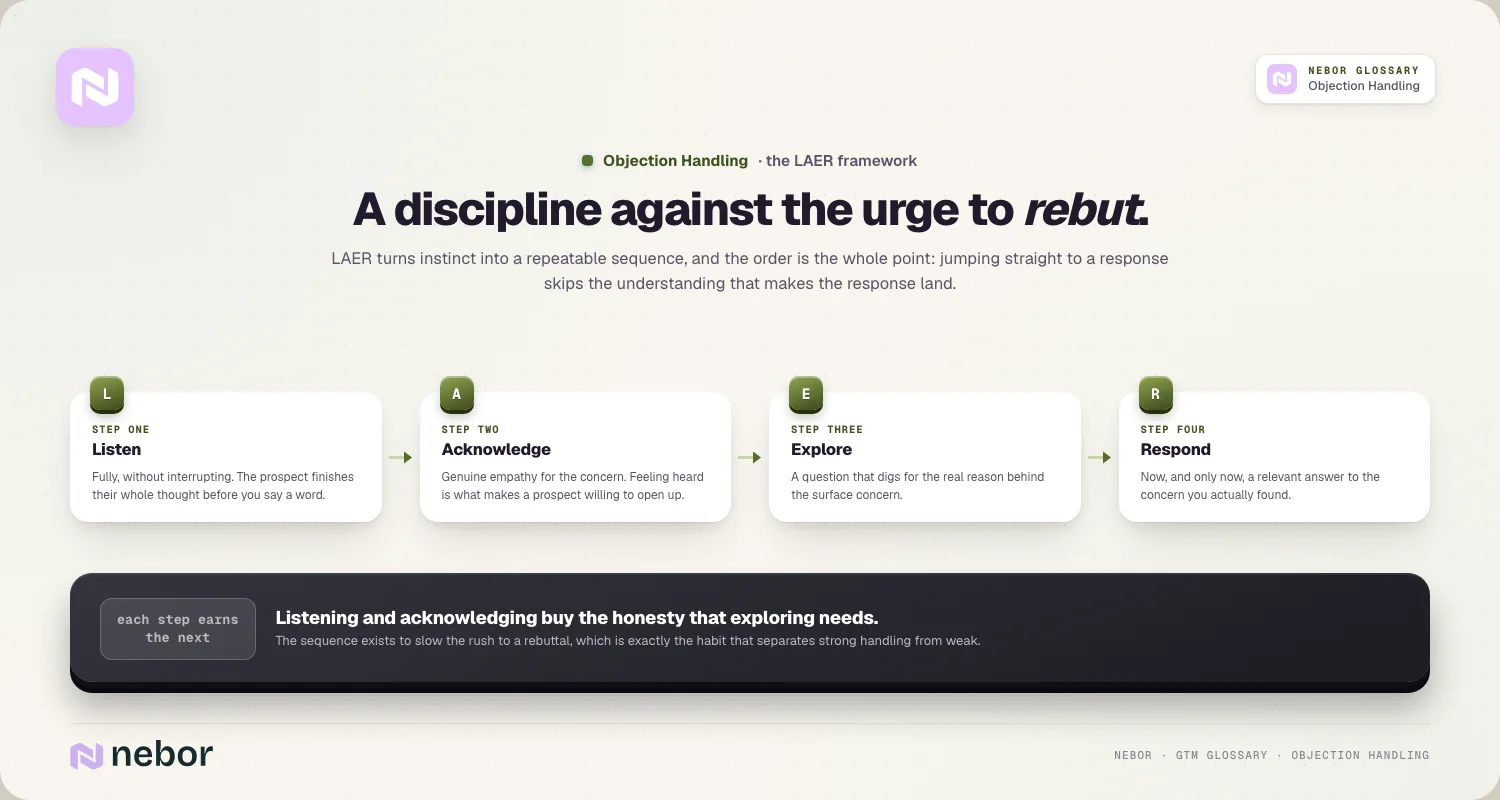
Each step earns the one after it. Listening and acknowledging make the prospect feel heard, which is what makes them willing to explore the real issue with you honestly.
The order matters more than any single step. Jumping straight to a response, the common mistake, skips the understanding that makes the response land, so the sequence keeps you from rushing.
So LAER is a discipline against the urge to rebut. It forces you to understand before you answer, which is exactly the habit that separates strong objection handling from weak.
How the Feel, Felt, Found approach handles emotional resistance
Another classic framework works especially well when an objection is more emotional than logical. Feel, felt, found meets the prospect with empathy first.
The structure is simple enough to use cold. You say you understand how they feel, note that others have felt the same, then share what those others found once they moved forward.
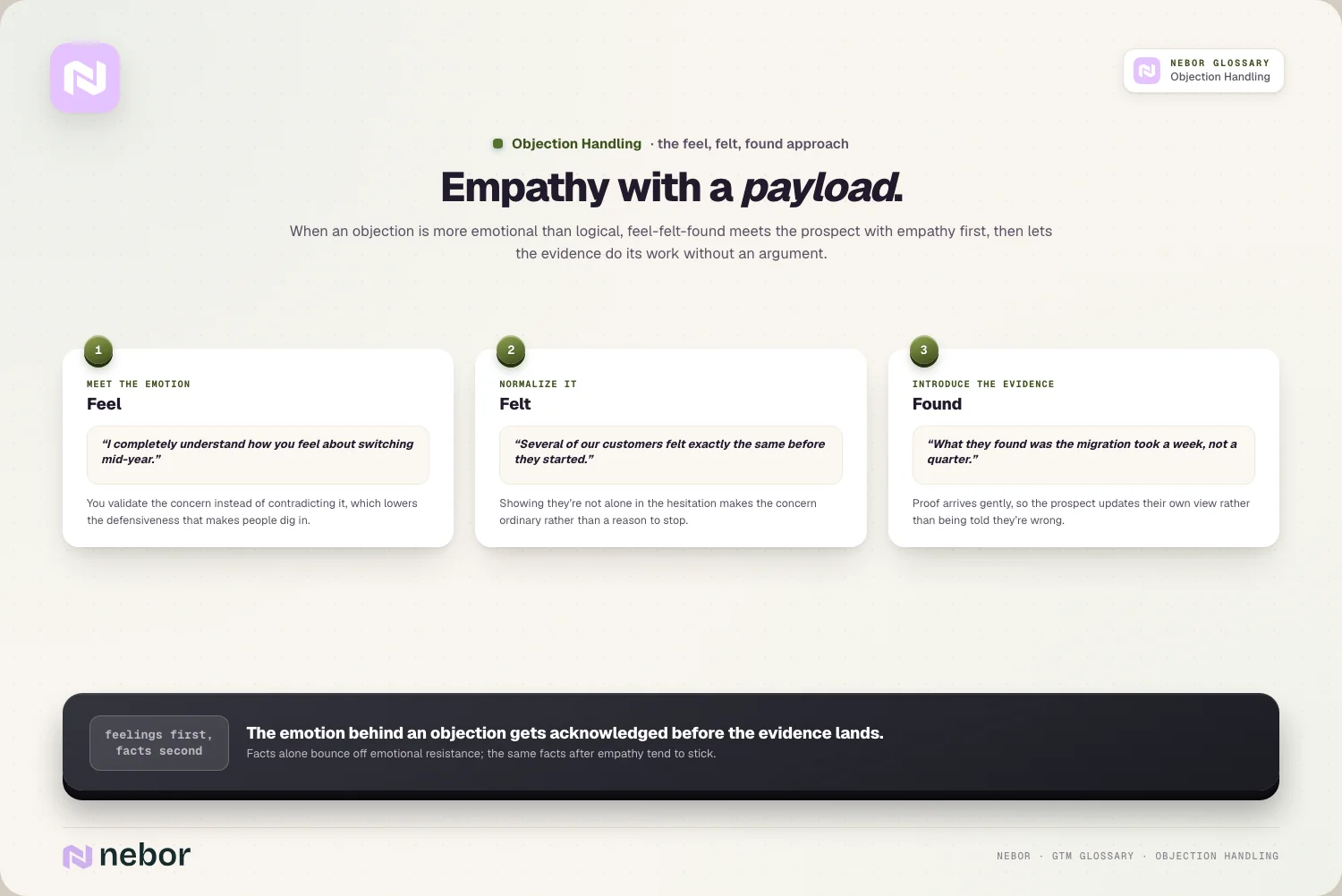
It normalizes the concern for the prospect. By showing them they're not alone in their hesitation, you lower the defensiveness that makes people dig in on an objection.
It leads to evidence gently as well. The "found" step introduces proof or a new angle without arguing, so the prospect updates their own view instead of being told they're wrong.
So feel, felt, found is empathy with a payload. It acknowledges the emotion behind an objection before offering the evidence that addresses it, which lands better than facts alone.
Why price objections are almost always really about value in disguise
Price is the objection reps fear most, and in our experience it's the one most often misread, because a complaint about cost is rarely just about the number.
A price objection is usually a value gap. When a prospect says you're too expensive, they typically mean they don't yet see enough return to justify the cost, and rarely that they can't afford it.
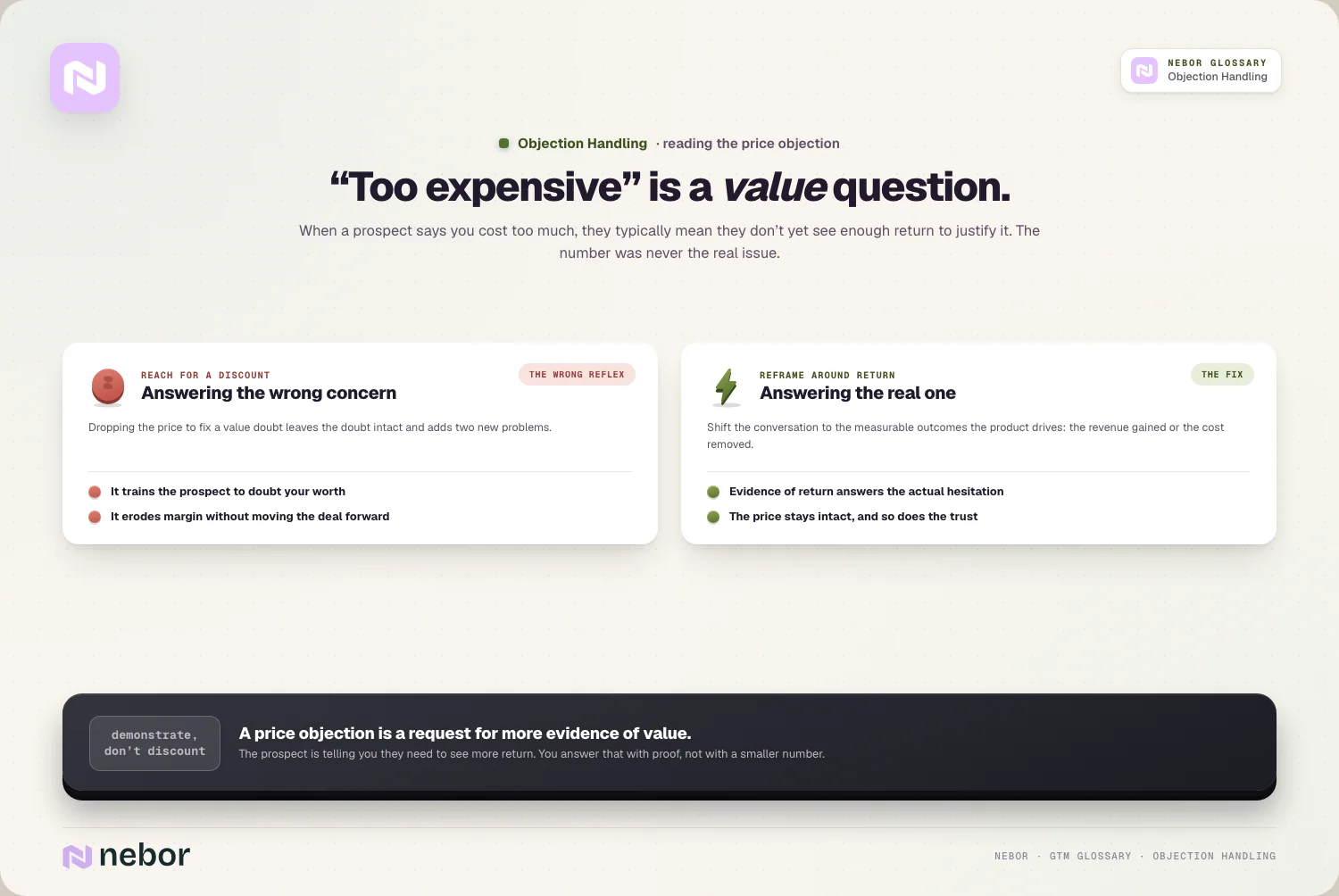
Discounting is exactly the wrong reflex to follow. Dropping the price to answer a value concern trains the prospect to doubt your worth and erodes your margin without addressing the real issue.
Reframing around return is the real fix. Shifting the conversation to the measurable outcomes your product drives, the revenue or cost savings, answers the actual concern behind the price.
So a price objection is a cue to demonstrate value before you negotiate anything. The prospect is telling you they need to see more return, which is a request you answer with evidence instead of a discount.
Why a budget objection is really a question about priority more than money
Close behind price comes the budget objection, and it hides a similar truth. A lack of budget is usually a lack of priority.
Companies find budget for whatever matters to them. A business that says it has no budget almost always means the initiative isn't a high enough priority to fund, because money appears for the things that are.
The cost of inaction is the lever to pull. Helping the prospect see what staying put costs them reframes your product from an expense into a way to stop losing money.
Priority is something you can build quite deliberately. Once a prospect sees the problem as urgent and expensive, budget often materializes or gets reallocated, so the real work is establishing importance instead of accepting the objection.
This is why value-led selling keeps winning. When you frame the deal around outcomes early, sometimes even as a route to expansion revenue down the line, the budget conversation gets far easier.
So a budget objection is a signal to raise the stakes instead of giving up. Showing the cost of doing nothing is what turns a nice-to-have into something worth funding now.
How objection handling connects to reaching the full buying committee
Some objections are about who else needs to weigh in more than about your product, and that points at a structural reality of B2B deals.
"I need to check with my team" comes up constantly. This objection reveals that the person you're talking to isn't the only decision-maker, which is normal in B2B.
It signals a buying group behind the scenes. Most B2B purchases go through a buying committee, so a single contact rarely has the full authority to say yes alone.
The answer is broader access to the account. Instead of accepting the deferral, you work to reach the other stakeholders directly, which is the heart of multi-threading a deal.
So this objection is a prompt to widen the deal. It tells you the decision involves more people, which means your job is to reach them instead of waiting on a single contact to sell for you.
Why a strong champion helps you handle objections you never hear
Not every objection reaches you directly, and the ones raised in rooms you're not in are the most dangerous. This is where a champion becomes essential.
Internal objections happen without you in the room. When the buying group discusses your deal privately, concerns come up that you can't address because you aren't there to hear them.
A champion carries your case for you. A strong internal champion can handle those objections on your behalf, answering concerns in the rooms you can't enter.
You have to arm them properly for the job. Giving your champion the answers, evidence, and framing they need is what lets them defend the deal when it matters most, out of your sight.
So objection handling extends beyond your own conversations. Equipping a champion to handle concerns internally is how you influence the objections you never get to hear yourself.
How preventing objections beats handling them after they arise
The best objection handling often happens before the objection is ever spoken. Preventing a concern is stronger than answering it.
Good qualification heads objections off before they form. Strong lead qualification surfaces concerns about fit and budget upfront, so you address them before they harden into deal-blocking objections.
Proactive framing defuses the most common ones. Raising the likely price or timing concern yourself, on your terms, is easier than answering it defensively once the prospect brings it up.
Targeting the right prospects reduces objections at the source. Selling to accounts that match your ideal customer profile means fewer fundamental objections, because the fit is there to begin with.
So the strongest reps shape the conversation before objections form. Preventing a concern through good qualification and framing is easier than overcoming it once it's been voiced.
How objection handling shows up across the whole sales motion
Objection handling carries through every channel and stage, far beyond live calls, and the same skill applies wherever prospects push back.
It appears in your cold outreach first. A reply to a cold email that pushes back is an objection, and handling it well over text follows the same principles as handling it on a call.
It belongs in your team's playbook too. The common objections and best responses are exactly what an outbound playbook should document, so reps handle them consistently across the whole sales cadence.
It shows up in your pipeline numbers too. How well reps handle objections directly shapes the conversion rate from conversation to deal, because objections are where deals stall.
So objection handling is a thread through the entire motion. From the first cold touch to the final signature, how you respond to concerns is one of the biggest levers on whether deals close.
The common ways reps get objection handling wrong under pressure
Objection handling fails in a few recognizable ways, and we keep seeing the same habits when we listen to client calls. Most come from treating objections as threats.
The most common bad habit is arguing back. Meeting an objection with a rebuttal puts the prospect on the defensive, which hardens the concern instead of resolving it.
Another is discounting on pure reflex under pressure. Answering a price objection with an immediate discount concedes value and trains the prospect to doubt your worth.
A third is never asking why at all. Responding to the surface objection without exploring the real reason means you often solve the wrong problem entirely.
The last is treating silence as agreement. Assuming no objections means no concerns is a mistake, because the quietest prospects are often the ones with unspoken doubts.
Why objection handling is really a listening skill more than a persuasion one
The instinct to see objection handling as a persuasion skill gets it backwards. The reps who handle objections best are the ones who listen hardest.
An objection is the prospect telling you what they need. Every concern points at something standing between them and a decision, so hearing it clearly is more than half the work.
The goal is understanding well before victory. Resolving a concern together builds the trust that closes deals, while winning an argument tends to lose them.
The skill compounds with preparation over time. Knowing your common objections cold, and the real concerns behind them, lets you respond with real understanding instead of scrambling.
Approached this way, objection handling becomes one of the most human parts of selling and a core discipline in any modern go-to-market system. It's the skill of helping a prospect past their own hesitation, even at the scale you automate sales prospecting toward.
Share this post
Conversations
Guide
Outbound
Glossary
Related glossary items
Understanding the core GTM concepts




Ready to build your pipeline











