

In this post:
Agentic AI is software that chases a goal on its own. You hand it an outcome, and it plans the steps, picks the tools, acts, checks the result, and adjusts, instead of waiting for your next prompt.
That's the line between agentic AI and the generative AI your team probably already uses. Generative AI produces content while agentic AI completes work, and the same model that drafts an email becomes agentic once it can also decide who to send it to, send it, read the reply, and book the meeting.
TL;DR
Most "agentic AI" in sales today is a chatbot with a to-do list and a marketing budget. Real agentic AI works a loop, perceive, reason, plan, act, then observe and go again, with memory and the ability to use tools.
In go-to-market, the wins right now are narrow. Bounded agents that research accounts, enrich data, and draft outreach inside a human-owned system work. Autonomous AI SDRs replacing your team mostly don't, and the reason comes down to governance and data quality more than model intelligence.
Treat agentic AI as a sharp tool for specific jobs instead of a headcount replacement. Scope it tight, gate it with human approval, and own it inside your own stack.
So what actually makes AI agentic, beyond the marketing label on the box
Plenty of tools wear the "agentic" label. What earns it is a specific set of traits, and a system needs most of them to count.
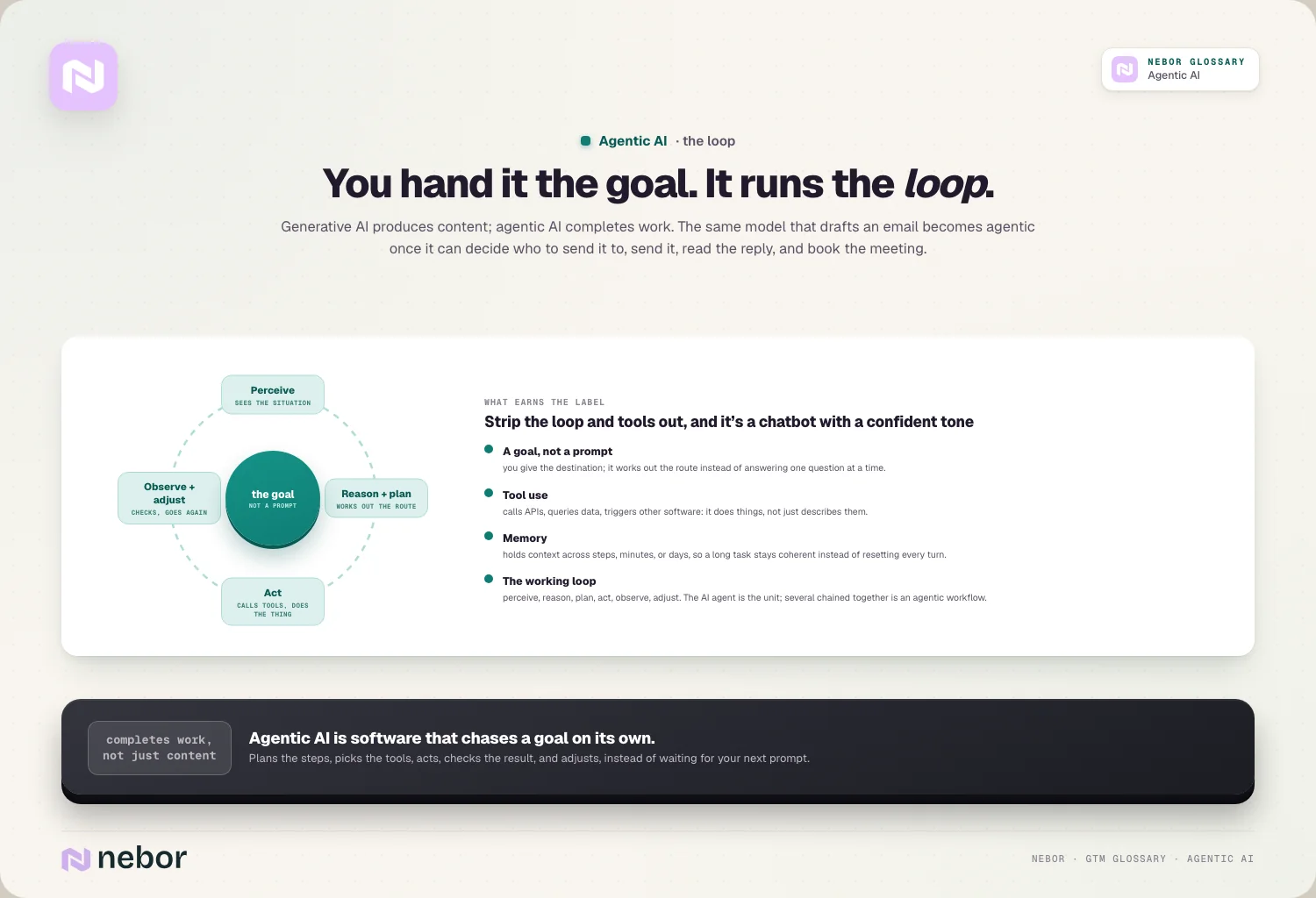
A goal instead of a prompt. You give it the destination and it works out the route instead of answering one question at a time.
A working loop. It perceives the situation, reasons about it, plans, acts, and then observes the result and adjusts.
Tool use. It calls APIs, queries data, and triggers other software so that things really happen instead of just getting described.
Memory. It holds context across steps, minutes, or days, so a long task stays coherent instead of resetting every turn.
If you strip out the loop and the tool use, you won't have an agent. You'll just have a chatbot with a confident tone. The AI agent is the unit doing the work, and stringing several together into a sequence is what people mean by an agentic workflow.
How you can tell agentic AI apart from generative AI and plain automation
Three different things get blurred together in most conversations about this. Plain automation follows fixed rules you wrote in advance, generative AI turns data into content, and agentic AI turns knowledge into action.
A Zapier zap that moves a lead from a form into your CRM is automation, and it never decides anything along the way. A model that writes a follow-up email is generative, because it produces the words but can't choose the moment or the recipient.
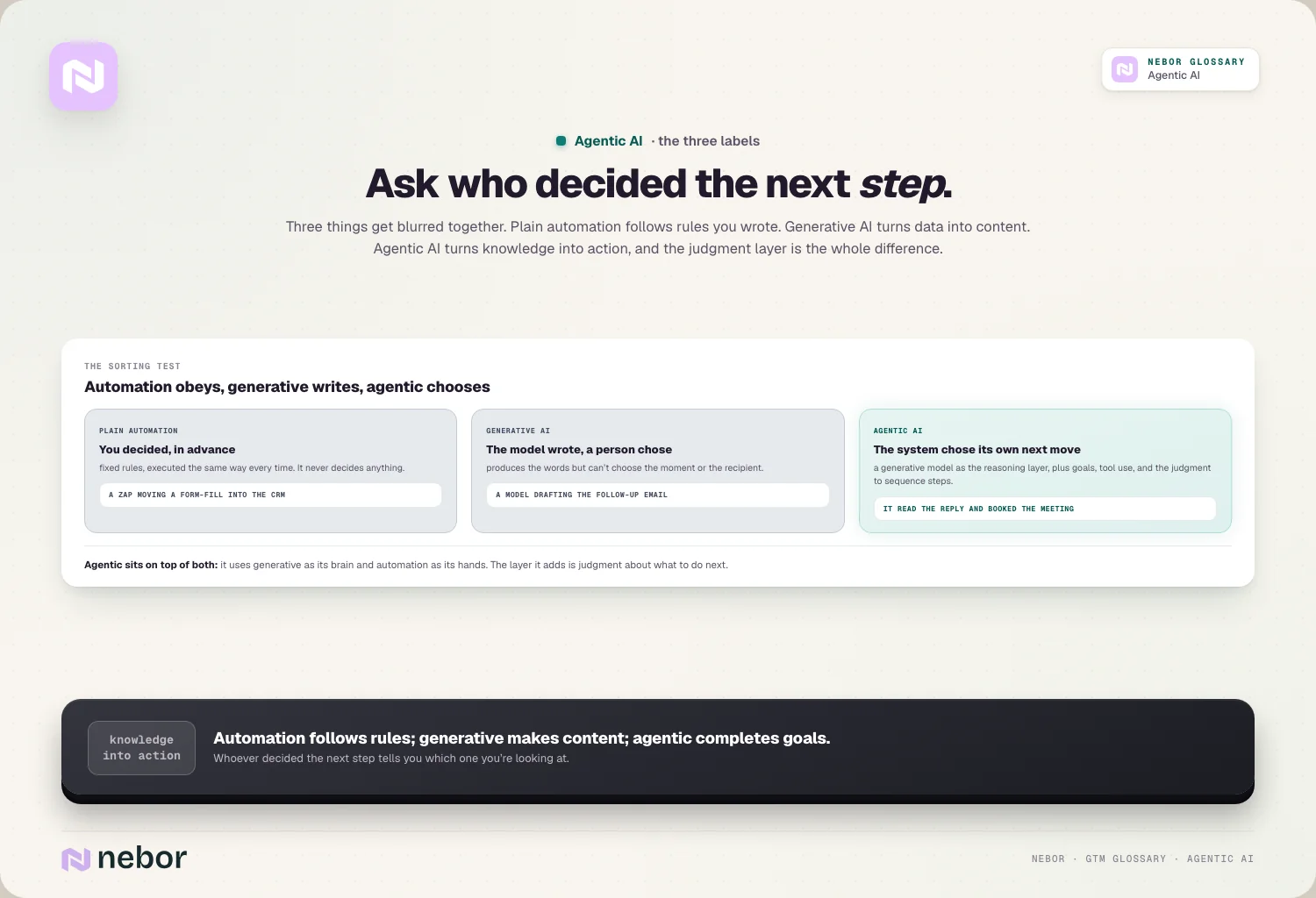
Agentic AI builds on both. It uses a generative model as its reasoning layer, then adds goals, tool use, and the judgment to sequence steps. That last layer of judgment is the whole difference.
Here's a quick test for which one you're looking at, and it comes down to asking who decided the next step. If you wrote the rule ahead of time, it's automation.
If the model wrote the words but a person chose what to do with them, it's generative. If the system looked at what it just learned and chose its own next move, that's the agentic part.
Why you should think of "agentic" as a dial you set rather than a feature you switch on
"Agentic" works less like a switch and more like a dial, and where you set it matters more than whether the tool technically counts as an agent.
At the co-pilot end, the agent suggests and a human approves before anything ships. At the autopilot end, it acts without sign-off. Most GTM work belongs left of full autonomy, with a human in the loop on anything a buyer will see.
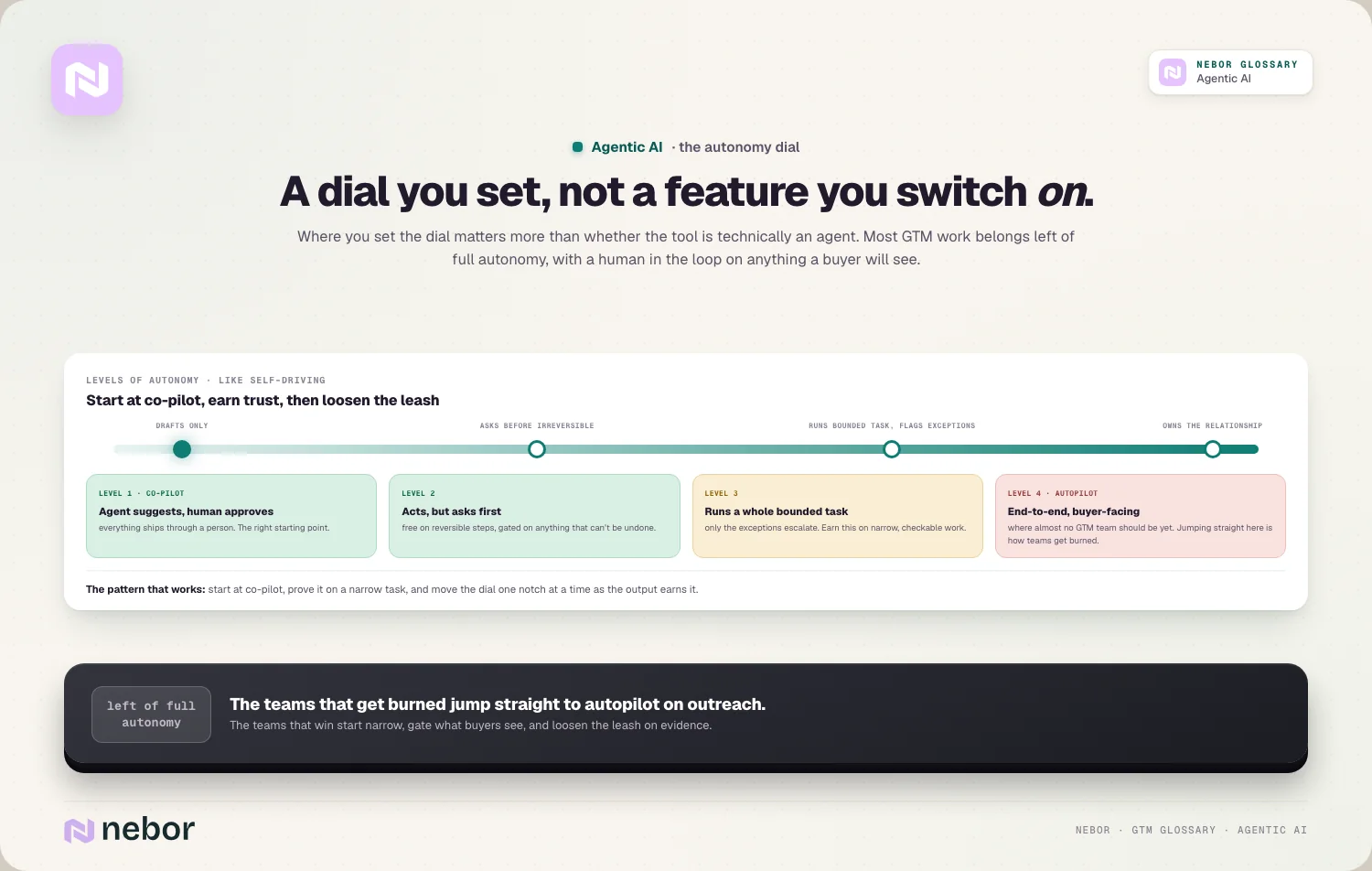
The teams that get burned are the ones that jump straight to autopilot on customer-facing outreach. The teams that do well start at co-pilot, earn trust on a narrow task, and only then loosen the leash.
It helps to think in levels of autonomy, the way self-driving cars do. At the lowest level the agent only drafts and a person does everything else, and a step up from that, it acts but asks before anything irreversible.
Higher still, it handles a whole bounded task and only flags the exceptions. Full autonomy, where it owns the buyer relationship end to end, is the level almost no GTM team should be at yet.
The kinds of agentic AI you'll meet across a working GTM stack
Not all agents look the same, and the differences matter when you're buying or building one. A few rough categories show up again and again.
Single-task agents do one bounded job, like enriching a record or drafting a brief, and then stop. They're the safest place to start because the output is easy to check.
Orchestrated multi-agent setups split a bigger job across several agents, where one researches, one writes, and one reviews. They're more powerful and far more failure-prone, because a mistake early on travels downstream before anyone catches it.
Then there are the conversational agents that live in a chat window and act when you ask, and the background agents that wake on a trigger or a schedule with no one watching. The background kind needs the tightest guardrails, because there's no human reading along in real time.
Where agentic AI earns its keep in your go-to-market motion right now
The honest answer is the unglamorous middle-of-the-funnel work your reps lose most of their week to. On our own breakdown, reps spend around 70% of their day on work that is not selling, and that's exactly where agents help.
Account research, data enrichment, list building, CRM hygiene, and first-draft personalization are all bounded, checkable tasks. An agent can do them at a scale a human team can't match, and that's the honest version of what an AI SDR delivers today.
We have written about which prospecting jobs you can hand to a machine and which still need a rep.
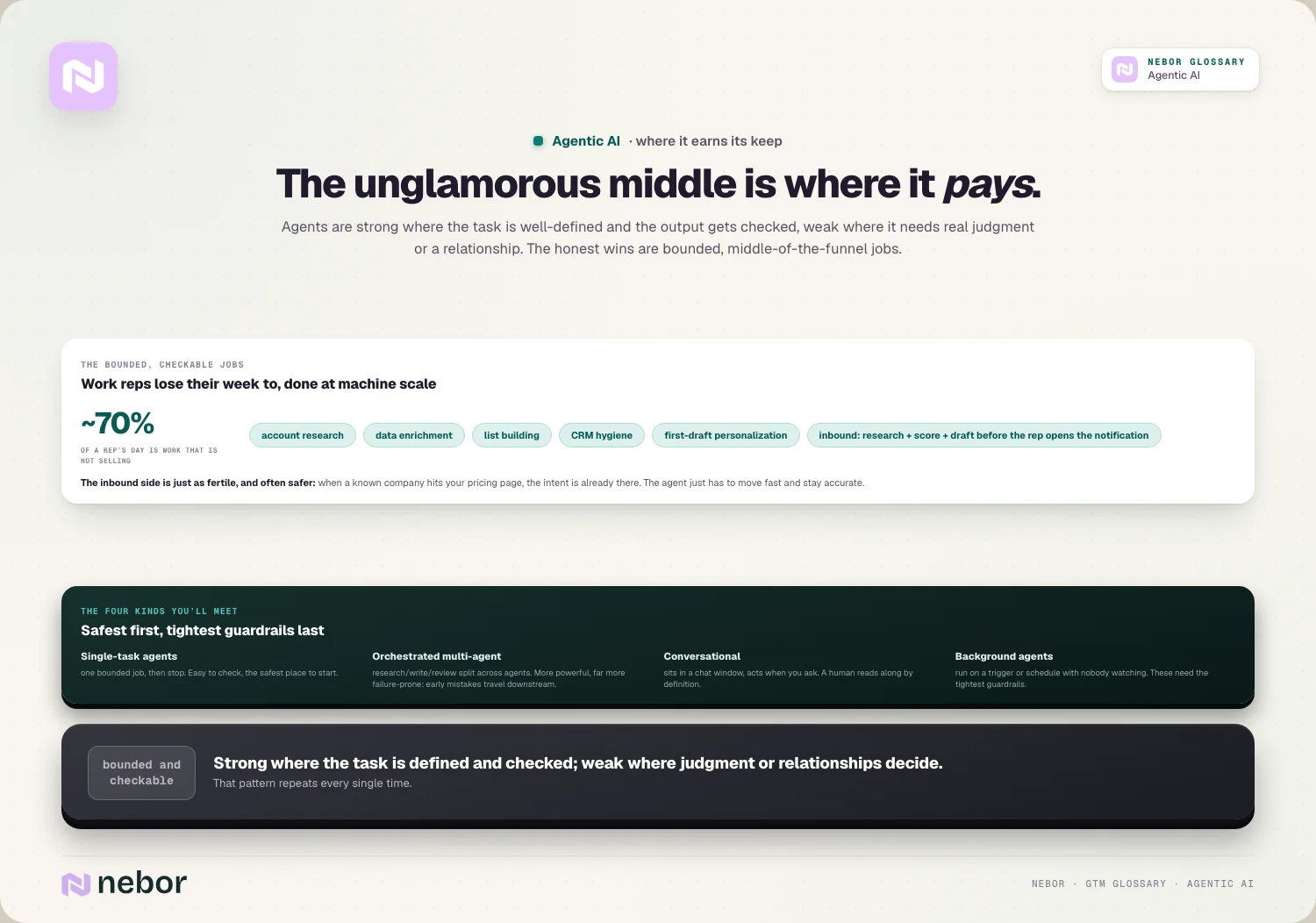
The pattern repeats in every build we do. Agents are strong where the task is well-defined and the output gets checked, and weak where it needs real judgment or a relationship.
The inbound side is just as fertile, and often safer. When someone fills a form or a known company lands on your pricing page, an agent can research them, score the fit, and draft a tailored first touch before a rep even opens the notification.
Our own website visitor workflows lean on exactly this kind of bounded agent, because the intent is already there and the agent just has to move fast and stay accurate.
Why the real bottleneck for agentic AI tends to be governance rather than raw model intelligence
The failure mode is full autonomy on the things that need a human. Autonomous outbound that emails prospects with no oversight scales mistakes faster than results, and buyers notice.
The available data backs up that caution. Gartner expects AI agents to outnumber sellers tenfold by 2028, yet fewer than 40% of sellers to say the agents improved their productivity. Gartner also expects companies to scrap more than 40% of agentic AI projects by the end of 2027.
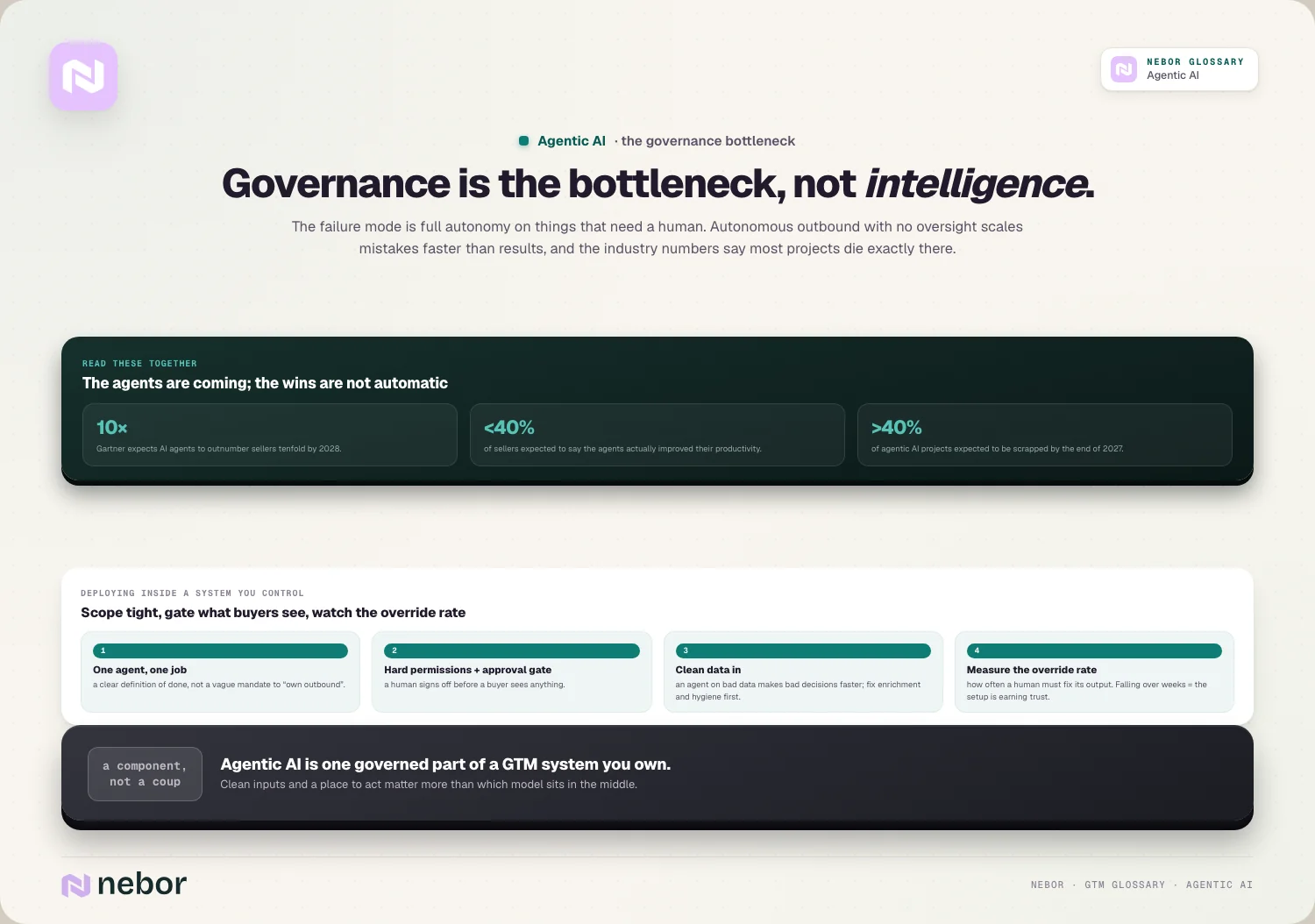
When you read those two predictions together, the lesson is clear. The block is rarely the model itself, but messy data, missing guardrails, and no one owning what the agent is allowed to do. Governance and data quality decide whether an agent helps or hurts.
The mistakes that quietly sink most agentic AI projects before they pay off
Most of the failures we see aren't dramatic. They're a handful of avoidable setup mistakes that show up over and over.
The first mistake is plain scope creep, where a team gives one agent a vague mandate like "own outbound" instead of one job with a clear definition of done, and the agent wanders.
The second is feeding it bad data. An agent reasoning over stale or thin records doesn't get cautious, it gets confidently wrong, and it does it at machine speed. If your enrichment and your CRM hygiene are weak, fix those before you point an agent at them.
The third is skipping the approval gate on anything a buyer sees. The fourth is having no logs, so when the agent does something strange, no one can work out why. If you can't reconstruct what an agent did and what it was reasoning over, you can't trust it yet.
How to actually deploy agentic AI inside a GTM system you control
Start with a narrow scope, giving one agent one job and a clear definition of done instead of a vague mandate to handle outbound.
Set hard permissions and an approval gate on anything customer-facing, so a human signs off before a buyer sees it. Feed it clean data, because an agent on bad data just makes bad decisions faster.
Then wire it into the rest of your stack as one step in a larger GTM system, governed by the same workflow orchestration behind everything else. Agentic AI works as one component of sales automation, and it never replaces the system around it.
Tools like Clay show up here as the connective tissue. They give an agent clean inputs and a place to act, which is far more important than which model powers the middle. The build around the model decides the outcome, and a clever model on a thin setup still fails.
How you'd measure whether your agentic AI setup is really working
Vendors love to talk about autonomy in their demos. The number that matters more is how often a human has to step in and fix the agent's output.
Track the override rate, meaning how many of the agent's drafts or decisions a rep has to correct before they ship. A high override rate isn't a failure, it's a signal that the task is too broad or the data is too thin. A falling override rate over a few weeks is the clearest sign the setup is earning trust.
Watch time saved per rep, but pair it with quality. An agent that saves an hour but doubles the error rate isn't a win. And watch downstream outcomes like reply rate and meeting rate, because the point was never activity, it was pipeline.
How agentic AI stacks up against the other "AI" labels you keep hearing
The market throws a lot of words around, and they're not interchangeable. Sorting them out makes it much easier to know what you're buying.
A chatbot answers questions and then waits for the next one. It has no goal of its own and takes no action in your systems. Plenty of "AI assistants" are really just chatbots with a nicer wrapper.
Robotic process automation, or RPA, follows fixed rules and clicks through screens the same way every time. It's reliable until something on the page changes, at which point it breaks, because it never makes a decision.
Agentic AI takes the opposite trade, less predictable but able to handle the messy cases where the right next step depends on what it just found.
Generative AI falls somewhere between those two. It produces text or images on demand, and it's the reasoning layer inside most agents, but on its own it doesn't choose what to do with what it wrote.
Agentic AI is what you get when you wrap a generative model in goals, memory, and tools so it can carry a task from start to finish.
How to tell a real agentic AI tool from a rebranded chatbot when you're buying
The "agentic" label sells, so a lot of vendors slap it on tools that don't earn it. A few sharp questions in a demo cut through most of the noise.
Ask what the tool does after it generates text. If the answer is "it shows you a draft," that's generative AI with a coat of paint. A real agent takes the next action on its own, like enriching the record, scoring the fit, or queuing the send.
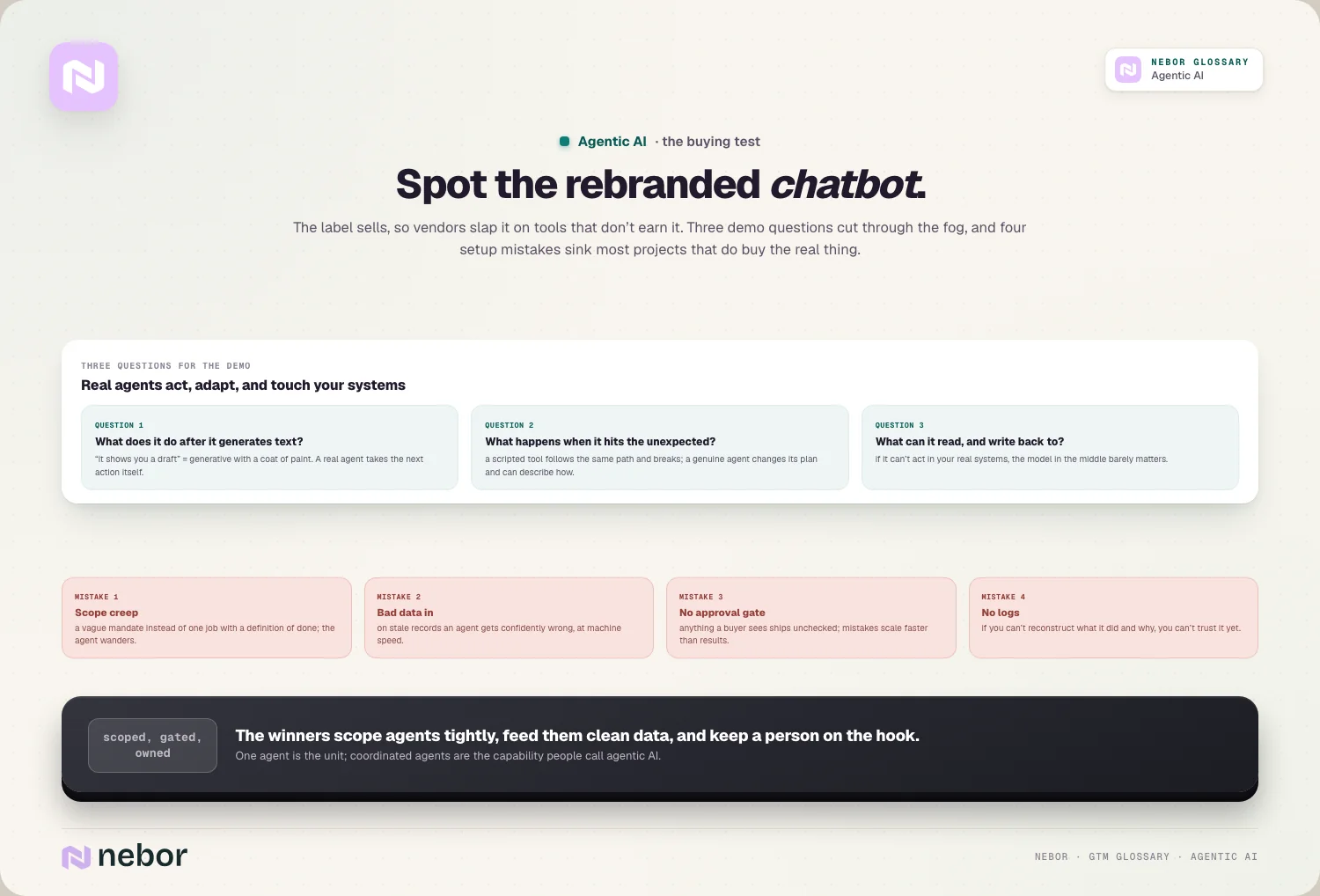
Ask what happens when it hits something it didn't expect. A scripted tool follows the same path regardless and breaks when reality shifts. A genuine agent looks at what it found and changes its plan, so it should be able to describe how it adapts mid-task.
Ask where the data comes from and what it can write back to. If the tool can't read your real systems and act in them, the model in the middle barely matters, because the agent has nothing to work with and nowhere to act.
What's still genuinely unsettled about agentic AI in go-to-market
It would be dishonest to pretend the picture is fully clear, because it isn't. A few real questions are still open, and they'll shape how this plays out.
The first open question is trust at scale. We can supervise a handful of agents today, but nobody has a clean answer for governing hundreds of them working across a GTM stack at once. The tooling for that oversight is still young.
The second is how buyers react as agentic outreach becomes normal. If everyone's agents are emailing everyone's inboxes, the bar for relevance rises fast, and the lazy implementations get tuned out first.
That pressure pushes back toward the warm, well-researched, inbound-led motions where we already do our best work.
How a single agent turns into the broader idea of agentic AI
One agent doing one job is the unit. The phrase "agentic AI" is really the whole capability that emerges once you have several of those units and a way to coordinate them.
When you chain a few agents and steps together, you get an agentic workflow. When several agents hold distinct roles and pass work between each other, that's a multi-agent system. From a step back, that combined capability is what people mean when they say agentic AI.
The teams that win the next few years won't be the ones with the cleverest model. They'll be the ones who scoped their agents tightly, fed them clean data, kept a person on the hook for anything a buyer sees, and treated agentic AI as one well-governed part of a system they own, rather than a magic box they bought.
Share this post
AI
Automation
Glossary
Related glossary items
Understanding the core GTM concepts



Ready to build your pipeline











