
In this post:
When people argue about AI in sales, they usually argue about how smart the AI is. That's the wrong question, because the real question is who holds the controls.
That's the whole distinction between auto-pilot and co-pilot mode. It isn't about how sophisticated the technology is, it's about how much decision authority you hand the machine versus keep with a human.
Auto-pilot and co-pilot mode describe two ways AI operates in a sales workflow. In co-pilot mode the AI assists a human who stays in control, while in auto-pilot mode the AI handles the workflow on its own and only escalates exceptions.
The reason this framing matters is that it cuts through the hype. Whether you should use one or the other depends on your sales motion and your risk tolerance instead of on which sounds more advanced.
TL;DR
Co-pilot mode means AI assists a human who approves the decisions, while auto-pilot mode means AI handles the workflow end to end and only flags exceptions for a person.
The difference lives in decision authority instead of sophistication. Co-pilot recommends and the human decides, while auto-pilot acts and the human supervises.
Co-pilot suits complex, relationship-driven sales where judgment matters, and auto-pilot suits high-volume, repeatable motions where speed and scale matter most.
The trade is that auto-pilot removes the human safeguard. That's fine for low-risk, high-volume work, but risky for complex deals or regulated industries where a person should stay in the loop.
So what do auto-pilot and co-pilot mode actually mean in sales?
The two terms describe where the human fits in an AI-driven sales workflow. They're points on a spectrum of how much the AI does on its own.
Co-pilot mode is AI as an assistant. It drafts messages, surfaces signals, and recommends actions, but a human reviews and approves before anything real happens.
Auto-pilot mode is AI as an operator. It handles the whole workflow, from research to outreach to booking, on its own, and only brings a human in for the exceptions it can't handle.
The aviation borrowing fits well, because a co-pilot supports the pilot who's flying, while auto-pilot flies the plane itself, with the human watching and ready to take over.
So the two modes are really about control. Co-pilot keeps a person at the controls with AI helping, and auto-pilot puts AI at the controls with a person supervising.
Why does decision authority matter more than how smart the AI is?
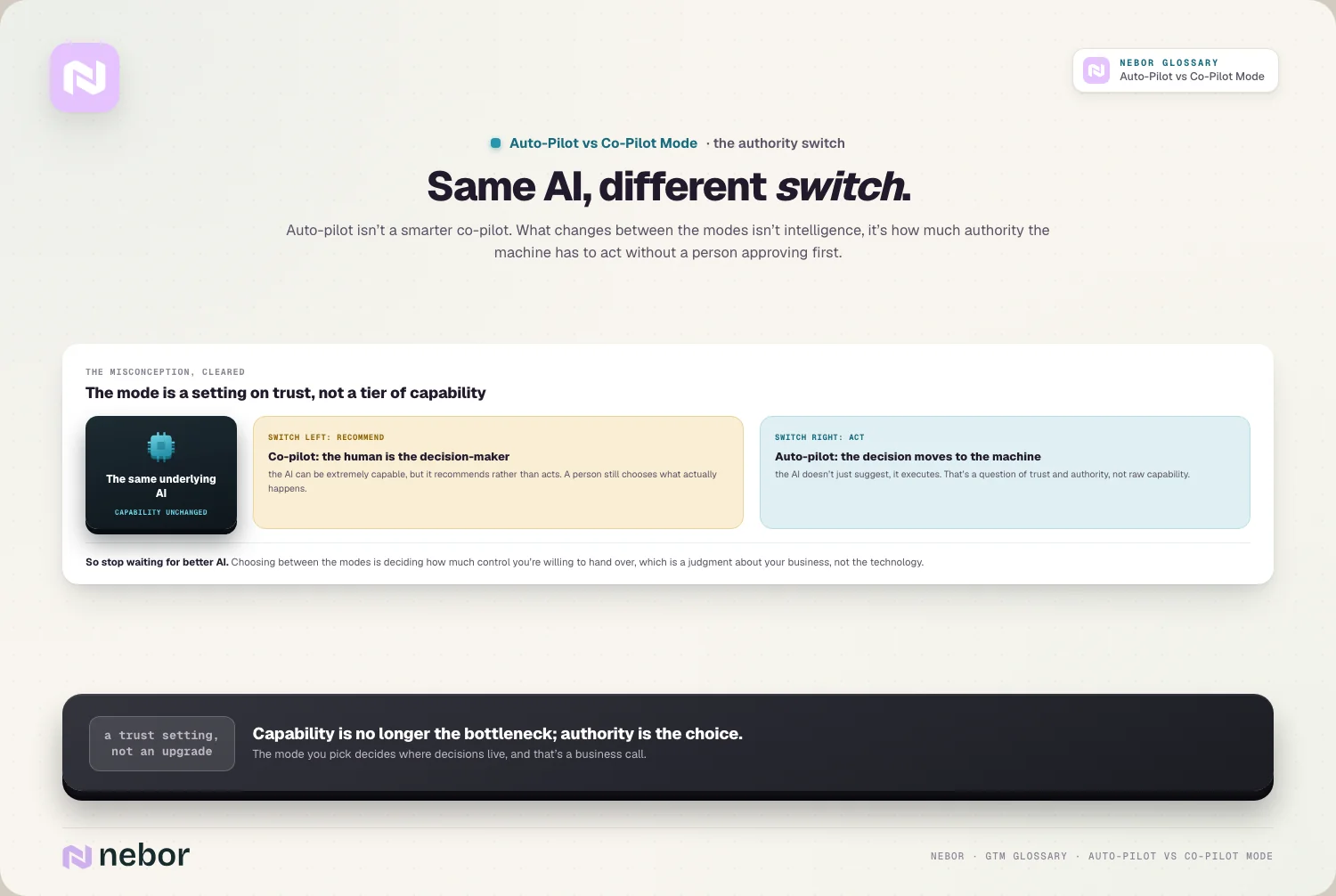
This is the misconception worth clearing up, because it shapes how you choose. People assume auto-pilot is just a smarter version of co-pilot, and it isn't.
The same underlying AI can work in either mode. What changes between them isn't the intelligence, it's how much authority you give it to act without a human approving first.
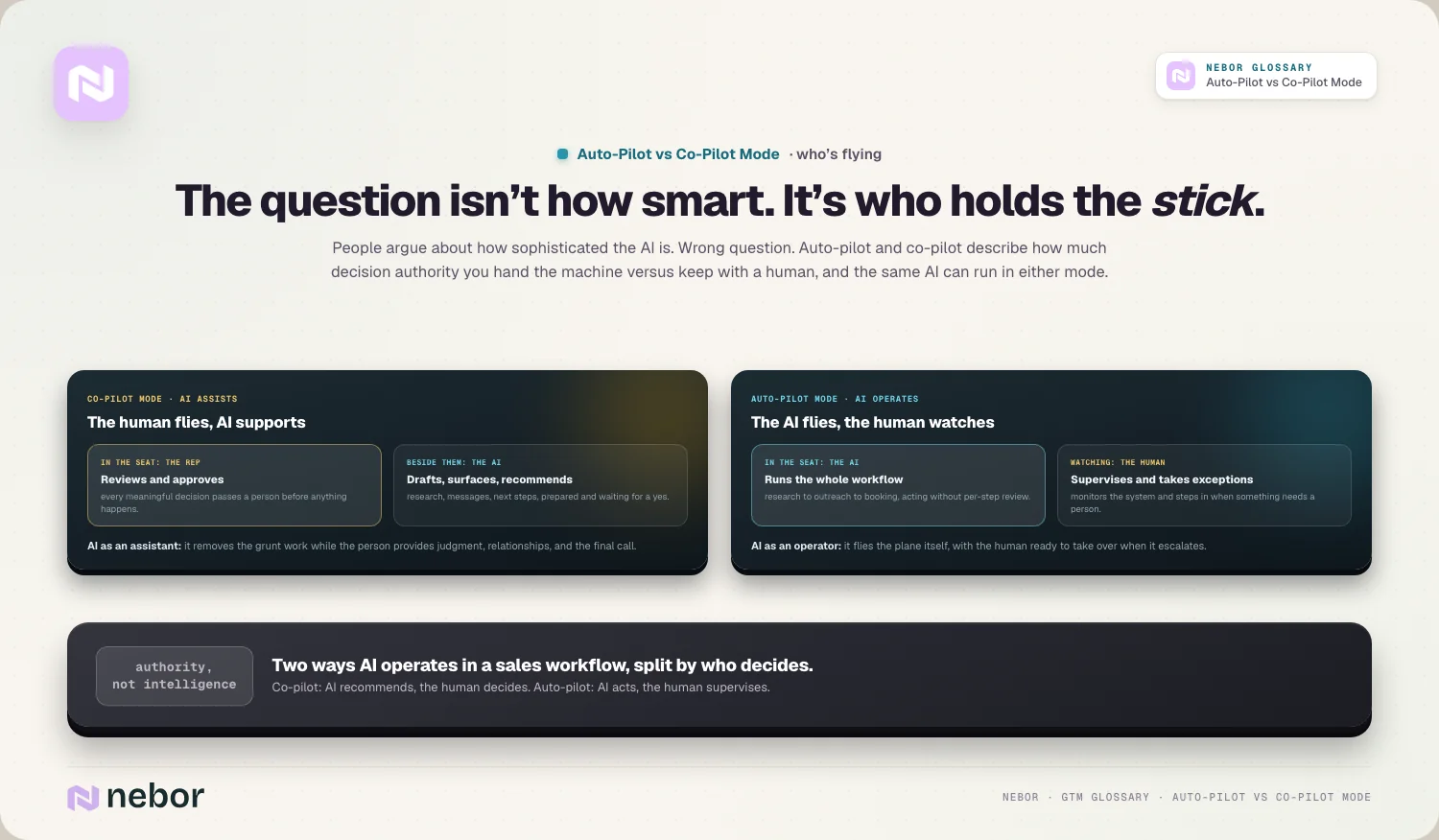
Co-pilot keeps the human as the decision-maker. The AI can be extremely capable, but it recommends rather than acts, so a person still chooses what goes ahead.
Auto-pilot moves the decision to the machine, which goes beyond suggesting into executing, and that's a question of trust and authority rather than raw capability.
So choosing between them isn't about waiting for better AI. It's about deciding how much control you're willing to hand over, which is a judgment about your business more than the technology.
How does co-pilot mode work in practice once it's switched on?
Co-pilot mode is where most of the teams we work with start, and the shape is simple, with the AI doing the work and a human staying in control.
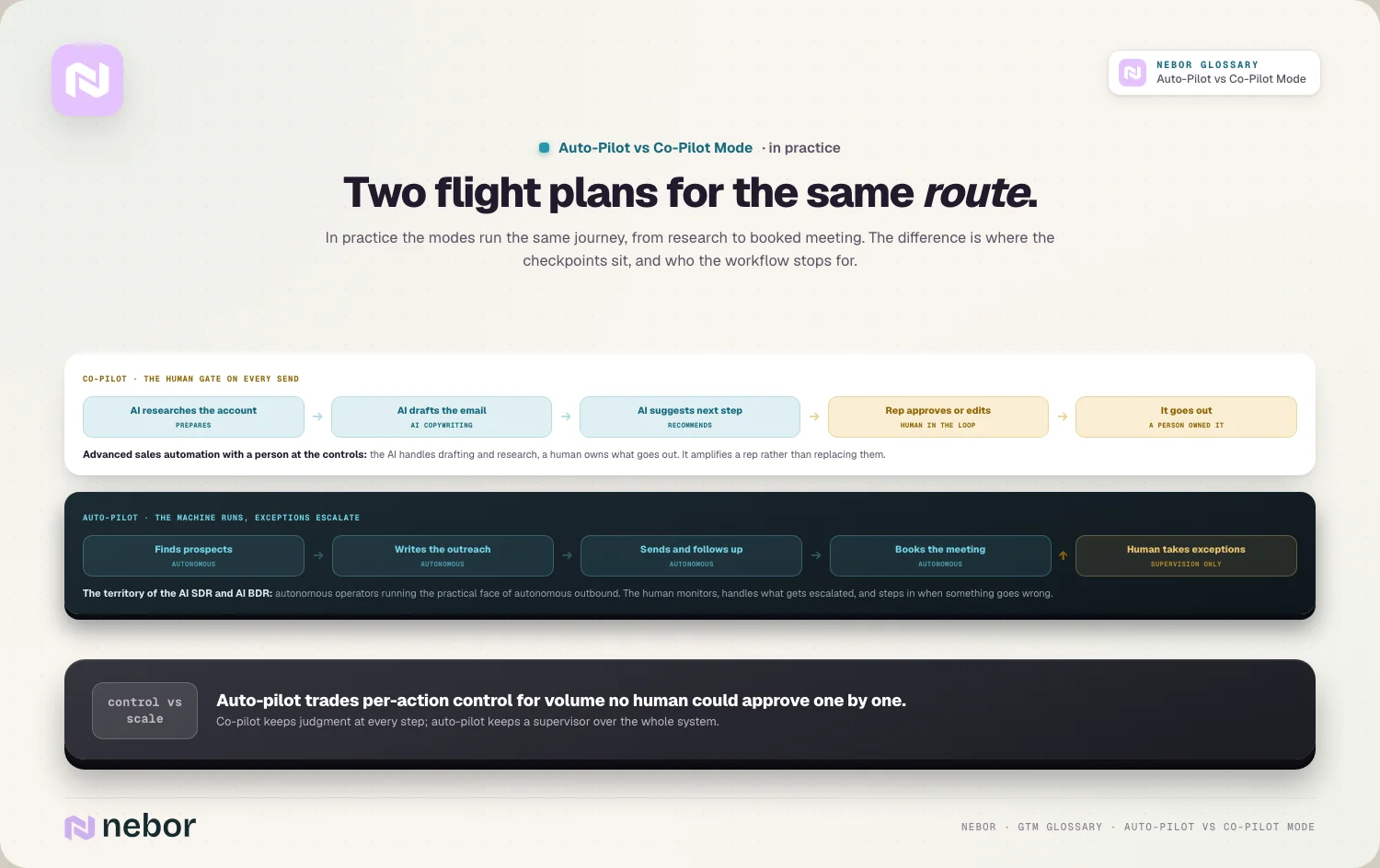
In a co-pilot setup, the AI prepares and the rep decides. It might research an account, draft an email, and suggest the next step, then wait for your rep to approve or edit.
This keeps a human in the loop at every meaningful decision. The AI removes the grunt work while the person provides the judgment, the relationships, and the final call.
It's essentially advanced sales automation with a person at the controls. The AI handles drafting and research, often including AI copywriting, but a human owns what goes out.
So co-pilot mode multiplies a rep instead of replacing them. It makes each person faster and better informed, and that's the reason it suits sales where human judgment is the differentiator.
How does auto-pilot mode work in practice when it takes over?
Auto-pilot mode is the more autonomous end, where the AI carries the whole motion with minimal human touch.
In an auto-pilot setup, the AI handles the full workflow. It finds prospects, writes the outreach, sends it, and follows up, often booking meetings in your team's calendar without a human reviewing each step.
This is the territory of the AI SDR and AI BDR. These roles act as autonomous operators, which is the practical face of autonomous outbound.
The human role shifts over to supervision. Instead of approving each action, a person monitors the system, handles the exceptions it escalates, and steps in when something goes wrong.
So auto-pilot mode trades control for scale. It can carry far more volume than a human could approve one by one, and that scale is exactly what suits high-volume, repeatable outbound.
When should you use co-pilot mode instead of fuller autonomy?
Choosing the right mode depends on your sales motion, and co-pilot shines in a few specific situations.
It fits complex, high-value sales, because when deals are large and involve nuanced relationships, the judgment a human brings deserves keeping at every step, which co-pilot preserves.
It fits relationship-driven motions too, where trust and rapport decide the deal, so you want a person shaping the conversation, with AI handling the prep behind them.
And it fits regulated industries, since in sectors like finance, healthcare, and legal, fully autonomous outreach can be legally risky, so human review is an important control layer.
The payoff is real even with a person involved. Early co-pilot deployments have improved win rates by more than 30% according to Bain, because they make reps faster without removing their judgment.
When should you use auto-pilot mode and just let the system take over?
Auto-pilot fits a different set of situations, and its sweet spot is scale and speed.
It fits high-volume outbound, because when you're reaching many prospects with a repeatable motion, the speed of auto-pilot lets you operate at a scale no human could approve manually.
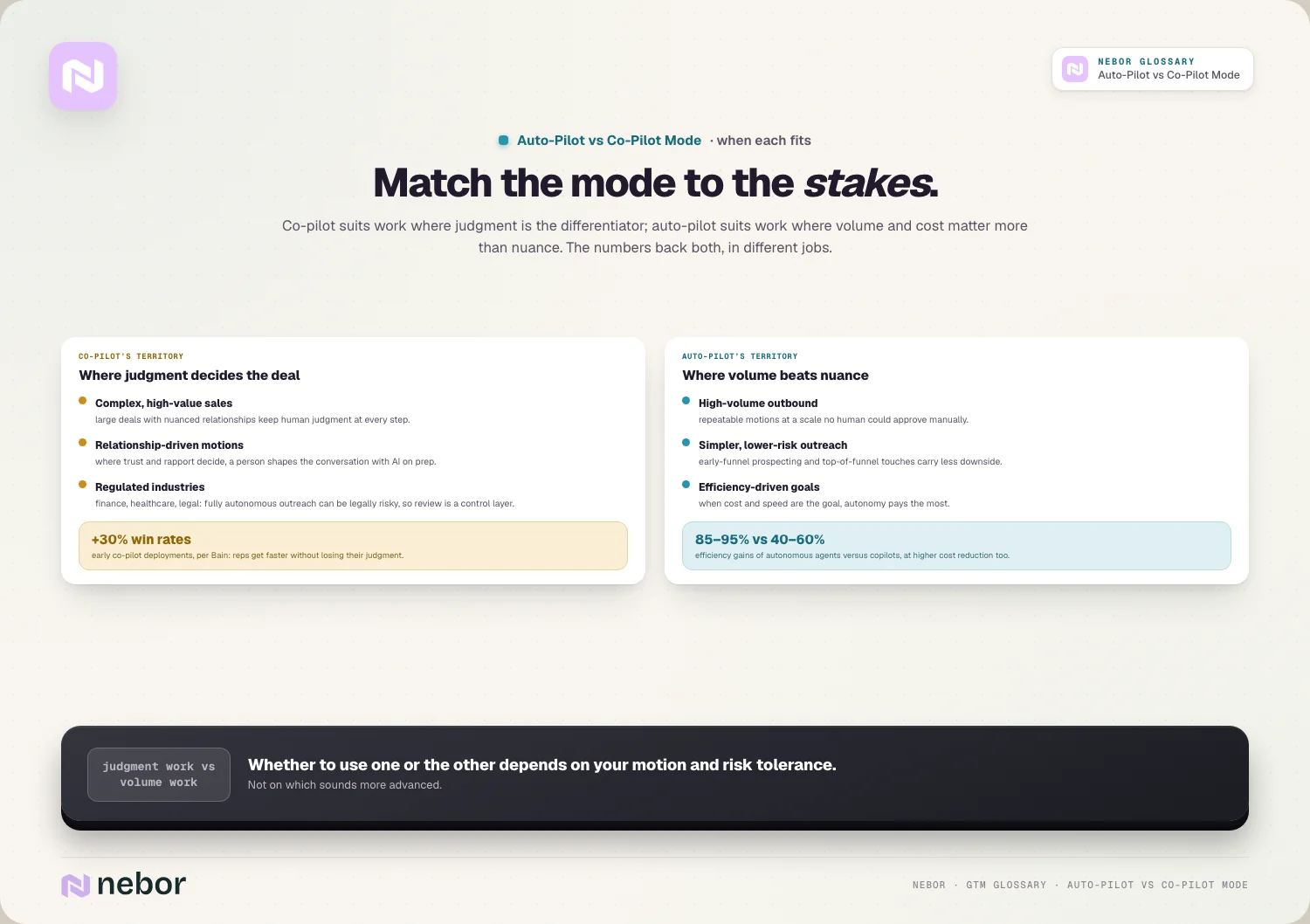
It fits simpler, lower-risk outreach as well, since early-funnel prospecting and top-of-funnel touches are lower-stakes, so handing them to AI carries less downside than autonomous handling of a complex deal.
And it fits efficiency-driven goals, where the gains are larger, with autonomous agents reaching 85 to 95% efficiency improvements versus 40 to 60% for copilots, at a higher cost reduction too.
So auto-pilot suits motions where volume and cost matter more than nuance. The trade is that you give up per-action control in exchange for scale and speed.
Is it really a choice between one mode or the other forever?
Framing this as a binary is tempting, but the reality is more of a spectrum, and most of the teams we build for end up using both.
The two modes were never mutually exclusive. You can use auto-pilot on your high-volume, low-risk work while keeping co-pilot on complex, high-value deals, splitting the funnel by stakes.
Many teams start at co-pilot and move toward auto-pilot. As they build trust in the AI and prove it on low-risk tasks, they hand it more authority over time.
The split often follows the shape of the funnel. AI auto-pilots the repetitive top-of-funnel work, while humans, assisted by co-pilot AI, handle the relationship-heavy later stages.
So the smart question is which mode for which work, instead of which mode overall. You match the level of autonomy to the stakes of the task, instead of picking one for everything.
How do these modes relate to AI agents and orchestration tools?
Auto-pilot and co-pilot are really about how much autonomy you give the AI, and that connects them to a few broader AI concepts.
Auto-pilot mode is closely tied to the AI agent. An agent that acts on its own, carries a workflow, and handles exceptions is the engine behind auto-pilot operation.
It also relates to the agentic workflow, where AI executes a chain of steps with minimal hand-holding. Auto-pilot is that idea applied to a whole sales motion.
Both modes depend on getting good direction. The quality of either is shaped by prompt engineering for GTM, because the AI only acts well when it's instructed well.
So the modes are a way of describing autonomy, and the underlying tech is agents and orchestration. Choosing a mode is choosing how much of that autonomy to switch on.
How do you move from co-pilot toward auto-pilot without a crash?
We advise against jumping straight to full autonomy, because a gradual path builds trust and catches problems before they scale.
You start in co-pilot mode, letting the AI draft and recommend while humans approve, so you can see how good its output is before handing it real authority.
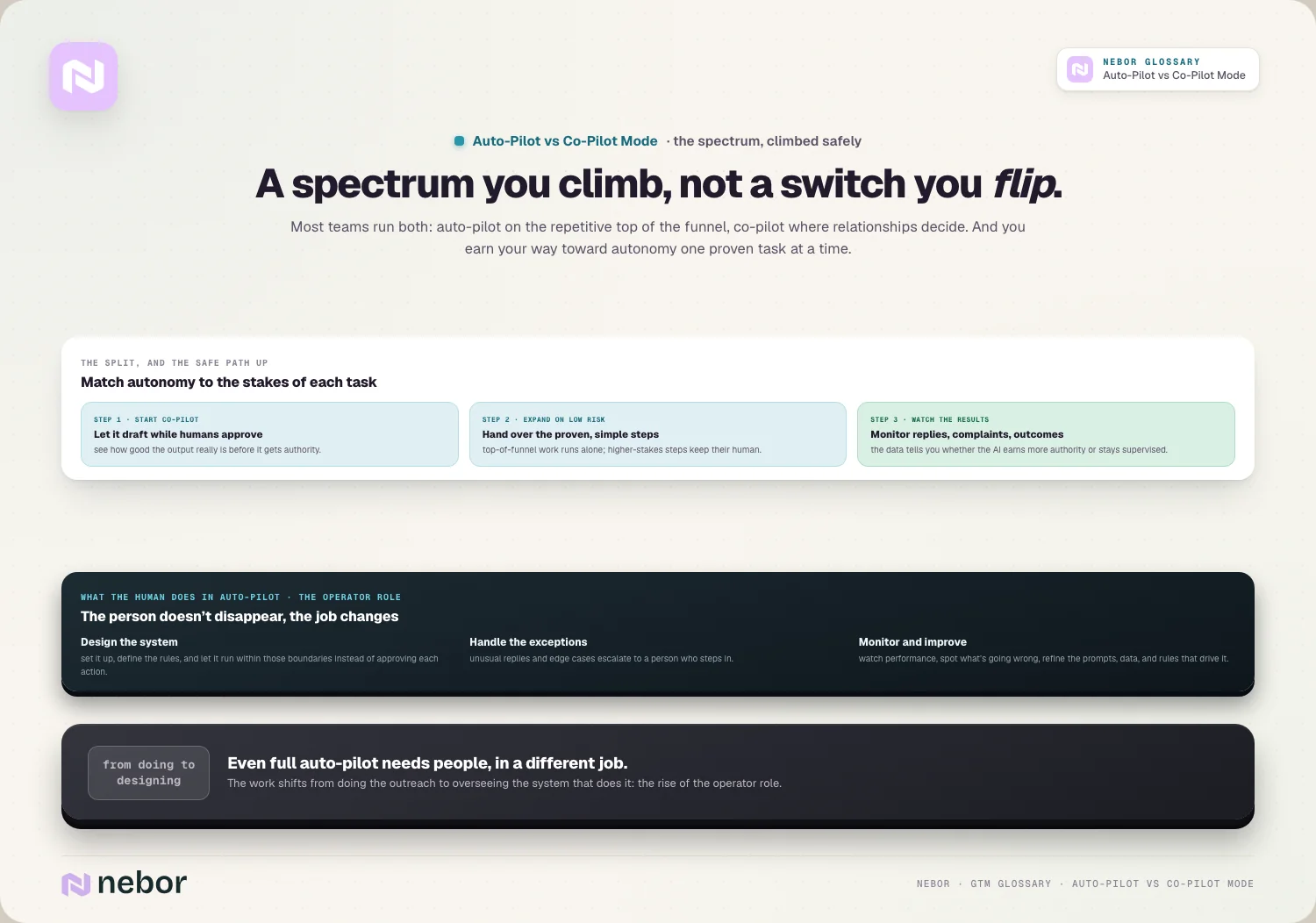
From there you expand autonomy on low-risk tasks. As the AI proves itself on simple, top-of-funnel work, you let it take those steps on its own while keeping humans on the higher-stakes ones.
The results deserve close watching as you go, because monitoring reply quality, complaints, and outcomes tells you whether the AI is ready for more authority or needs to stay supervised.
So the safe path moves one step at a time. You earn your way to auto-pilot one task at a time, instead of flipping a switch and hoping the AI handles everything correctly from day one.
What does the human still do once auto-pilot mode takes over?
A common misunderstanding is that auto-pilot means no human at all. In reality, the human role changes instead of disappearing.
The person stops approving each action, and instead of reviewing every message, they set up the system, define the rules, and let it work within those boundaries.
Exceptions still land with them, because when the AI hits something it can't resolve, like an unusual reply or an edge case, it escalates to a human who steps in.
And the monitoring never stops, with someone watching the system's performance, spotting where it's going wrong, and refining the prompts, data, and rules that drive it.
So even full auto-pilot needs people, just in a different job. The work shifts from doing the outreach to designing and overseeing the system that does it, which is the rise of the operator role.
Does the choice between modes depend on the size of your team?
Team size is one practical factor in choosing a mode, so it deserves a look. Smaller and larger teams often lean different ways for different reasons.
Small teams often lean toward auto-pilot, because with few people and big goals, automating high-volume work lets a tiny team operate at a scale that would otherwise need many hires.
Larger teams can afford co-pilot at scale. With more reps, they can keep humans in the loop on more deals, using AI to make each person faster instead of replacing anyone.
But the deciding factor is still the work itself instead of the headcount. Even a small team should keep humans on its most complex, high-value deals, and a large team can auto-pilot its repetitive top-of-funnel.
So team size influences the mix, but it doesn't override the basic rule. You match autonomy to the stakes of the task first, and let your resources shape the balance from there.
What are the common mistakes with auto-pilot and co-pilot modes?
Teams get this choice wrong in a few predictable ways. Knowing them helps you match the mode to the work.
The classic one is auto-piloting complex deals, because handing relationship-driven, high-value sales to full autonomy removes the judgment those deals need, and it costs you.
Its opposite is co-piloting everything, where keeping a human approving every low-risk, high-volume touch wastes the scale that auto-pilot could provide on simple work.
Leaving auto-pilot without oversight comes third, because even autonomous systems need monitoring, and unsupervised AI can send bad outreach at scale, a frequent reason AI and Clay implementations fail.
And ignoring compliance rounds out the list, because in regulated industries full autonomy can create legal risk, so defaulting to auto-pilot without considering the rules is a real hazard.
Why is this distinction becoming so central to how teams deploy AI?
As AI gets more capable, the auto-pilot versus co-pilot question is moving to the center of how teams deploy it. The reason is that capability is no longer the bottleneck.
A few years ago, AI couldn't reliably handle a sales workflow at all, so the only real option was light assistance. Now it can, which makes the authority question urgent rather than theoretical.
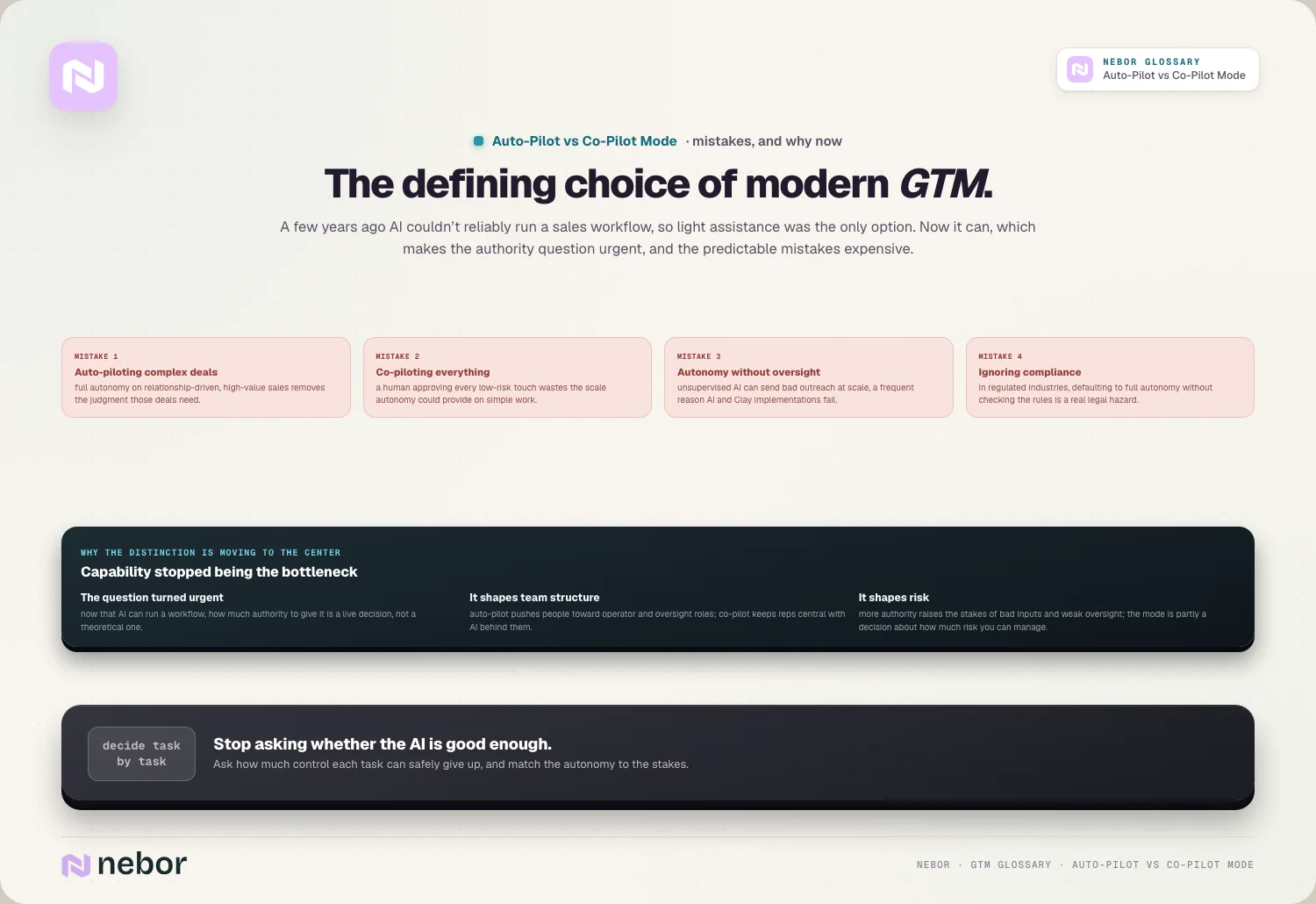
The choice now shapes how a team is structured. Auto-pilot pushes people toward operator and oversight roles, while co-pilot keeps reps central with AI behind them, and that changes hiring and skills.
Risk moves along with the choice as well. Handing more authority to AI raises the stakes of getting the inputs and oversight wrong, so the mode you choose is partly a decision about how much risk you can manage.
So this isn't a passing piece of jargon. As AI keeps improving, deciding how much authority to give it, task by task, becomes one of the defining choices in modern go-to-market.
Why the mode question is really a question about control and stakes
The auto-pilot versus co-pilot distinction reframes the whole AI-in-sales question. The issue turns out to be how much authority you give the AI to act on its own, instead of how smart it is.
The deeper point is that the right answer depends on the stakes. Co-pilot keeps a human in control for complex, high-value, or regulated work, while auto-pilot trades control for scale on high-volume, low-risk motions.
The honest framing is that this is a spectrum instead of a binary. The best teams match the level of autonomy to the task, auto-piloting the repetitive parts and co-piloting the parts where judgment decides the deal.
So if you're deciding how to deploy AI in your sales motion, stop asking whether the AI is good enough and start asking how much control each task can safely give up.
That decision, made task by task, is what lets AI automate sales prospecting at scale while keeping humans where they matter. It's exactly the balance a modern go-to-market system is built to strike.
Share this post
Automation
AI
Glossary
Related glossary items
Understanding the core GTM concepts

Ready to build your pipeline