

In this post:
Trying to close a two-hundred-thousand-dollar deal on the first call means convincing a dozen stakeholders to bet big on a vendor they've never used, and that burden is why those deals crawl for a year and often die.
Land and expand takes the opposite approach. You sell one team a thirty-thousand-dollar slice, prove it works, and grow to that same two hundred thousand over the next year and a half, without ever asking for one enormous leap of faith.
The idea is to win a foothold instead of the whole organization at once. You land a small, focused deal with a single team, deliver undeniable value, and then let that success open the door to more users, more products, and more departments, so the account grows steadily instead of requiring one giant leap of faith.
Land and expand is a growth strategy where you acquire a customer with a small initial purchase, the land, and then grow the relationship over time, the expand, by adding users, upgrading plans, and selling into new teams. It trades one huge upfront deal for a smaller start that compounds.
The reason it works so well in SaaS is that expanding an existing customer is far easier than winning a new one. A happy customer who already trusts your product is dramatically more likely to buy more, so the land creates the trust and proof that makes every subsequent expansion faster and cheaper than starting cold.
TL;DR
Land and expand means winning a small initial deal with one team, proving value, then growing the account over time through upgrades, add-ons, and new departments instead of selling everything upfront.
The land is deliberately small and focused so it's easy to say yes to, which avoids the long, risky process of selling a whole organization on an unproven vendor at once.
The expand comes from three moves, upselling to higher tiers, cross-selling complementary products, and spreading to new teams and regions, and it's where most of the account's lifetime value is earned.
It's powerful because selling more to an existing customer is far likelier to succeed than closing a new one, so land and expand drives the high net revenue retention that defines strong SaaS businesses.
What land and expand means in practice and how its two phases work
Land and expand splits the customer relationship into two deliberate phases that play very different roles. The land is the initial sale, a small, focused deal that gets your product in the door, and the expand is everything that comes after, growing that beachhead into a much larger account over months and years.
The two phases are designed to reinforce each other instead of stand alone. The land isn't meant to be a big win on its own, it's meant to prove value cheaply and create the internal demand that makes the expand possible, so a small first deal is a feature of the strategy instead of a compromise.

This framing changes how you think about a new customer. Rather than treating the first deal as the goal, your team treats it as the opening move in a longer game, and that framing is why land and expand fits so naturally with the bowtie funnel view that most value is earned after the initial sale.
Why landing small is easier and faster than selling the whole organization
The core insight behind landing small is that a big deal is hard to approve while a small one is easy. Selling an entire organization means winning over a dozen stakeholders and surviving a six to twelve month process, whereas selling one team a focused solution is a decision a single champion can often make quickly.
A small land also lowers the buyer's risk, which removes the biggest obstacle to a first purchase. Committing a whole company to an unproven vendor feels dangerous, but letting one team try a focused solution is low-stakes, so the small deal sidesteps the fear that stalls large initial purchases.
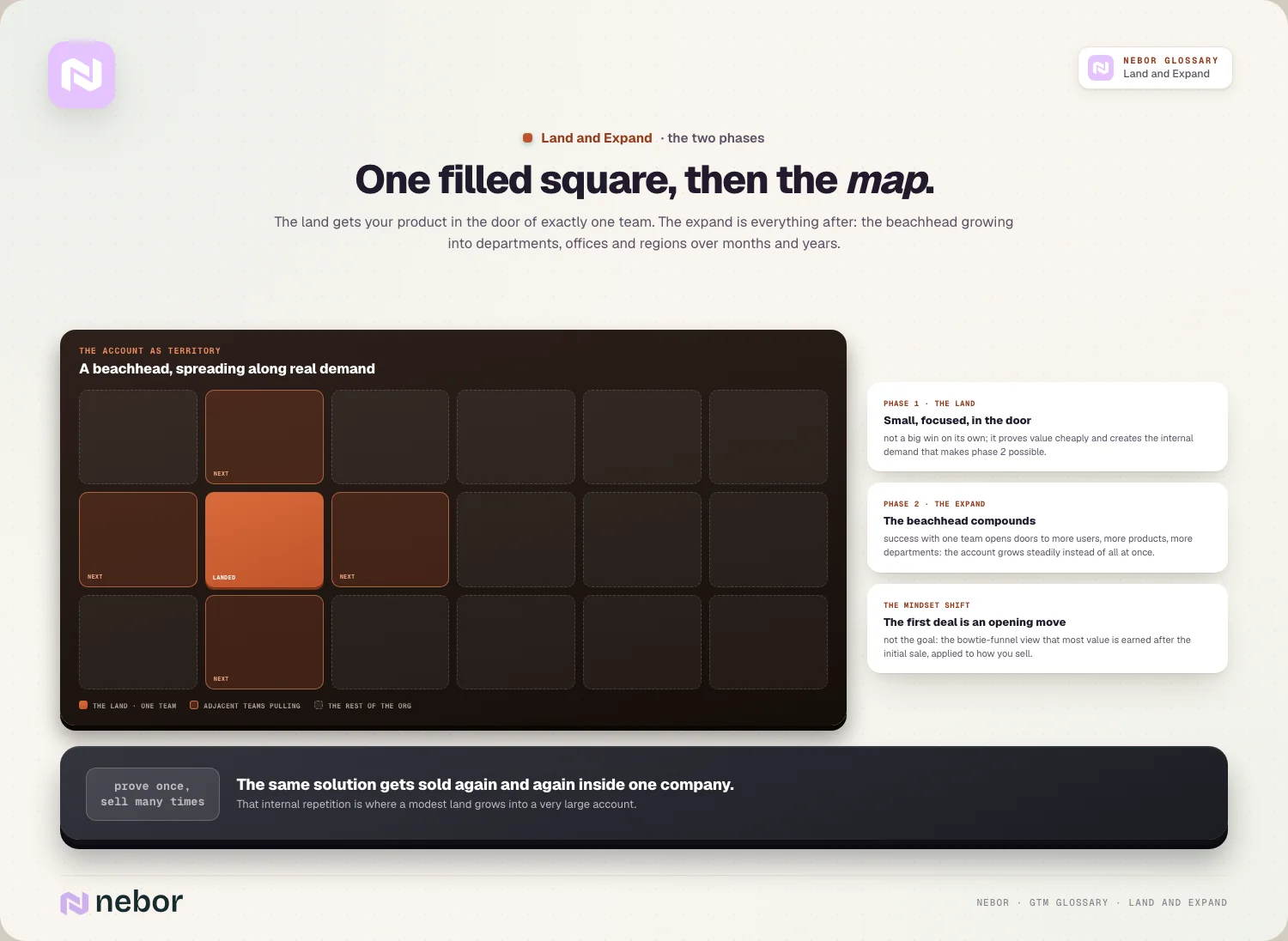
The speed advantage compounds because a shorter first deal shrinks the sales cycle length dramatically. Instead of a year-long enterprise slog, you close a focused deal in weeks, start delivering value immediately, and build the track record that makes the far larger expansion conversations easy later.
The three ways an account tends to grow after you land inside it
Expansion happens through three distinct moves, and strong land-and-expand motions use all of them. The first is upselling, where you move an existing customer to a higher tier or turn on more advanced features, growing the value of the same use case they already bought.
The second is cross-selling, where you introduce complementary products or services that fit alongside what the customer already uses. Because they already trust you, adding a related product is a natural next step, which is how a single-product land turns into a multi-product relationship over time.
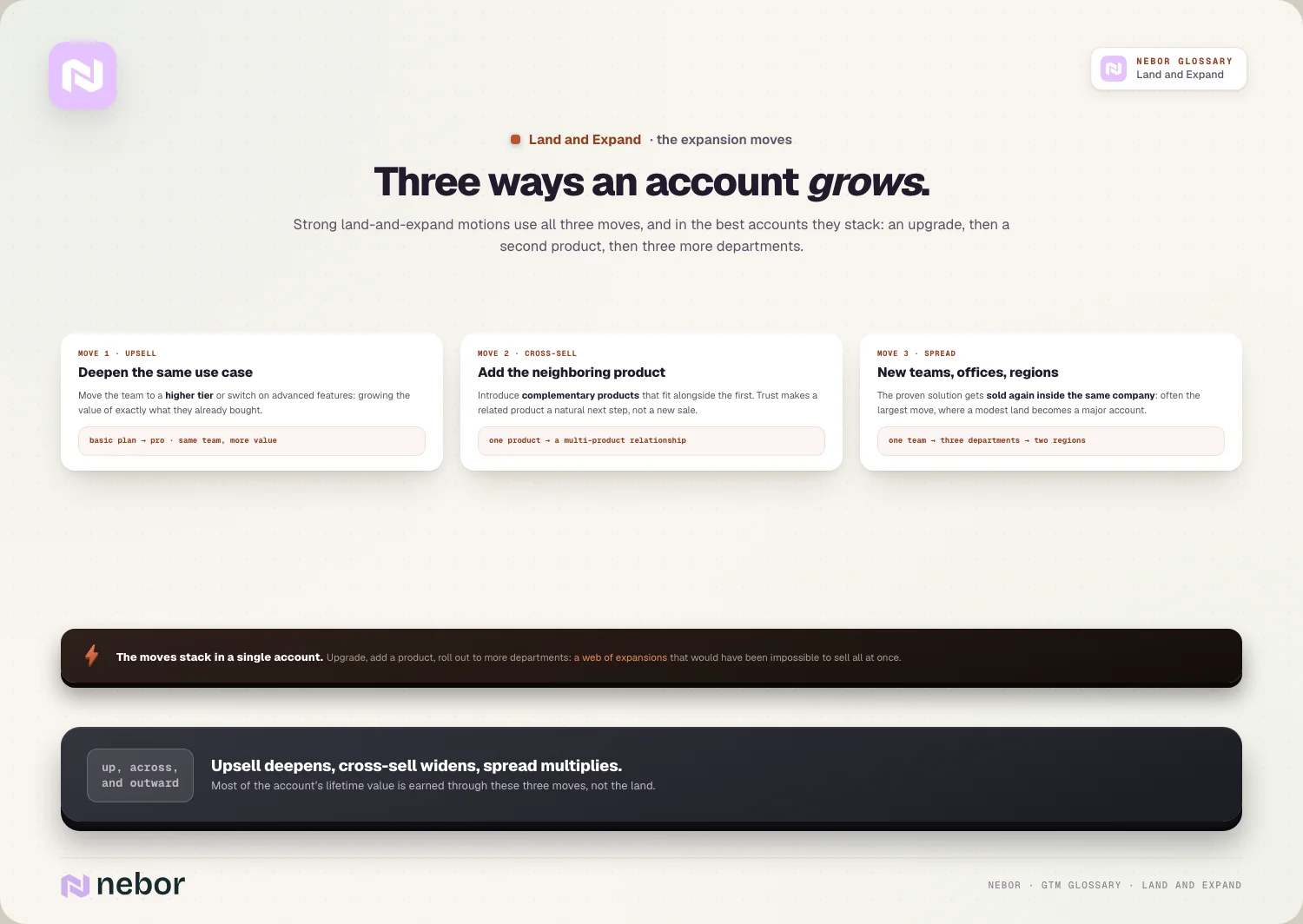
The third and often largest is spreading to new parts of the organization. A product that proves itself with one team can expand to other departments, offices, or regions, so the same solution gets sold again and again inside one company, the path along which a modest land grows into a very large account.
These three moves often stack on top of each other in a single account. A team on a basic plan upgrades, then adds a second product, then rolls the whole thing out to three more departments, so what began as one small deal becomes a web of expansions that would have been impossible to sell all at once.
Why expanding an existing customer beats winning a brand-new one
The economics of land and expand rest on a simple truth about selling to people who already know you. The likelihood of selling more to an existing customer is around 60 to 70%, more than triple the odds of closing a new one, because trust and proven value do most of the persuading for you.
This gap exists because the hardest parts of a sale are already behind you after the land. The customer has adopted your product, seen it work, and integrated it into their workflow, so an expansion conversation skips the skepticism and evaluation that make winning a cold account so slow and expensive.
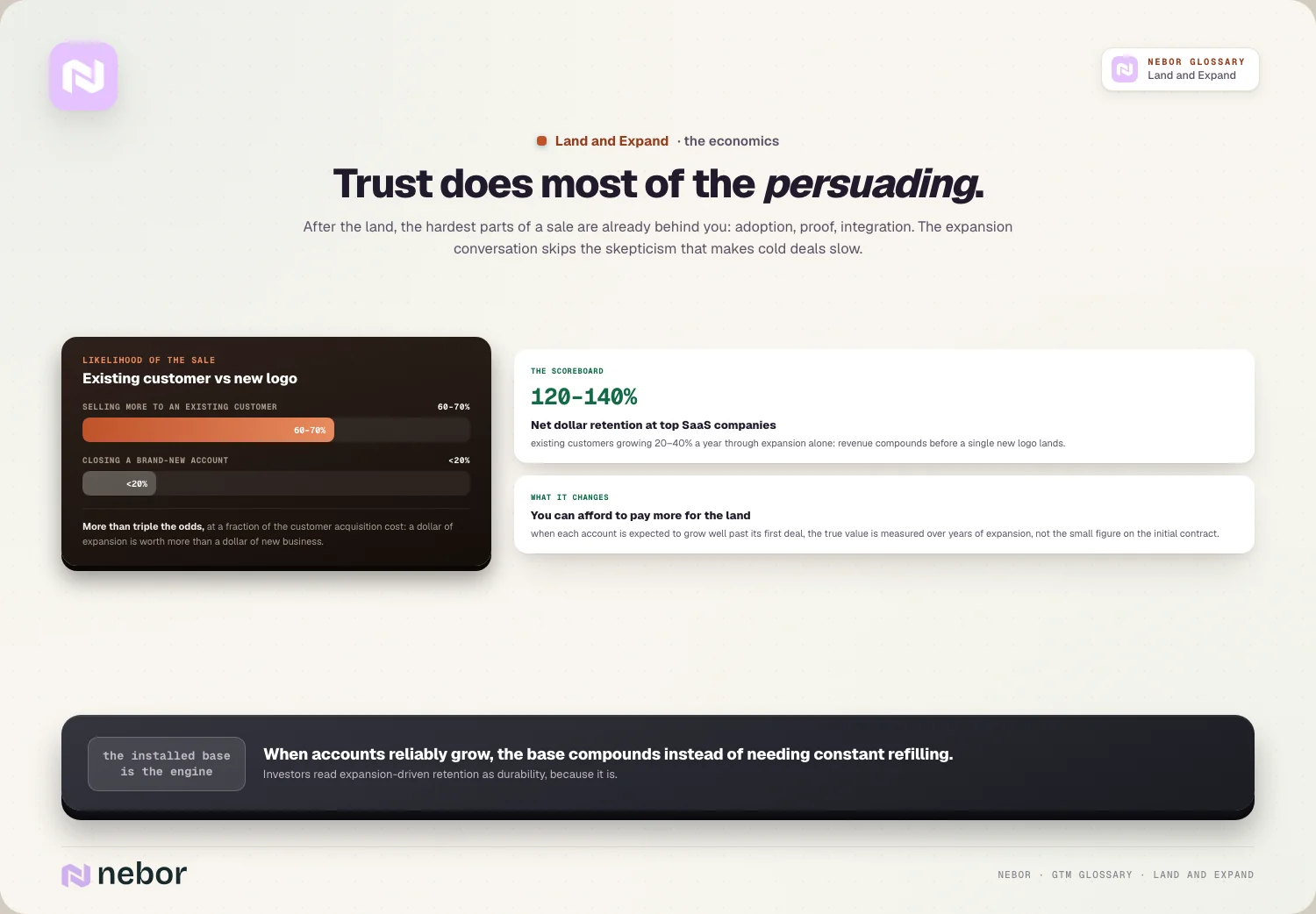
The result is that expansion revenue is far cheaper to generate than new business. Selling more to an existing account carries a fraction of the customer acquisition cost of a new logo, making a dollar of expansion worth more than a dollar of new business and making expansion revenue is such a prized growth lever.
How land and expand shows up inside your net revenue retention number
The clearest scoreboard for a land-and-expand strategy is net revenue retention, because it measures whether accounts grow after the land. Top-performing SaaS companies reach 120 to 140% net dollar retention, meaning their existing customers grow 20 to 40% a year through expansion alone.
That kind of retention is what makes a SaaS business compound instead of churn in place. When existing customers reliably expand, revenue grows even before you add a single new logo, so a strong net revenue retention turns your installed base into a growth engine instead of a bucket you're constantly refilling.
This is why investors treat expansion-driven retention as a sign of real durability.
A company landing small and expanding steadily has a revenue base that grows on its own, which is far healthier than one that posts big initial deals but never grows the accounts it wins, and it shows up directly in customer lifetime value.
It also changes the math on new-customer acquisition entirely. When each landed account is expected to grow well beyond its first deal, you can afford to spend more to win it, because the true value of the customer is measured over years of expansion instead of by the small figure on the initial contract.
Why the land has to deliver real value before any expansion can happen
The whole strategy hinges on the land delivering real value, because expansion gets earned rather than assumed.
If the first team doesn't get real value from the initial deal, there's nothing to expand from, so a land that underdelivers doesn't just fail on its own terms, it poisons every future opportunity in that account.
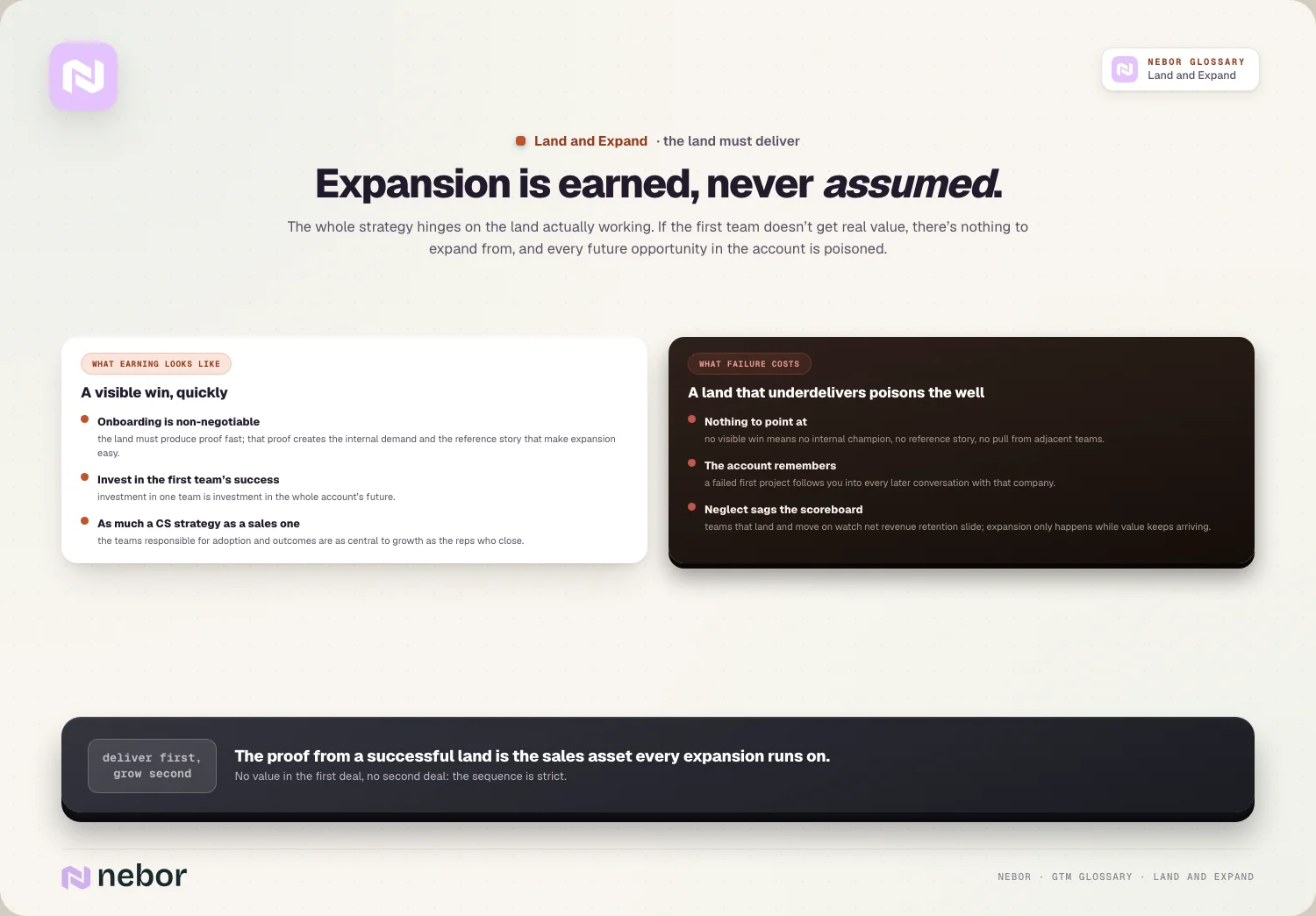
This makes onboarding and early success non-negotiable instead of nice-to-have, and we tell clients to fund it accordingly.
The land has to produce a visible win quickly, because that proof creates the internal demand and the reference story that make expansion easy, so investment in the first team's success is investment in the whole account.
It also means land and expand is as much a customer success strategy as a sales one. The expand depends on the customer succeeding with what they bought, so the teams responsible for adoption and outcomes are as central to growth as the reps who close, which is exactly the shift the bowtie funnel describes.
How companies work a land-and-expand motion once the strategy is set
Doing land and expand well starts with designing an initial offer that's genuinely easy to say yes to. You need a focused, lower-risk entry point, a single-team solution or a smaller plan, that delivers clear value fast, because the entire strategy depends on getting that first foothold cheaply and quickly.
Product usage then becomes the map for where to expand. Watching how the initial team uses the product reveals which features they're bumping against, which teams are getting invited, and where demand is building, which is exactly the signal that powers a product-led sales approach to timing expansion.
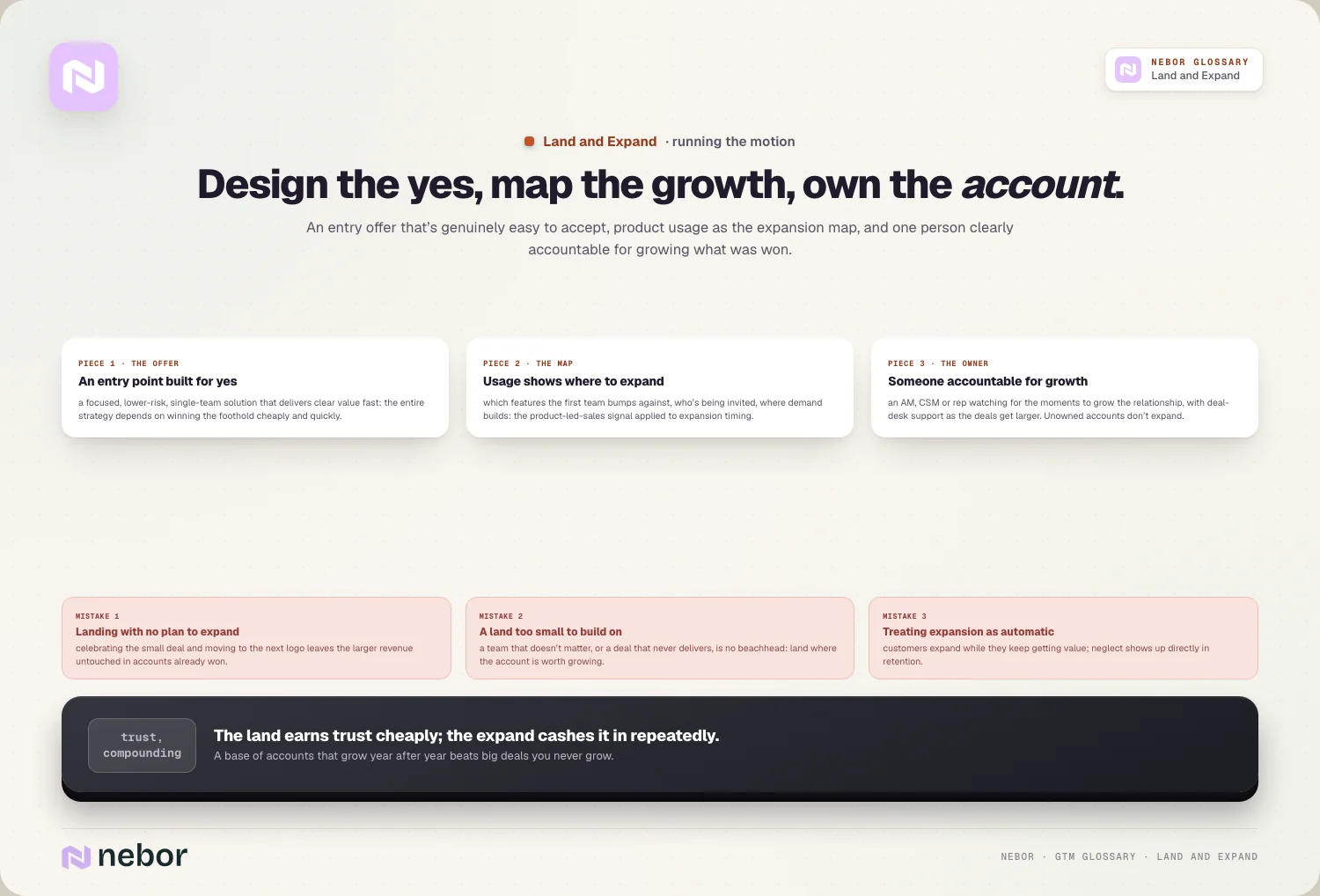
The motion also needs someone clearly accountable for growing the account rather than only closing it.
Whether that's an account manager, a customer success manager, or a rep, the expand only happens when a person is watching for the moments to grow the relationship, often with pricing support from a deal desk as deals get larger.
The common mistakes teams make with a land-and-expand strategy
The most common mistake, and we meet it in most accounts we look at, is landing without any real plan to expand. Winning a small deal is worthless if you never grow it, yet many teams celebrate the land and then move on to the next new logo, leaving the far larger expansion revenue untouched inside your accounts.
Another is landing so small or so poorly that there's nothing to build on. A first deal with a team that doesn't matter, or one that never delivers value, gives you no foundation, so the land has to be a real beachhead in an account worth growing instead of just any easy sale you can close.
The subtler mistake, in our experience, is treating expansion as automatic instead of earned.
Existing customers only expand when they keep getting value, so a team that lands accounts and then neglects them watches your retention numbers sag, proof that land and expand fails without genuine ongoing investment in customer success.
Why land and expand is really a bet on trust compounding over time
The deepest way to understand land and expand is as a strategy that treats trust as the asset being built. The land is where you earn a customer's trust cheaply, and the expand is where you cash it in repeatedly, so the whole approach is about compounding a relationship instead of maximizing a single transaction.
That compounding is what makes the strategy so powerful relative to chasing big initial deals. A company that lands small and expands steadily builds a base of accounts that grow year after year, a more durable path to scale than winning large deals you never grow, and it flows straight into a stronger revenue engine.
A modern go-to-market system built around land and expand treats every new customer as the start of a growing relationship instead of a finished sale.
When the small deals you automate sales prospecting to win are landed with expansion in mind, the accounts you acquire keep growing on their own, and the business compounds from the base it has already built.
Share this post
RevOps
Marketing
Glossary
Related glossary items
Understanding the core GTM concepts




Ready to build your pipeline











