

In this post:
Thousands of people sign up for your free product, and most poke around, get value, and either convert or drift away without talking to a human. But buried in that crowd are a handful of power users at large companies who've invited their whole team and are hitting usage limits, and those deserve a real conversation.
Product-led sales is the motion built to spot exactly those users and send sales after them, while leaving everyone else to self-serve. Instead of putting a rep on every signup or none, it lets the product do the early selling and brings salespeople in only when the usage data says a user is ready and valuable enough.
Product-led sales is a strategy where users first experience the product through a free trial or freemium plan, and sales teams then use the resulting usage data to convert and expand the highest-potential accounts. It blends self-serve product-led growth with targeted, well-timed human selling.
The reason it has taken off is that pure self-serve leaves money on the table while pure sales is too expensive for a broad user base. Product-led sales resolves that tension by reserving human effort for the accounts where it pays off, using product signals to decide exactly when and where a rep should step in.
TL;DR
Product-led sales lets users experience the product first through free access, then has sales engage the highest-value users based on how they use it in practice, blending self-serve with human selling.
It centers on product-qualified leads, users who've shown real intent through their usage, which is a stronger signal than a marketing-qualified lead who merely filled out a form.
It lowers customer acquisition cost by letting most users self-serve while reserving expensive sales effort for the accounts where a rep can clearly add value and revenue.
It's a hybrid of product-led and sales-led growth instead of a replacement for sales, which is why nearly all product-led companies still build or plan to build sales teams.
What product-led sales means and how it blends two motions into one
Product-led sales lands deliberately between two older approaches, taking the best of each. It keeps the self-serve engine of product-led growth, where the product itself attracts and activates users, but adds a sales layer that engages the accounts most likely to become large, high-value customers.
The blend works because the two motions cover each other's weaknesses. Self-serve is cheap and scalable but leaves larger deals under-served, while traditional selling captures big accounts but is too costly to apply to everyone, so combining them lets each do what it does best.
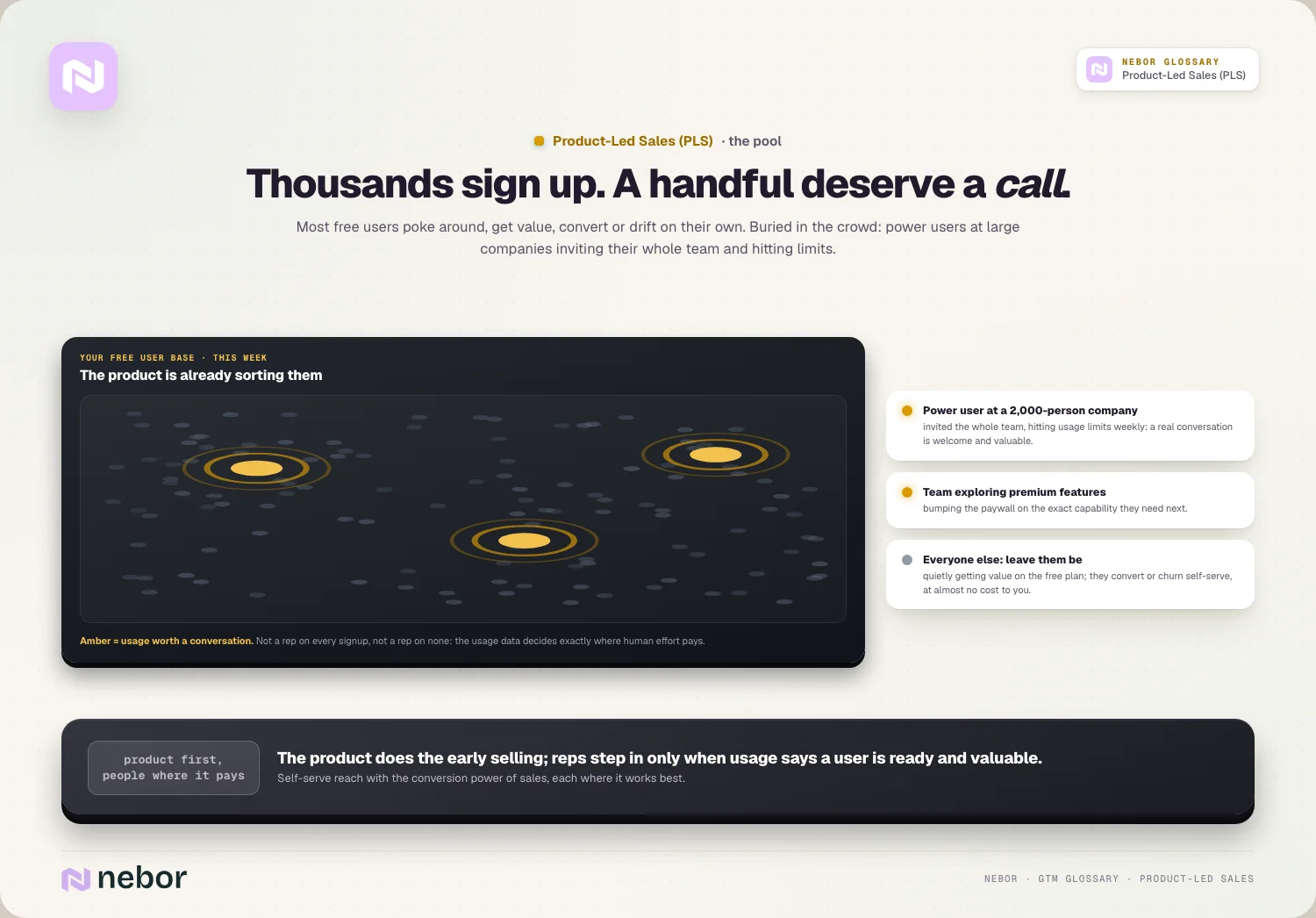
This is why product-led sales is best understood as an evolution instead of a rejection of sales. It doesn't remove the sales team, it changes when and why reps engage, so the role shifts from chasing cold leads to helping users who've already shown they want what the product offers.
Why the product does the first selling and reps come in later
The defining move of product-led sales is letting the product carry the early part of the journey. Rather than a rep reaching out to explain the value, the user experiences that value directly through a free trial or freemium plan, so they arrive at any sales conversation already convinced the product works.
This flips the traditional sequence, where sales comes first and the product demo follows. In product-led sales, usage comes first and sales comes after, which makes the eventual conversation far more grounded, because the rep is talking to someone who has real hands-on experience instead of an abstract prospect.
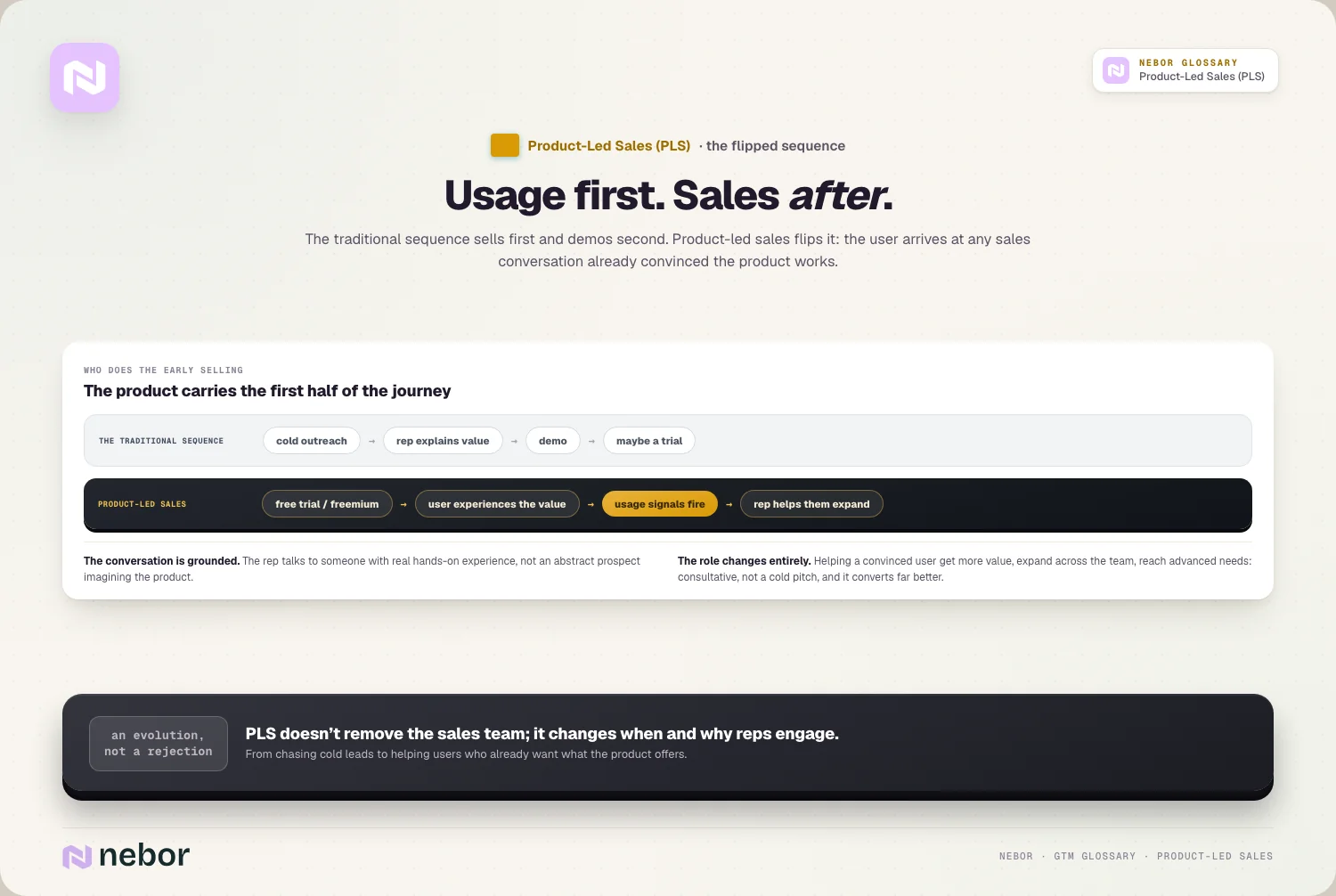
The timing shift changes the nature of the sales role entirely. Because the user already understands the product, the rep's job becomes helping them get more value, expand across their team, or reach more advanced needs, which is a consultative conversation instead of a cold pitch, and it tends to convert far better.
What a product-qualified lead is and why it beats a marketing-qualified one
At the heart of product-led sales is the product-qualified lead, which is a fundamentally stronger signal than older lead types. A product-qualified lead is someone who has used your product and shown, through their behavior, that they're likely to become a paying customer.
The reason a PQL beats a marketing-qualified lead is that actions speak louder than form fills. A marketing-qualified lead downloaded an ebook or attended a webinar, which shows mild interest, whereas a product-qualified lead used the product and hit the moments that signal real intent, far closer to buying.
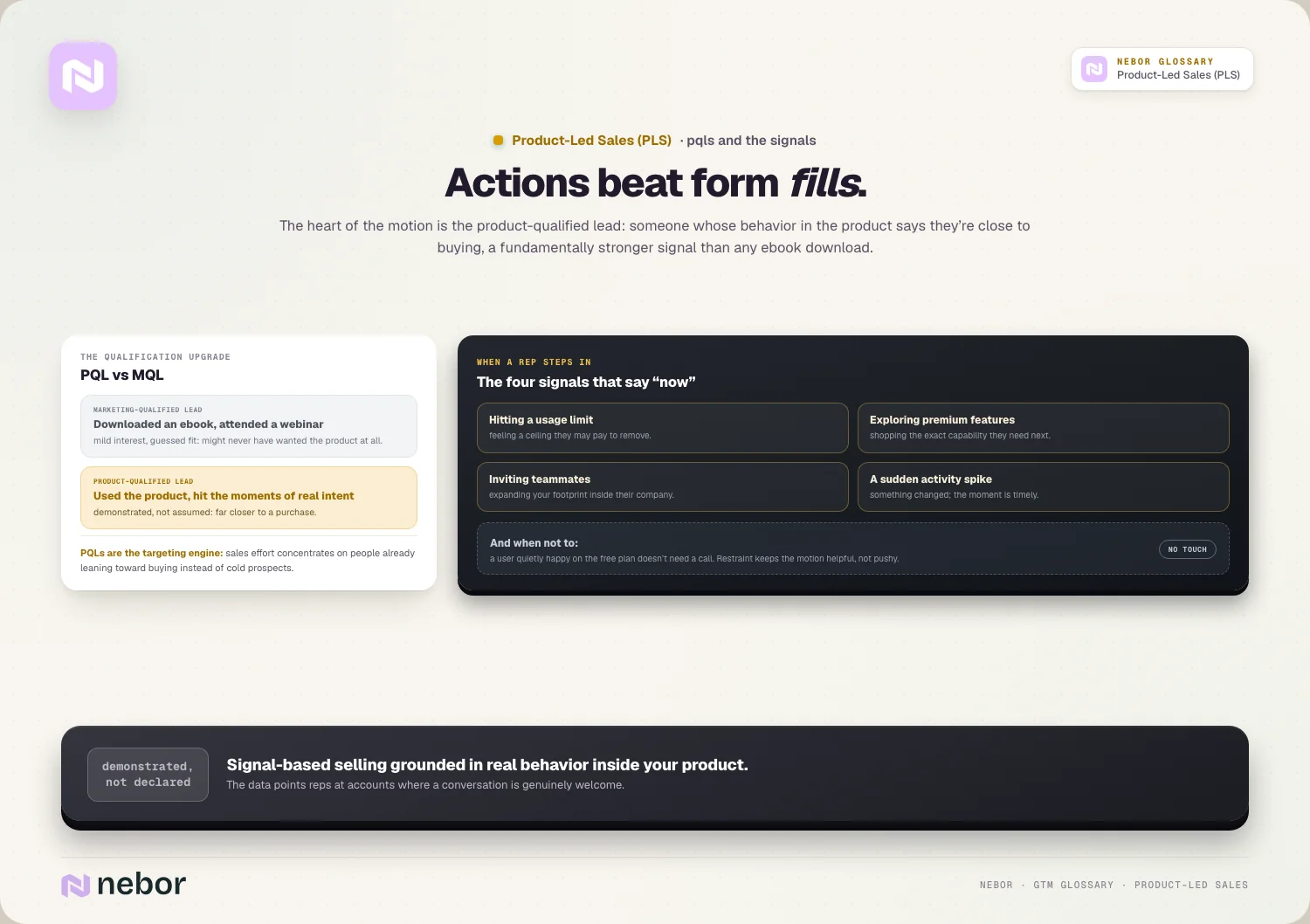
This makes PQLs the targeting engine of the whole motion. Instead of reps chasing leads based on assumed fit, they engage users who have demonstrated intent through action, so the sales effort concentrates on people already leaning toward a purchase instead of on cold prospects who might never have wanted it.
Which product usage signals tell your reps the moment to engage
The engine that drives product-led sales is the set of usage signals that tell a rep when to step in. Hitting a usage limit, exploring premium features, inviting teammates, or a sudden spike in activity all indicate that a user is getting serious, and each is a cue that the moment for a conversation has arrived.
These signals work because they reveal genuine, timely intent instead of guessed interest.
A user inviting five colleagues is expanding the product's footprint inside their company, and someone bumping against a paywall feels a limit they may pay to remove, so acting on those moments is signal-based selling grounded in real behavior.
Reading the signals also tells your reps when not to engage, and in our experience that restraint matters just as much. A user happily getting value on the free plan with no expansion behavior probably doesn't need a sales call, so the data points reps at the accounts where a conversation is welcome instead of intrusive.
That restraint is part of what keeps a product-led motion feeling helpful instead of pushy. By staying away from users who are happy self-serving, reps protect both their own time and the trust the product has earned with a low-touch customer base.
Why product-led sales lowers acquisition cost while still winning big accounts
One of the strongest arguments for product-led sales is that it improves unit economics by spending sales effort selectively. Because most users self-serve, the expensive human touch is reserved for the accounts where it clearly pays off, which lowers the overall customer acquisition cost across the business.
The efficiency comes from letting the funnel sort itself before sales gets involved. Thousands of users can try the product at almost no marginal cost, and only the small fraction with high-value potential ever need a rep, so the company gets the reach of self-serve with the conversion power of sales where it matters.
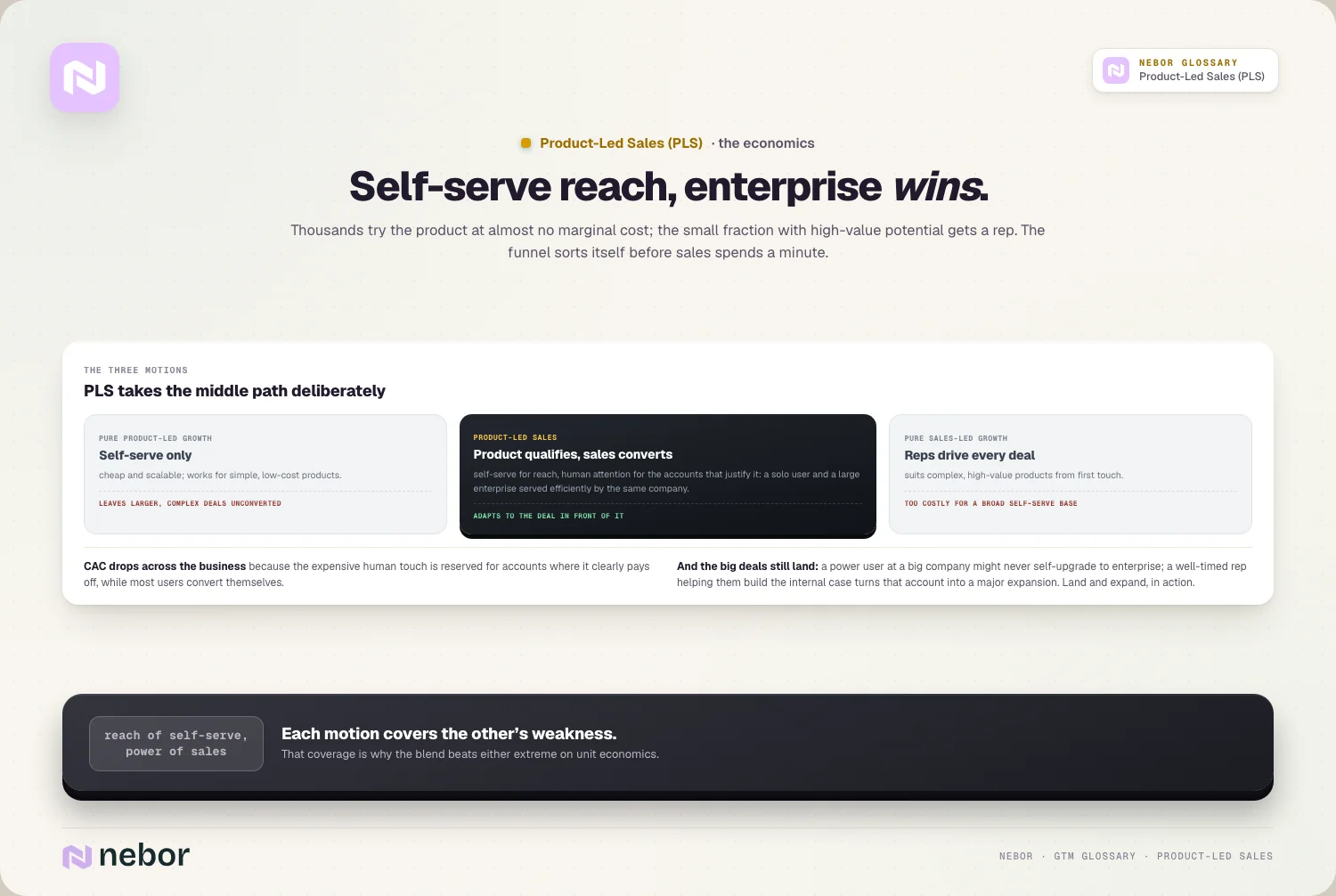
This is also how product-led sales captures the large deals that pure self-serve would miss.
A power user at a big company might never upgrade to an enterprise plan on their own, but a well-timed rep who helps them build the internal case can turn that account into a major expansion, which is the land and expand motion in action.
How product-led sales differs from pure product-led and sales-led growth
It helps to place product-led sales against its two neighbors, because it borrows from both without being either. Pure product-led growth relies entirely on self-serve with no sales team, which works for simple, low-cost products but leaves larger, more complex deals unconverted.
Pure sales-led growth is the other extreme, where sales drives every deal from the first touch, which suits complex, high-value products but is expensive and doesn't scale to a broad self-serve base. Product-led sales takes the middle path, using self-serve for reach and sales for the accounts that justify it.
The practical result is a motion that adapts to the deal in front of it. Small users convert themselves at low cost, while high-potential accounts get human attention, so the same company can serve a solo user and a large enterprise efficiently, which neither pure model can do on its own.
How to build a product-led sales motion once the pieces are in place
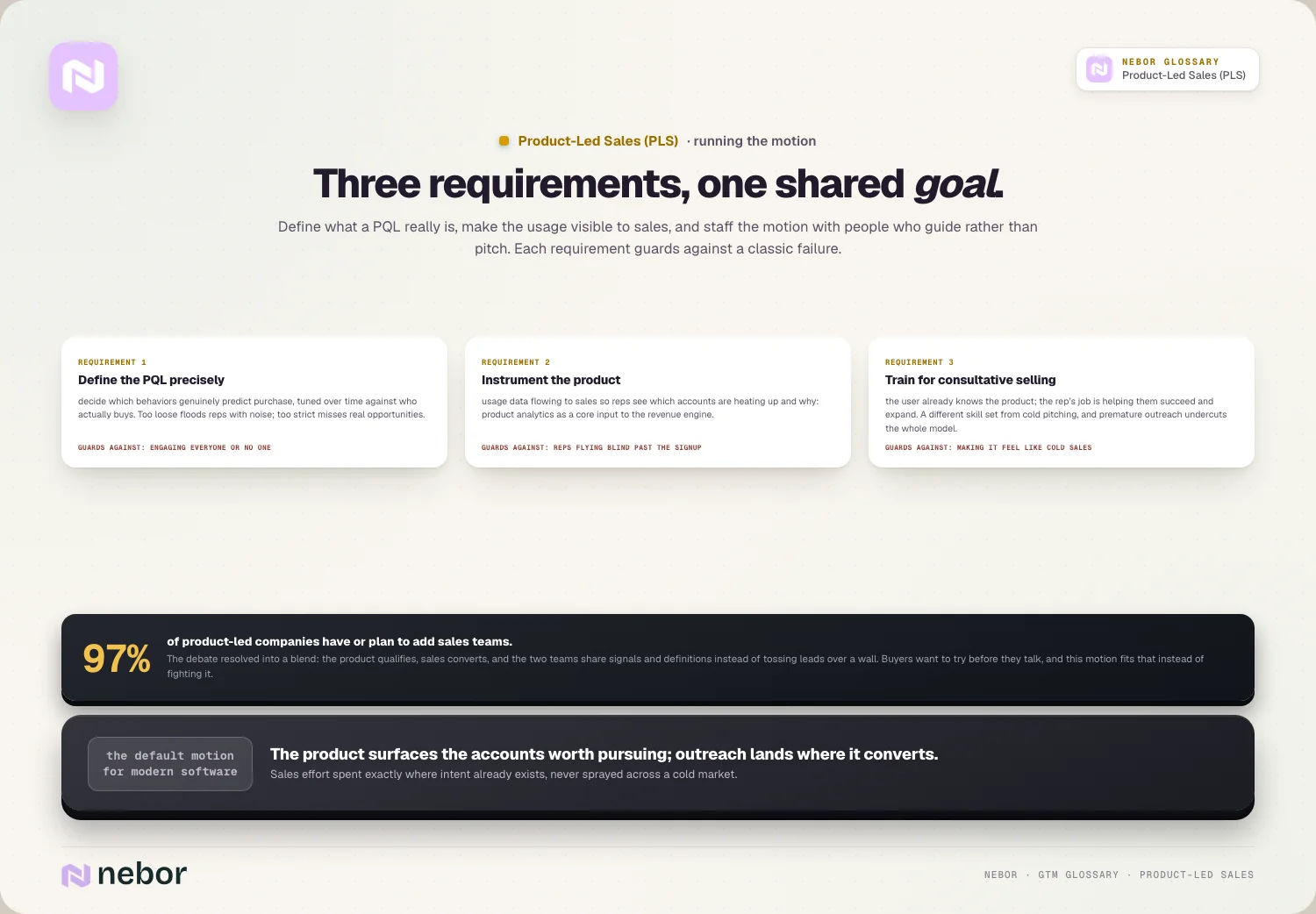
Doing product-led sales well starts with defining what a product-qualified lead means for your product specifically. You have to decide which usage behaviors reliably predict a purchase, because a vague or overly broad PQL definition sends reps after users who aren't ready, which is where many motions go wrong.
The next requirement is instrumentation, because the whole motion depends on seeing usage clearly. You need product data flowing to the sales team so reps can see which accounts are heating up and why, which means treating product analytics as a core input to the revenue engine instead of a separate product concern.
The final piece is training reps to sell consultatively instead of push. Because the user already knows the product, the rep's job is to help them succeed and expand, so a product-led sales team needs people who guide and advise instead of pitch, which is a different skill set from traditional cold selling.
Why product usage alone falls short without account fit beside it
Product signals are powerful, but clients ask us regularly why their strongest users never buy, and the answer is that signals mislead when used in isolation.
A heavy user at a tiny or irrelevant company is a strong product-qualified lead on paper, yet that account may never grow into a meaningful customer, so usage intent has to be weighed against whether the company is worth pursuing in the first place.
This is why the best product-led sales motions combine product signals with firmographic fit.
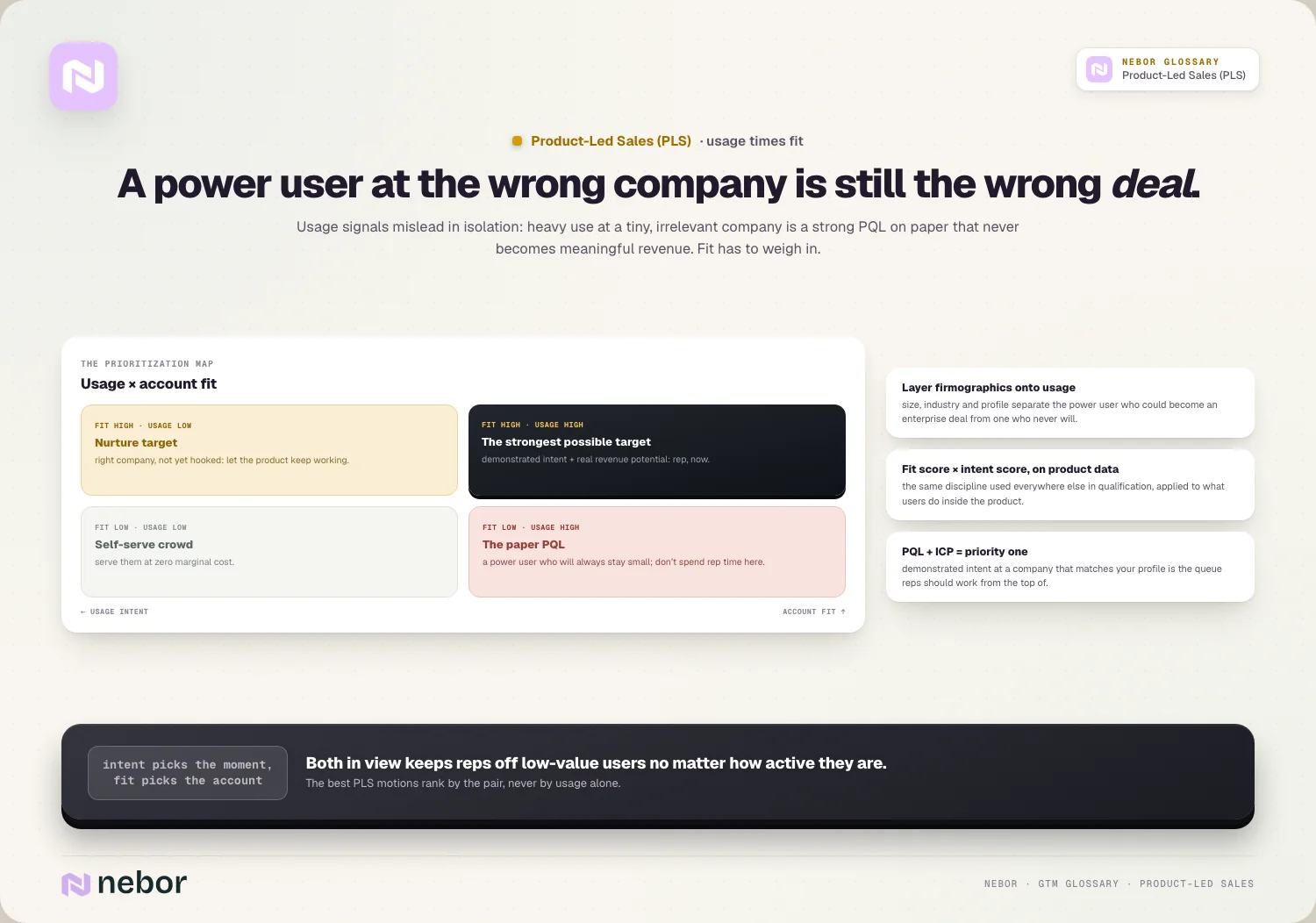
Layering a company's size, industry, and profile onto its usage separates a power user who could become an enterprise deal from one who will always stay small, which is the fit score versus intent score idea applied to product data.
Keeping both in view is what keeps reps focused on the right accounts.
A product-qualified lead that also matches your ideal customer profile is the strongest possible target, because it pairs demonstrated intent with real revenue potential, so prioritizing those accounts is how product-led sales avoids chasing low-value users.
The common mistakes teams make when they adopt product-led sales
The most common mistake, and the one we advise watching for first, is engaging users too early, before the product has done its job.
Sending a rep after someone who just signed up undercuts the whole model, because the value of product-led sales comes from letting users experience the product first, so premature outreach makes it feel like ordinary cold sales.
Another is defining product-qualified leads badly, either too loosely or too strictly. A PQL definition that flags every trial user floods sales with noise, while one too narrow misses real opportunities, so the definition needs tuning against which behaviors correlate with real buying, refined over time.
The subtler mistake is failing to align product and sales around the same goals. Because the motion depends on product data guiding sales, teams that operate separately can't make it work, so it needs product and revenue working as one, sharing signals and definitions instead of tossing leads over the wall.
Why product-led sales is becoming the default motion for modern software
The deepest reason product-led sales has spread is that it matches how people want to buy software now. Buyers increasingly prefer to try a product themselves before talking to anyone, so a motion that lets them do exactly that, then offers help at the right moment, fits modern buying instead of fighting it.
This is why the debate between product-led and sales-led has largely resolved into a blend. Nearly 97% of product-led companies have or plan to add sales teams, which shows that the future isn't self-serve replacing sales but the two working together, with the product qualifying and sales converting.
Inside a modern go-to-market system, product-led sales is what lets a company scale reach and revenue at once.
When the product surfaces the accounts worth pursuing and the outreach you automate sales prospecting to send focuses on those high-intent users, sales effort lands exactly where it converts instead of being sprayed across a cold market.
Share this post
RevOps
Marketing
Glossary
Related glossary items
Understanding the core GTM concepts




Ready to build your pipeline











