

In this post:
Every business lives or dies by its flow of potential customers. Without a steady stream of new people to sell to, even a great product stalls, because you eventually have nobody left to sell to.
Lead generation is how you create that flow. It's the work of attracting and capturing people who might buy, so your sales team always has new prospects to talk to rather than a drying pipeline.
Lead generation is the process of attracting and capturing interest from potential customers, then turning that interest into contacts your team can pursue. It covers everything from content that draws people in to outreach that goes out and finds them.
Lead generation feeds the entire revenue machine. Every deal starts as a lead, so the quality and volume of your lead generation sets the ceiling on how much you can ever close.
TL;DR
Lead generation is the process of attracting and capturing potential customers, creating the steady flow of prospects your sales team needs to fill its pipeline.
Every deal starts as a lead, so the volume and quality of your lead generation set the ceiling on how much revenue you can close.
It splits into inbound and outbound halves. Inbound draws prospects to you through content and search, while outbound goes out and finds them through targeted outreach.
The balance to strike is quality against volume. Generating many poor-fit leads wastes sales time, so good lead generation weighs quantity against fit.
So, what is lead generation, and what does the work look like?
Lead generation is the work of creating new potential customers for your business. It turns strangers into contacts your team can pursue toward a sale.
A lead is a potential customer in concrete form. It's a person or company that has shown some interest or fits your market, captured as a contact you can follow up with.
Generating them takes many forms across channels. It ranges from publishing content that attracts interest, to buying ads, to reaching out directly to people who fit your market.
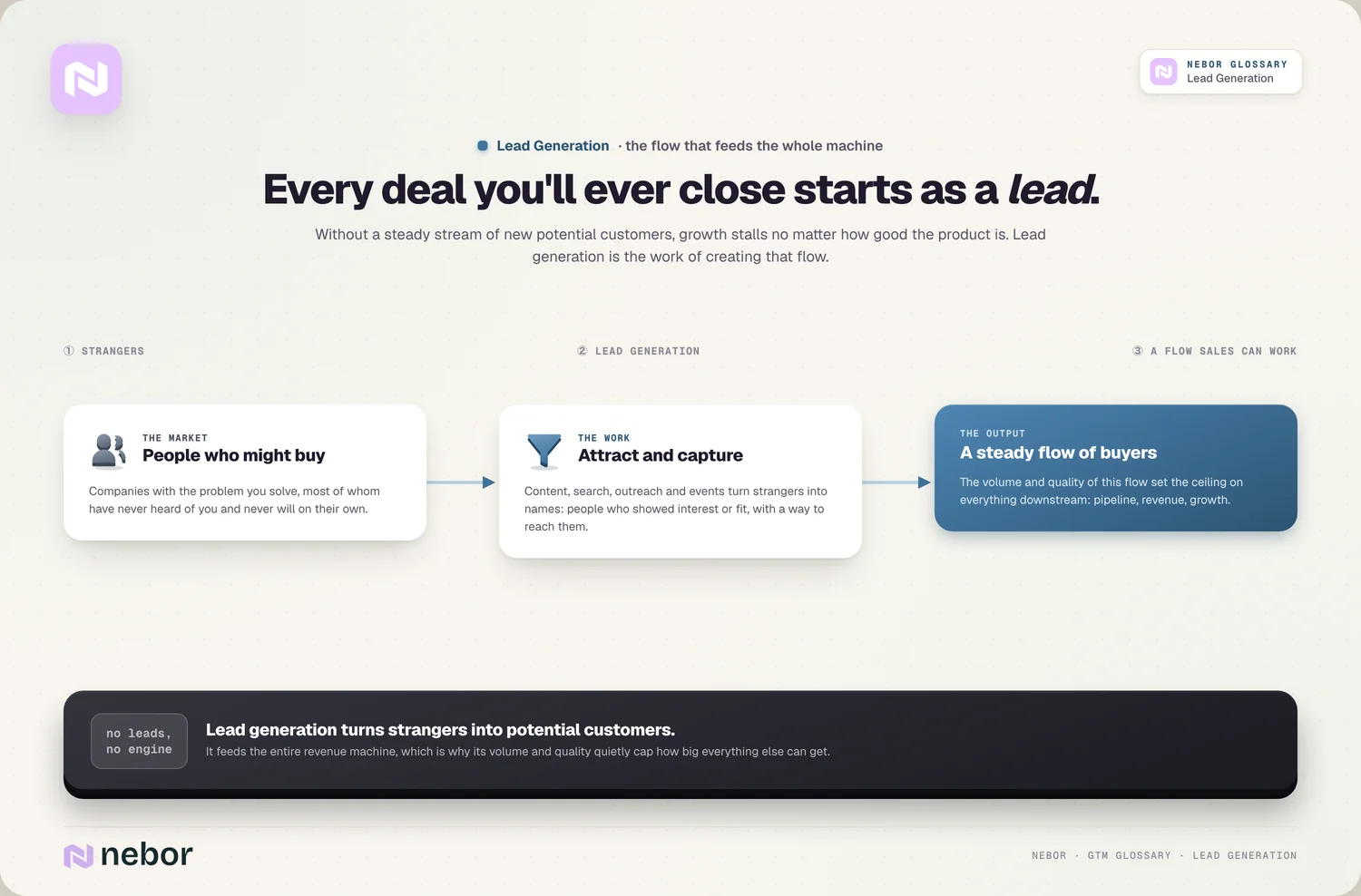
The output is a flow of prospects. When it works, lead generation produces a steady stream of new contacts, so your pipeline stays full instead of drying up.
So lead generation is the top of your entire funnel. It's where every customer relationship begins, and a healthy flow of leads is the foundation everything else in sales is built on.
It's also a system rather than a one-time push. A flow of leads has to be steady and renewable, because a single campaign that fills the pipeline once leaves you empty again as soon as those leads are worked.
What's the difference between inbound and outbound lead generation?
Lead generation splits into two broad approaches, and most teams use both, with the difference being who makes the first move.
Inbound draws prospects toward you on their own initiative. Through content, search, and social presence, you attract people who are already looking, so they come to you and raise their hand.
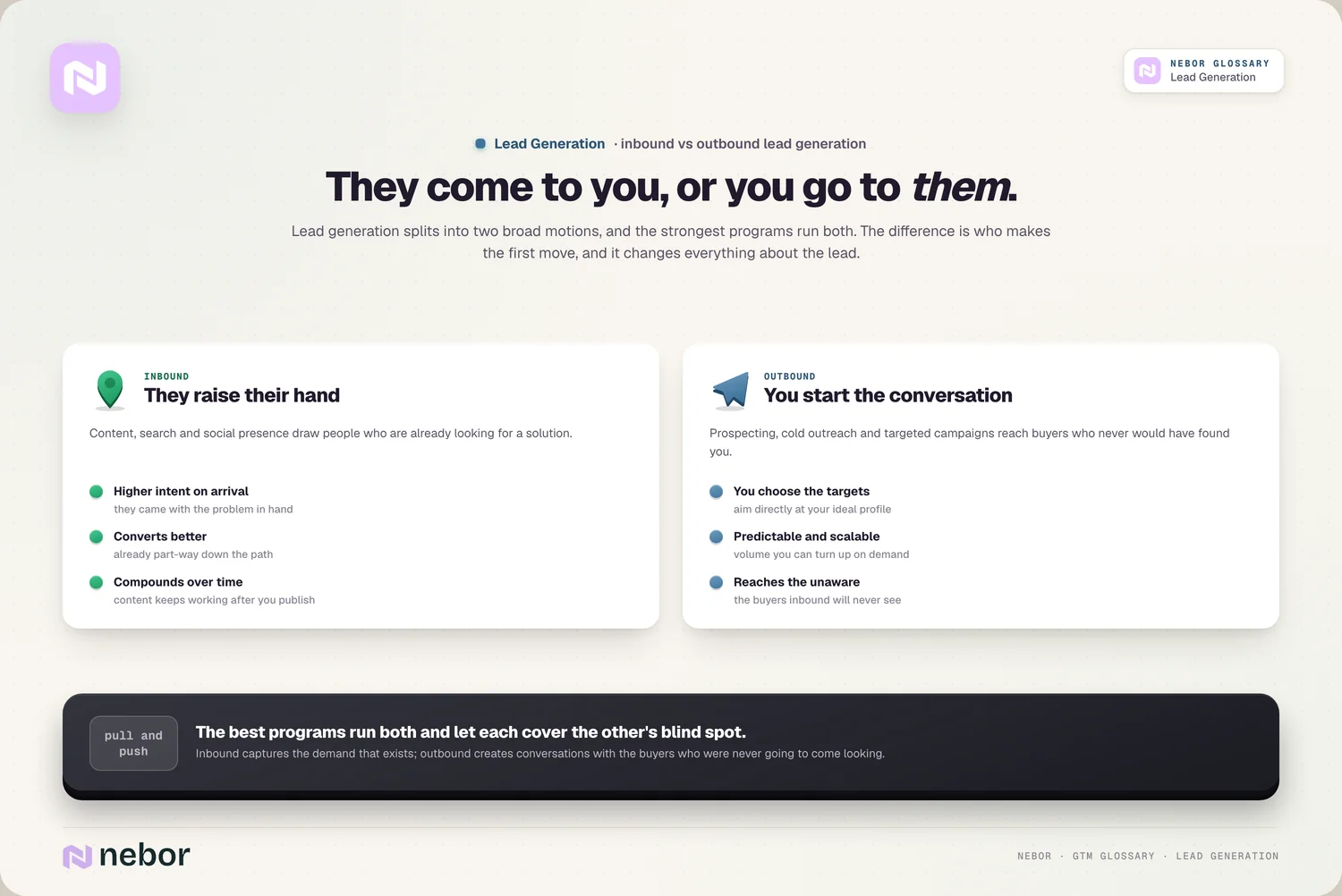
Outbound goes out and finds them instead. Through outbound sales and proactive outreach, you identify accounts you want and reach out directly, without waiting for them to find you.
Each approach carries its own clear trade-offs. Inbound leads tend to convert better because they're already interested, while outbound lets you target exactly who you want, including accounts that would never find you on their own.
So the two approaches complement each other instead of competing. Inbound captures existing demand and outbound creates new conversations, and the strongest programs use both instead of betting on one.
Why do inbound leads convert so much better than outbound ones?
The conversion gap between inbound and outbound is large, and it comes down to who initiated.
Inbound leads arrive with interest already formed. They came looking for a solution, so they're further along and more receptive, and that head start is what converts at a far higher rate.
The gap is dramatic in the data. One widely cited figure puts inbound conversion around 14.6% versus 1.7% for outbound, because inbound prospects arrive with intent.
But outbound holds its own kind of edge. Targeted outbound campaigns tend to produce larger deal sizes, because you choose exactly which high-value accounts to pursue instead of taking whoever finds you.
So inbound wins on conversion rate while outbound wins on control and deal size. That trade-off is exactly why most teams want both, capturing easy inbound demand while proactively going after their best-fit accounts.
What are the main lead generation channels worth investing in?
Leads come from many channels, and the mix matters, because a few channels do most of the work in B2B.
Content and search lead the inbound side. Content marketing is used by around 91% of B2B marketers, because useful content plus search visibility attracts prospects actively researching.
Social and LinkedIn matter right alongside them. LinkedIn in particular is a top source of high-quality B2B leads, because it's where professional buyers gather and engage.
Outreach carries the whole outbound side of the mix. Cold email and calling reach prospects directly, and while the average reply rate has fallen, targeted, personalized outreach still drives meaningful pipeline.
So the channel mix spans content, search, social, ads, and outreach. The right blend depends on your market, but relying on a single channel is fragile, because any one can shift or dry up.
Why does multichannel lead generation work better than one channel?
Spreading across channels consistently beats betting on one, and the reasons come down to reach and resilience.
No single channel reaches everyone you want. Different buyers respond to different channels, so a single-channel program misses everyone who doesn't engage there.
Channels reinforce each other on top of that. A prospect who sees your content, then gets a relevant email, is more receptive than one touched on either channel alone, which is the logic of multi-channel outreach.
The numbers support the multichannel approach directly. Multichannel campaigns have been found to cut cost per lead by around 31% compared to single-channel, because the combined reach is more efficient.
So multichannel lead generation is more effective and more resilient. It reaches more of your market and protects you when any one channel shifts, and that resilience is why diversified programs outperform.
How much does a lead cost, and what do the benchmarks really say?
Cost per lead is how you judge efficiency, and the benchmarks vary widely by channel and industry.
The median has been climbing steadily for years. B2B cost per lead reached around $213 in 2026, up from prior years, as competition and ad costs rise.
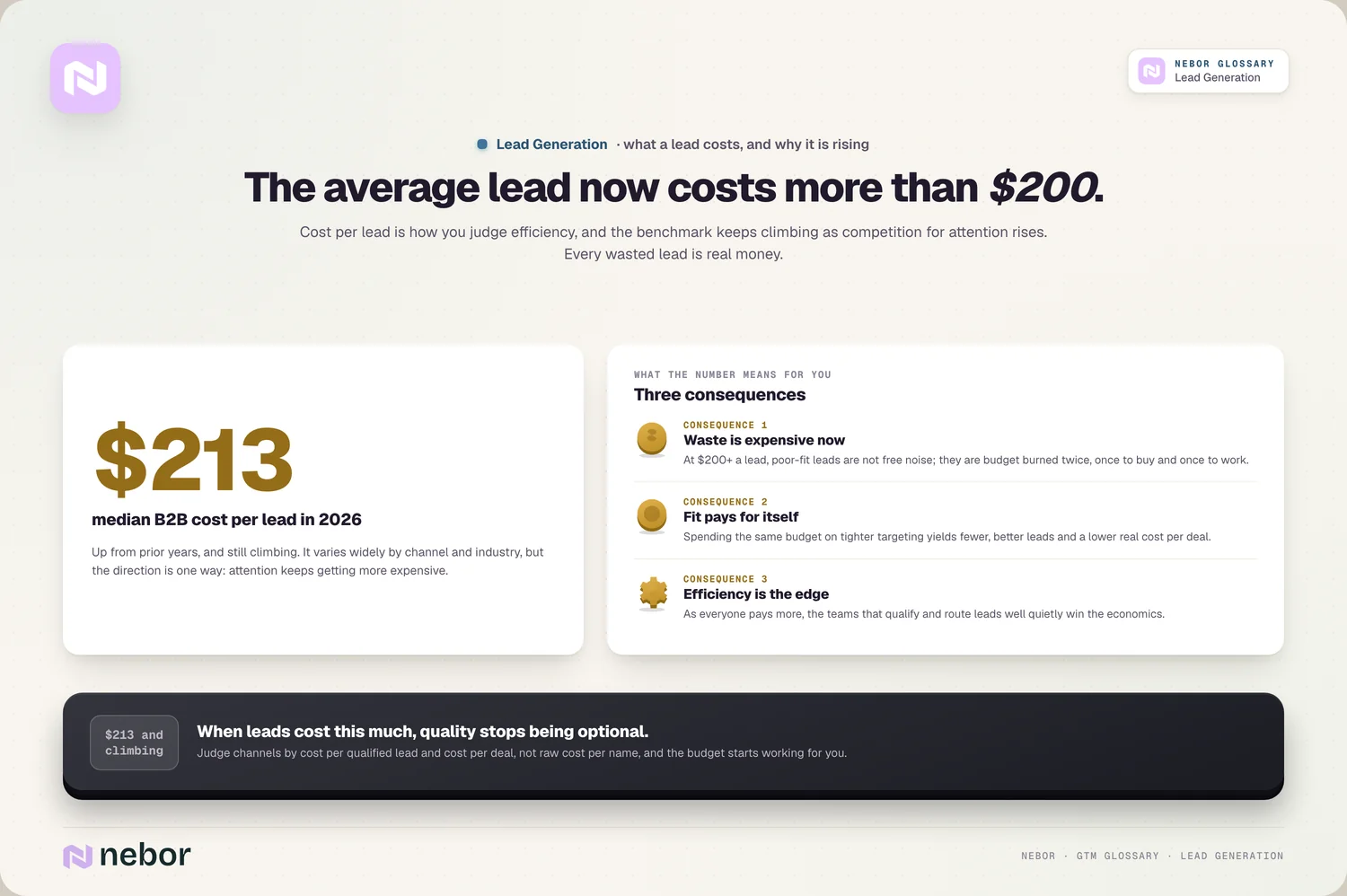
It splits clearly by the approach you take. Inbound leads tend to cost roughly $20 to $400 each, while outbound ranges from about $50 to $700, depending on channel and targeting.
Cost tells only part of the story. A cheap lead that never converts is expensive in the end, so you read cost per lead alongside how well those leads close.
So cost per lead is a useful efficiency metric instead of a goal on its own. The real question is cost per lead that converts, which ties lead generation directly to your customer acquisition cost.
Why is lead quality so much more important than lead volume?
A common trap we watch teams fall into is chasing raw lead volume, which can waste a whole sales effort. Quality is what matters in the end.
Volume alone misleads everyone who reads the report. Generating thousands of leads feels productive, but if few of them fit your market, your sales team burns time chasing people who'll never buy.
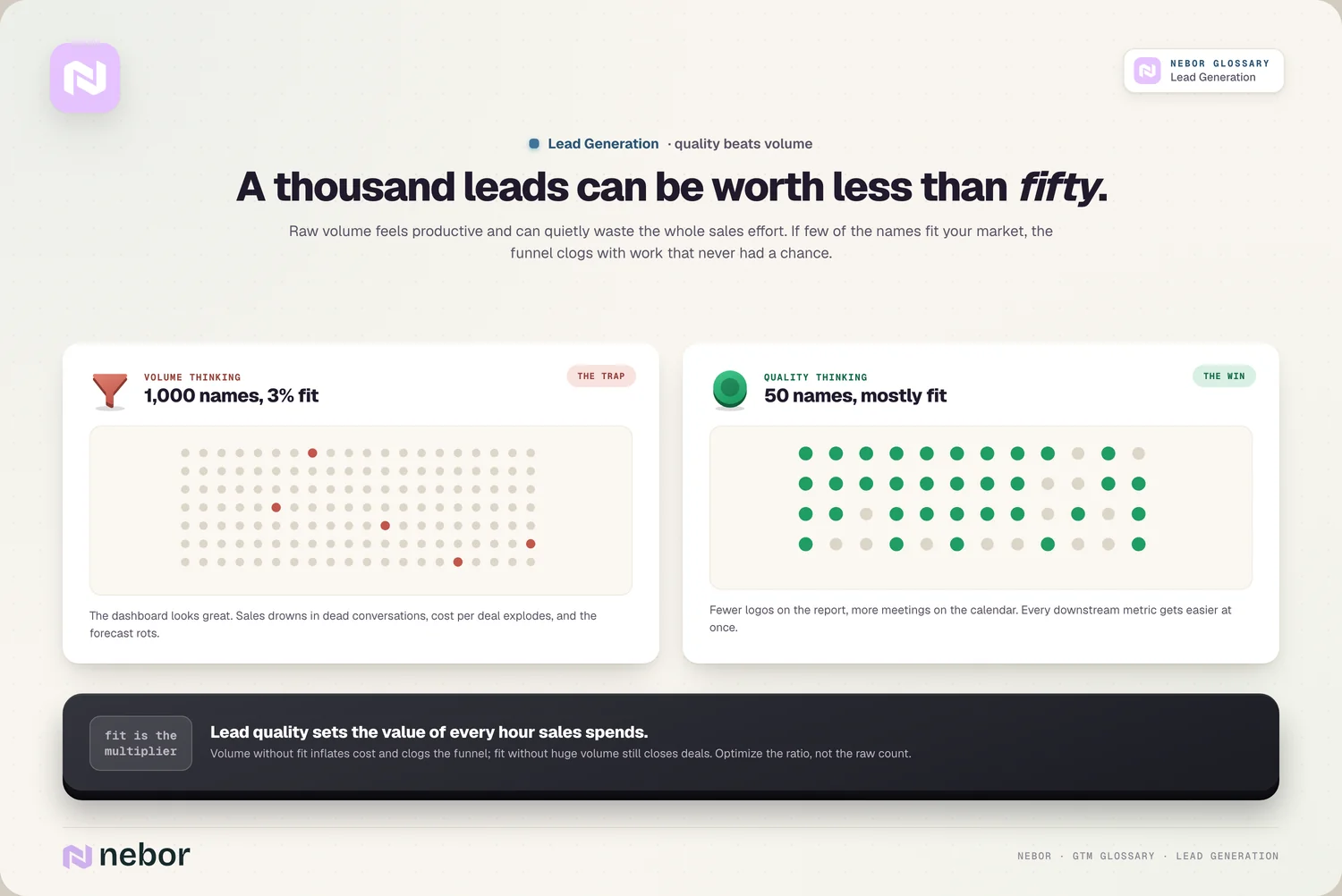
Fit is what makes a lead valuable. A lead that matches your ideal customer profile is worth far more than ten that don't, because it has a real chance of closing.
This is where scoring earns its place in the flow. Ranking leads with lead scoring lets you focus on the ones most likely to convert, so volume gets filtered into quality before it reaches sales.
So good lead generation optimizes for qualified leads over raw count. The goal is a steady flow of well-fit prospects, because those are the only leads that turn into revenue.
How does lead generation hand off to sales without leaking value?
Generating a lead is only useful if it reaches sales in good shape, and in our experience a few things make the handoff work.
Leads need qualification before anything else happens. Before sales spends time, a lead should be checked for fit and interest, so reps work the ones worth their attention rather than every raw contact.
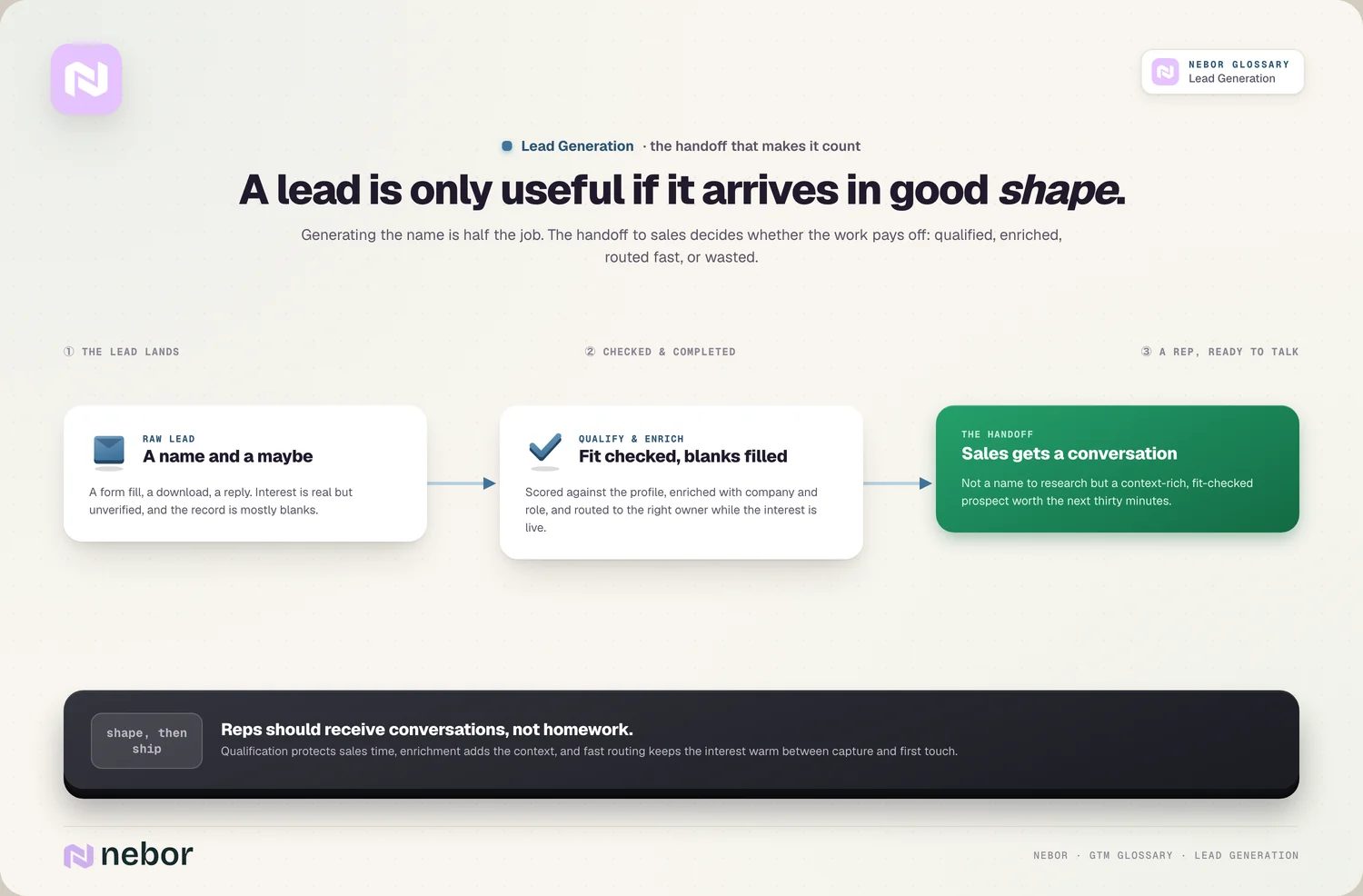
Speed matters enormously at the handoff stage. Reaching a fresh lead fast, the heart of speed to lead, dramatically improves conversion, because interest fades quickly after a lead comes in.
The handoff itself has to be clean. Marketing and sales need to agree on what counts as a qualified lead, so good leads don't fall through the cracks between the teams.
So lead generation doesn't end when a lead is captured. It ends when a qualified lead reaches a rep fast and gets worked, which is where generation turns into actual pipeline.
How does lead generation connect to buying signals and intent data?
Modern lead generation is getting smarter about who to pursue, because signals make it more targeted.
Intent makes the outbound side considerably warmer. Reaching out to accounts showing interest, the logic of inbound-led outbound, produces far better leads than cold lists alone.
It blurs the old line between inbound and outbound. When outbound is triggered by inbound signals, lead generation becomes a blend, targeting accounts that have shown they're in the market.
It's increasingly automated from end to end. Capturing, scoring, and routing leads is exactly the kind of work you can automate sales prospecting around, so the flow keeps going without constant manual effort.
So lead generation is evolving from broad capture to targeted, signal-driven flow. The best programs use intent to focus their effort on the accounts most likely to become real opportunities.
How is lead generation different from the demand generation before it?
These two terms get blurred constantly, but they describe different stages of the same goal.
Demand generation creates the awareness and interest. It's the broad work of making your market aware of the problem you solve and want a solution, often before any specific lead exists.
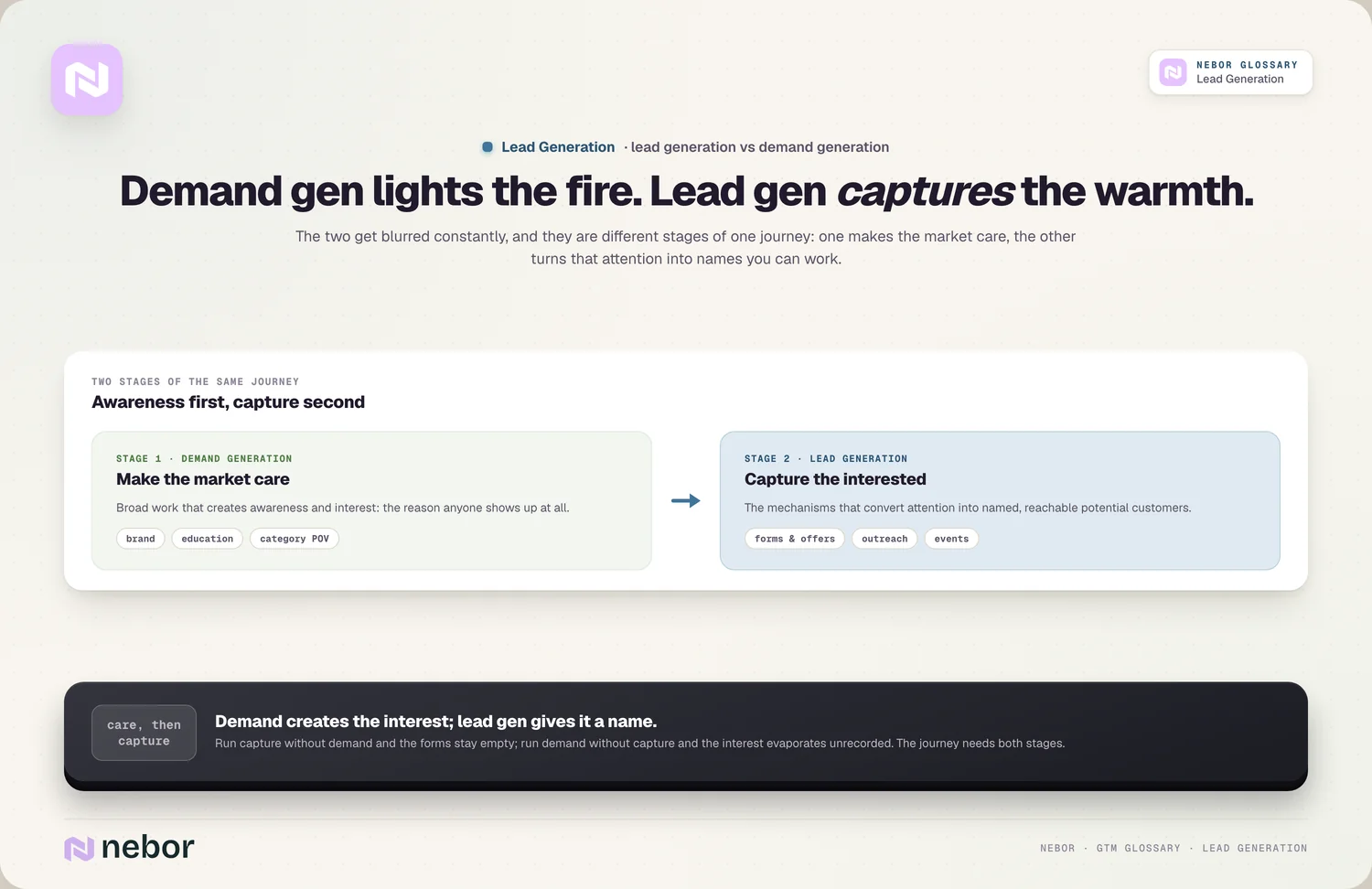
Lead generation captures that interest once it exists. It turns the demand into named contacts you can pursue, so it's the step that converts general interest into specific, followable leads.
The two depend on each other completely. Without demand, your forms stay empty, and without lead capture, the demand you created never reaches sales, so strong programs do both deliberately.
So demand generation fills the room with interested people, and lead generation gets their contact details. Confusing the two leads teams to chase contacts before they've created any reason for people to care.
How does lead generation feed the pipeline velocity further down?
Lead generation doesn't just fill the top of the funnel, it shapes how fast deals move through it. The quality of leads affects the whole pipeline.
Better-fit leads move faster through every stage. A lead that truly matches your market progresses more quickly, because the need is real, which lifts your overall pipeline velocity.
Poor leads clog the pipeline instead of feeding it. Bad-fit leads stall and linger, consuming rep time and dragging down the speed at which real deals close.
So the quality of your lead generation echoes all the way through. Generating well-fit leads keeps the whole funnel moving as well as filling it, so quality matters far beyond the first step.
How do you measure lead generation beyond counting the leads?
Measuring lead generation well is what lets you improve it, and the metrics that matter go beyond raw count.
Volume is only the starting point of measurement. How many leads you generate tells you whether the top of your funnel is healthy, though it's only the first number.
Quality and conversion matter more than the count. What share of leads turn into opportunities and customers tells you whether those leads are any good.
Cost is what ties the whole picture together. Cost per lead and cost per acquired customer show how efficiently your program turns spend into revenue, which is what ultimately matters.
So measure volume, quality, conversion, and cost together. Any one alone misleads, but the full picture tells you whether your lead generation is truly feeding profitable growth.
What are the common mistakes teams make with lead generation?
Lead generation goes wrong in a few predictable ways, and we keep seeing the same ones when clients walk us through their funnels. Avoiding them keeps the flow both steady and valuable.
Chasing volume over quality wastes the most, because generating many poor-fit leads burns sales time and inflates your numbers without producing revenue.
Relying on one channel adds fragility, because any shift in that channel can dry up your whole pipeline at once.
Slow follow-up squanders what you generated, because leads left unworked go cold fast, and the effort behind them goes with it.
And ignoring the sales handoff leaks value at the last step, because leads that aren't qualified or routed cleanly fall through the cracks between the teams.
Why the flow of well-fit leads sets the ceiling on everything else
Lead generation is what feeds your entire revenue machine. Every deal starts as a lead, so the volume and quality of what you generate sets the ceiling on everything you can close.
The deeper point is that it splits into inbound and outbound, and the best programs use both. Inbound captures existing demand at high conversion, while outbound creates new conversations with the accounts you most want.
The honest caveat is that quality beats volume. A flood of poor-fit leads wastes your sales team, so good lead generation balances a steady flow with real fit and a fast, clean handoff to sales.
So if your pipeline feels thin or your reps are chasing leads that never close, the fix usually starts at the top. Building a steady flow of well-fit leads across multiple channels is the foundation a modern go-to-market system is built to create.
Share this post
Prospecting
Marketing
Glossary
Related glossary items
Understanding the core GTM concepts




Ready to build your pipeline











