In this post:
Lead leakage is the loss of interested leads between the moment they raise their hand and the moment they get a real answer from you, caused by process failures rather than by the lead deciding against you. A form that never syncs to the CRM, a lead that matches no routing rule, a single unanswered call followed by silence, a booked meeting that falls through between two reps: each of those is a leak. The prospect didn't say no. Your system ended the conversation first.
It hides because it looks like ordinary low conversion. A team that closes 20 deals from 1,000 leads tends to write the other 980 off as junk, ask marketing for more volume, and then pay to acquire new leads that fall through the same gaps.
The useful thing about leaks is that they happen in specific places, and almost every one leaves evidence: a form submission with no matching contact, a contact with no owner, an owner with no logged activity, a meeting with no outcome. That means you can count them, put a euro figure on them and fix the expensive ones first.
TL;DR
A lead is lost when the prospect hears from you and decides against you. It has leaked when your process stopped first, with no record, no owner, no real follow-up or no meeting. Only leakage is fully in your control.
Leads fall out at five handoffs: the form's sync into the CRM, the record the lead lands on, routing, follow-up, and the handoff to whoever runs the meeting.
In an illustrative quarter at a Ghent software company, 114 of 600 inbound leads (19%) leaked. At the team's own conversion rates that was about €97,500 of first-year revenue, next to the €270,000 it actually closed.
Rank leaks by value, not by count. Ten meetings that fell through cost that team €30,000, close to the €33,750 lost on 50 leads that got too little follow-up.
Measure it with a lead trace: reconcile form submissions against new CRM records, flag leads with no owner or no activity past your agreed window, store a reason on every closed-out lead, and follow a random sample by hand each quarter.
Most fixes are small pieces of plumbing, such as an alert when a form sync fails, a fallback owner, a minimum number of follow-up attempts and a rule for rescheduling no-shows. Do them in order of the money each leak costs.
Leaked or lost: did anyone actually decide?
Losing a lead is a normal part of selling. Someone looked at what you offer, compared it with the alternatives or with doing nothing, and chose not to go ahead. You can learn from those losses, but you won't win them all.
A leaked lead never reached that point. The phone number was wrong, the email went to a rep who left in the spring, the first call went to voicemail and nobody tried again. From the outside it looks identical to a lead that lost interest, because in both cases the prospect goes quiet.
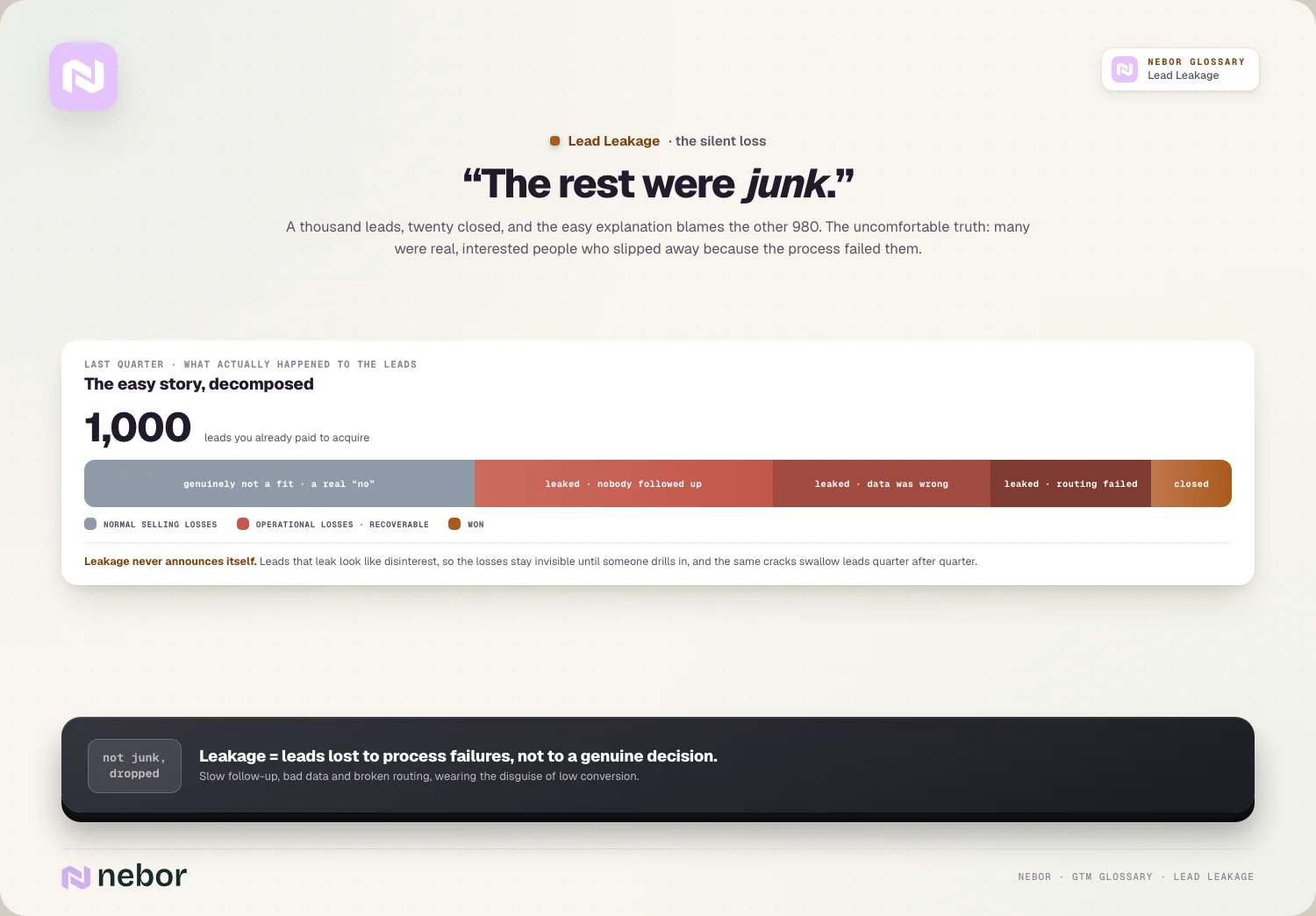
The test is simple to state. Did this lead get everything your own process says it should get, within the time you've agreed? If yes and it still didn't buy, it was lost. If no, it leaked. Disqualified leads (students, job seekers, suppliers, competitors) sit outside both categories, as long as someone actually looked at them and made the call.
A rising loss rate is a question for positioning, pricing or lead qualification. A rising leak rate is a question for operations, and the answer is almost never more leads.
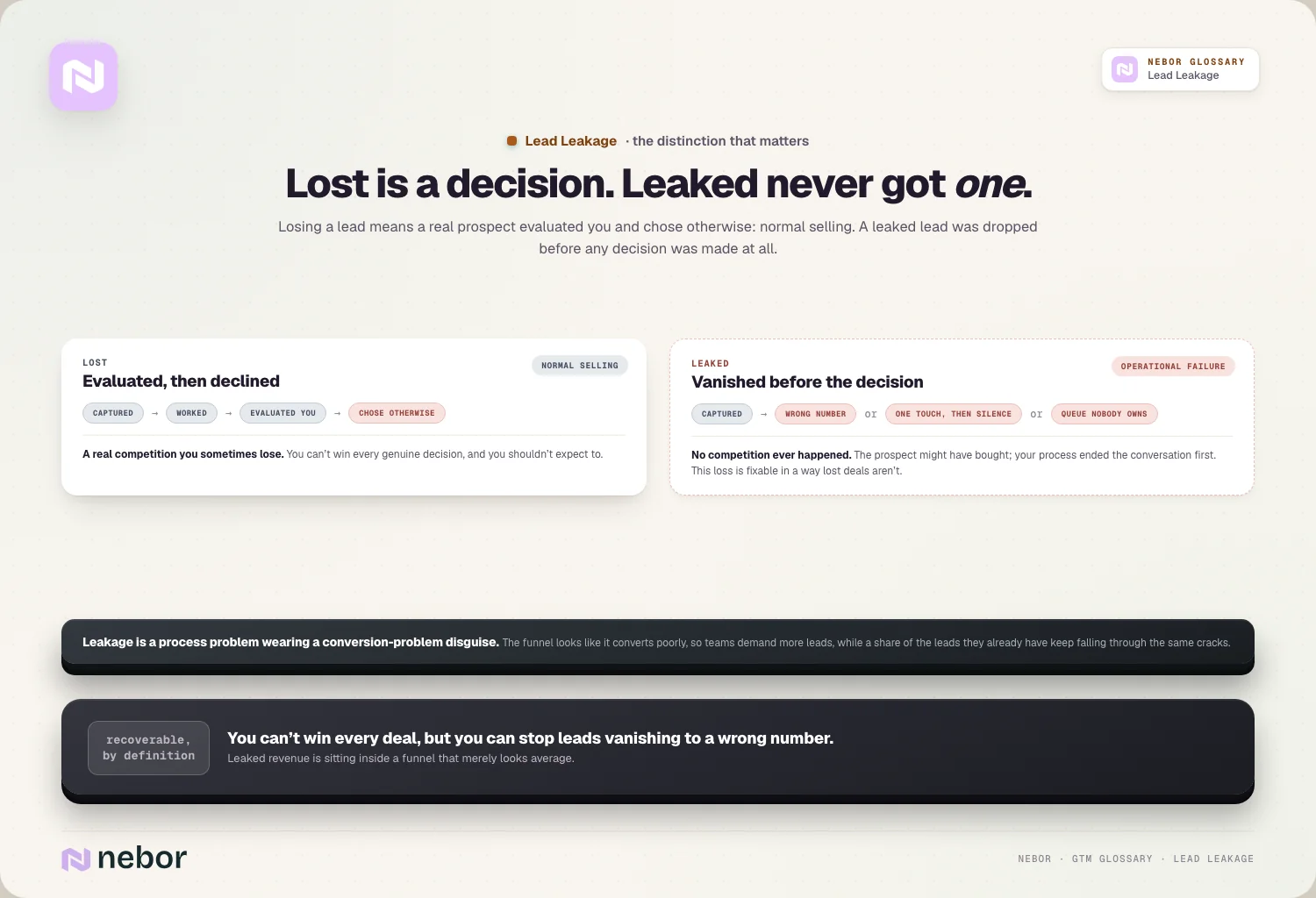
Where leads fall out between the form and the first meeting
Every time a lead moves from one tool, team or person to the next, there's a chance it doesn't arrive. These are the five handoffs where leads go missing most often.
The form and the sync into the CRM
Native CRM forms are rarely the problem. The trouble starts with forms built in a website builder, a survey tool or a landing page tool, connected to the CRM through an integration platform. A field gets renamed, an API key expires, or someone copies a landing page for a French-language campaign and never connects the new form. The visitor sees a thank-you message, and nothing reaches your CRM.
Integration tools can also switch themselves off. Zapier's help centre says it will automatically turn off a Zap that errors 95% of the time it runs, once it has run more than 20 times in the past seven days. That's sensible behaviour for a tool, and it means a broken lead sync can stop completely while everyone assumes inbound has had a slow week.
The same leak happens off the website, with trade show scans left in a spreadsheet and calls to the main number that end as a name on a sticky note.
The record the lead lands on
When a lead arrives, the CRM decides whether it's new. HubSpot adds a form submission to the existing contact when the email address already exists, which is what you want if each person is to have one record. But that record may still belong to a rep who left, carry a lifecycle stage like "unqualified" from two years ago, or sit in a list that's excluded from every alert. The new demo request is on the record, and nobody is told.
Bad data does the rest. A mistyped email address from the form, a company field filled with "n/a", or a contact merged into the wrong account all stop the lead before anyone tries to reach it. That's why data hygiene belongs in a leakage review, and why CRM hygiene (cleaning owners and stages, not just duplicates) closes leaks that look like routing problems.
Routing that finds nobody
A lead with a Gmail address, a country your territories don't cover or a company the CRM can't match falls through every rule and waits without an owner. Lead routing covers the fallback rules and timers that prevent this, and lead-to-account matching covers the step that connects a new lead to the account and owner you already have. From a leakage point of view, the thing to watch is simple: how many leads are sitting with no owner, or with an owner who no longer works there, right now.

Follow-up that stops after one try
Here's the leak that looks most like disinterest. A rep calls once, gets voicemail, sends one email, then gets pulled into a deal that's closing. The lead is marked "attempted" and slides down the list. Two weeks later the record says the prospect never responded.
Harvard Business Review published the classic test of this in 2011. Its researchers filled in contact forms on company websites, and 23% of the firms never wrote back, while the rest took 42 hours on average to reply. Reaching a lead within the first hour raised the odds of qualifying it nearly sevenfold. Speed to lead deals with the first touch. The leak we see more often comes after it, when one attempt is all a lead gets. A follow-up sequence with an agreed minimum number of attempts across email, phone and LinkedIn turns that from a matter of memory into a rule.

The handoff to whoever runs the meeting
The last seam is between the person who books the meeting and the person who holds it. The account executive gets a calendar invite with no context, the prospect doesn't show, and nobody owns the reschedule. Or the meeting is booked through a round-robin scheduling page that still includes someone who has left. HubSpot's own guidance on removing users warns that if a deactivated user stays in a round-robin or rotation, meetings will continue to be scheduled for that user, and the user won't be notified. The prospect turns up to a call nobody is going to join.
These leaks are rare by count and expensive by value, because a booked meeting is the warmest lead you have. Handing a lead from marketing to sales in HubSpot without losing its history has a post of its own, including how to pass context along so the receiving rep starts where the first one stopped.
A quarter of lead leakage at a Ghent software company
Here's what a lead trace turned up for a fictional but typical team: a Ghent company selling maintenance planning software to food manufacturers, with an SDR team booking meetings for account executives. In one quarter it spent €48,000 on inbound demand and received 600 form submissions, or €80 per lead.
Form to CRM. The form tool logged 600 submissions, and the CRM had 576 matching contacts. The 24 missing ones came from a French-language landing page whose form had never been connected.
Triage. Of the 576, sales disqualified 96 (students, suppliers, job seekers and two competitors). That's one in six, and it isn't leakage. It leaves 480 valid leads.
Routing. 30 valid leads matched no rule, mostly free email addresses and Walloon postcodes outside any territory, and sat without an owner past the agreed window. 450 reached a rep.
Follow-up. 50 of those got fewer attempts than the team's own cadence required, usually one call and one email. 400 were worked properly.
Handoff. The 400 worked leads produced 100 booked meetings. 10 of them never happened and were never rescheduled. 90 were held, and 18 became customers at an average first-year value of €15,000, so €270,000.
That's 24 + 30 + 50 + 10 = 114 leaked leads, 19% of everything that came in, and 114 × €80 = €9,120 of acquisition spend that bought nothing.
The bigger number is what those leads would have been worth. Across the quarter, a properly worked lead was worth €270,000 ÷ 400 = €675 to this team, and a held meeting €270,000 ÷ 90 = €3,000. Applying those rates:
Form leak: about 20 of the 24 would have survived triage, at the same one-in-six rate, so 20 × €675 = €13,500.
Routing leak: 30 × €675 = €20,250.
Follow-up leak: 50 × €675 = €33,750.
Handoff leak: 10 × €3,000 = €30,000.
Together that's €97,500 of first-year revenue, more than a third on top of what the team closed. Treat it as an estimate, since the leads that matched no routing rule may well have been weaker than average. The ranking is the useful part. The ten dropped meetings were the smallest leak by count and nearly the largest by value.

Measuring lead leakage with a lead trace
Conversion reports show where volume drops, but they can't tell a leak from a legitimate no. A stage-by-stage conversion rate tells you which transition to look at. A lead trace tells you what happened inside it. It's built from a handful of checks that mostly run as saved reports.
Reconcile the counts. Compare submissions in each form tool, chat tool and event list with new contacts created in the CRM for the same period. Any gap is a sync leak, and it should be zero.
List leads with no working owner. Unassigned leads older than your agreed window, plus leads owned by deactivated users.
List owned leads with no logged activity after the window you've set for a first touch.
Check closed-out leads against the cadence. Every lead marked "no response" should show the minimum number of attempts. The ones that don't are follow-up leaks.
Track meetings booked, held, no-show and rescheduled. A no-show with no reschedule attempt within a few days is a handoff leak.
Add a required reason when a lead is closed out, with process reasons ("couldn't reach, data wrong", "no owner") kept apart from decision reasons ("chose a competitor", "not a fit"). Over a quarter, that field becomes your leakage report.
Then follow a sample by hand. Once a quarter, pick 30 leads at random from the previous month and trace each one from the original submission to today: which record it landed on, who owned it, what happened and when. We've found that half an hour of this turns up problems no report was built to catch, such as a lifecycle rule that kept moving returning customers into nurture.
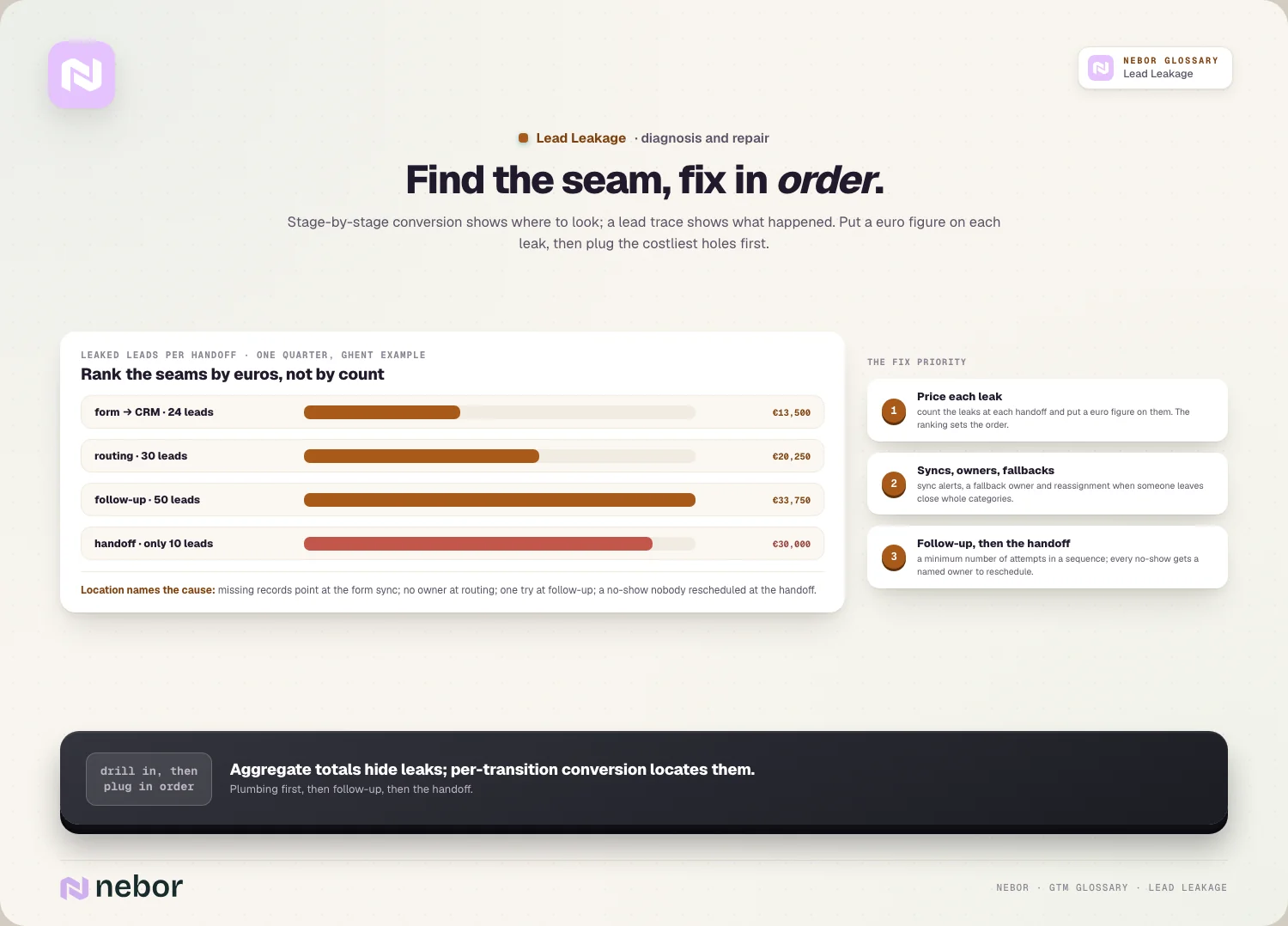
Report leakage as leaked leads divided by leads that entered, per handoff and per monthly batch, so a sync failure in March doesn't hide inside a good quarter. Put the euro estimate next to it, because a leak rate on its own rarely moves anyone.
Fixing the leaks that cost the most first
Most fixes are small rules in tools you already have, and the trace tells you the order.
The cheapest fixes usually come first because they close whole categories at once: an alert when a form sync fails or a Zap switches off, a fallback owner so no lead waits unassigned, a check that reassigns records and scheduling pages when someone leaves, and email validation on the form so a typo gets caught while the visitor is still on the page.
Follow-up comes next, because it's usually the largest leak by count. Agree the minimum number of attempts per lead type, put them into a sequence rather than a reminder, and make "no response" a status a lead can only reach after the sequence has finished.
The handoff gets its own rules: context travels with the meeting, every no-show gets a reschedule attempt with a named owner, and nobody stays in a round-robin after they've left. In the Ghent numbers, that was the leak where each fix paid back most per lead.
All of these are steps in one chain, from form to CRM to owner to meeting, and they hold up better when they're designed together as workflow orchestration than when each team patches its own part. The same chain carries the leads you generate yourself, so once you hand outbound prospecting to automation, its positive replies should go through the same owner and timer rules as a demo request.
The end state is a zero-leakage pipeline, where every lead that enters either gets a decision from a person or a recorded reason why not. You won't reach zero, but you'll know your number and where it comes from.
In short
Lead leakage is a process failure that looks like a demand problem. Prospects who never got a proper answer show up in the reports as prospects who weren't interested, so the usual response is to buy more of them.
The way out is to read the handoffs instead of the totals, and to price each leak before fixing it. The expensive ones are often the few at the end of the funnel rather than the many at the start.
Every lead in that trace was already paid for, which is the strongest argument for doing it before the next campaign. It's also a natural first look at how well the marketing, SDR and sales parts of a revenue team pass work to each other. When teams bring us in for this, we run the trace with them, build the alerts, fallbacks and follow-up rules in their own CRM and sending tools, and leave the reports in place so the next quarter's leaks show up without anyone having to go looking.
Frequently asked questions
What is a normal lead leakage rate?
There is no benchmark worth quoting, because teams define a lead, an owner and a completed follow-up very differently, and few measure leakage at all. A more useful target is your own trend. Measure the share of leads that leaked at each handoff for a few months, put a euro value on each, and watch whether the expensive leaks shrink after you change something.
Is lead leakage the same as revenue leakage?
No. Revenue leakage usually means money lost after a deal is signed, through unbilled usage, missed renewals, discounts nobody approved or invoicing errors. Lead leakage happens earlier, before a prospect ever reaches a buying decision. Both are process failures rather than lost competitions, and both are found the same way: by reconciling what should have happened against what the systems recorded.
Does lead leakage happen in outbound as well as inbound?
Yes. The most common outbound leak is a positive reply that sits in a sequencer inbox for days because nobody is alerted. Others are interested prospects who reply from a different address than the one in the sequence, and meetings booked by an SDR that the account executive never confirms. Treat an outbound reply with the same owner and response rules as a demo request.
Who should own lead leakage, marketing or sales?
Usually revenue operations, because leaks sit between teams rather than inside one. Marketing owns the forms and their syncs, SDRs own the first response and follow-up, and account executives own the meetings, so each team only sees its own part. Someone needs to run the trace across all of them, report the leaks by handoff and agree the fixes with each team.
How do leads from events and trade shows leak?
Mostly through delay and spreadsheets. Badge scans and business cards end up in a file on one person's laptop, get imported a week or two later without an owner or a campaign, and arrive in the CRM after the conversation at the stand has been forgotten. Import event leads within a day, assign owners during the import and send a follow-up that refers to the event.
Can marketing automation cause lead leakage?
Yes, often without anyone noticing. A lifecycle rule can push returning customers or new demo requests back into nurture, a suppression list can exclude contacts from sales alerts, and a lead score threshold can keep a qualified person from ever being routed. Review the workflows that touch lifecycle stage, owner and alerts whenever you change them, and test them with a real form submission.
How long can a lead wait before it counts as leaked?
Set the limit per lead type and write it down. A demo request or a positive reply might get minutes to an hour for a first response, a content download the same working day, and every type a minimum number of follow-up attempts. A lead counts as leaked once it passes its window without the agreed response, whether or not someone reaches it later.
Can spam protection on forms cause lead leakage?
It can. Filters that block free email addresses turn away real buyers at small companies that run on personal domains, and aggressive bot checks can stop genuine submissions on some browsers. Spam that gets through causes the opposite problem, burying real leads under junk in the queue. Check what your filters reject now and then, rather than only what they let through.
What is a zero-leakage pipeline?
It is a pipeline designed so that every lead that enters either gets a decision from a person or a recorded reason why not. In practice that means alerts on broken syncs, fallback owners, timers on first response, minimum follow-up rules and a required close-out reason. Reaching literally zero is rare, but the design makes every remaining leak visible and countable.
Share this post
RevOps
CRM
Glossary
Related glossary items
Understanding the core GTM concepts

Automation
Lead Routing
Lead routing is the automated process of assigning each incoming lead to the right rep, team or queue based on rules you set, so someone can follow up while the lead's interest is still fresh.

Automation
Speed to Lead
Speed to lead is the time between a prospect showing interest, like filling out a form or requesting a demo, and your team making real contact. Faster responses connect with far more leads.
Automation
Lead Scoring
Lead scoring gives each lead a number based on how well it fits your ideal customer profile and how much it engages with you, so your team knows which leads to call first.

Automation
Pipeline Conversion Rate
Pipeline conversion rate is the percentage of prospects that move from one sales pipeline stage to the next, measured stage by stage and across the whole funnel, so you can see where deals drop out.
Ready to build your pipeline