

In this post:
LinkedIn is where B2B buyers spend their professional time, and that's exactly why their inboxes there are flooded. Every seller has the same idea, so the average decision-maker gets a stream of generic connection requests and pitches they've learned to ignore.
LinkedIn outreach done well cuts through that noise. It's the difference between being one more templated pitch in a crowded inbox and being the relevant message that earns a reply, and the gap between those two outcomes is enormous.
LinkedIn outreach is the practice of proactively contacting prospects on LinkedIn through connection requests, messages, and InMail to start sales conversations. It's outbound prospecting done on the platform where professional buyers already gather.
LinkedIn reaches buyers in a place where they're receptive. When the outreach carries real relevance, it can produce far higher response rates than cold email, with InMail seeing 10 to 25% responses against email's low single digits.
TL;DR
LinkedIn outreach is proactive prospecting on LinkedIn through connection requests, messages, and InMail, done on the platform where B2B buyers already are.
It is valuable because it helps you reach buyers in a receptive place, with response rates that can far exceed cold email when the outreach is relevant.
It depends on relevance instead of volume. Targeted, signal-anchored messages get strong replies, while generic templated blasts get ignored and increasingly capped.
The constraint to plan around is that the platform now limits volume hard. Recent caps reward tight targeting and personalization, so spray-and-pray approaches no longer work.
What is LinkedIn outreach, and which tools does it actually use?
LinkedIn outreach is proactive sales prospecting carried out on LinkedIn. Instead of email or phone, you start conversations through the platform's own messaging tools.
It uses a few channels on the platform. Connection requests open a relationship, direct messages reach people you're connected with, and InMail lets you message people you aren't connected to.
It's still outbound at its heart, though. You're reaching out to people who haven't asked to hear from you, so the same rules of relevance and value apply as in any cold outreach.
It fits B2B especially well as a channel. Because LinkedIn is built around professional identity and work, it's a natural place to reach business buyers in their work mindset.
So LinkedIn outreach amounts to outbound prospecting on the buyer's professional home turf. It reaches people where they already think about work, and that setting is what makes it such a strong channel when handled with care.
It carries built-in context with every prospect. Unlike a cold email address, a LinkedIn profile shows you who someone is, which makes both targeting and personalization far easier than on most channels.
How is LinkedIn outreach different from the cold email next to it?
LinkedIn outreach and cold email are cousins that behave differently, and knowing the differences helps you use each well.
The context differs before anything else does. Email reaches a private inbox, while LinkedIn reaches a professional profile where people expect work conversations, which can make outreach feel more natural.
The response rates differ along with it. LinkedIn InMail tends to see far higher response rates than cold email, because the platform is built for professional connection and messages feel more personal.
And the volume ceilings differ sharply between them. Email can scale to large numbers, while LinkedIn limits how many people you can contact, so LinkedIn rewards quality over raw quantity far more than email.
So LinkedIn and email complement each other instead of substituting. Email scales reach while LinkedIn offers higher-quality, more personal contact, and the strongest motions use both together.
What are the moving parts of LinkedIn outreach on the platform?
LinkedIn outreach uses a few distinct tools, and each works differently, so understanding them shapes your approach.
Connection requests are how the relationships start. You ask to connect, and once accepted, you can message freely, so the request is the gateway to most LinkedIn conversations.
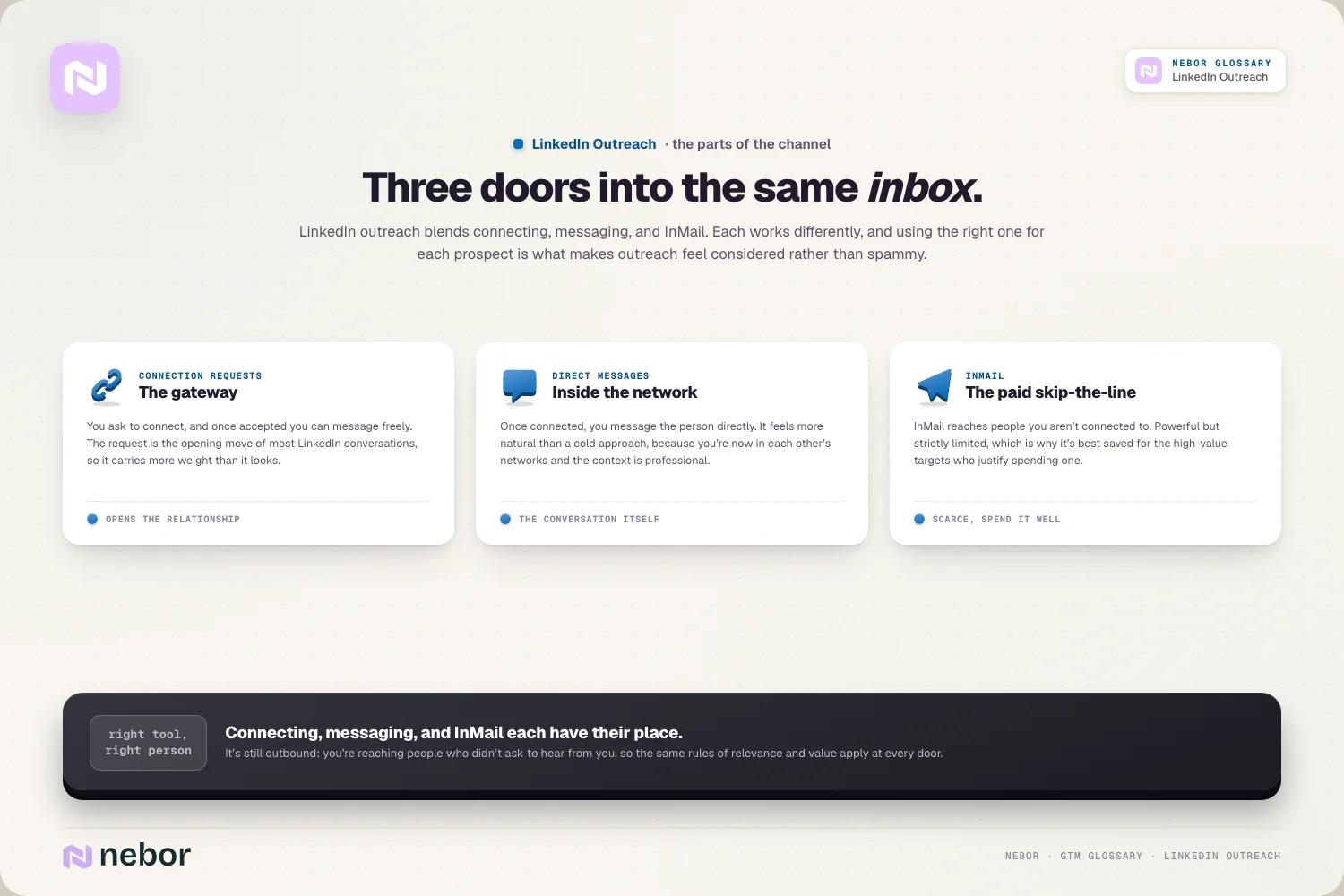
Direct messages reach the people you've connected with. Once connected, you can message the person directly, which feels more natural than a cold approach because you're now in each other's networks.
InMail reaches beyond the people you're already connected to. It lets you message people you aren't connected to, which is powerful but limited, so it's best saved for high-value targets.
So LinkedIn outreach blends connecting, messaging, and InMail. Each has its place, and using the right tool for each prospect is part of sending outreach that feels considered rather than spammy.
Should you include a note with your connection requests or not?
A surprisingly debated question clients ask us is whether to add a note to connection requests, and the data is more nuanced than it first appears.
Blank requests get accepted noticeably more often. Connection requests without a note tend to see acceptance rates of 55 to 68% versus around 30% for templated notes, because a generic pitch in the note can put people off.
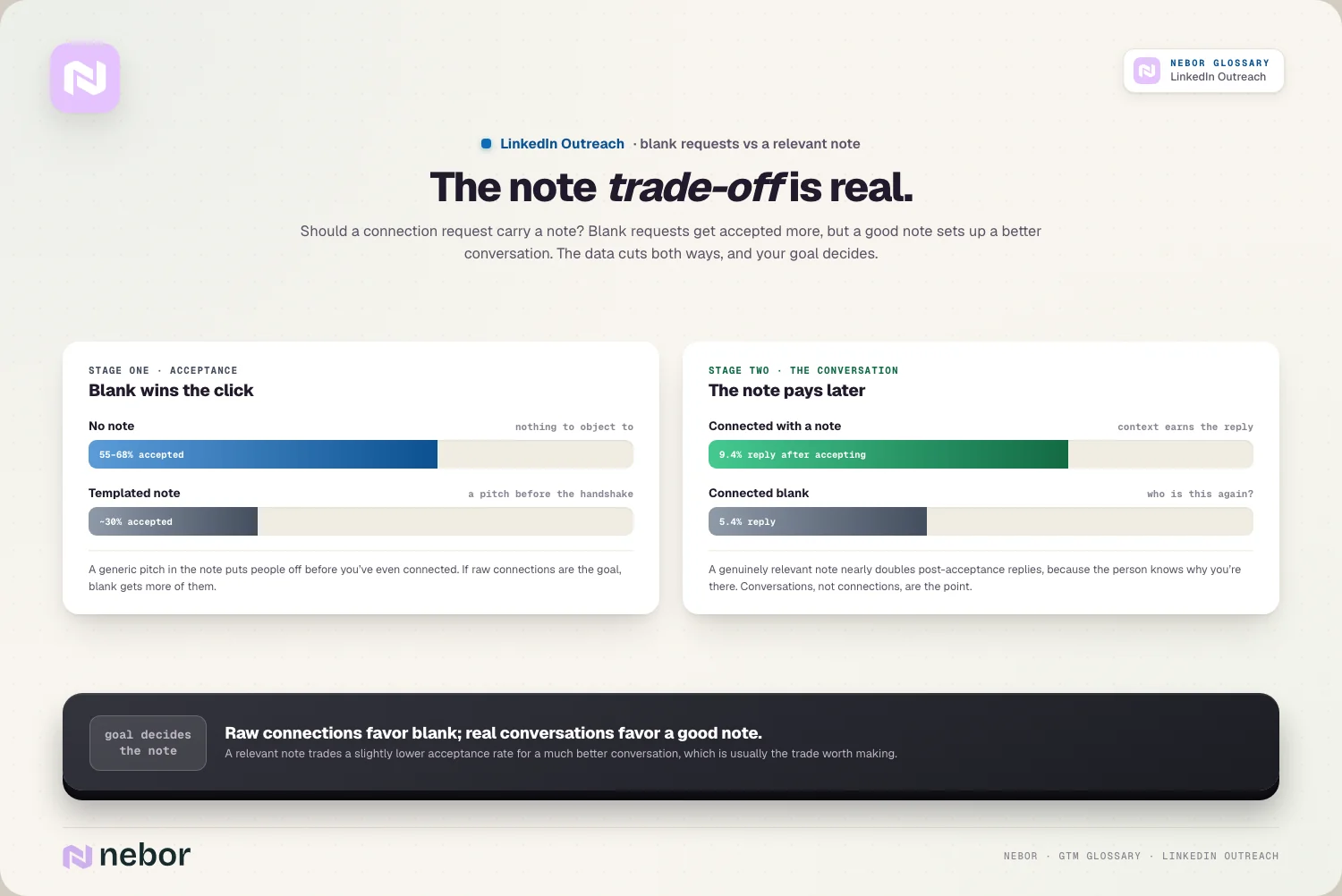
But notes lift the replies that come later. Including a note can raise post-acceptance reply rates, from around 5.4% without a note to 9.4% with one, because it gives context for the connection.
So the trade-off is a real one. A note may lower acceptance but improve the eventual conversation, which means a good, relevant note can be worth the slightly lower acceptance rate.
So whether to add a note depends on your goal. If you want raw connections, go blank, but if you want conversations, a truly relevant note tends to produce better outcomes down the line.
Why does relevance beat volume on LinkedIn more than ever now?
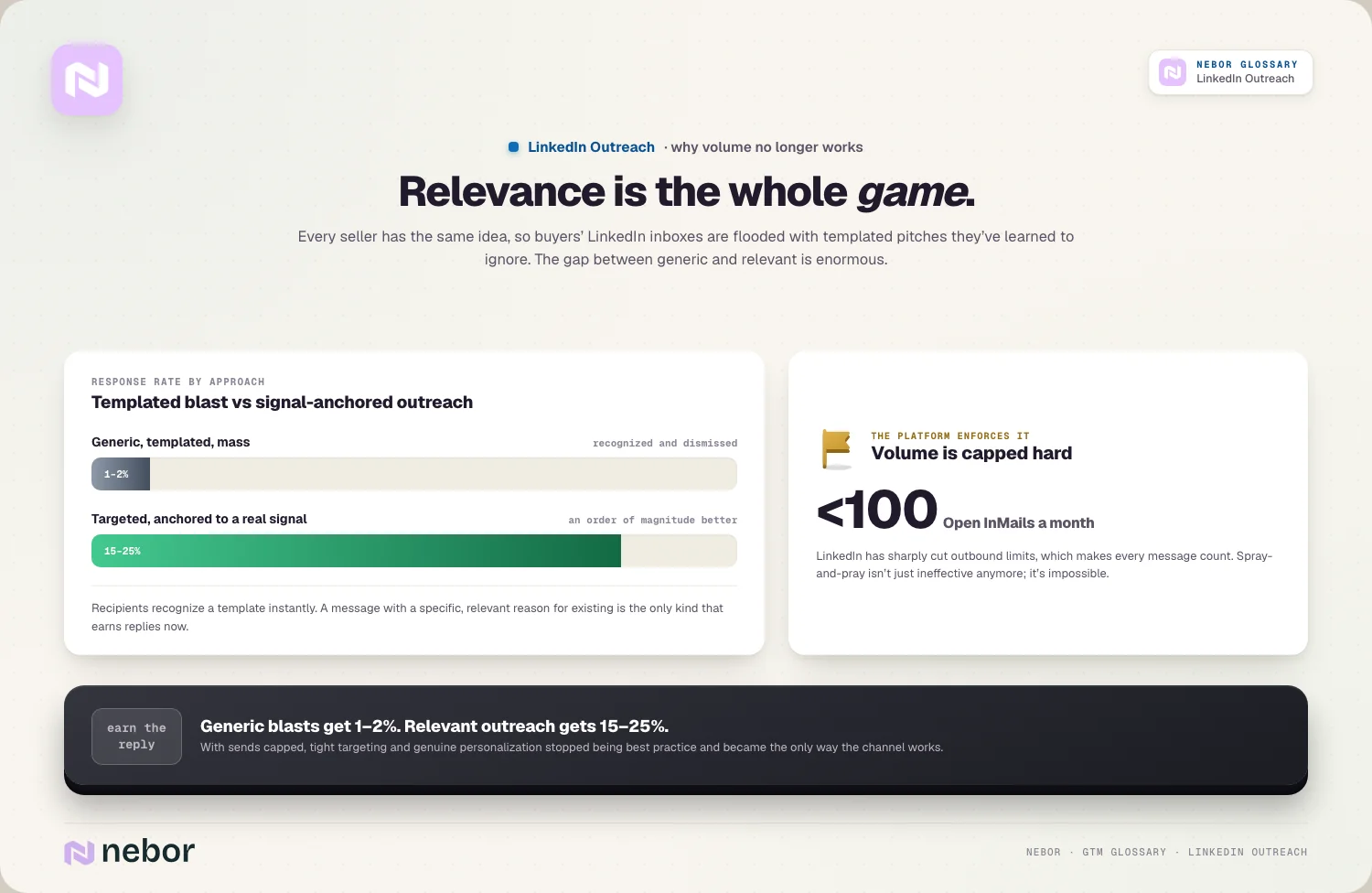
The single biggest shift in LinkedIn outreach is that volume no longer works, because relevance is now the whole game.
Generic blasts get ignored the moment they land. Templated, mass outreach achieves response rates of just 1 to 2%, because recipients instantly recognize and dismiss it.
Targeted, relevant outreach wins by a mile. Outreach anchored to a real signal and tight targeting can hit 15 to 25% responses, an order of magnitude better than generic messages.
The platform now enforces the shift itself. LinkedIn has sharply capped outbound volume, cutting Open InMail sends to under 100 a month, which makes every message count.
So relevance has gone from more effective to mandatory on LinkedIn. With volume capped hard, the only way to get results is tight targeting and real personalization on each message.
How do you personalize LinkedIn outreach without losing your scale?
Since relevance is everything, personalization is the core skill, and in our experience a few approaches make a message land.
Anchor every message to something specific about them. Referencing the person's role, company, or a recent change shows you actually looked, which separates you from the templated crowd instantly.
Tie it to a live signal where you can. Outreach timed to a trigger event like a funding round or a new hire is far more relevant, because you're reaching out at a moment that matters.
Scale it with real care rather than shortcuts. Personalizing every message by hand doesn't scale, so personalization at scale techniques keep messages relevant across many prospects without going fully generic.
So good personalization makes each message feel one-to-one. The goal is outreach that reads as if you wrote it for that person specifically, and that impression is what earns replies in a channel where generic messages die.
How does LinkedIn fit into a coordinated multi-channel motion?
LinkedIn rarely works best alone, because combining it with other channels multiplies results.
It pairs naturally with your email sequences. A prospect who sees your LinkedIn message and gets a relevant email is touched in two places, which reinforces your outreach across channels.
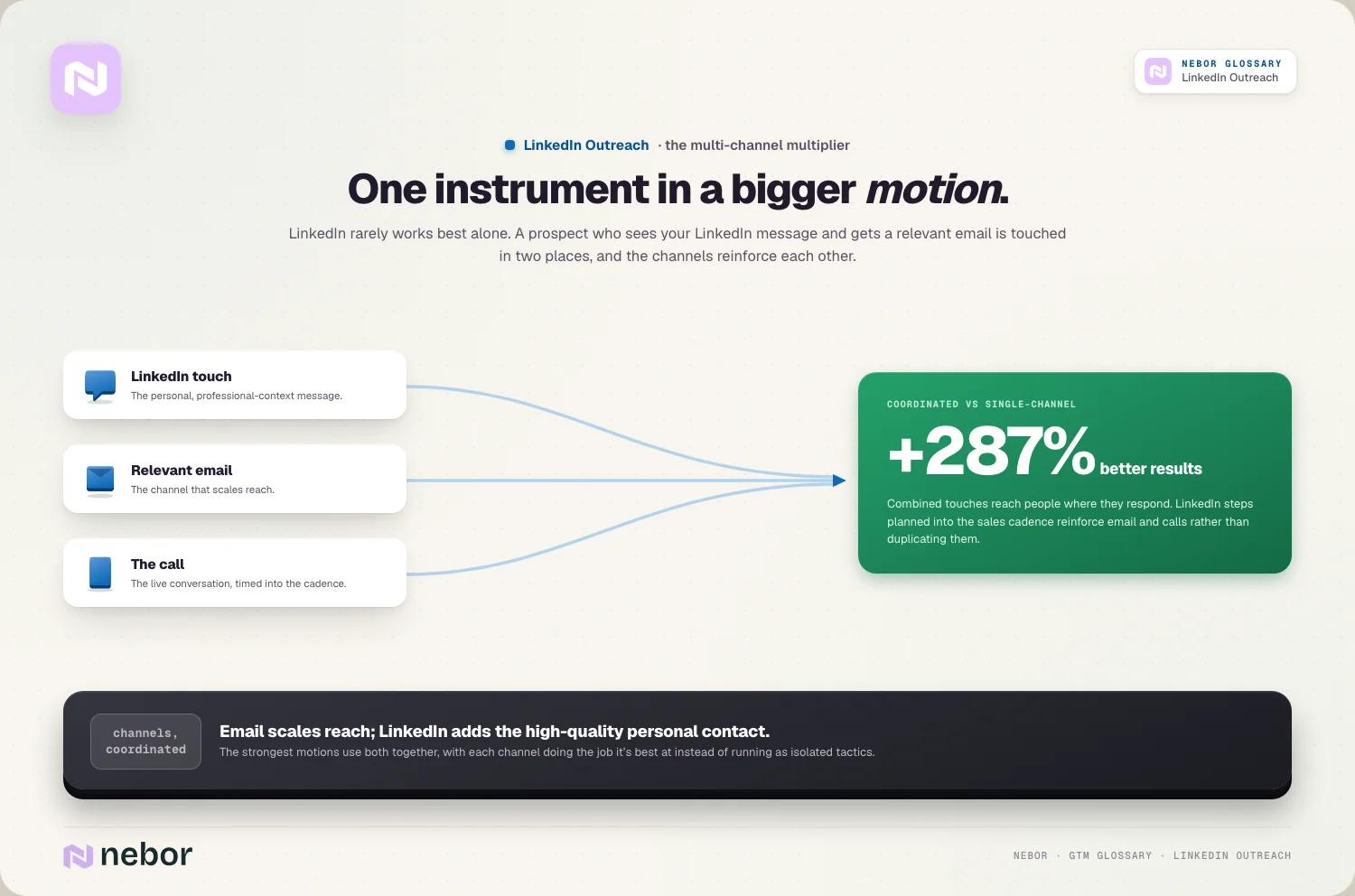
The lift from coordination is genuinely large. Outreach across email, LinkedIn, and phone together can boost results by over 287% compared to a single channel, because combined touches reach people where they respond.
It belongs inside your sequence as planned steps. LinkedIn touches should be built into your sales cadence alongside email and calls, so the channels reinforce instead of duplicating each other.
So LinkedIn is one instrument in a multi-channel outreach motion. It's strongest when coordinated with your other channels instead of used as an isolated tactic.
How does LinkedIn outreach relate to the broader social selling?
LinkedIn outreach is often confused with social selling, but they're different things, and the distinction changes how you plan.
Outreach is the proactive messaging piece of it. LinkedIn outreach is the direct, one-to-one act of reaching out to start conversations, much like cold outreach on any channel.
Social selling covers far more ground than that. It includes building a presence, posting content, and engaging with prospects' activity to warm them up over time, well past direct messages.
The two reinforce each other all the time. A strong social presence makes your outreach land better, because prospects who've seen your content are more receptive when you reach out directly.
So outreach is the direct messaging and social selling is the wider relationship-building. They work best together, where presence warms the ground that outreach then acts on.
How does LinkedIn outreach connect to signals and trigger events?
Modern LinkedIn outreach is increasingly driven by signals, because timing makes it far more effective.
Signals make the outreach timely instead of random. Reaching out when something changes at an account, the logic of signal-based selling, lands when the person is most receptive instead of at random.
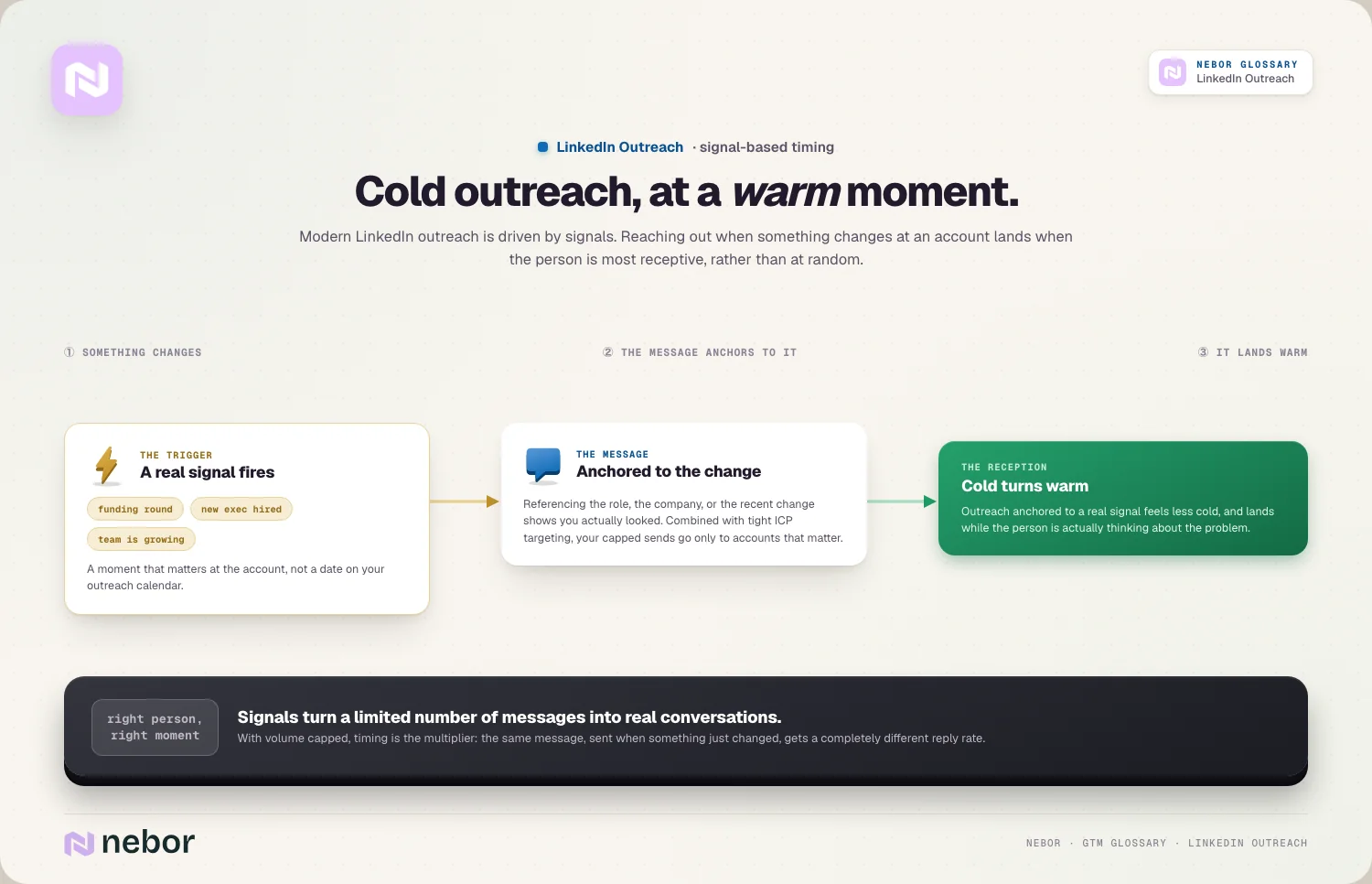
It turns cold contact into warmer contact. Outreach anchored to a real signal feels less cold, which moves it toward the higher-converting territory of warm outbound.
It aims your team's limited sends at the right people. Combining signals with tight targeting against your ideal customer profile ensures your limited LinkedIn outreach goes to accounts that matter.
So signals make LinkedIn outreach considerably sharper. With volume capped, reaching the right person at the right moment is what turns a limited number of messages into real conversations.
Does your own profile matter for how your outreach performs?
A piece teams often overlook is that your own profile shapes how outreach lands, because prospects check you before they reply.
Your profile is the first impression you make. When someone gets your message, they look at your profile, so a weak or salesy one undercuts even a good message.
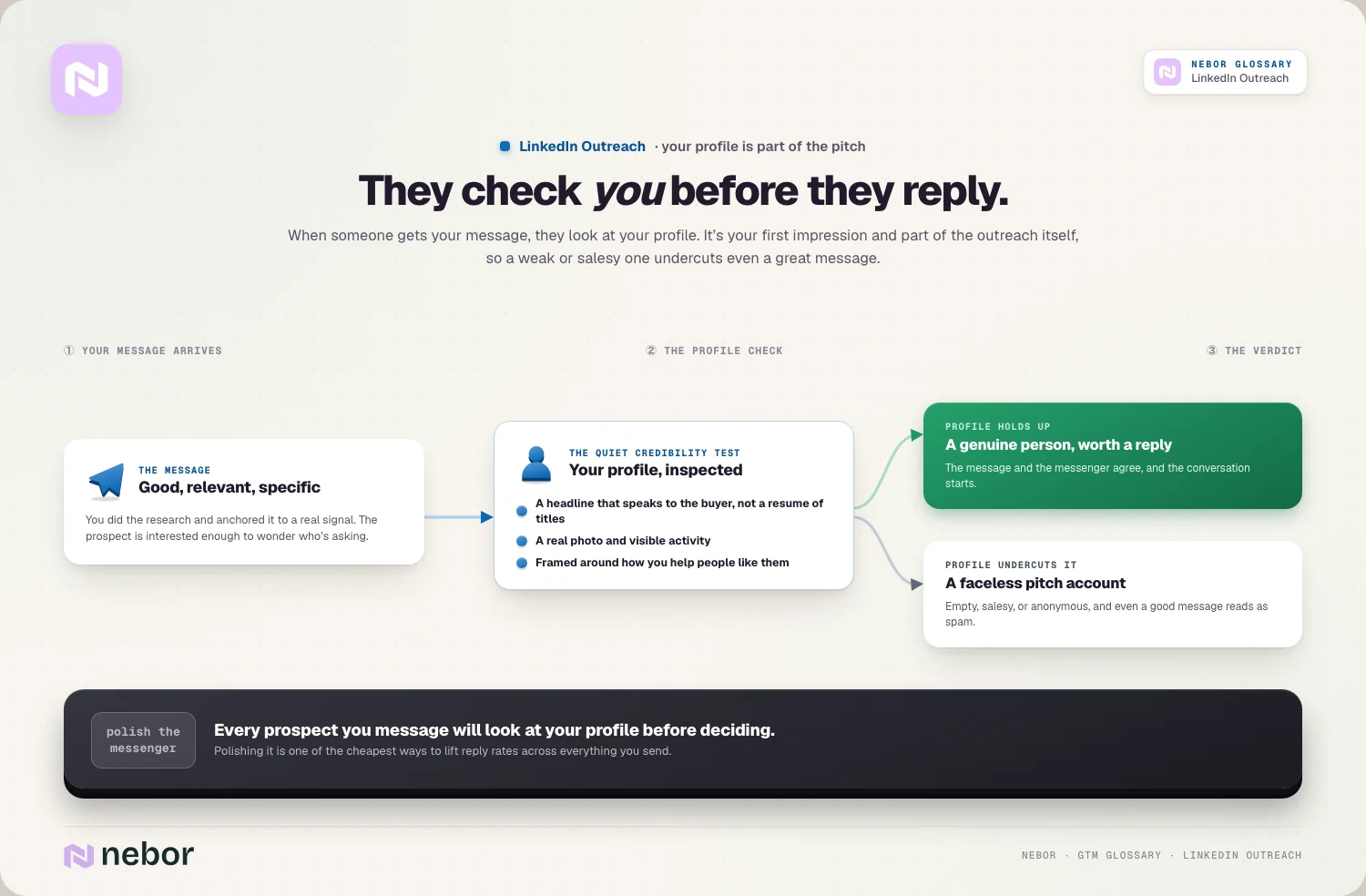
It should speak to the buyer directly. A profile framed around how you help people like them, instead of a resume of your titles, makes a prospect more comfortable replying.
It builds your credibility in the background. Activity, a clear headline, and a real photo signal you're a real person worth answering instead of a faceless pitch account.
So your profile is part of your outreach instead of separate from it. Polishing it is one of the cheapest ways to lift reply rates, because every prospect you message will look at it before deciding.
How do you measure LinkedIn outreach across the whole funnel?
Measuring LinkedIn outreach tells you what's working, and the metrics that matter track each stage of the funnel.
Acceptance rate comes first in the funnel. What share of connection requests get accepted shows whether your targeting and approach are landing at the top of the funnel.
Reply rate matters more than the acceptance number. What share of messages get a response, much like reply rate in email, shows whether your messaging starts real conversations.
Meetings booked is the goal underneath it all. Connections and replies are steps, but meetings and pipeline are what tell you the outreach is producing actual business.
So measure acceptance, replies, and meetings together. Each stage shows where outreach succeeds or breaks down, and that visibility lets you sharpen a channel where every message now counts.
Watch the quality signals alongside the funnel. A rising rate of ignored or flagged requests is an early warning that your targeting or messaging has drifted toward spam, and catching it early beats waiting for the platform to restrict you.
How do you sequence LinkedIn outreach across multiple touches?
LinkedIn outreach works as a sequence rather than a single message, and a patient, multi-step approach beats a one-shot pitch.
It usually starts on a soft note. A connection request, then a light value-led message once accepted, opens the door without pushing for a meeting too soon.
It builds over a handful of touches. Like any follow-up, most replies come after the first message, so a short series of relevant touches outperforms a single attempt.
It should also know when to stop. A handful of well-spaced, value-adding messages is persistent without crossing into pestering, which protects your reputation on a platform built on identity.
So LinkedIn outreach deserves a patient sequence. Open softly, add value across a few touches, and stop at a sensible point, which reads as professional instead of desperate.
What are the common mistakes people make with LinkedIn outreach?
LinkedIn outreach goes wrong in a few predictable ways, and we keep seeing the same ones in the motions we review. Avoiding them is what makes the channel work.
Pitching in the connection request kills things earliest, because leading with a hard sell before you've even connected feels pushy and tanks both acceptance and trust.
Relying on volume fails outright now, because with sends capped and recipients wary, mass generic outreach gets ignored and can get you restricted.
Being generic wastes the sends you have, because a message that could go to anyone gets treated as spam, so every message needs a specific, relevant reason for existing.
Ignoring your presence undercuts the rest, because reaching out cold with an empty or weak profile costs replies, given prospects check who's messaging them before they answer.
And treating it like email misreads the room, because copying long, formal email pitches into LinkedIn feels out of place, when the platform rewards shorter, more conversational messages.
Why relevance is the only LinkedIn strategy left that still works
LinkedIn outreach reaches B2B buyers where they're most receptive. Done with relevance, it can produce response rates that far exceed cold email, because the platform is built for professional connection.
The deeper point is that relevance has fully replaced volume. With the platform capping sends hard, the only outreach that works is tightly targeted, personalized, and ideally anchored to a real signal about the account.
The honest caveat is that it takes more effort per message. You can't blast your way to results on LinkedIn anymore, so the channel rewards teams willing to research and personalize over those chasing raw numbers.
So if your LinkedIn messages keep disappearing without a reply, the fix is almost always relevance. Reaching the right people with messages that clearly fit them is how LinkedIn becomes a top channel in a modern go-to-market system.
It's also a discipline you can scale. You can automate sales prospecting signals around it without losing the personal touch that makes each message land.
Share this post
Outbound
Glossary
Related glossary items
Understanding the core GTM concepts



Ready to build your pipeline











