

In this post:
A cold pitch from a stranger gets ignored, but a message from someone a buyer already recognizes gets a reply. That recognition is the whole difference, and most sellers never build it.
They stay invisible until the moment they want something, which is the worst possible time to introduce themselves.
Social selling flips that whole order around. Instead of appearing out of nowhere with an ask, you build a presence and a relationship first, so that by the time you reach out, the prospect already knows who you are and why you're worth listening to.
Social selling is the practice of using social media, almost always LinkedIn in B2B, to find, research, and build trust with prospects before the formal sales conversation. It replaces cold, transactional outreach with relationship and credibility built over time.
The approach works because trust changes everything about a conversation, and we watch it play out in the replies clients get.
A prospect who has seen your team's useful posts and engaged with you is far warmer than one hearing from you for the first time, and that warmth is why social sellers consistently outperform those who skip it.
TL;DR
Social selling uses social media, mostly LinkedIn in B2B, to find, research, and build trust with prospects before you ever pitch them.
It works by building presence and relationships first, so a prospect already recognizes and trusts you by the time you reach out directly.
It's broader than direct messaging, because it includes posting content, building authority, and engaging with prospects' activity, well beyond sending outreach.
The payoff is measurable, with social sellers consistently generating more opportunities and hitting quota more often than peers who don't use it.
What social selling means beyond simply having a LinkedIn account
Social selling is using social media as an active part of your sales process. It's not merely having a profile, it's using the platform to build relationships that lead to sales.
It starts with quiet research into your prospects. You use social media to learn about the prospects on your list, their roles, and what they truly care about, which then informs how you eventually engage with them.
It builds credibility that everyone in your market can see. By sharing useful perspectives and showing expertise, you become someone prospects recognize and trust before any sales conversation.
It nurtures the relationships slowly over time. Rather than a single cold touch, social selling is a series of interactions that warm a prospect gradually toward a conversation.
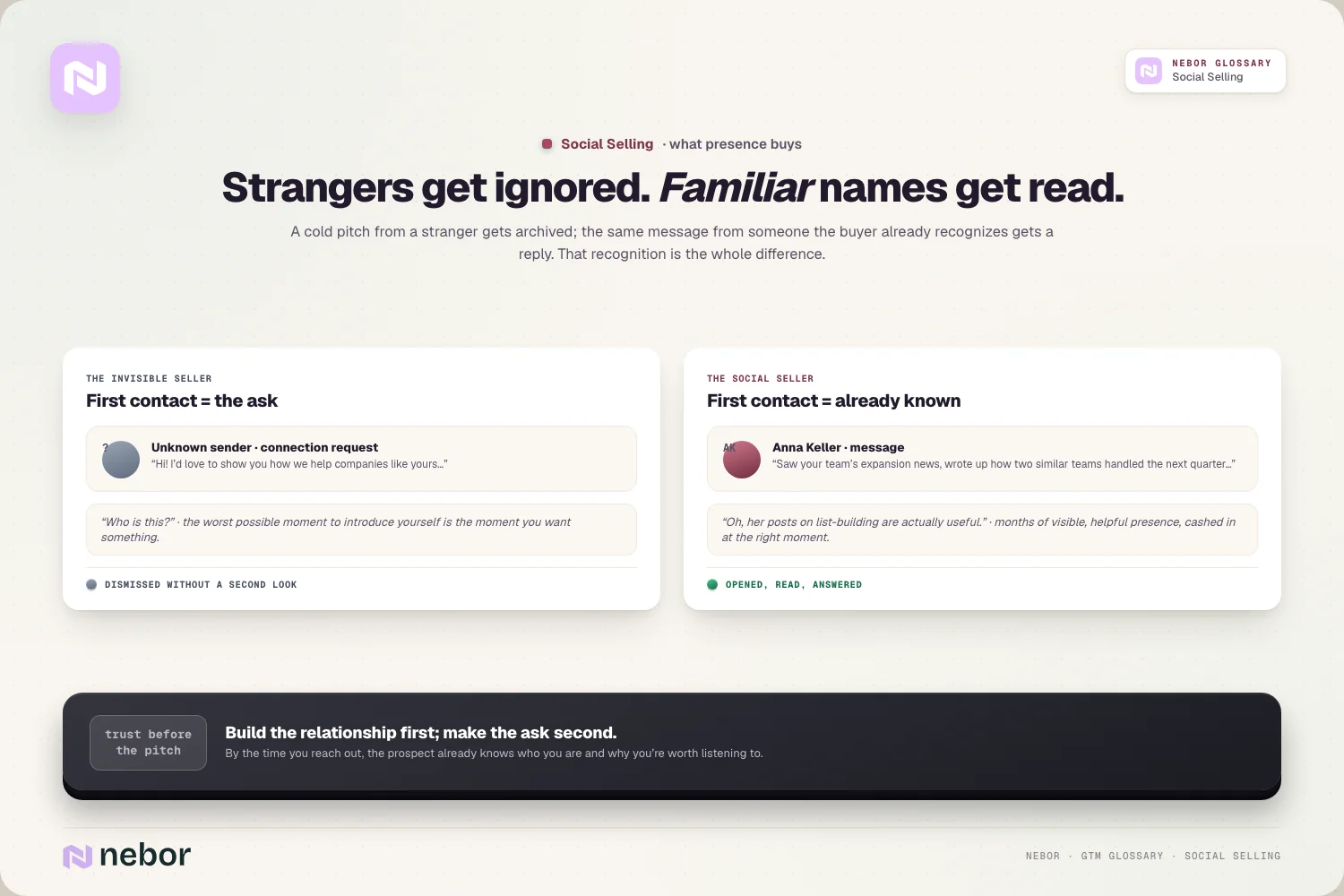
So social selling is a relationship-first approach to finding and winning customers. It uses social media to build the trust that makes the eventual sales conversation far easier than a cold one.
Almost always, in B2B, this means LinkedIn. That's where decision-makers gather and engage professionally, so it's the platform where building presence reaches the people you sell to.
The shift it represents is from interrupting to attracting. Instead of pushing a message onto someone who's never heard of you, you become someone worth hearing from, which changes how every later interaction feels.
How social selling differs from direct LinkedIn outreach itself
Because these two overlap heavily, it helps to separate them clearly. One is a broad approach and the other is a specific tactic within it.
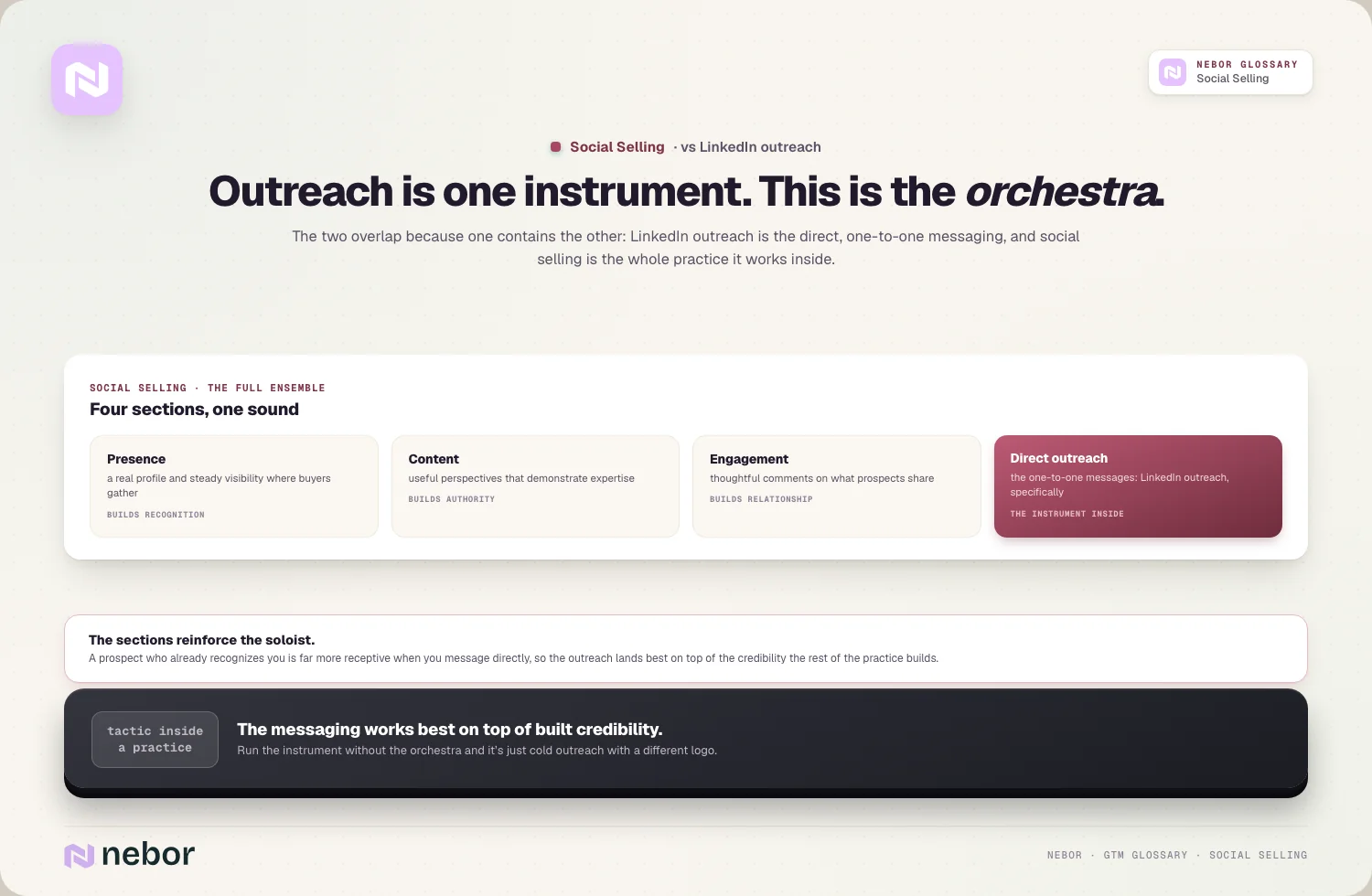
LinkedIn outreach is the direct part of it. It's the act of messaging prospects to start conversations, which is proactive and one-to-one.
Social selling is the wider practice around it. It includes that outreach but also the presence, content, and engagement that build your reputation and warm prospects up over time.
The two reinforce each other every day. A strong social presence makes your outreach land far better, because a prospect who already recognizes you is more receptive when you reach out directly.
So outreach is one instrument and social selling is the whole orchestra. The messaging works best on top of the credibility that the broader social selling practice builds.
Why building an audience matters more than sending more messages
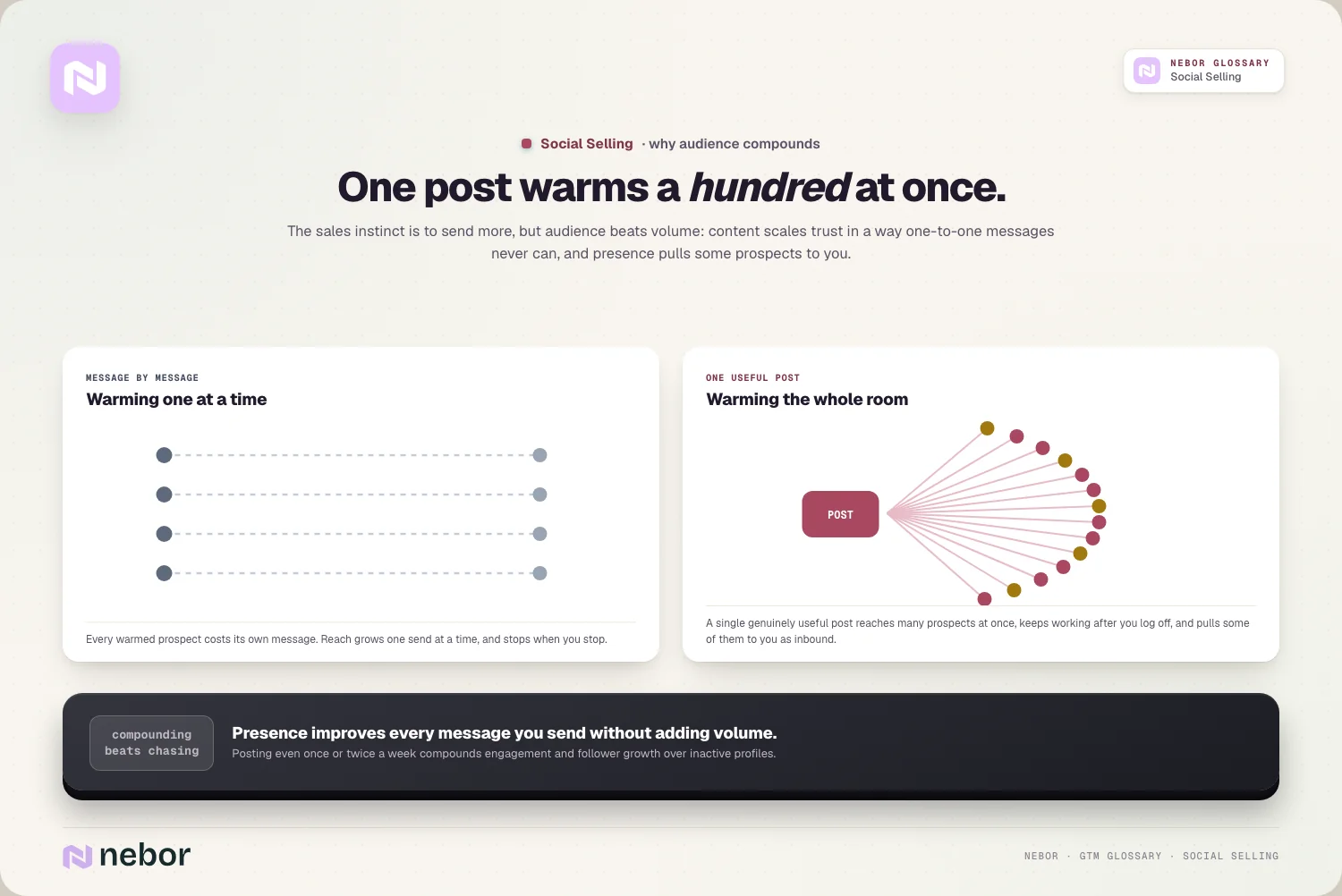
The instinct in sales is to send more, but social selling rewards the opposite. Building an audience often beats increasing outreach volume.
Presence generates a little inbound of its own. A strong, visible presence draws prospects to you, so some conversations start with them reaching out instead of you chasing.
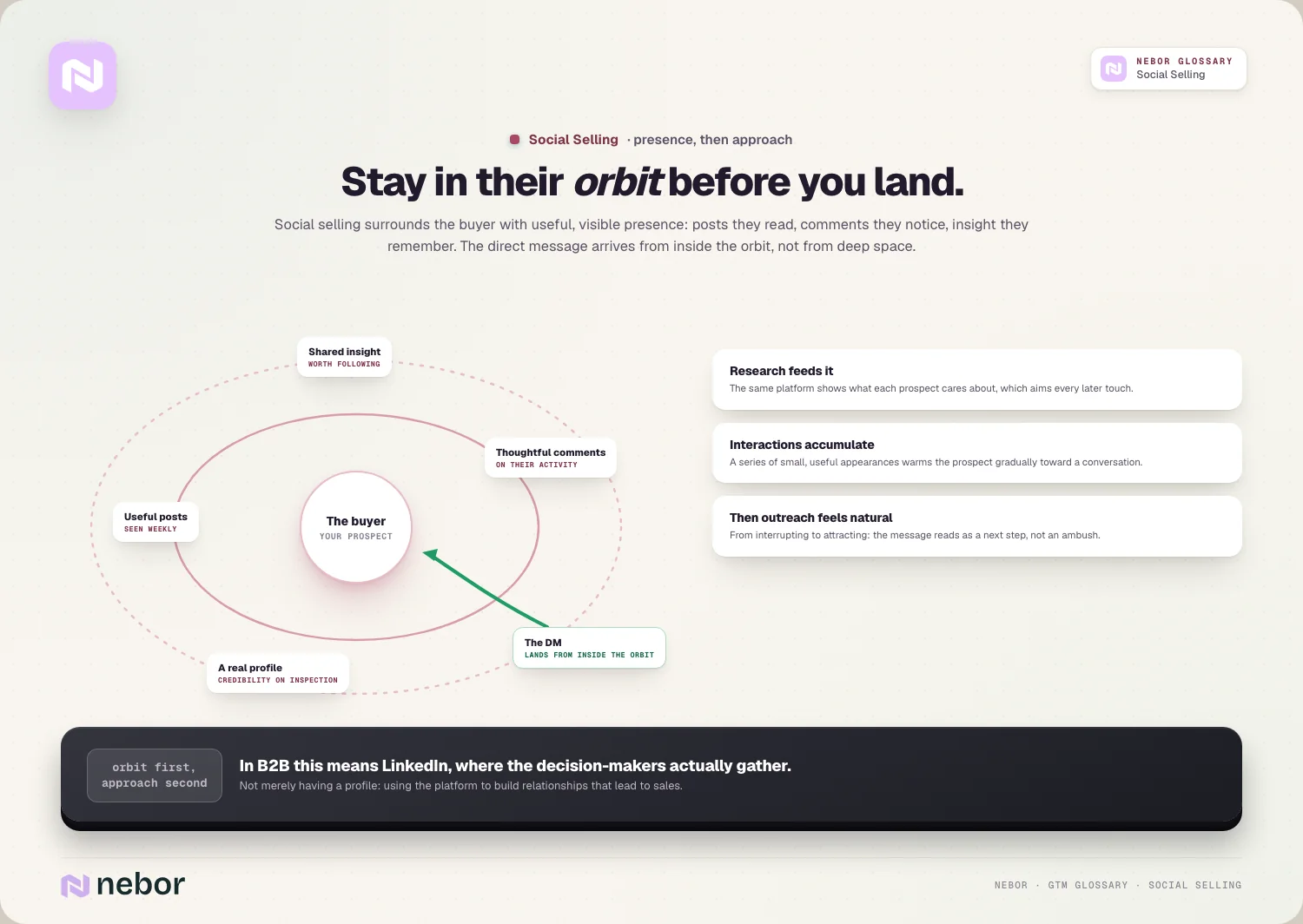
It makes every later piece of outreach warmer. Every message you send lands better when the recipient already follows or recognizes you, so audience-building improves your outreach without adding volume.
Content scales trust in a way messages can't. A single useful post can reach and warm many prospects at once, which is far more efficient than warming each one through individual messages.
So investing in an audience compounds in a way raw outreach doesn't. Building presence warms many prospects at once and pulls some toward you, which is a kind of reach that pure messaging can't match.
How content and thought leadership drive social selling from below
At the heart of social selling is the content you share, because that's what builds the authority everything else rests on, and in our experience publishing useful perspectives is the engine of the whole practice.
Content demonstrates your expertise where prospects can see it. Sharing truly useful insight shows prospects you understand their world, which builds the credibility that makes them trust you.
Consistency is what makes it compound over time. Businesses posting even once or twice a week see far more engagement and faster follower growth than inactive ones, so steady posting builds presence over time.
It positions you as a resource worth following. Strong thought leadership makes you someone prospects follow for value, so you're already trusted when a buying need arises.
So content is the foundation of social selling. It's what turns a profile into a presence, building the authority that makes prospects receptive long before you ever reach out to them directly.
How engaging with prospects builds relationships before the pitch
Beyond posting your own content, social selling involves engaging with what prospects share. That two-way interaction is where the relationships form.
Engaging with prospects' posts is what gets you noticed. Thoughtfully commenting on a prospect's posts puts you on their radar in a helpful way, instead of appearing out of nowhere with a pitch.
It signals interest that reads as real. Engaging with their content shows you pay attention to them specifically, which builds goodwill that a cold message never could.
It warms the ground before any outreach lands. By the time you reach out directly, a prospect you've engaged with recognizes you, so the conversation starts from familiarity instead of from zero.
So engagement is how social selling builds real relationships. Showing up consistently and usefully in a prospect's world makes your eventual outreach feel like a natural next step instead of an unwelcome interruption.
What the LinkedIn Social Selling Index measures for you in practice
LinkedIn has its own score for social selling, and understanding it helps make the practice concrete. The SSI turns a fuzzy idea into a number.
It scores four distinct pillars of activity. The Social Selling Index rates you from 0 to 100 across establishing a professional brand, finding the right people, engaging with insights, and building relationships.
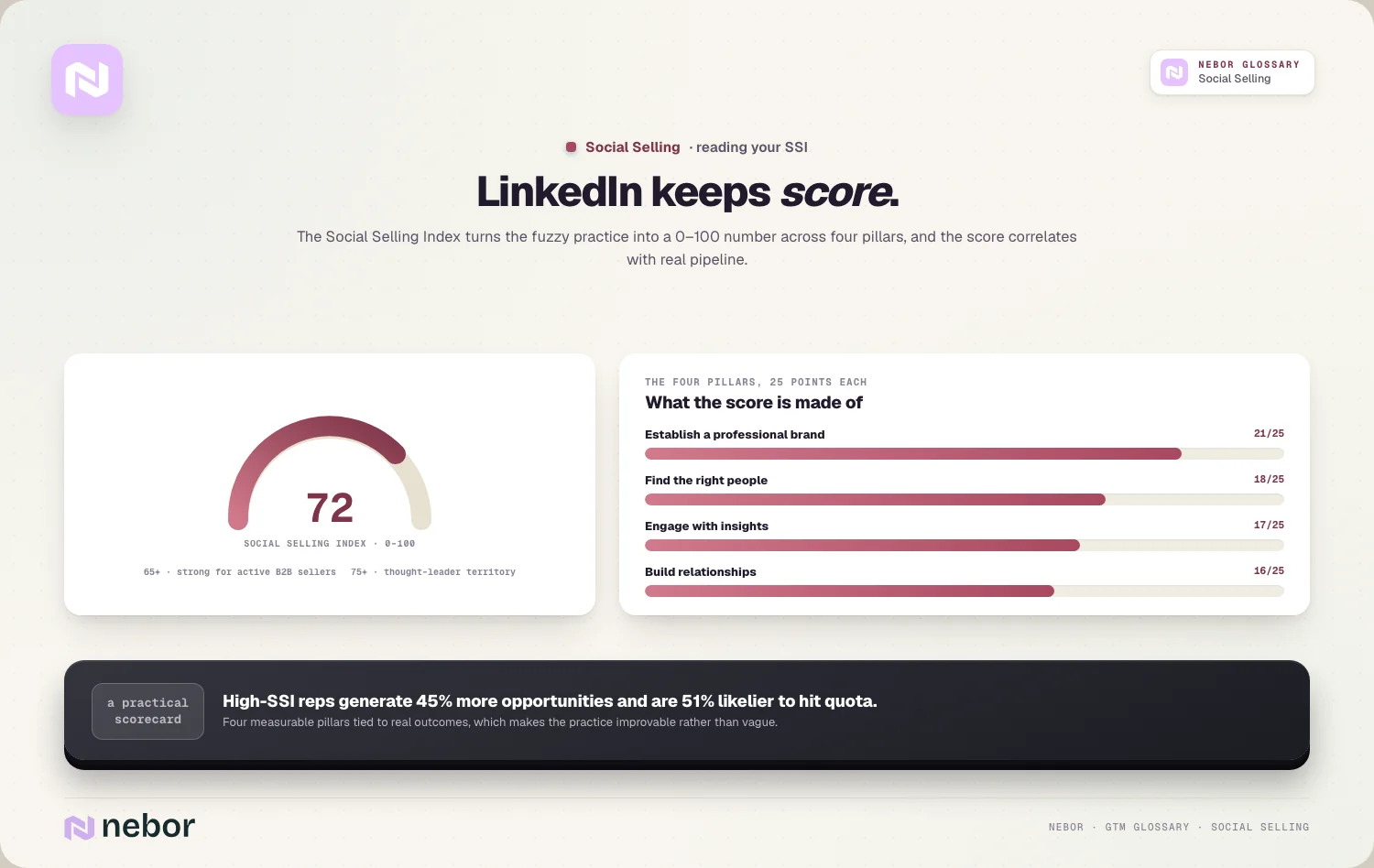
The benchmarks are clear enough to aim at. A good SSI lands at 65 or above for active B2B sellers, well past the typical average, with scores above 75 marking thought-leader territory.
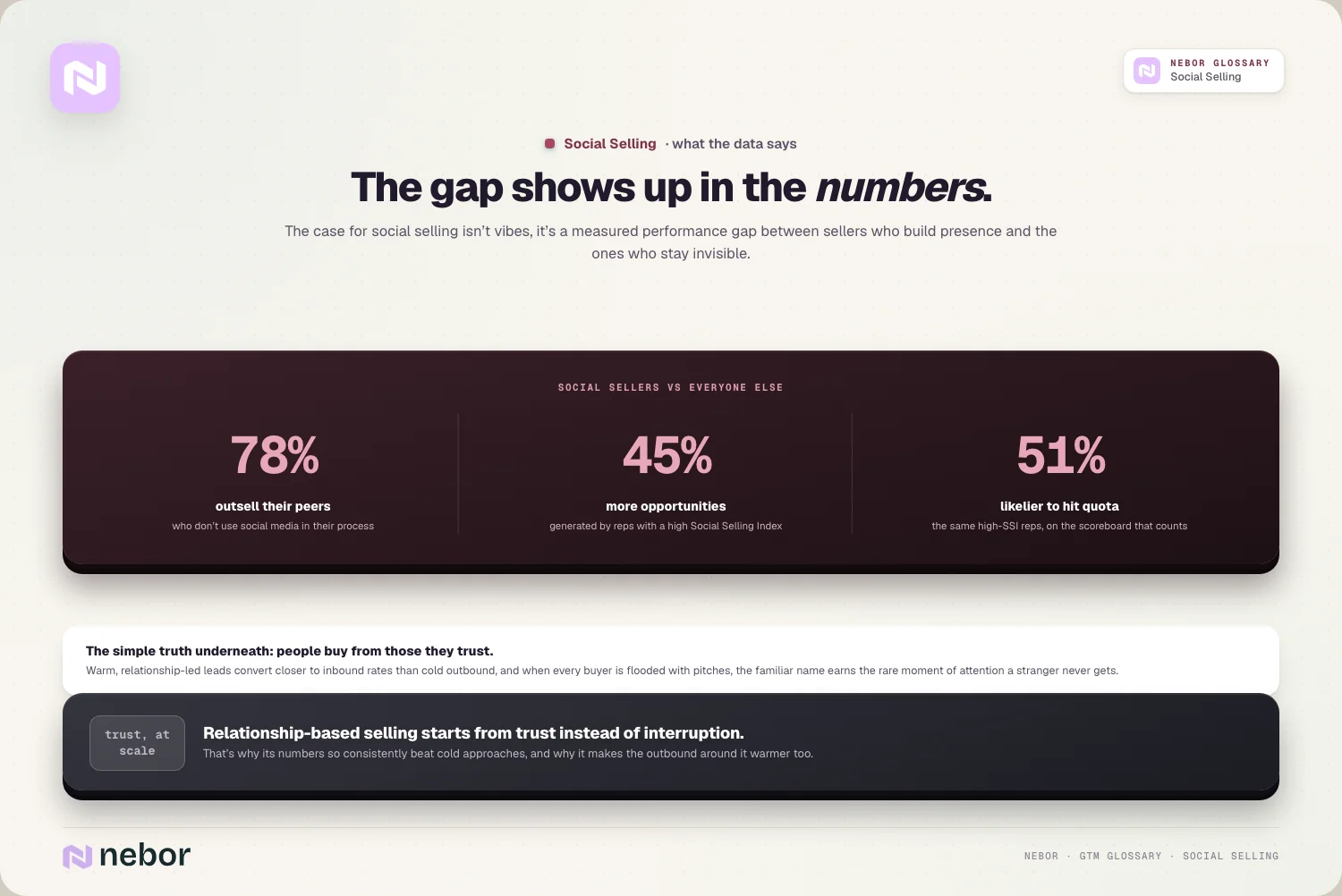
It correlates meaningfully with the results you get. Reps with high SSI generate 45% more opportunities and are 51% more likely to hit quota, which shows the practice pays off.
So the SSI is a useful gauge of your social selling. It breaks the practice into four measurable pillars and ties them to real outcomes, which makes it a practical scorecard to improve against over time.
Why social selling produces such strong results in B2B sales
The case for social selling rests on hard numbers, and they're worth seeing. The performance gap between social sellers and everyone else is large.
Social sellers reliably outperform the peers who skip it. Around 78% of social sellers outsell peers who don't use social media in their process, a striking majority.
The return on the effort is higher. Relationship-based social selling tends to produce stronger returns than cold email and phone, because it starts from trust instead of interruption.
Warm leads close better at every single stage. Leads that come through authority and relationships convert far more often than cold prospects, closer to the high conversion of inbound than outbound.
So the results reflect a simple truth about buying. People buy from those they trust, and social selling builds that trust at scale, so its numbers consistently beat cold approaches.
The advantage also holds because attention is scarce. When every buyer is flooded with cold pitches, being a familiar, trusted name is what earns the rare moment of attention that a stranger never gets.
How social selling connects to warm outbound and buying signals
Social selling doesn't replace outbound, it makes it warmer and better timed. The two work together through presence and signals.
It feeds your warm outbound motion directly. Reaching out to someone who already engages with your content is a form of warm outbound, because the relationship is partly built before the first message.
It surfaces timing signals as they happen. Watching a prospect's activity can reveal a trigger event, like a new role or a post about a problem, that makes outreach timely.
It sharpens further when paired with intent. Combining social presence with the timing of signal-based selling means you reach warm prospects at the moment they're most receptive.
So social selling and outbound reinforce each other. Presence warms the relationship, signals provide the timing, and outreach turns both into a conversation that starts far ahead of where a cold one would.
How social selling fits alongside your inbound and outbound motions
Social selling isn't a standalone channel, it strengthens both sides of your wider motion. It bridges inbound and outbound and improves each.
It powers a lighter kind of inbound. A strong presence pulls prospects toward you, which behaves like inbound built on your own ideal customer profile instead of paid demand.
It warms your outreach before it arrives. Prospects who already engage with your content respond far better to direct messages, which lifts the reply rate of your outbound.
It scales through relevance instead of volume. Keeping content and engagement relevant across many prospects is a form of personalization at scale, applied to presence instead of just messages.
So social selling threads through the whole motion. It creates a little inbound pull, warms the outbound push, and makes both feel less cold, so it complements instead of competing with them.
How to do social selling well without ever tipping into spam
The biggest risk in social selling is turning it into thinly disguised spam, which undoes the trust it's meant to build, and in our experience a few principles keep the practice honest.
Lead with value and hold the pitches. Sharing useful content and helping without asking builds the credibility that makes people receptive, while constant pitching burns it.
Engage with sincerity or skip the engagement entirely. Generic, copy-paste comments read as fake, so real engagement means paying actual attention to what a prospect shares.
Be patient with the timeline it demands. Social selling builds relationships over time, so pushing for a meeting too fast breaks the trust that the slower approach is designed to create.
So authentic social selling is about being genuinely useful first. The trust that produces results comes from real value and patience, which is exactly what a pushy, transactional approach quietly destroys.
How to scale social selling across an entire sales team consistently
Social selling works for individual reps, but scaling it across a team takes deliberate effort. A few things make it repeatable instead of dependent on a few naturals.
It needs a steady content engine behind it. Giving reps useful content and ideas to share, tied to clear buyer personas, lets the whole team build presence instead of just the naturally prolific ones.
It rewards steady consistency far above cleverness. Building presence takes steady activity, so the teams that win treat social selling as an ongoing habit instead of an occasional push.
It fits inside the wider motion you build. Social selling works alongside a broader multi-channel outreach approach, so it's one coordinated channel instead of a separate effort.
So scaling social selling means systematizing presence and consistency. Equipping every rep to build credibility, instead of leaving it to a few naturals, is what turns it into a genuine team-wide advantage.
The common mistakes teams make when they first try social selling
Social selling fails in a few predictable ways, and each undercuts the trust it depends on. Avoiding them is what keeps the practice effective.
The biggest is pitching far too soon. Treating social selling as an excuse to message everyone immediately turns it into the cold outreach it's meant to replace.
Another is showing up only in inconsistent bursts. Posting once and going quiet builds no presence, so sporadic effort produces none of the compounding benefit.
A third is faking the engagement with automation. Generic comments and automated interactions read as insincere, which damages instead of builds credibility.
The last is measuring only vanity metrics. Chasing likes and followers without connecting them to conversations and pipeline misses the point, because presence only matters if it warms real prospects toward a sale.
Why social selling is really about earning attention before you need it
The deepest logic of social selling is that it builds trust in advance, so you're not a stranger when you finally reach out. It's the opposite of the cold approach that most sellers default to.
It changes when the relationship actually starts. Instead of beginning at the moment of the pitch, the relationship starts far earlier, through content and engagement, so the pitch lands on warm ground.
It compounds the way a reputation does. Every useful post and genuine interaction adds to how prospects see you, so the advantage grows steadily instead of resetting with each campaign.
It fits how B2B buying actually works. Buyers research and form impressions long before they talk to sellers, so being present and trusted during that phase is where social selling wins.
A seller who builds real presence and relationships turns social selling into one of the most durable advantages in a modern go-to-market system. It earns the trust that makes every later conversation easier, even the ones you automate sales prospecting around.
Share this post
Outbound
Content
Glossary
Related glossary items
Understanding the core GTM concepts




Ready to build your pipeline











