

In this post:
One person at a company downloads a whitepaper, and your marketing automation flags them as qualified and hands them to sales. Meanwhile four colleagues visited your pricing page, attended a webinar, and read three case studies, none of which shows up because your system only cares about that one individual.
A marketing qualified account fixes that blind spot by looking at the whole company instead of a single contact. Instead of qualifying one person on one action, it reads the combined signals from everyone at an account and asks whether the organization as a whole is showing real buying interest.
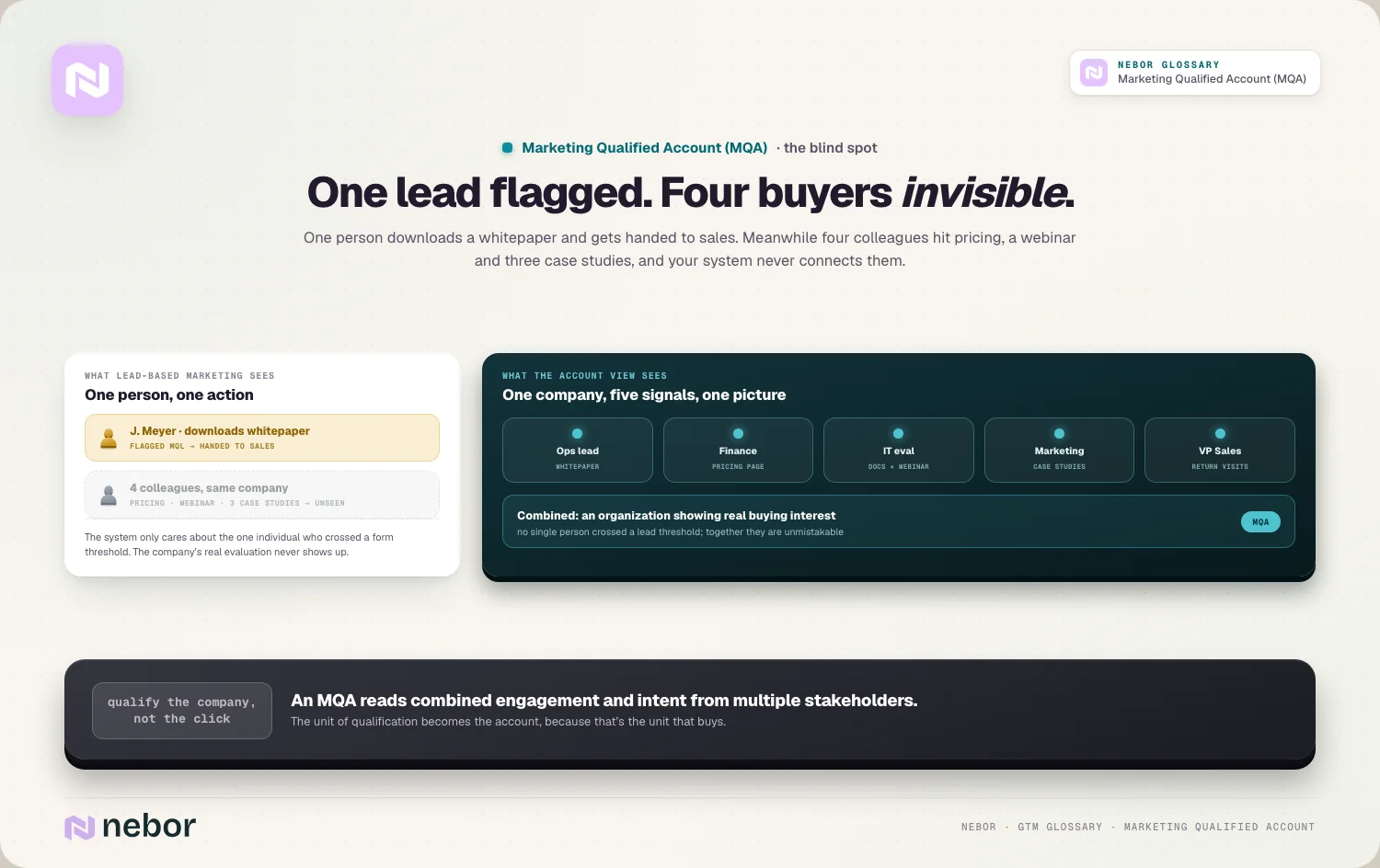
A marketing qualified account, or MQA, is a company that marketing has identified as ready for sales attention based on the combined engagement and intent signals of multiple stakeholders within it. Rather than qualifying an individual, it qualifies the entire account as a unit worth pursuing.
The concept has gained ground because B2B purchases are made by groups instead of individuals, so qualifying one person misreads the situation. An MQA aligns qualification with how companies really buy, catching accounts where a genuine evaluation is underway even when no single person has crossed a lead threshold.
TL;DR
A marketing qualified account is a company judged ready for sales based on the combined engagement and intent of multiple people within it, instead of one individual's action.
It exists because B2B buying is a committee decision, so watching a whole account's behavior reflects real buying interest far better than flagging a single lead who filled out a form.
Defining one well means combining firmographic fit, technographic fit, and engagement signals across the buying committee into an account-level score instead of a per-person one.
It isn't a complete answer on its own, because a qualified account still needs a real person to contact, so the strongest motions pair account qualification with the individuals driving the interest.
What a marketing qualified account is and why the account becomes the unit
An MQA treats the company as the thing being qualified, a meaningful shift from lead-based thinking. Rather than asking whether one person is ready, it asks whether an account shows enough collective interest to justify sales attention, so the unit of measurement is the organization instead of the individual.
This account-level view captures interest that lead-level qualification misses.
When several people at one company engage in different ways, no single one may look impressive alone, yet together they paint a clear picture of an account actively evaluating you, and that collective picture is exactly what an MQA is built to detect.
The concept is at the heart of account-based motions for that reason. Because account-based marketing targets whole companies instead of scattered individuals, it needs a qualification model that works at the account level, and the MQA is that model, defining when a target account has earned real engagement.
How a marketing qualified account differs from a marketing qualified lead
The cleanest way to understand an MQA is against the familiar marketing qualified lead, because the difference is the unit each one qualifies. An MQL focuses on a single individual's engagement, flagging one person who took an action, while an MQA focuses on the collective behavior of everyone at the account.
This changes what counts as a qualifying signal. Under an MQL model, one person downloading an ebook can trigger qualification, whereas under an MQA model, qualification comes from a pattern across contacts, so five people lightly engaging can matter more than one person acting once.
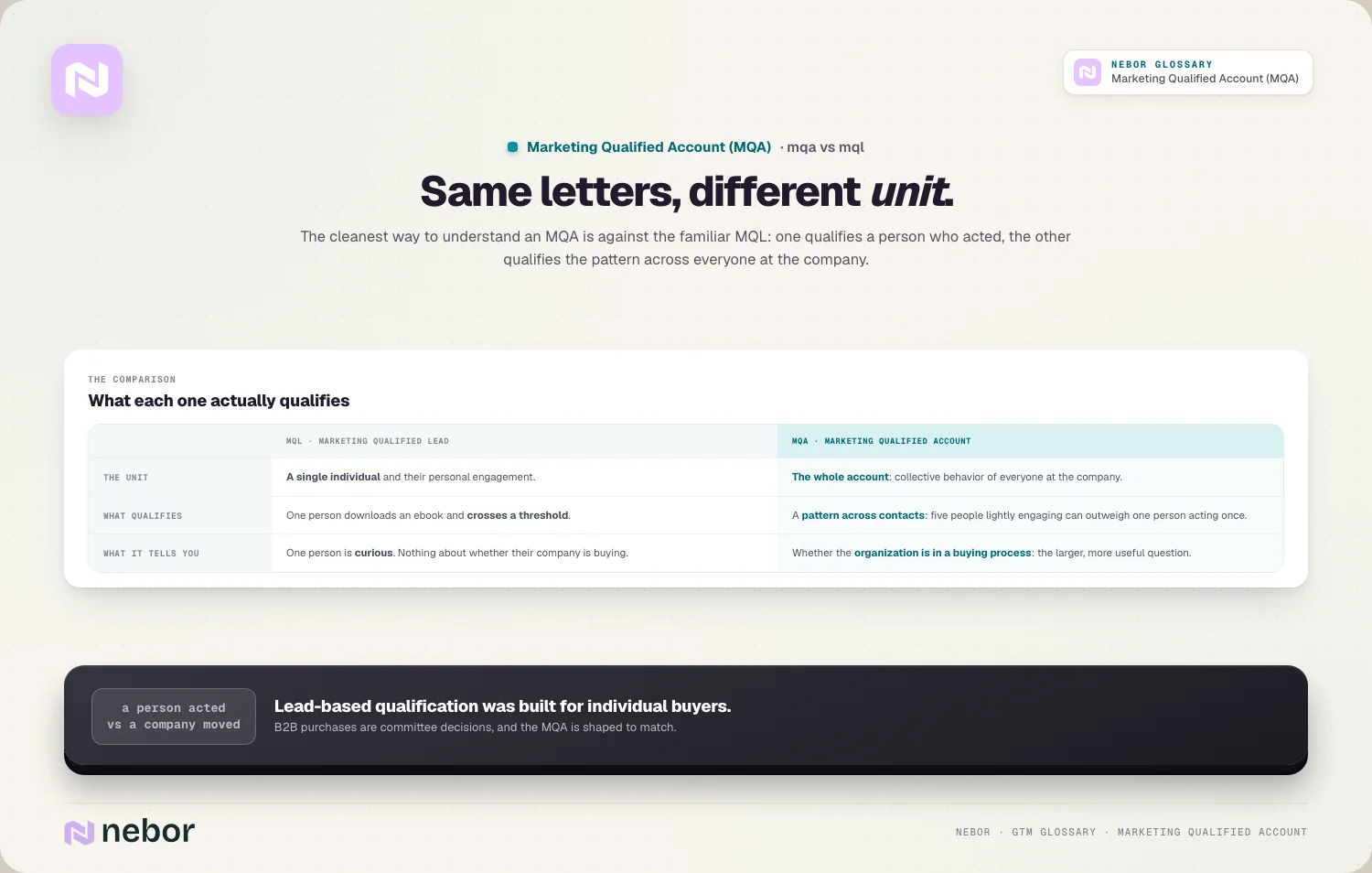
The distinction reflects a real weakness in lead-based qualification for B2B. A single MQL tells you one person is curious, but it says nothing about whether their company is in a buying process at that moment, whereas an MQA is designed to answer that larger and more useful question directly.
Why B2B buying committees make the account the right thing to qualify
The case for MQAs rests on how B2B purchases happen in reality, through a group instead of a person. A buying committee of several stakeholders evaluates, debates, and decides together, so qualifying only one member of that group gives your team a narrow and often misleading view of the deal.
Watching the whole account reveals the committee forming. When people from different functions start engaging, an economic buyer reading pricing while a technical evaluator downloads documentation, that cross-functional pattern is a strong sign a real evaluation is underway, which no single lead could show.

This is why the account view is more predictive of real deals. An account with broad, multi-stakeholder engagement is far more likely to be truly buying than one with a single active contact, so qualifying at the account level catches real opportunities and filters out isolated curiosity that rarely converts.
What signals make an account marketing-qualified when you look closely
A good MQA definition, and this is where we spend most of our tuning time with clients, combines several types of signal instead of leaning on engagement alone.
Firmographic fit asks whether the company matches your target profile on industry, size, revenue, and geography, ensuring you only qualify accounts that could plausibly become good customers in the first place.
Technographic fit adds a second layer about the company's technology. Whether an account uses complementary tools, uses a particular stack, or lacks something your product provides can all indicate fit, so these signals help distinguish accounts that are a natural match from those that merely look right on paper.
Engagement is the third and most dynamic layer, measuring how the account behaves day to day.
Website visits, content downloads, webinar attendance, and third-party intent data across multiple contacts show whether the account is actively researching, and combining these with fit is what turns raw activity into a meaningful MQA.
How account-based engagement scoring aggregates signals across stakeholders
Turning those signals into a decision requires scoring at the account level instead of the person level. An account-based scoring model assigns values to engagement activities across the whole buying committee and sums them, so the score reflects the organization's total interest instead of any one contact's.
The aggregation is what makes the model powerful, because it recognizes patterns individuals hide. Email engagement from several contacts signals broad interest, webinar attendance across job functions suggests a committee forming, and several people moving through content reveals a company deep in evaluation.
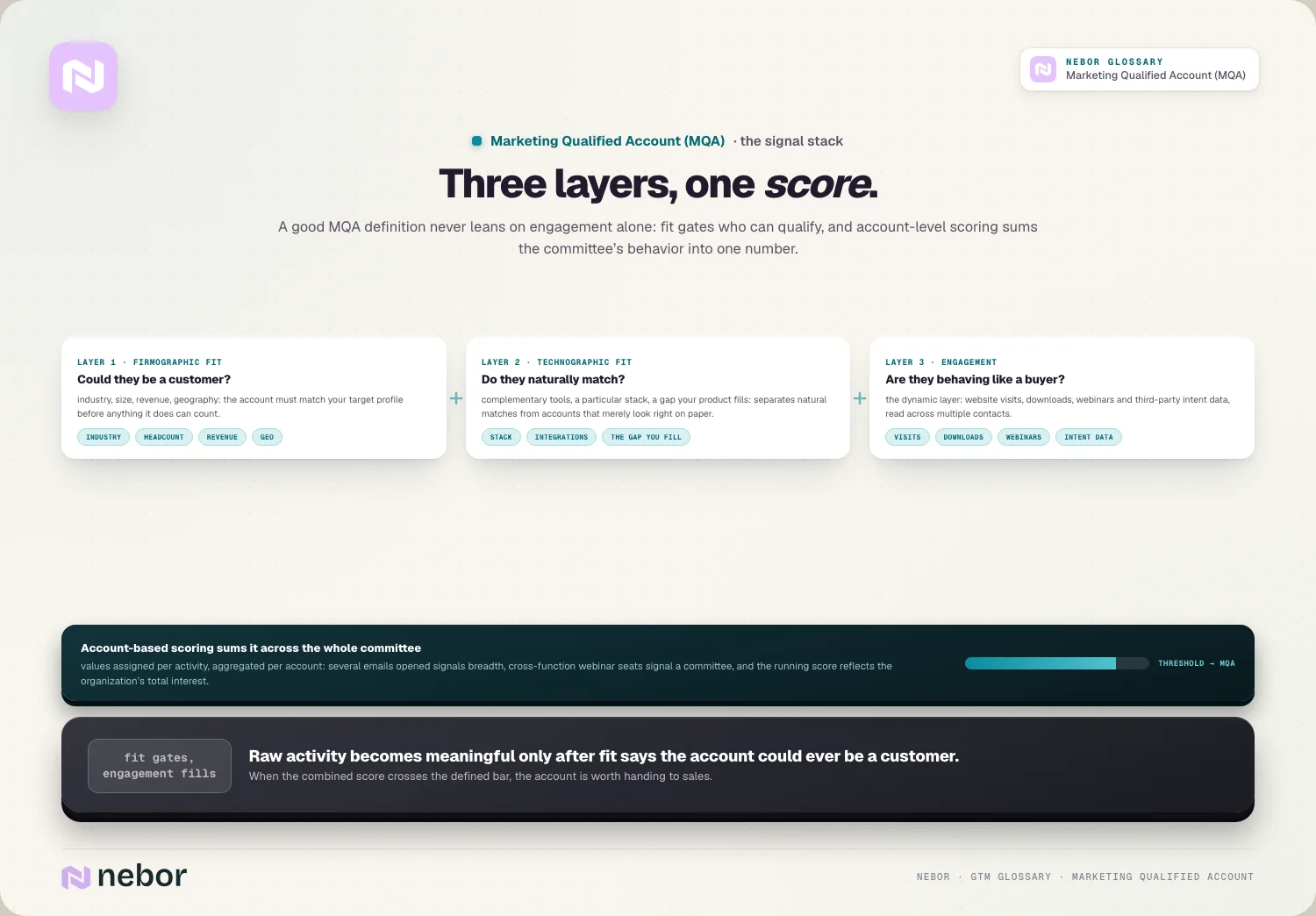
This is essentially account scoring applied to marketing qualification. Rather than a lead score tied to one record, the model builds a live picture of each target account, and when the combined score crosses a defined threshold, the account becomes an MQA worth handing to sales.
Why both fit and intent have to be present before an account is a real MQA
A common failure is qualifying an account on engagement alone while ignoring whether it fits, which produces busy but worthless MQAs. An account that engages heavily but doesn't match your profile is not a real opportunity, so fit has to gate qualification instead of being an afterthought once activity looks high.
The reverse is just as misleading, because a perfect-fit account with no engagement isn't buying anything yet. A company that matches your profile but has shown no interest is a target rather than an MQA, so intent has to be present alongside fit for the account to deserve sales attention right now.
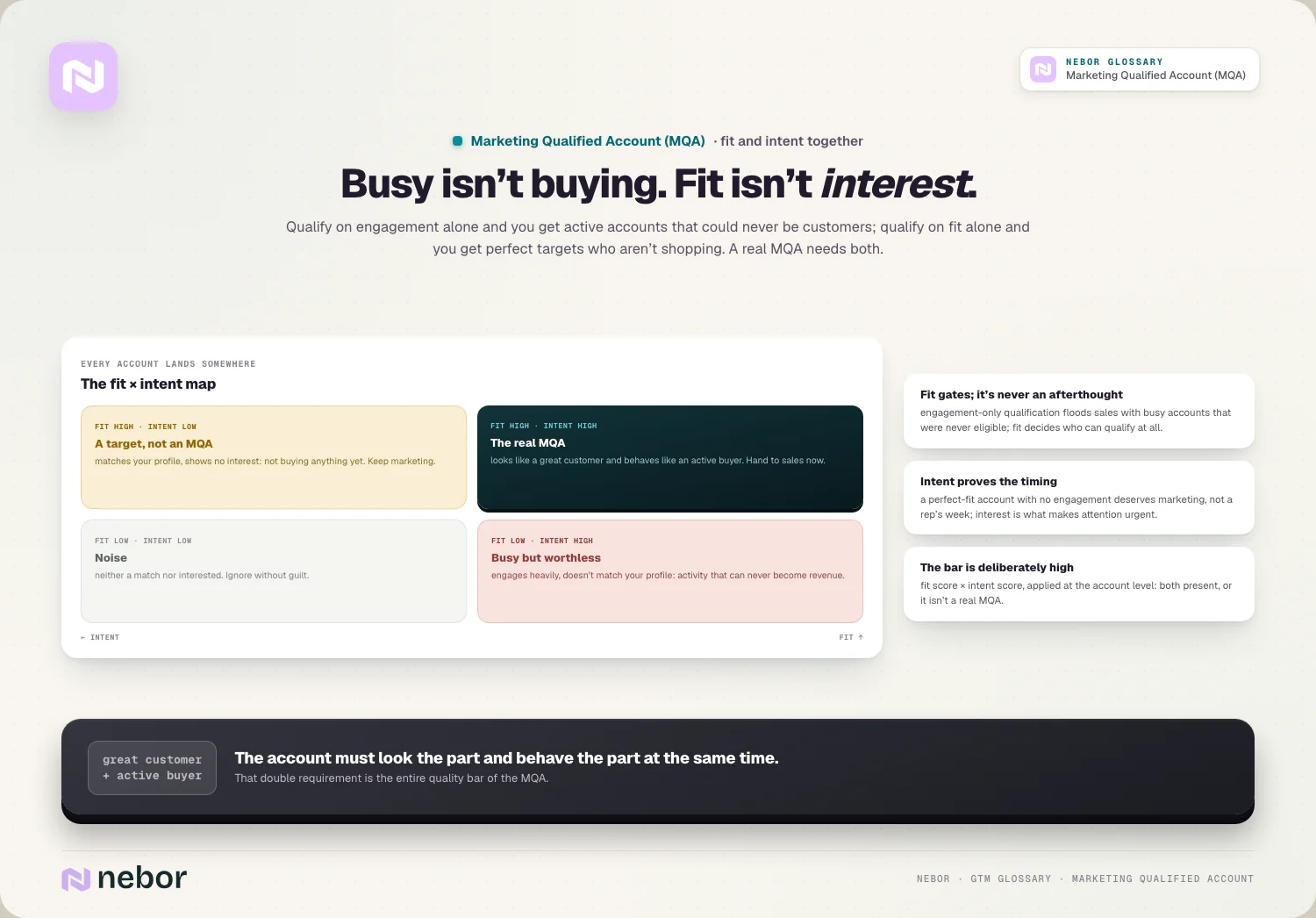
Holding both together is the whole point, and it mirrors the fit score versus intent score distinction applied at the account level. A true MQA is an account that both looks like a great customer and is actively behaving like a buyer, a far higher bar than either signal alone.
Why a marketing qualified account is not a complete answer on its own
For all its strengths, an MQA has a real limitation that mature teams take seriously. Qualifying a company tells you an account is interested, but sales still has to talk to a person, so an MQA with no clear individual to contact leaves reps knowing a company is hot without knowing who to call.
This is the core of the critique that account-level qualification can be too abstract. An account is not a person who answers the phone, so handing sales a warm account without surfacing the specific engaged stakeholders can create work instead of remove it, fueling the argument that the MQA alone is not the answer.
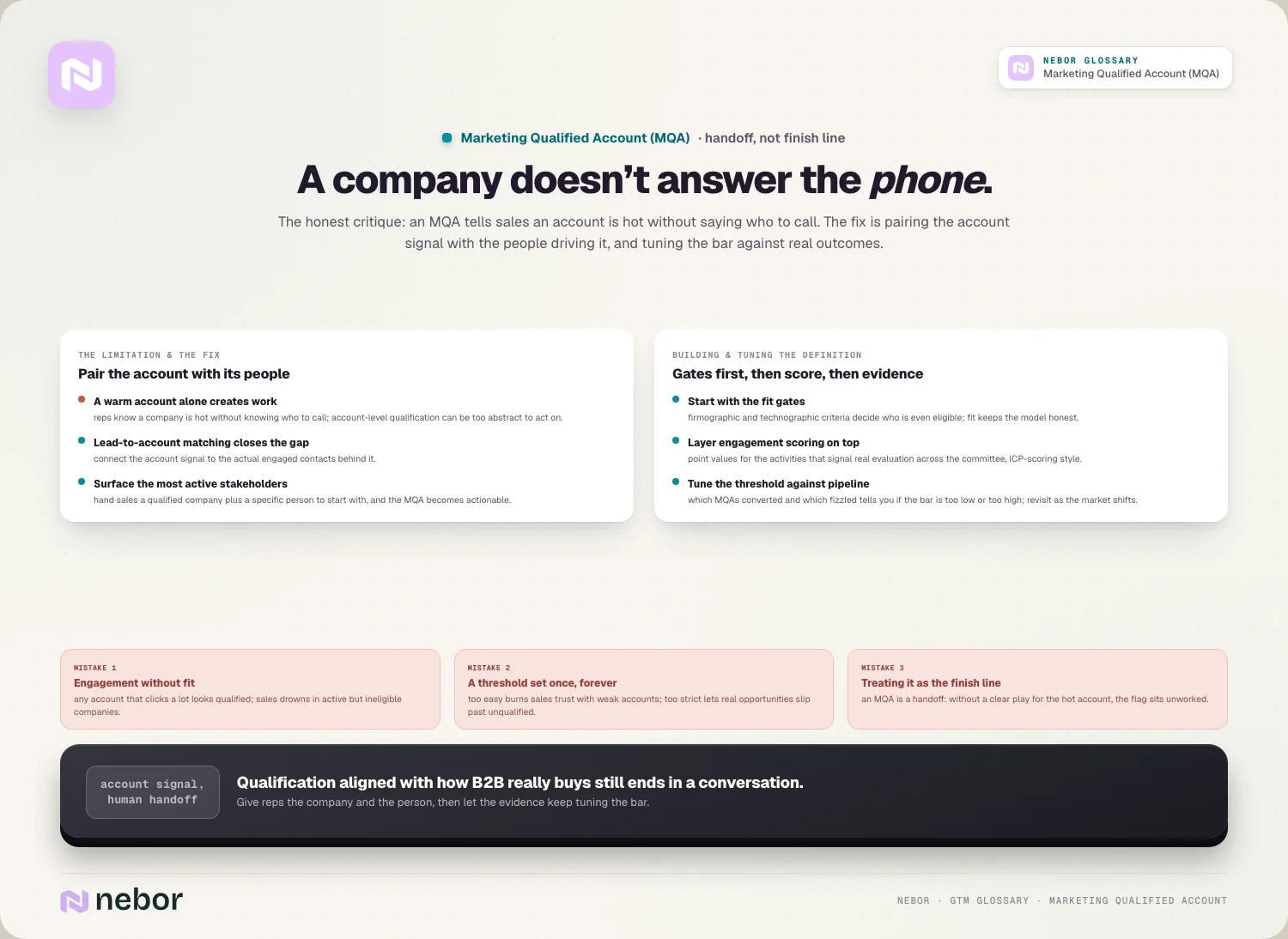
The resolution is to pair the account signal with the people behind it. The strongest motions use the MQA to identify which accounts to pursue and then use lead-to-account matching to connect that account signal to the actual engaged contacts.
In practice, and in the builds we do this is non-negotiable, that means surfacing the most active stakeholders alongside the account score instead of handing over a company name alone.
When sales gets both a qualified company and a specific person to start with, the MQA becomes something your reps can act on the same day.
How to build and tune your MQA definition as the evidence comes in
Building an MQA definition starts with the fit gates instead of the engagement, because fit is what keeps the model honest. Begin with your target profile and decide the firmographic and technographic criteria an account must meet to even be eligible, so only real potential customers can ever qualify.
With the gates set, you layer engagement scoring on top to detect intent. Assign point values to the activities that signal real evaluation across the committee, an approach that borrows directly from a good ICP scoring model, so heavier and broader engagement pushes an account toward the qualifying threshold.
The threshold itself has to be tuned against real outcomes instead of guessed once, and we advise revisiting it quarterly. Looking back at which MQAs became pipeline tells you whether your bar is too low or too high, so the model improves as you feed it evidence about which qualified accounts converted and which fizzled.
None of this is set-and-forget, because your market and product keep changing. New competitors, new buying behaviors, and new intent sources all shift what a qualified account looks like, so revisiting the definition periodically is what keeps the MQA reflecting reality instead of last year's assumptions.
The common mistakes teams make when they define and use MQAs
The most common mistake is defining the MQA on engagement without fit, which floods sales with active but unqualified accounts. Without firmographic and technographic gates, any account that clicks a lot looks qualified, so the definition has to combine fit and intent instead of rewarding raw activity.
Another is setting the threshold poorly, either too low or too high. A threshold that's too easy sends sales weak accounts and burns trust, while one that's too strict lets real opportunities slip past unqualified, so the scoring model needs tuning against actual outcomes instead of being set once and forgotten.
The subtler mistake is treating the MQA as the finish line instead of a handoff. An MQA is only useful if sales acts on it well, so a strong lead qualification process and a clear play for what to do with a hot account are what turn the signal into pipeline, instead of a flag that goes unworked.
Why marketing qualified accounts align qualification with how B2B really buys
The deepest value of the MQA is that it corrects a mismatch that has dogged B2B for years. Lead-based qualification was borrowed from a world of individual buyers, but B2B purchases are collective, so qualifying accounts instead of leads simply fits the reality of how companies decide to buy.
That alignment makes marketing and sales more likely to agree on what a good opportunity is. When both teams look at whole accounts and their combined signals, defined by a shared ideal customer profile, the handoff stops being a fight over one lead and becomes a conversation about a company worth pursuing.
Inside a broader go-to-market system, the MQA is what lets account-based effort scale without losing focus.
When you can reliably tell which target accounts are genuinely heating up, the outreach you automate sales prospecting to send concentrates on the companies inside a live buying cycle instead of spraying effort across everyone.
Share this post
ABM
Marketing
Glossary
Related glossary items
Understanding the core GTM concepts




Ready to build your pipeline











