
In this post:
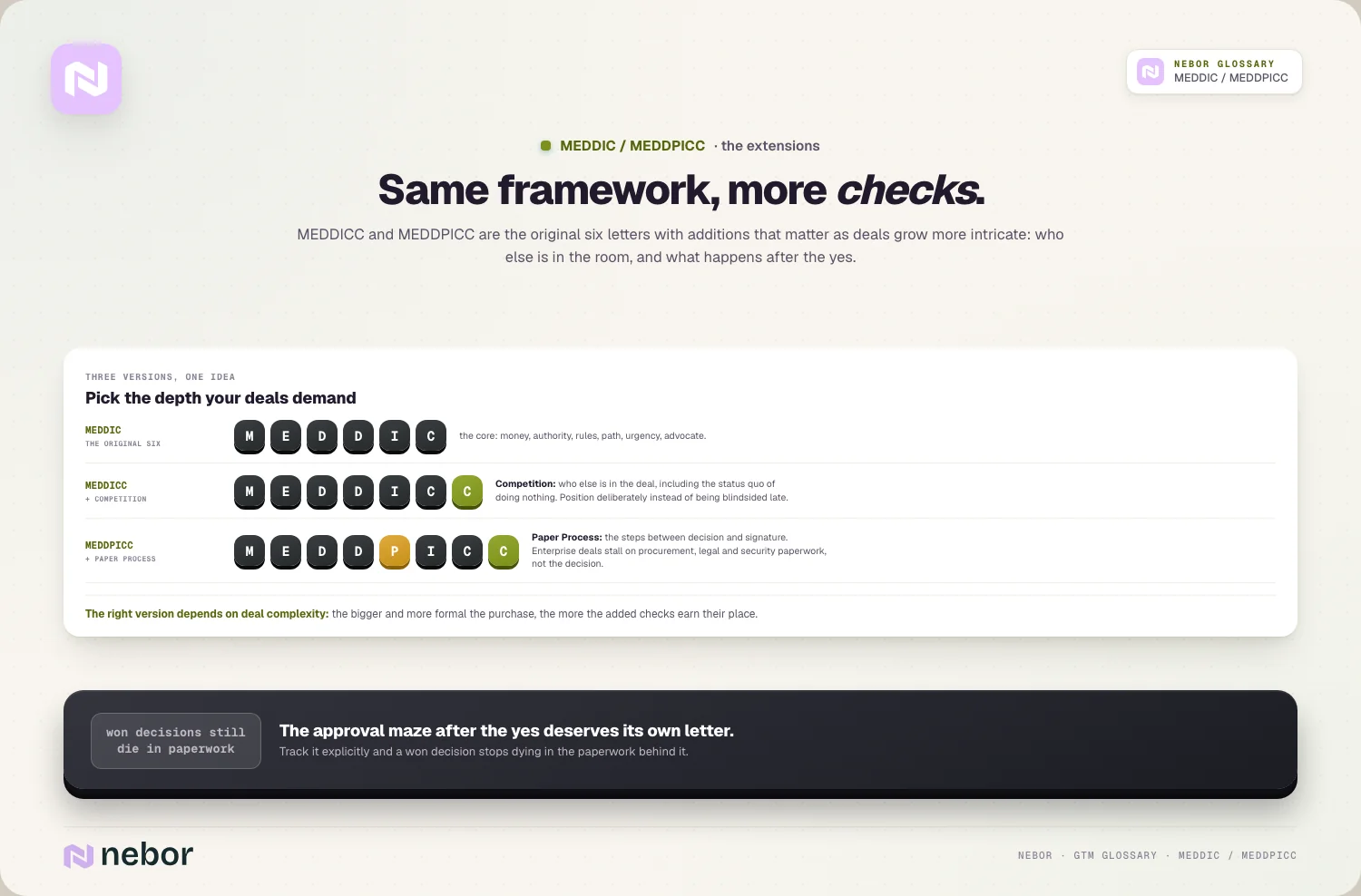
A rep says they feel great about a deal, the demo went well, and the buyer seems excited, then it dies in procurement without warning or loses to a competitor no one knew was there. That happens because feeling good about a deal and understanding it are different things, and complex sales punish the gap.
MEDDIC exists to close that gap with rigor instead of optimism. It's a checklist of the things you must know to judge whether a deal is real, from who signs the check to what pain is driving the purchase, so a rep can say not just that a deal feels good but exactly why it will or won't close.
MEDDIC is a B2B sales qualification framework built from six elements, Metrics, Economic Buyer, Decision Criteria, Decision Process, Identify Pain, and Champion, that a rep must understand to properly qualify a complex deal. MEDDICC and MEDDPICC are extended versions that add Competition and Paper Process.
The reason it has become the standard for complex sales is that big deals fail on the things reps don't know rather than the things they do. By forcing a rep to answer hard questions about each element, MEDDIC surfaces the gaps that would otherwise sink a deal late, when it's too costly to fix.
TL;DR
MEDDIC is a qualification framework of six elements, Metrics, Economic Buyer, Decision Criteria, Decision Process, Identify Pain, and Champion, that a rep must understand to judge whether a complex deal is real.
MEDDICC adds a seventh element, Competition, and MEDDPICC adds an eighth, the Paper Process, so the three are versions of the same framework with more checks for more complex deals.
It's a qualification tool instead of a sales script, because its job is to reveal what you don't know about a deal so you can either fill the gaps or disqualify early.
Its biggest payoffs are cleaner forecasts and less wasted effort, because a deal that scores poorly on the framework is exposed as weak before a rep pours months into it.
What MEDDIC stands for and what each of its six letters demands you know
MEDDIC breaks a complex deal into six things a rep has to understand, and the letters spell out each one. Metrics are the quantifiable business benefits your solution delivers, the numbers that justify the purchase, while the Economic Buyer is the single person with the real authority to say yes.
The middle letters cover how the decision gets made. Decision Criteria are the formal requirements each stakeholder will judge the solution against, and the Decision Process is how the customer evaluates, selects, and buys in practice, so together they map the rules and the path a deal must travel.
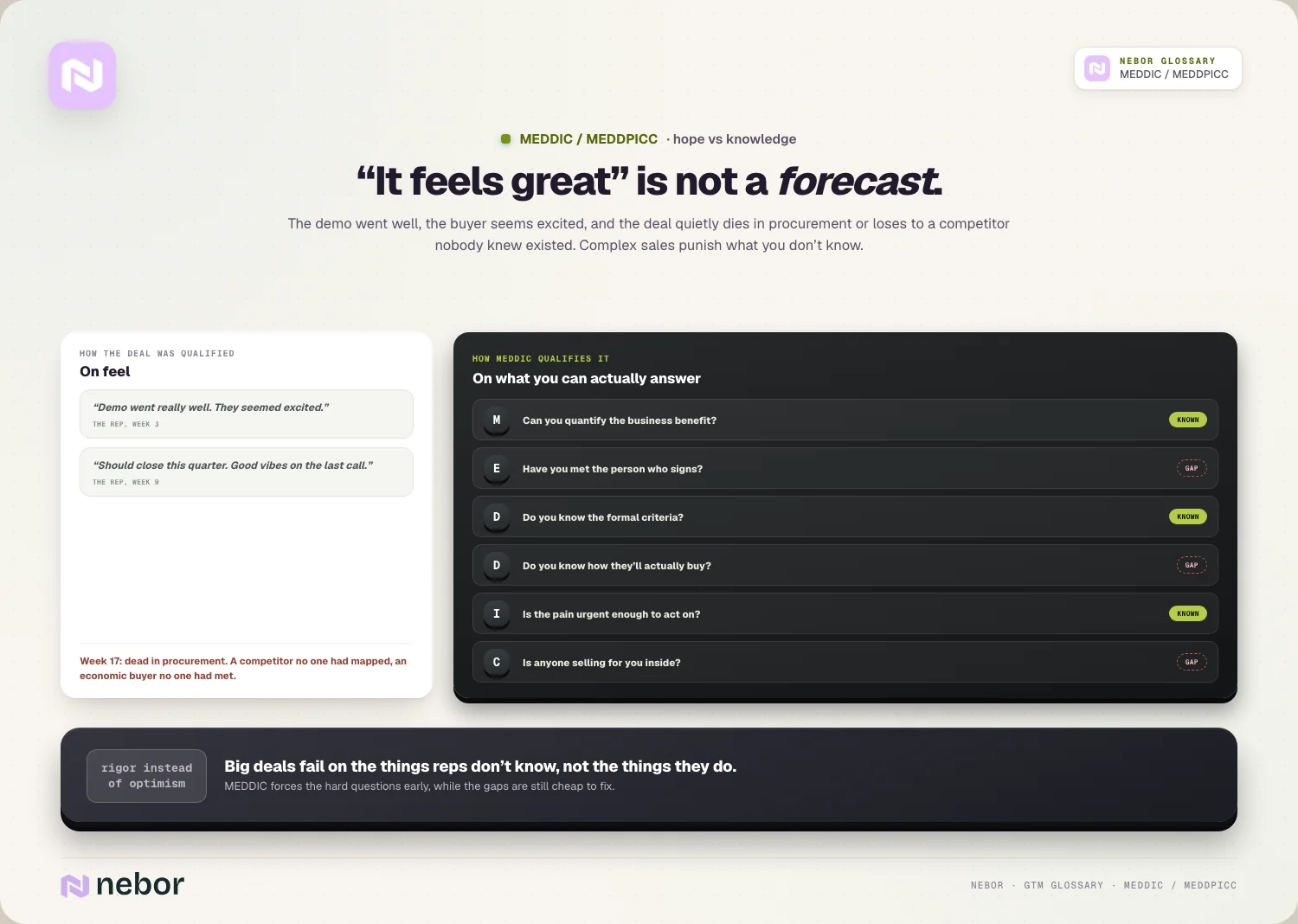
The last two letters are about urgency and advocacy. Identify Pain is the problem serious enough to make the buyer act within a timeframe, because without real pain a deal drifts forever, and the Champion is a person inside the account with influence who is personally invested in your solution winning.
How MEDDICC and MEDDPICC extend the original framework letter by letter
The three names, MEDDIC, MEDDICC, and MEDDPICC, are versions of the same framework that differ only in how many checks they include. MEDDIC is the original six, and each extension adds elements that matter more as deals grow more complex, so the right version depends on how intricate your sales really are.
MEDDICC adds a second C for Competition, forcing the rep to understand who else is in the deal. Knowing your competitors, including the status quo of doing nothing, lets you position against them deliberately instead of being blindsided late, the reason competition gets its own dedicated check in bigger deals.
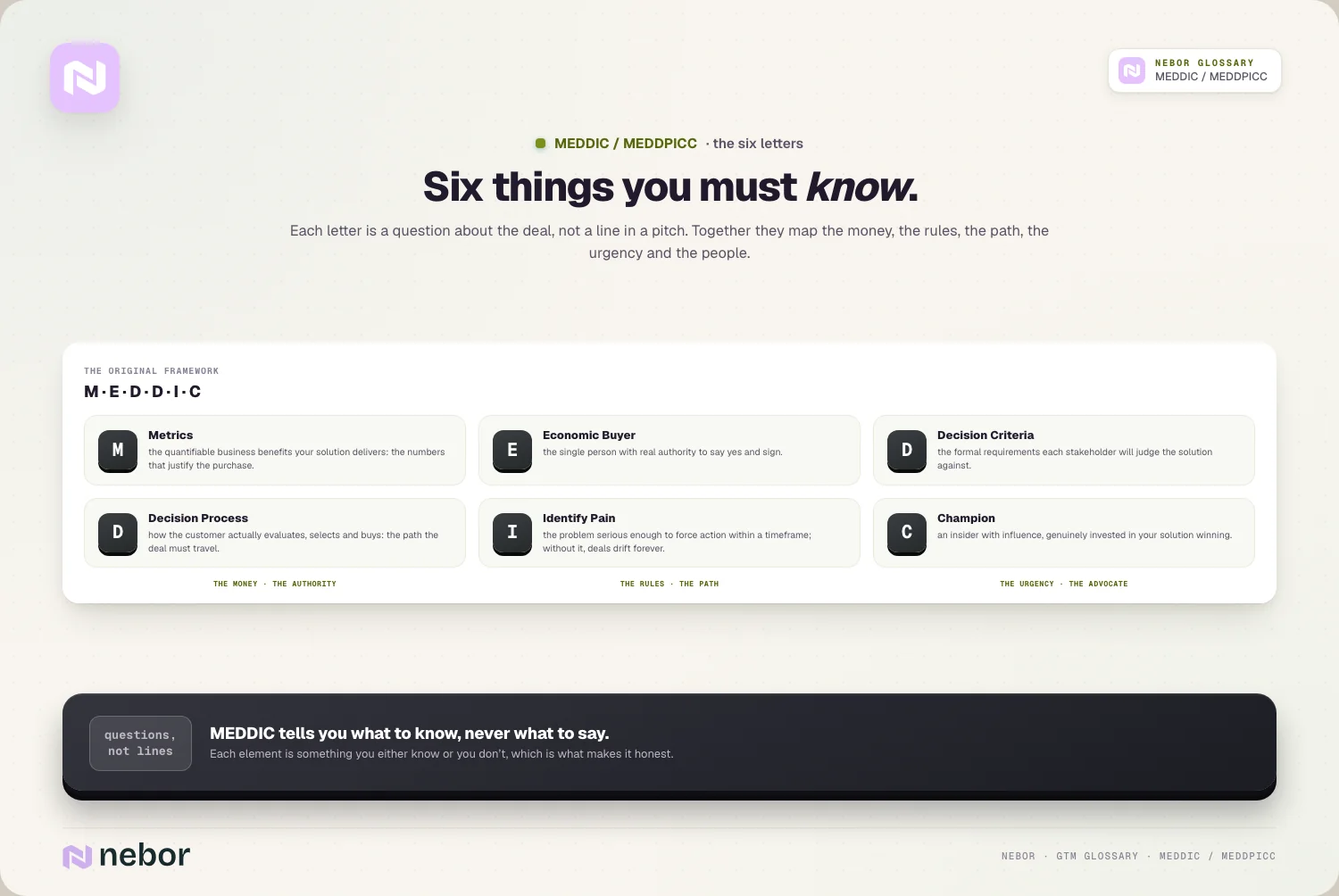
MEDDPICC adds a P for the Paper Process, the steps between a decision and a signature. Enterprise deals often stall not on the decision but on the procurement, legal, and security paperwork that follows, so tracking it explicitly keeps a won decision from dying in the approval maze, often with help from a deal desk.
Why MEDDIC is a qualification framework instead of a sales script
A key thing to understand is that MEDDIC tells you what to know instead of what to say. It isn't a script for handling a call or a sequence of tactics, it's a set of questions you must be able to answer about a deal, which makes it a diagnostic tool instead of a selling technique.
This framing is what makes it so useful for judging deal health honestly. Because each element is something you either know or you don't, MEDDIC exposes the gaps in your understanding, so a rep who can't name the economic buyer or the metrics has just learned their deal is weaker than it felt.
That honesty is the whole value, because the framework's job is to reveal risk early.
A deal that scores poorly is flashing a warning, which lets a rep either fill the gaps or disqualify and move on, instead of discovering the weakness after months of effort, much like disciplined lead qualification earlier in the funnel.
Why the Economic Buyer and Champion are the make-or-break elements
Of the six elements, two consistently decide whether a complex deal lives or dies, and the first is the Economic Buyer.
Deals routinely stall because a rep has been selling to people who like the product but can't authorize the purchase, so reaching the true economic buyer is often the single most important move in the deal.
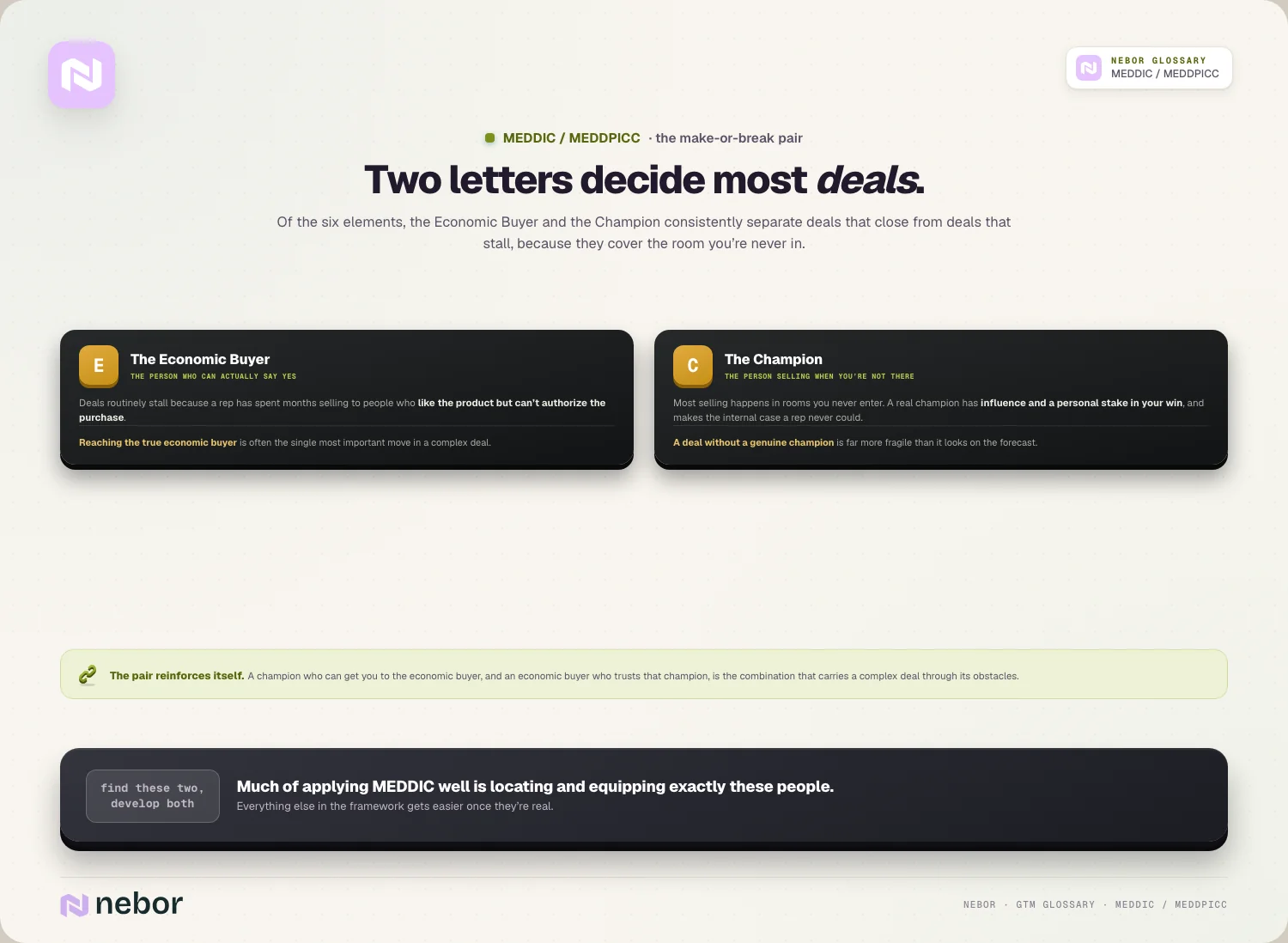
The Champion is the other decisive element, because most selling happens when you're not in the room. A real champion has influence and a personal stake in your winning, and they make the internal case to colleagues that a rep never could, leaving a deal without a real champion more fragile than it looks.
The two work together in a way that makes each stronger. A champion who can get you to the economic buyer, and an economic buyer who trusts that champion, is the combination that carries a complex deal through the obstacles, so much of applying MEDDIC well is finding and developing these two people specifically.
How MEDDIC improves your forecasting and cuts the effort deals waste
One of the biggest organizational payoffs of MEDDIC, and the one clients ask us about first, is far more accurate forecasting.
When every deal is scored against the same elements, a manager can see which deals are qualified on the evidence and which just feel good, so the forecast reflects reality instead of rep optimism and improves overall forecast accuracy.
It also concentrates effort where it stands a chance of paying off. Because the framework exposes weak deals early, your reps stop pouring months into opportunities that were never real, which frees them to invest in the deals that score well, lifting both productivity and the win rate on the deals they do pursue.
The shared language is a quieter but real benefit across the team. When everyone qualifies deals the same way, reviews get sharper and coaching gets easier, because a manager and rep can talk about a specific missing element instead of a vague feeling, which is the consistency a strong sales playbook is meant to create.
How teams put MEDDIC to work in the day-to-day work of their deals
In practice, MEDDIC usually shows up as a scorecard applied to every significant deal. Reps rate how well they understand each element, and the resulting picture reveals a deal's strengths and gaps at a glance, so the framework becomes a working tool instead of an abstract concept.
Deal reviews are where the framework earns its keep. Instead of a manager asking how a deal feels, they walk through the elements and probe the weak ones, which turns a vague check-in into a rigorous examination that surfaces exactly what still needs to happen for the deal to close.
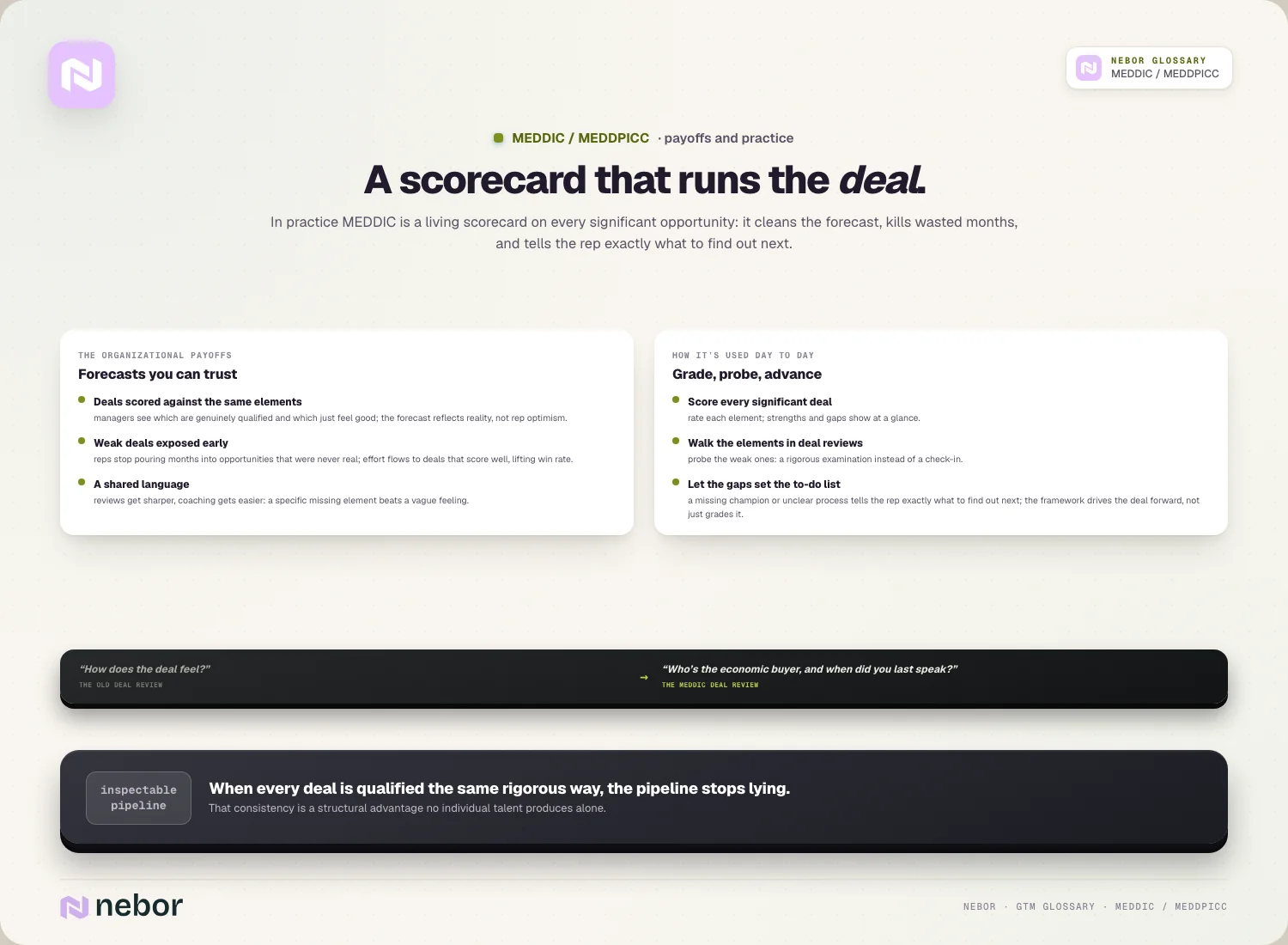
The framework also guides the selling work between reviews. When the scorecard shows a missing champion or an unclear decision process, it tells the rep exactly what to find out next, so MEDDIC drives the day-to-day work of advancing a deal instead of just grading it, which supports steady pipeline acceleration.
Why MEDDIC works best on complex, high-value deals specifically
MEDDIC was built for enterprise selling, and it fits that world because complex deals have all the elements it checks. A large deal has multiple stakeholders, a formal buying process, a real economic buyer, and competition, so there's something real to qualify against each letter of the framework.
On simple, low-value deals the framework can be overkill. A small self-serve purchase doesn't have a multi-stakeholder decision process or a paper process worth mapping, so applying the full rigor of MEDDPICC to a tiny deal wastes effort that the deal size can't justify.
This is why the framework pairs so naturally with a sales-led growth motion. The high-value, multi-stakeholder deals that require a human sales team are exactly the deals where MEDDIC's rigor pays off, so the framework and the motion tend to show up together in the same kinds of businesses.
How MEDDIC compares to other qualification frameworks like BANT and SPICED
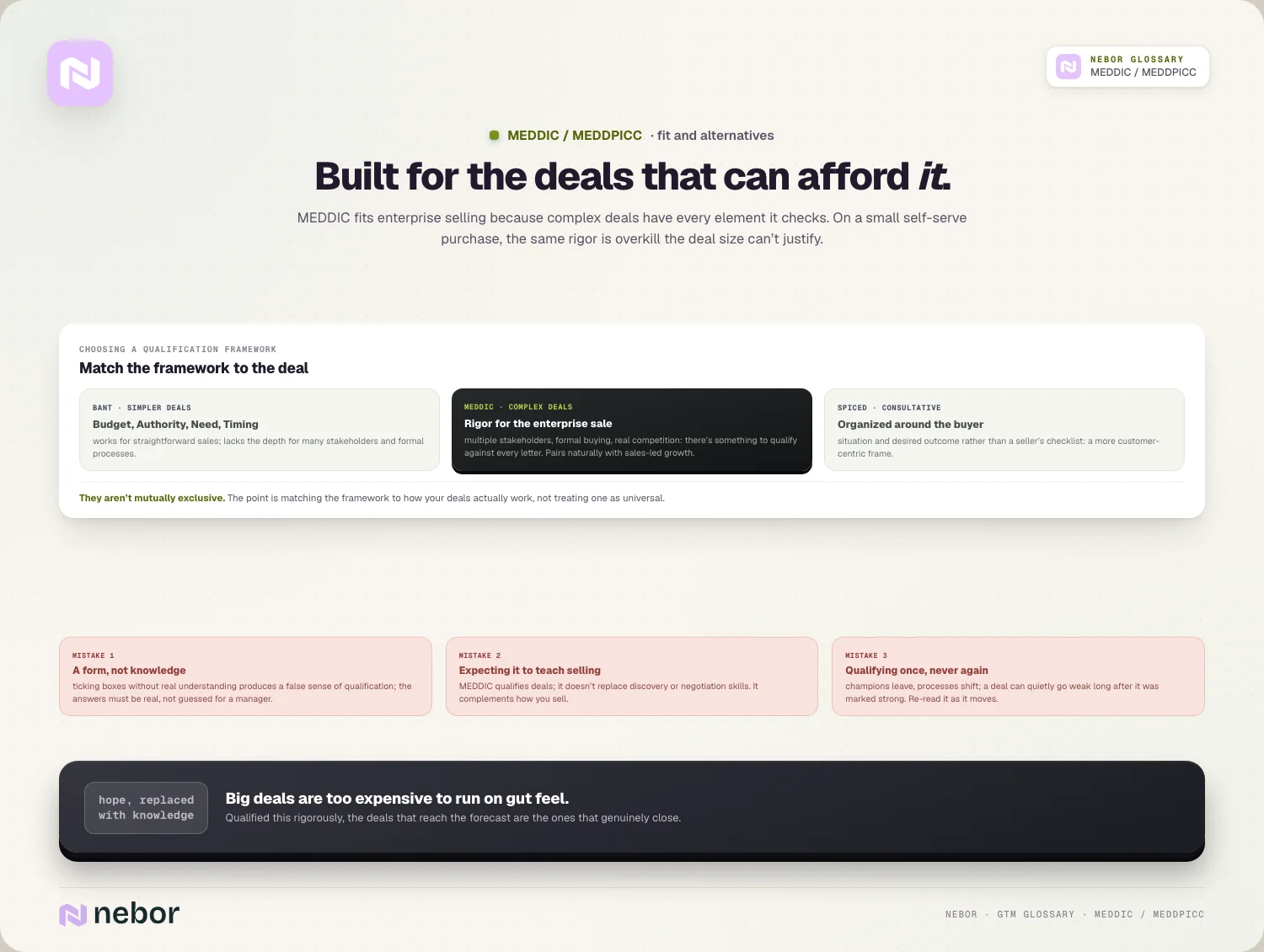
MEDDIC is one of several qualification frameworks, and it helps to see where it fits among them. The older and simpler BANT checks Budget, Authority, Need, and Timing, which works for straightforward deals but lacks the depth to qualify a complex enterprise sale with many stakeholders and a formal process.
A newer alternative is the SPICED framework, which is more customer-centric and organizes qualification around the buyer's situation and desired outcome instead of a checklist of what the seller needs to know. It reflects a shift toward framing qualification around the customer instead of the deal.
These frameworks aren't mutually exclusive, and the right choice depends on your deals. MEDDIC's rigor fits complex sales, BANT suits simpler ones, and SPICED appeals to teams wanting a more consultative frame, so the point is matching the framework to how your deals work instead of treating one as universal.
The common mistakes teams make when they adopt MEDDIC as their standard
The most common mistake, and we keep seeing it in teams that adopted the framework by memo, is treating MEDDIC as a form to fill out instead of knowledge to gather.
Reps who mechanically tick boxes without understanding each element get a false sense of qualification, so the framework only works when the answers are real instead of guessed to satisfy a manager.
Another is confusing MEDDIC with a sales methodology that tells reps how to sell. The framework qualifies deals, it doesn't teach discovery or negotiation, so a team that adopts MEDDIC expecting it to replace selling skills will be disappointed, because it complements how you sell instead of replacing it.
The subtler mistake, in our experience, is qualifying once and never revisiting. A deal's MEDDIC picture changes as it progresses, because a champion can leave or a decision process can shift, so treating qualification as a one-time gate instead of an ongoing read means a deal can go weak long after it was marked strong.
Why MEDDIC is really about replacing hope with knowledge in your pipeline
The deepest value of MEDDIC is that it replaces wishful thinking with disciplined knowledge, exactly what complex sales require. Big deals are too expensive to work on gut feel, so a framework that forces a rep to understand the buyer, the pain, and the process turns hope into something you can inspect and manage.
That discipline compounds across a whole sales organization instead of helping one rep. When every deal is qualified the same rigorous way, the pipeline becomes trustworthy, forecasts hold, and effort flows to the deals that deserve it, a structural advantage no amount of individual talent produces alone.
A modern go-to-market system uses a framework like MEDDIC to keep its most valuable deals honest as they move toward a close. When the complex opportunities you automate sales prospecting to surface are qualified this rigorously, the deals that reach your forecast are the ones that close, and the pipeline stops lying.
Share this post
RevOps
Guide
Conversations
Glossary
Related glossary items
Understanding the core GTM concepts




Ready to build your pipeline











