

In this post:
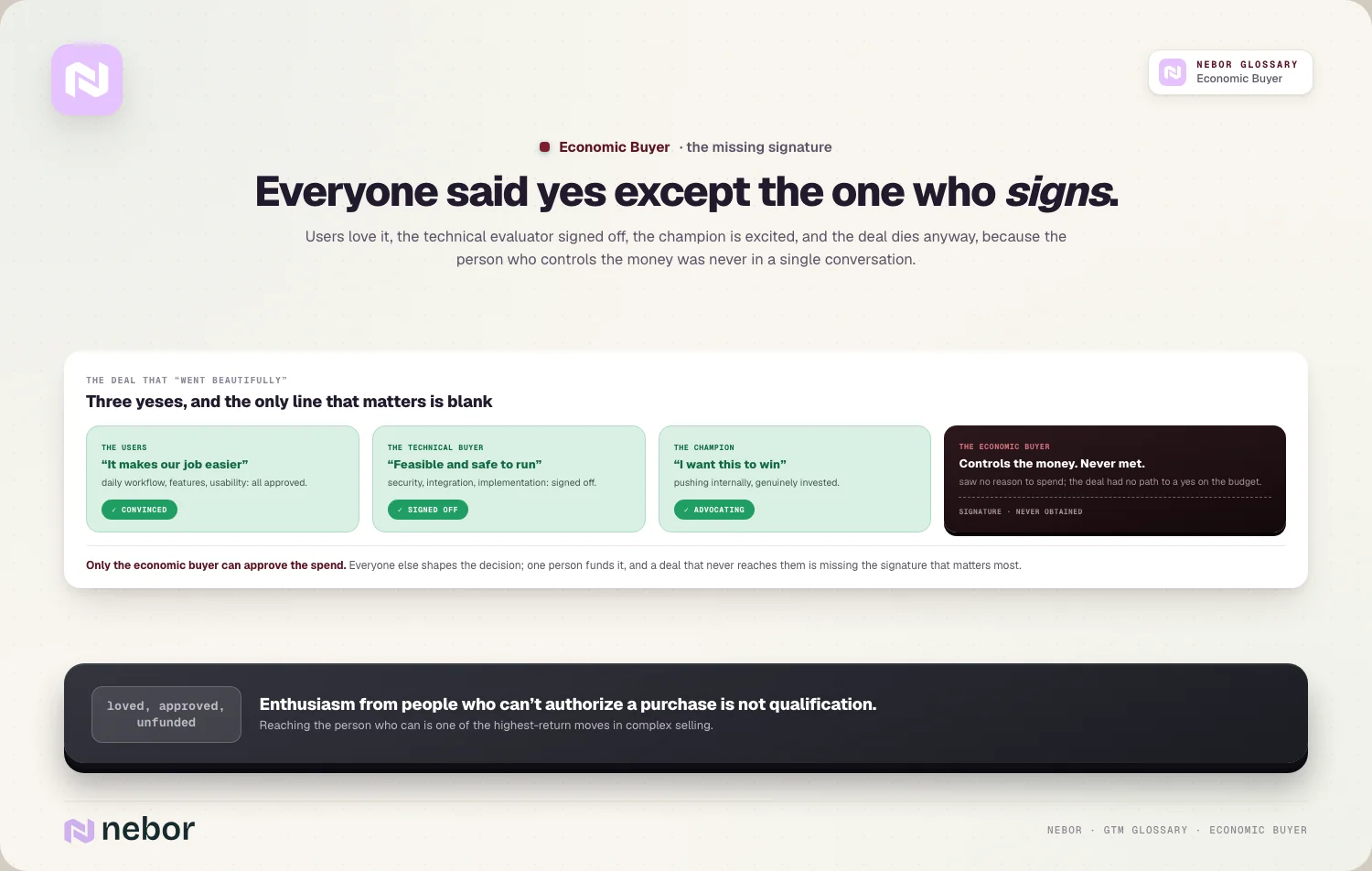
Your deal is going beautifully, or so it seems. The users love the product, the technical evaluator has signed off, and your champion is excited, so you feel confident heading into the quarter. Then it dies, because the one person who controls the money was never in a single conversation and saw no reason to spend it.
That person is the economic buyer, and reaching them is often the difference between a deal that closes and one that stalls forever. Everyone else in the account can love your product, but only the economic buyer can approve the spend, so a deal that never reaches them is missing the one signature that matters most.
The economic buyer is the person who controls the final budget decision and holds the authority to approve or reject a purchase based on its financial and strategic value. They have veto power over any deal, access to discretionary funds, and a big-picture focus on business impact instead of features.
The reason they deserve their own term is that identifying and reaching them is one of the highest-return moves in complex selling. Deals routinely stall because your reps spend all their time with enthusiastic users who simply can't authorize a purchase, so finding the person who can is what gets a deal done in the end.
TL;DR
The economic buyer is the person with final authority over the budget and the power to approve or veto a purchase based on its financial and strategic value.
They're defined by three traits: veto power over the deal, access to discretionary funds beyond fixed budgets, and a strategic view focused on business impact and return instead of features.
Deals frequently die because reps never reach the economic buyer, spending all their energy with users and evaluators who love the product but can't authorize the spend.
Reaching them usually happens through a champion and multi-threading, and selling to them means speaking their language of return, risk, and strategic value instead of features.
What an economic buyer is precisely and the three traits that define them
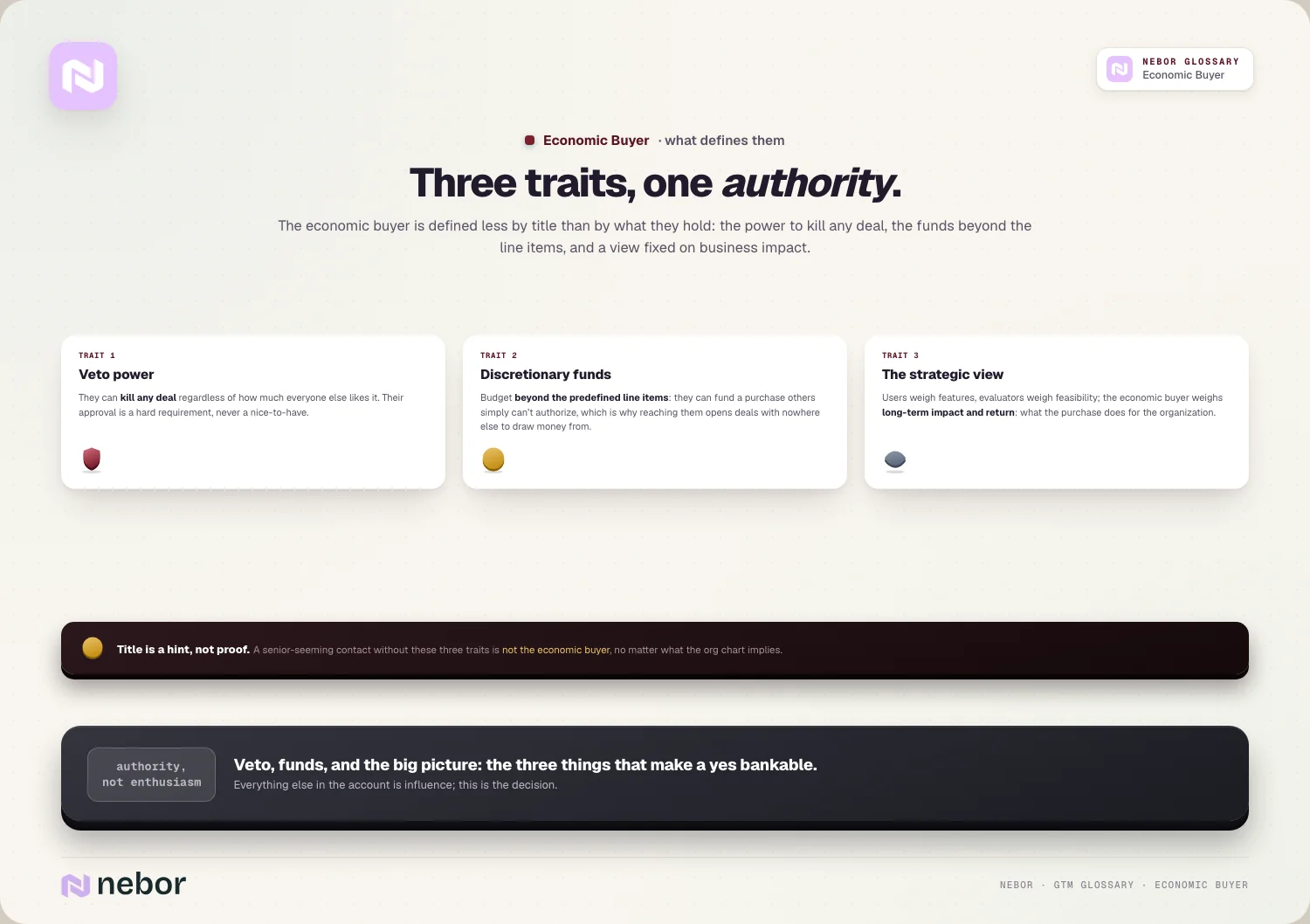
The economic buyer is defined less by title than by the authority they hold, and three traits capture it. The first is veto power, because the economic buyer can kill any deal regardless of how much everyone else likes it, which makes their approval a hard requirement instead of a nice-to-have.
The second trait is control over discretionary funds. The economic buyer has access to budget beyond the predefined line items, so they can fund a purchase that others simply can't authorize, and that access is exactly why reaching them opens deals that would otherwise have nowhere to draw money from.
The third trait is a strategic, big-picture perspective. While users care about features and evaluators care about feasibility, the economic buyer thinks about long-term business impact and return, so they judge a purchase by what it does for the organization instead of by how it works day to day.
How the economic buyer differs from the user, technical buyer, and champion
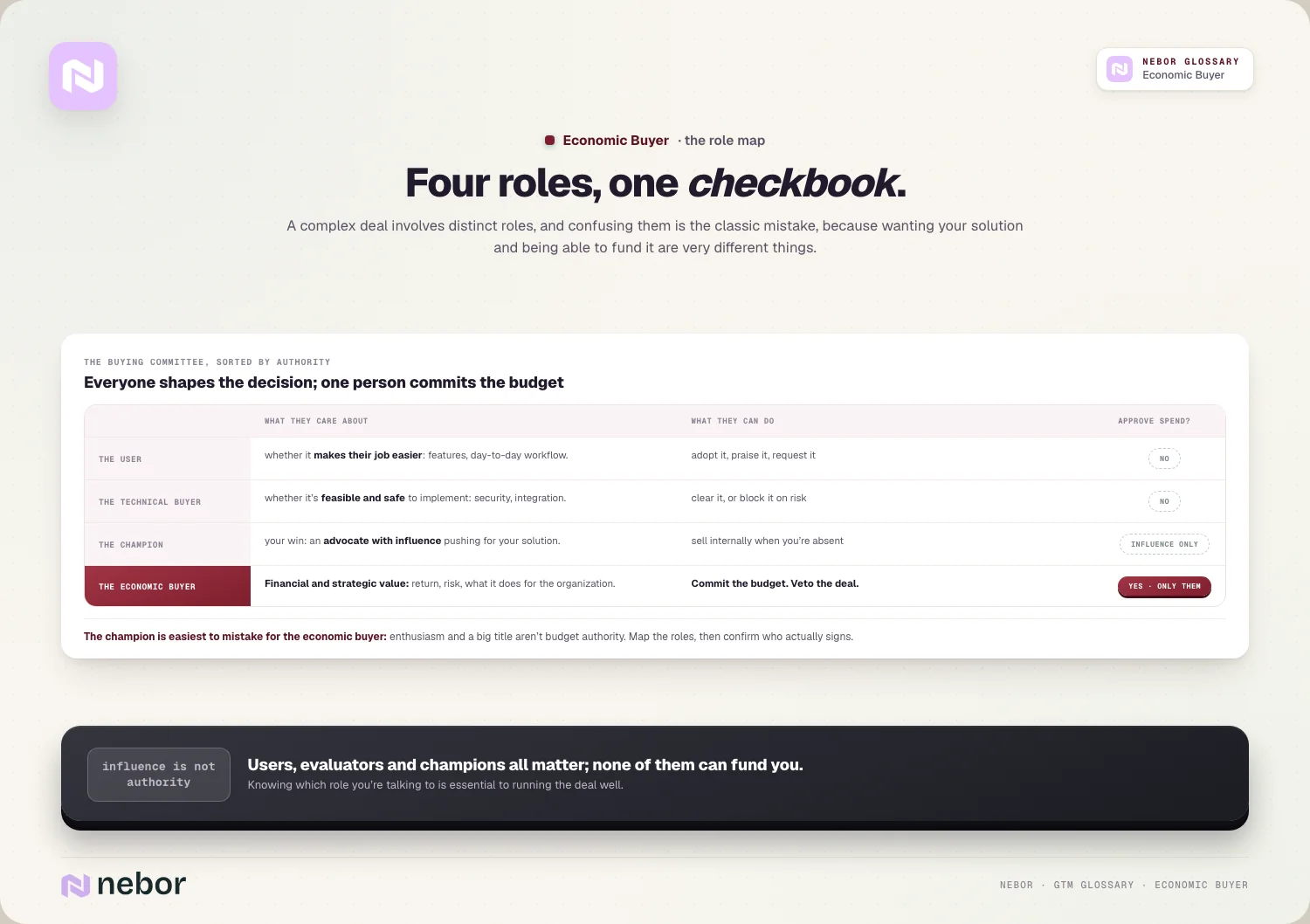
A complex deal involves several distinct roles, and confusing them is a classic mistake. The user is the person who will work in your product daily and cares whether it makes their job easier, while the technical buyer, often in IT, evaluates whether the solution is feasible and safe to implement.
The champion is different again, and easy to mistake for the economic buyer. A champion is your internal advocate who wants you to win and pushes for your solution, but wanting something and being able to fund it are different things, so a champion often has influence without the actual authority to approve the spend.
The economic buyer stands above all of them on the question of money. Users, technical buyers, and champions all shape the decision, but only the economic buyer can commit the budget, so mapping these roles across the buying committee and knowing which is which is essential to working a deal well.
Why so many deals die when reps never reach the economic buyer
The single most common reason a well-managed deal stalls is that the rep never got to the economic buyer. It's comfortable to spend time with enthusiastic users and a friendly champion, but if the person controlling the budget stays out of the conversation, the deal has no path to a yes on the spend.
This happens because the people reps naturally talk to are rarely the ones who authorize purchases. Users and evaluators are accessible and engaged, so a rep can feel great while the actual decision-maker has never heard the value proposition, and that gap is how a deal that seems healthy suddenly dies at approval.
Reaching the economic buyer early is therefore central to frameworks like MEDDIC, which makes the economic buyer one of its core checks. A deal where you can't name or reach that person is flashing a warning, and closing that gap is often what separates a real opportunity from a comfortable illusion.
What the economic buyer weighs most heavily when they judge a deal
Selling to the economic buyer requires understanding what they weigh, and in our experience it differs sharply from what everyone else in the account values.
Their primary concerns are cost, the bottom line, and return on investment, so a pitch built around features that impress a user will fall flat with someone thinking about financial impact.
The economic buyer judges a purchase by its strategic value to the organization. They want to know how the investment moves the business forward, what risk it carries, and what happens if they don't act, which means the case you make to them has to be framed in outcomes and money instead of functionality.
This is why the quantified impact from a framework like SPICED matters so much when you reach them. An economic buyer evaluating a spend wants the numbers, the return, and the risk laid out clearly, so arriving with a concrete business case instead of a demo is what earns their approval.
How to identify who the real economic buyer is inside a target account
Identifying the economic buyer takes deliberate work, because they're often not the person a rep is already talking to. Organizational research through company websites and professional networks reveals the likely holders of budget authority, giving you a starting hypothesis about who ultimately controls the money.
Direct qualification questions are the most reliable way to confirm it. Asking a contact who controls the budget for this kind of purchase, or who has to sign off on the spend, surfaces the economic buyer far faster than guessing, and a good champion will readily tell you if you ask.
Studying the approval and signing process is the third path. Understanding how purchases of your size get approved in that company, and who holds the authority at that dollar threshold, tells you who the economic buyer must be, which matters even more on large deals where a deal desk and formal approvals are involved.
How to reach the economic buyer through your champion and multi-threading
Once you know who the economic buyer is, reaching them well usually goes through your champion instead of a cold approach. A champion who trusts you can make the introduction and vouch for your value, which gets you a far warmer and more productive first conversation than trying to reach a busy executive on your own.
Multi-threading protects the deal and creates multiple paths to that person.
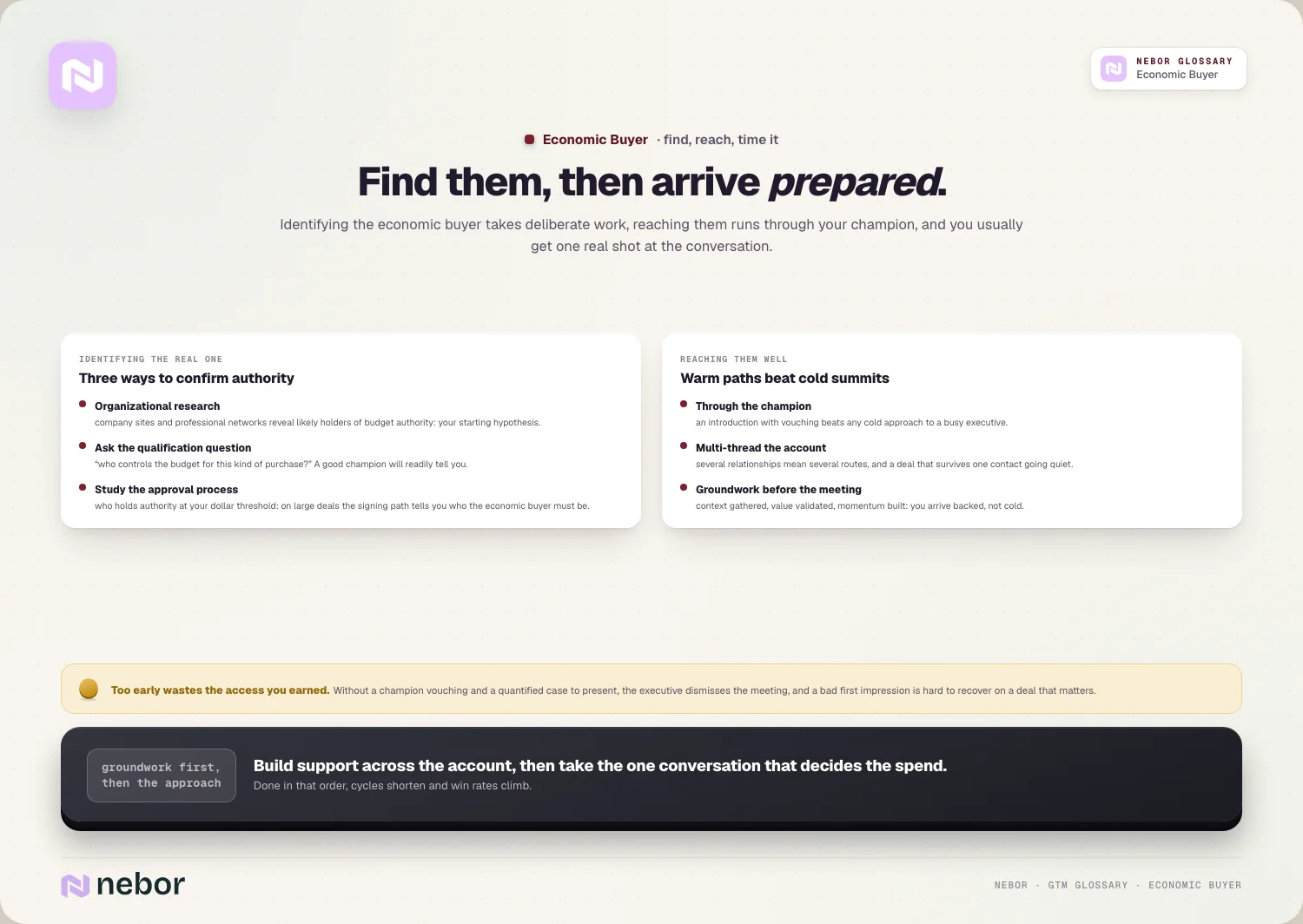
Engaging several stakeholders instead of a single contact means your pipeline doesn't hinge on one relationship, and it gives you more routes to the economic buyer if a contact goes quiet, a core piece of a resilient multi-channel outreach motion.
Doing the groundwork first is what makes the eventual conversation land. Using your other relationships to gather context, validate value, and build momentum before you reach the economic buyer means you arrive with backing instead of cold, which raises the odds the meeting advances the deal instead of stalling it.
How to sell to an economic buyer once you finally reach them
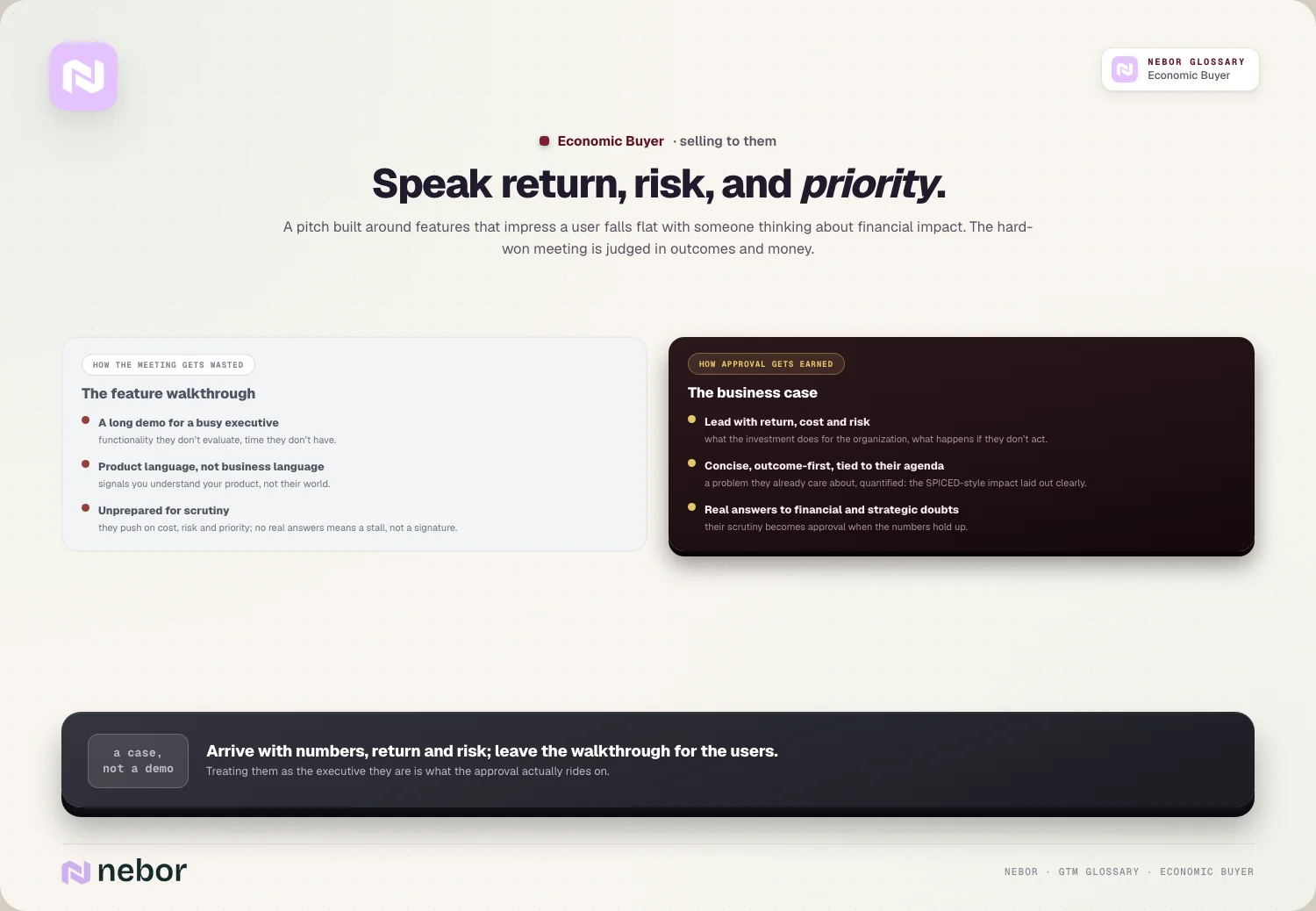
Getting the meeting is only half the battle, and the conversation itself has to speak their language. An economic buyer has little patience for a feature walkthrough, so you lead with the business case, the return, and the risk, treating them as the executive they are instead of a product evaluator.
Respecting their time and framing is essential, because these are busy people focused on outcomes. A concise, outcome-focused conversation that ties your solution to a problem they already care about is far more effective than a long demo, and it signals that you understand their world instead of just your product.
Handling their concerns directly is the final piece.
An economic buyer will push on cost, risk, and priority, so being ready with real answers, the kind of objection handling that addresses financial and strategic doubts, is what turns their scrutiny into approval instead of a stall, which keeps the whole deal on track for pipeline acceleration.
Why timing your approach to the economic buyer matters as much as reaching them
Reaching the economic buyer isn't only about getting to them, it's about getting to them prepared, because you usually get one real shot. An executive who controls budget will quickly dismiss a rep who shows up cold with an unproven pitch, so arriving too early can waste the very access you worked to earn.
The failure mode is going straight to the top before you've built any internal support or business case. Without a champion vouching for you and a quantified impact to present, the economic buyer has no reason to take the meeting seriously, and a bad first impression can be hard to recover from on a deal that matters.
The right sequence is groundwork first, then a well-timed approach backed by momentum. Building support across the account and arriving with a strong case tends to shorten the overall sales cycle length and lift the win rate, because the one conversation that decides the spend goes well when it finally happens.
The common mistakes teams make when they deal with the economic buyer
The most common mistake, and the one we see most when deals stall, is avoiding the economic buyer out of fear or comfort.
Your reps stay with the friendly champion and users because those conversations feel good, but never engaging the person who controls the money leaves the deal fundamentally unqualified, no matter how positive everything else seems.
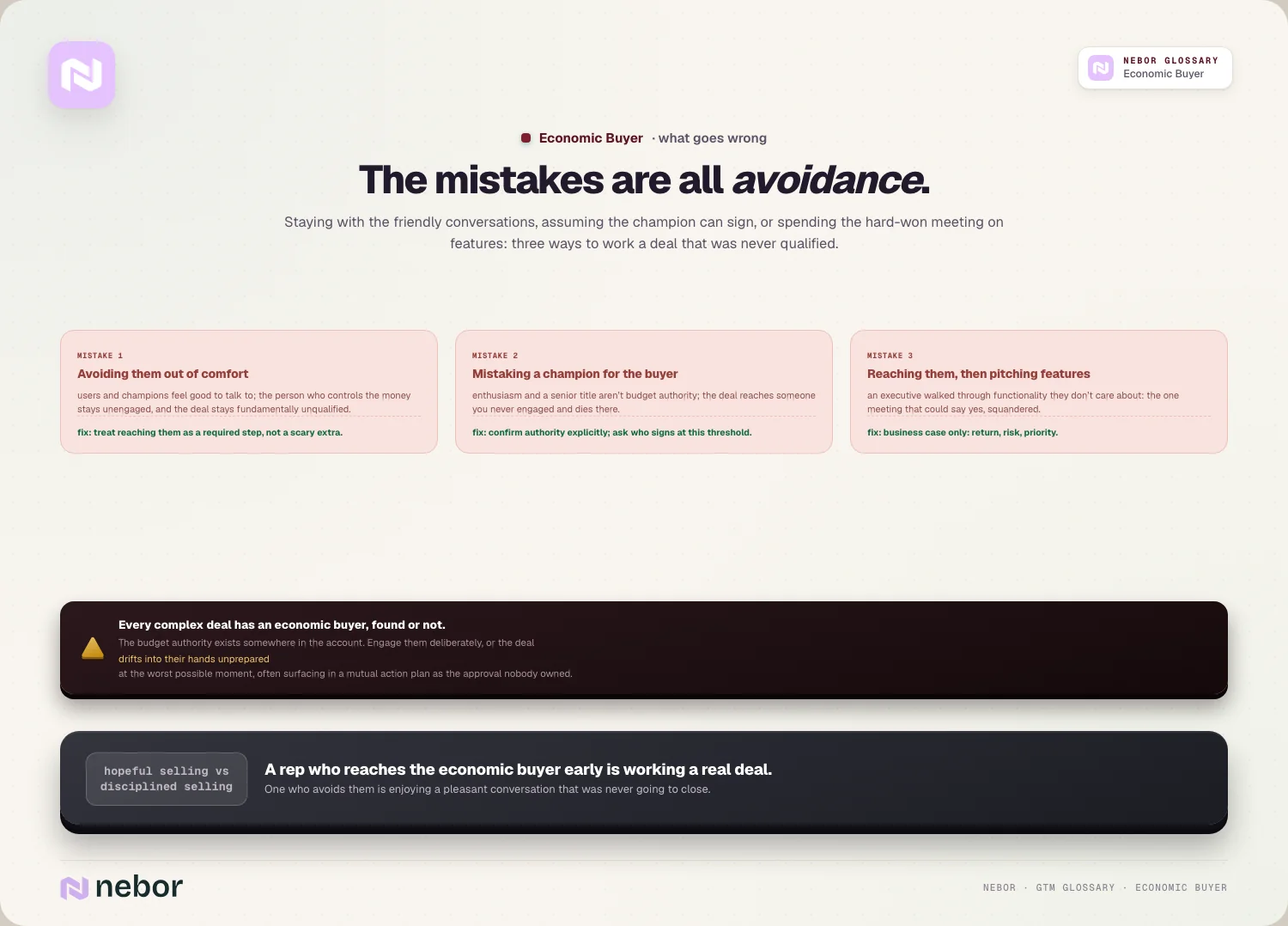
Another is mistaking a champion or a senior-seeming contact for the economic buyer. Enthusiasm and a big title aren't the same as budget authority, so a rep who assumes their champion can approve the spend can be blindsided when the deal reaches someone they never engaged, making it essential to confirm authority early.
The subtler mistake, one we tell clients to rehearse against, is reaching the economic buyer but selling to them the wrong way.
Walking an executive through features they don't care about wastes the hard-won meeting, so failing to shift from a product pitch to a business case is how reps squander access to the one person who could have said yes.
Why the economic buyer is the person your whole deal ultimately depends on
The deepest truth about the economic buyer is that every complex deal has one, whether or not the rep has found them. The budget authority exists somewhere in the account, so the only question is whether you engage that person deliberately or let the deal drift into their hands unprepared at the worst possible moment.
Treating the economic buyer as central instead of an afterthought is what separates disciplined selling from hopeful selling. A rep who identifies, reaches, and sells to that person early is working a real deal, while one who avoids them is often just enjoying a pleasant conversation that was never going to close.
A modern go-to-market system builds the discipline of reaching the economic buyer into how its best deals are worked, often formalized through a mutual action plan that names who must approve what.
When the opportunities you automate sales prospecting to create are worked to the person who controls the money, the deals that reach your forecast are the ones that can be signed.
Share this post
Guide
RevOps
Conversations
Glossary
Related glossary items
Understanding the core GTM concepts



Ready to build your pipeline











