

In this post:
You have forty deals in your pipeline and a solid win rate, yet revenue keeps arriving later than planned because half of them go untouched for weeks between stages. The problem isn't a shortage of opportunities, it's that the deals you have crawl through the funnel, and every day of delay pushes the number out.
Pipeline acceleration is the discipline of fixing exactly that. Rather than pouring more leads into the top, it works on the active deals already in flight, removing the friction that slows them down so they reach a decision faster and less revenue gets stuck in limbo.
Pipeline acceleration is the practice of moving existing opportunities through the sales pipeline faster by reducing friction at each stage. It combines people, process, and technology to compress the sales cycle and speed up revenue, focusing on the deals you already have instead of on generating new ones.
Time is the enemy of every deal, and that hostility is what makes acceleration so valuable. The longer an opportunity stays open, the more likely it is to stall, lose its champion, or fall to a competitor, so compressing the cycle both pulls revenue forward and raises the odds that a deal closes in the first place.
TL;DR
Pipeline acceleration compresses the time it takes existing deals to move through your pipeline by removing friction at each stage, so you close faster instead of just adding more leads.
It's the opposite of a top-of-funnel play, because it works on the active opportunities you already have instead of trying to generate new ones, making it a mid and bottom-funnel discipline.
The biggest accelerants are human: multi-threading across several stakeholders, activating an internal champion, and agreeing a mutual action plan that gives the deal shared momentum and deadlines.
It's about removing friction and building consensus faster instead of pressuring buyers, so the goal is helping ready deals progress instead of forcing unready ones to move before their time.
What pipeline acceleration means and why it has nothing to do with more leads
The defining feature of pipeline acceleration is where it focuses, which is inside the pipeline instead of at the top of it. Instead of asking how to get more opportunities, it asks how to move the opportunities you already have through their stages faster and with fewer drop-offs along the way.
This is a different discipline from lead generation altogether, and confusing the two is common. Adding leads grows the volume entering your funnel, while acceleration shortens the time each deal spends inside it, so a team can be great at one and terrible at the other, and they solve completely different problems.
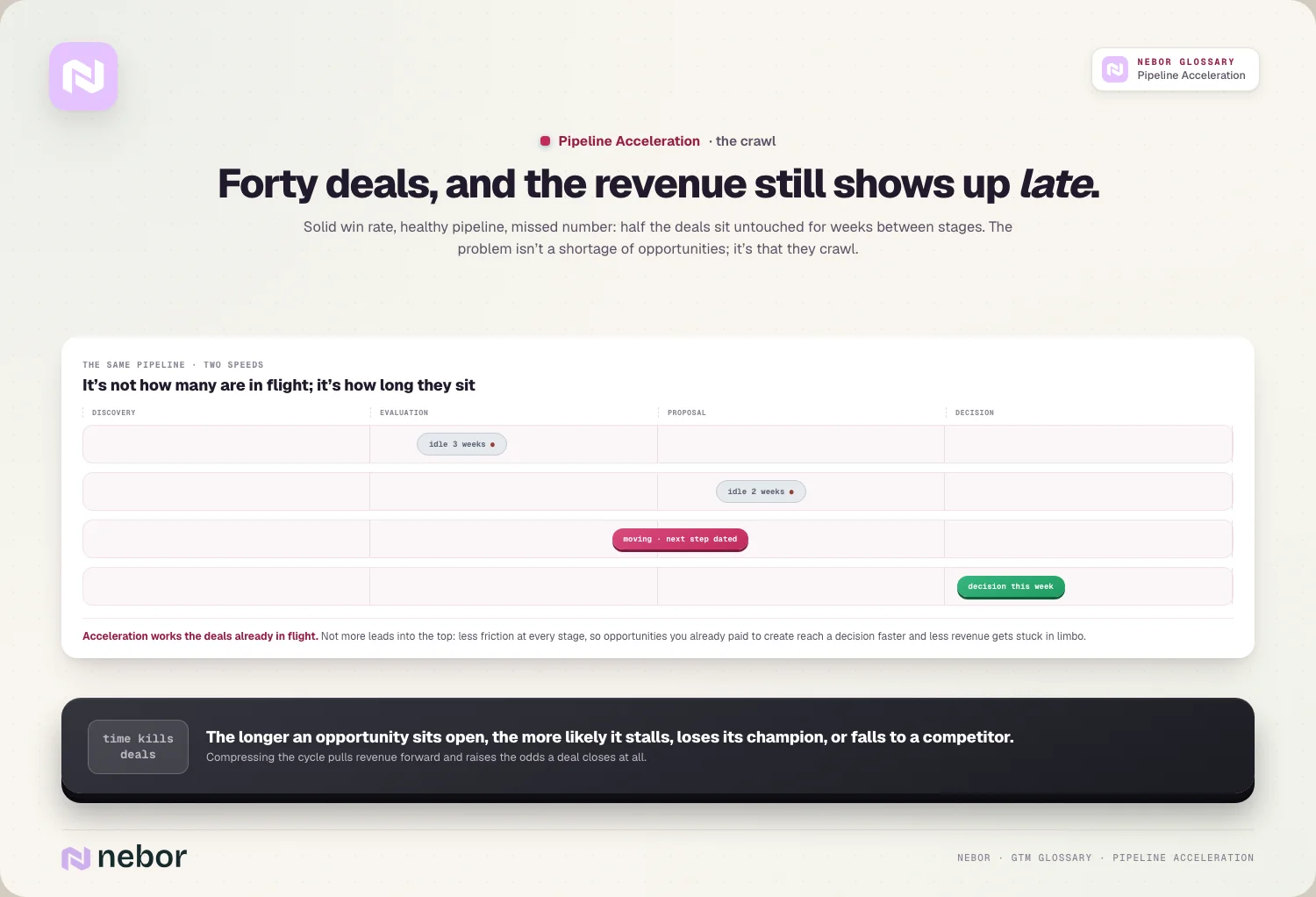
The value of this focus is that it improves revenue without increasing acquisition cost. Because you're working deals you already paid to create, closing them faster pulls revenue forward and frees up rep time for new deals, which makes acceleration one of the most efficient levers a sales team has.
How pipeline acceleration differs from pipeline velocity as a metric
Pipeline acceleration and pipeline velocity are closely related but not the same, because one is the practice and the other is the measure. Pipeline velocity is a metric that quantifies how fast revenue moves through your pipeline, while acceleration is the set of actions you take to improve that metric.
The velocity formula makes the relationship concrete. Pipeline velocity multiplies your number of opportunities, average deal size, and win rate, then divides by the average sales cycle length, so acceleration mainly works on that last term by shrinking the cycle, though better multi-threading can lift win rate too.

Seeing it this way keeps your efforts honest. If you're accelerating the pipeline, your velocity should measurably rise, so tracking the metric tells you whether your friction-removal is working or whether deals are moving no faster than before despite the effort.
Why removing friction beats trying to push prospects to buy faster
A key distinction in pipeline acceleration is that it works by removing obstacles rather than by pressuring buyers.
Pushing a prospect to decide before they're ready backfires, so acceleration instead clears the friction slowing a buyer who already wants to move, letting the deal move at the speed the momentum already supports.
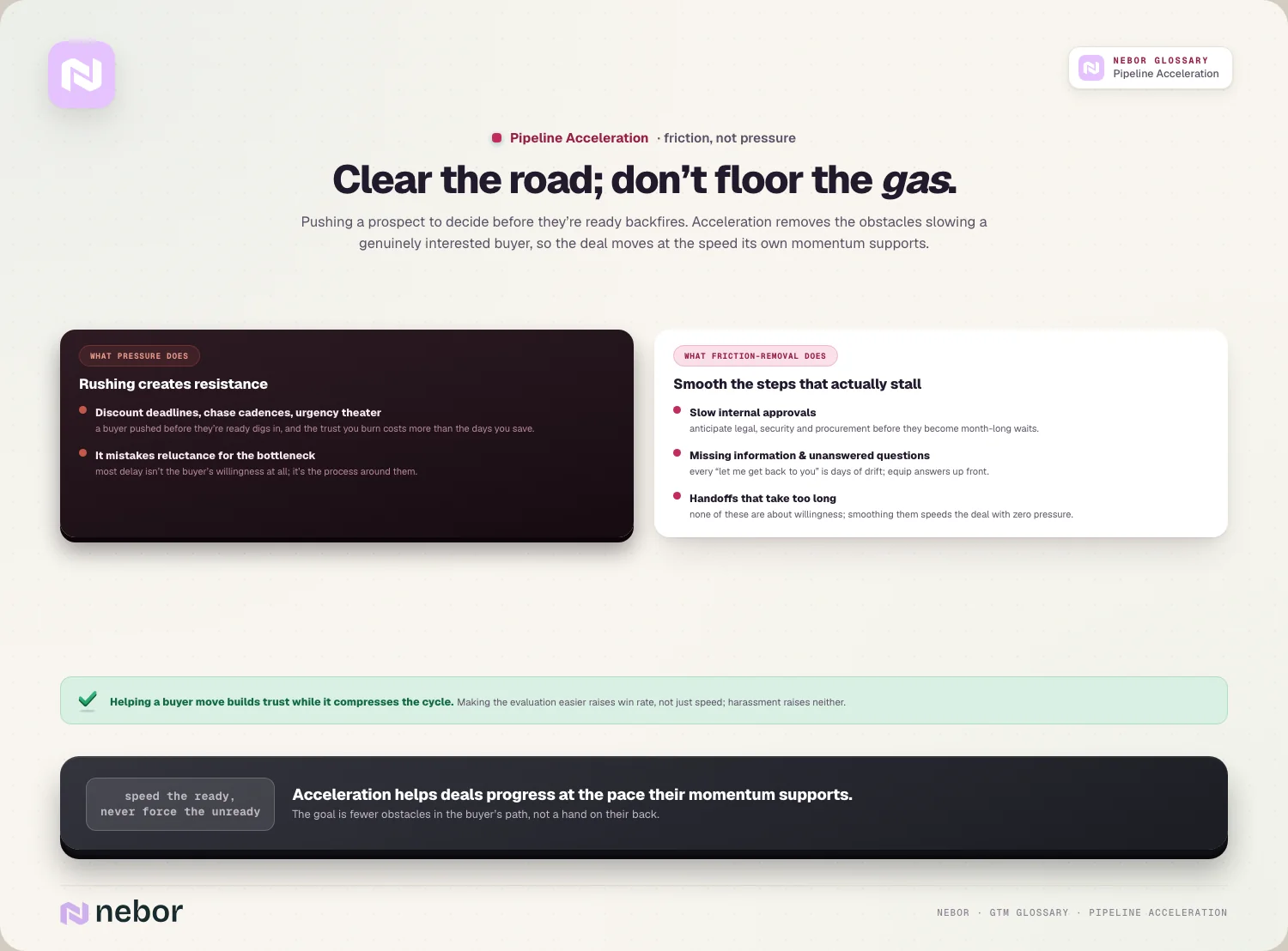
Most of that friction is process instead of reluctance, and in our experience the split surprises people.
Deals stall on slow internal approvals, missing information, unanswered questions, and handoffs that take too long, none of which are about the buyer's willingness, so smoothing those steps speeds the deal without applying any pressure.
This reframing is important because it protects the relationship while it speeds the deal. When you help a buyer move by making their evaluation easier instead of harassing them to sign, you accelerate the deal and build trust at the same time, and that combination raises your win rate instead of just your speed.
Why multi-threading across stakeholders accelerates deals so much
One of the most reliable accelerants is engaging several people at the account instead of relying on a single contact. Deals that rest on one lone champion close at lower rates and move more slowly, so multi-threading, building relationships with several stakeholders, speeds and de-risks the deal at once.
The reason is that B2B decisions go through a group, so a single-threaded deal is fragile. If your one contact goes quiet, changes roles, or lacks the influence to drive a decision, the deal stalls, whereas a deal wired into the whole buying committee keeps progressing even when any one person steps back.

Multi-threading also speeds the internal consensus that determines timing. Because much of a deal's delay comes from stakeholders aligning with each other, engaging several directly, ideally three to five by the evaluation stage, helps that consensus form faster than waiting for one contact to sell it internally.
Why an active champion is the single biggest accelerant you can build
If multi-threading spreads your risk, an active champion is what drives the deal when you aren't in the room. A champion is an internal advocate who wants you to win and sells on your behalf to their colleagues, and deals with an active champion have been found to close roughly twice as fast as those without one.
The reason a champion accelerates so powerfully is that most of the buying process happens without you. Your rep is absent for the internal meetings where the real decisions get debated, so a champion doing that internal selling keeps the deal moving through the parts of the process a seller can never directly touch.
This makes identifying and equipping a champion a core acceleration move instead of a nice-to-have. Giving your champion the materials, business case, and answers they need to win internally turns them into an extension of your team, which does more to compress the cycle than almost any tactic a rep tries alone.
How mutual action plans create shared momentum and real accountability
A mutual action plan is one of the most concrete ways to accelerate a deal by aligning both sides on a timeline. It's a shared document that maps every milestone from evaluation to go-live, with dates and owners on both the seller's and the buyer's side, so the path to a decision is explicit instead of assumed.
The power of a mutual action plan is that it creates buyer accountability for their own timeline. When the buyer has agreed to specific dates and owns specific steps, the deal has a shared momentum that keeps it moving, instead of drifting whenever the seller stops pushing.
It also surfaces stalls early, before they finish off the deal unnoticed. Because the plan makes the next step and its deadline visible to everyone, a missed milestone becomes an obvious signal to address instead of a silent delay, which lets you intervene while the deal is still saveable.
What tends to stall deals in practice and how to get them moving again
Most stalled deals share a small set of causes, and naming them is the first step to unsticking them. Deals commonly stall on a missing decision-maker, an unresolved objection, a slow internal process, or simply a next step that was never clearly agreed, and each has a specific fix instead of requiring more pressure.
The fix usually matches the cause directly. A stalled deal missing a stakeholder needs multi-threading, one blocked by a concern needs real objection handling, one waiting on approvals may need a deal desk, and one drifting without a plan needs a clear agreed next step, so diagnosis points straight at the remedy.

Consistent follow-up is what keeps deals from stalling in the first place, and it's the first lever we point clients toward.
Much of the delay in a pipeline comes from momentum fading between touches, so a disciplined follow-up sequence that keeps each deal progressing prevents the silence in which opportunities go cold and slip.
How automation and process compress the cycle without cutting corners
Beyond the human tactics, a lot of acceleration comes from removing operational delay that has nothing to do with the buyer. Fast responses, quick quoting, and clean handoffs all shave days off a cycle, so wiring these into reliable workflow orchestration removes friction the buyer would otherwise feel as waiting.
Process discipline matters as much as tooling here. A clear sales playbook that defines what has to happen at each stage keeps deals from stalling on ambiguity, because reps know the next step to drive instead of improvising, compressing the cycle across the whole team without any single dramatic change.
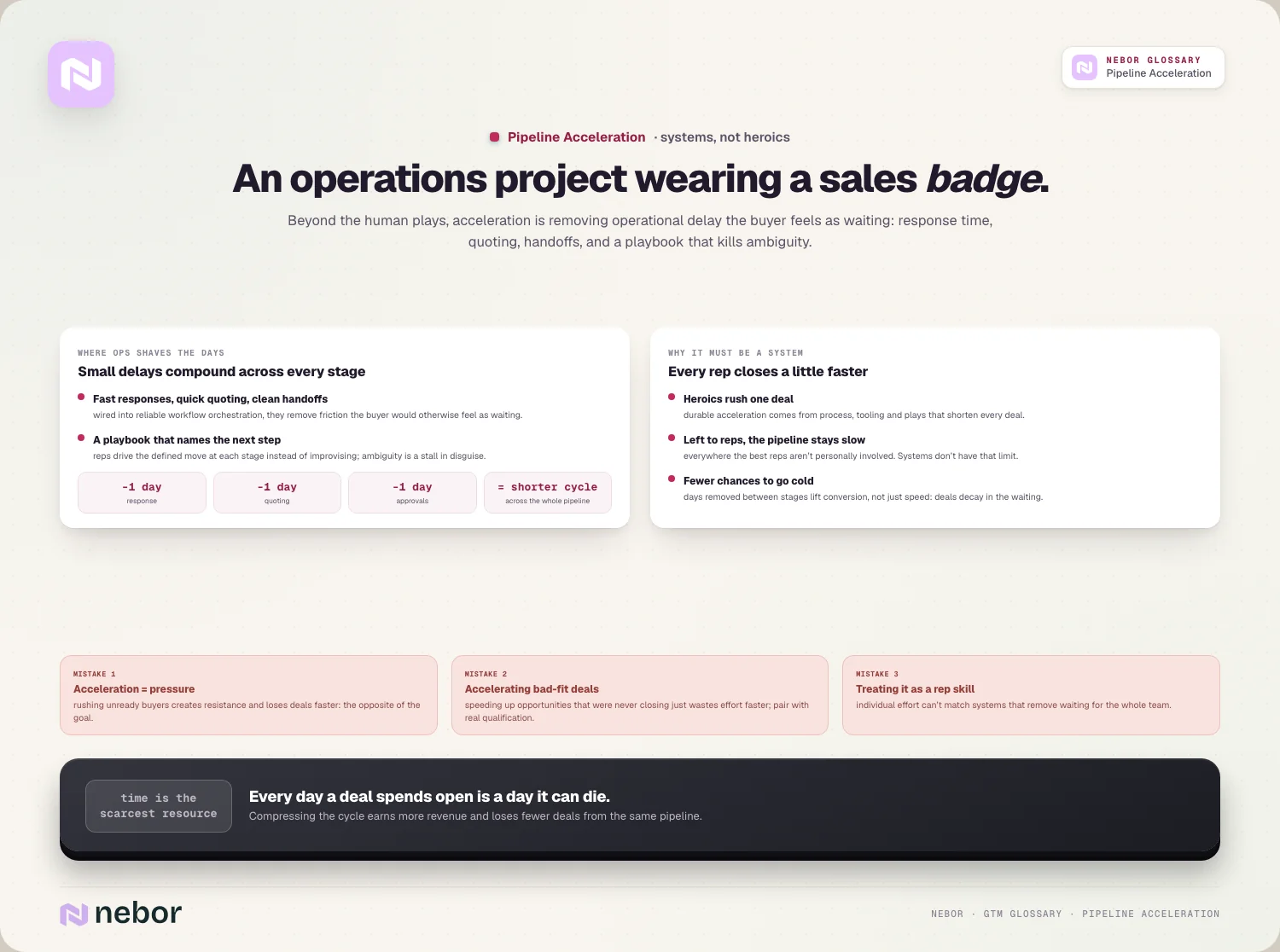
The gains compound because small delays add up across every stage. A day saved on response, a day on quoting, and a day on approvals may each seem minor, but across a full pipeline they meaningfully shorten the average cycle and lift the conversion rate by giving deals fewer chances to go cold.
This is why acceleration is as much an operations project as a selling one. Reps close the deals, but the systems that remove waiting between stages are what let every rep close a little faster, a gain no amount of individual effort can match.
The common mistakes teams make when they chase pipeline acceleration
The most common mistake, and we tell clients to watch for it in their own coaching, is confusing acceleration with pressure, pushing buyers to decide before they're ready.
Rushing a prospect creates resistance and damages trust, so acceleration that ignores the buyer's real timeline tends to lose deals instead of close them faster, which is the opposite of the goal.
Another is trying to accelerate a pipeline full of bad-fit deals. Speeding up opportunities that were never going to close just wastes effort faster, so acceleration only pays off on properly qualified deals, working best when paired with solid qualification instead of applied to everything.
The subtler mistake is treating acceleration as a rep skill instead of a system. Individual heroics can rush a single deal, but durable acceleration comes from process, tooling, and plays that shorten every deal, so leaving it to reps means the pipeline stays slow everywhere the best reps aren't personally involved.
Why pipeline acceleration is really about respecting time as your scarcest resource
The deepest way to understand pipeline acceleration is as a recognition that time, more than leads, is often the real constraint on growth. Every day a deal spends open is a day it can die, so compressing that time is simultaneously a way to earn more revenue and to lose fewer deals to delay.
That dual benefit is what makes acceleration so valuable relative to its cost. Because it works on opportunities you already have, improving speed lifts revenue without spending more to acquire demand, so a team that shortens its cycle gets more out of the same pipeline it already built.
Inside a healthy go-to-market system, acceleration is what ensures the demand you create converts before it goes stale. When the deals you automate sales prospecting to generate move quickly and cleanly toward a decision, the whole engine turns effort into revenue faster and with far less leaking out along the way.
Share this post
RevOps
Glossary
Related glossary items
Understanding the core GTM concepts




Ready to build your pipeline











