

In this post:
A rep who launches into a demo before understanding the buyer's situation is like a doctor prescribing before hearing a single symptom. It feels productive, but it puts the solution before the diagnosis, and buyers can tell the difference between being sold at and being understood.
SPICED is a framework built to reverse that instinct. It gives sellers a diagnostic sequence, situation, pain, impact, critical event, decision, that they work through before pitching anything, so the conversation starts with the buyer's reality and only later arrives at whether your solution fits it.
SPICED is a sales framework, created by Winning by Design, made up of five components: Situation, Pain, Impact, Critical Event, and Decision. It structures a sales conversation as a diagnosis of the buyer's problem, helping revenue teams act like trusted advisors instead of product presenters.
The reason it has spread is that modern buyers are tired of being pitched and respond far better to being understood. By forcing a rep to diagnose before prescribing, SPICED builds the trust and relevance that move a deal forward, which a feature-led pitch almost never does on its own.
TL;DR
SPICED is a five-part sales framework, Situation, Pain, Impact, Critical Event, and Decision, that structures a deal as a diagnosis of the buyer's problem instead of a product pitch.
It's customer-centric by design, built to make sellers behave like trusted advisors who understand the buyer before proposing a solution, the posture modern buyers respond to.
Its standout element is Impact, which turns a vague problem into a quantified reason to act now, separating "we have a problem" from "this problem is worth solving today."
It complements qualification frameworks like MEDDIC instead of competing, because SPICED focuses on the consultative conversation while MEDDIC focuses on the checklist of what you must know to qualify.
What the SPICED framework spells out and what each letter asks you to learn
SPICED breaks a sales conversation into five diagnostic components that build on each other. Situation is the buyer's current context, their environment, constraints, priorities, and the triggers pushing them toward change, so it establishes the ground the whole conversation stands on.
Pain and Impact are the emotional and financial core of the diagnosis. Pain is the specific friction, inefficiency, or risk the buyer feels because of their situation, and Impact captures the consequences of solving or not solving it, the piece that turns a nuisance into a problem worth acting on.
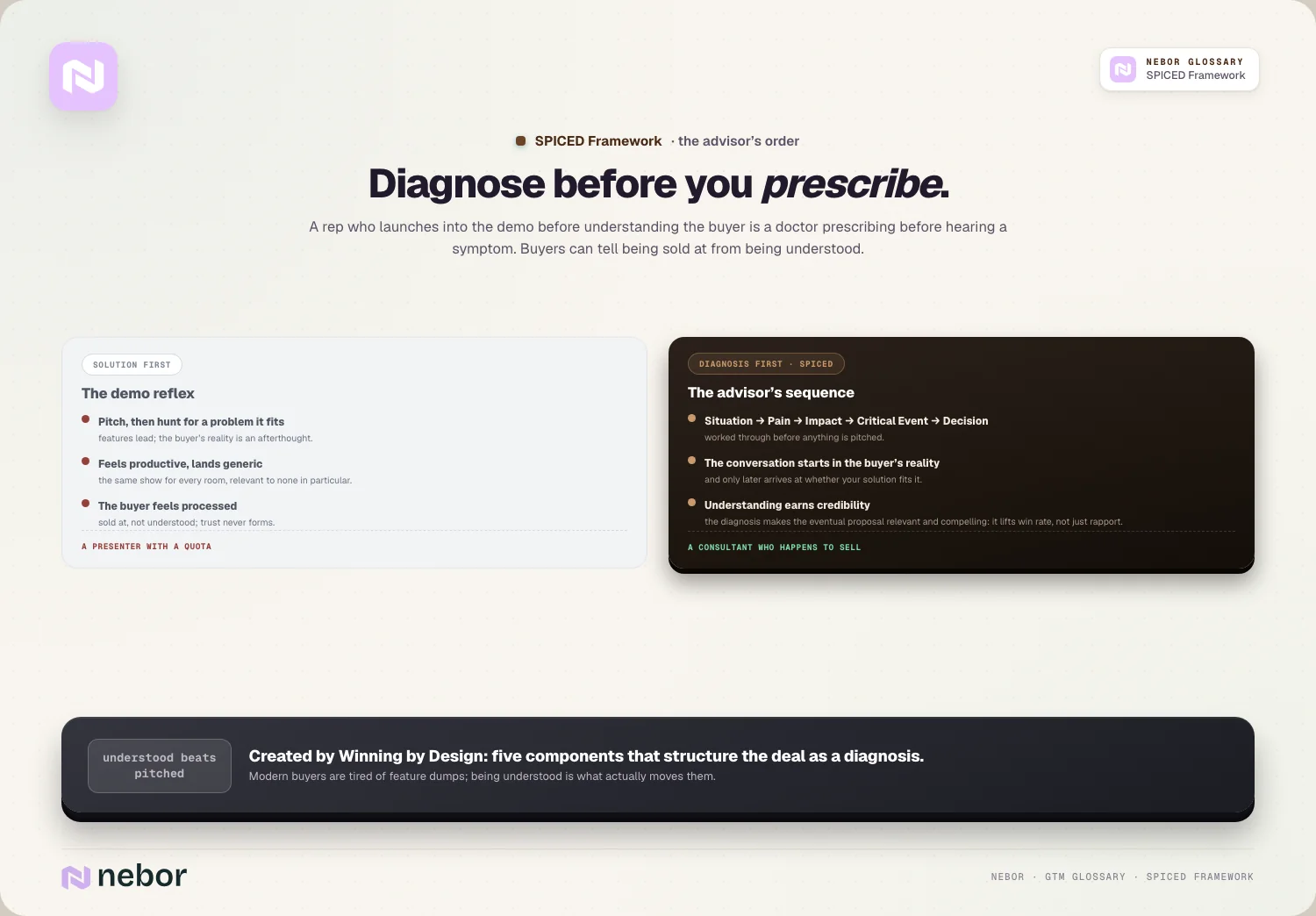
The last two components create urgency and clarity about the decision. The Critical Event is a deadline or trigger that forces the buyer to act by a certain time, and Decision covers the entire process of how they will choose, including the timeline, the criteria, and the buying committee involved.
Why SPICED is a customer-centric framework built around diagnosis
The defining quality of SPICED is that it puts the buyer's problem rather than the seller's product at the center of the conversation. Every component is about understanding the customer's world, so the framework naturally pulls a rep away from pitching features and toward diagnosing what the buyer needs.
This is what makes SPICED a trusted-advisor framework instead of a pitch structure. A rep working through SPICED behaves like a consultant who asks questions and listens before recommending anything, which earns credibility that a product-first approach can't, because the buyer feels understood instead of sold to.
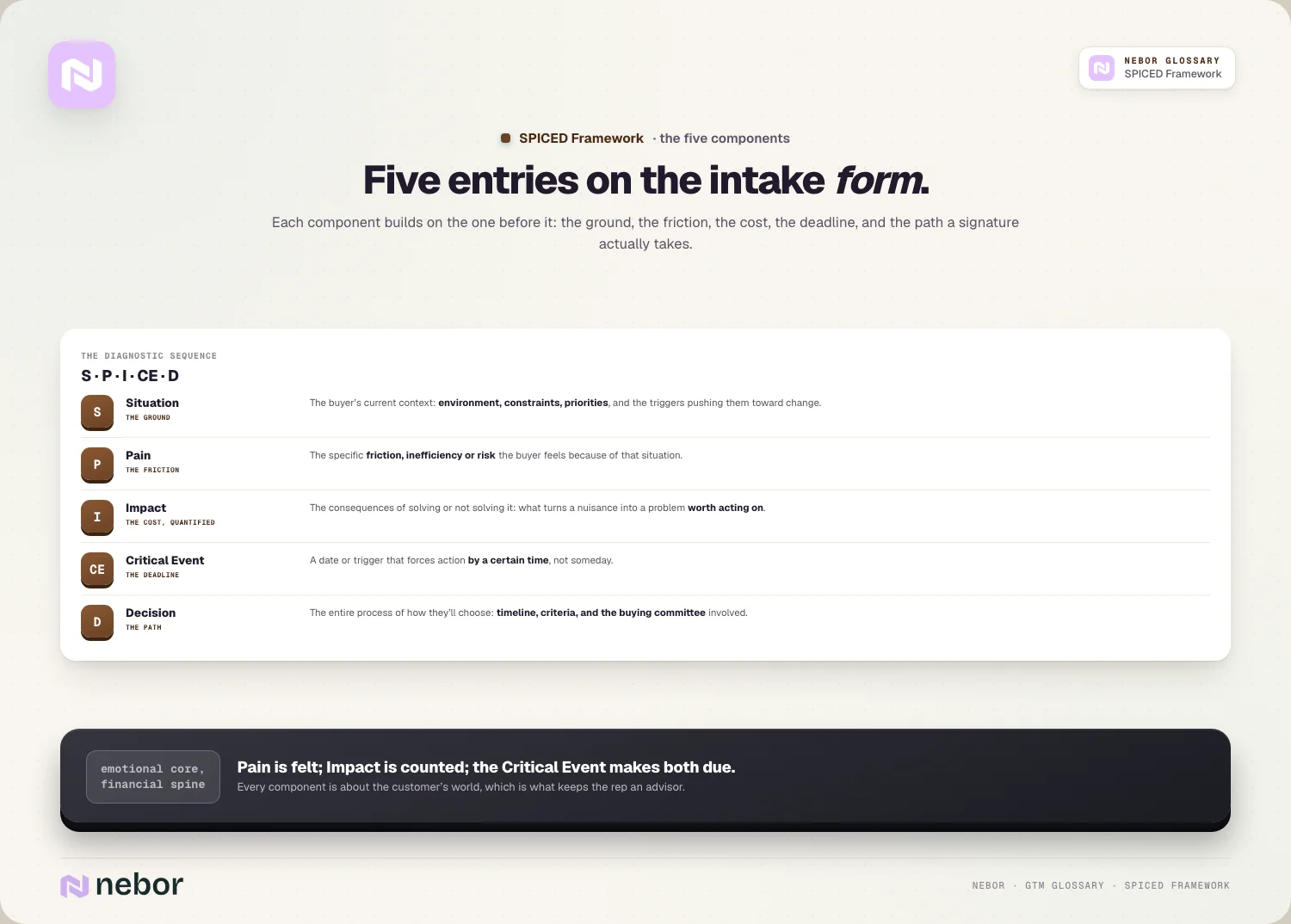
The diagnostic mindset also produces better outcomes on top of better feelings. When a rep truly understands the situation, pain, and impact, any solution they eventually propose is far more relevant and compelling, so the discipline of diagnosing first tends to lift the win rate instead of slow the deal down.
Why Impact is the element that separates a problem from a priority
Of the five components, Impact is the one that most often decides whether a deal happens, because it answers the question of why now. A buyer can acknowledge a problem and still do nothing about it, so Impact is what bridges the gap between having a problem and treating it as worth solving today.
Impact works by quantifying the consequences on both sides of the decision. It captures what the buyer gains by solving the problem and what they lose by leaving it unsolved, which turns a vague complaint into a concrete business case.
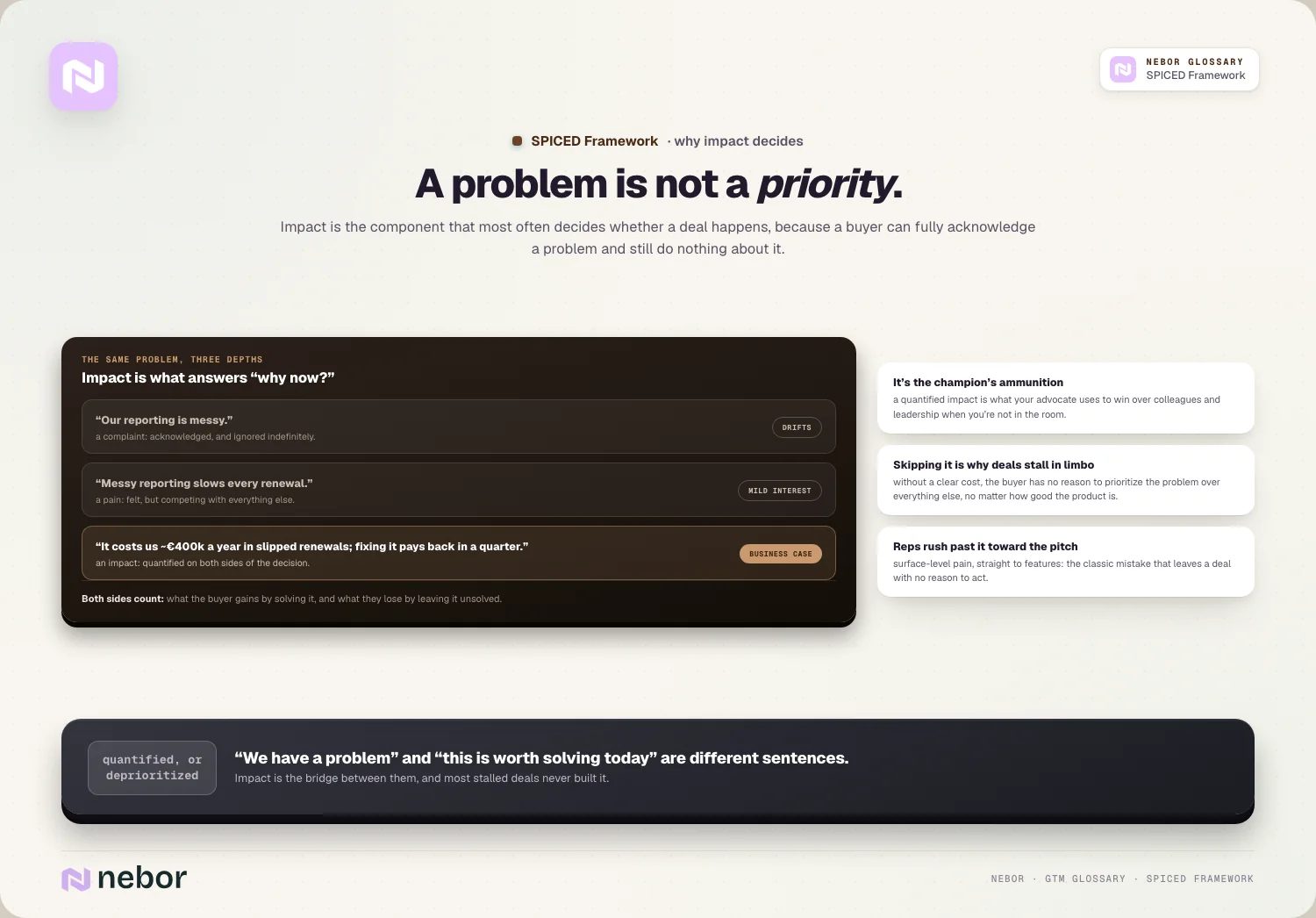
That business case is often what a champion uses to sell the deal internally when the rep isn't in the room. A quantified impact gives your advocate the numbers they need to win over colleagues and leadership on your behalf.
Skipping or rushing Impact is why so many deals stall in a limbo of mild interest.
Without a clear sense of what the problem costs in money and time, a buyer has no reason to prioritize it over everything else, so a rep who hasn't established real impact is working a deal that will drift no matter how good the product is.
Why the Critical Event is the component that creates urgency to act
The Critical Event is SPICED's answer to the deals that qualify well but never close, because it supplies the deadline that forces a decision. It's a specific date or trigger, a contract expiring, a regulation taking effect, a board mandate, that means the buyer has to act by a certain time instead of someday.
Without a critical event, even a well-diagnosed deal can slip indefinitely.
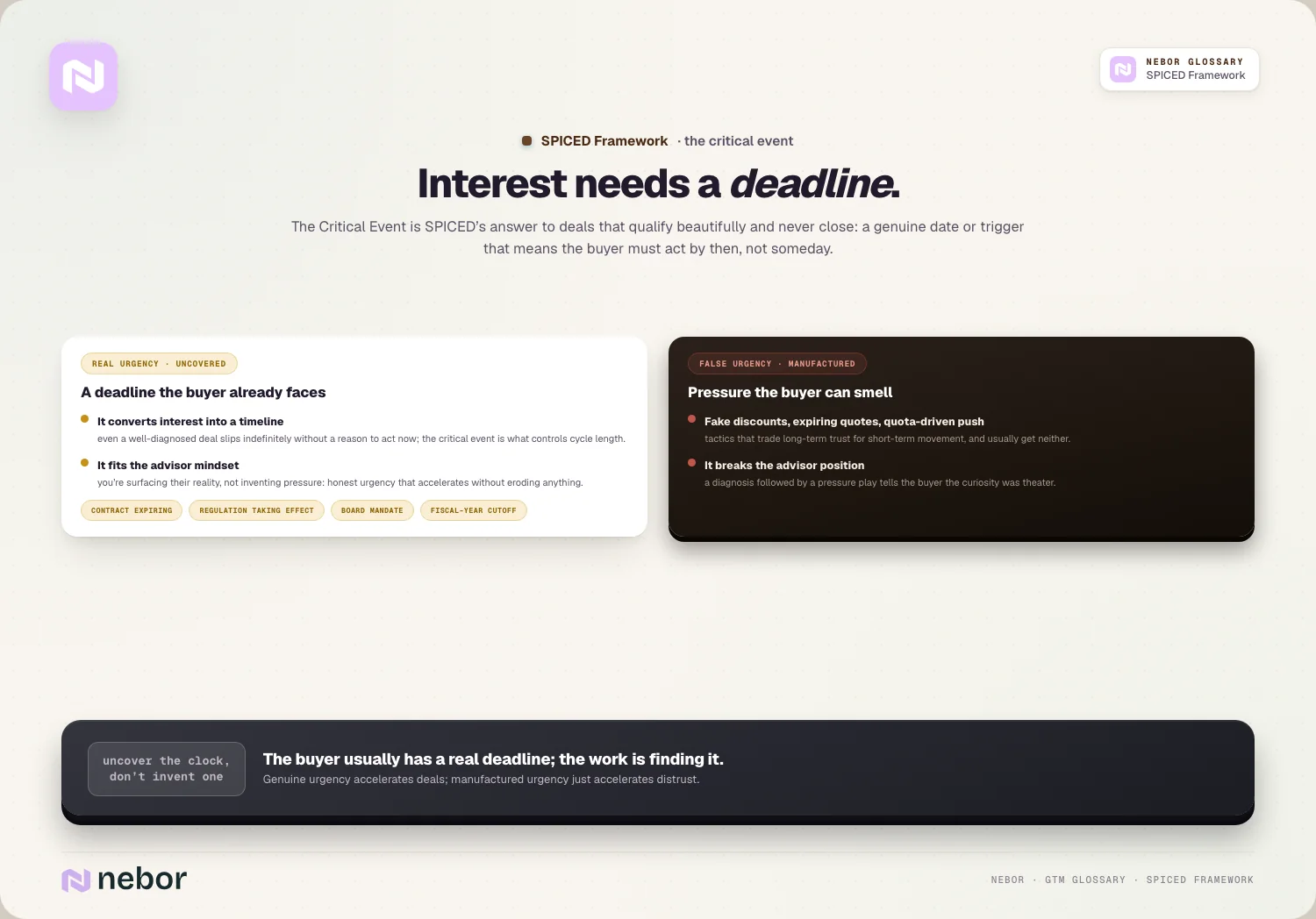
A buyer who agrees the problem is real and the impact is meaningful will still deprioritize it if there's no reason to act now, so the critical event is what converts real interest into a timeline, essential for controlling the sales cycle length.
Finding a real critical event is different from manufacturing false urgency. Pushy tactics like fake discounts erode trust, whereas uncovering a deadline the buyer already faces gives the deal an honest reason to move, exactly the kind of urgency that fits SPICED's advisor mindset and supports real pipeline acceleration.
How SPICED differs from a qualification framework like MEDDIC
SPICED is often compared to MEDDIC, and clients ask us to pick between them, but the two do different jobs and work well together.
MEDDIC is a qualification checklist that tells a rep what they must know to judge whether a deal is real, while SPICED is a conversation framework that guides how a rep discovers and diagnoses the deal.
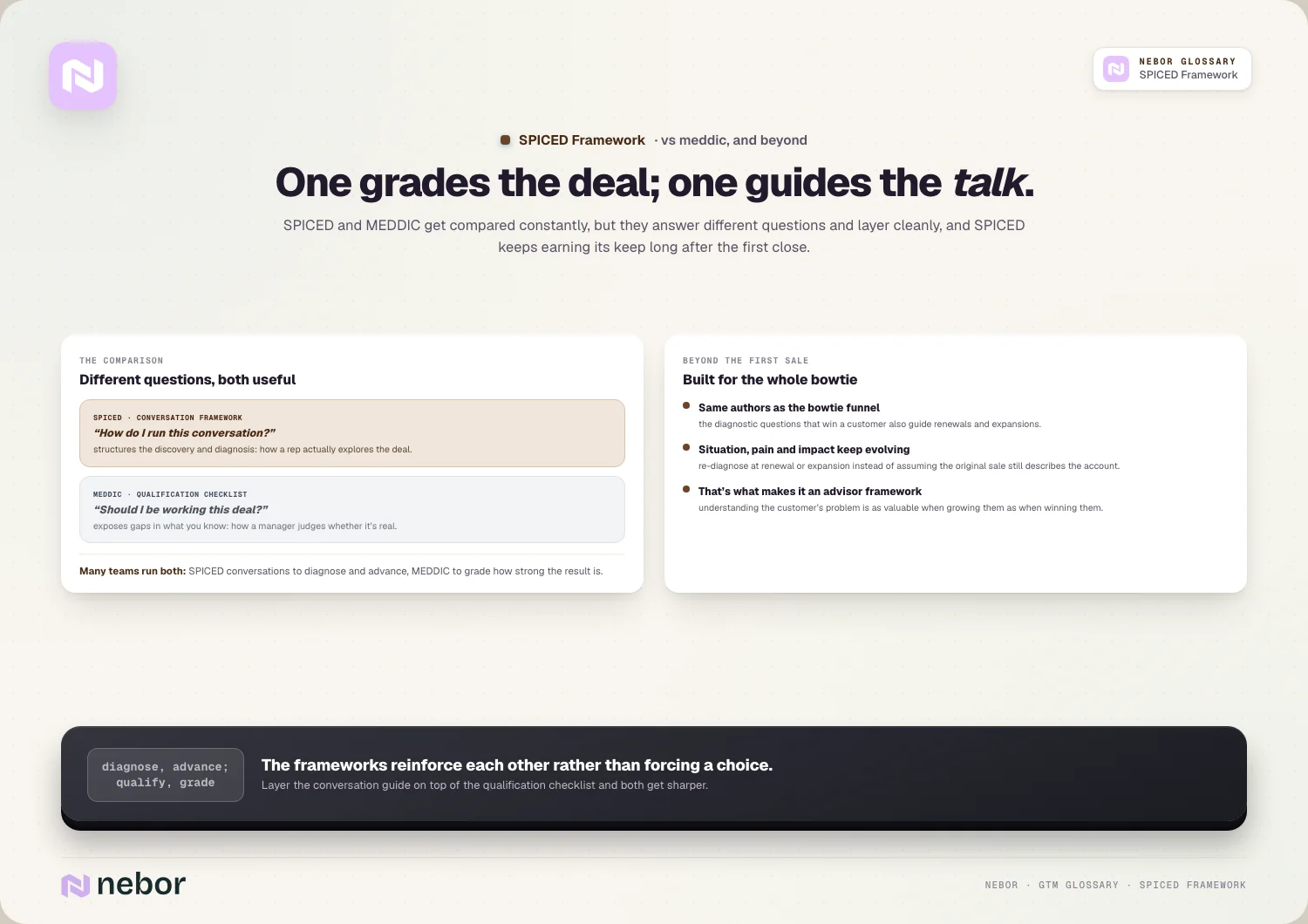
The clearest way to see the difference is what each one is for. MEDDIC answers "should I be working this deal" by exposing gaps in your knowledge, whereas SPICED answers "how do I lead this conversation" by structuring the diagnosis, so one grades the deal and the other guides the discovery.
Because they operate at different levels, many teams use both. A rep can use SPICED conversations to diagnose and advance a deal while using MEDDIC to qualify how strong that deal is, so the frameworks reinforce each other instead of forcing a choice, much like layering diagnosis on top of disciplined lead qualification.
Why SPICED keeps working across the whole customer lifecycle beyond the first sale
A distinctive feature of SPICED is that it applies well beyond the initial deal, because it was built by the same people behind the bowtie funnel view of the full customer lifecycle. The same diagnostic questions that win a new customer also guide renewals and expansions later.
This is because a customer's situation, pain, and impact keep evolving after they buy. Revisiting SPICED at renewal or when an expansion appears lets a rep or success manager diagnose the account's current needs instead of assuming they match the original sale, which keeps the relationship relevant over time.
Using SPICED throughout the lifecycle is what makes it a genuine advisor framework instead of a closing tactic. Because the goal is understanding the customer's problem, that understanding is as valuable when helping them expand as when first winning them, so it serves the whole bowtie-funnel relationship.
How teams put SPICED to work in the conversations they have every day
In practice, SPICED shows up as the structure behind discovery calls and deal notes instead of a rigid script. Your reps use the five components as a checklist of what they need to understand, so a call in your sequence becomes a guided diagnosis where each area gets explored properly instead of a rush to demo.
The framework also organizes how deals are documented and reviewed.
Capturing the situation, pain, impact, critical event, and decision for each deal gives managers in your pipeline reviews a consistent picture of where a deal truly stands, which sharpens coaching and lifts forecast accuracy by grounding it in the buyer's reality.
Codifying SPICED into how the team sells is what makes it stick, and in our experience it's the step most rollouts skip.
When the framework is built into the sales playbook, call templates, and CRM fields, it becomes the default way reps handle conversations instead of a training concept that fades, and that codifying is how a diagnostic approach becomes a durable habit.
How the Decision step maps the real path a deal takes to a signature
The Decision step is often underrated, because reps assume it just means finding who says yes, when it covers the entire process of how a purchase gets made. It pushes a rep to learn the timeline, the criteria, and every person who touches the decision instead of a single name.
A big part of that is separating the people who like the product from the person who can authorize the spend. Identifying the real economic buyer is central to the Decision step, because a deal championed by enthusiastic users can still stall if the person controlling the budget was never engaged.
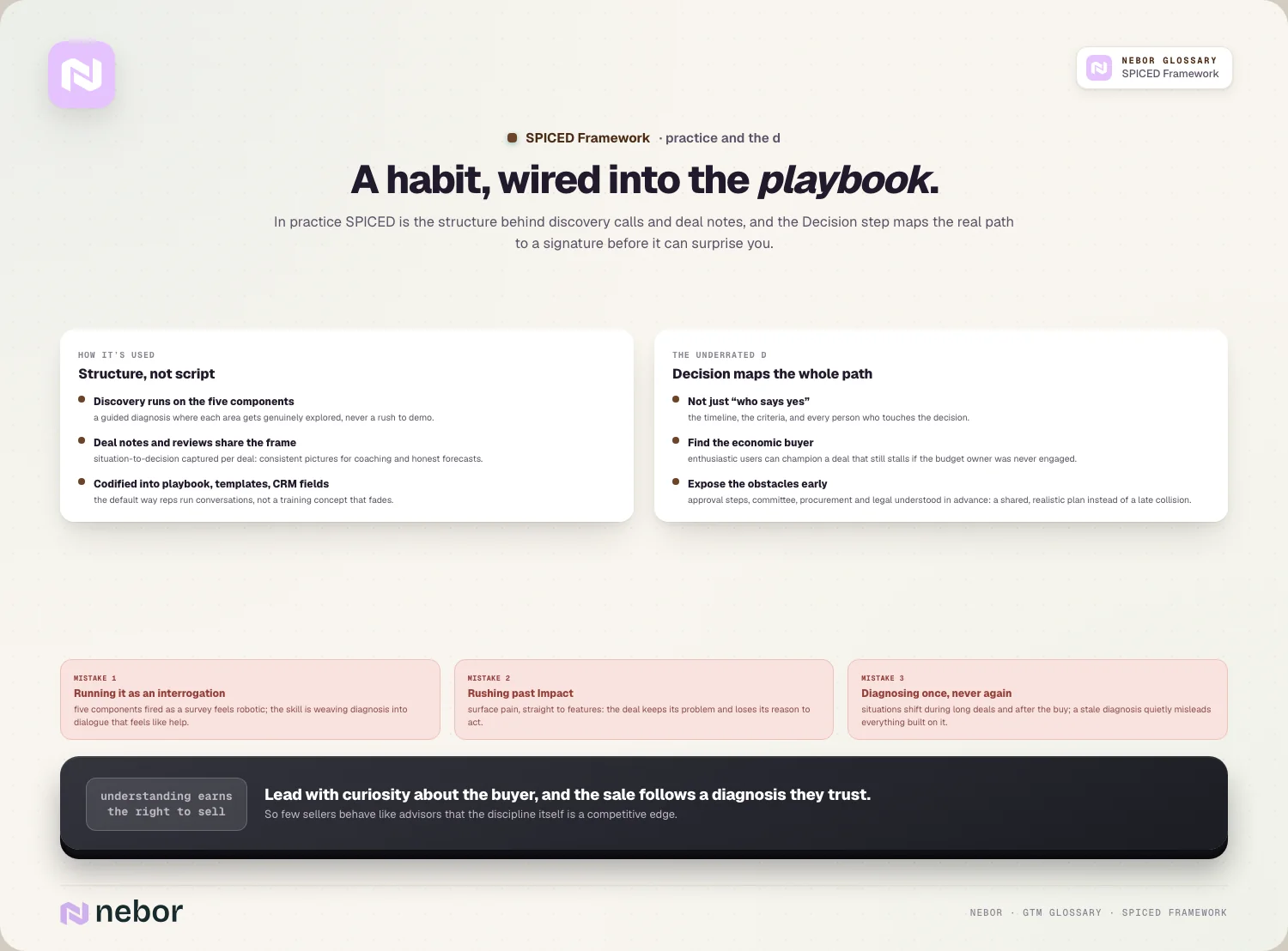
Getting the Decision step right also exposes the hidden obstacles before they surface late. When a rep understands the approval steps, the committee, and the timeline in advance, the deal moves on a shared, realistic plan instead of colliding with a procurement or legal process nobody saw coming at the last minute.
The common mistakes teams make when they use the SPICED framework
The most common mistake, and the one we see whenever a team adopts SPICED by decree, is treating it as a rigid interrogation instead of a natural conversation.
Throwing the five components at a buyer as a list of questions feels robotic and defeats the advisor mindset, so the skill is weaving the diagnosis into a real dialogue that feels like help instead of a survey.
Another is rushing past Impact to get to the pitch. Because reps are eager to present their solution, they often establish a surface-level pain and jump straight to features, skipping the quantified impact that would have made the deal urgent, which leaves them selling to a buyer who has no real reason to act.
The subtler mistake is diagnosing once and never returning to it. A buyer's situation and priorities shift during a long deal and after they buy, so a rep who treats SPICED as a one-time discovery instead of an ongoing read can end up advancing a deal on an understanding that has quietly gone stale.
Why SPICED is really about earning the right to sell by understanding first
The deepest idea in SPICED is that understanding a buyer's problem is what earns you the right to propose a solution, which inverts the usual order of selling. Instead of leading with what you offer, you lead with genuine curiosity about the buyer, and the sale follows naturally from a diagnosis they trust.
That inversion is why the framework fits how people want to be sold to now. Buyers have endless information and no patience for feature dumps, so a seller who behaves like an advisor diagnosing a problem stands out precisely because so few do, which turns the discipline of SPICED into a real competitive edge.
A modern go-to-market system built on a framework like SPICED treats every conversation as a chance to understand instead of pitch.
When the opportunities you automate sales prospecting to create meet reps who diagnose before they prescribe, deals advance because buyers feel understood at last, the most durable reason anyone ever buys.
Share this post
RevOps
Guide
Conversations
Glossary
Related glossary items
Understanding the core GTM concepts




Ready to build your pipeline











