

In this post:
Building an outbound engine from scratch is slow, expensive, and easy to get wrong. You hire reps, buy tools, set up sending infrastructure, and wait months to see whether any of it works. Plenty of companies want the pipeline without that long, risky build.
Outbound-as-a-service is the answer some of them choose. A provider brings the reps, the tools, and the know-how, and handles your outbound for you as a service, so you rent a working outbound motion instead of constructing one yourself.
Outbound-as-a-service is a model where an external provider supplies the people, technology, and management to drive your outbound campaigns, usually for a monthly fee. Rather than hiring and equipping an outbound team, you pay a specialist to do it for you.
The model is sometimes called SDR-as-a-service, and it exists because outbound has become truly hard to do well. Deliverability, tooling, and messaging all take real expertise, which is exactly what these providers package up.
TL;DR
Outbound-as-a-service is a managed model where a provider delivers your outbound with their own reps, tools, and infrastructure, usually for a monthly retainer.
It exists because outbound is hard to build well, so companies rent a working motion rather than spending months assembling reps, tooling, and deliverability from scratch.
It's fastest to launch and often cheaper early. An agency can reach full volume in weeks, while a new in-house rep can take months to ramp.
It's not right for everyone, since deep enterprise selling and a proven, scaled motion often favor an in-house team, and many companies end up using both.
What outbound-as-a-service includes when you actually buy it
Outbound-as-a-service bundles everything an outbound motion needs into one managed package. Instead of assembling the parts yourself, you get them from a single provider.
It supplies the people who do the work. The provider brings trained reps who do the prospecting, so you don't hire, onboard, or manage sales development staff directly.
It supplies the technical infrastructure underneath it all. The sending infrastructure, tools, and data come with the service, so you skip the cost and complexity of building a tech stack.
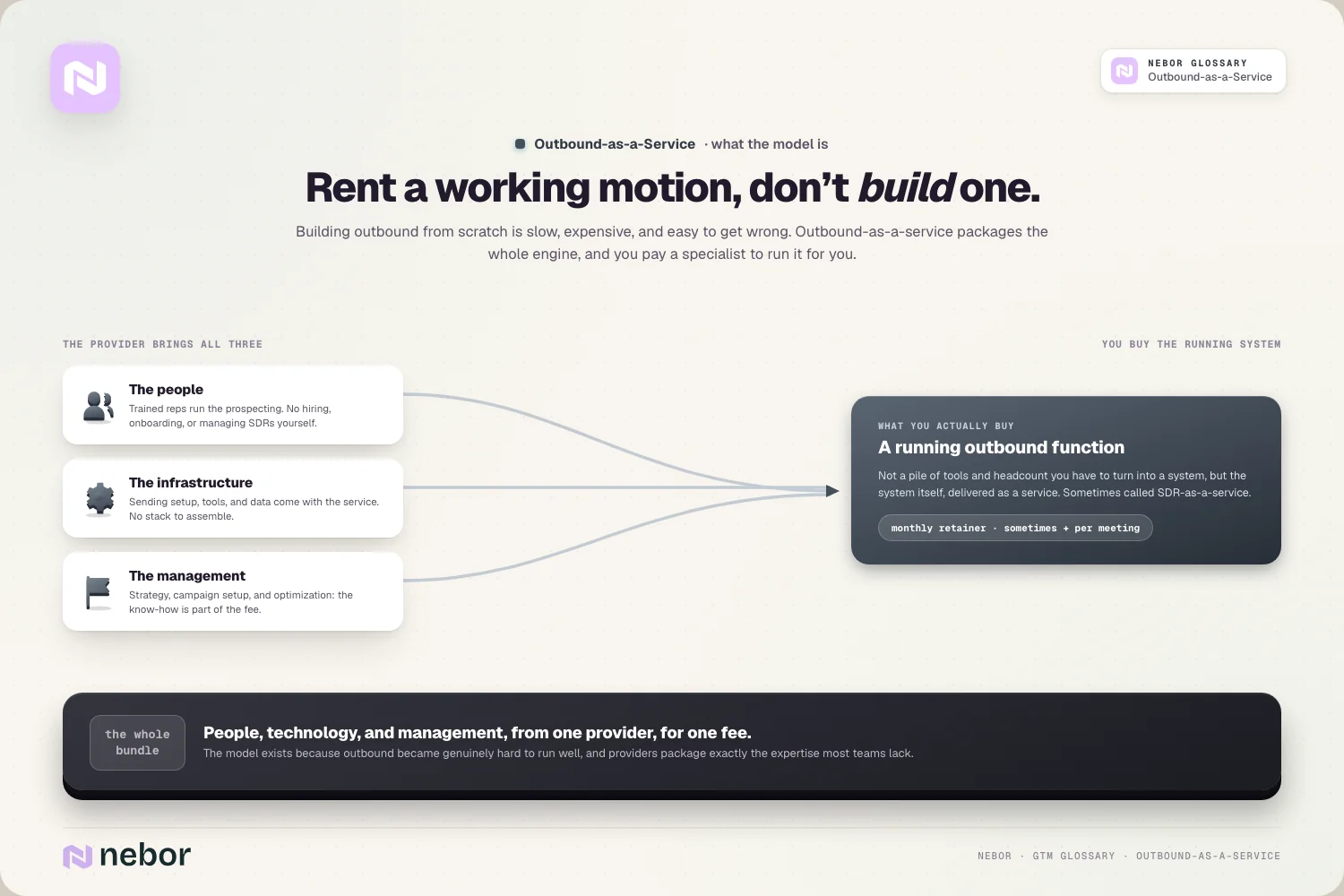
It supplies the management layer on top. The provider handles strategy, campaign setup, and optimization, so the expertise that makes outbound work is part of what you're paying for.
What you buy, in short, is a working outbound function. Instead of a pile of tools and headcount you have to turn into a system, you get the system itself as a service.
The pricing usually reflects that bundled shape. Providers tend to charge a monthly retainer, sometimes with a per-meeting component, so the cost is predictable and scales with the volume you want instead of with fixed salaries.
Why outbound became hard enough to hand off in the first place
The whole model exists because outbound stopped being simple, and we watch teams discover this the hard way. Several moving parts now each demand real expertise.
Deliverability alone is a discipline of its own. Keeping email out of spam takes warmed domains, careful sender warmup, and constant maintenance, which is a specialty in itself.
Tooling has multiplied on every side of the motion. A modern outbound stack spans data, sequencing, and enrichment tools that take time and skill to wire together, before a single email goes out.
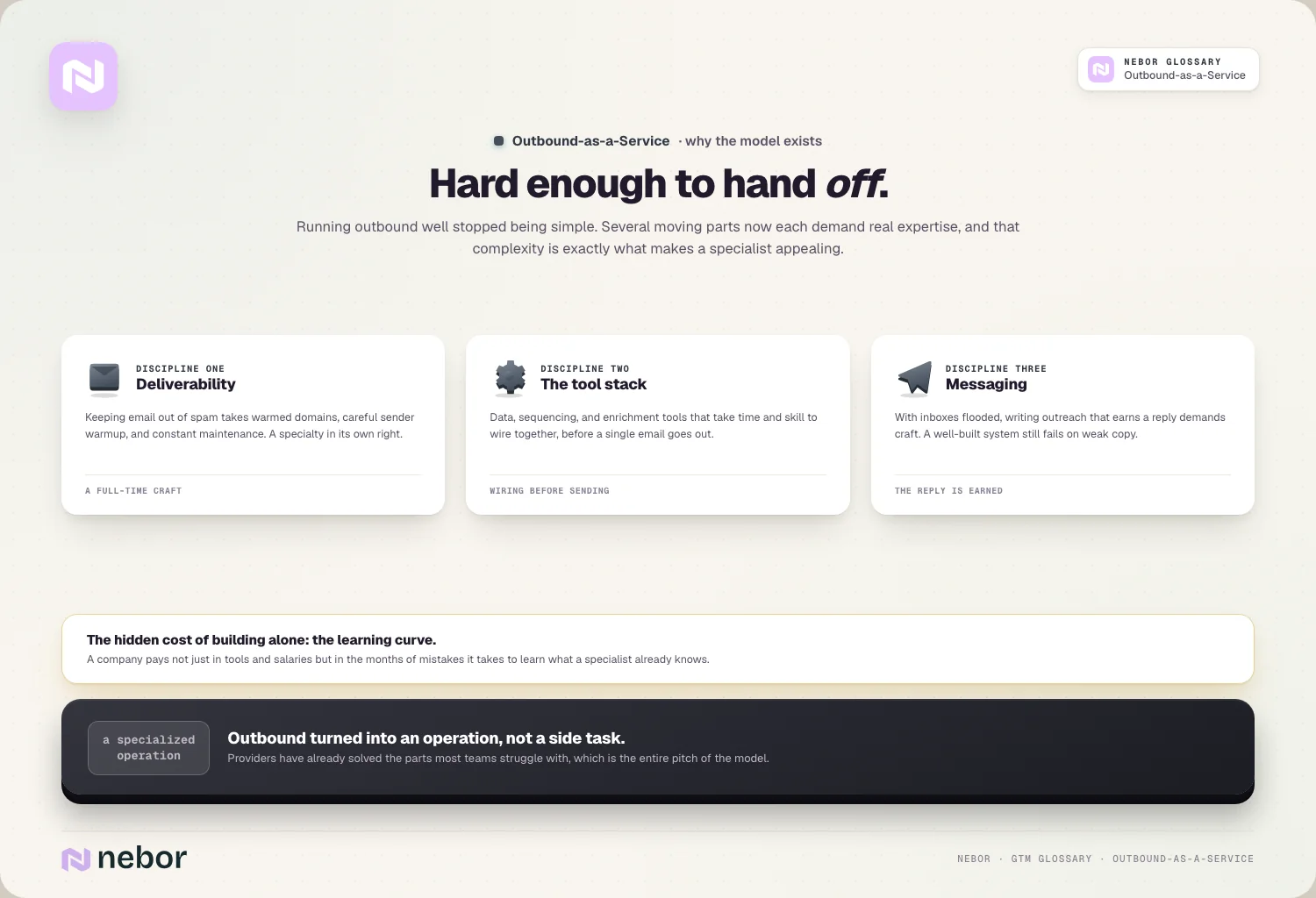
Messaging is harder than it has ever been. With inboxes flooded, writing outreach that earns a reply demands craft, so even a well-built system fails on weak messaging.
So outbound turned into a specialized operation instead of a side task. That complexity is exactly what makes handing it to a provider appealing, because they've already solved the parts most teams struggle with.
The learning curve is the hidden cost. A company building outbound alone pays not just in tools and salaries but in the months of mistakes it takes to learn what a specialist already knows.
How outbound-as-a-service compares to hiring an in-house team
The real decision most companies face is between renting outbound and building it. Each path has a very different cost and timeline.
A fully loaded in-house rep is expensive. Salary, tools, and overhead put a single SDR at roughly $116,000 to $210,000 a year, before you know whether the motion works.
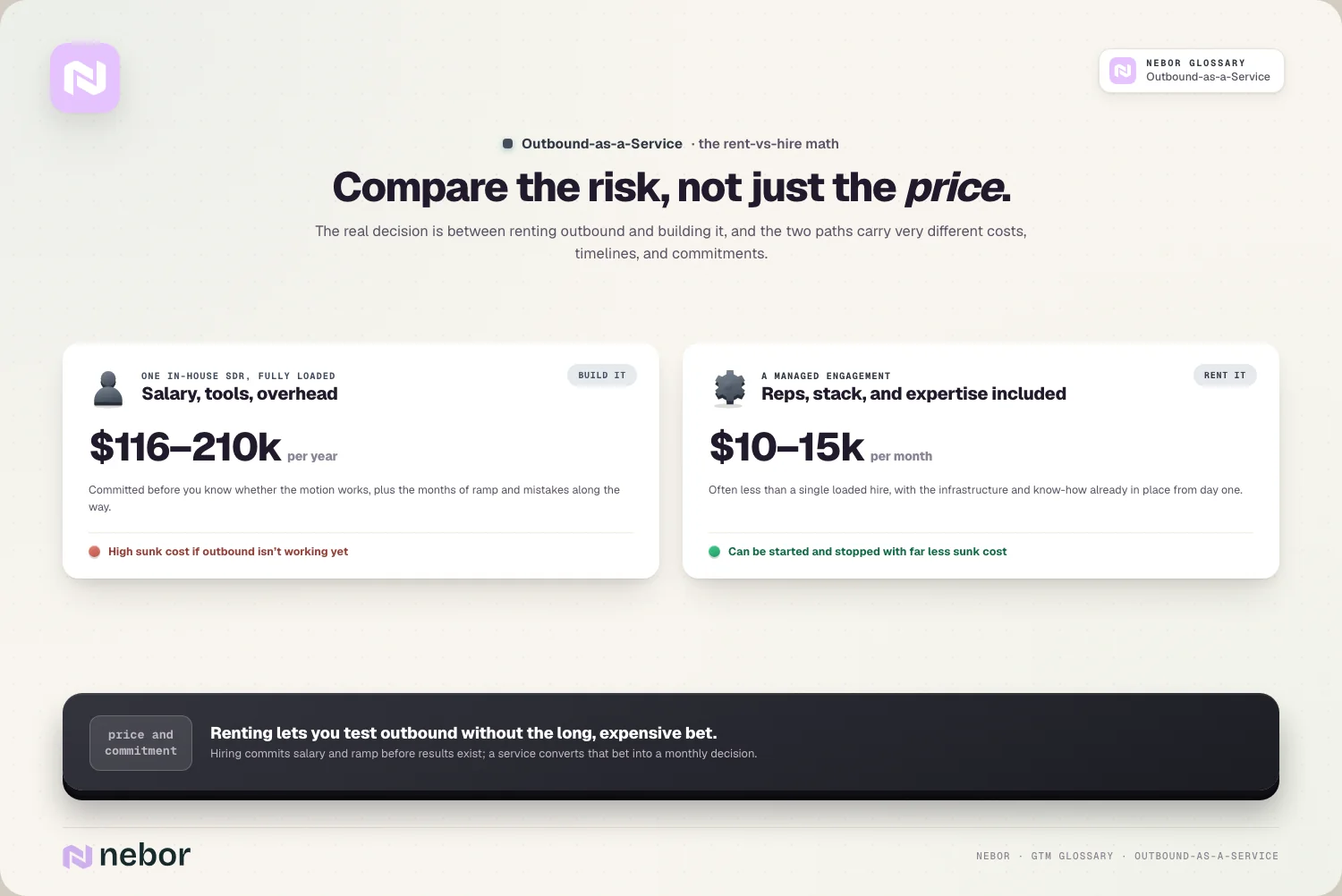
An agency bundles it for a comparable or lower cost. A managed engagement at ten to fifteen thousand a month includes the reps, stack, and expertise, often for less than a single loaded hire.
The risk profile differs just as sharply. Hiring means committing to salary and ramp before seeing results, while a service can be started and stopped with far less sunk cost.
So the comparison covers risk and commitment as much as price. Renting lets you test outbound without the long, expensive bet that building an in-house team requires up front.
Why outbound-as-a-service launches so much faster than a new hire
Speed is one of the model's biggest advantages, and the gap is large. A provider gets going in a fraction of the time a new team needs.
An agency launches in a matter of weeks. A provider can reach full campaign volume in about four to six weeks, limited mostly by how long domains take to warm.
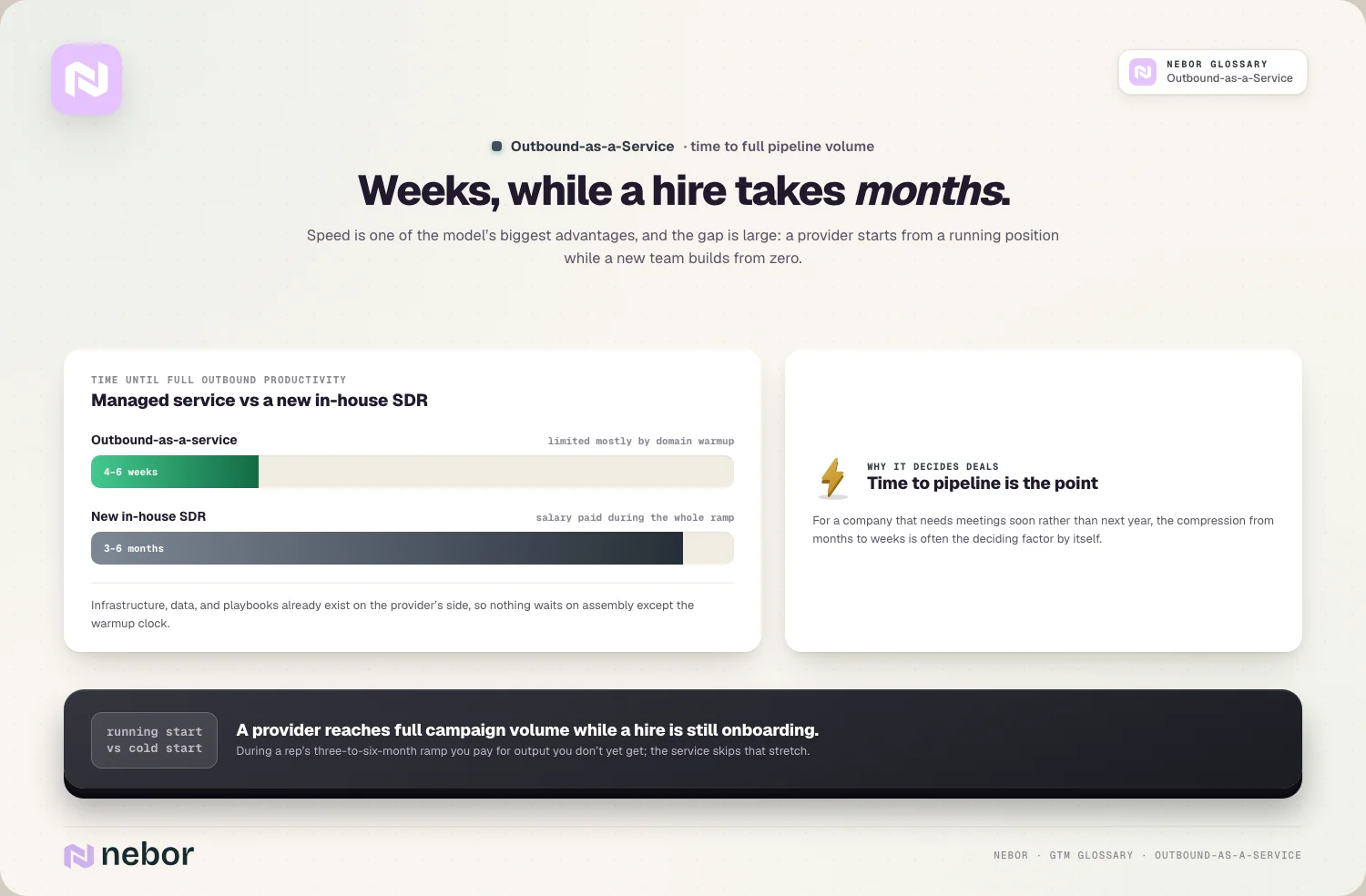
A new hire takes months to reach speed. Average ramp time for an SDR to reach full productivity takes three to six months, during which you're paying for output you don't yet get.
The provider skips the setup phase entirely. Because they already have infrastructure, data, and playbooks, they start mid-stride instead of building from zero.
So outbound-as-a-service compresses time to pipeline dramatically. For a company that needs meetings soon instead of next year, that speed is often the deciding factor.
When building an in-house outbound team makes more sense instead
The service model isn't always the right answer, and hiring wins in clear situations, because scale and complexity shift the math toward in-house.
Deep enterprise selling favors your own employees. Complex, high-value deals need reps steeped in your product and market, which is easier to build with a dedicated in-house team.
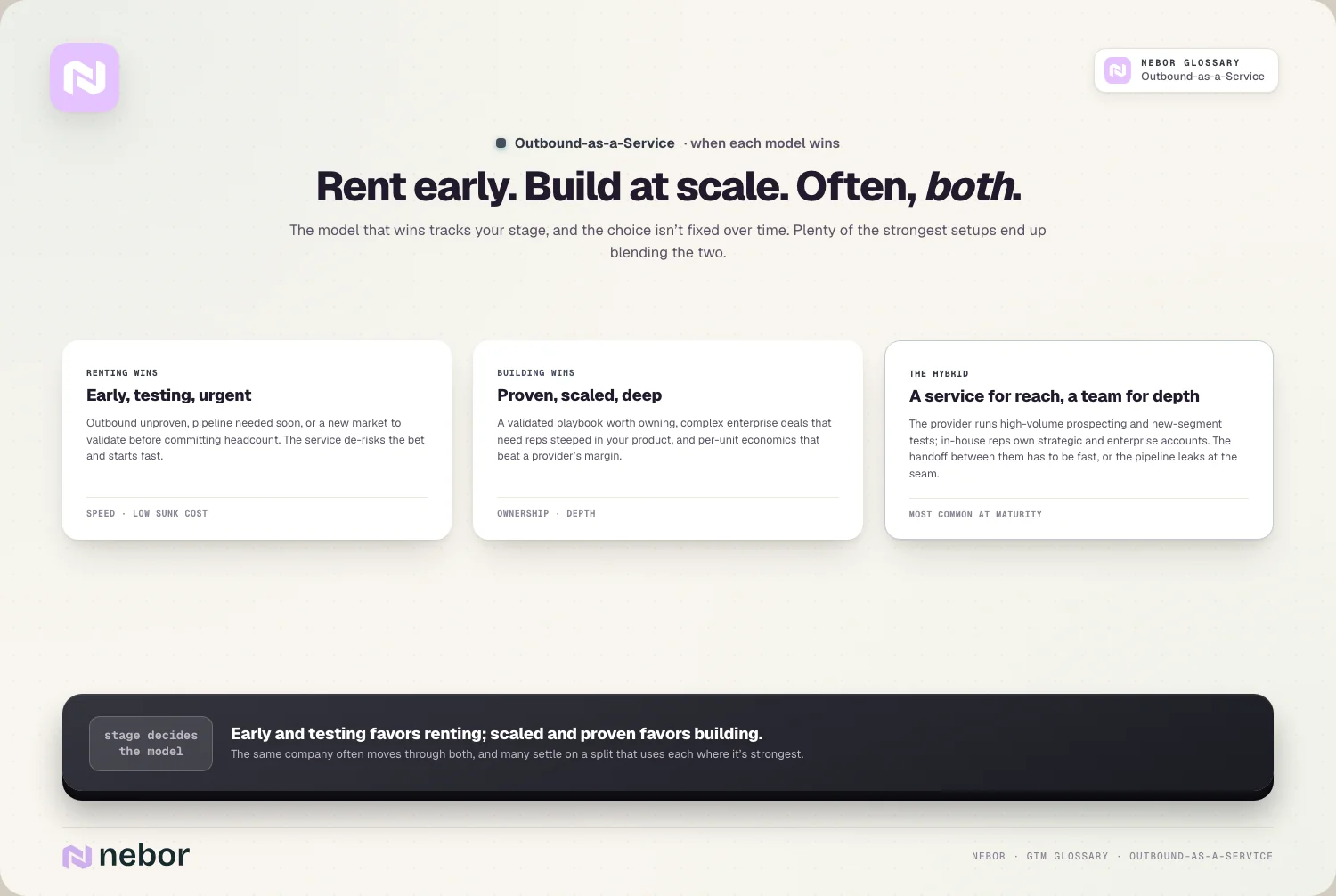
A proven motion deserves to be owned. Once your outbound playbook is validated and you're scaling it, building in-house captures the value instead of paying a provider's margin.
Scale changes the underlying economics as well. Past a certain size, with multiple sellers and a clear market, the per-unit cost of in-house often beats a service, so ownership pays off.
So the model that wins tracks your stage. Early and testing favors renting, while scaled and proven favors building, so the choice isn't fixed for a company over time.
Why many companies end up with both models side by side at once
The choice is rarely all-or-nothing, and the strongest setups often blend the two. A hybrid captures the best of each.
The split usually follows the tier of accounts. Many teams let a service handle high volume prospecting and new-segment testing, while in-house reps focus on strategic and enterprise accounts.
It balances raw speed against selling depth. Outsourcing the volume gets pipeline fast, while keeping high-value selling in-house preserves the depth those deals need.
It de-risks your new market bets too. Using a service to test a new market or ideal customer profile lets you validate it before committing headcount to it.
So the practical answer for many companies is both. A hybrid uses a service for reach and testing while the in-house team owns the accounts where depth matters most.
The handoff between the two needs real care. When a service books a meeting, it has to reach your reps fast, so strong speed to lead between the provider and your team is what keeps the pipeline from leaking at the seam.
How outbound-as-a-service relates to building your own outbound sales
It helps to place the model against the broader practice it delivers, because the service is one way to do outbound sales instead of a different activity.
The underlying work stays exactly the same. Whether rented or built, it's still outbound sales, reaching prospects who haven't raised their hand and starting conversations.
The difference is simply whose people do it. In-house means your employees do the work, while the service means a provider's team does it, but the motion itself doesn't change.
The channels stay entirely familiar as well. A provider works the same multi-channel outreach across email, phone, and social that an in-house team would, just with their own people and tools.
So outbound-as-a-service is a delivery model for outbound sales instead of a new kind of selling. What you're deciding is who operates the motion, with the motion itself staying the same.
How to tell whether an outbound provider is genuinely any good
Because the model hands your outreach to someone else, choosing the right provider matters enormously. A few signals separate strong ones from weak.
Look at how they handle deliverability first. A serious provider maintains proper infrastructure and warmup, because a service that burns through domains will damage your results and reputation.
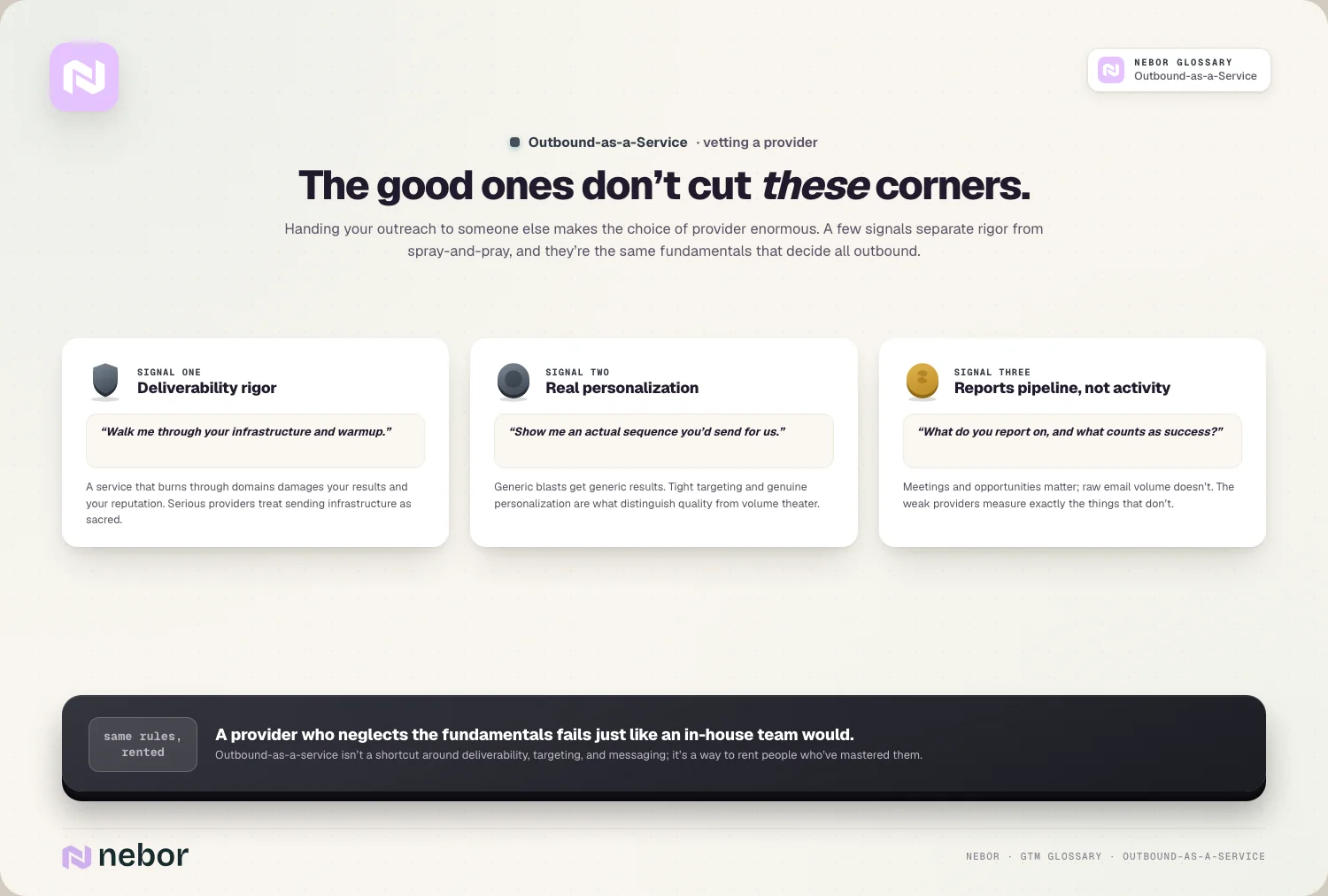
Ask how they personalize once volume climbs. A provider relying on generic blasts will get poor replies, so real personalization and tight targeting are what distinguish quality from spray-and-pray.
Check what they measure and report back on. A good provider reports on real pipeline instead of just activity, because meetings and opportunities matter far more than raw email volume.
So evaluating a provider is mostly about rigor. The best ones treat deliverability, targeting, and reporting as seriously as a strong in-house team would, and the weak ones cut exactly those corners.
Why outbound-as-a-service lives or dies on the same fundamentals
Handing outbound to a provider doesn't change what makes outbound work. The same fundamentals decide results whether you build or rent.
Deliverability still rules everything else that follows. A provider's emails have to reach the inbox, so their cold email infrastructure and sender reputation matter exactly as much as they would in-house.
Targeting still decides the fit of the pipeline. A service reaching the wrong accounts wastes effort, so their targeting against your market is as important as any tool or rep.
Messaging still has to earn every single reply. No provider succeeds on volume alone, so the quality of the outreach they write is what ultimately drives responses.
So outbound-as-a-service is a way to rent teams who have mastered the fundamentals instead of a shortcut around them. A provider who neglects the basics fails just as an in-house team would.
How outbound-as-a-service fits alongside automation and modern tooling
The model has shifted as outbound tooling and automation have advanced. Providers increasingly build on the same systems that power modern in-house teams.
Automation raises what a provider can deliver. Because you can now automate sales prospecting across data, sending, and follow-up, providers deliver more volume and consistency than manual work allowed.
It blurs the old line between reps and software. Some services lean heavily on sales automation and AI, so what you're renting is increasingly a system as much as a set of people.
It raises the bar on quality as well. As automation handles the mechanics, the provider's real value moves to strategy, targeting, and messaging, and that's where the good ones now compete.
So the modern version of the model is part team, part system. The best providers pair skilled people with strong automation, and that pairing lets them deliver outbound at a level many companies can't easily match alone.
How outbound-as-a-service can build toward an in-house engine later
One underrated use of the model is as a stepping stone rather than a permanent arrangement. A service can teach you how outbound works before you own it.
It reveals what works in your market. Watching a provider push campaigns shows you which messaging, segments, and channels produce meetings, which is a validated playbook you can later bring in-house.
It buys you time to hire well. Outsourcing outbound while you recruit means you're generating pipeline during the months a new team would otherwise take to ramp.
It de-risks the eventual in-house build too. By the time you hire, you know the motion works, so you're building a proven revenue engine rather than betting headcount on an unproven one.
So the model can serve as a bridge as much as a destination. Some companies use a provider to prove and learn the motion, then internalize it once the value of owning it outweighs the convenience of renting.
The common pitfalls companies hit with outbound-as-a-service
The model can go wrong, usually when expectations or oversight are off, and we keep seeing the same pitfalls when companies compare notes with us.
The biggest is expecting completely hands-off magic. A provider needs your input on positioning and targeting, so treating it as fully set-and-forget tends to produce generic, underperforming campaigns.
Another is choosing a provider purely on price. The cheapest ones often cut corners on deliverability and personalization, which produces volume without results.
A third is ignoring the brand risk. Because the provider emails prospects in your name, sloppy work can damage your reputation, so their standards become yours.
The last is having no clear success metric. Without agreeing on what pipeline outcome counts as success, it's easy to pay for activity that never turns into real opportunities.
A related slip is simply talking to the provider too little. The best engagements feel like a partnership, with regular feedback on what's landing, so a provider left to work in isolation rarely produces the results a closely guided one does.
How to decide whether the outbound-as-a-service model is right for you
The decision comes down to a few honest questions about your stage and needs, and in our experience the answers point clearly one way or the other.
Ask first how fast you need pipeline. If you need meetings in weeks instead of quarters, the speed of a service is hard to match by hiring.
Ask whether your motion is proven yet. If you're still finding what works, renting lets you test without committing, while a validated motion is often worth building in-house.
Ask how complex your sale really is. Simple, higher-volume selling suits a service well, while deep enterprise deals usually need the depth of an in-house team.
So the model fits best when you want speed, flexibility, and expertise without a long build. It's one option within a modern go-to-market system, and the right call depends on your stage, your sale, and how much of the motion you want to own.
Share this post
Outbound
Glossary
Related glossary items
Understanding the core GTM concepts




Ready to build your pipeline











