

In this post:
ABM campaign orchestration is the coordination of every marketing and sales touch aimed at a target account, so the right person in the buying group hears the right message at the moment they're ready for it. It's one level above individual campaigns.
If account-based marketing picks the accounts, orchestration drives the coordinated plays against them. It decides which play to send, for which account, on which channel, in what order, and who owns the follow-up.
Your team probably already pushes ads, email, and outreach against the same account list. Orchestration is the layer that makes those touches add up instead of colliding.
TL;DR
Most vendors describe ABM campaign orchestration as coordinated multichannel campaigns across a target list, then rolling everyone's behavior up into a single account score. We think that score is exactly what breaks the program.
Orchestration lives or dies at the contact level, because a buying committee of a dozen-plus people doesn't move as one number. The teams that win aren't the ones touching the most channels. They launch a tight two or three channel play within 48 hours of a real signal, into the specific people who triggered it.
Channel count turns out to be a vanity number, and the programs that win do it on speed, contact-level targeting, and clean ownership of every touch.
What ABM campaign orchestration coordinates across your sales and marketing teams
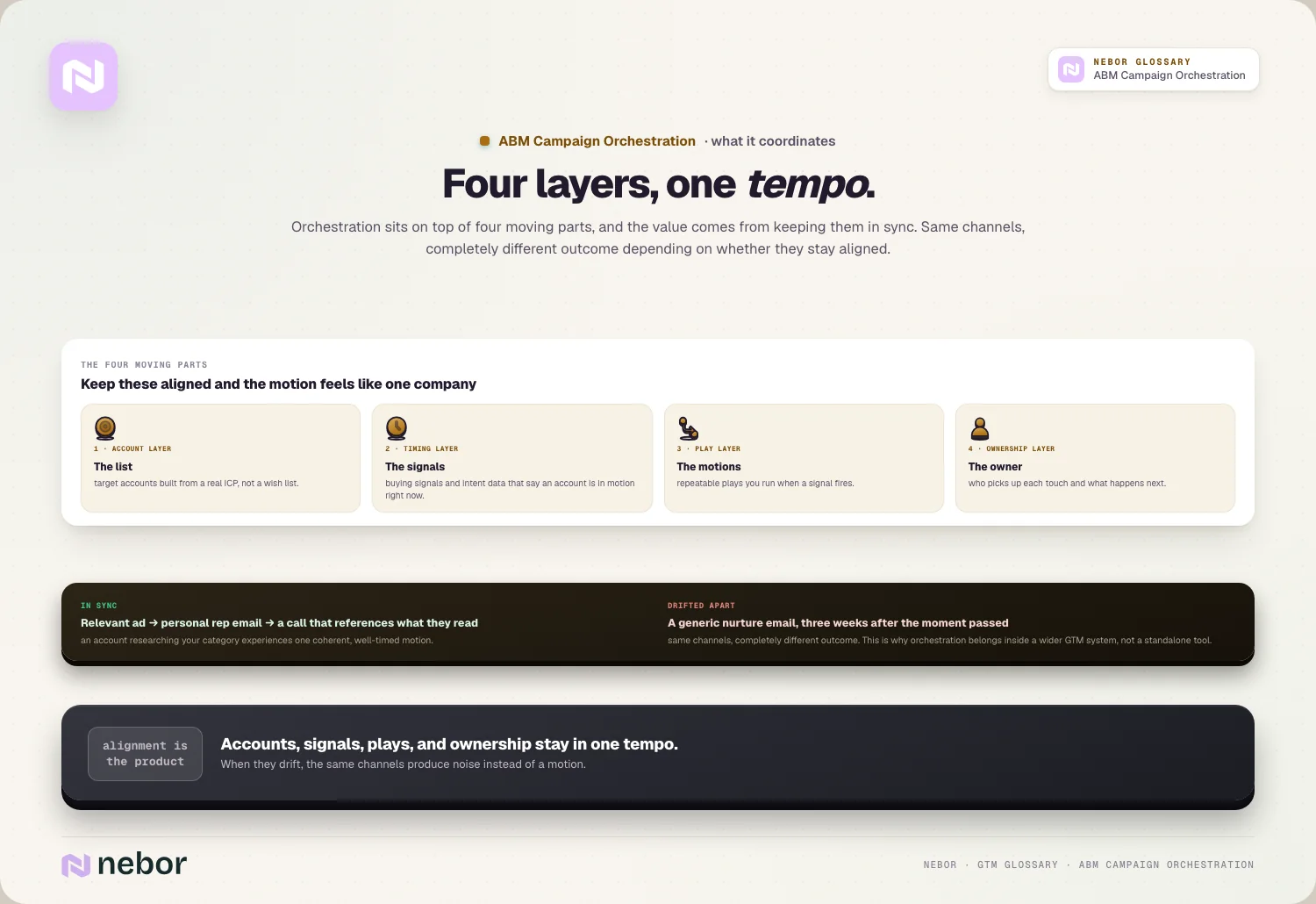
ABM orchestration rests on four moving parts, and the value comes from keeping them in sync.
The first is the account layer, your target account list built from a real ideal customer profile instead of a wish list. The second is the timing layer, the buying signals and intent data that tell you an account is in motion right now.
The third is the play layer, the repeatable motions you have ready when a signal lands. The fourth is the ownership layer, who picks up each touch and what happens next.
When these four stay aligned, an account researching your category sees a relevant ad, gets a personalized email from a real rep, and takes a call that references the exact thing they were looking at.
When they drift apart, that same account gets a generic nurture email three weeks after the moment passed. The channels were identical in both cases, and the outcome came out completely different.
Orchestration only holds together inside a wider GTM system, because as a standalone campaign tool it drifts away from the data and the people it depends on.
How orchestration is different from the campaigns and the strategy around it
People mix up three words all the time, and the mix-up causes real damage to how teams plan. Strategy, campaigns, and orchestration are three different jobs.
Account-based marketing covers the strategy side of that trio, answering who you go after and why those accounts are worth the effort. It's the choice to treat named companies as markets of one.
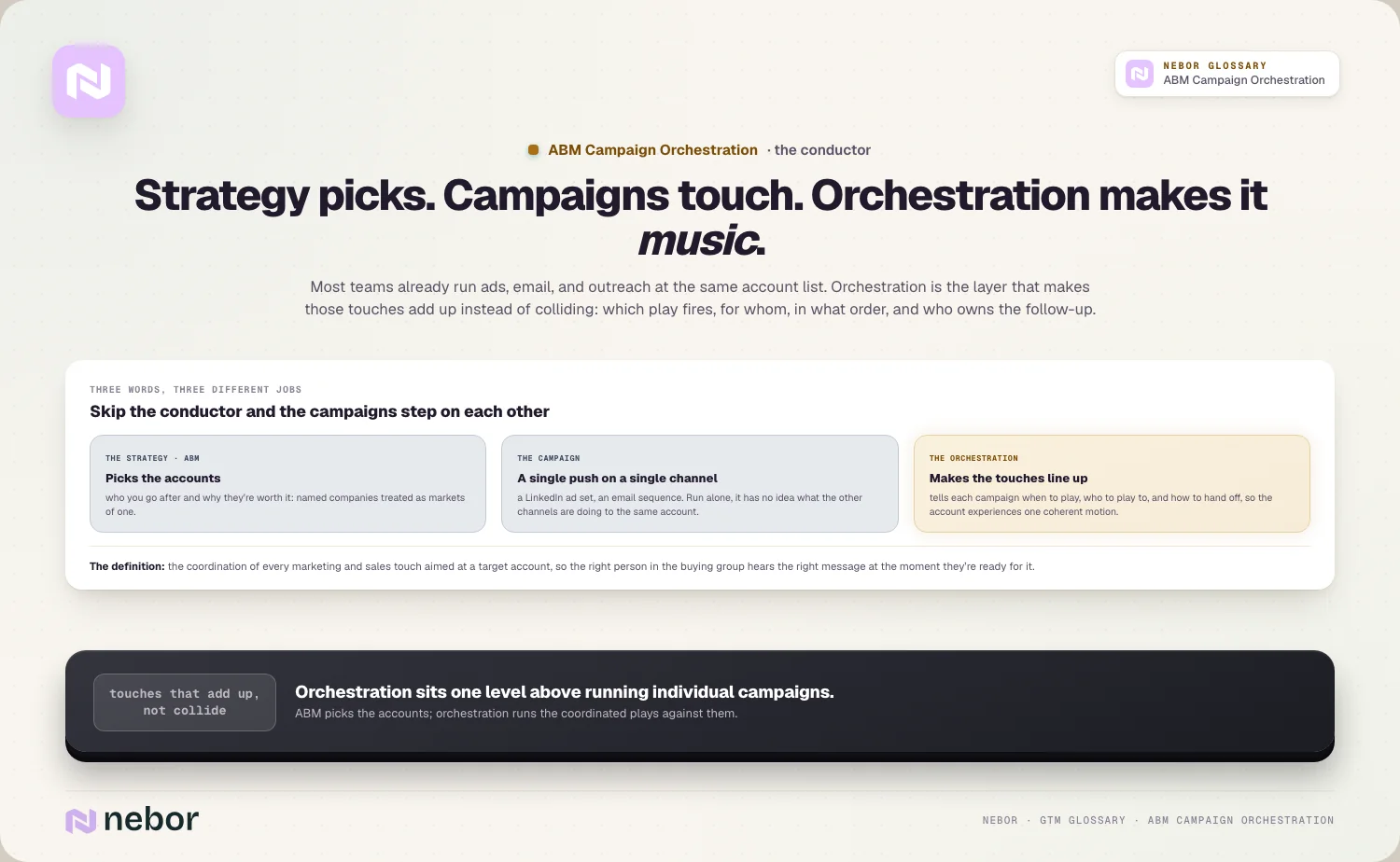
A campaign is a single push on a single channel, like a LinkedIn ad set or an email sequence. A campaign working on its own has no idea what the other channels are doing to the same account.
Orchestration works like the conductor standing in front of those campaigns, and it never replaces them. It tells each one when to play, who to play to, and how to hand off to the next touch so the account experiences one coherent motion instead of four disconnected ones.
If you only take one distinction away from this entry, take this one. Strategy picks the accounts, campaigns do the touching, and orchestration makes the touches line up in time and across people. If you skip the orchestration layer, you still have campaigns, they just step on each other.
Why rolled-up account scores break orchestration for real buying committees
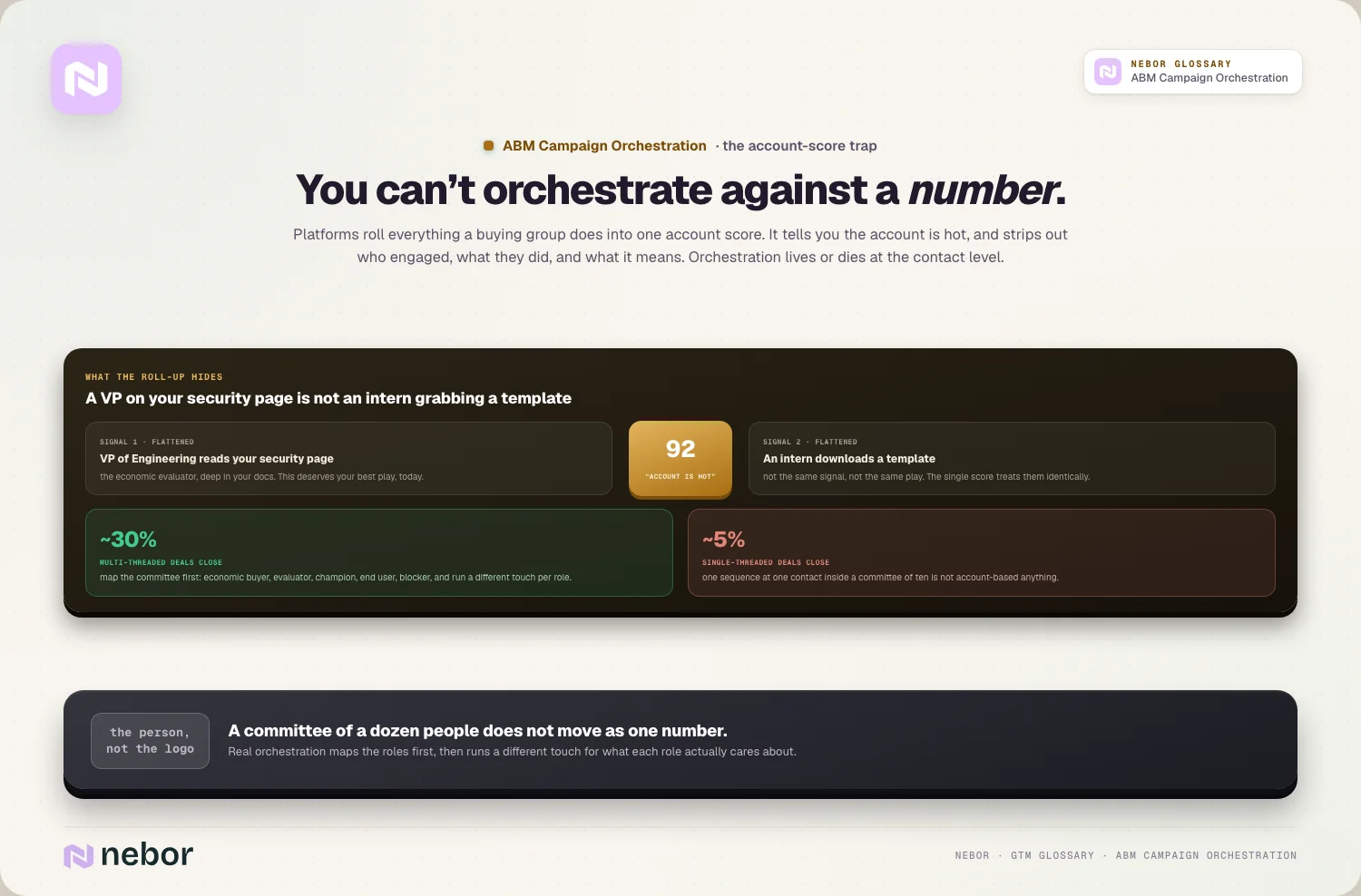
Here's the part most platforms get wrong. They take everything a buying group does, intent clusters, page visits, content downloads, and roll it into one account score. That score tells you the account is hot, but it strips out who engaged, what they did, and what it means.
You can't aim coordinated plays at a number like that, because the score never tells your rep who to reach or with what. A VP of Engineering reading your security page and an intern downloading a template are two very different signals, and they deserve two very different plays.
Single-threading is the version of this mistake your reps make. One sequence at one contact inside a buying committee of ten or more people is not account-based anything.
In our own inbound meeting workflow, multi-threaded deals close at around 30% while single-threaded ones land near 5%.
Real orchestration maps the committee first, the economic buyer, the technical evaluator, the champion, the end user, and the likely blocker. Then it builds a different touch for each role based on what that role actually cares about.
How you map a buying committee before you send a single touch
If orchestration happens at the contact level, then knowing the contacts is step zero. We keep meeting teams that skip it and then wonder why their plays feel scattershot.
The mapping goes faster when you start from the roles and fill in the names afterward. Inside almost any B2B deal you have a handful of jobs to be done, and each one cares about something different.
The economic buyer signs off on the spend and cares about return and risk. The champion wants the problem solved and will carry your case internally if you arm them. The technical evaluator tests the product hard and cares about whether it holds up in real use.
The end user lives with the tool day to day and cares about whether it makes their job easier or harder. The blocker is whoever loses something if you win, often security, legal, or the person inside who backs the tool they already use.
Once you have the roles, fill in the real people and confirm they're still in seat, because contact data rots fast. Then write a different angle for each role.
The champion gets ammunition, the economic buyer gets the business case, the evaluator gets proof. That gives you five conversations inside the same account, all moving as one coordinated motion, and that's multi-threading when someone does the real work instead of renaming a sequence.
Why speed from signal to first touch beats the number of channels you use
The instinct when a program feels thin is to add channels, more display, more LinkedIn, more direct mail, more events. It feels like more orchestration, and in our experience it usually delivers less.
A three-channel play that lands within 48 hours of a signal, a targeted ad plus a personalized email plus a sales call, will outperform a seven-channel play that takes two weeks to assemble. By the time the seven-channel version ships, the trigger event is cold and the buyer has moved on.
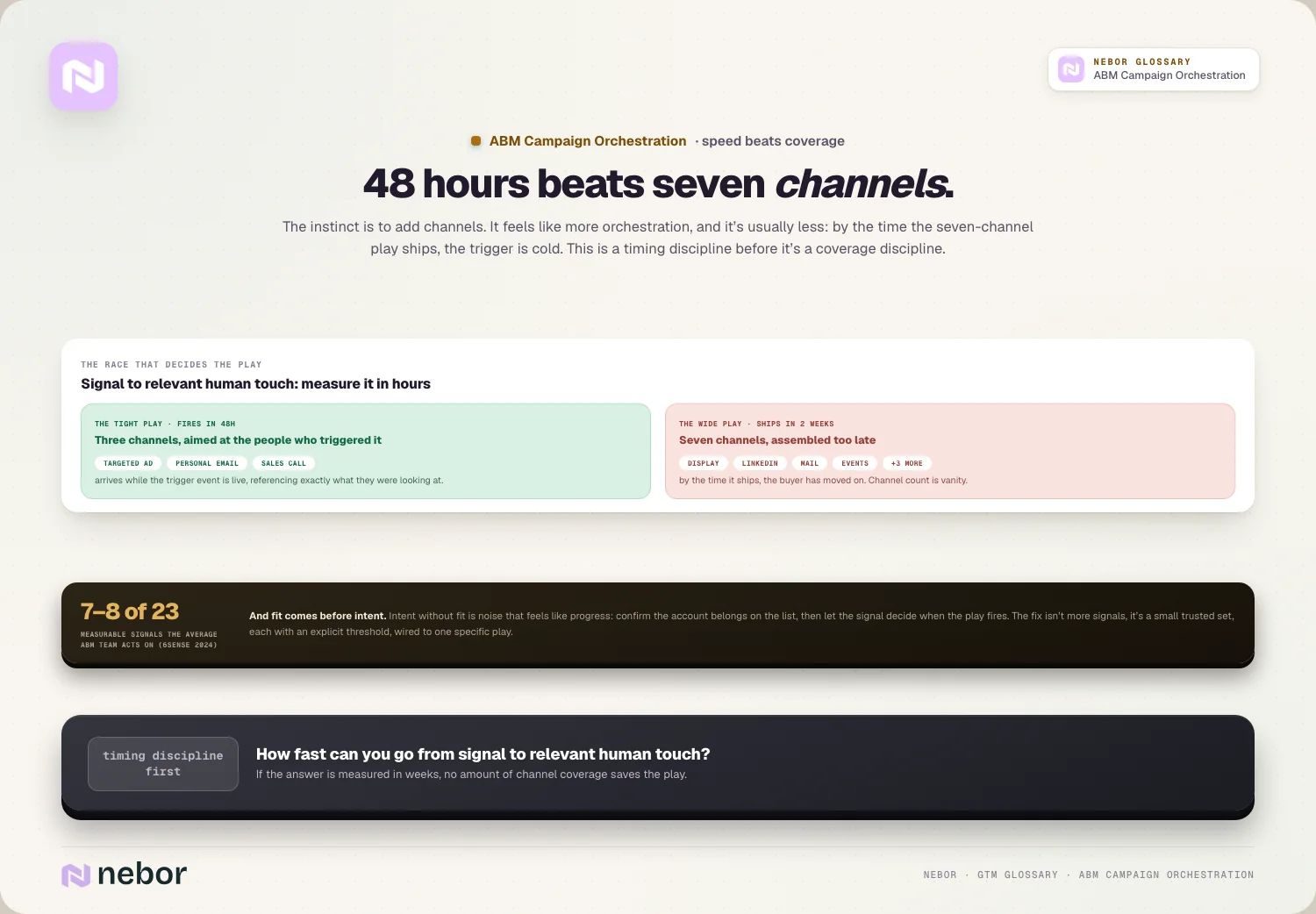
ABM orchestration is a timing discipline before it's a coverage discipline. So the right question is how fast you can move from signal to relevant human touch, and if your answer is measured in weeks, no amount of channel coverage saves the play.
Why account fit has to come before intent data when you orchestrate
A common and expensive mistake is buying intent data before confirming account fit. Teams see a list of companies researching solutions like theirs and start throwing plays at them, without checking whether those companies match the ICP.
Intent without fit hands you noise that feels like progress while it wastes your best plays. The sequence to get right is fit first, then intent data for timing.
Confirm the account belongs on the list, then let the signal decide when the play starts. The line between fit scoring and intent scoring keeps those two jobs separate.
There's also a lot of unused signal buried in the tools you already pay for. 6sense's 2024 ABM benchmark found the average account-based team acts on only seven or eight of 23 measurable signals.
That gap separates orchestration that feels like guesswork from orchestration that produces predictable pipeline.
The fix is a small set of signals you trust, like repeat pricing-page visits or a relevant job change, an explicit threshold for each, and one specific play wired to it. That's signal-based selling in its simplest form.
How inbound signals and outbound plays come together in one orchestration motion
A lot of teams keep inbound and outbound separate, with different owners and different tools. Good orchestration joins the two, because from the buyer's side there's only ever one company reaching out.
Inbound gives you the warmest signals you'll ever get. Someone hits your pricing page, fills a form, opens three emails, or shows up in your deanonymized website traffic. That's a person telling you the timing is right.
Outbound gives you reach into accounts that haven't raised a hand yet but clearly fit. The plays here are colder, so they lean harder on relevance and on a sharp reason to reach out now.
Orchestration is the place where those two motions finally meet. A warm inbound signal can trigger an outbound-style multi-threaded play into the rest of the committee, because one person browsing rarely means the whole account is bought in.
And a cold outbound play can warm up fast the moment the account starts showing inbound behavior.
The cleanest programs we've seen use inbound-led outbound. You let the signal pick the timing and the entry point, then you orchestrate the coordinated push around it.
That approach lands far warmer than cold outreach blasted at a static list, and it moves far faster than waiting for every buyer to find you on their own.
The five parts of an orchestration play that make it repeatable
The working unit of ABM orchestration is the play rather than the campaign. A play is a single repeatable motion you trigger when a condition is met, and every clean play has five parts.
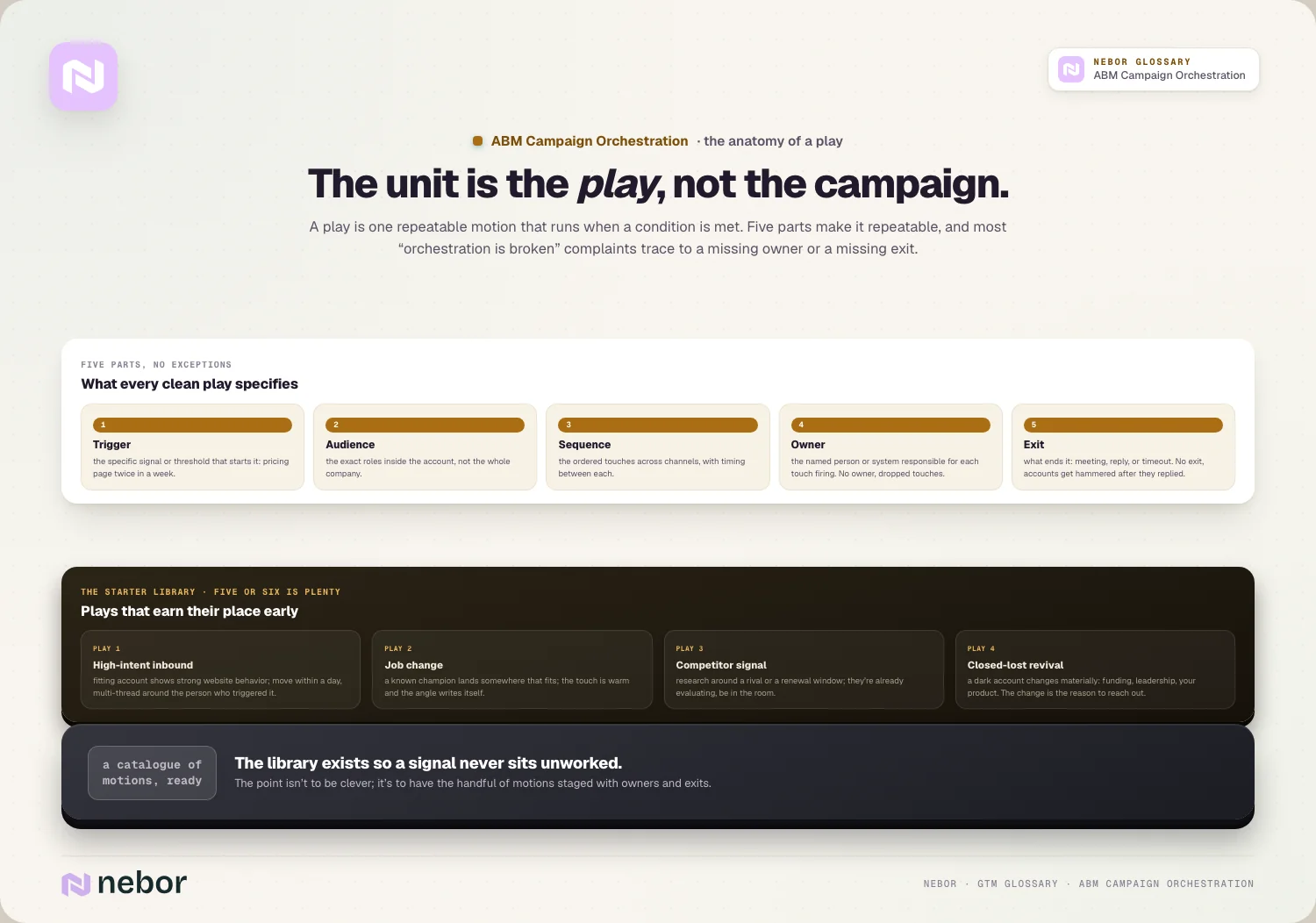
A trigger, the specific signal or threshold that starts it, like an account hitting your pricing page twice in a week.
An audience, meaning the exact roles inside the account that the play should reach.
A sequence, the ordered set of touches across channels, with timing between each.
An owner, the named person or system responsible for each touch actually happening.
An exit condition, what ends the play, whether that's a booked meeting, a reply, or a timeout.
A team's play library is just the catalogue of these motions. When a play has no owner, touches get dropped. When it has no exit condition, accounts keep getting hammered with messages long after they replied.
Most of the "orchestration is broken" complaints we hear trace back to a missing owner or a missing exit condition, and almost never back to the strategy.
A few plays worth keeping in your library from the start
You don't need fifty plays to do this well, because five or six with clear triggers cover most programs. These are the ones we end up building for almost every client.
The high-intent inbound play kicks in when a fitting account shows strong website behavior, like repeat pricing-page visits. It moves fast, within a day, and multi-threads the committee around the person who triggered it.
The job-change play activates when a known champion or buyer lands at a new company that fits. You already have a relationship, so the touch is warm and the angle writes itself.
The competitor-signal play opens when an account shows research around a rival, or when a renewal window comes up on the tool they already use. The angle is timing, because they're already evaluating, and you want to be in the room.
The closed-lost revival play wakes up accounts that went dark months ago, when something material changes, like new funding, new leadership, or a relevant product launch on your side. The change itself hands your rep the reason to get back in touch, which reads far better than a check-in the calendar told you to send.
Each of these has the same five parts, a trigger, an audience, a sequence, an owner, and an exit. None of this needs to be clever, because the value is in having a handful of motions ready so a signal never goes unworked.
How to tell whether your ABM orchestration is working or just looking busy
Channel count is a vanity metric, and we tell clients to drop it as a measure of success altogether. What you want to know is whether coordinated motions are producing pipeline from accounts you chose on purpose.
The first number to watch is speed, meaning the time from a signal landing to the first relevant human touch. If that number drifts into weeks, your orchestration is broken no matter how good the messaging is.
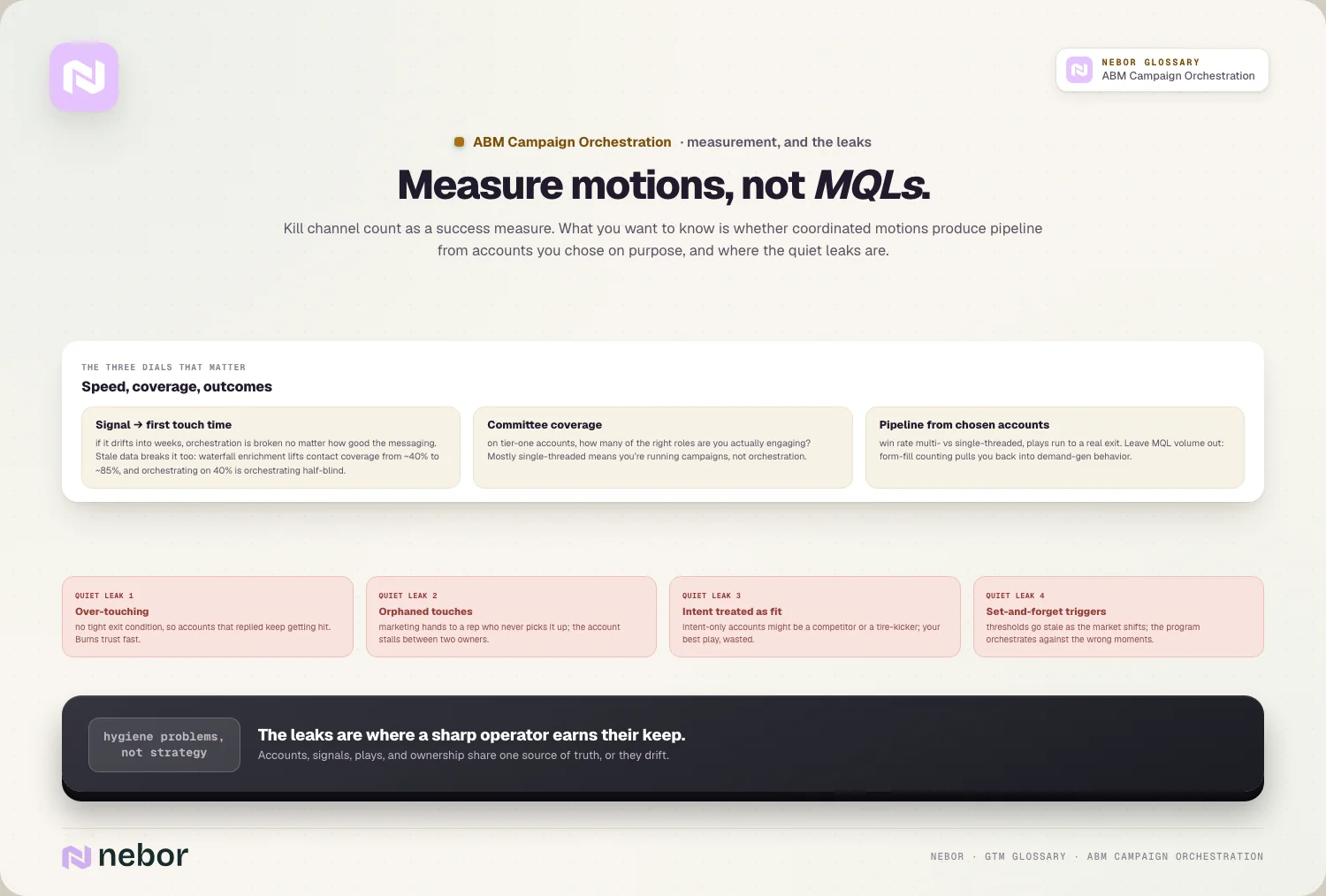
Committee coverage is the second number worth watching, so ask how many of the right roles you're engaging inside your tier-one accounts. If most of your deals are single-threaded, what you have is closer to plain campaigns than to orchestration.
Then look at the outcomes that carry real weight. Pipeline created from target accounts, win rate on multi-threaded deals versus single-threaded ones, and how many plays ran to a real exit rather than dying mid-sequence.
We'd leave MQL volume out of the scoreboard completely. Counting form fills pulls you straight back toward demand gen behavior, and it tells you nothing about whether the account moved, so measure the accounts and the motions themselves instead of raw lead counts.
Where ABM campaign orchestration breaks down in practice
ABM orchestration is only as good as the data feeding it. If your contact data is stale, every downstream touch lands on the wrong person or bounces.
Serious programs do waterfall enrichment before orchestrating anything, passing each contact through multiple providers in sequence to lift coverage from roughly 40% with a single provider to around 85% across the full waterfall. Orchestrating on 40% coverage means orchestrating half-blind.
The second failure we see is a plain lack of alignment between the two teams. When marketing picks target accounts without sales input, reports leads without sales accepting them, and leaves sales feedback outside the system, orchestration becomes two teams working parallel campaigns that never connect.
ABM orchestration forces sales and marketing to plan, send, and measure the same plays together. That forcing function is most of the value.
In practice we build this layer in Clay, where the account list, the enrichment, the signal thresholds, and the routing to email and LinkedIn live in one place instead of four disconnected tools.
The tool isn't the point, and a Clay build won't save a team that skipped the thinking, the pattern behind most failed Clay implementations. The point is that accounts, signals, plays, and ownership share one source of truth or they drift.
The slow leaks that drain even a well-funded orchestration program
The loud failures get noticed and fixed quickly, but these four bleed a program for months before anyone looks their way, and the earlier you catch them the cheaper they are.
The first leak shows up as over-touching, where accounts that already replied keep getting hit by plays still going in the background because nobody set a tight exit condition. It annoys buyers and burns trust fast.
The second leak is the orphaned touch, where a play hands off from marketing to a rep, the rep never picks it up, and the account stalls between two owners who each think the other has it.
The third leak comes from treating intent as fit. An account that fits and shows intent is gold. An account that only shows intent might be a competitor, a student, or a tire-kicker, and spending your best play on it wastes the effort.
The fourth leak is the set-and-forget program, where triggers that made sense six months ago go stale as your market shifts. If nobody revisits the thresholds, the program ends up orchestrating against the wrong moments.
Every one of these is a hygiene problem before it's a strategy problem, and hygiene is exactly where a sharp operator earns their keep.
What ABM campaign orchestration looks like when a real play kicks off
A target account that fits the ICP lands on your pricing page twice in five days, and that second visit trips the trigger. Clay then enriches the three people on that account who match your buyer roles and checks they're still in seat.
This is the same website visitor workflow we use to turn anonymous pricing-page traffic into named pipeline.
Within a day, the champion sees a LinkedIn ad referencing the problem they were pricing, the economic buyer gets a short personalized email from the AE tied to that exact use case, and the AE books time referencing the page visit directly.
That's one trigger moving three coordinated roles on purpose, all inside 48 hours, and everything slower or more generic is just a campaign with extra steps.
So the real test of your orchestration is a simple one. Can one real signal move a coordinated, contact-level motion into the right hands before the moment goes cold? Once that loop is tight, everything else in the program compounds on top of it.
Share this post
ABM
Marketing
Automation
Glossary
Related glossary items
Understanding the core GTM concepts




Ready to build your pipeline











