
In this post:
An AI BDR is a set of AI agents that does the outbound prospecting a business development rep used to do by hand. It finds target accounts, researches them, enriches the contacts, writes personalized cold outreach, and follows up across email and LinkedIn until someone replies.
The name borrows from the human role. A BDR, or business development rep, chases new business through cold outbound, while an SDR usually works inbound leads. An AI SDR and an AI BDR overlap a lot in practice, but the BDR side leans outbound and net-new.
TL;DR
Most "AI BDR" products are a cold email sequencer with an LLM writing the copy. That's the easy 10% of the job.
A real AI BDR is the whole outbound motion handled by agents, list building, research, enrichment, personalization, sending, and follow-up, with a human taking the live conversations. It only works if the targeting, the data, and the email infrastructure underneath it are solid.
If you point a clever model at a bad list and weak deliverability, you don't get a BDR, you get spam at scale. The AI is the smallest part, and the system around it is the actual job.
So what does an AI BDR actually do, step by step, once you put it to work?
An AI BDR takes over the outbound motion a human BDR used to grind through by hand. The work breaks into a clear chain, and agents handle each link in it.
It starts from a buying signal or an ICP and builds the list of target accounts and contacts. Then it researches each account, fills in the missing data, and writes outreach personalized to what it found.
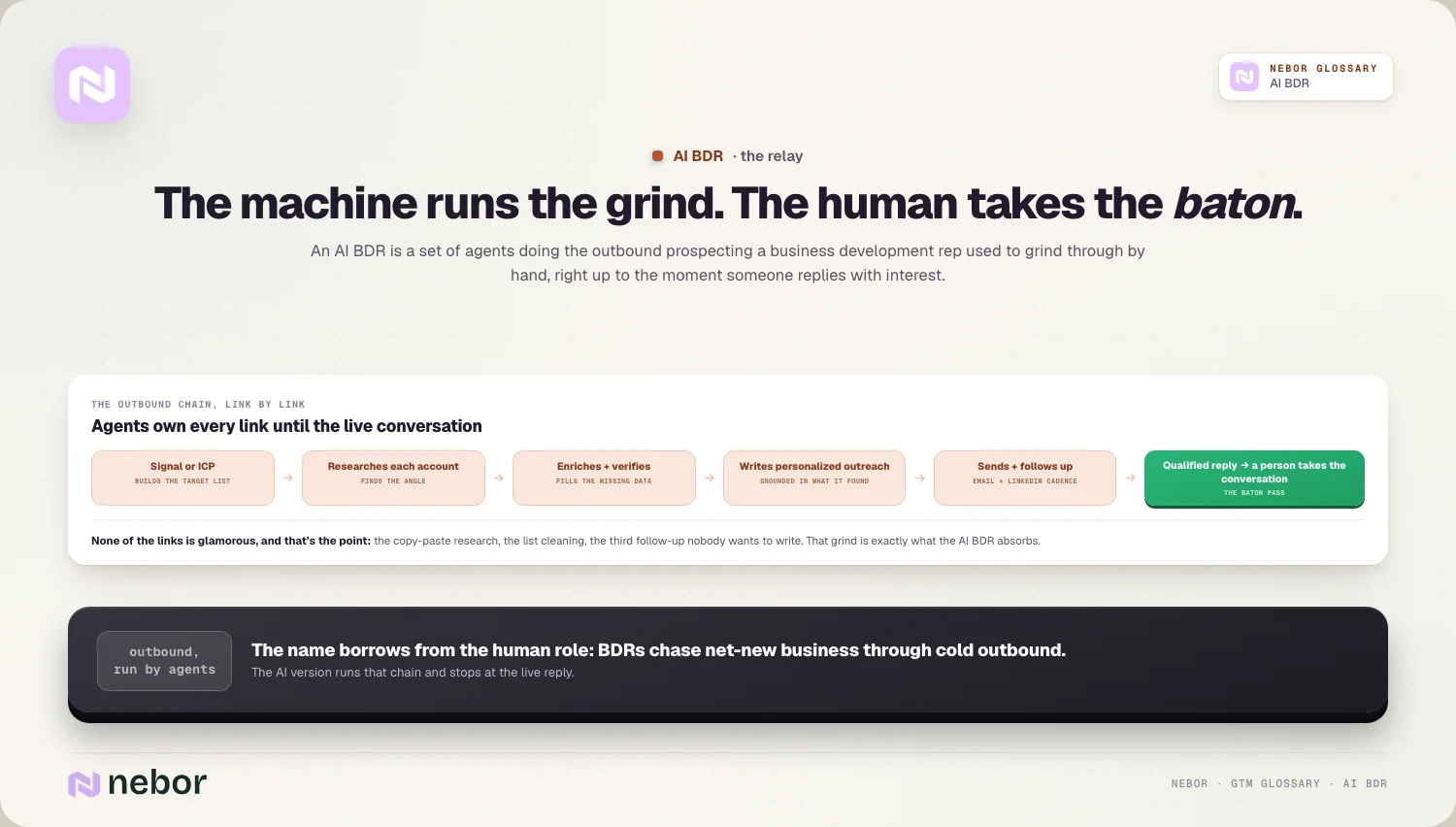
From there it sends across email and LinkedIn, follows up on a set cadence, and watches for replies. When someone responds with interest, it qualifies the reply and hands the conversation to a person.
None of those steps is glamorous on its own. The grind a human BDR hated, the copy-paste research, the list-cleaning, the third follow-up nobody wants to write, is exactly the part an AI BDR is built to absorb.
Why the line between an AI BDR and an AI SDR stays so blurry in real life
The two names come from the human roles, and those never had clean edges either. A BDR chases new business through cold outbound. An SDR usually works inbound leads and qualifies them.
So an AI BDR leans outbound and net-new, while an AI SDR leans inbound and qualification. In real products the two blur, because most tools do overlapping things and the label is mostly marketing.
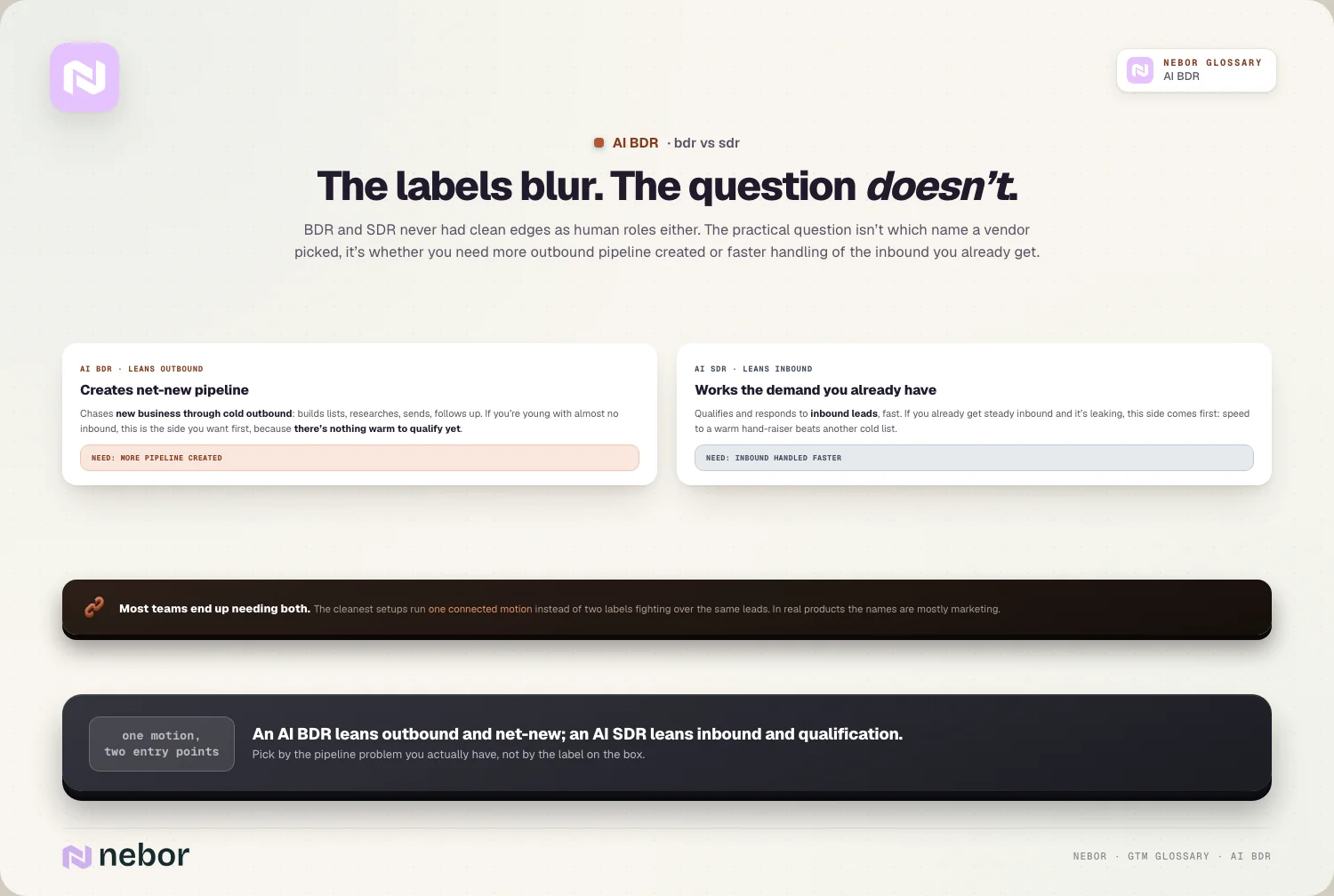
The practical question isn't which name you pick. It's whether you need more outbound pipeline created, or faster handling of the inbound demand you already get. That tells you which side to lean on.
If you're a young company with almost no inbound, you mostly want the BDR motion, because there's nothing warm to qualify yet. If you already get steady inbound and it's leaking, you want the SDR side first.
Almost everyone ends up needing both eventually, which is why the cleanest setups build one connected motion instead of two labels fighting over the same leads.
How an AI BDR works inbound signals too, and doesn't just hammer a cold list
The outbound framing is only half the picture now. The best AI BDR setups don't just work a cold list, they react to inbound signals the moment those appear.
When a great-fit company deanonymizes on your site, fills in a form, or engages your content, that's a warm reason to reach out. An AI BDR can catch that signal, research the account, and start a relevant conversation while the interest is still fresh.
That's really inbound-led outbound, and it beats untargeted cold outreach every time. We build a lot of this directly, like the website visitor workflow that turns anonymous traffic into named, timely outreach.
Timing is what makes this worth the wiring. A cold prospect has no reason to care today, but a warm one just told you they care by viewing your pricing page or reading a comparison post. An AI BDR that watches for those moments gets to skip the cold-start problem entirely on a slice of its pipeline.
Let's break down the different kinds of AI BDR you'll meet in the wild
Not every "AI BDR" means the same thing, and the gap between them is huge. It helps to sort them by how much of the motion they really cover.
The first kind is the sequencer with a writing layer. It sends cold email, maybe adds a LinkedIn step, and uses an LLM to draft the copy. You still feed it the list and the data, so it automates the typing while the thinking stays your job.
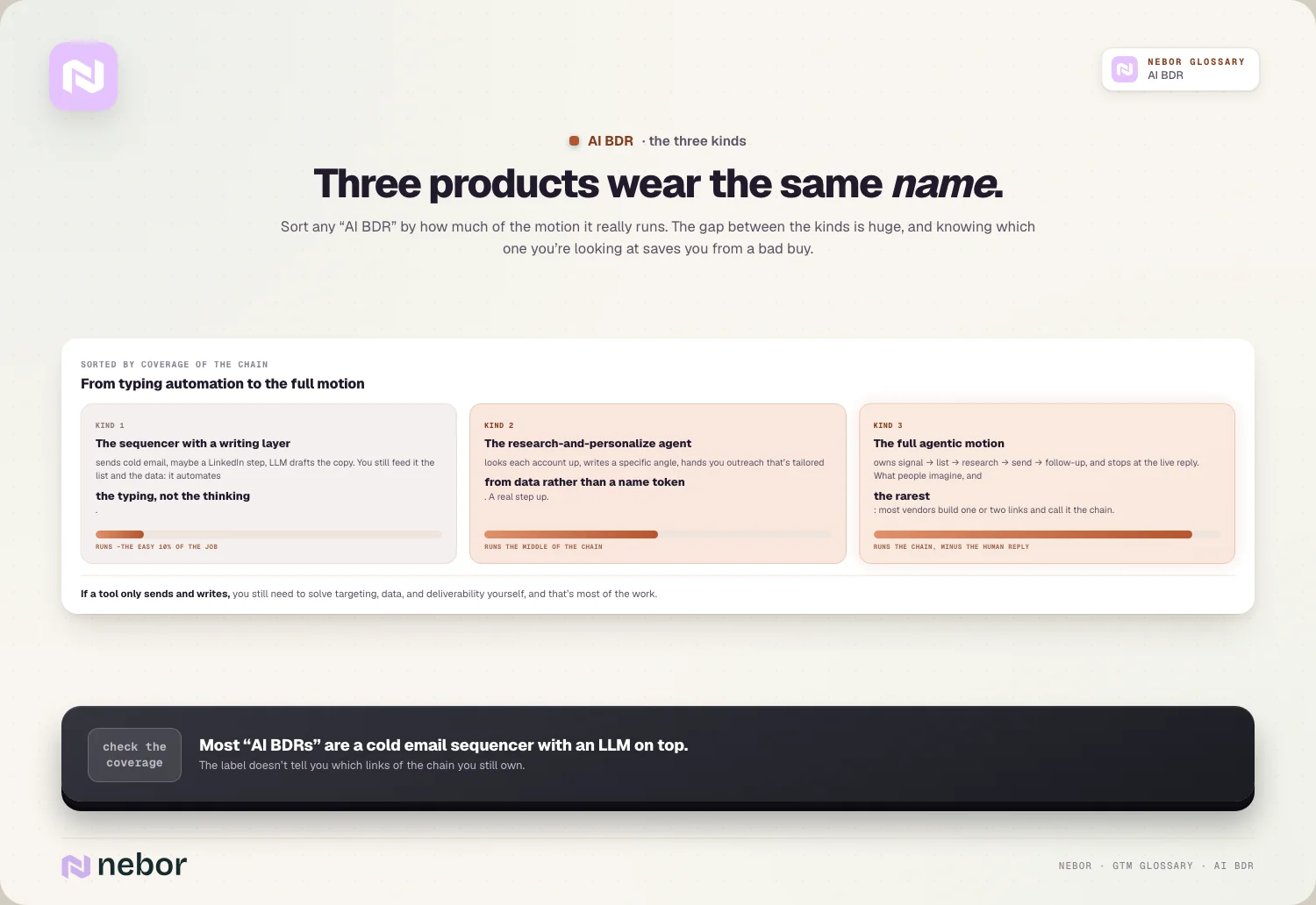
The second kind is the research-and-personalize agent. It takes a list, looks each account up, writes a specific angle, and hands you outreach that's actually tailored. That's a real step up, because the personalization comes from data rather than a name token.
The third kind is the full agentic motion. It owns the chain from signal to list to research to send to follow-up, and only stops at the live reply. This is what people imagine when they hear "AI BDR," and it's the rarest, because most vendors only build one or two links of the chain and call it the whole thing.
Knowing which kind you're looking at saves you from a bad buy. If a tool only sends and writes, you still need to solve targeting, data, and deliverability yourself, and that's most of the work.
Why an AI BDR is only ever as good as the data and infrastructure under it
The demos never show you this part. The AI writing the email is the easy part, and everything underneath it is the hard part.
An AI BDR sending to a bad list just reaches the wrong people faster. If it reasons over thin data, the personalization is weak, and if it sends from poorly set up domains, even great emails land in spam. Deliverability is doing more for your reply rate than the model is.
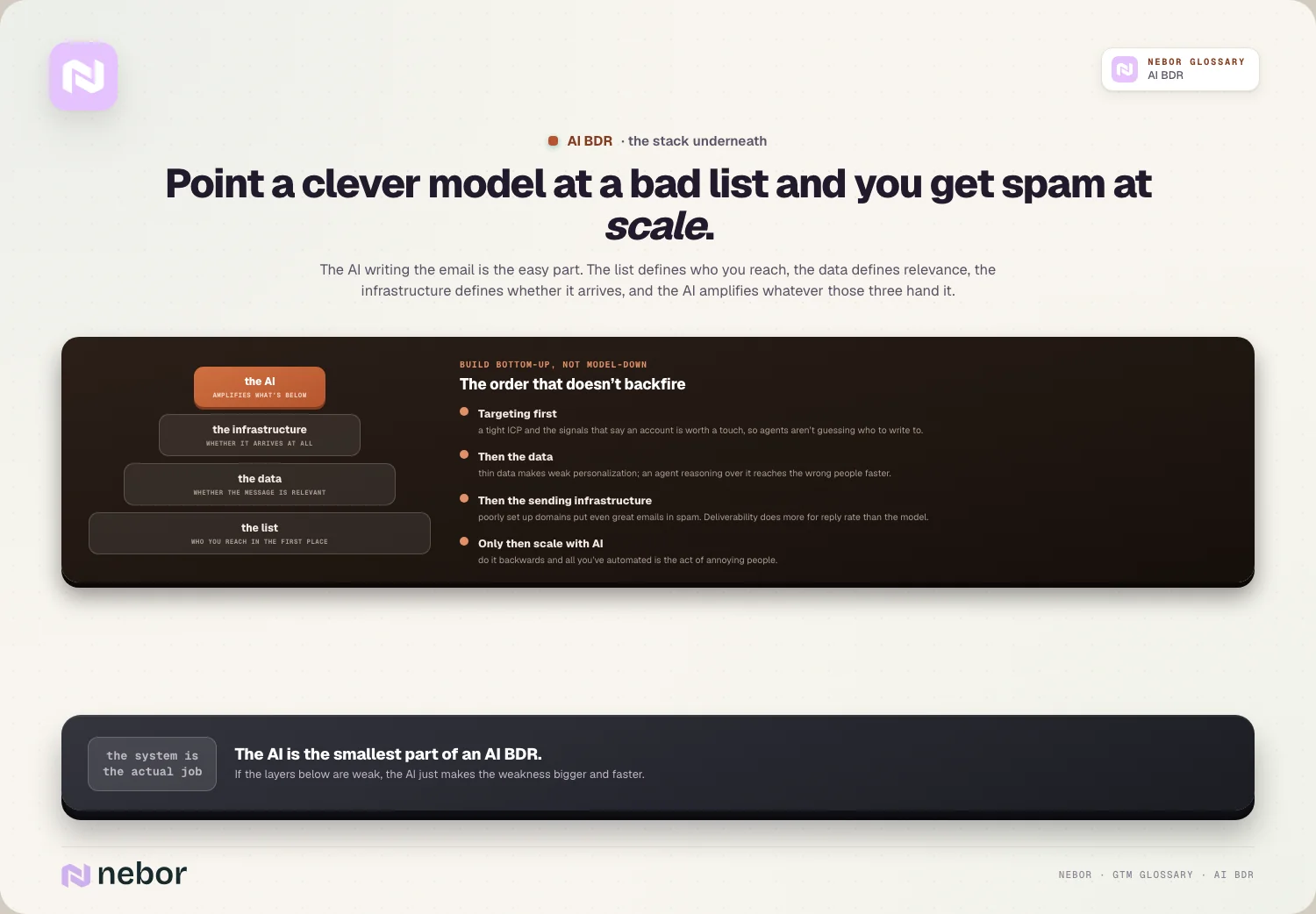
So the order of operations matters more than the model. Get the targeting, the data, and the sending infrastructure right first, and then let the AI scale it. If you do it backwards, all you've automated is the act of annoying people.
The whole thing works like a stack. The list defines who you reach, the data defines whether the message is relevant, and the infrastructure defines whether it arrives at all.
The AI is built on top of those three and scales whatever they hand it, good or bad. If the layers below are weak, the AI just makes the weakness bigger and faster.
How to set up an AI BDR in the right order so it doesn't backfire
If you want an AI BDR to work, you build from the bottom of that stack up, and the model comes last. Plenty of setups go backwards, and those are the ones wondering why the replies never come.
Targeting comes first in that build order. Define a tight ICP and the signals that say an account is worth a touch, so the agents aren't guessing who to write to. A smaller, sharper list has beaten a giant vague one every time we've tested it.
Then fix the data and the sending. Make sure the contact data is fresh and verified, and warm your domains before you scale volume, because cold domains and bad data sink campaigns no matter how good the copy is.
Only once those are solid do you let the AI write and send at scale, and even then you watch the early sends by hand.
This order feels slow, and that's the point. The teams that rush straight to "AI writes my emails" are the ones burning domains and reputations a month later.
What an AI BDR genuinely takes off a rep's plate, and what stays human
It pays to be concrete about which jobs an AI BDR really owns, because the pitch is usually vague. The work it takes over is the repetitive top-of-funnel grind.
On the prep side, it builds and cleans target lists, enriches and verifies contacts, and researches each account for a relevant angle. On the sending side, it drafts the first touch, works the sequence across channels, and chases the follow-ups nobody enjoys writing.
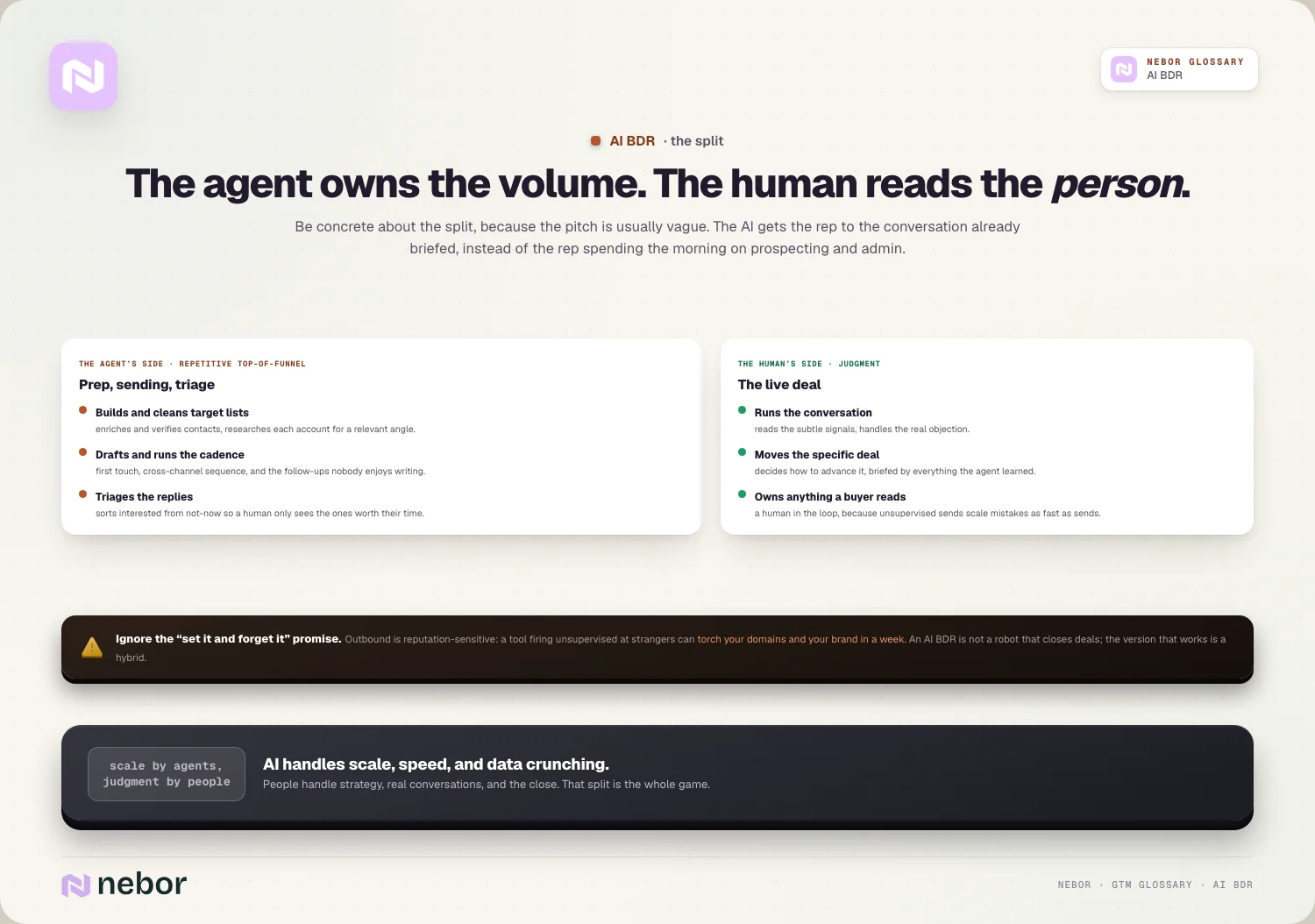
It also triages replies, sorting interested from not-now so a human only sees the ones worth their time.
What stays human is everything that needs judgment. A person handles the live conversation, reads the subtle signals, handles the real objection, and decides how to move a specific deal forward. The AI gets the rep to that conversation already briefed, instead of the rep spending the morning on prospecting and admin.
That split, honestly, is the whole game. Let the agent own the volume and the prep, and keep the human on anything that requires reading a person.
The honest version of an AI BDR, and the hype you can safely ignore
Nobody should sell you an AI BDR as a machine that closes deals, and anyone who does is selling the hype.
The version that works is a hybrid. AI handles the scale, the speed, and the data crunching, and people handle the strategy, the real conversations, and the close. The reps we work with lose most of their day to prep work, and that prep is exactly what an AI BDR takes off their plate.
The line to hold is a simple one. Let agents take the repetitive top-of-funnel work, but keep a human in the loop on anything a buyer reads. Fully autonomous outbound with no person watching scales mistakes as fast as it scales sends.
The hype to ignore is the "set it and forget it" promise. Outbound is reputation-sensitive, and a tool blasting unsupervised at strangers can torch your domains and your brand in a week. Treat full autonomy as a risk you manage instead of a feature you chase.
What common mistakes sink most AI BDR setups before they get going
Plenty of teams buy an AI BDR, use it for a quarter, and quietly switch it off. The failures rhyme, and they're almost never about the AI itself.
The first mistake is starting with volume. Teams crank the sends before the list, data, and domains are ready, and they burn their sender reputation fast. The second is skipping personalization grounded in a real detail, so every email reads like the same template with a name swapped in.
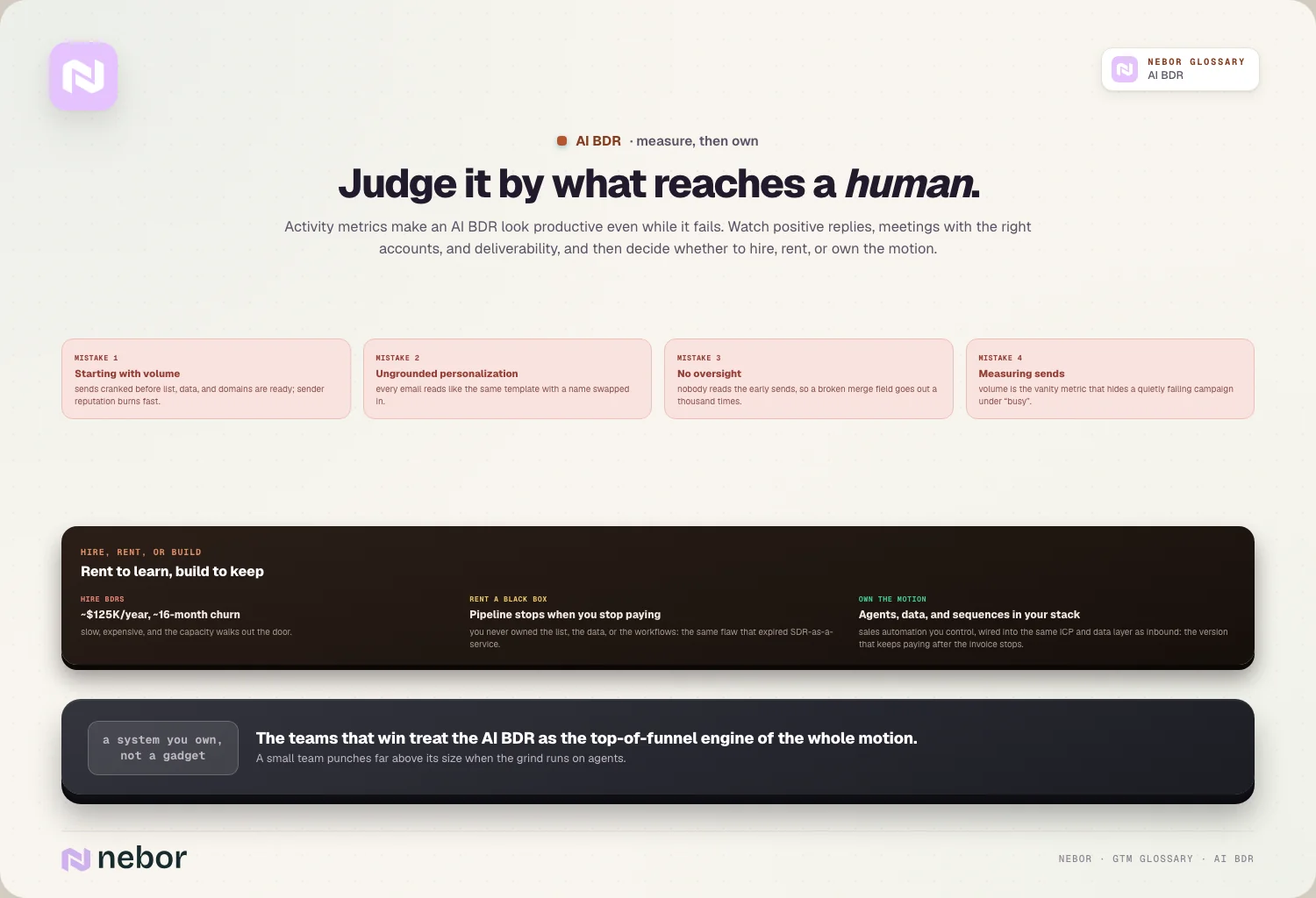
The third is going in with no oversight. When nobody reads the early sends, small errors, a broken merge field, a wrong company name, go out a thousand times.
The fourth is measuring the wrong thing, watching messages sent instead of positive replies and meetings, so a campaign that's failing still looks busy and fine.
All four failures share the same cure. Go slower at the start, ground every message in real data, keep a human watching, and judge the whole thing by what reaches a real conversation.
How you should measure whether your AI BDR setup is truly working
An AI BDR is easy to misread, because activity metrics make it look productive even when it's failing. The trick is to watch outcomes and let the volume numbers stay in the background.
The numbers that matter are reply rate, positive reply rate, and meetings booked with the right kind of account. Sheer send volume is the vanity metric that hides every problem underneath, from a bad list to weak deliverability.
Watch deliverability signals too, like bounce rate and spam complaints, because those tell you whether your messages even arrive. And watch qualification accuracy, because an AI BDR that books lots of meetings with the wrong people wastes your reps' time and trains them to ignore it.
Judge it by the quality of what reaches a human rather than the quantity of what it did.
Do you need to hire BDRs, buy an AI BDR, or build the motion yourself?
This is where a lot of teams pick the wrong door. Hiring a stack of BDRs is slow and expensive, and in-house reps can cost around $125K a year and still churn within about 16 months.
Renting a black-box AI BDR product has its own trap. When you stop paying, the pipeline stops, and you never owned the list, the data, or the workflows. That's the same flaw that made SDR-as-a-service expire.
The third option is to build the outbound motion as a system you own. The agents, the data, and the sequences live in your stack as sales automation you control. That's the version that keeps paying off after the invoice stops.
There's no single right answer for every company. A tiny team testing a new market might rent first to learn fast, then build once the motion proves out. The thing to avoid is renting forever, because you keep paying and never accumulate an asset of your own.
Where an AI BDR fits inside the wider go-to-market system you own
An AI BDR isn't a standalone gadget. It's one motion inside a larger go-to-market system, and it works best when it's wired into the rest of it.
That means it should share the same ICP, the same data layer, and the same definition of a good lead as your inbound and marketing motions. When the BDR agents and the inbound workflows draw from the same source of truth, a signal caught in one place can trigger action in another.
It also means the handoff to your human reps has to be clean. The AI does the prospecting and the prep, then passes a warm, well-researched lead into the same pipeline your reps already work, with everything it learned attached.
When it's built this way, the AI BDR feels like part of the team rather than a separate tool bolted onto the side, and that's the version we aim for in every build.
The teams that get the most out of it stop thinking of it as "the cold email robot" and start thinking of it as the top-of-funnel engine for the whole motion. That reframing is what turns it from a point tool into real, durable capacity.
The future here isn't a salesperson replaced by software. It's a small team that punches far above its size, because the grind that used to cap their output now belongs to agents, and the people spend their hours on the part of the job only people can do.
Share this post
AI SDR
AI
Outbound
Glossary
Related glossary items
Understanding the core GTM concepts

Ready to build your pipeline











