
In this post:
For a lot of sales teams, producing a quote is one of the most painful parts of the whole deal. Your rep digs through a price list, works out which options the customer needs and what discount to give, checks that it's allowed, chases an approval, and finally builds the proposal.
All of that can eat days on a deal the buyer wanted priced yesterday.
CPQ software exists to collapse that whole ordeal into minutes. It guides the rep through configuring the right product, applies the correct pricing automatically, routes any approvals that are needed, and generates a clean, accurate quote, turning a slow and error-prone task into a fast and reliable one.
CPQ stands for Configure, Price, Quote, and it refers to software that automates building an accurate customer quote by helping reps select the right product configuration, apply the correct pricing and discount rules, and generate the proposal. It replaces the manual work of assembling quotes by hand.
The reason it has become so important is that quoting is both time-consuming and easy to get wrong when done manually. Quote creation is one of the biggest non-selling time sinks reps face, and CPQ removes most of that burden while also preventing the pricing errors that manual quoting inevitably produces.
TL;DR
CPQ is software that automates configuring a product, applying pricing and discount rules, and generating a quote, replacing the slow manual assembly of proposals by hand.
It makes quoting dramatically faster, often turning a process that took days or weeks into one that takes minutes, which frees your reps to spend their time actually selling.
It also enforces accuracy and pricing discipline, because it applies the correct rules and guardrails automatically instead of relying on each rep to price and discount by hand.
It matters most for companies selling complex or configurable products, and for subscription businesses juggling tiers, usage, and contract lengths, where manual quoting breaks down fastest.
What the three letters in CPQ stand for and what each step does
The name describes the three jobs the software handles in sequence, starting with configure. This is where the rep selects the right combination of products, options, and add-ons for the customer, with the software guiding the choices and preventing invalid combinations that wouldn't work together.
The price step is where the system applies the correct pricing to that configuration automatically. Instead of a rep looking up list prices and calculating discounts by hand, CPQ applies the relevant pricing rules, volume breaks, and discount policies, so the number that comes out is both accurate and allowed.
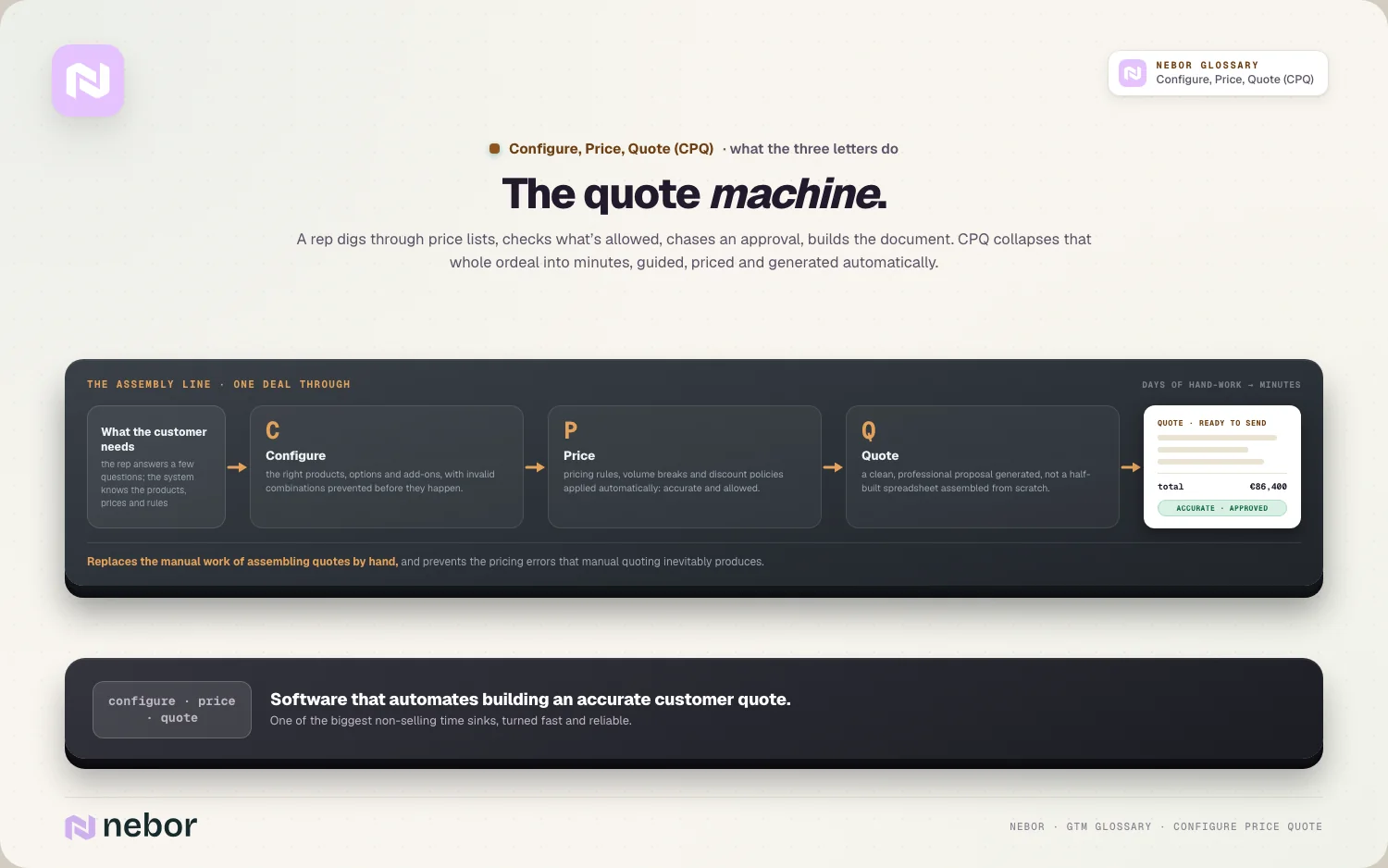
The quote step turns all of that into a finished proposal the customer can act on. The software generates a clean, professional document with the configured products, correct pricing, and terms, so the rep ends up with a ready-to-send quote instead of a half-built spreadsheet or a Word file assembled from scratch.
Why manual quoting is so slow and so prone to costly pricing errors
The problem CPQ solves is that quoting by hand is one of the quiet time sinks that drains a sales team. Research has found that quote creation is the single biggest non-customer-facing task in sales, consuming around 17% of a rep's time, time that could otherwise go toward real selling.
Manual quoting is slow because it strings together several fiddly steps that each invite delay. A rep has to find the right products, calculate pricing, confirm the discount is permitted, chase an approval, and build the document, and any one of those can stall a deal for days while the buyer waits and cools.
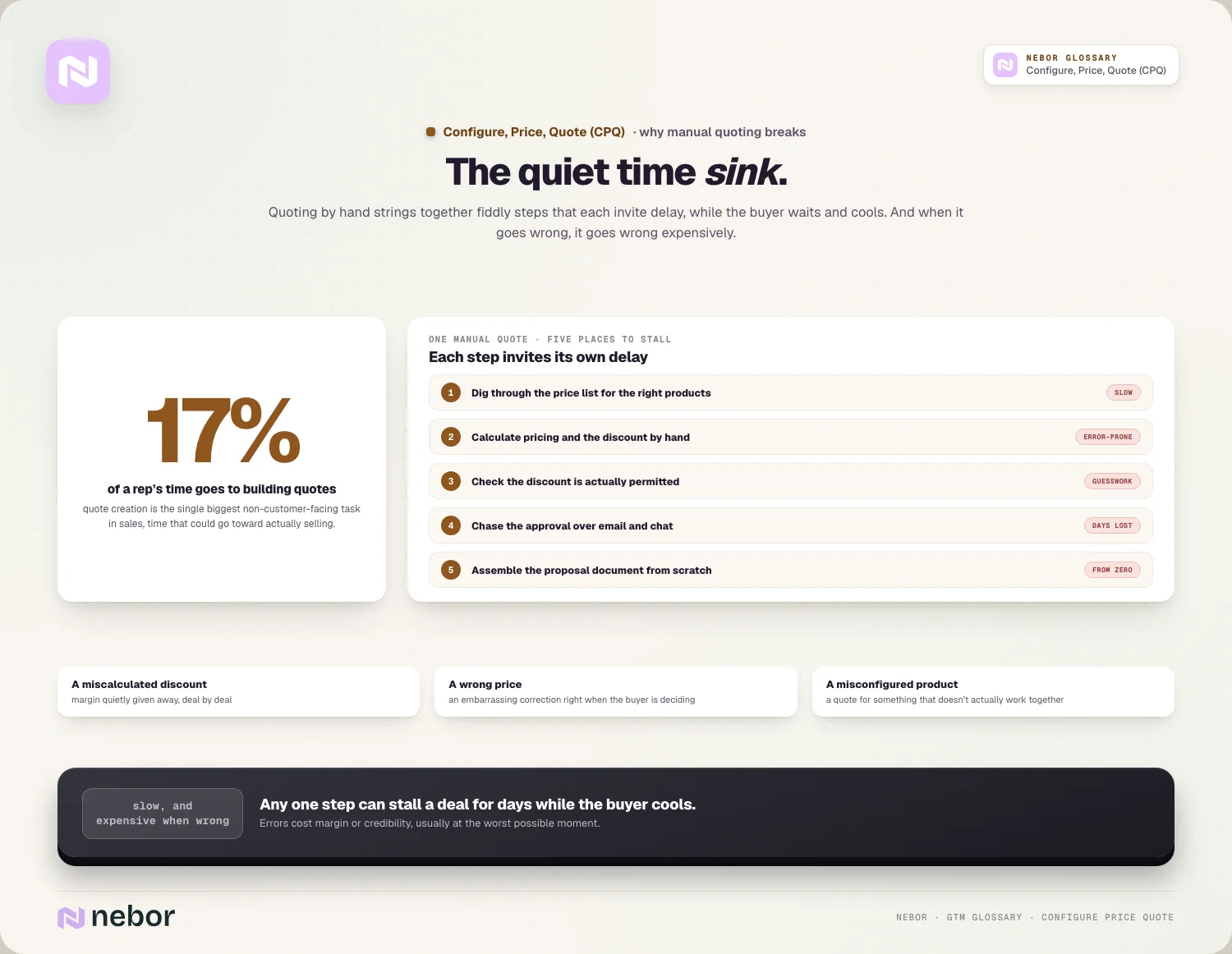
It's also a reliable source of errors that can be truly expensive. A miscalculated discount, a wrong price, or a misconfigured product can produce a quote that either loses margin or has to be embarrassingly corrected, both of which damage the deal and the company's credibility with the buyer.
How CPQ makes the whole quoting process dramatically faster
The most immediate payoff of CPQ is raw speed, because automating the steps compresses a process that used to take days into one that takes minutes. Many teams find quoting goes close to ten times faster with CPQ than without it, which changes what's possible in a deal.
That speed comes from removing the manual lookups and calculations entirely. Because the software already knows the products, prices, and rules, the rep answers a few questions about what the customer needs and the system assembles an accurate quote, with no piecing it together from scratch each time.
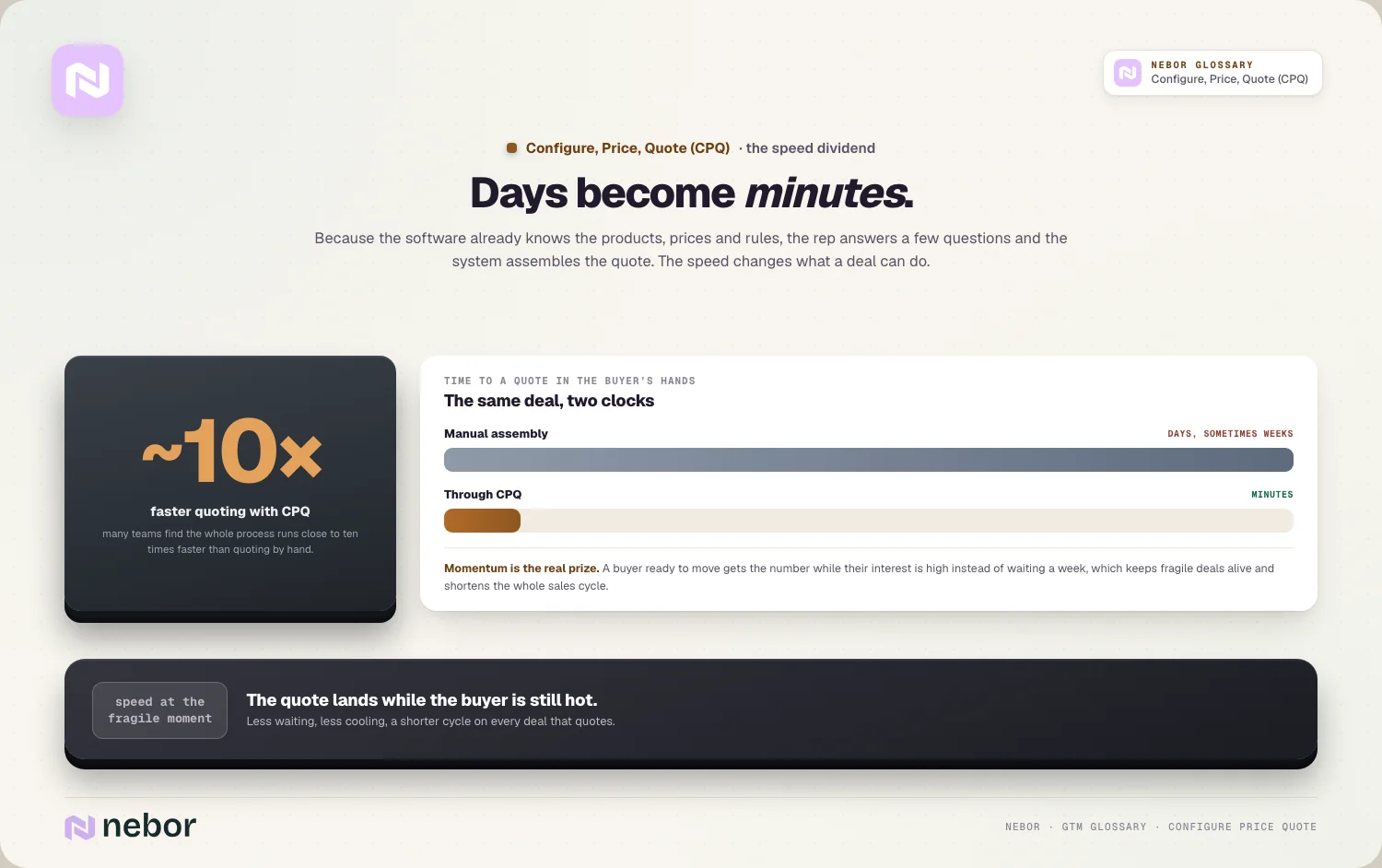
The effect on deals is more than convenience, because faster quoting keeps momentum alive at a fragile moment. A buyer ready to move can get a quote while their interest is high instead of waiting a week, which reduces the chance the deal loses momentum and shortens the overall sales cycle.
Why CPQ enforces pricing discipline and cuts errors at the same time
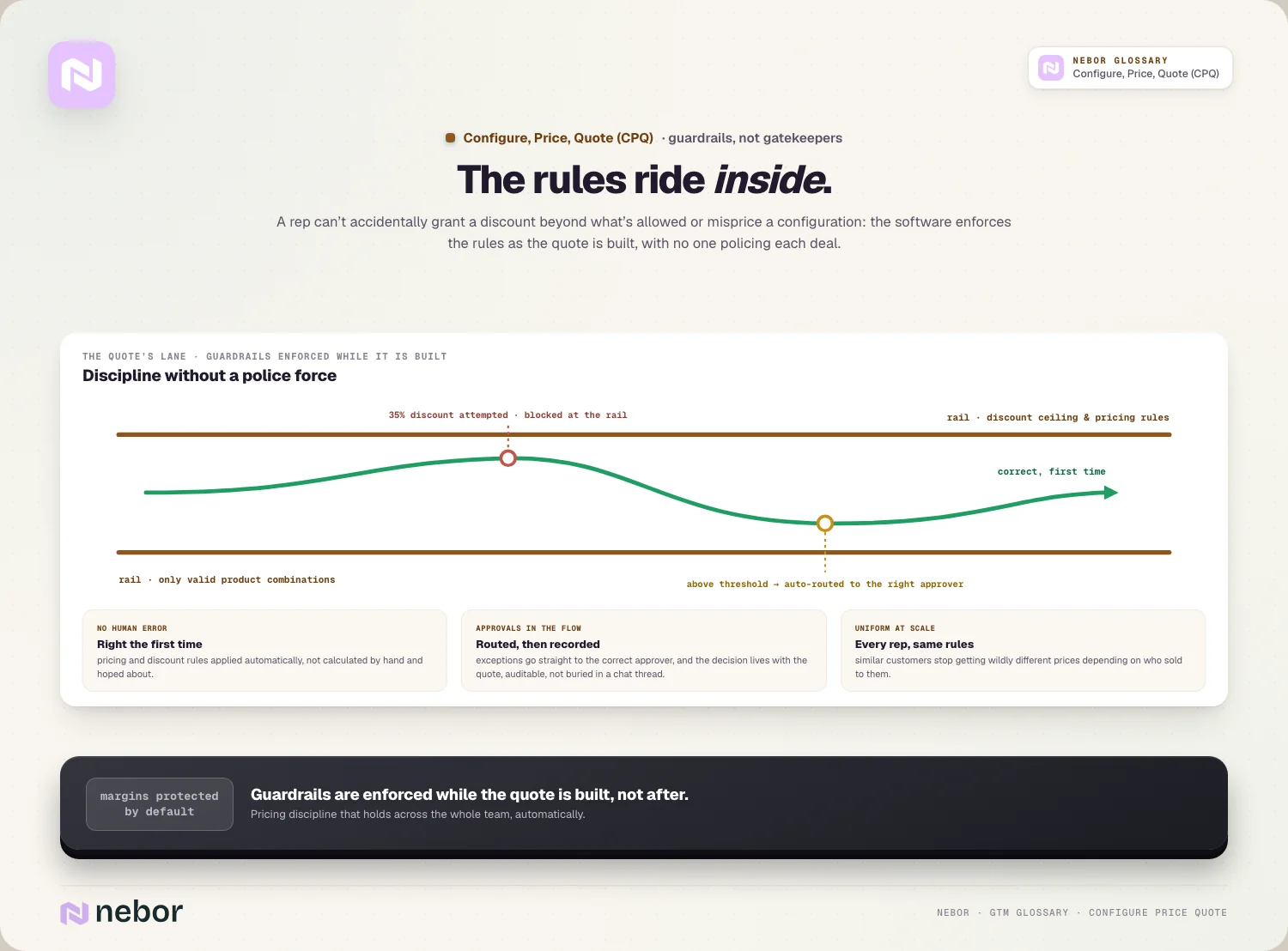
Beyond speed, one of CPQ's most valuable jobs is enforcing accuracy so quotes come out right the first time. Because the system applies pricing and discount rules automatically, it removes the human calculation errors of manual quoting, so the quote a customer receives is correct rather than roughly correct.
It also builds pricing guardrails directly into the quoting process. A rep can't accidentally grant a discount beyond what's allowed or misprice a configuration, because the software enforces the rules as the quote is built, which protects margins across the whole sales team without anyone policing each deal.
This consistency matters more the larger a company gets. When many reps across territories all quote through the same system, pricing stays uniform and disciplined, so the company avoids the drift where similar customers end up with wildly different prices depending on who happened to sell to them.
How CPQ handles approvals and routing without the usual chaos
Getting a non-standard deal approved is often where manual quoting bogs down, and CPQ builds that step into the flow. When a quote needs sign-off, such as a discount above a threshold, the system routes it automatically to the right approver instead of leaving the rep to chase people over email and Slack.
This automated routing removes the guesswork and delay from approvals, and we tell clients it's often the biggest single time saver.
The software already knows which deals need review and who has to approve what, so an exception moves straight to the correct person and back, instead of stalling while a rep figures out whose permission they need.
Handling approvals inside the quoting flow also keeps a clean record of what was approved and why. Instead of a decision buried in a chat thread, the approval lives with the quote, which makes the whole process auditable and prevents the confusion that comes from scattered, informal sign-offs.
Why CPQ matters especially for subscription and SaaS businesses
CPQ is valuable for anyone selling configurable products, but subscription businesses find it particularly essential because their pricing is so complex. A SaaS deal can mix tiers, usage-based components, varying contract lengths, and add-ons, all of which multiply the ways a manual quote can go wrong.
The software is built to handle exactly that variability automatically. Instead of a rep manually working out the price of a two-year, tiered, usage-based subscription with a few add-ons, CPQ applies the right rules to each element and produces an accurate number, which would be painfully error-prone by hand.
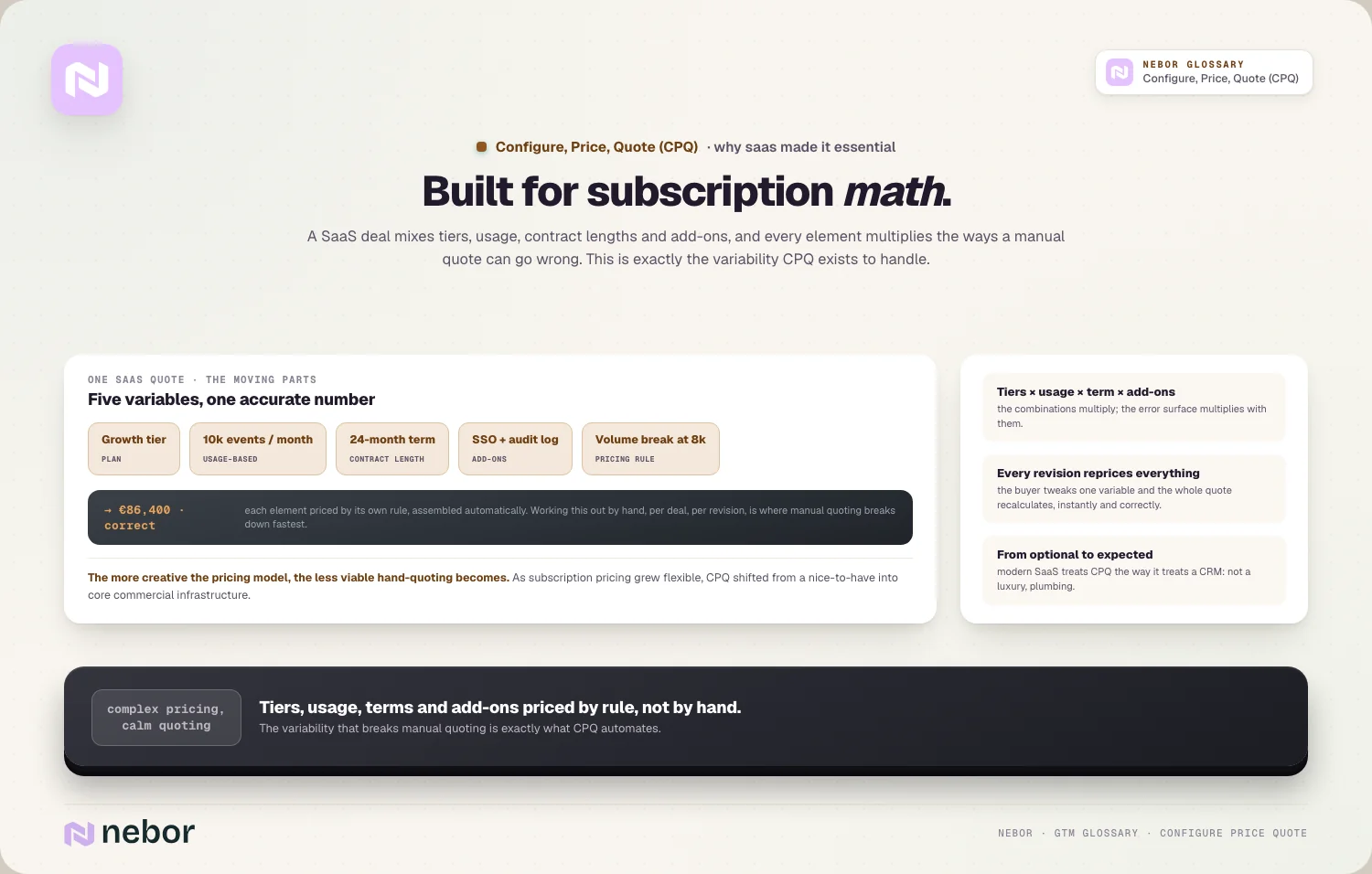
This is why CPQ has moved from optional to expected in modern SaaS. As subscription pricing models have grown more flexible and creative, quoting them manually has become impractical, so the software that automates it has shifted from a nice-to-have into core commercial infrastructure.
How CPQ works alongside a deal desk on your most complex deals
CPQ and a deal desk are complementary instead of competing, because they handle different parts of the same problem. CPQ automates the standard deals that fit within the rules, while the deal desk handles the genuinely unusual ones that fall outside what the software can approve on its own.
This division of labor is what makes both efficient. Because CPQ handles the routine quoting and enforces guardrails, the deal desk isn't buried in ordinary deals and can focus its attention on the truly complex, non-standard ones that need real judgment.
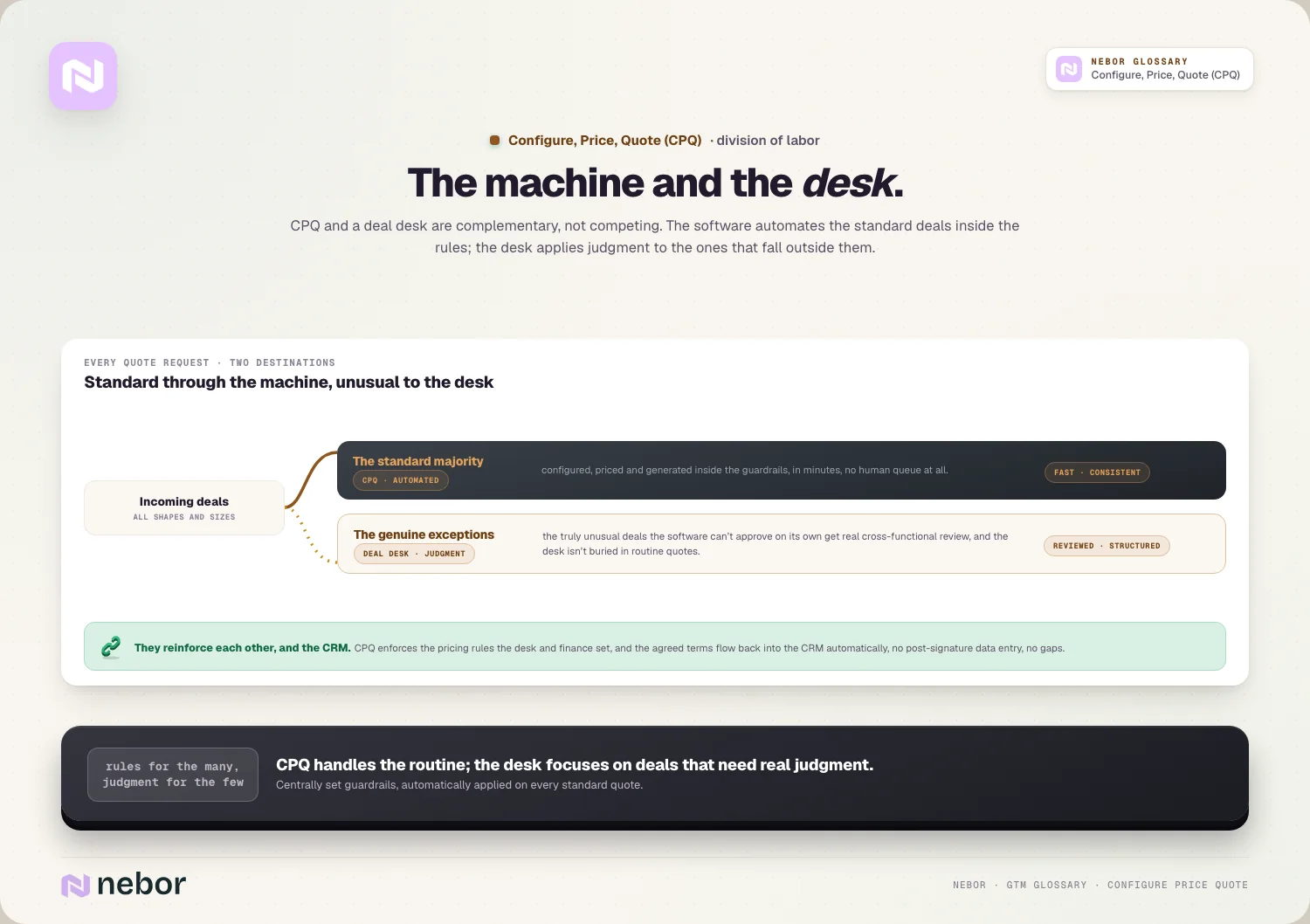
The two also reinforce each other's discipline. CPQ enforces the pricing rules the deal desk and finance set, much as a sales playbook codifies how to sell, so the guardrails a company decides on centrally get applied automatically on every standard quote.
How CPQ connects to your CRM and the rest of the revenue stack
CPQ rarely operates in isolation, because it needs to pull from and push back to the systems that hold your customer and product data. It draws on product and pricing information to build quotes, and once a deal is done, it feeds the agreed terms back so the record reflects what was really sold.
That connection is part of why CPQ supports good data quality instead of undermining it. Because the quote data flows into the CRM automatically, it strengthens CRM hygiene by eliminating the manual post-signature data entry that so often introduces errors and gaps.
Seen more broadly, CPQ is one component of the connected revenue operations stack behind the commercial side of a business. It stands alongside tools like a sales engagement platform as a natural piece of the wider workflow orchestration that keeps a go-to-market engine moving.
Why CPQ improves your win rates as well as your team's efficiency
The benefits of CPQ show up in more deals won as well as saved time, because speed and accuracy both help close. A faster, cleaner quoting process removes friction the buyer feels, which protects your win rate on deals that might otherwise stall while a manual quote gets assembled.
Part of that comes from professionalism and trust. A prompt, accurate, well-presented quote signals that the company is easy to do business with and helps your conversion rate, whereas a slow or error-ridden one plants doubt right when a buyer is deciding whether to commit.
The speed also lets reps pursue more deals at once. Because each quote takes minutes instead of days, reps spend far less time on quoting overhead and more on selling, which lifts their overall capacity and their quota attainment across the board.
The common mistakes companies make when they first adopt CPQ
CPQ can disappoint when it's implemented poorly, usually by encoding the wrong rules or over-complicating the setup, and in our experience the rules deserve the most care.
If the pricing logic built into the system is messy or inaccurate, the software just produces wrong quotes faster, so the quality of the rules that go in determines the value that comes out.
Another frequent mistake is making the configuration so rigid that reps can't handle legitimate edge cases. A CPQ system that blocks every unusual but valid deal frustrates reps and pushes them to work around it, so it needs sensible flexibility and a clean escalation path for the exceptions it can't approve.
Adopting CPQ too late is common as well, and we keep seeing teams wait until manual quoting is already causing real pain before investing. By the time quoting errors and delays are hurting deals, the disruption of introducing the software is greater than it would have been if the company had built the foundation earlier.
Why CPQ has shifted from a nice-to-have to core infrastructure
The clearest sign of how much CPQ matters is that it has moved from an optional tool to essential infrastructure for any company selling complex products. As products and pricing have grown more configurable and subscription models more elaborate, quoting them by hand has simply stopped being viable at scale.
That shift reflects a broader truth about modern selling, which is that the mechanics of a deal matter as much as the pitch. A great sales conversation still loses momentum if the quote takes a week and arrives with an error, so the systems that make quoting fast and accurate have become a real competitive factor.
Inside a modern go-to-market system, CPQ is what lets a company sell complex offerings without drowning in quoting overhead.
It handles the configuration, pricing, and paperwork so reps can focus on customers, complementing everything you automate sales prospecting around by making the close as efficient as the outreach.
Share this post
RevOps
CRM
Glossary
Related glossary items
Understanding the core GTM concepts




Ready to build your pipeline











