

In this post:
You spent weeks producing a truly useful whitepaper, published it on your site, and it got a few dozen downloads from people who already knew you. The content is good, but almost nobody who needs it has any idea it exists, which is the quiet frustration behind most great B2B content.
Content syndication is one answer to that reach problem. Instead of waiting for the right buyers to find your content, you pay to place it in front of a publisher's audience, and the people who download it hand over their contact details, turning your existing asset into a steady stream of leads.
Content syndication is the practice of distributing your gated content, like whitepapers and research reports, across third-party publisher networks to generate leads. Prospects access your content in exchange for their contact information, which is delivered to you as an opt-in lead you can then work.
The reason it has become a staple of B2B demand generation is that it converts content you already own into predictable lead volume. Rather than hoping for organic reach, you buy access to a targeted audience and pay per lead, which makes it one of the few channels where you can reliably dial volume up or down.
TL;DR
Content syndication distributes your gated content across third-party publisher networks so their audience downloads it in exchange for contact details, turning existing assets into opt-in leads.
Teams use it mainly for predictable, scalable MQL volume, because you pay per lead on a cost-per-lead model and can scale across a large publisher network instead of being capped by search volume.
Leads typically cost 40 to 120 dollars each, but that headline number is misleading, because the real cost per worked or qualified lead is far higher once nurture and sales effort are added.
It works only with a tight target profile, the right content, and real nurture behind it, because syndication leads are early-stage and rarely ready to buy the moment they arrive.
What content syndication is in practice and how the lead exchange works
Content syndication rests on a simple exchange between three parties, meaning you, a publisher, and a prospect. You provide a valuable gated asset, the publisher places it in front of their relevant audience, and a prospect who wants it fills out a form with their professional details in return for access.
That exchange is what makes the resulting lead permission-based instead of cold. The prospect chose to download your content and consented to be contacted, so unlike a scraped list, a syndication lead is someone who raised their hand for a specific piece of your material, giving you a legitimate reason to reach out.
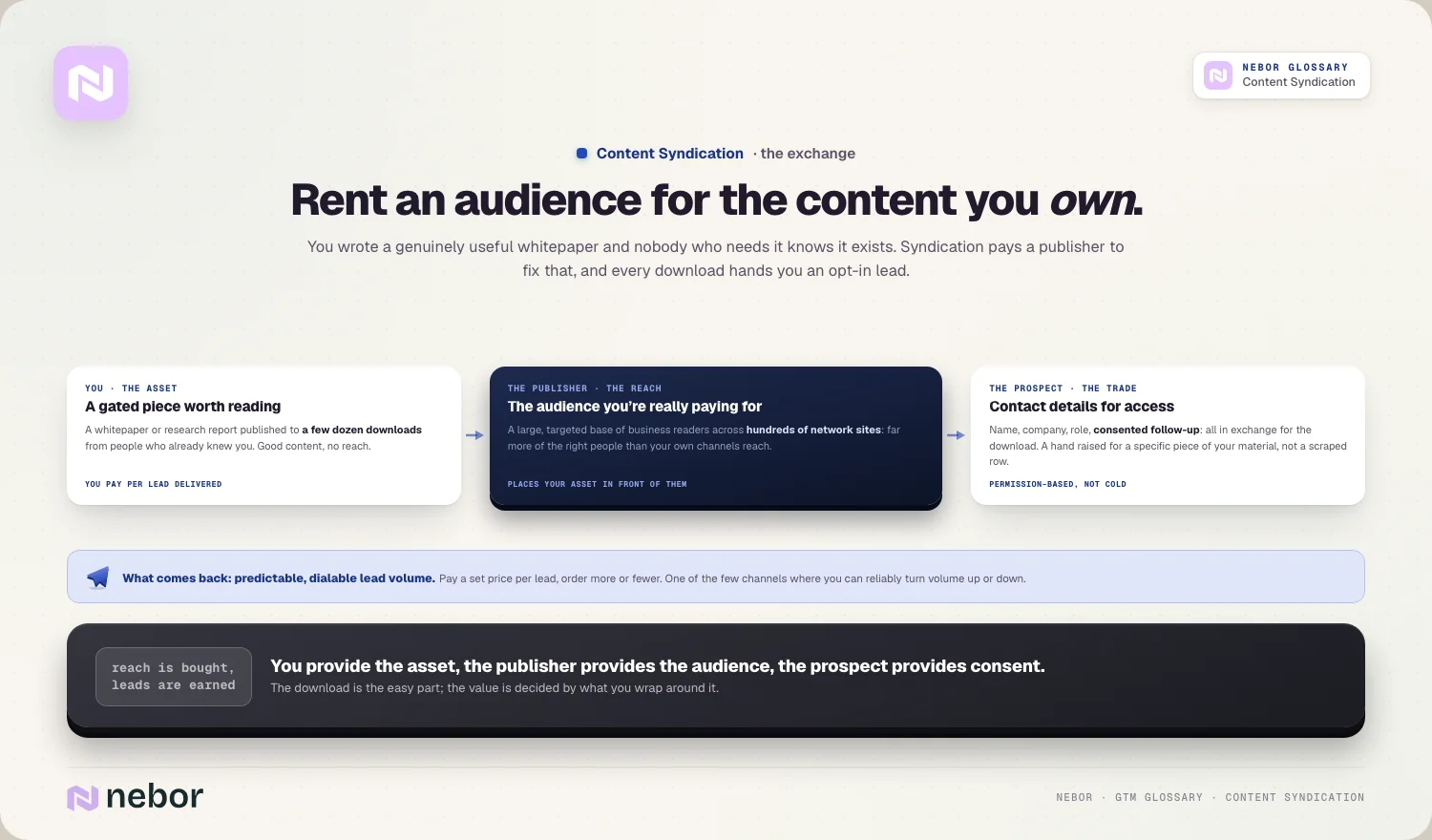
The publisher's role is what you're really paying for, because they supply the audience you lack. A good syndication partner has built a large, targeted base of business readers, so placing your content in their network reaches far more of the right people than your own channels could on their own.
How a syndicated lead gets generated and delivered into your systems
The mechanics are straightforward from the prospect's side. Someone browsing a publisher's site sees your whitepaper, clicks to access it, and completes a form with their name, company, role, and contact details, consenting to follow-up, which creates a warm opt-in record tied to a specific asset.
Behind the scenes, the lead usually passes through several checks before it reaches you. Reputable vendors verify each lead against your target criteria, scrub it against suppression lists, and validate the data for accuracy, so what lands in your CRM is meant to match your ideal customer profile instead of being random.
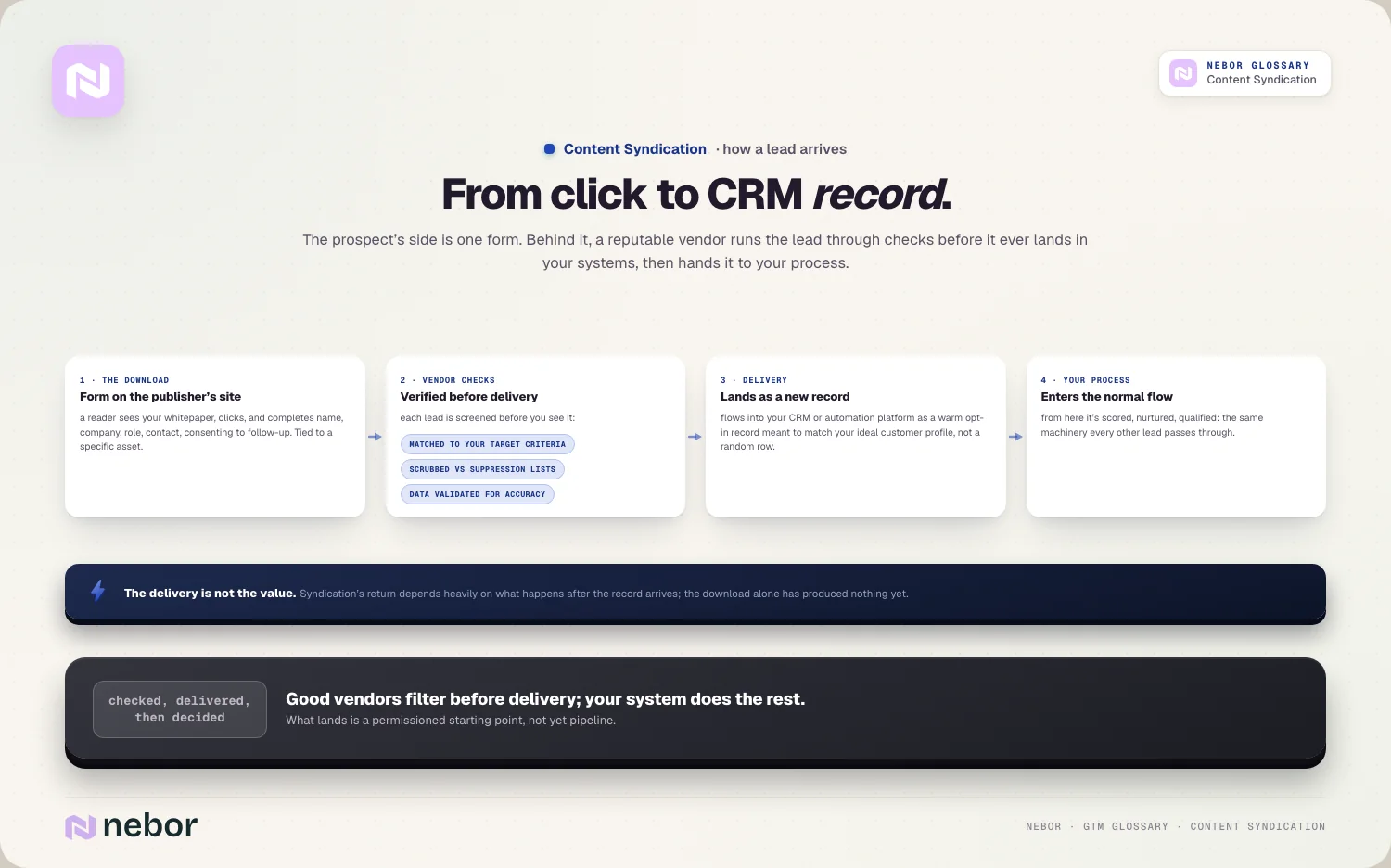
The delivered lead then flows into your marketing or sales systems ready to be worked. It arrives in your CRM or automation platform as a new record, at which point it enters your normal process, so the value of syndication depends heavily on what happens after delivery instead of the download alone.
Why teams rely on content syndication for predictable, scalable lead volume
The main draw of content syndication is that it produces lead volume you can plan around. Because you pay a set price per lead and can order more or fewer, it gives you a predictable, scalable flow of leads in a way that organic channels, which depend on unpredictable reach, simply cannot.
That predictability is why it fills a specific gap in the demand mix. Unlike paid search, which caps out at how many people are searching right now, syndication scales across a network of hundreds of publishers, so it can keep producing volume for topics that don't have much search demand yet.
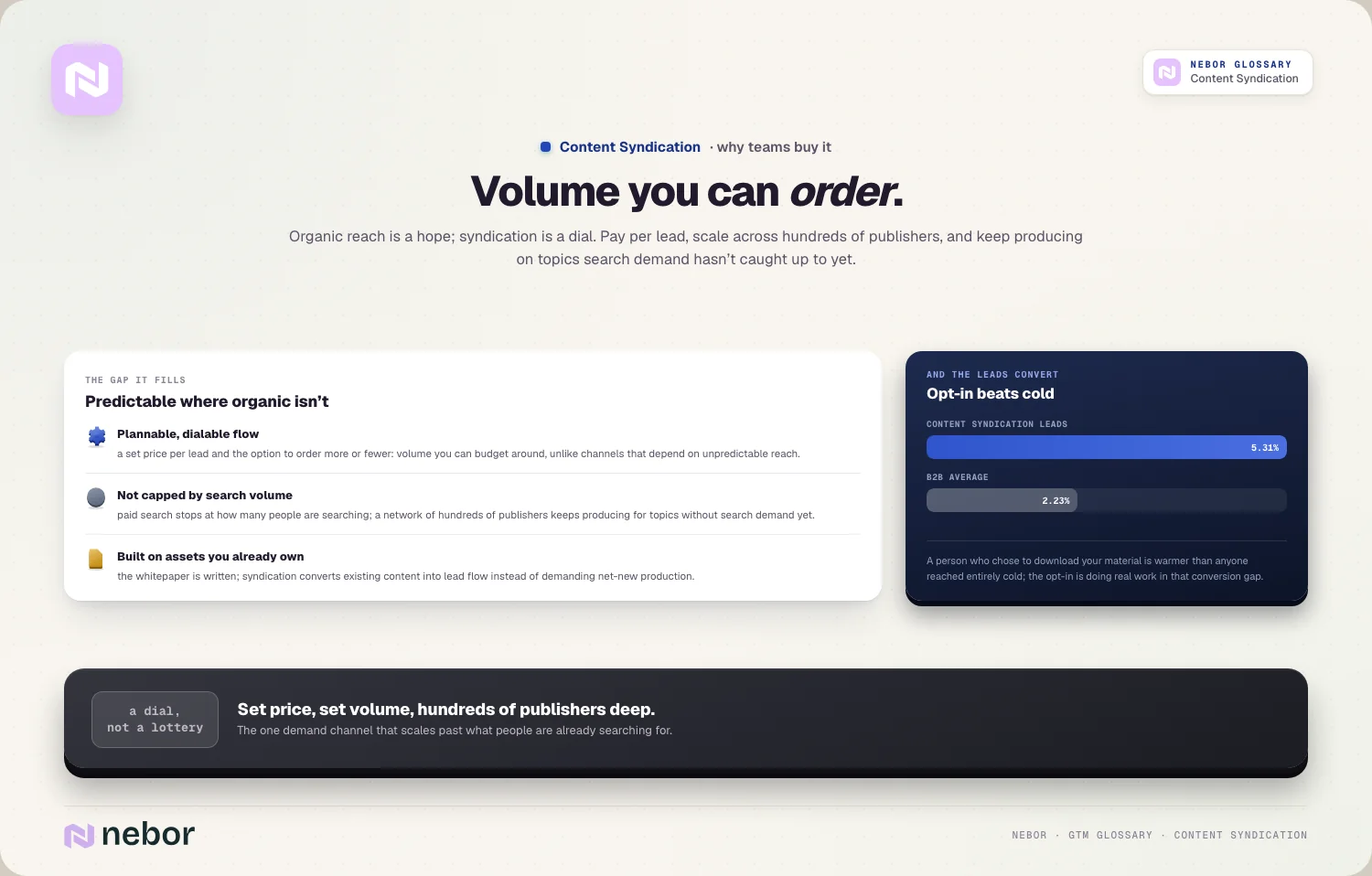
The channel also tends to convert well precisely because the leads opted in. One analysis found content syndication drove a 5.31% conversion rate versus a 2.23% B2B average, which reflects that a person who downloaded your material is warmer than someone reached entirely cold elsewhere.
What content syndication leads truly cost and where the CPL surprise hides
Content syndication works on a cost-per-lead model, and the headline prices are knowable upfront. Leads commonly cost around 40 to 120 dollars each depending on how tightly you target, how senior the audience is, and which publisher network delivers them, with quality leads often landing in the 40 to 65 dollar band.
Those numbers look attractive until you follow the lead further down the funnel. A 45 dollar cost per lead can swell to 150 dollars or more per worked lead once you add enrichment, scoring, and the sales touches needed to turn a download into a conversation, so the sticker price understates the true cost.
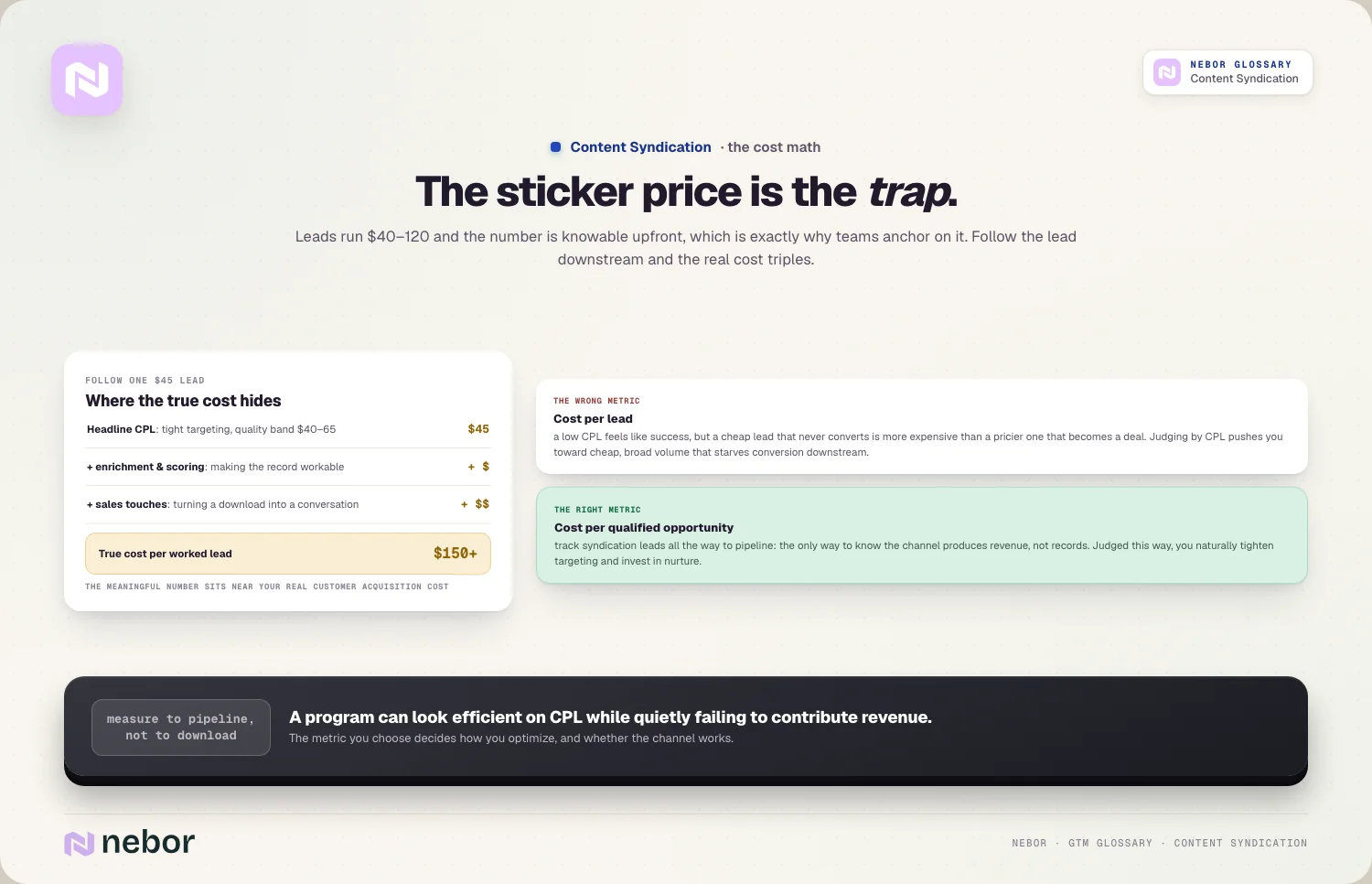
This gap is the central trap of the channel. Because the upfront CPL is low and visible, teams anchor on it and treat syndication as cheap, when the meaningful number is what it actually costs to produce a qualified opportunity, which lands much closer to your real customer acquisition cost.
Why cost per lead is the wrong metric and cost per opportunity is right
The most common mistake with content syndication is judging it on cost per lead instead of cost per pipeline. A low CPL feels like success, but a cheap lead that never converts is more expensive than a pricier one that turns into a deal, so the raw lead cost tells you almost nothing about whether the channel works.
The metric that deserves your attention is cost per qualified opportunity.
Tracking syndication leads all the way through to pipeline, instead of stopping at the download, is the only way to know if the channel is producing revenue or merely producing records, and that tracking requires connecting it to your multi-touch attribution.
Measuring the full journey also changes how you optimize. When you judge syndication by opportunities instead of leads, you naturally tighten targeting and improve nurture to raise quality, whereas judging by CPL alone pushes you toward cheap, broad leads that inflate volume and starve the conversion rate downstream.
Why syndication leads need real nurture and are rarely ready to buy
A key reality of content syndication is that a download signals interest well before it signals intent to purchase. Someone grabbing your whitepaper is early in their journey and researching a topic, so treating a syndication lead as sales-ready and pitching immediately usually wastes the lead and annoys the person.
This is why nurture infrastructure is a prerequisite instead of an afterthought.

A syndication lead falls closer to the cold end of the warm lead versus cold lead spectrum, so it needs a nurture sequence that builds interest over time before any serious sales conversation, and teams without that sequence see the leads go nowhere.
Qualification also has to happen after delivery, before you trust the lead with rep time. Even a well-targeted syndication lead should pass through your own lead qualification before a rep invests real time, because matching your profile on paper is not the same as being an active, qualified buyer ready to engage.
How to make content syndication produce pipeline instead of raw volume
The first requirement is disciplined targeting, because broad targeting is where most syndication programs fail, and in our experience it fails there more than anywhere else.
Defining a tight audience and holding the publisher to it keeps the leads relevant, so pairing syndication with clear target-profile criteria and an ICP scoring model is what separates useful volume from expensive noise.
The content asset itself has to fit the audience and the stage. A generic download attracts generic leads, so choosing an asset that speaks to a specific problem your ideal buyer has ensures the people who grab it are the ones worth reaching, which lifts quality far more than tweaking the targeting alone.
The follow-up process is where the return is earned or lost. A syndication lead delivered into a strong nurture and qualification flow can become real pipeline, so treating the download as the start of a sequence, ideally enriched through intent data, is what turns bought leads into opportunities instead of dead records.
What kinds of content tend to perform well in syndication programs
Not every asset works in syndication, and the ones that perform share a trait, offering standalone value instead of a sales pitch.
Educational pieces that help a reader understand or solve a problem attract people who are researching the topic in earnest, while thinly veiled product brochures pull in no one worth reaching.
Research reports, benchmark studies, and practical guides tend to travel best across publisher networks. Because these formats promise real insight a reader can use even if they never buy from you, they draw a higher-quality download than a generic overview, so the format itself shapes the caliber of the leads.
Matching the asset to the buying stage matters just as much as the format. Since syndication leads are early in their journey, top-of-funnel education fits the channel far better than bottom-of-funnel material, which is why syndication belongs naturally on the demand creation side instead of the ready-to-buy end.
The common mistakes teams make when they buy content syndication
The most damaging mistake, and the one we tell clients to guard against first, is treating syndication as a pure volume play.
Buying as many cheap leads as possible and dumping them into the CRM produces a flood of low-intent records that clog the funnel, leading many teams to conclude the channel doesn't work when the real problem was their own approach.
Another is having no nurture infrastructure to receive the leads. Without a sequence to warm early-stage prospects, syndication leads get one aggressive sales touch and then go cold, so the money spent acquiring them is wasted on people who were never going to buy on the first contact.
The subtler mistake, judging by the funnels clients ask us to look at, is measuring the channel wrong from the start.
Judging syndication on CPL, celebrating cheap leads, and never tracking them to pipeline hides whether the channel produces revenue at the end, so a program can look efficient on paper while contributing little to demand generation that closes.
Why content syndication is a reach channel that lives or dies on what follows
The deepest way to understand content syndication is as a way to buy reach for content you already have, which makes it only as good as the system it feeds. The download itself is the easy part, and the entire value of the channel is created or destroyed by the targeting, nurture, and measurement wrapped around it.
That framing means syndication is neither the magic source its vendors promise nor the waste its critics claim, but a tool whose return depends on discipline. Teams that target tightly, nurture, and measure to pipeline get a scalable source of early demand, while those chasing cheap volume get an expensive lesson.

Within a broader go-to-market system, content syndication works best as one predictable input among several instead of a standalone engine.
When the early-stage leads it produces flow into the same nurture and outreach you automate sales prospecting to send, the channel adds steady top-of-funnel volume that the rest of your motion can convert into real deals.
Share this post
Marketing
Content
Glossary
Related glossary items
Understanding the core GTM concepts




Ready to build your pipeline











