

In this post:
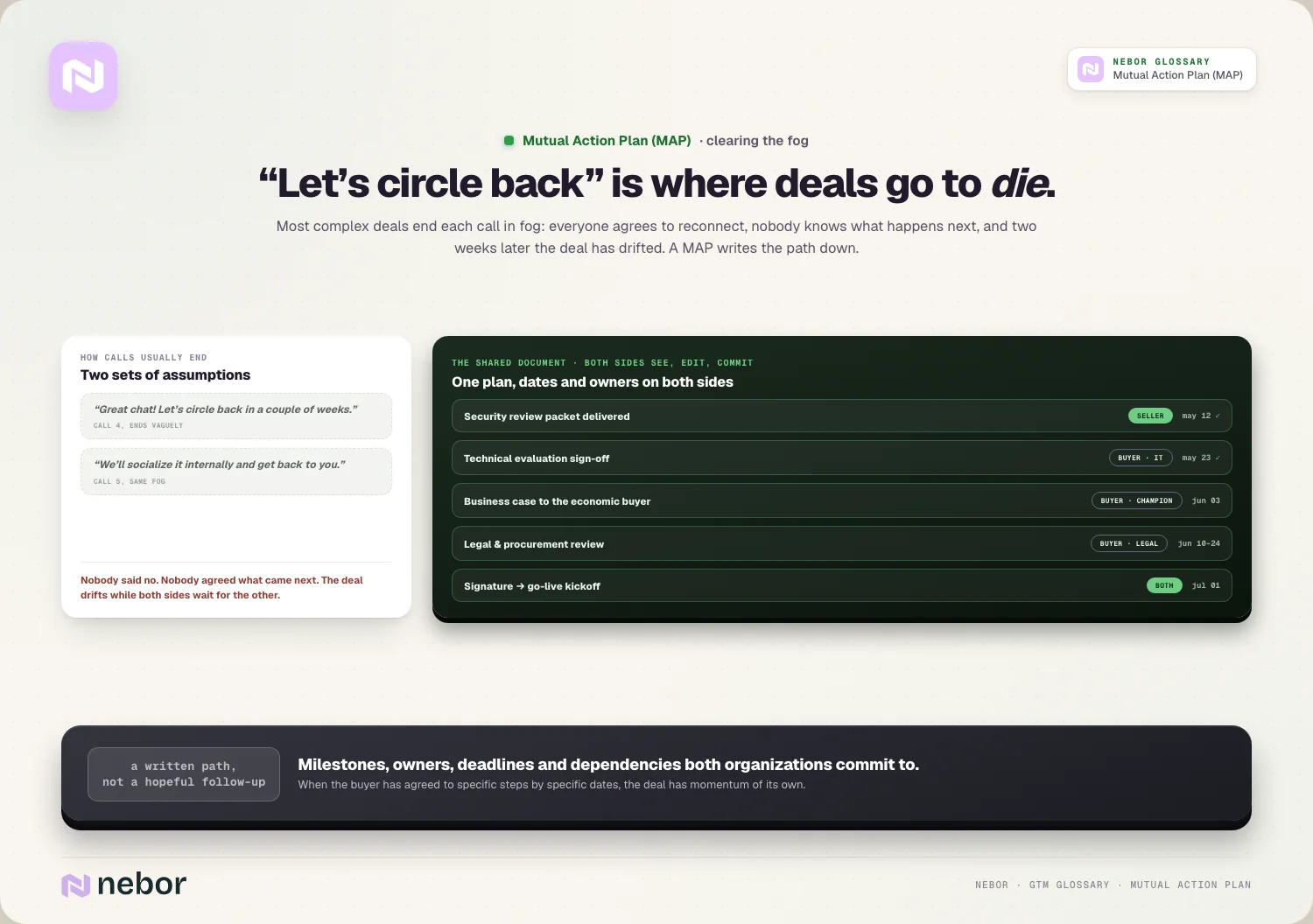
Most complex deals end each call the same vague way. Everyone agrees to circle back, nobody is sure what happens next, and two weeks later the deal has drifted while both sides wait. That fog is where good opportunities go to die, and rarely because anyone said no. They fade because no one agreed on what came next.
A mutual action plan clears that fog by writing the path down. It's a shared document that lays out every step from where the deal is now to a signed contract and go-live, with dates and owners on both sides, so the seller and the buyer are working from one plan instead of two sets of assumptions.
A mutual action plan, or MAP, is a shared, time-bound document that a seller and buyer create together to reach a decision, mapping the milestones, owners, deadlines, and dependencies both sides commit to. It turns a vague sales process into a coordinated plan that both organizations can see and follow.
The reason it works is that a written, shared plan creates accountability a hopeful follow-up never can. When the buyer has agreed to specific steps by specific dates, the deal has momentum of its own, so a MAP is one of the most reliable ways to keep a complex deal moving toward a close.
TL;DR
A mutual action plan is a shared, time-bound document co-created by seller and buyer that maps every milestone, owner, deadline, and dependency on the path to a signed deal.
Its power comes from being mutual, because a plan the buyer helped build and committed to creates real accountability that keeps the deal moving instead of drifting between calls.
It reduces sales cycle length and stalling by giving both sides one source of truth, so nobody waits on an unclear next step and momentum stays visible to everyone.
It's most valuable on complex, multi-stakeholder deals, where it surfaces hidden approvals and dependencies early and gives the whole buying group a shared roadmap to follow.
What a mutual action plan contains once you write the whole path down
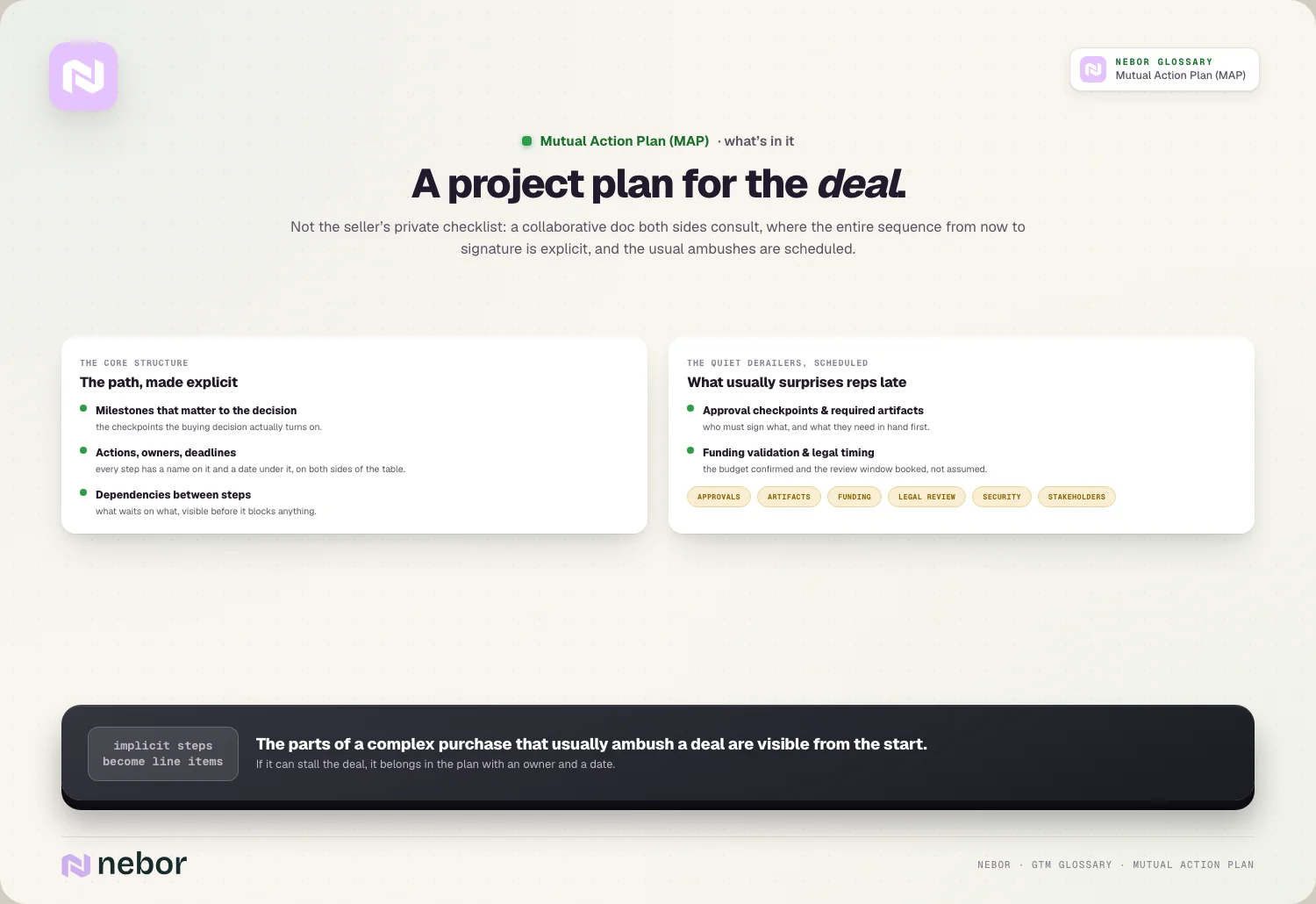
A mutual action plan is essentially a project plan for closing a deal, built jointly by the seller and the buyer. Rather than a document the seller keeps to themselves, it's a shared artifact, usually a collaborative doc or spreadsheet, that both sides can see, edit, and refer back to throughout the deal.
Its contents make the whole path to a decision explicit. A good MAP lists the milestones that matter to the buying decision, the concrete actions needed to reach each one, an accountable owner for every step, the deadlines, and the dependencies between steps, so the entire sequence from now to signature is laid out.
It also captures the things that derail deals when they stay implicit. Approval checkpoints, required artifacts, funding validation, legal review timing, and the stakeholders involved all belong in the plan, so the parts of a complex purchase that usually surprise a rep late are visible and scheduled from the start.
Why co-creating the plan with the buyer is the entire point of the exercise
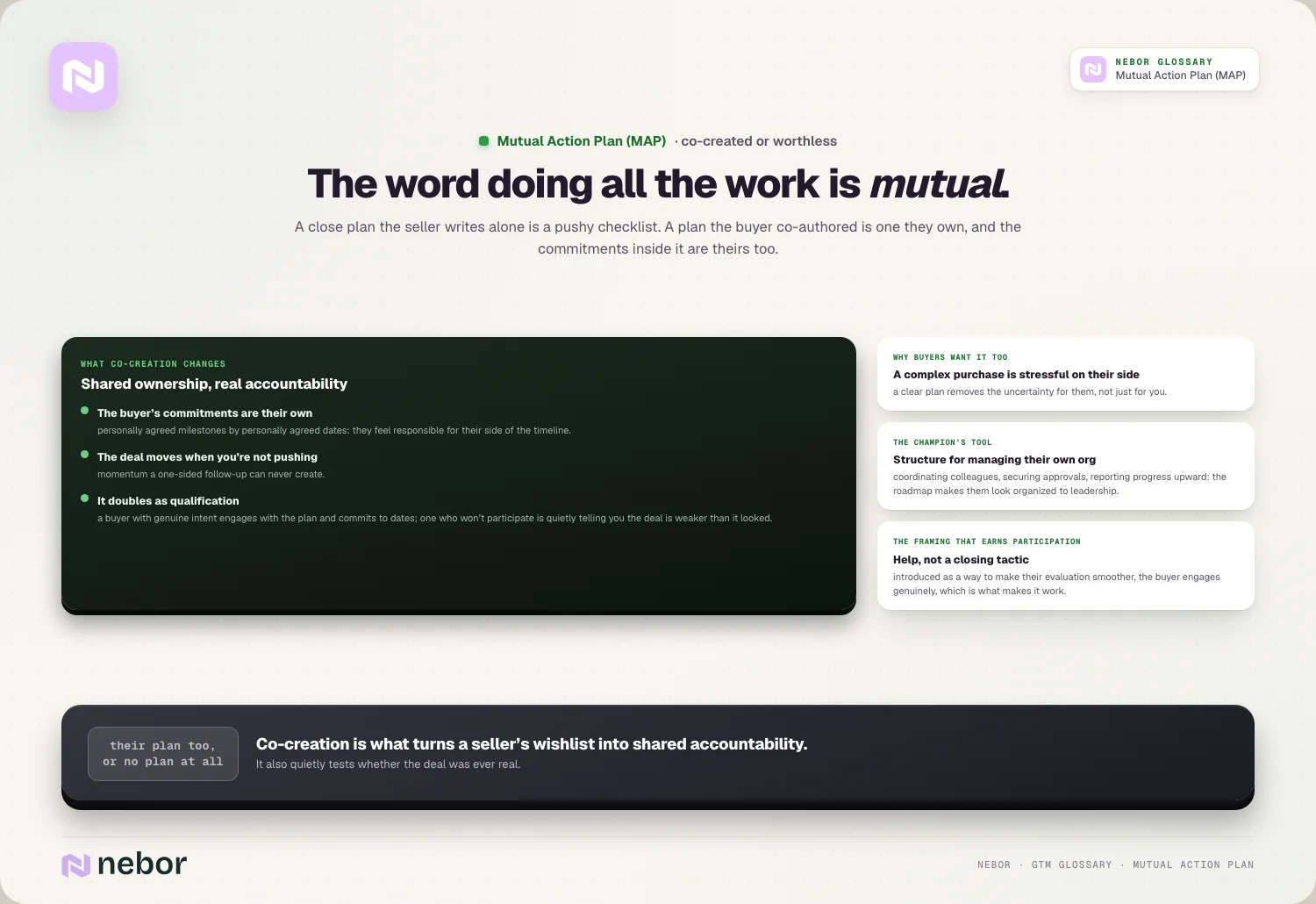
The word mutual is what separates a MAP from an ordinary close plan, because the buyer helps build it instead of receiving it. A plan the buyer co-authored and agreed to is one they own, so the commitments in it are theirs too, and that ownership turns a seller's wishlist into shared accountability.
That shared ownership is where the real value lives. When a buyer has personally agreed to hit a milestone by a date, they feel responsible for their side of the timeline, so the deal keeps moving even when the seller isn't pushing, something a one-sided follow-up can never achieve.
Co-creation also tests how real the deal is.
A buyer who truly intends to buy will engage with building the plan and commit to dates, while one who won't participate is telling your team, without saying it, that the deal is weaker than it seemed, so the MAP doubles as a qualification signal alongside frameworks like MEDDIC.
How a mutual action plan reduces stalling and shortens the cycle
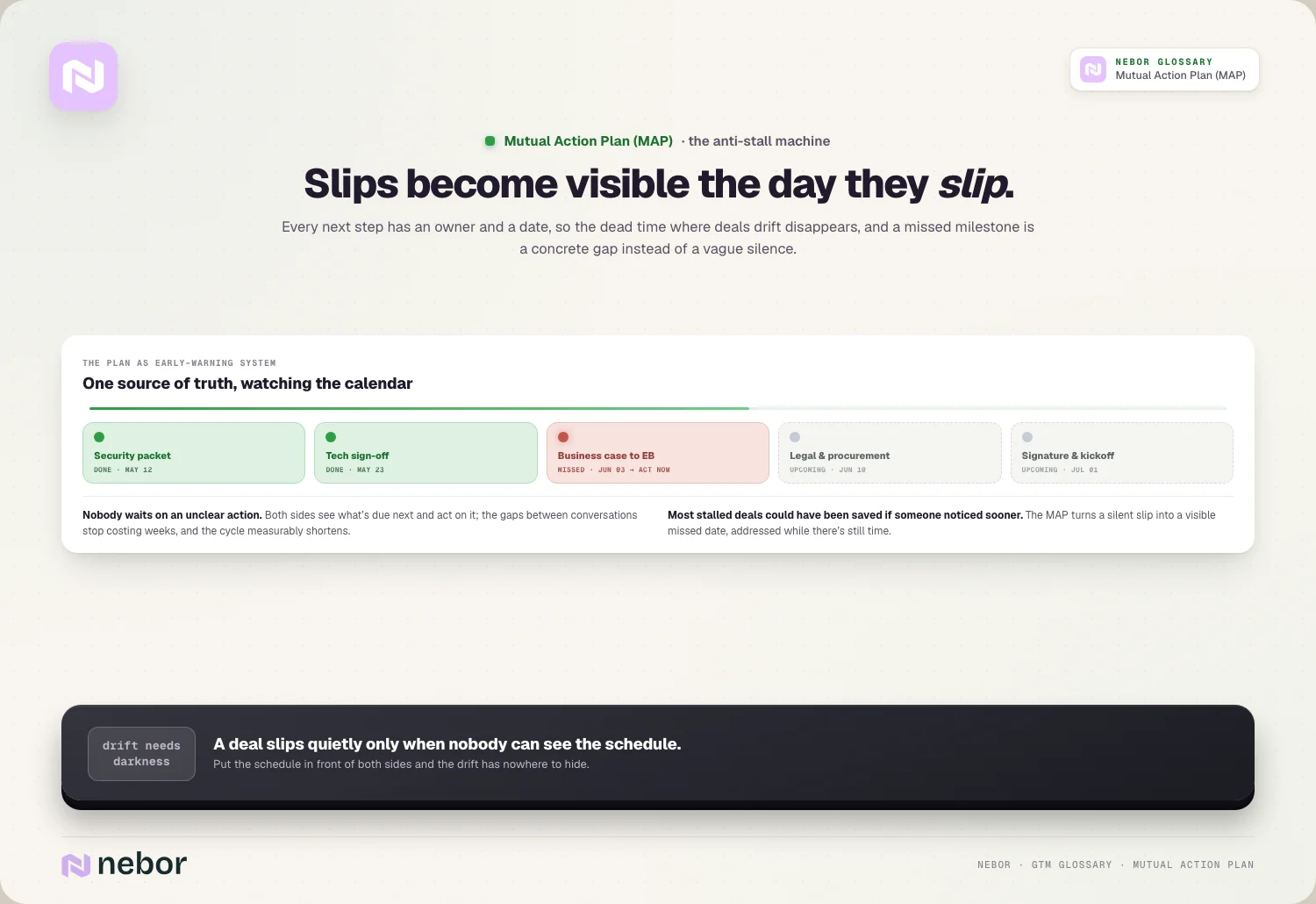
The most measurable benefit of a MAP is that it keeps deals from stalling in the gaps between conversations. Because every next step has an owner and a date, nobody is left waiting on an unclear action, so the dead time where deals usually drift simply disappears from the process.
That visibility is what compresses the timeline. A MAP acts as a single source of truth both sides consult, so instead of a deal slowing while each side waits for the other, everyone can see what's due next and act on it, which directly reduces sales cycle length.
The plan also makes slipping deals obvious the moment they slip. When a milestone is missed, it's visible to both sides as a concrete gap instead of a vague sense that things have gone quiet, which lets a rep intervene early and keep the deal on track, supporting real pipeline acceleration.
That early warning is worth more than it looks, because most stalled deals could have been saved if someone had noticed sooner. A MAP turns a silent slip into a visible missed date, so the problem gets addressed while there is still time instead of surfacing only when the deal is already lost.
Why a MAP is most valuable on complex, multi-stakeholder deals
A mutual action plan pays off most when a deal is complicated in earnest, because complexity is exactly what a MAP organizes. A simple, one-person purchase doesn't need a formal plan, but a deal with many steps, approvals, and people benefits enormously from having the whole path written down.
The multi-stakeholder nature of big deals is where it shines. When a buying committee of several people has to coordinate, a shared plan gives everyone the same roadmap, so the deal doesn't depend on one contact remembering what comes next and the whole group can see their roles and deadlines.
It also keeps the people who control the outcome engaged. A MAP naturally includes the approval steps that require the economic buyer, so it forces the deal to account for that person's involvement early instead of discovering at the end that the one signature that matters was never scheduled.
How a mutual action plan surfaces hidden risks before they bite
One of the quieter strengths of a MAP is that building it forces both sides to confront the steps nobody wants to think about. Mapping out legal review, security checks, procurement, and funding validation surfaces these dependencies early, so they get scheduled instead of ambushing the deal in its final weeks.
This is especially valuable for the paperwork that kills won deals. A decision to buy can still stall for weeks in the approval and contracting process, so putting that paper process into the plan, often with support from a deal desk, keeps a yes from dying between the decision and the signature.
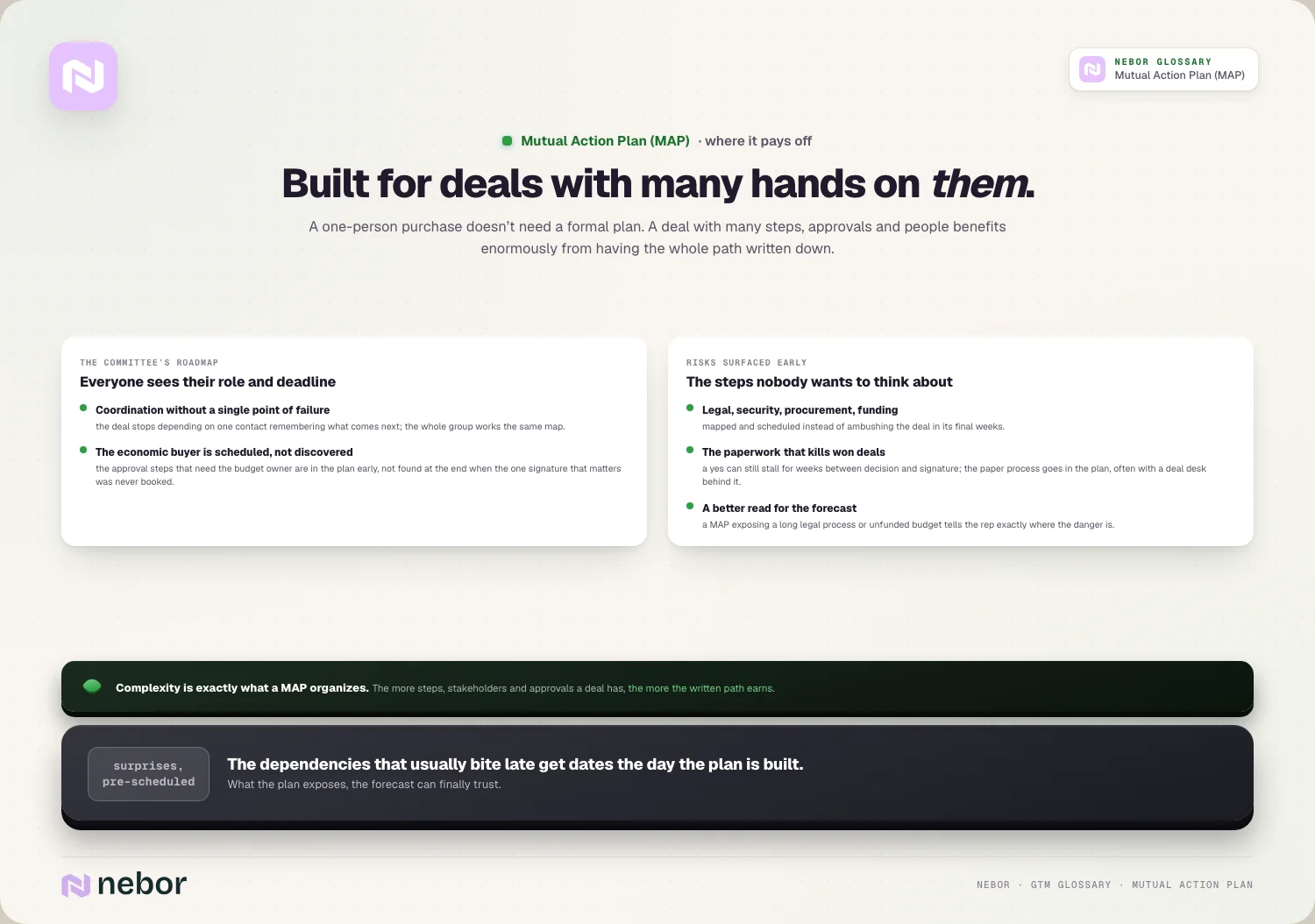
Seeing the risks laid out also improves the seller's read on the deal. A MAP that exposes a long legal process or an unfunded budget tells a rep exactly where the danger is, which makes the whole opportunity easier to manage and forecast, lifting overall forecast accuracy across the pipeline.
How to build and use a mutual action plan together with your buyer
Building a MAP starts by working backward from the buyer's goal and go-live date instead of from your own close date, the sequence we advise every time.
Anchoring the plan on when the buyer needs the outcome makes it about solving their problem, and that framing is what earns real participation instead of treating the plan as a seller's closing tool.
The plan then has to be built with the buyer rather than presented to them. Walking through the steps together, agreeing owners and dates, and letting the buyer shape their side creates the ownership that makes a MAP work, so introducing it as a collaboration is essential to how you use it.
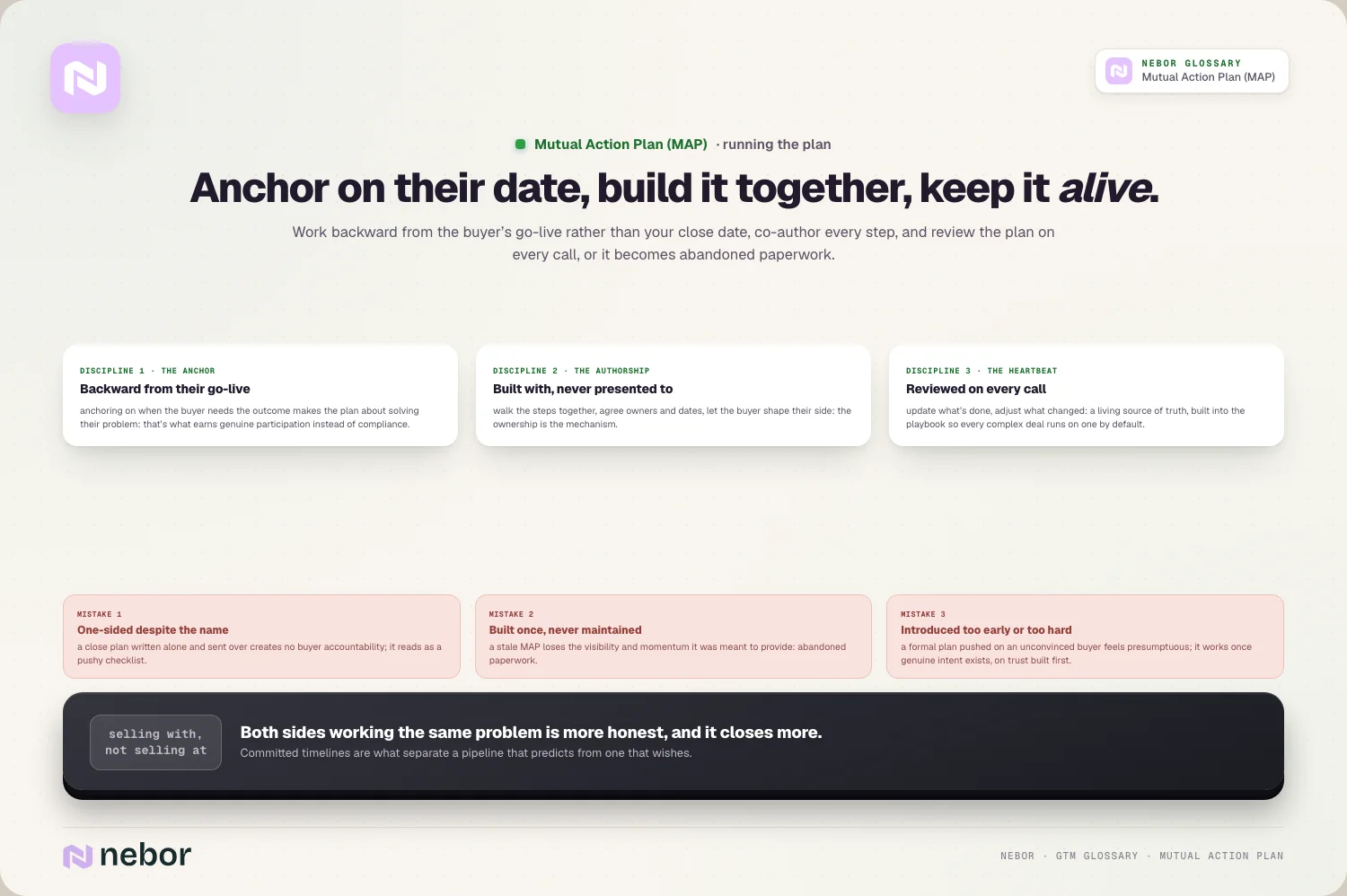
Keeping it alive is the final discipline, because a MAP left to gather dust is worthless.
Reviewing the plan on every call, updating what's done, and adjusting dates as things change keeps it a living source of truth, and the best teams go further by building the MAP into their sales playbook instead of treating it as a one-off document.
Making it a habit is what turns the MAP from a nice idea into a reliable system. When every complex deal works from a shared plan by default, the whole team gains a consistent way to keep opportunities moving, and managers get a clear view of exactly where each deal stands at any moment.
Why buyers want a mutual action plan just as much as the sellers do
It's easy to assume a MAP mainly serves the seller, and clients ask us this almost every time we introduce one, but a good one is just as valuable to the buyer, so the best reps present it as help instead of a closing tactic.
A complex purchase is stressful and confusing on the buyer's side too, and a clear plan removes that uncertainty for them.
The plan is especially useful for the buyer who has to manage their own organization. A champion leading an evaluation needs to coordinate colleagues, secure approvals, and report progress upward, and a shared roadmap gives them the structure to keep their side moving and to look organized to their leadership.
Framing the MAP around the buyer's benefit is what earns real participation. When a rep introduces the plan as a way to make the buyer's evaluation smoother and their internal job easier, instead of a way to close faster, the buyer engages with it willingly, and that engagement is what makes the plan work for both sides.
The common mistakes teams make when they use mutual action plans
The most common mistake is making the plan one-sided despite the name. A close plan the seller writes alone and sends over isn't mutual, so it never creates the buyer accountability that makes a MAP powerful, and it reads as a pushy checklist instead of a shared commitment.
Another is building the plan and then never maintaining it. A MAP only works as a living document, so a team that creates one at a single moment and lets it go stale loses the visibility and momentum the plan was supposed to provide, which turns a powerful tool into abandoned paperwork.
The subtler mistake, in our experience, is introducing a MAP too early or too aggressively. Pushing a formal plan on a buyer who isn't yet convinced feels presumptuous, so the plan works best once there's real intent to move forward, pairing naturally with the buyer trust that a framework like SPICED builds first.
Why a mutual action plan is really about selling with the buyer instead of at them
The deepest idea behind a mutual action plan is that the best complex sales are collaborations rather than persuasions. Instead of a seller pushing a buyer toward a close, a MAP has both sides working the same problem together, which is a fundamentally more honest and more effective way to reach a decision.
That collaboration is what makes the plan so durable, because it aligns the seller's and buyer's interests around a shared outcome. When both commit to the same roadmap, the deal stops being a tug of war and becomes a joint project, which raises the win rate precisely because the buyer is a partner in getting it done.
A modern go-to-market system treats the mutual action plan as the connective tissue that carries a complex deal from interest to signature.
When the opportunities you automate sales prospecting to create are worked with a shared plan the buyer helped build, the deals that reach your forecast move on committed timelines instead of hope. That is the difference between a pipeline that predicts revenue and one that merely wishes for it.
Share this post
RevOps
Guide
Glossary
Related glossary items
Understanding the core GTM concepts




Ready to build your pipeline











