

In this post:
Sometimes a sales leader needs the team to do something specific right now instead of next year, whether that's pushing a new product this quarter or closing a wave of deals before the period ends. The permanent commission plan is too slow and too broad to steer that kind of immediate, targeted push.
A SPIFF is the sharper, shorter tool leaders reach for instead. It's a short-term bonus attached to a specific goal, and because it's temporary and pointed, it can redirect the team's attention toward one outcome in a way the standing comp plan never could.
A SPIFF is a short-term, targeted bonus paid to reps for hitting a specific, immediate objective, like selling a particular product, closing deals before a deadline, or reviving a stagnant part of the pipeline.
It layers on top of normal compensation as a temporary incentive rather than becoming a permanent part of how reps are paid.
The reason SPIFFs work is that a small, near-term reward attached to a clear action is one of the fastest ways to move behavior. When reps can see an immediate payoff for doing a specific thing, they respond quickly, which makes SPIFFs a precise instrument for creating short bursts of focused effort.
TL;DR
A SPIFF is a short-term bonus paid for achieving a specific, immediate sales objective, layered on top of normal compensation as a temporary incentive.
It differs from commission, which is the permanent, percentage-based pay tied to overall quota, while a SPIFF is a tactical, one-off reward aimed at a narrow goal.
It's used to drive focused pushes, like promoting a new product, accelerating deals at quarter-end, or reviving a stalled part of the pipeline.
A good one rewards quality outcomes over raw activity, because a SPIFF that pays for volume alone can flood the pipeline with low-value deals.
What a SPIFF is in practice and what makes it different from other pay
A SPIFF is a bonus a company offers reps for accomplishing a particular, well-defined goal within a limited window. Rather than rewarding overall performance the way normal pay does, it attaches money to one specific action, so the incentive is narrow and the timeframe is short.
The defining traits are that it's temporary and targeted. A SPIFF lasts a set period and rewards a single behavior, and that narrowness is what lets it concentrate the team's attention on one outcome without permanently changing how anyone is compensated.
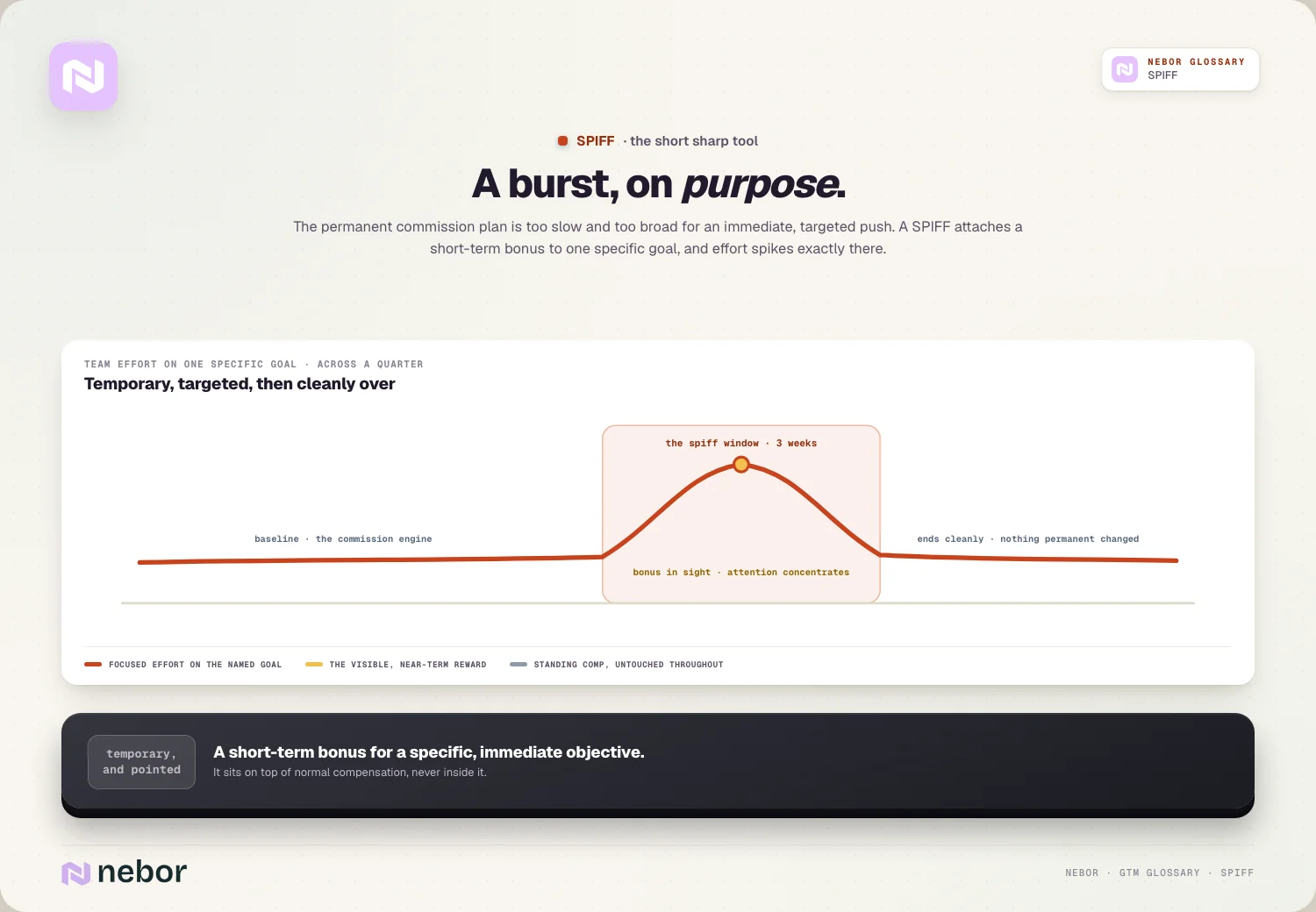
That focus is exactly the point of the tool. Because a SPIFF is aimed at a specific goal for a specific stretch of time, it can create a short, intense burst of effort toward whatever the company most needs right now, then end cleanly once that goal is met.
What the letters in the SPIFF acronym are supposed to stand for anyway
The term is usually written as an acronym, most often expanded as Sales Performance Incentive Fund, though a few variations exist. Whatever the exact wording, the meaning is consistent, a fund set aside to reward specific sales performance beyond the normal pay structure.
The name captures the essence of the tool, which is a pool of money earmarked for driving particular results. It signals that the reward is separate from base compensation, a deliberate extra set aside to push a defined outcome instead of part of the standing plan.
In everyday use, though, the acronym matters far less than the concept. Most people say SPIFF without thinking about the words behind it, treating it simply as the name for a short-term bonus aimed at a specific sales goal.
How a SPIFF differs from a normal ongoing sales commission plan
SPIFFs and commissions are both variable pay, but they do very different jobs, so it helps to keep them straight. A commission is the ongoing, percentage-based reward built into a rep's compensation plan, paid on their sales over time to reward consistent performance.
A SPIFF, by contrast, is a one-off incentive tied to a narrow goal instead of overall production. Where commission rewards steady results across everything a rep sells, a SPIFF rewards a specific action, like selling a particular product or closing before a deadline, for a limited time only.
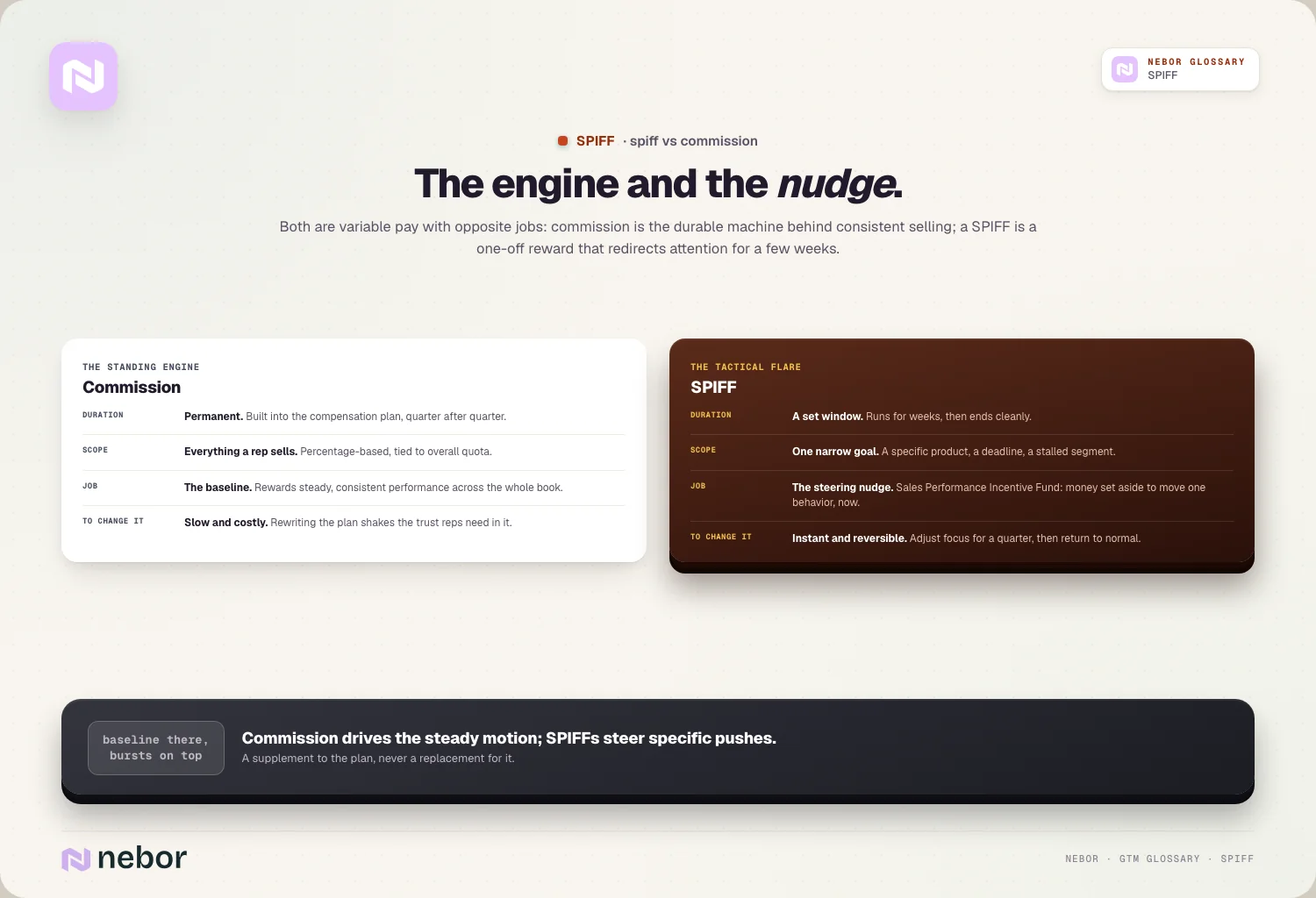
The two are used for opposite purposes as a result. Commission is the durable engine that drives consistent selling, while a SPIFF is a temporary nudge used to change short-term behavior, so a company relies on commission for the baseline and reaches for SPIFFs to steer specific pushes.
What sales teams tend to use SPIFFs to accomplish in the real world
The most common use of a SPIFF is promoting a specific product the company wants to sell more of. A bonus for every deal that includes a particular product, offered for a quarter, focuses reps on it in a way the general commission plan never would, so a new or strategic product gets the push it needs.
Another frequent use is accelerating deals against a deadline. A SPIFF in the final weeks of a quarter creates a hard, near-term reward that pulls your deals forward, so opportunities that might have drifted into the next period close now, which lifts short-term pipeline velocity and helps quota attainment.
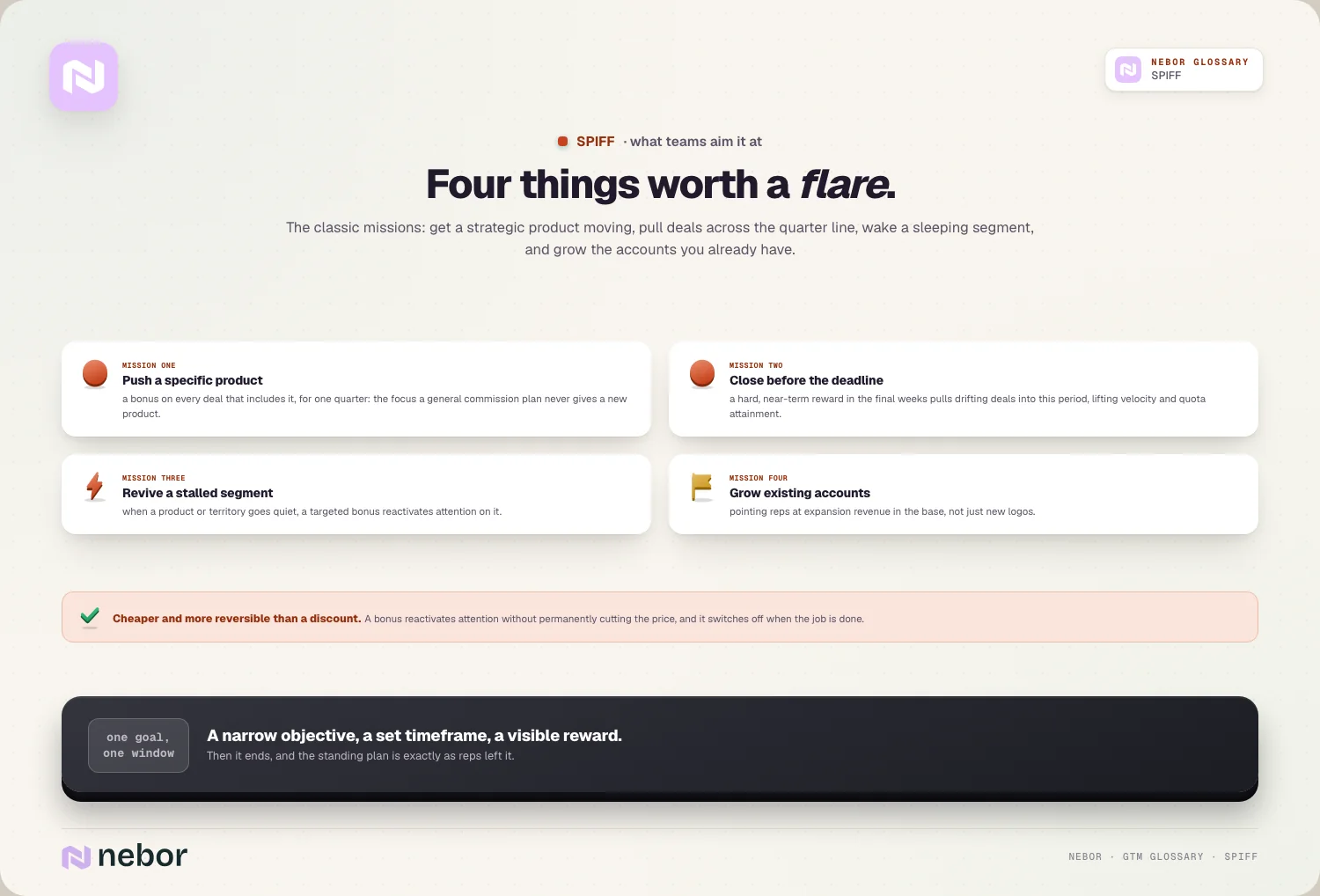
SPIFFs also help revive parts of the pipeline that have gone quiet, or push reps toward expansion revenue in existing accounts. When a product or segment stalls, a targeted bonus reactivates attention without cutting the price permanently, a cheaper and more reversible fix than a lasting discount.
Why a quarter-end SPIFF works so reliably on already-motivated reps
The reason deadline-based SPIFFs are so effective comes down to a quirk of human motivation called the goal-gradient effect, where people push hardest as a visible reward gets close. A SPIFF with a clear near-term deadline creates exactly that kind of visible, reachable target, so reps accelerate toward it.
The effect is strongest for reps who are already near their targets. One of your reps close to quota, with a fresh short-term bonus in view, has powerful reasons to push the last few deals over the line, so a well-timed SPIFF pulls extra effort out of the people best positioned to convert it.
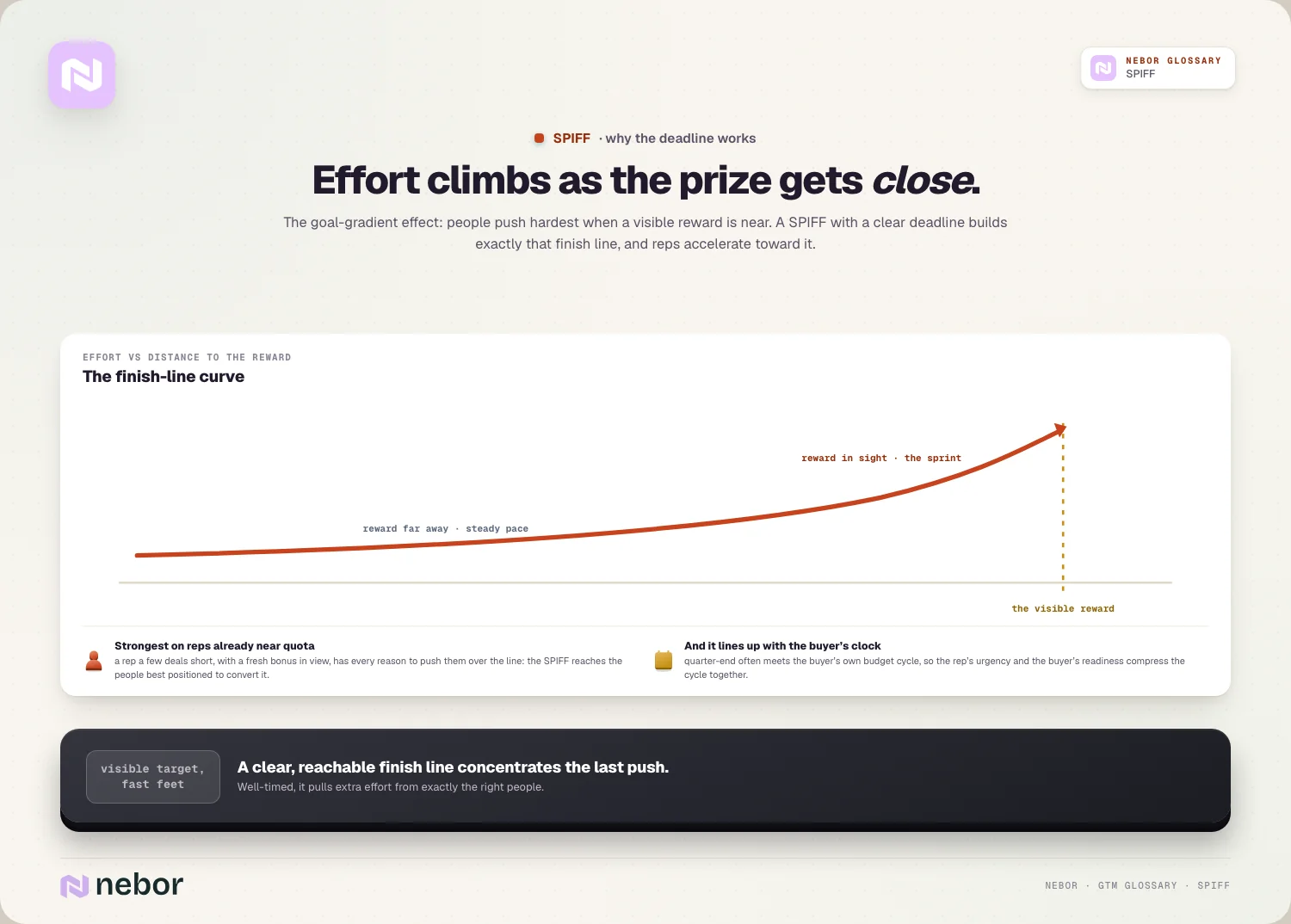
The timing also aligns with the buyer's world. A quarter-end SPIFF often coincides with a buyer's own budget cycle, so the rep's urgency to close and the buyer's readiness line up, which compresses the sales cycle on deals near the finish.
Why the form the reward takes can matter as much as the amount
A SPIFF doesn't have to be cash, and the form of the reward can shape how motivating it feels. Companies pay SPIFFs as cash, gift cards, travel, prizes, or other perks, and a memorable non-cash reward sometimes drives more excitement than the equivalent money would.
The reason is partly psychological, because a distinctive prize stands out in a way a slightly larger paycheck doesn't. A trip or a standout item becomes a story and a status marker, so it can generate more energy around a push than cash that quietly blends into a rep's normal earnings.
That said, the right form depends on the team and the goal. Cash is simple and universally valued, while non-cash rewards can build excitement and camaraderie, so the choice is another lever a company can use to make a SPIFF land the way it intends.
Why modern SPIFFs should reward quality instead of raw activity
The biggest shift in how SPIFFs are designed is a move away from paying for activity and toward paying for real outcomes. A bonus for raw volume, like demos booked, tends to inflate your pipeline with low-value activity as reps chase the reward instead of the result.
Better SPIFFs attach the reward to quality instead, and we advise clients to make this the default.
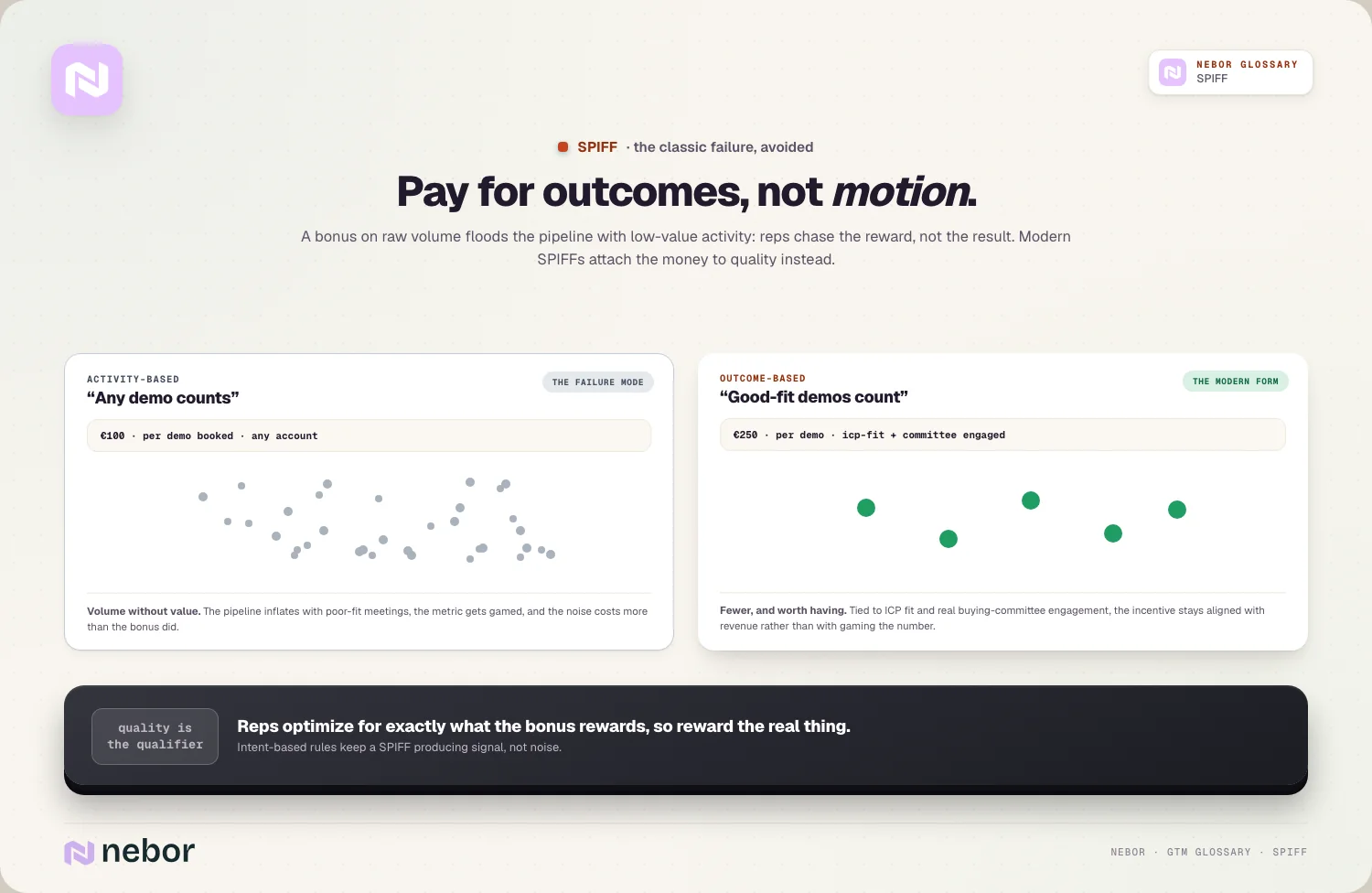
Paying for demos with good-fit accounts that match your ideal customer profile and show real buying-committee engagement, instead of any demo at all, keeps the incentive aligned with revenue instead of with gaming the metric.
This intent-based approach protects the pipeline from the classic SPIFF failure mode. When a bonus rewards a shallow action, reps optimize for it, so tying the reward to genuine buying committee engagement, closer to a real product-qualified lead, keeps a SPIFF producing quality instead of noise.
How to design a SPIFF so it produces the result you were hoping for
A SPIFF works best when the goal behind it is narrow, measurable, and worth the spend, and in our experience the narrowness is the part leaders skip.
Vague objectives produce vague behavior, so a company defines exactly what qualifies for the bonus, such as a closed deal that includes a specific product, instead of a fuzzy aim like selling more.
The size of the reward should match the effort and value involved. Small activity-based SPIFFs suit quick actions, while larger deal-based ones suit the harder work of closing, so the payout scales with what you're asking reps to do and what the outcome is worth to the business.
Tailoring the SPIFF to the audience sharpens it further. A bonus can be aimed at a particular product, territory, role, or sales tier, so it reaches the reps whose behavior needs to change in the first place, which keeps the program relevant and its budget focused where it matters most.
How SPIFFs fit alongside the standing sales compensation plan
A SPIFF supplements compensation instead of replacing any part of it, so it works best layered on top of a sound base plan. The commission structure handles ongoing performance, while SPIFFs are added selectively to steer specific behavior for limited stretches without rewriting the whole plan.
This layering keeps the core plan stable while allowing tactical flexibility. Constantly changing the base comp plan would destroy the trust reps need in it, whereas a temporary SPIFF lets a company adjust focus for a quarter and then return to normal, which is far less disruptive.
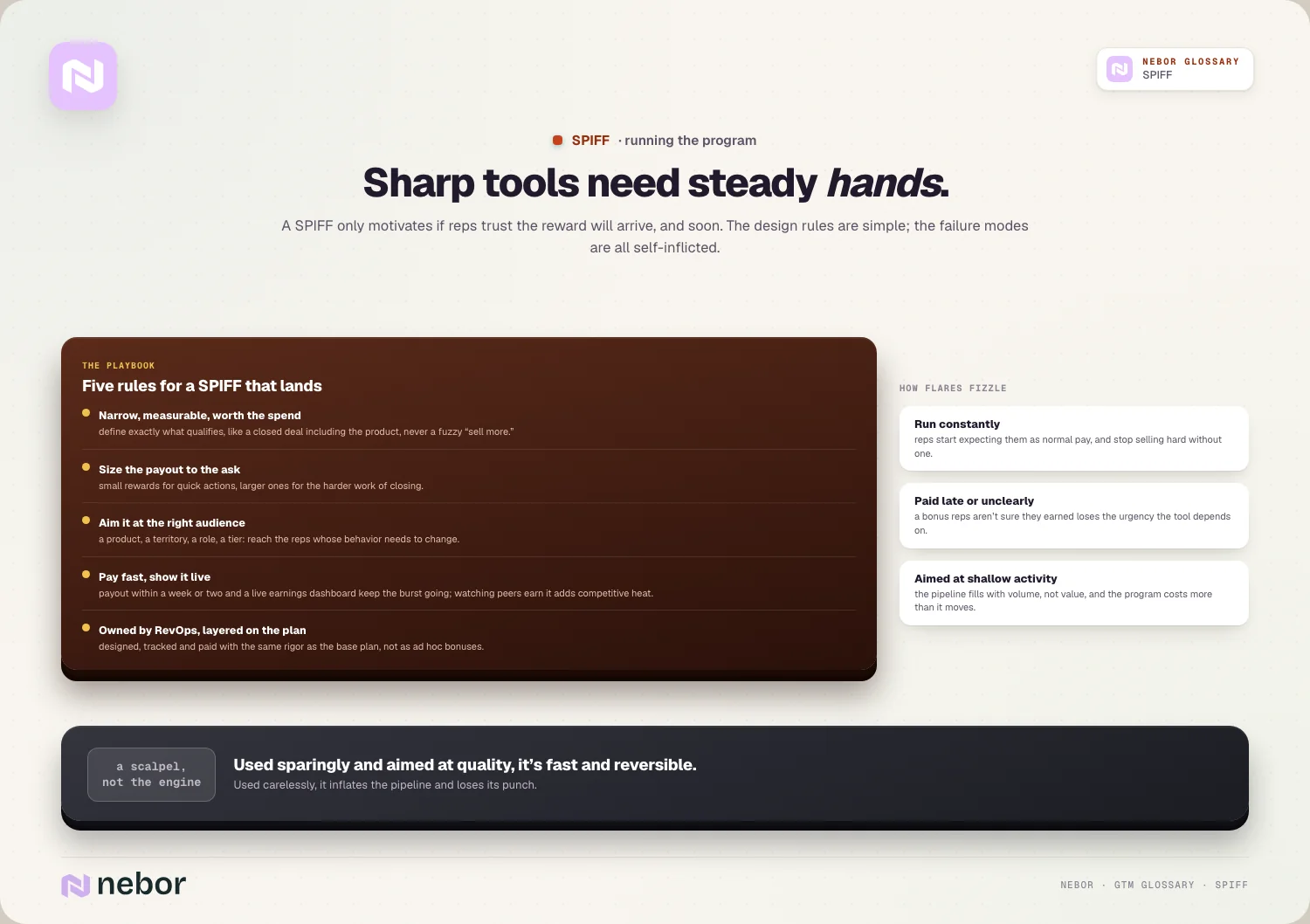
Because SPIFFs layer on top of the plan, they're usually the domain of the same revenue operations function that owns compensation. Designing, tracking, and paying them cleanly takes the same rigor as the base plan, so they're managed as part of the overall incentive system instead of as ad hoc bonuses.
Why fast and visible payouts are what make a SPIFF work at all
A SPIFF only motivates if reps trust that the reward will really arrive, and arrive soon. A bonus that takes months to pay, or that reps aren't sure they earned, loses the urgency that makes it effective, so speed and clarity of payout are essential instead of optional.
The best programs commit to fast payout and real-time visibility. Paying within a week or two of the qualifying result, and showing reps their SPIFF earnings on a live dashboard, keeps the reward tangible and immediate, and that immediacy is what sustains the burst of effort the SPIFF is meant to create.
Visibility also amplifies the motivation across the team. When reps can see the bonus accumulating and watch peers earning it, the SPIFF creates a visible, competitive energy, so transparent tracking does as much to drive behavior as the money itself.
The common mistakes companies make when they design SPIFF programs
The most common mistake, and the one we keep seeing when leaders describe their incentive programs to us, is rewarding activity instead of outcomes, which inflates your pipeline with low-quality work.
A SPIFF that pays for any demo or any deal, regardless of fit, teaches reps to chase the bonus instead of real revenue, so the program produces volume without value.
Another frequent error is offering SPIFFs so often that they lose their power. When bonuses become constant, reps start to expect them and treat them as part of normal pay, which erodes the urgency and makes the team reluctant to sell hard without one.
Slow or unclear payouts are the third recurring problem. A SPIFF that pays late, or whose rules reps don't understand, breaks the trust and immediacy the tool depends on, so a poorly administered program fails even when the incentive itself was well chosen.
Why a SPIFF is really a precise, temporary steering tool for leaders
The best way to understand a SPIFF is as a scalpel instead of the engine of compensation. The commission plan is the durable machine that drives consistent selling, while a SPIFF is a precise, temporary tool for redirecting attention toward a single goal when the moment calls for it.
When a leader uses it sparingly and aims it at quality, a SPIFF gives them a fast, reversible way to change behavior and lift the win rate on a targeted push. When they reach for it carelessly, it inflates the pipeline and loses its punch, so the discipline is in choosing the right goal and rewarding the right outcome.
Inside a modern go-to-market system, a well-designed SPIFF lets a company sharpen its team's focus exactly when and where it needs to. It's the tactical complement to steady compensation, pointing effort at a specific outcome much as the signals you automate sales prospecting around point it at the right accounts.
Share this post
RevOps
Glossary
Related glossary items
Understanding the core GTM concepts


Ready to build your pipeline











