
In this post:
A single email almost never wins a deal. Neither does one call, one ad, or one LinkedIn message. B2B buyers move toward a decision across dozens or hundreds of small interactions, and any one of them, seen alone, looks like it did nothing whatsoever.
Each of those interactions is a touchpoint. The concept matters because deals aren't won in a single moment, but across a long series of touches that together build the awareness and trust a buyer needs before they commit.
A touchpoint is any interaction where a buyer engages with your brand, direct or indirect, from a cold email or a demo to an ad impression or a support ticket. It's a single unit of contact in the much longer relationship that leads to a sale.
The reason touchpoints matter is that no single one carries a deal. Buyers now complete most of their research before ever talking to sales, so the touches they encounter along the way are what shape the decision before you're even in the room.
TL;DR
A touchpoint is any single interaction between a buyer and your brand, from an email or call to an ad or a piece of content they read.
It's significant because deals are won across many touches instead of one, with buyers moving toward a decision through a long series of interactions over months.
The number needed varies hugely, from a handful for a first meeting to hundreds across a full enterprise buying journey involving many stakeholders.
The part teams get wrong is that quality and consistency beat raw count, so more touches only help when each one adds value instead of just adding noise.
What counts as a touchpoint across the whole of the buyer journey
A touchpoint is any moment a buyer interacts with your company. It spans every channel and every stage, from the first glimpse of your brand to conversations long after a sale.
It covers both direct and indirect contact. A touchpoint can be something you initiated, like a cold email, or something the buyer sought out on their own, like reading your content or seeing a review.
It happens across every channel a buyer uses. Emails, calls, ads, social posts, demos, and support interactions are all touchpoints, so a buyer accumulates them across your entire presence.
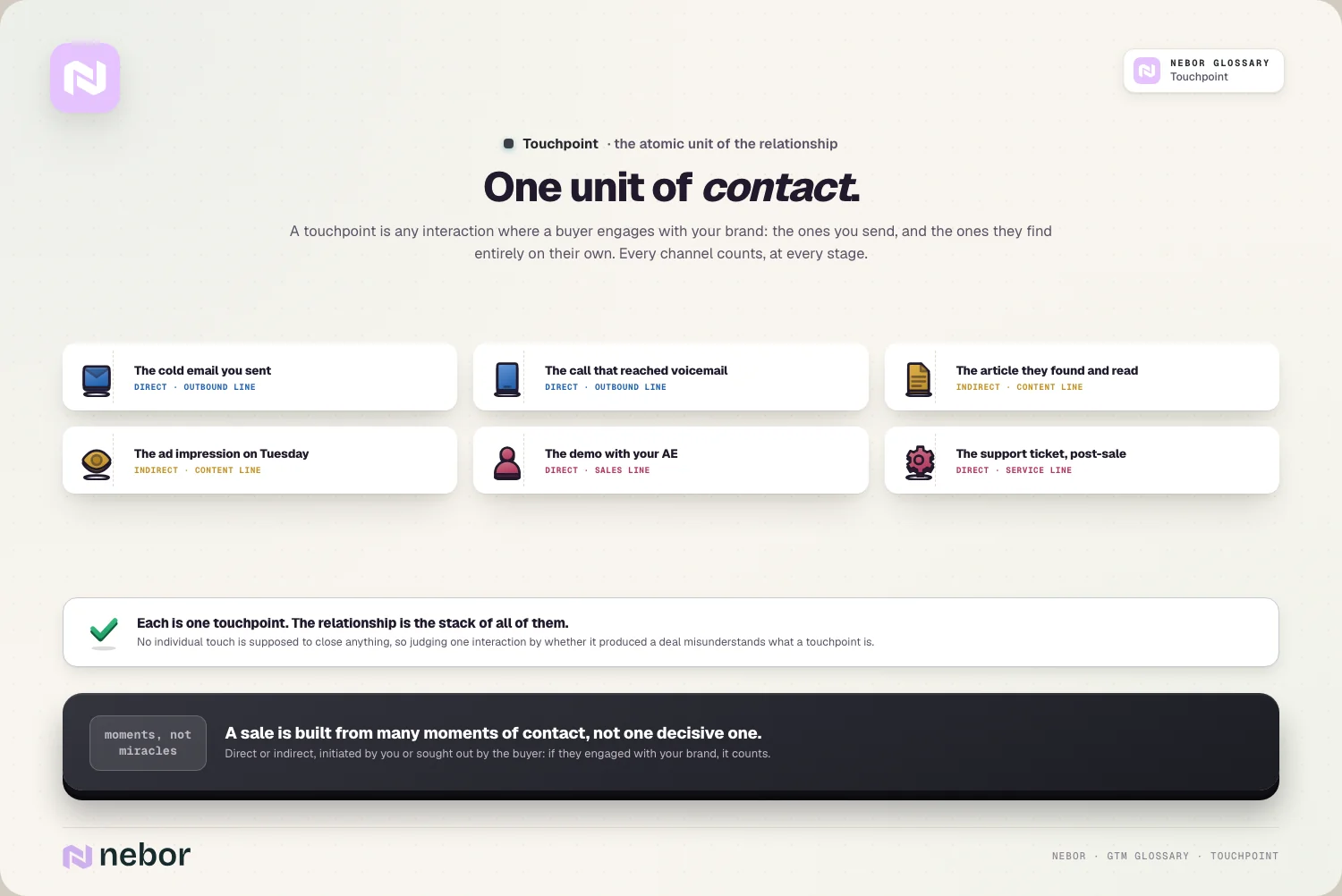
It's a single unit of the relationship. Each touchpoint is one interaction, and the full relationship with a buyer is made up of many of them stacked over time.
So a touchpoint is the atomic building block of a buyer relationship. It's one moment of contact, and the sale is built from many such moments instead of any single decisive one.
Framing it this way keeps expectations realistic. No individual touch is supposed to close anything, so judging one interaction by whether it produced a deal misunderstands what a touchpoint even is.
Why it takes many touchpoints instead of one to close a deal
The core truth about touchpoints is that they work cumulatively. No single one closes a deal, because the decision builds across all of them together.
Awareness builds gradually across those accumulating touches. A buyer rarely goes from never hearing of you to buying in one interaction, so each touchpoint adds a little recognition and trust toward the eventual decision.
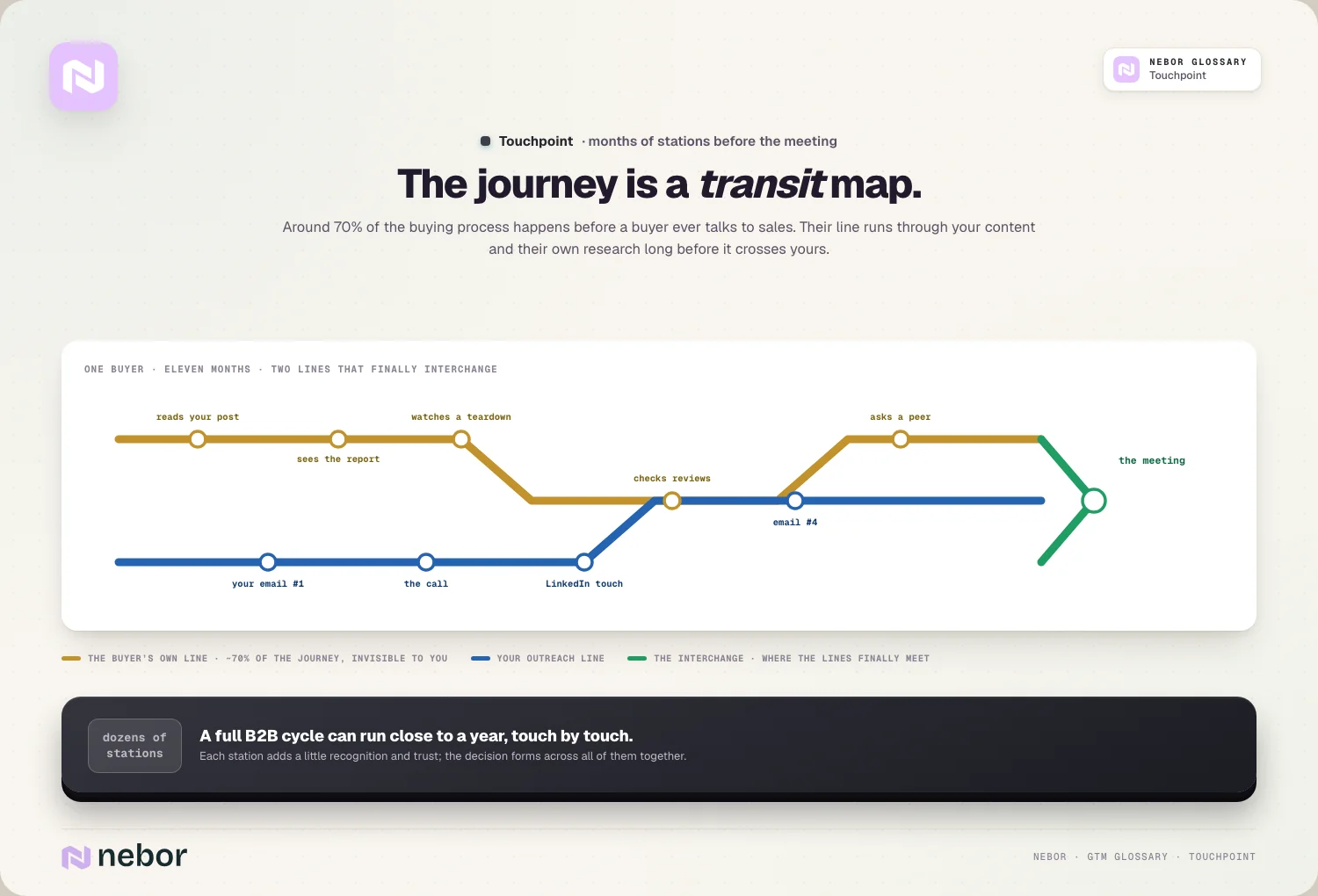
Most of the journey stays invisible to you. Buyers now complete around 70% of their process before contacting sales, so many touchpoints shape the decision before you ever speak to them.
The journey is longer than most teams assume. A full B2B buying cycle can stretch close to a year, so touchpoints accumulate over months instead of days, building the relationship slowly.
So a deal is the sum of many touchpoints instead of the result of one. Each interaction contributes to a decision that forms gradually, meaning persistence across touches matters far more than any single perfect message.
How many touchpoints it tends to take to book one first meeting
The number of touchpoints varies enormously by what you're trying to achieve, and the first-meeting figure is the most practical. It's smaller than the full-journey number but still more than one.
A first meeting takes several touches to earn. Direct outreach to book a first meeting averages around 8 touches, so a single email rarely gets there on its own.
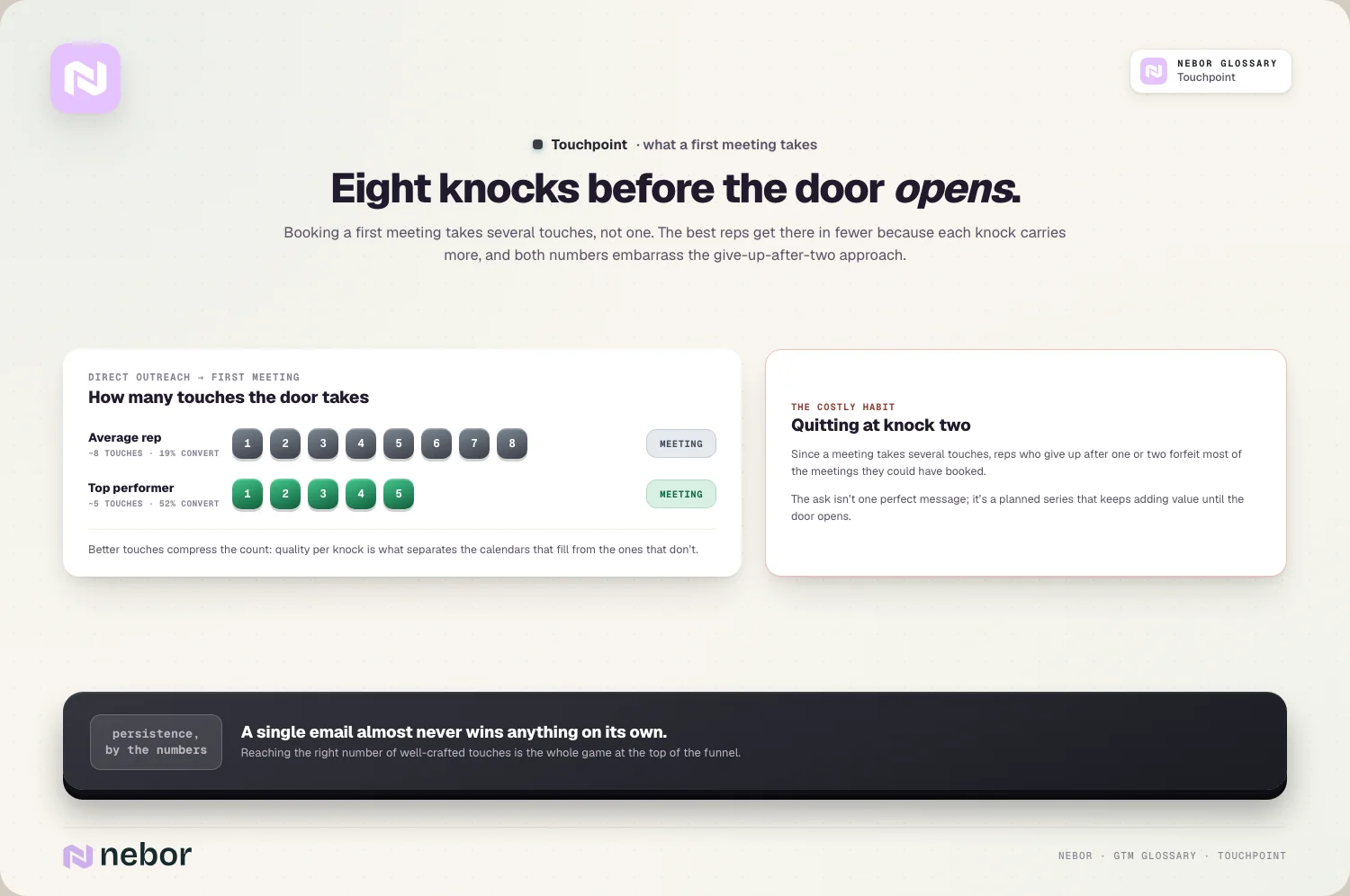
Top performers get there in fewer attempts. The best reps book the same meeting in about 5 touches with a 52% conversion rate, versus 19% for average reps, so quality of touches matters.
Persistence is essential to reaching that number. Since it takes several touches, reps who give up after just one or two forfeit most of the meetings they could have booked, which is a common and very costly mistake.
So booking a meeting is a multi-touch effort well past a one-shot ask. Reaching the right number of well-crafted touches separates the reps who fill their calendars from those who don't.
Why the full buyer journey involves so many more touchpoints
Beyond the first meeting, the complete path to a closed deal involves a vastly larger number of touchpoints. The full journey is on a different scale.
The totals across a real deal are large. Across a full journey, a closed deal can involve 88 touchpoints or many more, spanning several channels and stretching across the whole buying cycle.
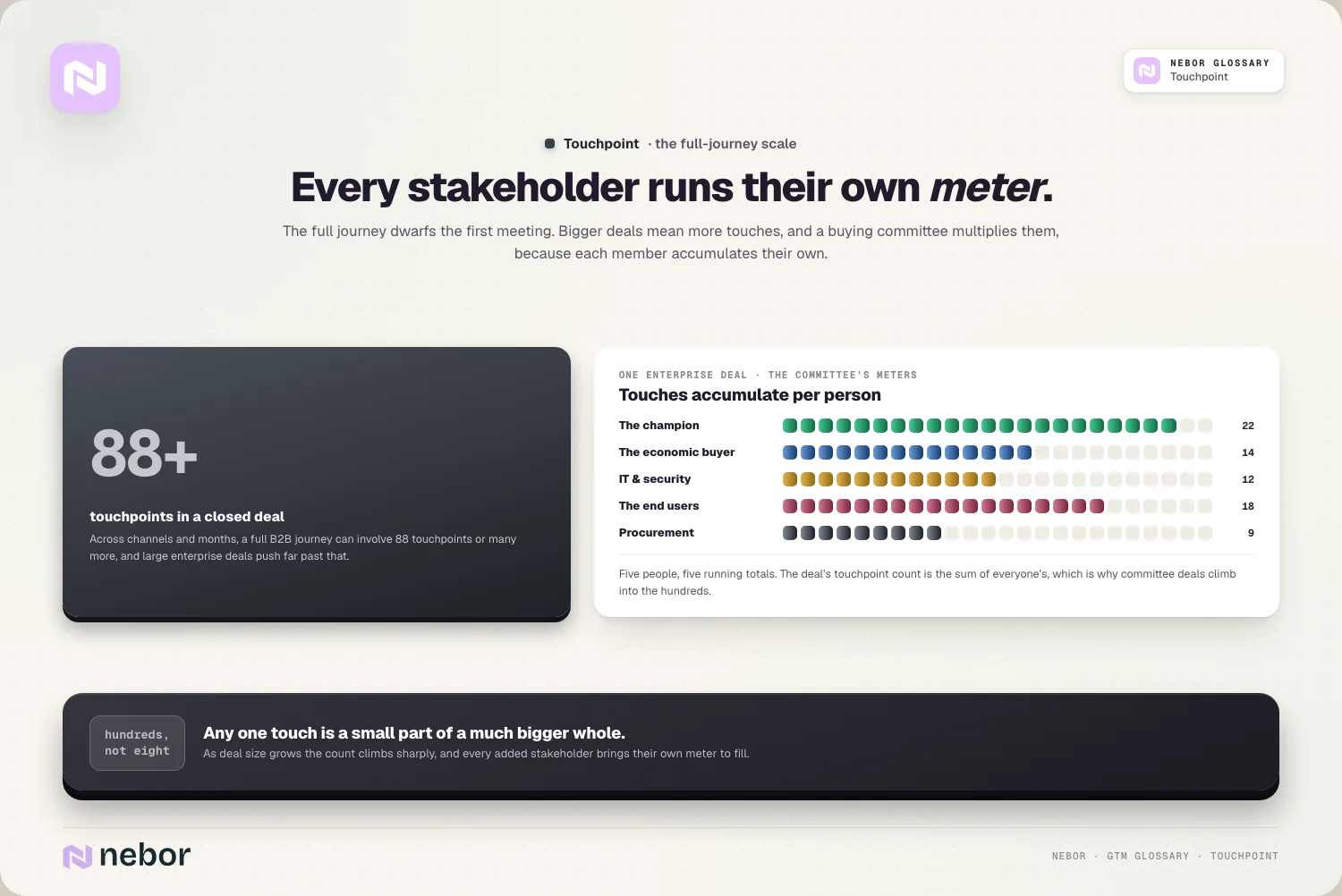
Bigger deals need considerably more of them. As deal size grows, touchpoints climb sharply, with large enterprise deals requiring far more touches than smaller, simpler ones.
Many stakeholders multiply the count further still. Because a deal involves a whole buying committee, each stakeholder accumulates their own touchpoints, so the total grows with the number of people involved.
So the full journey dwarfs any single interaction. Hundreds of touchpoints across many people and months are what produce a large deal in the end, which reframes any one touch as a small part of a much bigger whole.
How individual touchpoints combine into a coordinated sales cadence
Individual touchpoints only work when they're organized, and that structure has a name. A cadence turns scattered touches into a deliberate sequence.
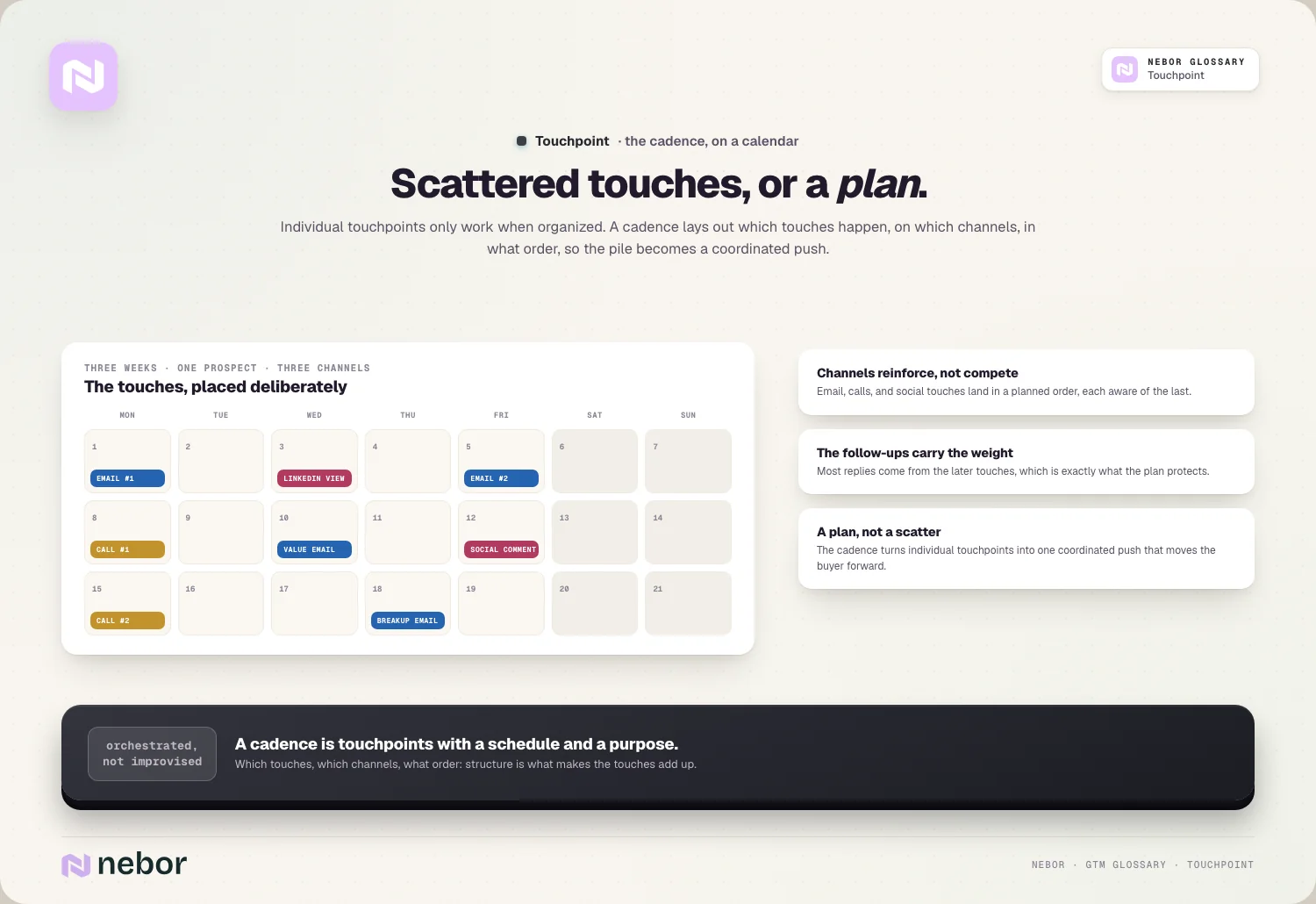
A cadence puts the touches in a deliberate order. A sales cadence lays out which touchpoints happen, on which channels, and in what order, so the interactions form a plan instead of a random scatter.
It spreads the touches across several channels. Coordinating touchpoints through multi-channel outreach means email, calls, and social touches reinforce each other instead of competing.
The follow-ups carry most of the weight. Much of a cadence is the follow-up sequence, because the later touchpoints are where most replies come from in practice.
So touchpoints become powerful when structured into a cadence. The plan is what turns a pile of individual interactions into a coordinated push that moves a buyer forward.
Why the quality of each touchpoint matters more than the count
A dangerous misreading of touchpoint data is that more is always better. Raw count without quality does more harm than good.
Empty touches do nothing except annoy the buyer. A touchpoint that adds nothing, like a bare check-in message, irritates the buyer and trains them to ignore you, so it counts against you.
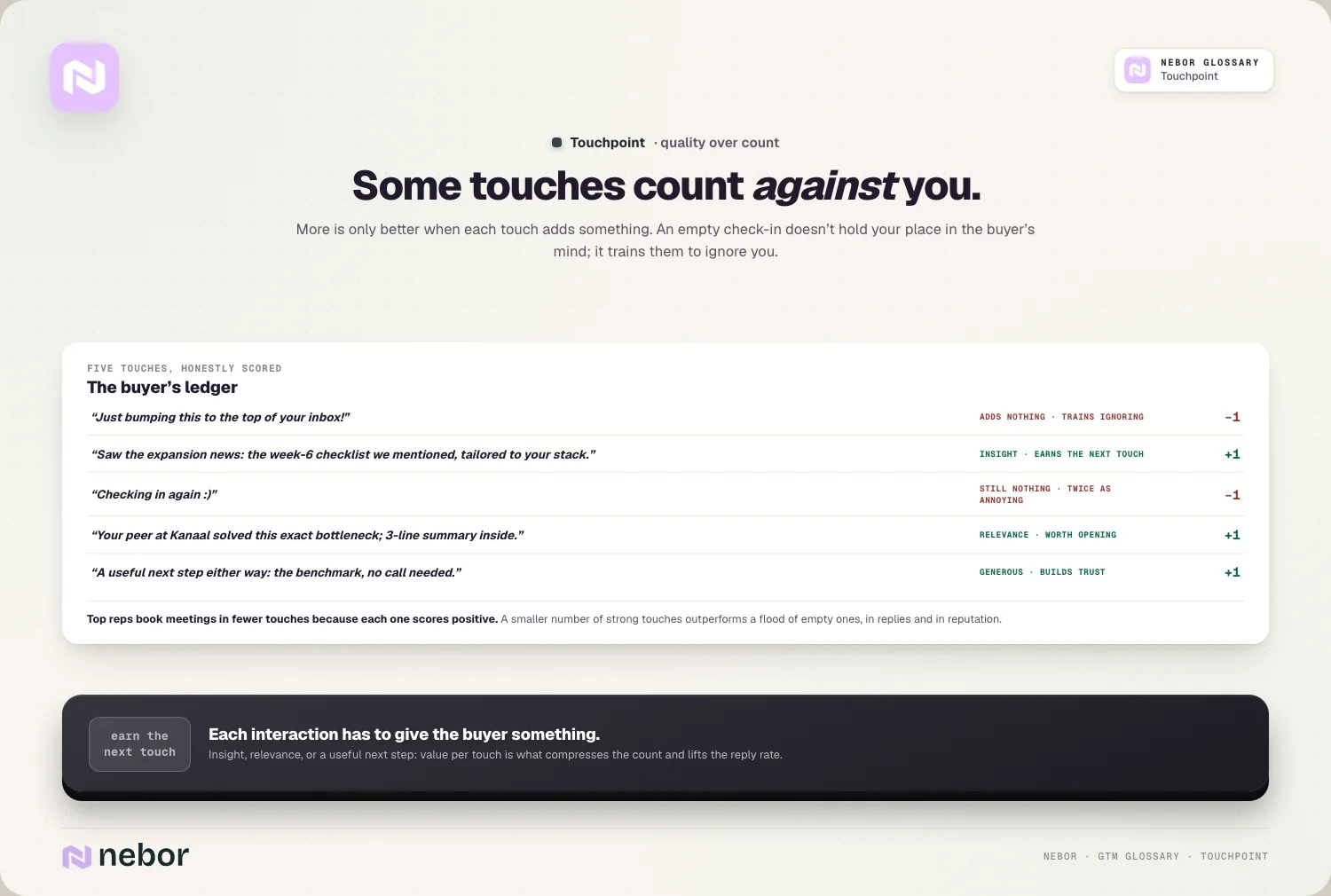
Value is what earns you the next touch. Each touchpoint should give the buyer something, whether insight, relevance, or a useful next step, and that value is what makes them willing to keep engaging.
The best reps prove the point every quarter. That top performers book meetings in fewer touches shows that better touchpoints beat more of them, because quality compresses the number needed and lifts your reply rate.
So the goal is touchpoints with value in them rather than mere frequency. Each interaction has to justify its arrival, because a smaller number of strong touches outperforms a flood of empty ones.
How thought leadership creates touchpoints before you reach out
Many of a buyer's most influential touchpoints happen without any direct outreach involved. Content is where a lot of early contact occurs.
Content works as a touchpoint in its own right. Every time a buyer reads your article or sees your post, that's a touchpoint, so thought leadership quietly accumulates contact before sales is involved.
It shapes the phase you never see. Since most of the journey happens before a buyer talks to you, these content touchpoints do much of the work of building awareness and trust.
It warms the outreach that comes later. A buyer who has encountered your ideas through content is already partway into the relationship, so your direct touchpoints land on warmer ground.
So touchpoints aren't only the messages you send. The content a buyer finds on their own is often the most influential contact of all, so presence matters as much as outreach.
Why touchpoints are so hard to measure and attribute cleanly
Because a deal involves so many touchpoints, working out which ones mattered is genuinely difficult. Attribution is one of the hardest problems here.
Every touch contributes something to the outcome. With dozens or hundreds of touchpoints, it's rarely one that closed the deal, so crediting any single interaction oversimplifies what happened.
Some touches stay invisible to you entirely. Buyers interact with reviews, peers, and content you never see, so a large share of the touchpoints influencing a decision go unrecorded.
This is part of the job attribution models exist for. Approaches like multi-touch attribution try to spread credit across the touchpoints, though no model captures the full picture perfectly.
So touchpoints resist any simple measurement you might try. The sheer number and invisibility of many touches make attribution an estimate instead of a certainty, something to keep in mind before over-crediting any single one.
How touchpoints connect directly to the length of your sales cycle
The number and pacing of touchpoints tie directly to how long deals take. They shape the sales cycle in both directions.
More touches can stretch the calendar out. A journey needing many touchpoints naturally takes longer, because each interaction happens over the weeks and months of the sales cycle.
But better touches can speed it up. High-value touchpoints that build trust faster can compress the journey, so quality can shorten the cycle even as the count stays high.
Consistency in your sequence is what prevents the stalls. Regular, valuable touchpoints keep a deal moving, while gaps let it cool, which is often what causes deals to stall midway.
So touchpoints and cycle length move together. Managing the number, pacing, and quality of touches is a direct way to influence how fast, or slow, your deals end up closing.
How a warm touchpoint differs from a cold one in actual practice
Not every touchpoint carries the same weight, and in our experience the biggest divide is between warm and cold contact. Where a touch lands changes how much it does.
Cold touchpoints start the relationship from absolute zero. A first cold email reaches someone with no prior awareness, so it does the hard early work of earning the first sliver of recognition.
Warm touchpoints build on the contact before them. A touch that reaches someone who already knows you, the essence of warm outbound, lands far better because trust is already partly there.
Earlier touchpoints make the later ones land harder. Each interaction warms the next, so a series of touchpoints compounds, with every one raising the value of the ones that follow.
So the sequence of touchpoints matters as much as the count. Early touches that build recognition make later touches far more effective, and that ordering is why warmth shapes the whole series.
Why fast touchpoints matter most right after a buyer engages
Timing changes how much a touchpoint is worth, and one moment stands out above the rest. A touch that reaches your buyer right after they show interest is worth many later ones.
Fresh interest fades faster than teams expect, something we watch play out in almost every funnel we look at. When a buyer engages, their attention is highest right then, so a touchpoint in that window lands far harder than one days later.
Speed is the lever that matters most there. Reaching a buyer quickly after they act, the heart of speed to lead, turns a fleeting moment of interest into a real conversation.
Delay wastes the opening the signal created. A touchpoint that arrives after the interest has cooled has to reawaken attention instead of ride it, which is far less effective.
So the timing of a touchpoint can matter as much as its content. A well-timed touch right after a buyer engages does more than several perfectly written ones sent too late.
The common mistakes teams make when they manage their touchpoints
Touchpoints get mishandled in a few predictable ways, and we see the same ones whenever teams show us their sequences. Avoiding them makes every touch count for more.
The biggest is giving up too early. Since it takes many touches, stopping after one or two forfeits most of the outcomes your sequence could have earned.
Another is sending touches with nothing in them. Adding interactions that carry no value annoys buyers and trains them to tune you out, so quantity without substance backfires.
A third is relying on a single channel alone. Reaching a buyer only through one channel misses the reinforcing effect of touchpoints across email, phone, and social together.
The last is treating every buyer the same. A simple deal needs fewer touchpoints than a complex one, so applying the same count everywhere over-contacts some buyers and under-serves others.
Why touchpoints are really about building a relationship over time
The deepest way to see touchpoints is as the individual moments of a relationship being built. No single one matters much, but together they're everything.
Each touch works like a small deposit. Every valuable interaction adds a little trust and recognition, so the relationship grows through the accumulation of good touchpoints over time.
The pattern matters more than any single point. A buyer's impression comes from the whole series of touches, so consistency and quality across them matter more than any one perfect message.
It rewards patience and value over cleverness. Since decisions form across many touches over months, the teams that win are the ones that show up consistently and usefully throughout.
Seeing every interaction as one touchpoint in a longer relationship is what makes outreach effective in a modern go-to-market system. It shifts the focus from any single message to the steady, valuable presence, even the touches you automate sales prospecting around, that wins deals in the end.
Share this post
Sequences
Outbound
Glossary
Related glossary items
Understanding the core GTM concepts




Ready to build your pipeline











