

In this post:
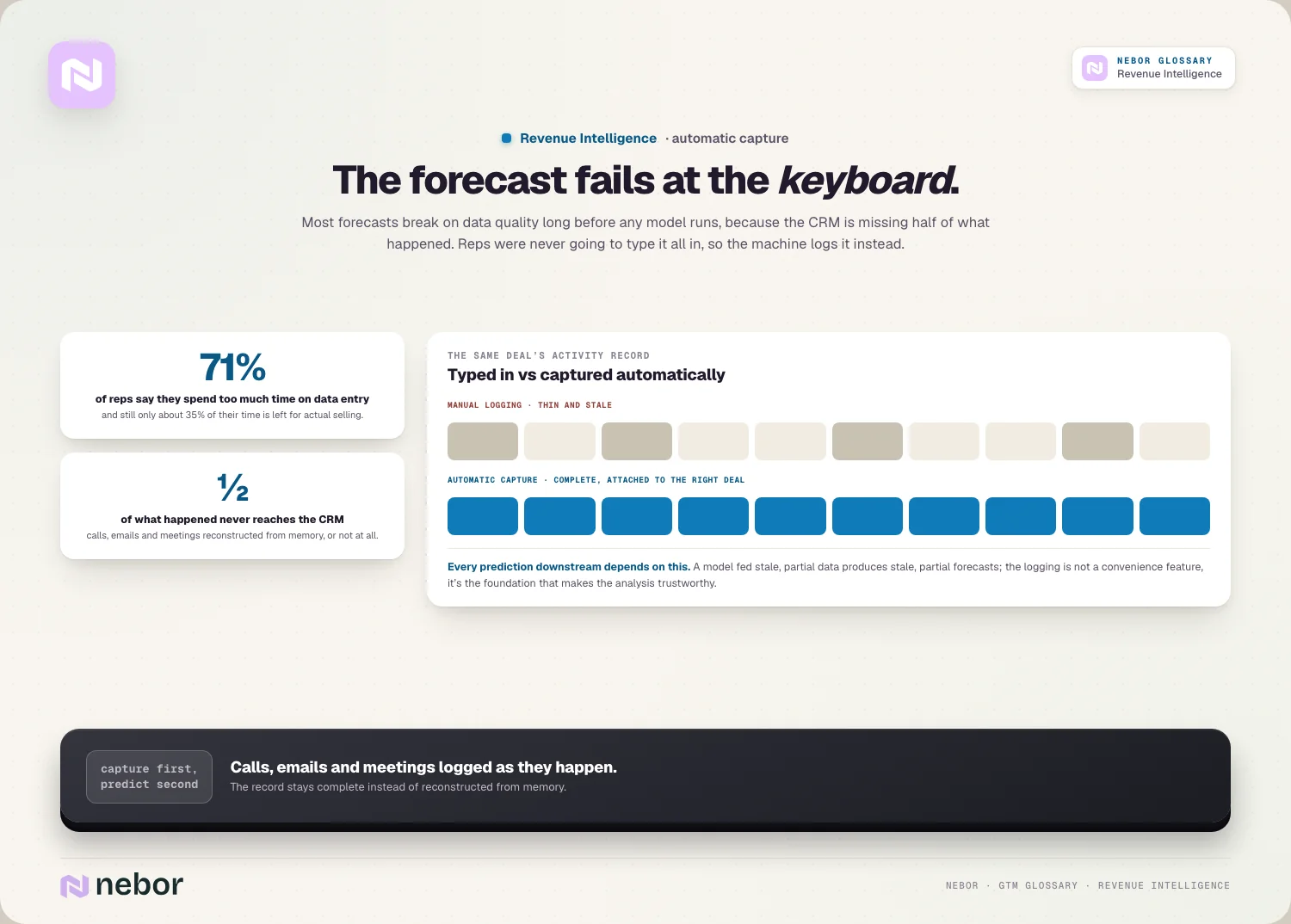
Ask most sales leaders how they build a forecast and the honest answer involves a lot of gut feel. Reps say a deal will close, managers apply a mental discount based on how much they trust each rep, and the number that reaches the board is a stack of optimistic guesses dressed up as a projection.
Revenue intelligence exists to replace that guesswork with something a machine can measure. Instead of asking reps what they think will happen, it reads the real signals buried in your calls, emails, and pipeline activity, then tells you what the data says is likely to happen and where the risk is hiding.
Revenue intelligence is AI-powered software that unifies data from your CRM, sales conversations, email, and pipeline activity, then analyzes it to predict revenue, score deal risk, and recommend next actions. It turns scattered sales signals into forecasts you can act on.
The shift it represents is from describing the past to predicting the future. A traditional CRM records what already happened, while revenue intelligence uses that history plus live engagement signals to estimate what will happen, which is a fundamentally different and more useful question for anyone carrying a number.
TL;DR
Revenue intelligence is AI software that pulls together data from your CRM, calls, emails, and pipeline, then analyzes it to forecast revenue, score deal risk, and recommend the next move.
Its core advantage over a plain CRM is prediction, because the CRM tells you what happened while revenue intelligence uses that data plus live signals to estimate what will happen next.
A big part of its value is automatic data capture, because it logs the calls and emails reps never get around to entering, which fixes the stale, incomplete CRM data that wrecks most forecasts.
The newest platforms go beyond surfacing insights to taking action, executing follow-ups and updates automatically instead of leaving a human to act on every recommendation.
What revenue intelligence does with the sales data you already scatter
Revenue intelligence starts by pulling together the data that normally lives in separate silos. It ingests CRM records, email and calendar activity, call recordings, and pipeline changes, then standardizes all of it into one connected picture of every deal and account instead of a set of disconnected systems.
Once the data is unified, the software analyzes it continuously with machine learning. It scores every open deal, watches how engagement is trending, and compares each opportunity against patterns from deals that closed and deals that died, so the analysis reflects real history instead of a rep's optimism.
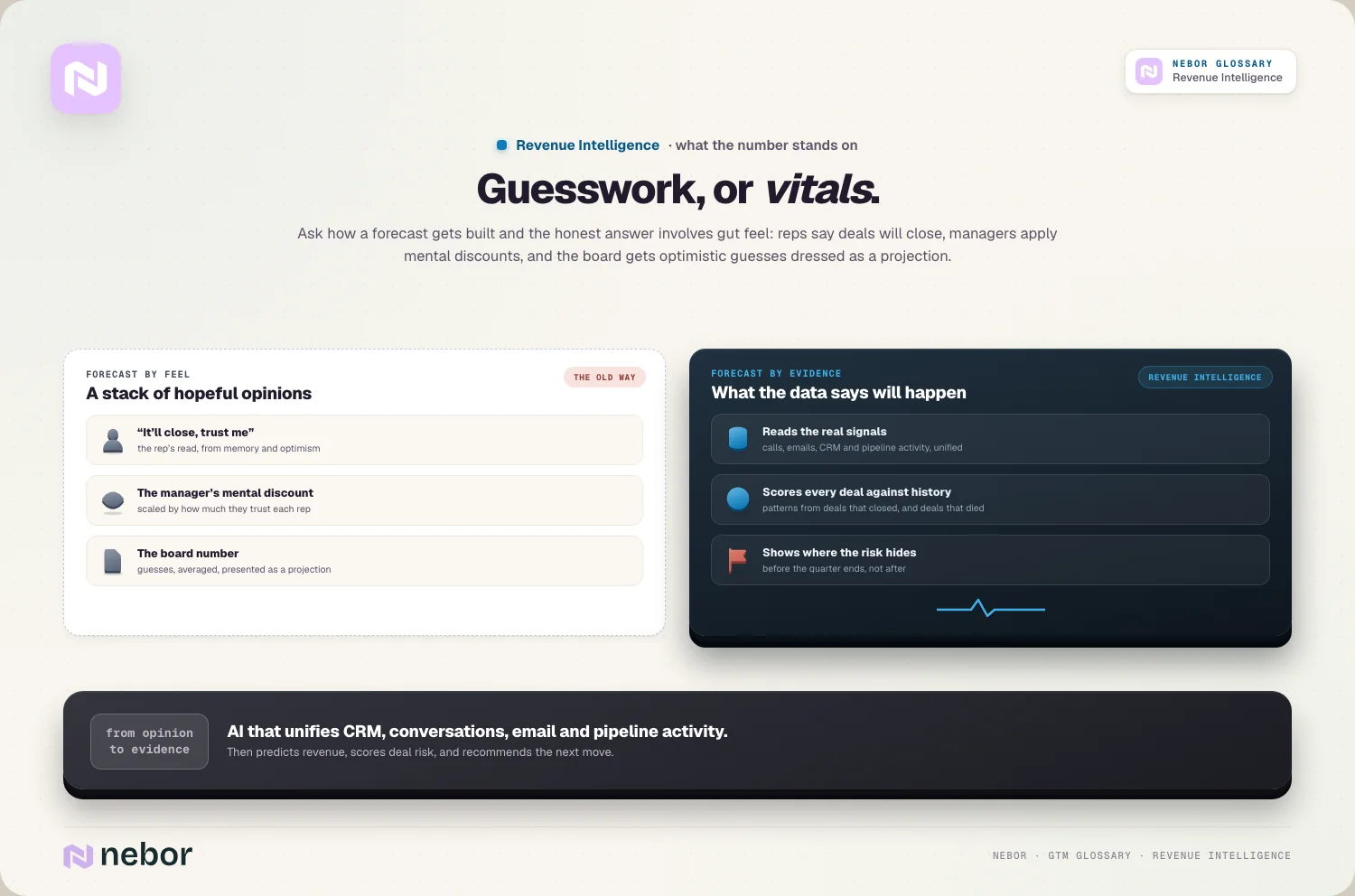
The final step is surfacing what it finds where people already work. Rather than producing a report nobody reads, revenue intelligence pushes its predictions and warnings into the CRM, dashboards, and daily workflows, so a manager sees which deals are slipping without having to go hunting for the signal.
Why the CRM tells you what happened while revenue intelligence tells you what will happen
The cleanest way to understand revenue intelligence, in our experience, is by contrast with the CRM it is built on top of. A CRM is a system of record, a place to log what already occurred, so it's excellent at telling you a deal moved to a stage last Tuesday but silent on whether that deal will ever close.
Revenue intelligence adds the predictive layer the CRM lacks. It takes the same underlying data and asks a forward-looking question, using patterns from past deals to estimate the odds that each current one closes, which turns a static record into a live read on where your revenue is really heading.
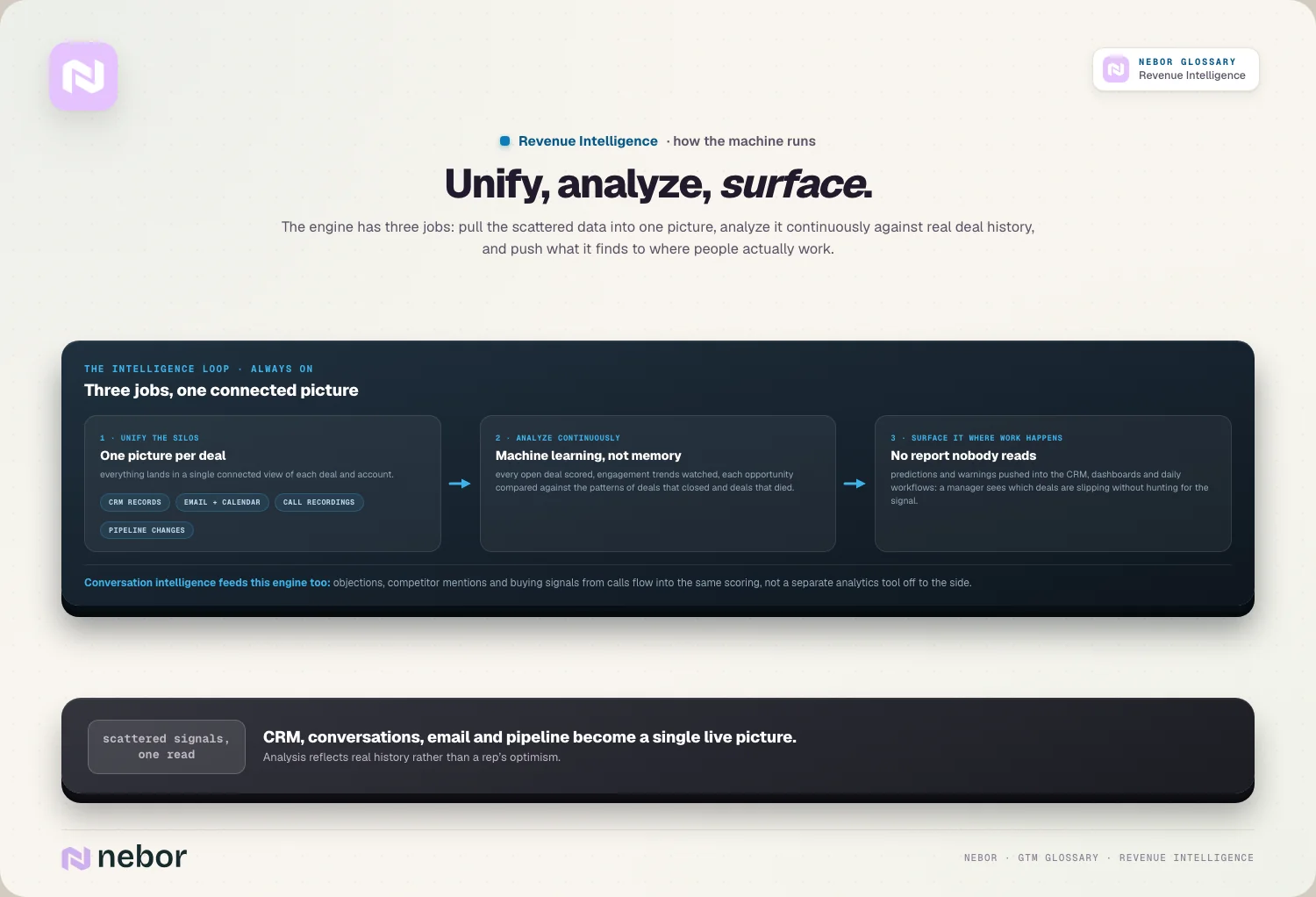
That shift changes the conversation from opinion to evidence. Instead of a rep insisting a deal will close and a manager guessing whether to believe them, revenue intelligence replaces the subjective claim with an objective one grounded in engagement data, so forecast reviews argue about signals instead of feelings.
How automatic data capture fixes the stale CRM problem reps create daily
Most forecasts fail on data quality long before any model gets involved, something we keep seeing in the CRMs we audit, because the CRM is missing half of what really happened.
Reps don't log every call, email, and meeting, so 71% say they spend too much time on data entry and still leave only about 35% of their time for selling, which guarantees the record is thin.
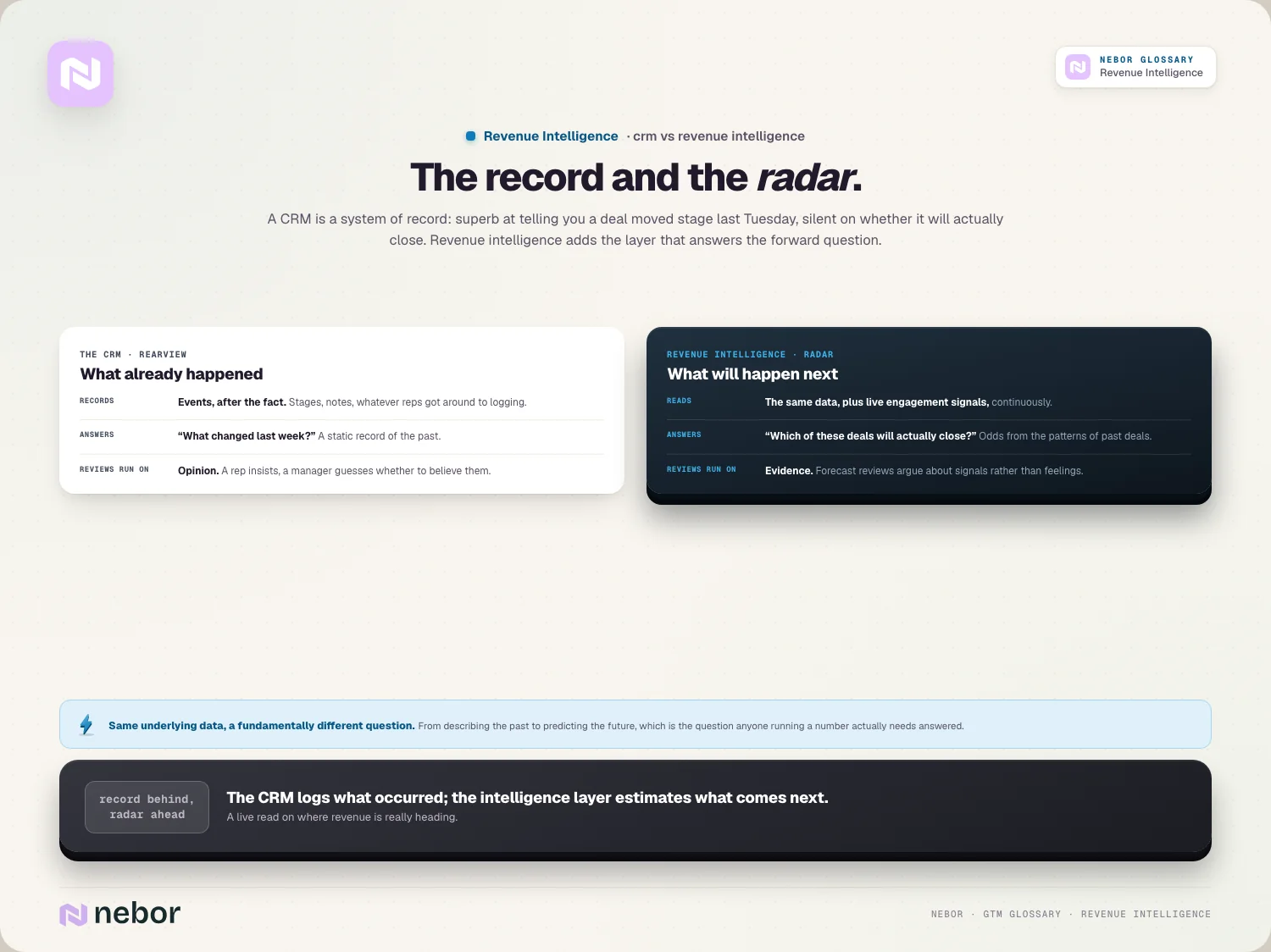
Revenue intelligence attacks this by capturing the activity automatically instead of relying on reps to type it in. It logs calls, emails, and meetings as they happen and attaches them to the right deal, so the picture stays complete instead of being reconstructed from memory when details are already lost.
Better capture is essential because every prediction downstream depends on it. A model fed stale, partial data produces stale, partial forecasts, so the automatic logging is not a convenience feature but the foundation that makes the analysis trustworthy, which is why it pairs so closely with strong CRM hygiene.
What deal scoring and AI forecasting predict and how the models do it
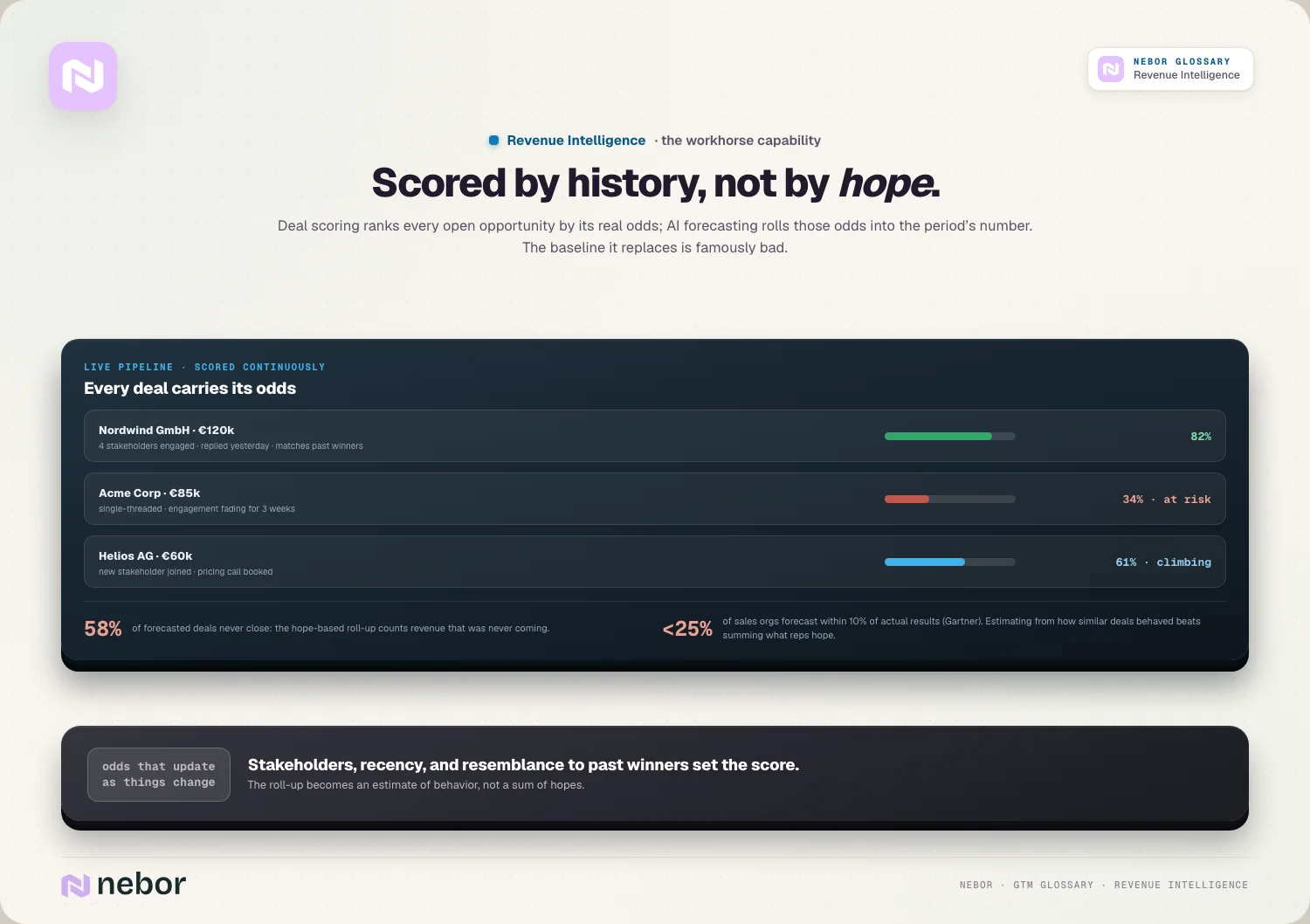
Deal scoring is the workhorse capability, ranking every open opportunity by how likely it is to close. The model weighs signals like how many stakeholders are involved, how recently the buyer responded, and how the deal compares to past winners, then assigns a probability that updates as things change.
AI forecasting rolls those individual scores into a prediction for the whole period. Rather than summing what reps hope will close, it estimates the number based on how similar deals have behaved historically, which tends to be far more accurate than the manual roll-up most teams still rely on.
The accuracy gap it targets is real and well documented. Around 58% of forecasted deals never close and, according to Gartner, fewer than 25% of sales organizations forecast within 10% of actual results, so a data-driven prediction improving on that baseline directly strengthens forecast accuracy.
Where conversation intelligence fits inside a revenue intelligence platform
Conversation intelligence is the piece that reads what happens on sales calls, and it's often confused with revenue intelligence as a whole.
It records and analyzes calls to surface objections, competitor mentions, and buying signals, turning hours of conversation into structured data about what buyers said in their own words.
The relationship is that conversation intelligence is one input feeding the larger revenue intelligence engine. What a buyer says on a call is a powerful signal about whether a deal is healthy, so those insights flow into the deal scoring and forecasting instead of living as a separate analytics tool off to the side.
Kept in that context, conversation data adds a dimension raw CRM activity misses. A deal can look active on paper while the calls reveal a stalled champion or a pricing objection nobody logged, so blending what was said with what was done gives revenue intelligence a fuller read on true deal risk.
How the newest layer moves from surfacing insights to taking action automatically
For years, revenue intelligence stopped at insight, handing a manager a warning and trusting a human to act. The problem is that surfaced insights often die in a dashboard, because a busy team can't chase every flagged deal, so the intelligence produced value only when someone happened to follow through.
The newest and most consequential layer closes that gap by acting on its own conclusions. Rather than just flagging a deal going cold, leading platforms can trigger the follow-up, update the record, or route the task automatically, so the recommended next step happens instead of waiting on a person to notice.
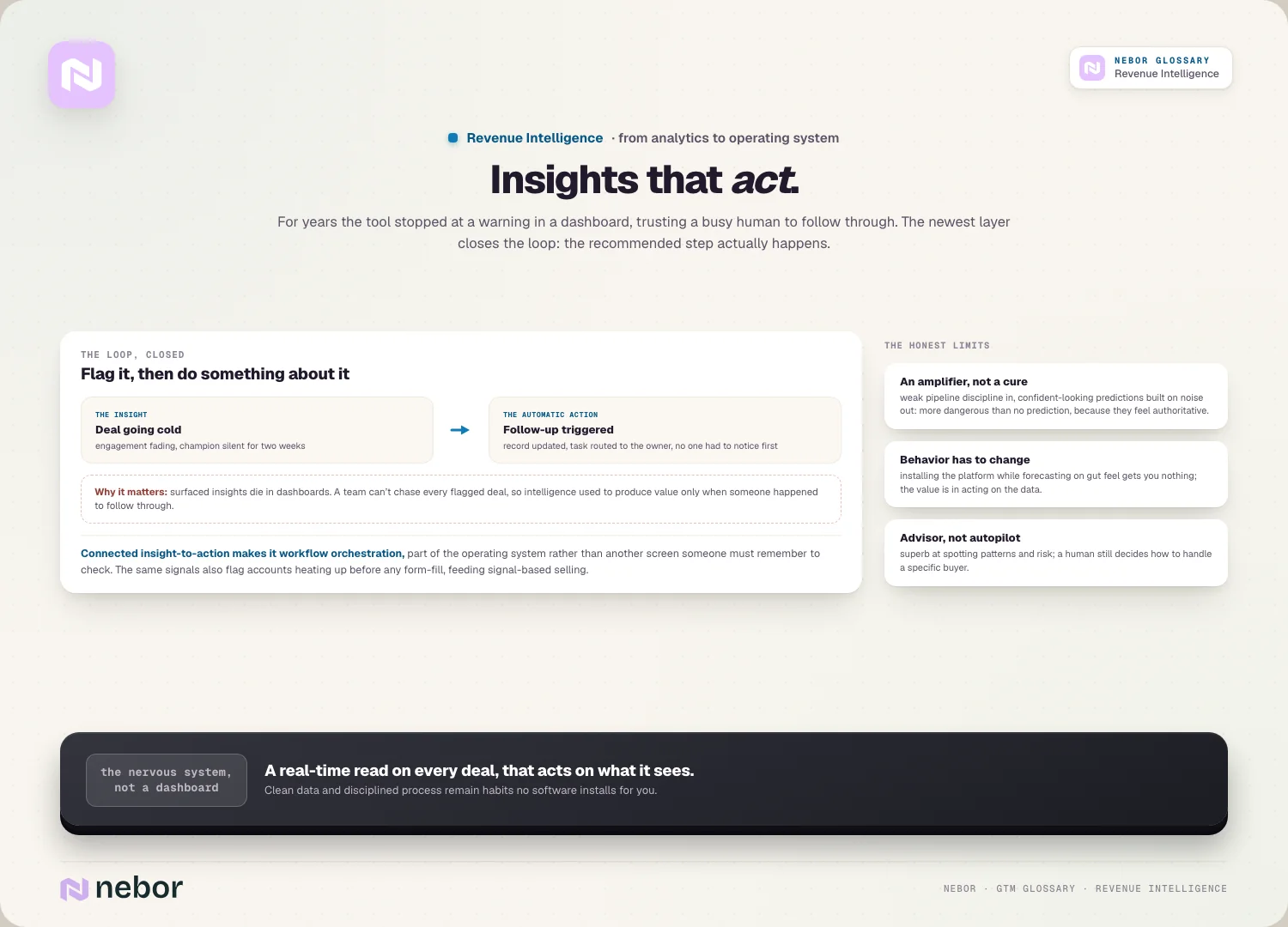
This move toward automated action is what turns revenue intelligence from an analytics tool into part of the operating system. When the insight and the action are connected, the platform becomes a piece of real workflow orchestration instead of another screen someone has to remember to check.
How revenue intelligence surfaces buying signals you would otherwise miss
Beyond scoring deals already in the pipeline, revenue intelligence increasingly watches for signs that a new opportunity is forming. It reads engagement patterns, product usage, and buyer behavior to flag accounts heating up, so a rep learns an account is ready to talk before the buyer ever fills out a form.
This makes the platform a source of timing as well as prediction. Knowing that a customer just expanded their usage or that a prospect keeps returning to your pricing page is exactly the kind of trigger that powers signal-based selling, turning raw activity into a reason to reach out at the right moment.
The advantage is that these signals often precede any obvious buying step. A deal that revenue intelligence flags as forming can be worked while interest is fresh, so the same data that grades existing deals also feeds the top of the funnel instead of only judging what's already there.
Why revenue intelligence is only as good as the data and process beneath it
Powerful as it is, revenue intelligence is not magic, and it inherits the quality of whatever it's built on. If your pipeline stages are defined inconsistently or deals are logged sloppily, the model learns from noise, so the predictions inherit the mess instead of cleaning it up on their own.
The process around the tool matters as much as the tool itself. Revenue intelligence works best when a team already has a disciplined sales playbook and clear definitions of what each stage means, because consistent human behavior is what gives the model stable patterns to learn from in the first place.
This is why revenue intelligence belongs naturally inside a mature revenue operations function instead of replacing it. The platform supplies the analysis, but the clean data, consistent process, and willingness to act on what it finds are organizational habits that no software installs for you.
What revenue intelligence changes about how managers handle their deals
The day-to-day effect shows up most in how managers spend their attention. Instead of reviewing every deal equally or chasing whichever one a rep mentions loudest, a manager can focus on the specific opportunities the system flags as high-value and at risk, which is a far better use of limited coaching time.
It also changes the tenor of pipeline reviews from interrogation to diagnosis. Rather than asking reps to justify each deal from memory, the team looks at objective signals together and decides what to do, which shortens reviews and points effort at the deals where intervention truly moves the win rate.
The compounding benefit is faster, better decisions across the whole pipeline. When risk is visible early, a stalling deal gets attention while there's still time to save it, which protects pipeline velocity instead of discovering the loss only when the deal slips past its close date unannounced.
The common mistakes teams make when they adopt revenue intelligence
The most common mistake is treating revenue intelligence as a cure for a broken process instead of an amplifier of a working one. If pipeline discipline is weak, the tool surfaces confident-looking predictions built on bad inputs, which is more dangerous than no prediction because they feel authoritative.
Another is buying the platform and never changing behavior around it, a pattern we tell clients to guard against from day one.
Teams that install revenue intelligence but keep building forecasts on gut feel get little from it, because the value comes from trusting and acting on the data rather than from owning the software while ignoring what it says.
The subtler mistake is expecting the AI to replace judgment entirely. Revenue intelligence is superb at spotting patterns and risk, but a human still decides how to handle a specific buyer, so the teams that win treat it as a powerful advisor that sharpens decisions instead of an autopilot that makes them.
Why revenue intelligence is becoming the nervous system of a modern revenue team
The deepest way to see revenue intelligence is as the sensory layer a revenue team has always lacked. For decades, sales ran on lagging records and human intuition, and revenue intelligence finally gives the organization a real-time read on what's happening across every deal and account at once.
That visibility compounds because it improves every decision built on top of it.
Better forecasts lead to better hiring and capacity plans, earlier risk detection lifts win rates, and cleaner data makes every downstream analysis sharper, so the intelligence layer ends up raising the performance of the entire revenue engine.
A go-to-market system that can see clearly makes far better use of everything feeding it, from the reps working deals to the outreach you automate sales prospecting to generate. When the whole motion is built on evidence instead of guesswork, the number you commit to starts to reflect what will really happen.
Deel dit bericht
RevOps
Conversations
Analytics
Begrippenlijst
Gerelateerde begrippen
De basis GTM-concepten begrijpen



Klaar om je pipeline te bouwen