Why the Best GTM Agency Is a Sales-Led Agency


In this post:
Nobody hires a GTM agency because they want engineers or more tools. They hire one because something in sales has stopped working, and it usually looks like one of these:
Pipeline is thin and the next quarter already looks short.
Reps spend their days chasing accounts that were never going to buy.
Outbound reply rates keep dropping.
Marketing’s leads go nowhere.
The CRM is too messy for anyone to trust.
The founder is still closing every deal.
Growth has stalled and nobody can say exactly why.
Every one of those is a sales problem. GTM is a sales job at its core, and a GTM agency’s job is to build the systems and workflows that fix those problems fast.
That’s why we think the best GTM agency is a sales-led one. People who have carried a quota know which problem to fix first, and they build the system around how your deals get won, not around the tools.
TL;DR
A good GTM agency makes it easier for your team to sell. If what they build is harder to use than what you had before, it doesn’t matter how clever it looks.
Ignore the badges and the logo walls. Most partner badges show how much of a vendor’s product an agency resells, not how good its work is, and every agency shows the same badges anyway.
Clay coined “GTM engineering” in 2023 for its own sales hires. We use the term because buyers search for it, but we don’t love it. It makes the job sound like wiring tools together, which is the smaller part of the work.
Nebor was started by two salespeople with 18 years of shared experience in sales and marketing. Every build starts with your ICP and buyer personas, so you reach the right buyers before your competitors do.
We build one integrated marketing system across outbound, ABM, paid ads and RevOps, so sales, marketing and customer success all work from the same record.
Everything lives in your own accounts, and your team can change it without calling us. Most agencies skip this part.
The 5 best GTM agencies in 2026 are Nebor, ColdIQ, Understory Agency, RevPartners and The Kiln, and each one fits a different kind of team.
Note: GTM is a sales job before it's an engineering one.
Most people treat GTM as an engineering job. We don't. The tools are open to everyone and anyone can connect them. What moves pipeline is the sales judgment behind them: who to go after, what to say and when to say it.
At Nebor, we came up through sales, and we think that's what makes the best GTM engineers.
Book a 15-minute call and let's talk through your go-to-market strategy.
What a GTM agency should actually do for you (and why it’s not the same as a marketing or lead gen agency)
Go-to-market is everything that happens between having something to sell and having customers who pay for it. It’s deciding which companies to go after, how to reach them, and what to say. It’s making sure a lead moves from marketing to sales to customer success without getting dropped. And it’s knowing whether any of it worked.
A GTM agency builds that system for you and keeps improving it. It often gets confused with three other kinds of agency, and there’s a reason for that.
Tools like Claude Code, ChatGPT, and Clay now let a small team do work that used to take a room full of SDRs or a growth marketing agency. A lot of the sales and marketing work that made sense to outsource a few years ago doesn’t anymore.
So outsourced SDR firms, appointment setters, lead generation shops, and growth marketing agencies have rewritten their websites in GTM language, and they build their workflows with the same tools we do.
From the outside, everyone looks the same, which is exactly why the tools are the wrong way to tell agencies apart.
The jobs themselves are still different:
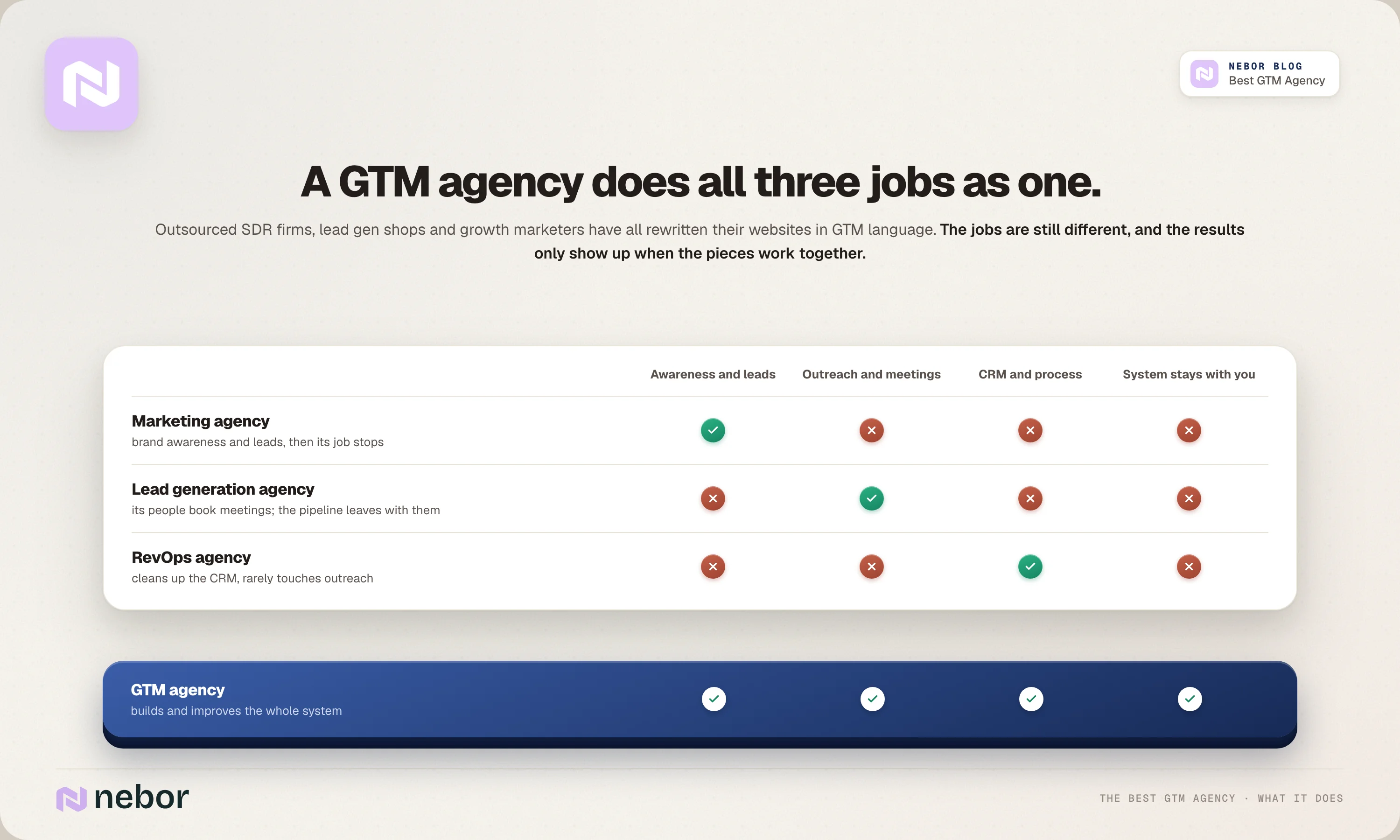
A marketing agency gets you brand awareness and leads. Its job stops there.
A lead generation agency puts its own people on your outreach and books meetings for you. When the contract ends, the pipeline usually leaves with them. We make the full case in why we’re not a lead generation agency post.
A RevOps agency cleans up your CRM and your process, but rarely touches the outreach itself.
A GTM agency does all three as one job, because the results only show up when the pieces work together.
Why the partner badges on every agency’s website don’t tell you who’s actually good at this
Every agency you’re comparing shows a row of partner badges, ours included. They look like proof of quality, but most of them are proof of a sales relationship with a vendor.
Here’s what’s behind some of the most common ones:
HubSpot’s partner tiers are based on how much HubSpot the agency sells.
HeyReach’s premium partner badge requires being a customer on their agency plan.
Inc. 5000 charges a fee to apply, and only US companies can enter.
Clay’s certification is the one exception. It’s based on work the agency submits, so it says something about skill.
We go through each one in our comparison of Understory Agency alternatives, and the same rules apply to our own badges.
A badge tells you an agency has a relationship with a tool. It doesn’t tell you whether the person building your system has ever had to hit a number, and that’s the skill this job needs most.
Where the term GTM engineering actually came from, and why we’re not big fans of it
The term started at Clay. In 2023, Clay began calling some of its own sales hires GTM engineers, and its own description of the role is still the clearest one out there.
The role “collapses SDR, AE, and sales engineer roles into one high-leverage function,” and GTM engineers “automate processes that SDRs would’ve done manually.”
Then comes the telling line: “The strongest signal that someone will be a good GTM engineer at Clay is simple: they’re really good at using Clay.”
The term was born at a tool company, to describe people who are good at that tool, doing work that used to be called sales development and sales operations. That doesn’t make it meaningless.
It caught on fast because it named something real: revenue teams had become technical, and nobody had a good word for the person handling that side of the work.
Not everyone is convinced it’s a new job. Barb Mosher Zinck at Diginomica argues GTM engineers are marketing and sales operations rebranded, and quotes Simon Daniels: “the skills in this role aren’t new.”
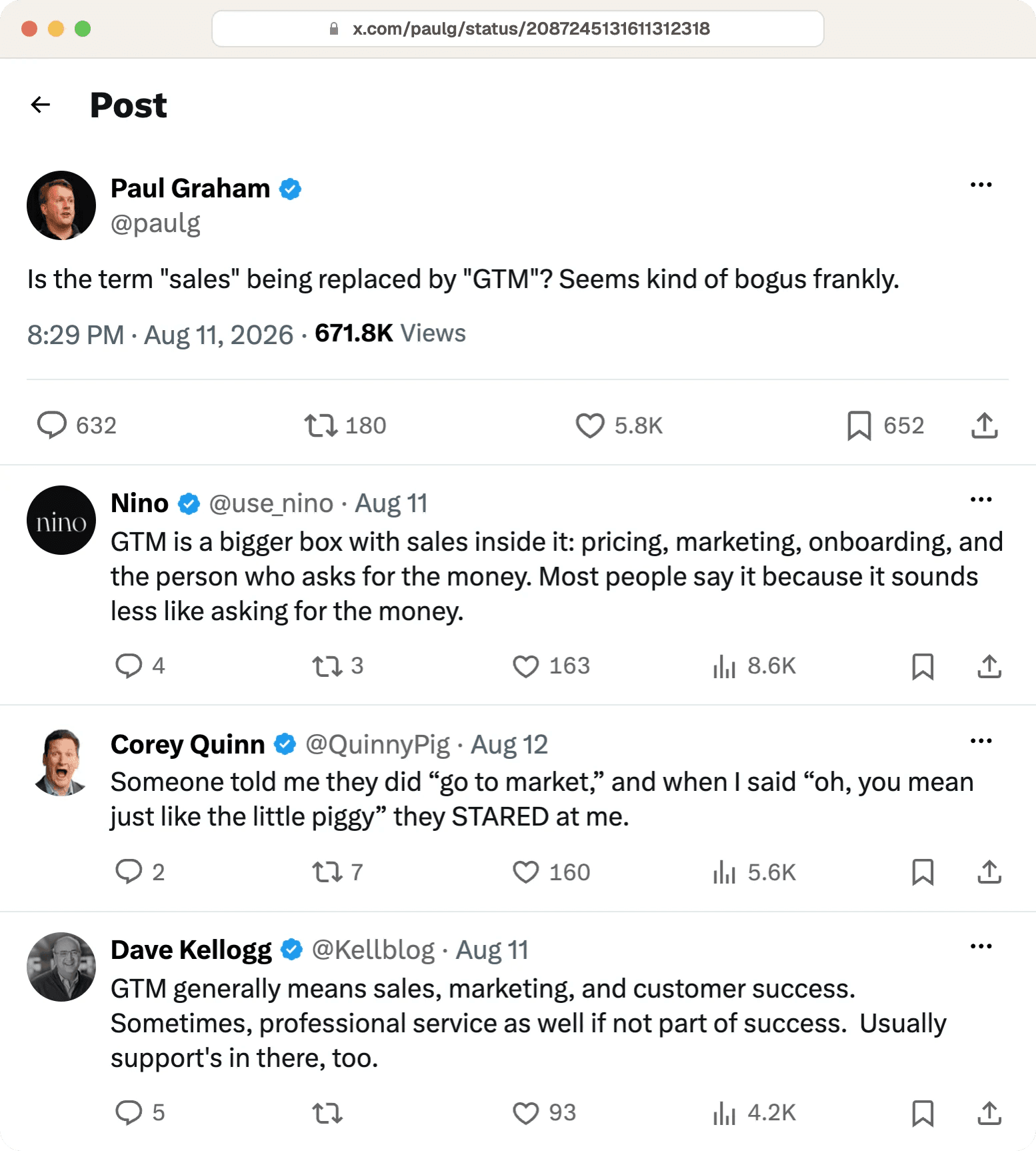
Paul Graham argued the same on Twitter/X in August: “Is the term ‘sales’ being replaced by ‘GTM’? Seems kind of bogus frankly.” The post passed 670,000 views and set off a long argument among founders and sales leaders.
We mostly agree with both of them. The tools are new. The job underneath them isn’t.
We still use the term ourselves. Clients search for it, the market uses it, and refusing to would cost us.
What we don’t love is what most buyers picture when they hear it: a dozen tools chained together, custom scoring models, and pipelines only the person who built them understands. That work is real, and we do it. But it’s one part of the job, and it was never the main part.
The main part has always been making a sales and marketing team simpler and faster to manage. In practice, that means your reps know which accounts to call this week and why, leads don’t wait untouched in the CRM, and nobody loses their day copying data from one tool to another.
The goal is that your people reach the right accounts before your competitors and spend more of their week selling.
The engineering label makes all of that sound harder and more technical than it is. That’s convenient for anyone billing by the hour. It’s not really helpful for you if you’re trying to hire, because it pushes you toward the person with the most impressive stack instead of the one who understands how your deals get won.
Every GTM agency has access to the same tools, so what actually makes one better than another?
Clay, Instantly, HeyReach, Lemlist, HubSpot, and Salesforce show up in nearly every tech stack in this space, ours included. And it’s not only the tools.
The truth is that most of us are in the same Slack communities, expert directories, and WhatsApp groups, where new tools, Clay templates, and outbound plays get shared.
So there are very few secrets in this industry. A new data source, a clever workflow, a sequence that’s getting replies: within a few weeks, everyone has it. Any agency that tells you its edge is its tech stack is selling you something its competitors can copy.
What doesn’t get passed around in a Slack thread is the sales judgment or marketing interpretation. And technically that’s why you’re hiring an expert GTM agency because if it was just about the tools, you could vibe code your way into a solid GTM system in a day.
Knowing which of your accounts deserves a call this week, what your rep should open with, which objection is coming, and which signal is real buying intent comes from years of taking sales calls yourself and losing deals when you got it wrong.
Two agencies can build the exact same workflow in Clay and get very different results, because one of them knew what to point it at. That’s why we think the best GTM agency is a sales-led one.
What we do instead, and why we think it makes Nebor the best GTM agency for a growing B2B company
We’re a GTM and RevOps agency founded by two salespeople, Andrew van Rossenberg and Yannick Kok, with 18 years of shared experience in sales and marketing.
Andrew worked as a BDM, AE, and team lead, including two years in corporate sales at Gartner. Yannick spent 10 years in SaaS sales and led his EMEA BDR team at OneStream to global #1.
That background shapes everything you get with Nebor. We’re based in Amsterdam and work with teams across Europe and the US, in English and Dutch.
You get foundation work done by salespeople: your ICP and buyer personas, agreed before anything gets built
This is where our sales background matters most. Before we build a single workflow, we define three things with you: your ICP, your buyer personas, and the reasons those buyers pick you over the alternative they’re already considering.
We approach it the way a sales team would. We sit in on your sales calls, go through your closed-won and closed-lost deals, and ask your reps which deals came easy and which ones dragged on for months.
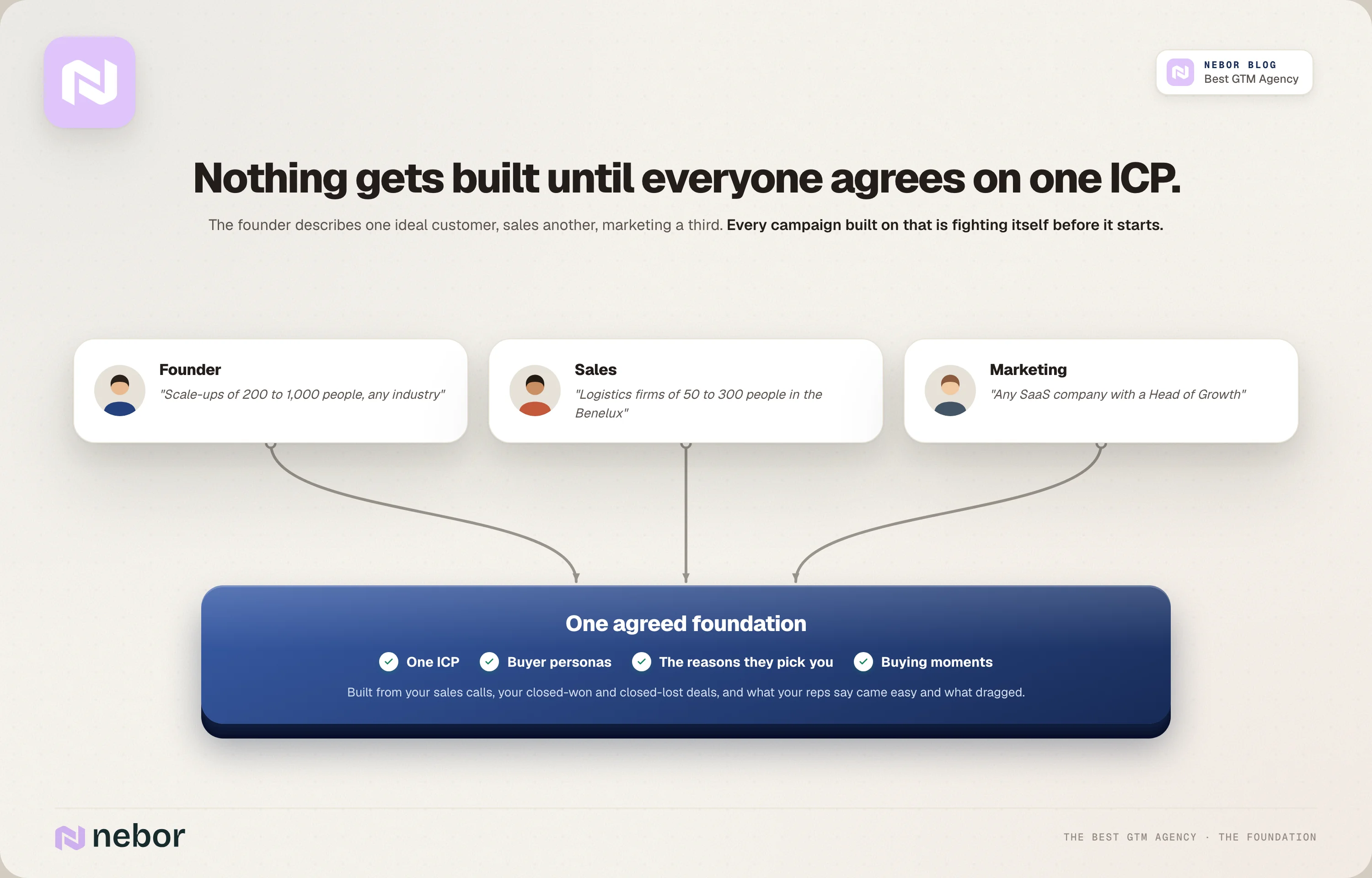
It almost always uncovers a gap. The founder describes one ideal customer, sales describes a slightly different one, and marketing targets yet another one. Every campaign built on that is fighting itself before it starts.
So nothing gets built until everyone agrees on the same ICP, the same personas and the buying moments that make them likely to buy now. Most agencies skip this because it isn’t technical, but it decides whether anything built afterwards works.
You get one system that covers your whole market, from the first list to the closed deal
Most agencies sell you one channel and call it a strategy. But every piece depends on the others. Traffic nobody captures is wasted spend, and leads nobody follows up on are wasted effort.
So we build the whole motion as one integrated marketing system, with every part feeding the next.
Finding who to sell to
Closed-won lookalikes: we study the customers you already won and find the companies that look most like them.
TAM mapping: every company that could buy from you, segmented by fit, so outbound, ads and your reps all work from the same list.
Prospecting workflows: the right people at each account, found and verified, with the research done before your rep opens the record.
Knowing when to reach out
Signal-led outbound: outreach triggered by a buying moment, like a funding round, a senior hire or a job ad for the role you sell into, not by a calendar.
Website visitor identification: the companies reading your pricing page get identified, scored by fit and intent, and routed to the right next step.
Social engagement tracking: the people liking and commenting on your content, and your competitors’ content, become leads instead of vanity numbers.
News and RSS monitoring: industry news, press releases and company blogs get read for you, so each lead carries context and intent that no data provider sells.
Job change tracking: when a champion from a past deal moves to a new company, your rep hears about it that week.
Competitor complaint tracking: when a competitor’s customers complain on review sites, forums or LinkedIn, you know while the frustration is fresh.
Capturing and converting demand
ABM and paid ads: ads that reach the accounts you want, show you who from those accounts is on your site, and tie spend back to real deals.
Lead capture: forms and lead magnets matched to the channel they appear on, so the traffic you pay for doesn’t leave without a trace.
Inbound lead management and routing: every form fill and demo request gets enriched, scored and sent to the right rep in minutes, not days.
Nurturing: leads that aren’t ready yet get useful follow-up, instead of an early sales call or silence.
Meeting prep: when one person books a call, the system finds the other people who have to agree and briefs your rep on all of them.
Closing deals and keeping your data true
Deal management: notes, CRM updates, follow-ups and the contract chase handled around your closer, so they spend the week selling.
CRM enrichment that goes beyond filling in blank fields: records get checked every week, wrong data gets fixed, and real changes turn into tasks and new leads.
Revenue attribution: every closed deal traced back to the touches that earned it, so budget goes where it works.
RevOps: a CRM set up around the way you sell, so leads, deals and forecasts stay predictable.
All of it is built on your pricing, sales playbook and value proposition. That way the ad, the cold email and the rep’s call describe the same customer, the same problem and the same price.
You don’t need every one of these on day one. You need the few that fit your market, connected so they strengthen each other.

Note: GTM is a sales job before it's an engineering one.
Most people treat GTM as an engineering job. We don't. The tools are open to everyone and anyone can connect them. What moves pipeline is the sales judgment behind them: who to go after, what to say and when to say it.
At Nebor, we came up through sales, and we think that's what makes the best GTM engineers.
Book a 15-minute call and let's talk through your go-to-market strategy.
You get integrated marketing, where sales, marketing, and customer success all work from one record
Most revenue teams work from three versions of the truth. Marketing qualifies a lead in one tool, sales re-creates it in another, and customer success opens a third record once the deal closes.
Six months later, three teams are arguing about whose numbers are right, and the customer is getting three different experiences.
We fix that at the root. A lead that marketing scores becomes the same record sales works, and customer success inherits, with the source and every conversation attached.
Every contact carries one score, built from how well the company fits and how strong the buying signal is. High fit and high intent go straight to a rep. Lower scores go into nurture until the signal gets stronger. Treating every lead as equal is the fastest way to burn out a sales team.
When the reports finally match the pipeline, the side spreadsheet your sales leader keeps usually disappears. The teams pull in the same direction because they’re finally looking at the same numbers.
You get to your customers before your competitors do
This is the outcome everything else is built for. You stop fighting over the same tired lists as everyone else in your market, and start reaching the right accounts first, at the moment they’re ready, with a reason to talk that’s specific to them.
Your sales reps will spend their day selling while AI does the research, without anyone writing a prompt
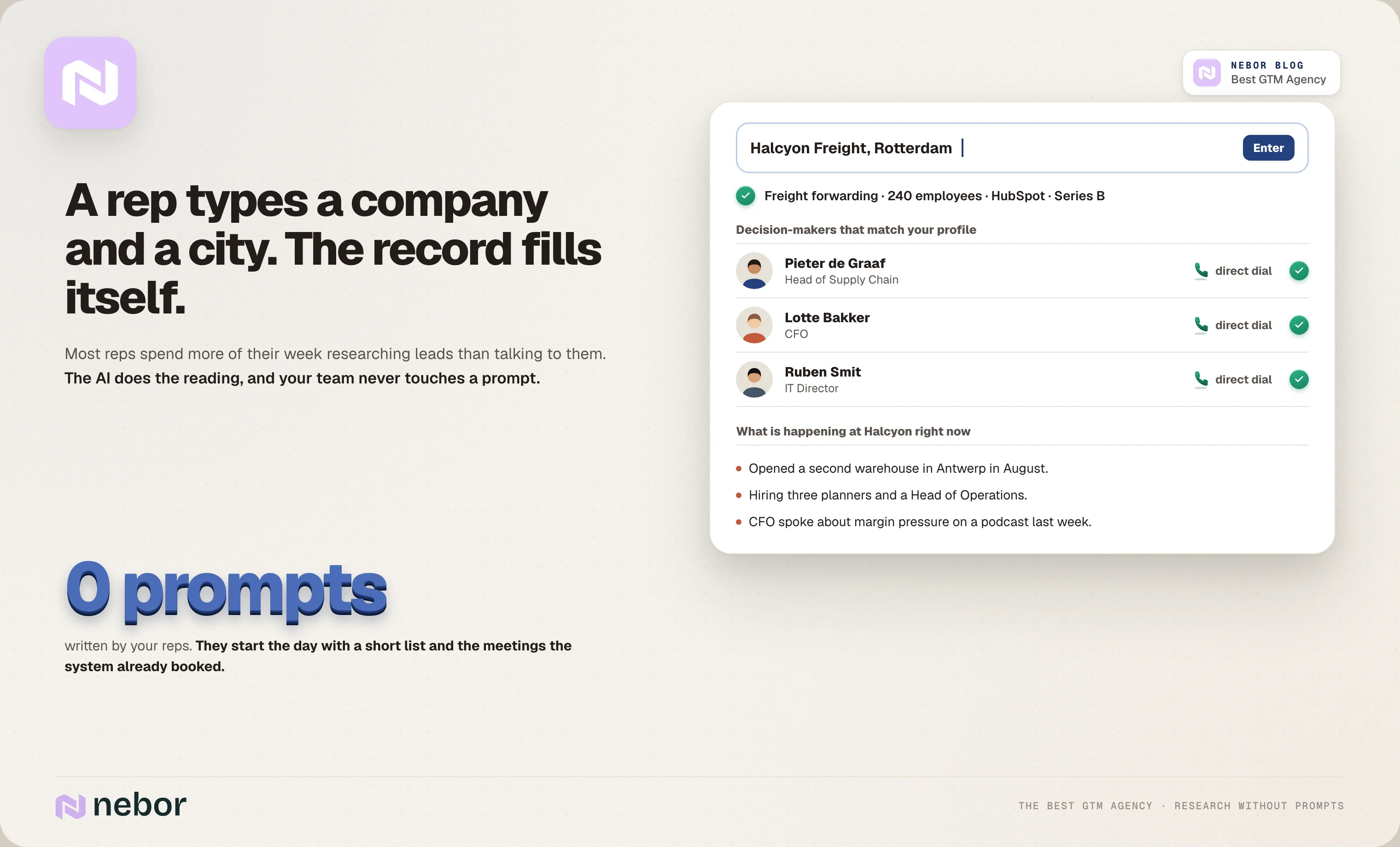
Most reps spend more of their week researching leads than talking to them, so we make the research cost them nothing.
A rep types a company name and a city. Within seconds, the record fills with verified company data, the decision-makers who match your profile, direct phone numbers, and a three-line summary of what’s happening at that company right now.
The AI does the reading, and your team never touches a prompt. They start the day with a short list and the meetings the system already booked, and they spend the rest of it selling.
You get a system that improves every month, with results you can measure
We track everything: reply rates by segment, message, industry and company size, time from first touch to first meeting, how fast deals move through each stage, and where they drop off.
What works gets more budget. What doesn’t gets rewritten, in weeks rather than quarters.
Here’s what that has looked like for clients so far:
Dymaxa, an Austrian cleantech company: €12M in qualified pipeline from almost nothing, meetings with all 10 major European trailer manufacturers, and 14 new clients on an 8-month average sales cycle.
Crisiscentrale, a Dutch crisis management firm that had never sent a cold email: 34 sales opportunities during the pilot, and a 10.8% average reply rate across 1,881 emails.
ExpoGenie, a California SaaS platform for event organizers: 55 qualified leads in the first three months, making up 30% of their total lead inflow.
GroeiLeaders, a Dutch sales and marketing agency we power behind the scenes: 20+ hours a week saved on manual sales work for each of their clients, and reply rates of 2.5% to 30% where they used to get 1% or less.
You get a simple system, built in your own accounts, that your team owns
A simple system your team can operate beats an impressive one they can’t touch. So we keep the moving parts few and write the reasoning down next to each workflow.
Everything lives in your own Clay, sequencer, n8n and CRM accounts, on subscriptions you pay for directly. Your team learns to change it, and the engagement ends with a handover we plan for from the first week.
The 5 best GTM agencies in 2026, and who each one is right for
We judged every agency below on the same questions we’d want a buyer to ask us: who makes the sales decisions, what results they can show with names attached, and who owns the system when the contract ends.
Here’s the list, and who each one fits best:
Nebor: best for B2B and SaaS companies that want a sales-led GTM system that fosters an integrated marketing environment and makes their org more efficient.
ColdIQ: best for SaaS companies that want someone else to handle high-volume outbound.
Understory Agency: best for post-product-market-fit companies that want ads and outbound working as one motion.
RevPartners: best for mid-market teams on HubSpot whose CRM needs fixing before anything else.
The Kiln: best for teams with a hard data problem and someone in-house to operate what gets built.
We compare each of these agencies, plus two more, in our guide to the best GTM engineering agencies.
How to choose a GTM agency, and what to look for once you get past the website
Every agency on your shortlist will look good on its website, so the real test is the first call. Start with the people: who on the team has actually carried a quota, and for how long? They’ll decide which accounts matter and what your reps say.
Then ask to see the work. A real client table with the name blurred, plus real numbers like hit rate and cost per contact, tells you more than any case study.
Finally, check what happens after the build. Your team should be able to change the system, and keep the workspace, data and domains if you stop. An endless retainer pays the agency more the longer you depend on it.
People who have sales experience build this way because it’s what they’d want as buyers. If an agency passes all three tests, you’ve probably found a good one.
Hire Nebor to build a GTM and RevOps engine your own team can operate
This whole article argues that the best GTM agency is a sales-led one. We’re a sales-led agency, so test us on it.
Bring us a real account you’re stuck on. We’ll tell you who to contact, what to open with and why this month. Then ask the other agencies on your list the same question.
If you have no sales team and just need meetings booked next month, we’ll say so on the first call and point you to someone who does that.
Book a 15-minute call and bring the account.


Related Articles


By clicking Sign Up you're confirming that you agree with our Terms and Conditions.