Clay Alternatives: What to Use Instead And When to Switch


In this post:
Most people looking for a Clay alternative should stay on Clay. The reasons they start looking are real, though. The bill grows faster than the results, the tool takes longer to learn than the team has time for, or they only need one part of what Clay does.
Some of those get solved by setting Clay up differently. Others call for a different tool. This guide helps you work out which one you're dealing with.
If you'd rather just talk it through, you can book a 15-minute call. Tell us the job and we'll tell you whether Clay is the right tool for it.
TL;DR
Clay is still the best tool in its category if you use several data providers, need AI research on each row, or change segments often.
Clay bills on two meters: actions and data credits, and testing a column costs the same as using it for real. That’s where most cost complaints come from.
Since Workflows launched in August 2026, Clay also handles the automation that used to need a separate tool.
ChatGPT and Claude can handle one-off research, but they still call the same paid data providers, so you only save Clay’s platform fee.
The right alternative depends on the job: Apollo for finding and emailing in one tool, Cognism for European mobiles, Ocean.io for picking accounts, Breeze for HubSpot teams, and LeadMagic or FullEnrich for the cheapest verified emails.
If your whole market is a few hundred companies, a spreadsheet and a per-credit tool are enough.
Is Clay still the best tool for most GTM and sales teams?
Clay isn't really one tool. It's closer to four tools sharing one account, and that combination is what you're paying for:
It finds companies and the people who work there. You search for the accounts that match your ICP, then pull in the right contacts at each one.
It gives you 150+ data providers through one account. Instead of signing a separate contract with every data vendor, you pay Clay and pick whichever provider works best for each job.
It lets AI research every row for you. You write a question, like "Does this company sell to hospitals?", and Clay's AI agent, called a Claygent, visits each company's website and answers it.
It turns all of that into automated plays. Since Workflows launched in August 2026, Clay can also take the next step on its own, like sending a fresh lead to your sequencer or your CRM.
No other tool on this list does all four. Most of them do one thing well, and that's often enough. The combination only pays off if you actually need more than one of those things. In our experience, that comes down to four kinds of team.
You use more than one data provider. No single provider finds everyone. One is great for European mobile numbers, another is better for US emails, and a third finds people the other two miss. If you're buying from several of them, you end up juggling a separate contract and bill for each.
With Clay, all of that sits in one account. You can ask one provider first and fall back to the next if it comes up empty, which is what people mean by a waterfall. You get more contacts, and you only pay for the ones you actually find.
Your qualification needs a judgment call. Some questions can't be answered by a database. Does this company sell to enterprise customers? Did they just launch a new product? Are they hiring for the role that would buy from you?
A normal enrichment tool can't answer those, because the answer isn't sitting in a field somewhere. A Claygent can. It reads the website or the job posts and answers the question you wrote, for every company on your list. That's the part of Clay that nothing else here really replaces.
Your target list keeps changing. Maybe you're testing a new segment every month, or moving into a new country. Each time, you need different companies and different data to go with them.
In Clay, that usually means adding a few columns or building a new table in an afternoon. With a hard-coded setup, it often means paying someone to rebuild the pipeline from scratch.
Someone on your team owns it. Clay is powerful, but it takes a few weeks to learn properly. It works best when one person is clearly responsible for it and keeps an eye on how the credits get spent.
When Clay is everyone's side job, it tends to go wrong quietly. Tables get messy and credits disappear. After a while, nobody is quite sure what's still running, and you're paying for a tool nobody knows well enough to use.
If none of these sound like your team, Clay is probably more than you need. One of the alternatives further down will likely do the job for less.
How much Clay costs, and how its 2 credit meters work
This is the part that catches people out, and it's why most of these searches happen.
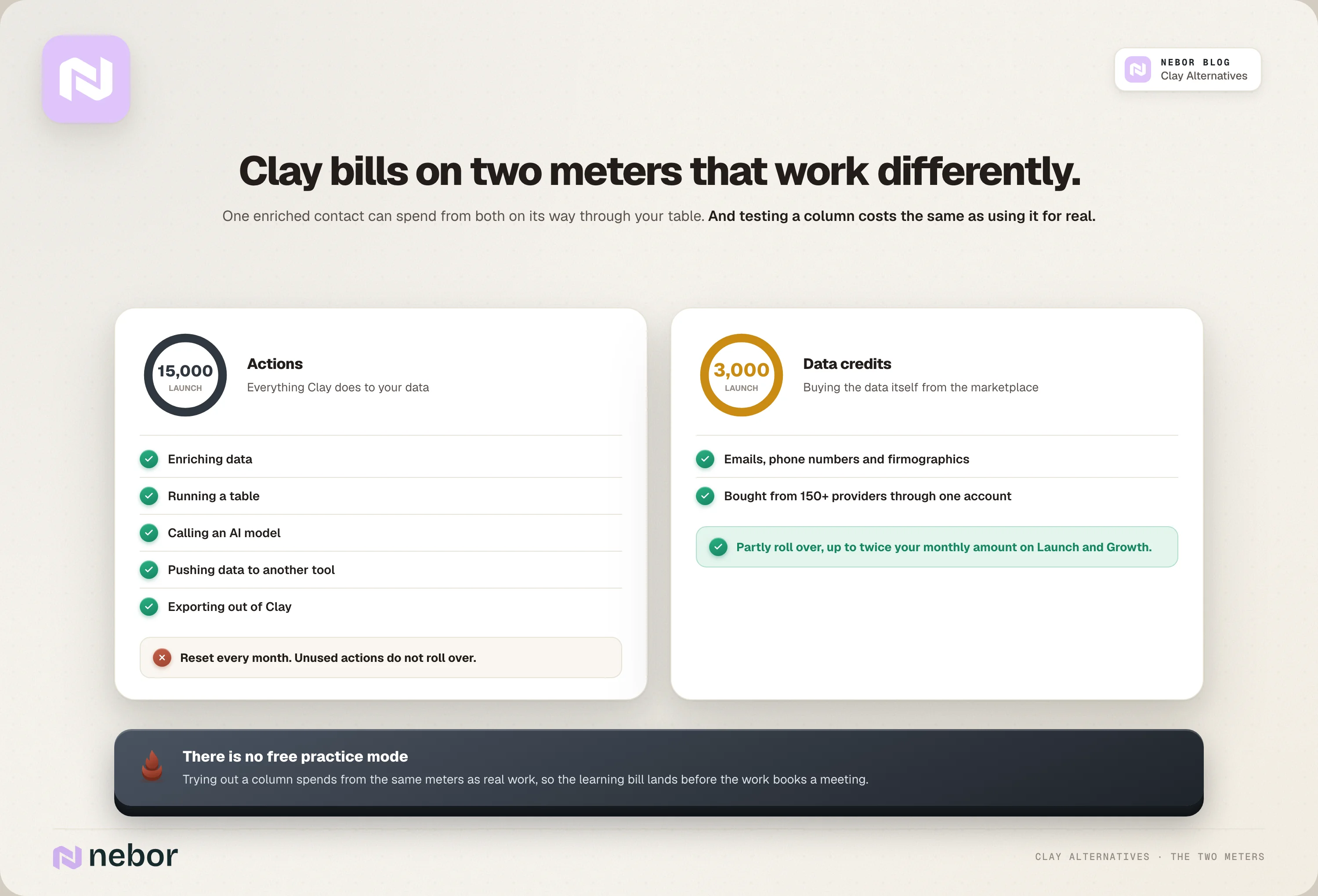
Clay bills you on two separate meters that work differently.
Actions cover enriching data, "running a table", calling an AI model, pushing data to another tool, and exporting out of Clay.
Data credits are separate and cover buying the data itself from the marketplace.
One enriched contact can spend from both meters on its way through your table. They also work differently at month-end. Actions reset monthly and don't roll over. Data credits partly roll over, up to twice your monthly amount on Launch and Growth.
The published plans, in dollars, because Clay prices in dollars:
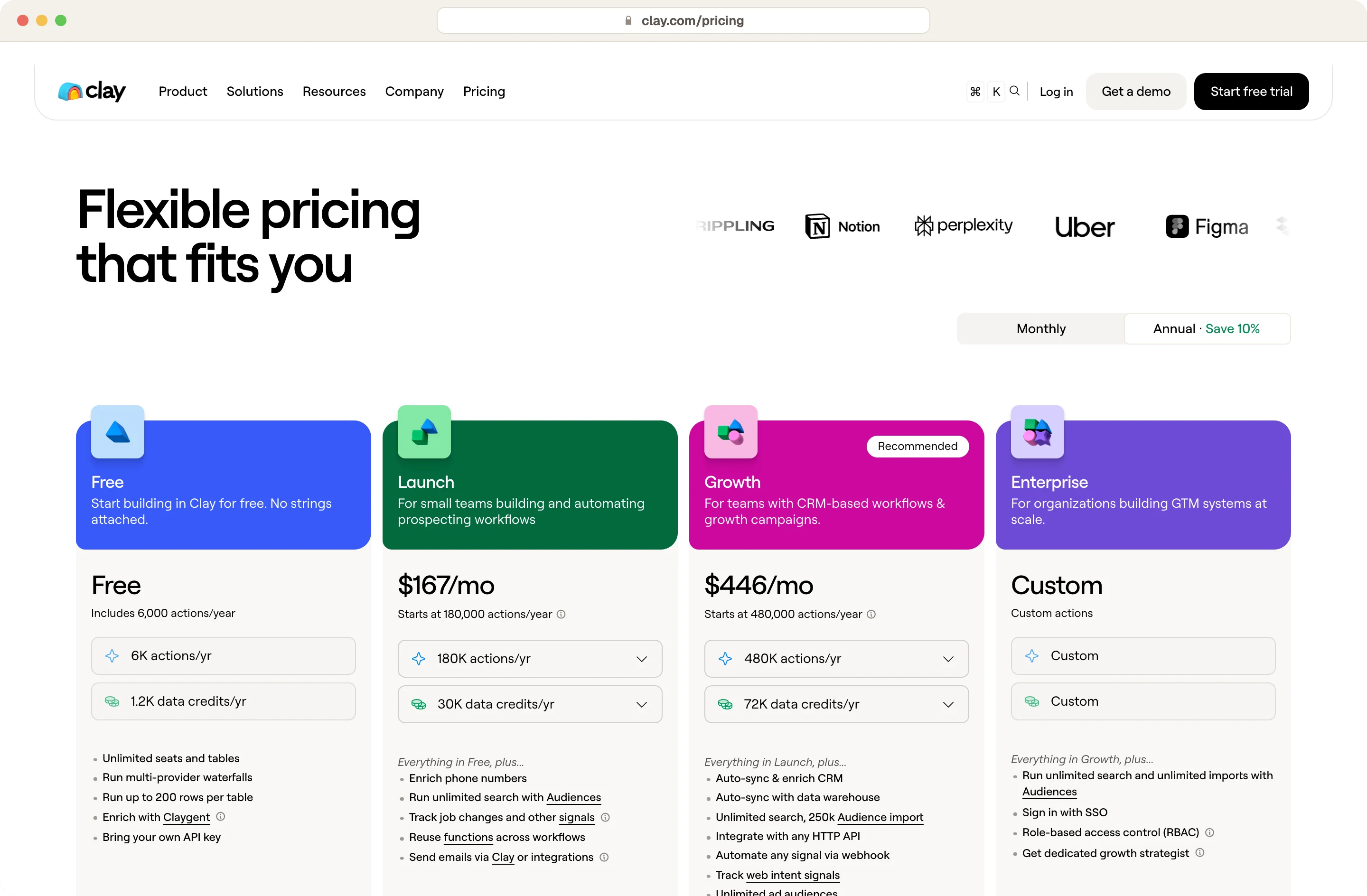
Plan | Price | Actions / month | Data credits / month |
|---|---|---|---|
Free | $0 | 500 | 100 |
Launch | from $167/mo | 15,000 | 3,000 |
Growth | from $446/mo | 40,000 | 6,000 |
Enterprise | custom | custom | custom |
Paying yearly saves you 10%, and seats and tables are unlimited on every plan. That matters more than it sounds, because adding a colleague costs nothing.
The thing people miss is test spend. Trying out a column costs the same as real work, and there's no free practice mode. So you pay to learn the tool, and that bill lands well before the work books you a meeting.
What changed when Clay launched Workflows in August 2026
The standard advice used to be to enrich in Clay and hand anything with branching logic or triggers to n8n, Make or Zapier. Clay launched Workflows on 11 August 2026 and now does a lot of that itself.
Workflows is a canvas of nodes that you wire together yourself. You link up triggers, conditions and agents, drop in code or Functions where you need exact behaviour, call a Claygent where you need research or scoring, and push out to any of 15+ sequencers.
It also tracks every record through each pass, so you can see where it went, why it went there, what failed and what it cost. It's on Launch, Growth and Enterprise, plus the old plans until the end of this year.
Two things should stop you cancelling your automation tool this week.
Clay never says Workflows replaces n8n, Make or Zapier. There's no comparison to them in the announcement or on the product page, and we think they're right to leave it out.
Every node still spends from Clay's meters, and a self-hosted n8n doesn't meter per step at all. So the case for building outside Clay has moved. It used to be about what Clay couldn't do. Now it's about cost at volume and who owns the thing when you stop paying.
Why teams start looking for a Clay alternative
Cost is the top complaint on G2. It's rarely the plan price by itself. It's what that price becomes once a team works at volume, and it's the most common gripe in Clay's own reviews.
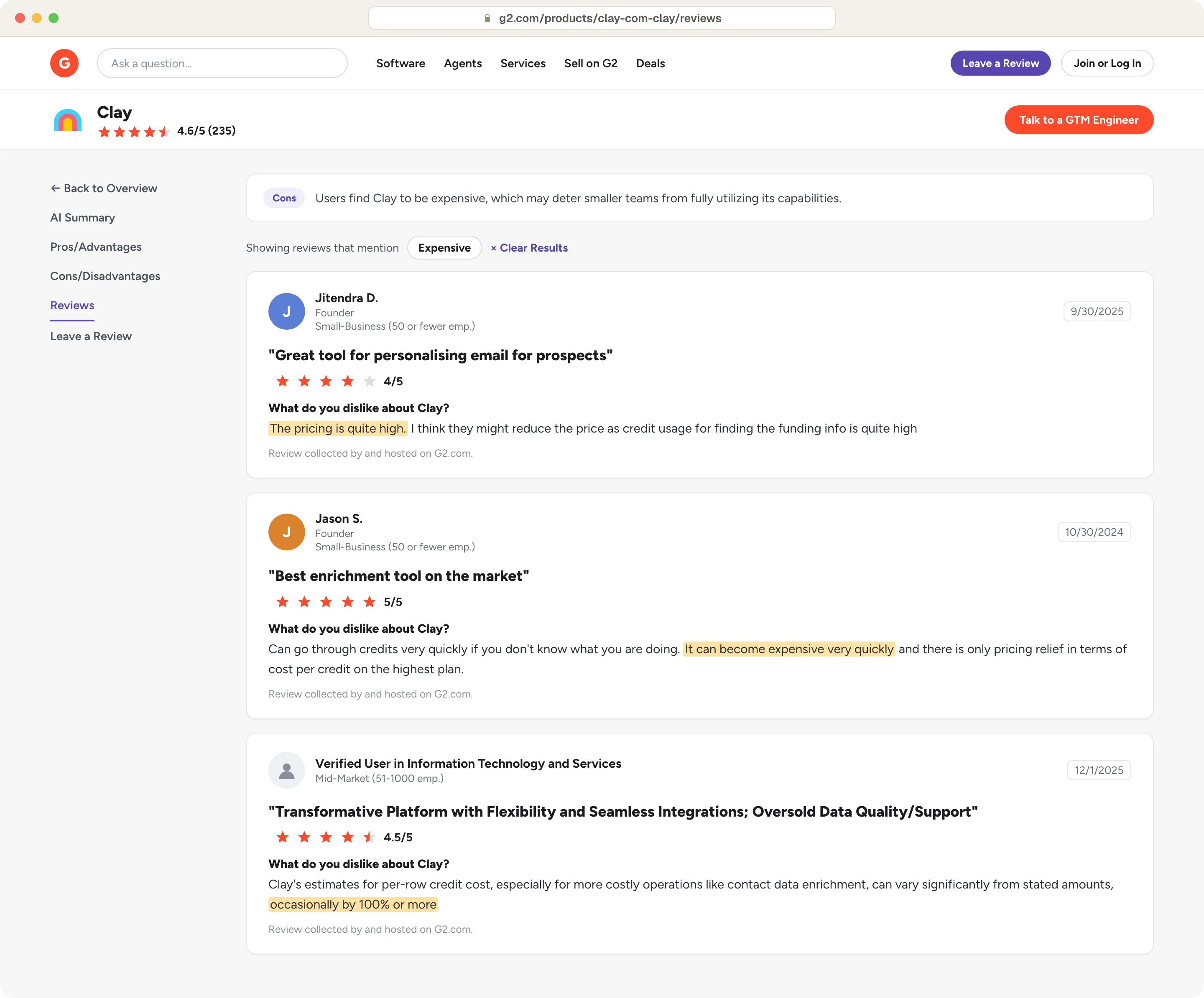
Credits go faster than people expect. Tests cost the same as real work, so a team learning Clay burns money before it ships anything. Reviewers describe watching the counter drop while they set things up.
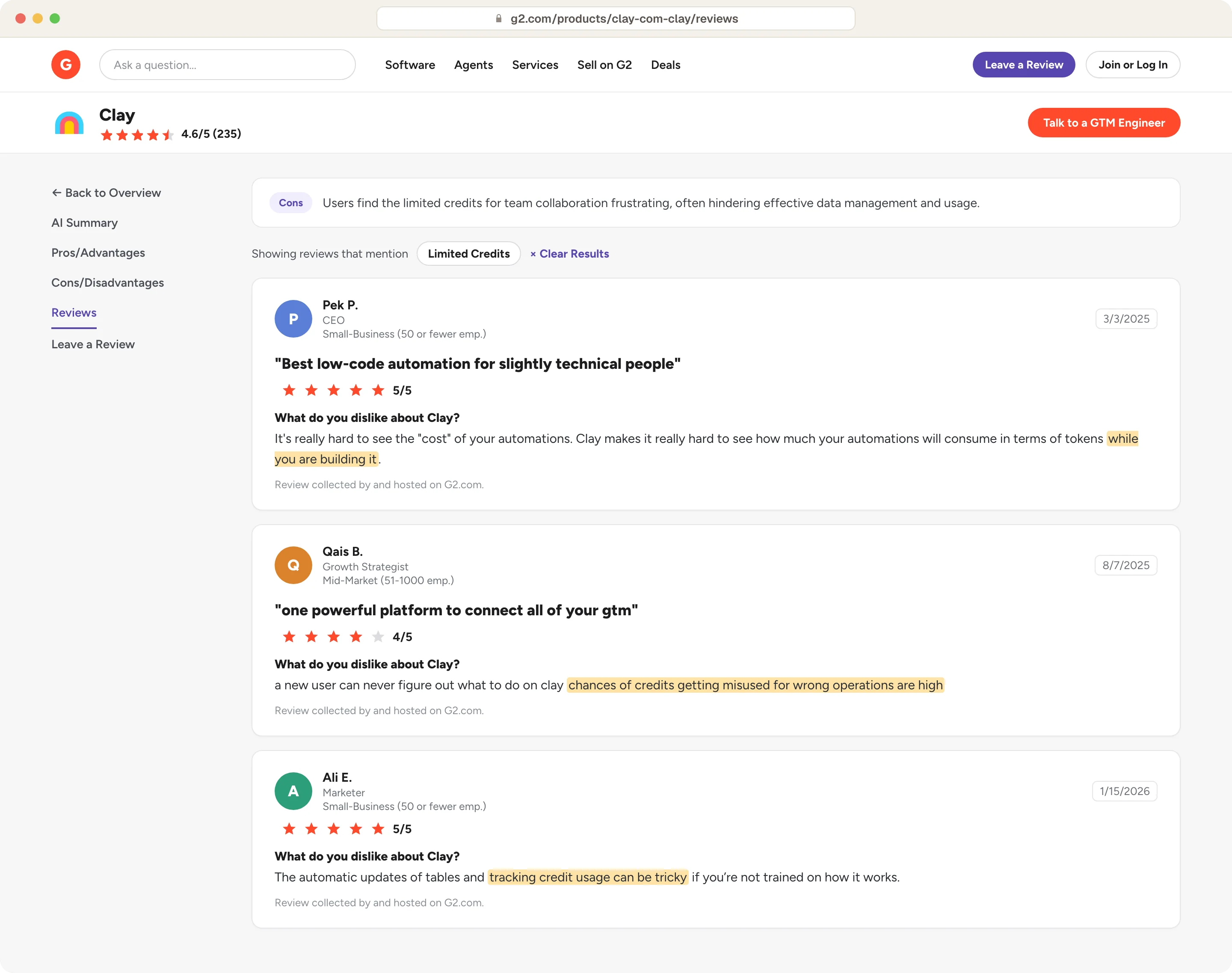
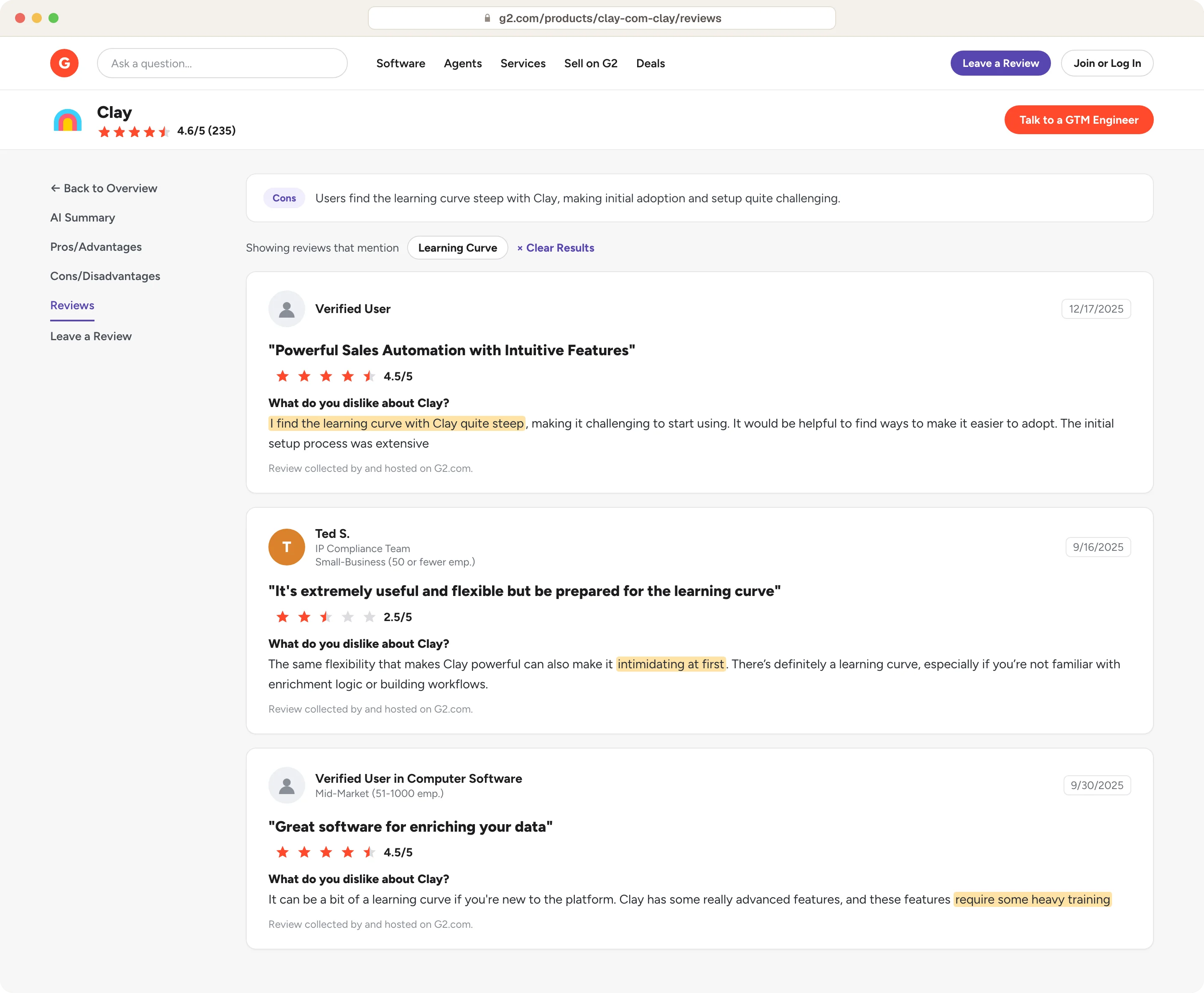
The learning curve is steep, and reviewers say so. Clay is a deep tool and depth takes time, so most people need weeks before they build anything good. A team with nobody named to own it usually never gets there.
None of this makes Clay a bad product. It's why a particular team, doing a particular job, ends up paying platform money for something much simpler.
Can Codex and Claude Code just replace Clay?
You'll have seen this argument on LinkedIn. "You can point Claude Code straight at the enrichment providers, write a bit of code, and pay a fraction of what Clay charges".
It's the right call for some work. For one-off research on a short list, an AI tool with a terminal beats a Clay table on cost and speed. It's also the fastest way to test your logic before you build it, and it'll write the n8n workflow for you.
The problem is the data, because the AI doesn't have any of its own. It still calls the same providers you'd call anyway, so you still need accounts with FullEnrich or Findymail or whoever, and you still pay them per lookup.
You save Clay's platform fee, and nothing else.
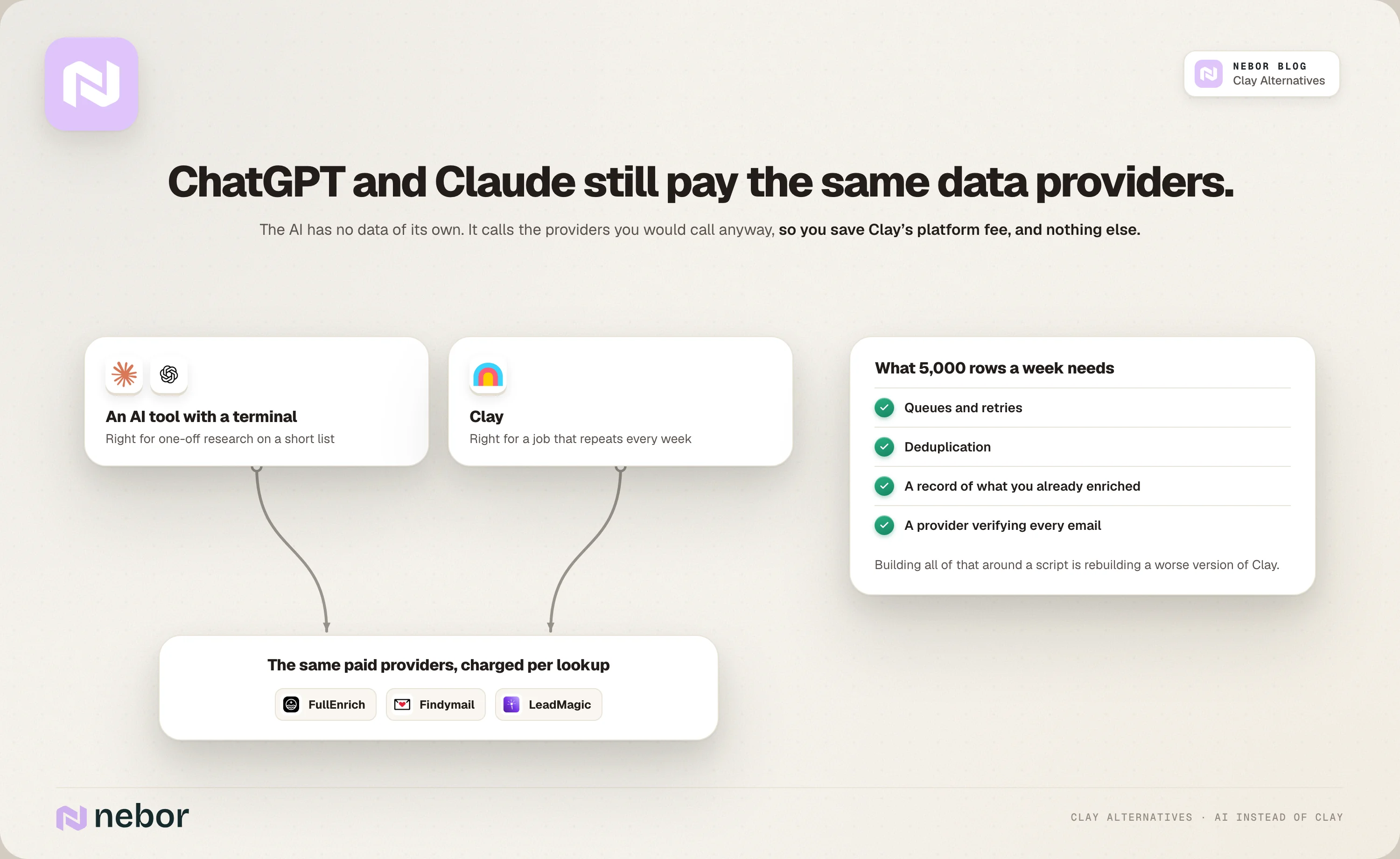
Clay's own Claude connector makes the point better than we can. Since January, you've been able to find contacts, pull company intelligence, and map buying committees from a Claude chat. You still need a Clay account to do it, because Clay is what supplies the data underneath.
An AI will also guess an email format if you let it, so you need a provider to verify every record anyway.
A script that handles 50 accounts once is also a long way from 5,000 rows a week, which needs queues, retries, deduplication, and a record of what you already enriched. Building all of that is just rebuilding a worse version of Clay.
Clay alternatives compared on price, coverage and upkeep
Option | What we like | Published price | Who keeps it working |
|---|---|---|---|
Clay | One account across 150+ providers, plus AI research and orchestration | from $167/mo | Clay, plus your internal owner |
Apollo | Finding and sending in one tool | from $49 per seat/mo, billed yearly | Apollo |
Cognism | European mobiles with DNC checking | no public price | Cognism |
ZoomInfo | Depth on US enterprise accounts | no public price | ZoomInfo |
Ocean.io | Account lookalikes, European company | no public price | Ocean.io |
Breeze Intelligence | Enrichment where your CRM already is | billed in HubSpot credits, cost per record not published | HubSpot |
Lusha | Simple per-credit lookups | from $49.90/mo | Lusha |
Apify + n8n | You own it and pay no per-step fee | n8n from $20/mo, free self-hosted | You |
FullEnrich | Only charges when it finds something | $55/mo for 1,000 credits | You |
Findymail | Verified results with a bounce guarantee | $99/mo for 5,000 credits | You |
LeadMagic | Cheapest way in, pay on success | $49.99/mo for 2,000 credits | You |
A spreadsheet | Free, and you already have it | $0 | You, for an afternoon |
The 7 best Clay alternatives for GTM and data enrichment, and the job each one fits
1. Apollo, for finding leads and emailing them from one tool
The strength of Apollo is that it never hands off to another tool. The database, the sequencer, and the dialler are one product, so nothing gets exported anywhere. For a small team with no operations person, that beats flexibility they'd never use.
Paid plans start at $49 per seat a month, billed yearly, which includes 30,000 credits per seat per year, and Professional is $79 for 48,000. Apollo claims 4.7 out of 5 across 9,690 reviews on its own pricing page, a much bigger sample than anything else here.
Apollo can't do deep research on a company. You get the fields Apollo holds, and you can't point it at a company's website and ask it a question.
2. Cognism and ZoomInfo, for European mobiles and US enterprise data
Neither publishes a price, so expect a yearly contract and a sales process first.
Cognism is the one to call if you sell into Europe and your team lives on the phone. They sell verified mobiles with do-not-call checking across European markets, which is a compliance job as much as a data one.
ZoomInfo goes deeper on US enterprise accounts. Either one makes sense when your deal sizes justify a five-figure yearly commitment, and you want a vendor answerable for coverage. Neither is a sensible first data purchase.
3. Ocean.io, for picking accounts before people
Ocean.io is European, and it thinks in companies. If you give it a set of accounts that closed well, it finds more companies like them, and that lookalike logic is genuinely good. It answers a question Clay makes you put together yourself.
They don't publish prices, so it's a sales conversation. Use them when your problem is choosing which 500 companies to chase. Use something else when your problem is finding the right person at those companies.
4. Breeze Intelligence, for better records inside HubSpot
If your CRM is HubSpot and you want better records without adding a vendor, Breeze is the easiest path. The enrichment happens where the data already lives, so nothing syncs and nothing drifts apart.
Its ceiling is HubSpot's own data, and it won't do the research work Clay does. For a marketing team that wants better firmographics on inbound leads, that's high enough.
HubSpot bills it in credits and charges $0.010 per credit once you go over your allowance. They don't publish how many credits one enriched record costs, so ask before you plan a budget around it.
5. Lusha and RocketReach, for a few numbers a week
Lusha starts free at 40 credits a month, then costs $49.90 for 400 credits, $69.90 for 600, and $399.90 for 3,400. An email costs 1 credit, and a phone number costs 5, and RocketReach works the same way.
That's the whole tool, and for a rep who needs twenty numbers a week, it's the right answer. Nobody should build a system on it.
6. Apify and n8n, for building your own setup and keeping it
Most write-ups skip this option or make it sound easier than it is.
Apify does the scraping, n8n does the logic, and you keep both.
n8n lists $20 a month for Starter with 2,500 executions, $50 for Pro with 10,000, and $800 for Business with 40,000, all billed annually, and European buyers are quoted the same plans in euros.
One execution means one pass through a whole workflow, however many steps it has, which is the big difference from Clay's per-action meter.
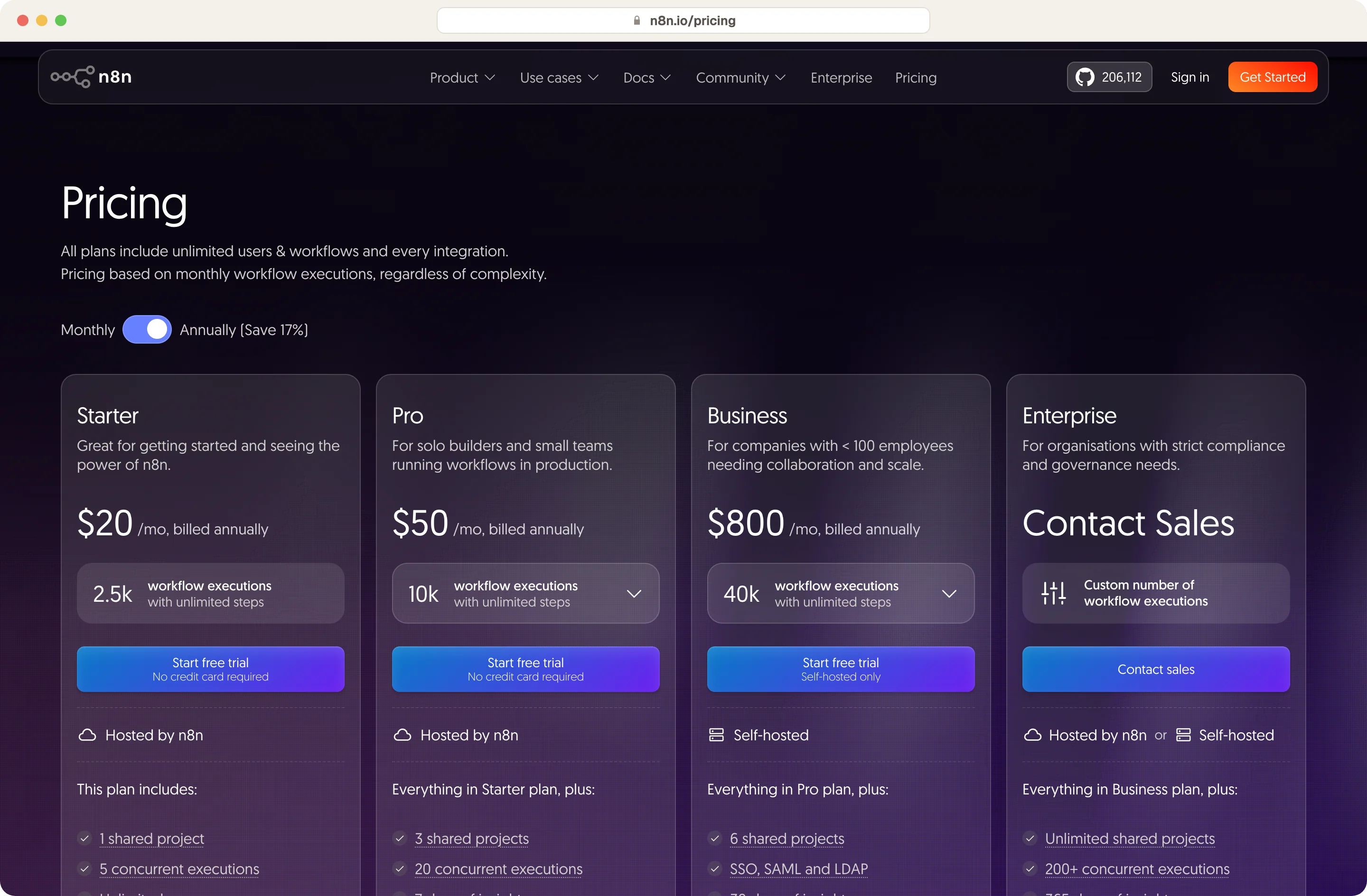
The community edition, hosted by you, is free, and that's the real argument for this route. A self-hosted n8n doing 50,000 enrichments a month costs you server time and little else, where a per-action meter costs a lot more.
You also keep the workflow file, so it carries on working whether or not you pay anyone.
In return, you take on the upkeep. Scrapers break when a site changes its markup, API responses change shape without warning, and someone has to spot it and fix it. None of it is hard, and all of it needs a person who notices. Anyone who tells you a build like this maintains itself has never looked after one.
7. FullEnrich, Findymail and LeadMagic, for a cheaper waterfall
If all you want is a waterfall that finds verified emails and mobiles, you can buy that on its own and skip the platform.
All three only charge when they find something. FullEnrich is $55 a month for 1,000 credits at $0.055 a credit, where a work email is 1 credit and a mobile is 10, and unused credits carry for three months.
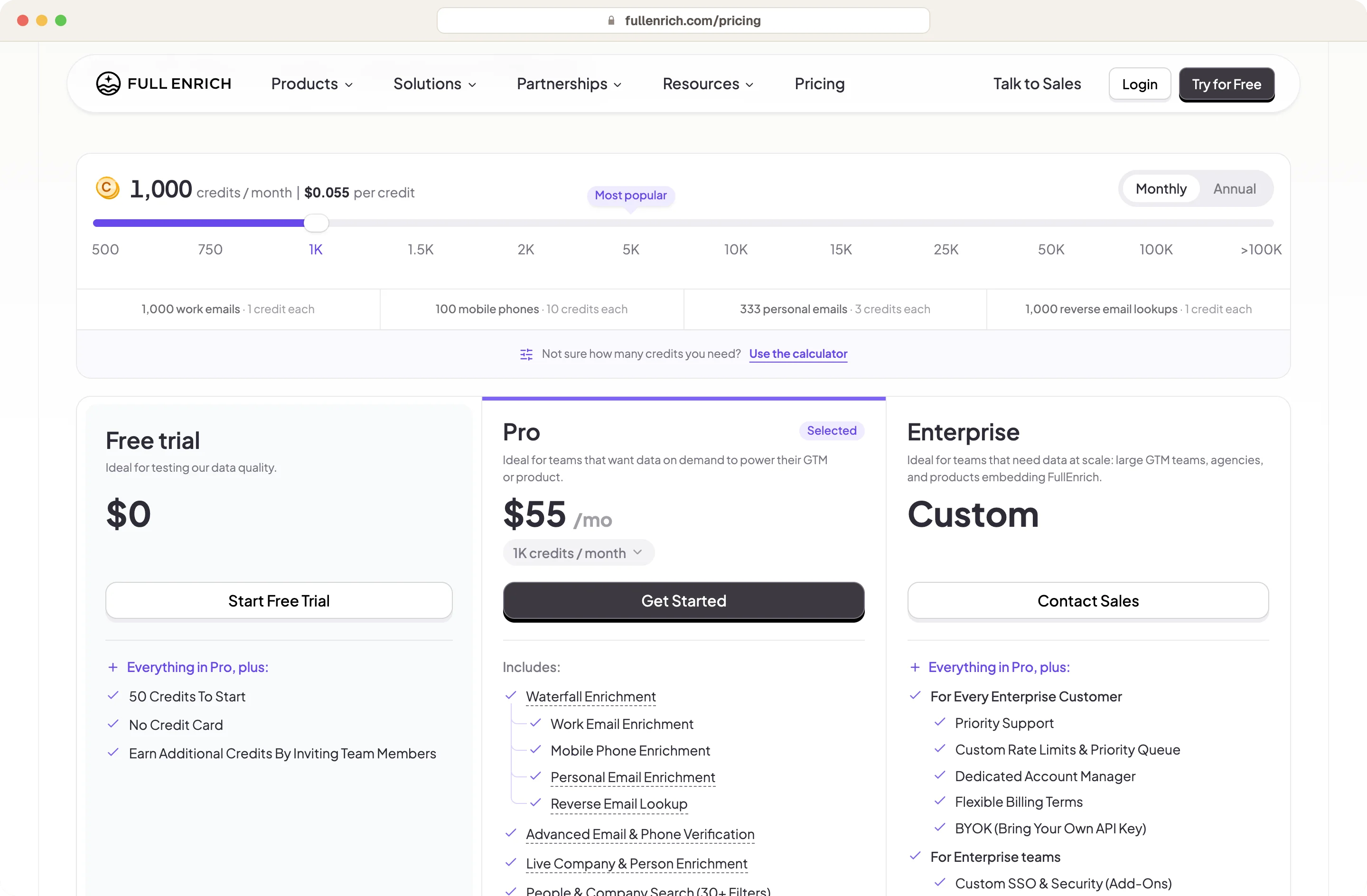
Findymail is $99 a month for 5,000 finder credits and 5,000 verifier credits, with the same 1-credit email and 10-credit phone split, and they refund credits if your bounce rate goes over 5%. LeadMagic starts at $49.99 a month for 2,000 credits, with emails at 1 credit and mobiles at 5.
If you chain two or three of them in n8n, you get a working waterfall for roughly $100 to $150 a month. Findymail also sells CRM enrichment on its own from $500 a month billed yearly, with no credits and no per-action fees, which matters if your problem is a rotting database instead of a new list.
You give up everything around the lookup itself. No research, no scoring, and no table to look at when you want to see what happened.
When a spreadsheet beats every Clay alternative
If your whole market is a few hundred companies, none of this applies to you. Build the list by hand, find the contacts with a per-credit tool, and put the time into the messages.
We've told prospects this and lost the deal over it, and we'd say it again.
Which Clay alternative you should buy
A small team that wants one tool. Apollo.
You sell into Europe and need mobile numbers. Cognism, and budget for a yearly contract.
You need to choose which accounts to chase. Ocean.io.
You want verified emails as cheaply as possible. LeadMagic or FullEnrich, called directly.
Your enrichment needs judgment, or your segments keep changing. Clay, and give someone real ownership of it.
If you want a second opinion on which of these fits you best, book a 15-minute call. We'll tell you if the answer is Clay.
Questions we get asked about Clay alternatives
Is Clay worth it for a small team?
Yes, as long as one person owns it and your qualification needs a judgment call. If you just want a list and a sequencer, Apollo does that for less with nothing to learn. The free plan gives you 500 actions and 100 data credits to find out.
What's the cheapest way to find verified emails?
Call an enrichment API directly. LeadMagic starts at $49.99 a month for 2,000 credits and only charges for what it finds, and FullEnrich is $55 a month for 1,000 credits on the same basis. Chaining two costs less than any platform plan.
Can n8n replace Clay completely?
For settled enrichment that repeats, yes, and self-hosting drops the per-action meter. For research, scoring and anything needing an AI judgment per row, no. Since Workflows launched, Clay also covers the orchestration that used to be n8n's main edge.


Related Articles


By clicking Sign Up you're confirming that you agree with our Terms and Conditions.