Go-to-Market Strategy Template With Real Examples From Clay and Gong


In this post:
An effective go-to-market strategy comes down to three questions: who you target, why they'd buy from you and which channels best reach them. Everything else in the template, from pricing to the CRM setup, depends on getting those three right.
This template is the very one we start most engagements from. So, we'll walk you through that same Go-to-Market (GTM) and launching strategy, starting with the step most templates skip: getting your founder, sales and marketing to agree on the answers.
To make every layer concrete, we fill it in with a real example from Clay or Gong. We've taken a close look at how they sell, through their pricing, job ads, case studies and founder interviews. So, let's get started.
TL;DR
A go-to-market (GTM) strategy comes down to three questions: who you target, why they'd buy and which channels reach them.
You need to get your sales, marketing and leadership to answer the same questions separately, then agree on one answer before you plan your go-to-market strategy.
Base the market layer on real research: talk to buyers, name the trends that change how they buy and work backwards from your revenue goal to a pipeline target.
Narrow your ideal customer profile (ICP) until two people on your team would pick the same accounts from a list, and expect it to change as your product grows, the way Clay's did.
Map the buying committee and write every pain point in the words your buyers use, the way Gong's customers describe a forecast nobody trusts.
Let your deal size decide how you sell: public prices and a free plan suit small contracts, while large ones go through a sales conversation and a custom proposal.
Test your ICP and messaging with a small campaign before you commit budget, and pick channels per persona instead of per company.
Set up your CRM so routing, scoring and one shared SQL definition turn the plan into daily work, and use call recordings as your fastest feedback loop.
Check that every part of your GTM plan feeds the next, because strong parts that don't connect still leak pipeline.
If you'd rather have us build it with you, our team turns this template into a working system in your own accounts and hands it over with documentation, so book a call with us when you're ready.
What a GTM strategy template is, and how it differs from a marketing plan
A go-to-market (GTM) strategy template is a reusable structure for turning a product launch, a new market or a new customer segment into a comprehensive plan. A finished one names the accounts you'll go after, the channels you'll use, the owners, the dates and the numbers you need to hit.
People often mix it up with a marketing plan, and the difference matters once you start filling it in. A marketing plan keeps the brand moving all year. A GTM strategy is built for one launch or one market, it has an end date, and it involves everyone who touches your revenue motion.
GTM strategy | Marketing plan | |
|---|---|---|
Scope | One product launch, market entry or new segment | Ongoing product marketing and brand activity |
Timeline | A defined start and end date | Usually a full year, repeated |
Covers | Targeting, pricing, channels, sales process, RevOps and metrics | Campaigns, content calendar and promotion plan |
Goal | Early adoption and pipeline for one launch | Brand awareness and broader growth goals |
Who's involved | Marketing, sales, product and customer success | Mostly marketing |
This GTM strategy template is built for B2B companies with a sales team, and we believe you can adapt it to different business models, from B2B SaaS to service businesses. It also saves time on every launch after the first, because your team fills in the same structure instead of starting from a blank page.
How to use this go-to-market strategy template
For us, the GTM template works best as a team exercise that gets your marketing, sales and product development teams on the same page, in (02) working sessions with a validation test in between.
Copy the tables below into a Google Doc, Notion or Confluence page.
Fill in the foundation layer through the messaging layer in a first session with everyone who touches your revenue operations and that includes the top of the funnel guys.
Work through the validation layer before you plan channels and sales.
Fill in the channel, RevOps and measurement layers in a second session, using what the test showed you.
Turn it into a go-to-market plan with owners and dates, track progress in a project management tool and review it every quarter.
The split into two sessions is on purpose. The first session produces decisions you haven't tested yet, and the test between the sessions tells you which of them hold up before you spend money on channels and tools.
Each layer of this go-to-market strategy template covers one of the key components of an actual GTM strategy. You get the fields to fill in, a real example from Clay or Gong and advice for the decisions teams get stuck on. The sources for every company detail are listed at the end.
The 11 layers of a go-to-market strategy template
The GTM template below has 11 layers, one for each of the key components of a go-to-market strategy, and you fill them in from top to bottom.
The first seven decide who you sell to and what you say. The validation layer then tests those choices, and the last three turn them into channels, systems and numbers you can track.
Here's the whole stack on one page, so you can see how the layers build on each other before we go through them one by one.

#1 Foundation layer: Align your key stakeholders on one set of answers
Most of the gaps we find in a go-to-market strategy are disagreements nobody has said out loud. Sales has one picture of the customer, marketing has another, and the founder carries a third one around in their head.
Each of those pictures shapes different work across the team. Marketing writes copy for one buyer, sales calls a different one, and the founder pitches a third story to investors and partners. Nobody notices the gap until the numbers come in and everyone explains them differently.
This layer gets all three pictures on paper before anyone spends budget, so your messaging stays consistent from day one.
Fill in your alignment snapshot
Ask your founder, head of sales and head of marketing to answer each question on their own. Then put the answers side by side and agree on one.
Question | What a useful answer includes | What Gong saw when it started |
|---|---|---|
Who is our ideal customer, and why? | An industry, a company size and the reason they buy | B2B sales teams that sell on calls |
What problem do we solve, and what's our value proposition? | The problem in the buyer's words, plus the outcome you deliver | The CRM shows what happened in a deal, but not why |
Which deals have we lost recently, and why? | Three to five real deals, with the reason each buyer gave | Not public, but founder Amit Bendov started Gong after sales at the company he led dropped and the CRM couldn't say why |
What's broken in how we sell today? | The step where deals stall or leads go missing | Reps' notes in the CRM were the only record of what buyers said |
Gong is a useful example here, because its founding question was an alignment question. When Bendov's sales dropped, the CRM could tell him which deals were lost, but nobody could agree on why. The only record of what buyers had said was whatever each rep typed into the CRM, and every rep remembered the calls differently.
How to get to one agreed answer
Collect the answers separately first: When people answer together, the most senior person's answer tends to become everyone's answer, and the disagreements never come up. Written answers, collected before the meeting, show you where the real gaps are.
Here's what that looks like when the three answers come in side by side, before the team agrees on one.

Give every team the same source of truth: Gong is a good example of this. Its sales, customer success and product marketing teams all work from the same call recordings, so when two people disagree about what a buyer said, they can go back and listen.
You don't need Gong to do this. A shared folder of call notes, or recordings from whatever tool you already use, gives every team the same evidence to argue from.
#2 Market layer: Research your market and set your business goals
Before you decide who to target, you need a clear picture of the market you're walking into. That's the market research behind your GTM strategy: what's changing, what's missing and the numbers you need to hit.
Without it, the ICP, pricing and channel decisions that follow have nothing to anchor to. You end up picking a segment because it feels right, and the goals turn into a number someone wrote down at the start of the year.
Fill in your market and goals
Field | What to write | Gong when it entered the market |
|---|---|---|
Target market | Region, industry, company size and target audience, based on your market research | B2B sales teams that sell on calls |
Research | How you tested your read of the market | The founders interviewed 50 buyers across different sales roles, Bendov has said |
Market trends | Two or three market and industry trends that change how buyers buy | Bendov's bet that "AI would be bigger than cloud" |
Competitive advantage | Whether it's a saturated market or an emerging one, and what sets you apart | Emerging. No category existed, so Gong named one, "revenue intelligence", in 2019 |
Business goals | Pipeline, revenue and new logos for this period | Not public for the early years. Gong says it passed $500M in ARR in May 2026 |
It's useful to look at how Gong's answers connect to each other. The 50 buyer interviews told the founders the problem was real, and the bet on AI told them the timing was right. Because no category existed yet, Gong had to name one, which shaped its messaging for years afterwards.
Bendov repeated that early bet in the press release about passing $500M in ARR, so you can see how long the founders held on to the same read of the market.
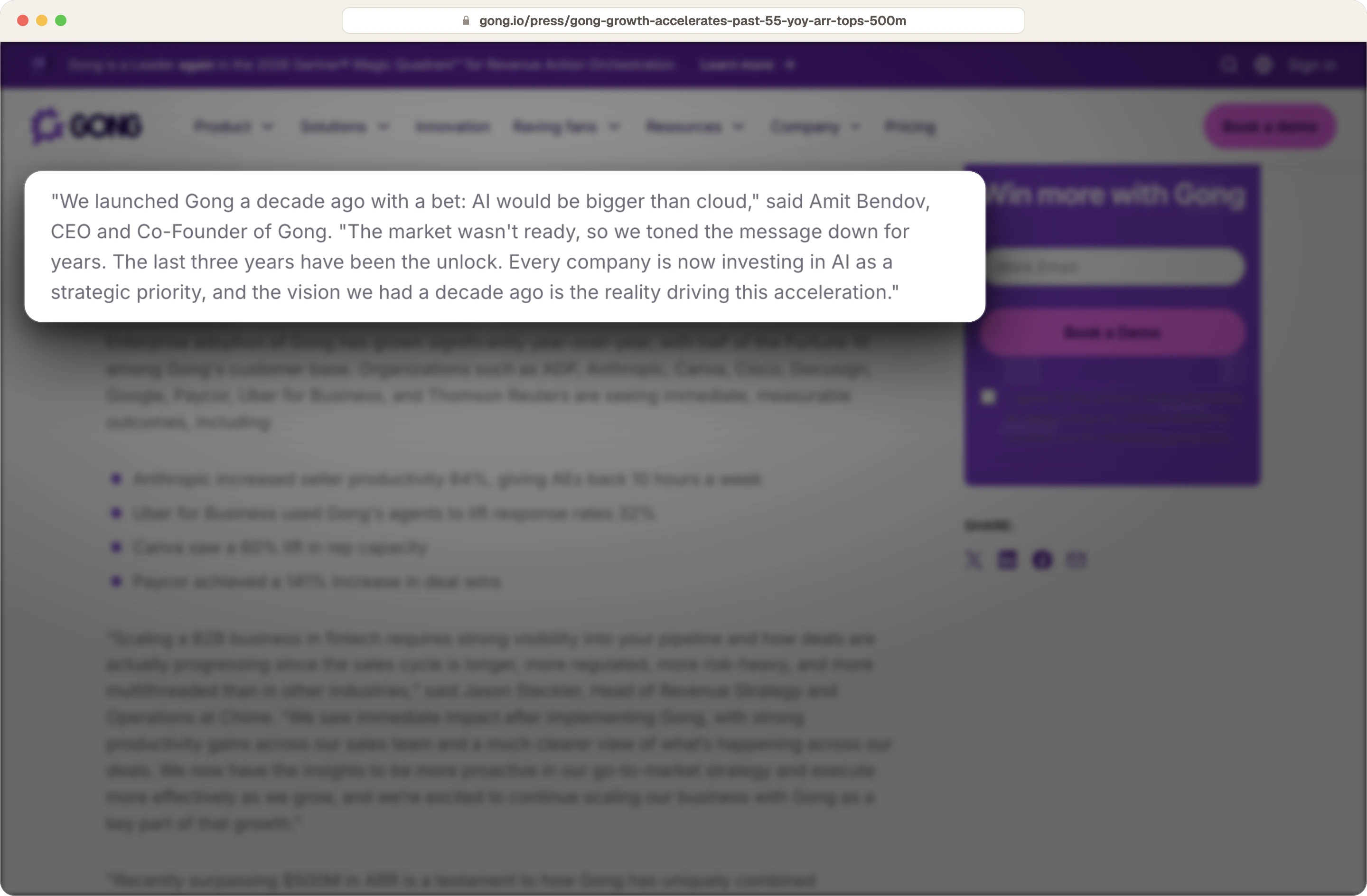
Source: Gong, Growth Accelerates Past 55% YoY; ARR Tops $500M
How to set goals you can plan around
Work backwards from revenue: Start with the revenue you need and divide it by your win rate, and you have your pipeline target. If you win about one in four qualified deals, €750k in revenue needs roughly €3M in pipeline.
That pipeline number is the one your channels and sales team will plan around later, so it's the number to agree on here. The math is simple, and it looks like this.
Redo the analysis when the market moves: The gap Gong entered through didn't stay open forever. Once call recording became a feature most sales tools offer, Gong moved its category from "revenue intelligence" to "Revenue AI", and today its homepage calls it an "AI OS for revenue teams".
The lesson for your own template is to put a date on this layer. A market read that was right two years ago can slowly turn into the reason a strategy stops working.
#3 ICP layer: Narrow your ICP and target customer segments
This is the layer most teams rush, and it decides where your team spends every hour after it. Your ideal customer profile is much narrower than your target market or target audience.
A loose ICP feels safe, because nobody gets told no. In practice it means your SDRs call companies that will never buy, your ads reach people who will never click and your best accounts get the same attention as your worst ones.
A good test is whether two people on your team would pick the same accounts from a list, using only your definition. If they wouldn't, the definition needs more detail.
Fill in your ICP
Field | What to write | Clay |
|---|---|---|
Industry and size | The industries and employee range where your product solves the most expensive problem | SaaS and AI companies of every size, like Anthropic, OpenAI and Intercom |
Tech stack | The tools a customer must already use for your product to work | A CRM, plus data warehouses and webhooks on the larger plans |
Must-haves | What an account needs before anyone reaches out | A team that wants Clay as the data layer for its whole funnel (our read) |
Disqualifiers | What rules an account out, even when it looks like a fit | Teams that only want contact data, for whom Clay says it "felt expensive" (our read) |
Segments | Two or three target segments you'll treat differently in messaging and channels | SMB, new business and strategic, from its sales job titles |
Market size | How many companies match, and whether you can find them in data | Not public. Clay says it has more than 17,000 customers |
The disqualifier row is the interesting one. Clay explained its 2026 pricing change by admitting that for teams focused on buying data, the old model felt expensive. That tells you which customers Clay is happy to lose: the ones who only want a contact database.

Source: Clay, Introducing Clay's New Pricing
You can also read Clay's segments straight off its job board. Its account executive roles are split into SMB, strategic and top accounts, which tells you how the company carves up its market.

Source: Clay, Open Positions
When the table is done, write your ICP as one sentence your whole team can repeat.
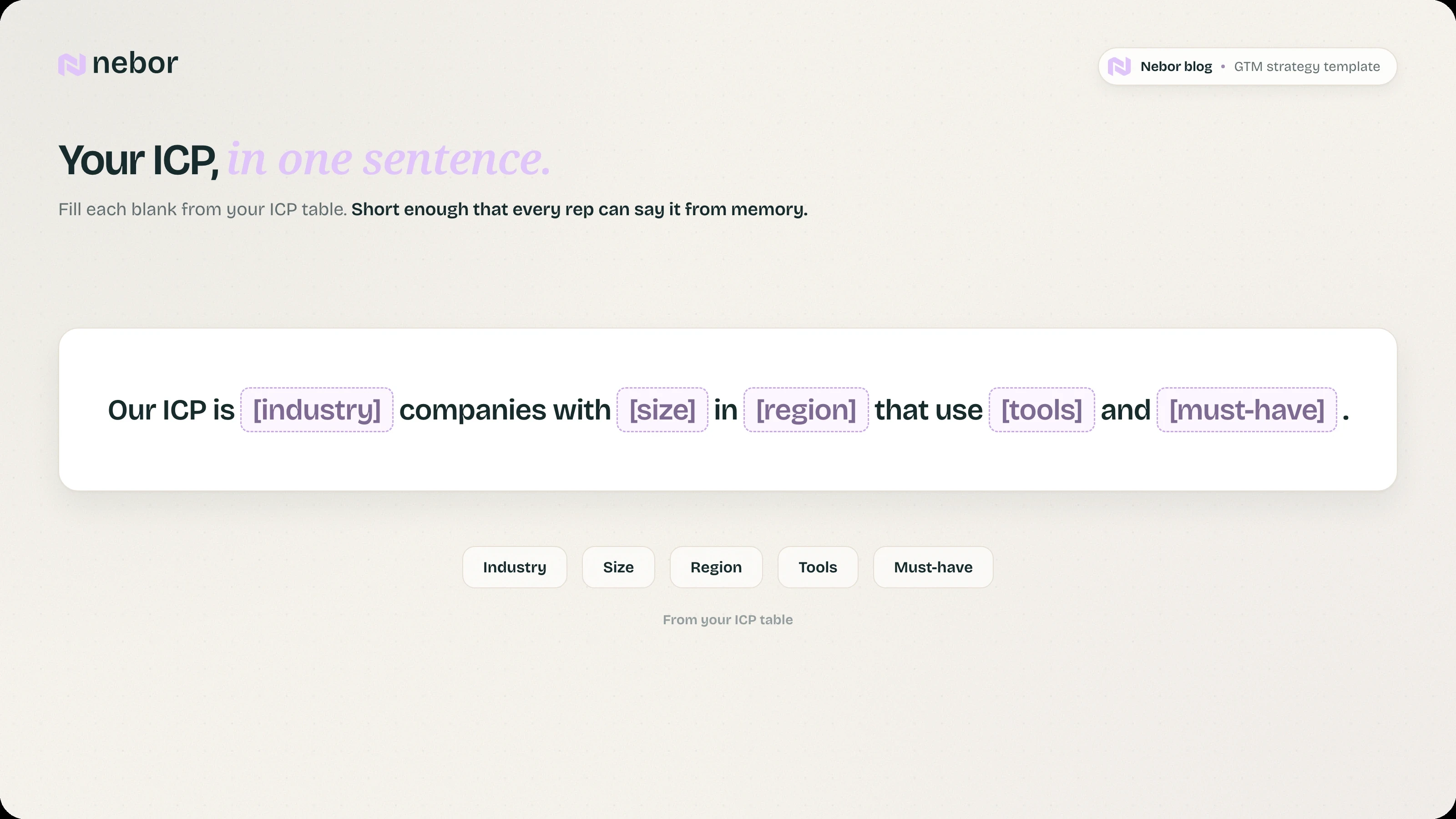
The sentence should be short enough for every rep to say it from memory.
Seen from the outside, Clay's sentence might read: "Our ICP is SaaS and AI companies of any size that use a CRM and want one data layer for their whole revenue funnel."
If you have existing customers, start with what your best ones share, and our guide to building your ICP from CRM data shows how to find it. Market size changes your whole go-to-market strategy too, and our guide to building your TAM shows how we work it out.
How to decide when you're stuck on your ICP
Expect your ICP to move: Clay is the best example we know of. It took the team about three and a half years to commit to one ICP, outbound salespeople, and once they did, they cut features and rewrote their copy around them.
That profile has kept moving since then, too. In our conversations with Clay as a solutions partner, the accounts they want most now use Clay across the whole revenue funnel, from the CRM to inbound and outbound. So treat your ICP as the best answer you have today, and plan to revisit it as your product grows.
Replace a qualifier you can't find: For instance, we worked with an energy company that was getting ready to offer solar panels with batteries to mid-sized businesses. For them, the qualifier that mattered most was building size, because a bigger roof makes a stronger case for solar. The trouble was that we could only find building sizes for about 500 of the 3,000 companies on the list.
So we flipped the question and asked which industries always have big buildings, and that gave us manufacturing, transport, logistics and storage. If the qualifier you need isn't in any database, look for one you can find that predicts it.

#4 Buying committee layer: Map your target accounts and the people who decide
Once you know the type of company, you need names: the target accounts you'll go after and the people at each one who have a say. In B2B one person rarely decides alone, so this layer maps the buyer personas on the buying committee.
Skipping this layer is how deals stall late. Your champion loves the product, the demo goes well, and then a finance lead nobody spoke to asks one question that sends the deal back to the start. We show how we find every decision maker in our guide to finding decision makers automatically.
Fill in your accounts and buying committee
Field | What to write | Gong |
|---|---|---|
Target accounts | How many accounts you'll focus on, and how you split them | Commercial, mid-market and enterprise, with vertical teams for financial services and healthcare |
Economic buyer | The person who signs, and the number they're judged on | The CRO or VP of Sales, who its "revenue leadership" pages speak to |
Champion | The person who wants the change and pushes it internally | RevOps leaders, like those quoted from Upwork and Uber for Business |
Users | The people who work with the product every day | Reps and sales managers, which is why Gong charges per user |
Gong's committee shows how each role wants something different from the same purchase. The CRO cares about the forecast, the RevOps lead cares about clean data and fewer tools, and the reps care about time back in their week. Gong's website has a separate page for each of them, which is the clearest sign of how seriously it takes the committee.
How to map a buying committee you can't see yet
Sort the roles by what they care about: Take a company selling design software to agencies. The design team uses it and wants to work faster, the agency owner decides and wants an edge over older agencies, and finance influences the deal because it cares about margins.
Each of them needs different product messaging, a different ad format and sometimes a different call script, even though they all work at the same company.

#5 Pain point layer: Name your customer pain points and buying triggers
Customer pain points decide what your messaging says. If you can't name them in the words your buyers use, your outbound, ads and discovery calls will all sound slightly off, and buyers notice that quickly.
Most teams write pain points in their own language. They write "lack of pipeline visibility" when the buyer says "I don't know what we'll close this quarter". The second version is the one that gets a reply, because the buyer recognizes their own problem in it.
Fill in your pains and triggers
Field | What to write | Gong |
|---|---|---|
Top pains | Three to five problems, written the way buyers say them | Paycor wanted to stop "relying on what a seller thinks is going to happen". Uber for Business wanted to move "from reactive to predictive". Sprout Social's forecast calls had been "a reporting exercise" |
Source | Where each pain comes from: a call, customer feedback, a lost deal or a guess | Customer stories on Gong's own website |
Buying triggers | Events that suggest an account is ready to buy, like the ones in our guide to signal-based outbound campaigns | A missed forecast, a new CRO or RevOps leader, or a push to cut the number of sales tools (our read) |
Notice that all three pains come from Gong's customers, in their own words. Paycor's VP of Client Sales put the first one plainly in Gong's case study.

Source: Gong, Paycor Customer Story
The second one comes from Uber for Business's head of RevOps, quoted on Gong's page for revenue operations teams.

Source: Gong, Gong for Revenue Operations
How to tell a real pain from a guess
Mark every pain as heard or guessed: Next to each pain, write whether you've heard a buyer say it or you're assuming it. The guessed ones are what your validation layer should check first.
This simple label stops a guess from turning into a fact just because it's been written down.
Borrow your customers' exact words: Look at Gong's three quotes again, and you'll notice none of them mention call recording. They talk about a forecast nobody trusts, and that's the pain Gong's messaging leads with.
#6 Offer layer: Set your product, key benefits and pricing strategy
Most of our clients already have their pricing when we start a GTM project. Pricing still shapes the rest of the strategy, though, because it decides which channels you can afford, what the buyer journey looks like and whether you need an offer like a free trial or a paid pilot.
A product that costs a few hundred euros a month can't carry a sales team that calls every lead. A product that costs six figures a year can't rely on a sign-up button. This layer makes sure the price and the way you sell fit together.
Fill in your product and pricing
Field | What to write | Clay |
|---|---|---|
Key benefits | Three to five features, each tied to the pain it solves | Data from many providers in one place, AI research and workflows that sync to the CRM |
Pricing model | Per seat, tiered pricing or usage-based, depending on your business model | Usage-based, split since March 2026 into Data Credits for data and AI, and Actions for platform work |
Target deal size | The average first-year contract you're aiming for | Self-serve plans from $167 a month billed annually, and new business deals of $50K to $100K according to its job ads |
Offer | What lowers the barrier to the first purchase | A free plan with 6,000 Actions and 1,200 Data Credits a year and unlimited seats |
Clay's pricing page shows all of this in one view: a free plan, two self-serve plans and a custom enterprise tier. The free plan is the offer, and the enterprise tier is where the sales team takes over.

Source: Clay, Pricing
How price changes the rest of your strategy
Let the deal size choose the motion: Clay and Gong are at opposite ends here. Clay shows its prices and has a free plan, so one person can try it alone and grow into an enterprise contract later. Gong publishes no prices at all and offers a "customized proposal" with no free trial, because every Gong deal goes through a sales conversation anyway.
Gong's pricing page makes the point by what it leaves out. Instead of prices, it asks how big your team is and offers to prepare a proposal.

Source: Gong, Pricing
Neither approach is better on its own. Each one follows from the deal size, and the picture below shows how the motion changes as the contract grows.

#7 Messaging layer: Write your positioning and core messaging
Positioning is how buyers should think about you compared with their other options, and your value proposition is why they should care. Writing both down gives every customer-facing team one source of truth for product messaging, so sales and marketing stop describing the product in two different ways.
Without it, every rep ends up improvising their own version. One leads with features, another with price and a third with a customer story, and the market ends up with three different ideas of what you sell.
Fill in your positioning
Field | What to write | Gong |
|---|---|---|
Value proposition | One sentence on the outcome you deliver | "Capture every interaction, analyze what's working, and automate what happens next" |
Proof points | Results, customer quotes or case studies that back it up | Gong says Paycor closed 141% more upselling deals per seller, Upwork reached 95% forecast accuracy and Anthropic cut ramp time by 46% |
Alternatives | What buyers use today instead of you, from a short competitor analysis | Rep notes in the CRM, spreadsheet forecasts and separate point tools (our read) |
Angle per role | One message for each person on the buying committee | From its persona pages: forecast confidence for CROs, one connected system for RevOps and time back for reps |
Gong's value proposition fits in one line on its homepage, and every part of it maps to a pain from the previous layer. Capturing every interaction answers the CRM gap, and automating what happens next answers the time reps lose.

Source: Gong, Homepage
Then put it together in one positioning statement:
For [ICP] who [pain], [product] is the [category] that [outcome], unlike [alternative].
Here's how we'd write Gong's version: "For revenue teams whose forecasts depend on what reps type into the CRM, Gong is the revenue AI platform that captures every customer interaction, unlike tools that only record calls."
How to write messaging angles you can test
Make the angles different on purpose: If two angles say almost the same thing, the test in the validation layer can't tell you which one works. Lead each angle with a different pain.
Here's what that split looks like: one value proposition, two angles, each opening with a different problem.

Once one of the angles works, you can check our guide to email personalization at scale to see how to effectively write it for thousands of accounts.
#8 Validation layer: Test your ICP and messaging before you commit budget
Before you commit budget to the full go-to-market plan, send a short campaign to see whether the market responds to the ICP and messaging you agreed on. We usually test with outbound, because it lets you compare several segments and angles in a few weeks.
Everything in the first seven layers is still a set of guesses at this point, however well researched. The test is cheap compared with a full launch, and it tells you which guesses to keep before the expensive work starts.
Fill in your test plan
Field | What to write | How Gong tested in 2016 |
|---|---|---|
Segments | Two to four segments to compare | Companies from the founders' own network |
Angles | Two or three messages from the messaging layer | The product itself, in an alpha |
Channels and size | Where the messages go, how many target accounts and for how long | 12 companies, starting in January 2016 |
Metrics | What you'll count, split by segment and angle | Whether beta users would become paying customers |
Decision rule | The result that makes you drop a segment or rewrite a message | Payment at full price, since Bendov refused to discount (our read). Eleven of the 12 said yes, and the last one paid later |
A test plan is easiest to read as a grid, with segments on one side and angles on the other. Each cell gets its own replies and meetings, so you can see which combination works.

How to decide whether outbound is the right test
Ask for money as the test: Gong's first real test was whether people would pay. In a 2021 podcast interview, Bendov described ending the beta by asking all 12 companies to pay. Eleven said yes straight away and the twelfth signed later, which gave Gong its first $100K in ARR.
A sales newsletter that wrote up the interview captured the moment the beta ended and the customers were asked to buy.

Source: Brian Hamor, How Gong Got Their First Customers
Asking for money is a stronger test than asking for feedback, because people are polite about feedback and honest about budgets.
Check whether your market suits outbound: Outbound isn't the right test for every company. Skip it if your market only has a few hundred accounts, if your buyers reject cold outreach, if the founder already has a large audience, or if inbound already brings in enough volume to test with.
Check your sending setup first: Before the first email goes out, go through our email deliverability checklist. Otherwise a spam problem can look like a messaging problem, and you'll end up rewriting copy that was fine.
Write the decision rule before you send: Agree on the result that ends a segment before the first email goes out. Otherwise everyone argues for their favorite segment once the numbers come in.
Those three checks fit on one card, and we go through them every time before a test starts. We go deeper on how we sequence this work in our guide on how to build a go-to-market system.
#9 Channel layer: Choose your GTM motion, channels per persona and sales hand-offs
Pick your channels per persona, based on where each person spends their working day. Then decide on the sales strategy behind them: how leads get nurtured and converted, and which accounts skip the sequence and go straight to your sales team.
Most teams pick channels per company instead. They choose LinkedIn and email for the whole account, and then wonder why half the buying committee never replies. The people who sign and the people who use the product often spend their days in very different places.
Fill in your channels and hand-offs
Field | What to write | Clay |
|---|---|---|
Lead motion | Outbound, inbound, product-led or ABM, and which channels generate demand | Product-led since 2022, with enterprise sales added on top from 2023 |
Channels per persona | Two or three sales channels for each role | A 30,000-member Slack community, Clay University, LinkedIn creators, agency partners and its Sculpt conference |
Direct to sales | Which accounts or contacts skip the marketing sequence | Larger teams that need SSO and admin controls, which only come with the Enterprise plan (our read) |
Sales team | Who works the leads, how they qualify and in what order | "ClayDRs" and account executives for SMB, new business and strategic accounts, all titled GTM engineers |
Sales enablement | The sales enablement tools and content reps need to close deals | Four to five hour live workshops for prospects who found the product too complicated |
Clay's mix shows how a product-led company adds sales without losing its community. Most new users still find Clay through people they already learn from, and the sales team steps in once an account needs enterprise controls.
How to pick channels when a persona is hard to reach
Follow the persona's working day: Dymaxa, a trailer company we worked with, taught us this one. Most of the people we targeted were fleet managers, who spend their day in the warehouse and rarely check LinkedIn or email.
What reached them were trucking magazines, keyword ads, events and cold calling. Looking back, we should have split the channels by persona from the start, with email and LinkedIn for the finance roles and ads plus calls for the fleet managers.
Here's that split drawn out, following each persona through a working day.

Let others carry your message: Clay reaches a lot of its buyers through people they already listen to. It calls its partner ecosystem "a critical growth lever", and its creator program grew Clay's LinkedIn following from 8,000 to 40,000 in 10 months.
You can see how much weight Clay puts on partners in its own job post for a partner manager.

Source: Clay, Partner Manager Job Listing
#10 RevOps layer: Set up your CRM, lead routing and data
RevOps is where the plan turns into something your team does every day. Without lifecycle stages, routing and scoring in your CRM, the strategy stays on paper, reps end up guessing which leads to call first and they struggle to close deals.
The symptoms are easy to spot once you know them. Hot leads wait days for a reply, two reps call the same account and the pipeline report shows a different number depending on who pulls it.
Fill in your CRM setup
Field | What to write | Clay |
|---|---|---|
Lifecycle stages | What moves a contact through the sales funnel, from Lead to MQL, SQL, Opportunity and Customer | Not public |
Routing | Who gets which leads, and how fast | A Head of GTM Strategy and Ops owns territories, "routing and handoffs" and the forecast cadence |
Lead scoring | The fit, behavior and intent signals you score on | Co-founder Varun Anand demoed it at SaaStr in 2026: enrichment, AI scoring and research briefs |
Enrichment and automation | The tools that fill in data and move leads | Salesforce plus Clay's own Clay instance, with a small GTM engineering team that owns "book carving, ROE automation, signal detection" |
Clay treats its own RevOps as an engineering job. One of its job posts describes a small team of GTM engineers who own the systems that decide which rep gets which account and when a signal turns into outreach.

Source: Clay, GTM Engineer Manager (Seller Efficiency) Job Listing
How to decide which leads reach sales first
Agree on the SQL definition before you build anything: If sales and marketing define an SQL differently, every report after it starts an argument. Write the definition in one sentence and put it in the CRM, the way we set it up in our guide to the marketing to sales handoff in HubSpot.
Sort leads into tiers: Tiers make sure your sales team spends its time on the right leads first, and our guide to HubSpot lead scoring shows how to build the score behind them.
Tier | Who belongs here | What happens next |
|---|---|---|
Tier 1 | Strong fit and clear buying intent | Goes straight to a salesperson within hours |
Tier 2 | Good fit with weaker intent, or the reverse | Goes into nurturing until intent grows |
Tier 3 | Weak fit | Filtered out or added to a newsletter |
Scoring, routing and the shared SQL definition work as one flow, and it helps to see them together.

We show how we route tier 1 leads to sales in our inbound meeting workflow.
#11 Measurement layer: Track success metrics, feedback loops and your launch timeline
Without success metrics and key performance indicators, you won't know whether your GTM strategy works until revenue shows up, or doesn't, months later. This layer gives you the numbers to watch along the way.
Revenue is the slowest number you have. By the time it tells you something went wrong, you've already spent the budget. Early signals like replies and meetings tell you much sooner whether you're on track.
Fill in your metrics and timeline
Field | What to write | Clay |
|---|---|---|
Results | Key performance indicators like pipeline, revenue, win rate, sales cycle length and market adoption | Clay says it grew from $1M to $100M in ARR in two years |
Early signals | What you check every week | Recurring use cases per customer each month, against the usage Clay expects |
Customer retention | How you'll know new customers stay, because a launch that wins customers who leave hasn't worked | Clay says its enterprise net revenue retention is "over 200%" |
Feedback loop | How what sales hears on calls reaches the strategy | ClayDRs give "structured feedback on signals, workflows, and plays" to the teams that build them |
Timeline | The phases of your product launch process, with dates and owners | Founded in 2017, close to $0 revenue in 2022, $100M ARR by late 2025 |
Contingency | The signal that proves an assumption wrong, and what you'll do | Not public |
Clay's retention number is the one to look at. When it announced $100M in ARR, Clay said it had never churned an enterprise customer, and that existing customers kept growing their spend.

Source: Clay, Clay Reaches $100M ARR
Your timeline puts all of these numbers on a calendar, with a checkpoint where you decide whether to change course.

How to learn faster than your dashboard
Listen to the calls: The best feedback we know comes from real conversations. Recordings of cold calls and demos show which pains and objections come up, and tools like AskElephant can summarize them for you.
When we onboard a client, we ask for their meeting recordings and the reasons recent deals were won or lost. That's often the fastest way to sharpen the ICP and messaging before a single campaign goes out.
Here's how one recorded call turns into sharper messaging and a better ICP.

Measure brand where buyers talk: Gong has a clever version of this. In his book Courageous Marketing, CMO Udi Ledergor describes counting how often Gong's podcast came up on its own sales calls, to see whether the brand work was reaching buyers.
The final check: does each part feed the next?
When we review a client's go-to-market process, we look less at whether each part exists and more at whether the parts connect. Before you call your plan finished, answer these questions about the customer journey:
Does the attention from each channel flow into a way to capture it?
Do captured leads land in the right nurture flow or with the right salesperson?
Does your website support the conversion everything upstream is working toward?
Do happy customers send new leads back to the top?
Every "no" is a gap to fill before you add anything new. It helps to picture the plan as one pipe, where each gap is a leak.
Mistakes to avoid with a go-to-market strategy template
Skipping ICP validation: An ICP nobody has tested can burn months of budget on the wrong segment, which is the reason the validation layer exists.
Poor market research: A plan built on guesses about the market solves problems your buyers don't have.
Treating it as a one-time document: Your GTM strategy should change as you learn, so put a quarterly review in the calendar.
From a plan on paper to a working system
Filling in this template is the easier part, because effective GTM strategies need systems that work every day, and that's where teams get stuck.
That's the part we build at Nebor, a GTM and RevOps agency. We set everything up in your own accounts, including your CRM, Clay, sending tools and ad accounts, and hand it over with documentation so your team can manage and change it.
Here's what that handover looks like: every system in your own accounts, documented so your team can change it without us.
If you've filled in the template and want to turn it into a working system, book a call with us and we'll go through it together.
Questions about using this go-to-market strategy template
What should a go-to-market strategy include?
It should cover your market and goals, who you sell to, why they buy, how you'll price it, which channels reach each persona and how you'll turn interest into revenue. A successful GTM strategy also includes two steps most teams leave out: aligning the team on the answers and testing them before committing budget.
What's the difference between a GTM strategy and a GTM plan?
The GTM strategy is the set of choices about who to target, how to position yourself and which channels to use. The plan is how you'll carry those choices out, with owners, budgets, timelines and metrics, and this go-to-market strategy template covers both.
How often should we update our GTM strategy template?
Review your whole GTM strategy every quarter, and update it whenever a test or your call recordings tell you something new. Your ICP may stay the same for a year, while channels and messaging usually change every few weeks.
Who should own the go-to-market strategy?
One person should own the document, usually a founder, a head of growth or a RevOps lead. Sales, marketing and customer success all need to help write it, or the team won't be on the same page about how the company sells.


Related Articles

Recommended
How to Build a Go-To-Market (GTM) System That Generates Business on Autopilot
Campaigns everywhere, everyone busy, revenue flat. The fix is a six-layer GTM system where every activity feeds the next. Here is how we sequence the build.
Andrew van Rossenberg

Recommended
How to Build Your TAM (Total Addressable Market) for B2B Sales and Go-to-Market in 2026
Most companies inflate their TAM or never map it at all, then plan whole quarters on guesses. Here is the framework we use to build one that holds up.
Andrew van Rossenberg

Recommended
Clay + LeadsFactory + LinkedIn Sales Navigator: How to Find Decision Makers Automatically for Sales and Lead Generation
LinkedIn searches, database exports, and About Us pages all work, until you try them at scale. Here is the workflow that finds decision makers automatically.
Yannick Kok
By clicking Sign Up you're confirming that you agree with our Terms and Conditions.